Identity and Access Management: The Complete 2026 Enterprise Security Guide
Identity and Access Management isn't a single product, a single category, or a single architectural decision. It's a layered envelope of capabilities — authentication, authorization, lifecycle, governance, posture, detection — that compose into the security foundation of modern enterprise IT. The definitive 2026 enterprise reference.

Identity and Access Management isn't a single product, a single category, or a single architectural decision. It's a layered envelope of capabilities — authentication, authorization, lifecycle, governance, posture, detection — that compose into the security foundation of modern enterprise IT. The definitive 2026 enterprise reference.
- Identity and Access Management is a layered envelope, not a single product. The 2026 enterprise IAM architecture has seven distinct layers, each with its own product category and operational discipline: authentication (MFA), authorization (least privilege + JIT), lifecycle (HRIS-driven), governance (IGA), posture (ISPM), detection (ITDR), and cloud-specific entitlement (CIEM).
- The major industry frameworks that shape enterprise IAM in 2026 — NIST 800-63 Rev. 4 (digital identity), NIST 800-53 Rev. 5 (security controls), SOC 2 Type II, ISO/IEC 27001:2022, PCI DSS v4.0.1, HIPAA Security Rule § 164.312, SOX Section 404 ITGC, GDPR, CCPA, CPRA — all define identity requirements that the seven-layer architecture has to satisfy continuously.
- Buyer-stage taxonomy for the IAM platform categories: IAM-as-platform (broad workforce identity), IGA (governance + workflow + certification), PAM (privileged access vaulting + JIT), CIEM (cloud entitlement complexity), ITDR (threat detection), ISPM (preventive posture), MFA (credential layer), HRIS-integration (authoritative source). Most enterprises compose 4-6 platforms rather than a single platform; pure single-vendor IAM is rare at scale.
- The five attack patterns the architecture must defend against: credential compromise (MFA territory), entitlement accumulation (IGA + least privilege territory), shadow access surface (ISPM + reconciliation territory), insider misuse (ITDR + behavioral analytics territory), privileged session abuse (PAM + continuous authentication territory). No single layer covers all five; the composition is what produces complete coverage.
- The 2026 enterprise IAM maturity ladder spans five stages from Manual/Reactive (Stage 1) to Autonomous (Stage 5). Most enterprises sit at Stage 2 (Tooled but Inconsistent); the Stage 2 → Stage 3 transition is where the bulk of operational ROI lives. The full ladder is documented in our [Identity Maturity Model piece](/en/blog/identity-maturity-model-enterprise-2026/).
Identity and Access Management is the architectural discipline that controls who can access what, under what conditions, with what audit trail, and how that access changes over time. It's also one of the most-misunderstood IT categories — confused with single products, conflated with subordinate concepts, treated as a binary deployed/not-deployed state when it's actually a layered envelope of capabilities that compose into the security foundation of modern enterprise IT.
This piece is the definitive 2026 enterprise reference. The seven layers of the IAM architecture, the eight regulatory frameworks that shape it, the eight platform categories that vendors organize around, the five attack patterns it must defend against, and the five-stage maturity ladder that determines where any given enterprise actually stands. It serves as both an introductory orientation for executives evaluating the IAM landscape and as a hub document linking to the detailed pieces on every component layer.
The companion pieces cover every layer in depth. Cross-link liberally as you read; the architecture is composable and understanding one layer is more productive when you've seen how it composes with the others.
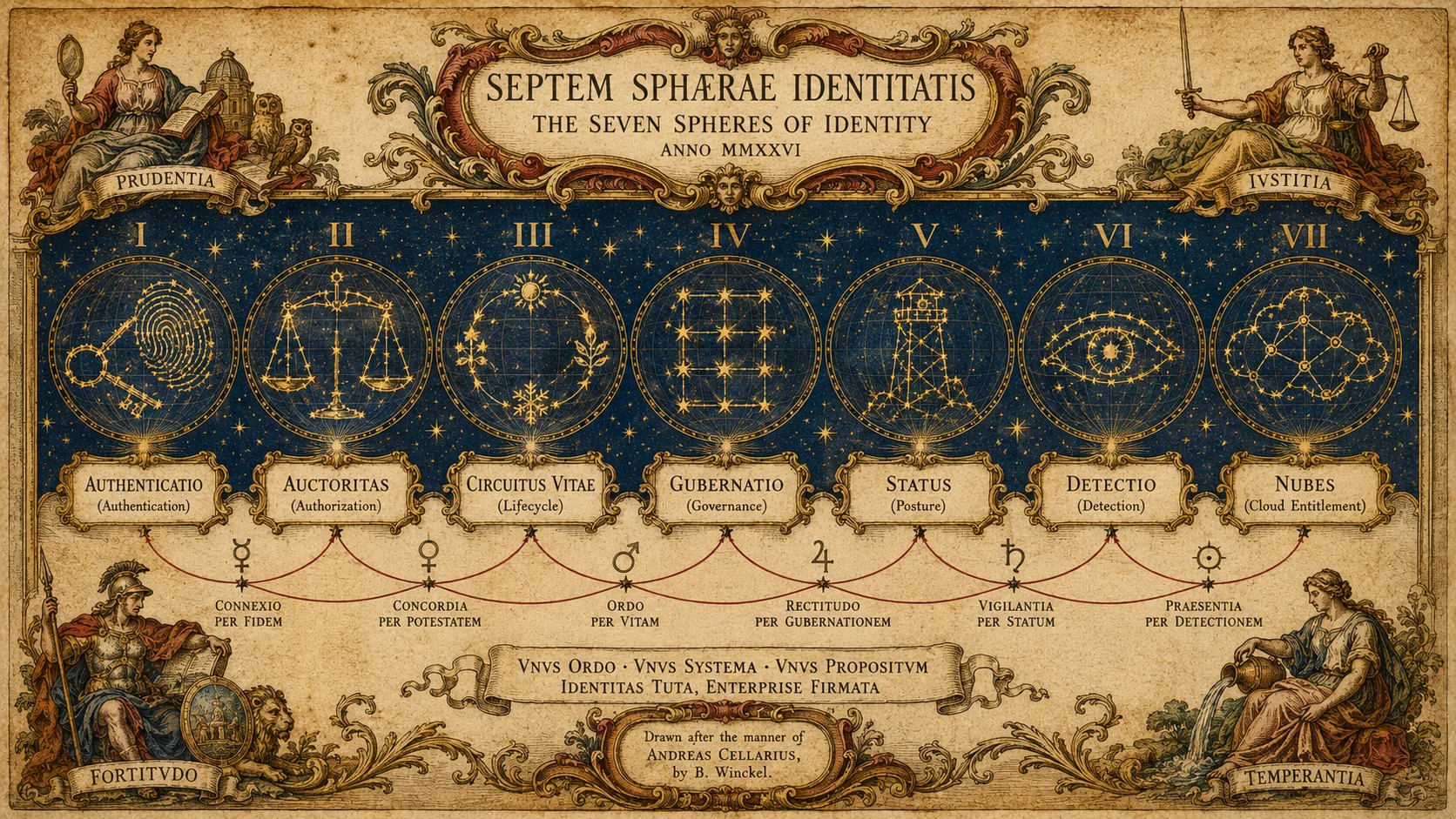 Seven layers, one envelope. Each layer has dedicated companion pieces; this guide is the hub that connects them. The architecture isn't sequential — all seven layers operate simultaneously in production deployments.
The seven layers of the 2026 enterprise IAM architecture
Layer 1: Authentication
Establishing who the identity is at the credential layer. The authenticated identity then proceeds to the authorization layer for permission evaluation.
The 2026 authentication baseline is phishing-resistant MFA. Passkeys (synced through iCloud Keychain, Google Password Manager, Microsoft Entra ID, or third-party credential managers like 1Password and Bitwarden) cover the bulk of the modern workforce. Hardware FIDO2 keys (YubiKey, Google Titan, Feitian, SoloKey) cover privileged operators and high-assurance segments. The Avatier Identity Challenge Card covers deviceless workforces (frontline retail, manufacturing floor, healthcare clinicians who can't bring smartphones to the bedside, defense workforces in classified environments).
Three companion pieces cover this layer in depth: Phishing-Resistant MFA Enterprise 2026 on the credential class taxonomy; Hardware FIDO2 Keys vs Passkeys for Enterprise 2026 on the comparative buyer evaluation; Adaptive Authentication and Risk-Based MFA 2026 on the risk-scoring layer that drives step-up authentication decisions; Continuous Authentication for High-Risk Workforces 2026 on the post-sign-in re-evaluation pattern. For AI agents specifically, the Agentic Authentication piece covers the per-invocation delegation token pattern.
Layer 2: Authorization
What the authenticated identity is permitted to do. The principle is least privilege — every identity gets only the permissions required for its current task scope. The operational mechanism for high-impact entitlements is Just-in-Time (JIT) access. The architectural target for high-risk segments is Zero Standing Privilege (ZSP).
Our Principle of Least Privilege piece covers the foundational principle and the four architectural patterns that produce it (role-based baselining, JIT elevation, attribute-conditional grants, continuous right-sizing). The JIT/ZSP piece covers the operational mechanism for the five workforce segments where JIT is operationally mature (privileged operators, engineering production access, financial-system operators, incident response, AI agents). The MFA vs IGA piece covers the four attack patterns that authorization handles where authentication can't.
Layer 3: Lifecycle
How the identity changes over time. The 2026 mature pattern is HRIS-driven: the HRIS (Workday, SAP SuccessFactors, BambooHR, ADP, UKG) is the authoritative source of workforce identity, and the joiner-mover-leaver workflow flows from HRIS events through SCIM push, delta synchronization, full reconciliation, and webhook event streams into the IGA platform.
The HRIS-Driven Lifecycle piece covers the four integration patterns and the platform-specific profiles (SuccessFactors via OData + Intelligent Services webhooks; Workday via Web Services + RaaS pull; BambooHR via REST + webhooks; ADP via SCIM marketplace connectors; UKG and Oracle Cloud HCM via REST polling). The Service Account Governance / NHI piece covers the parallel lifecycle for non-human identities (service accounts, AI agents).
Layer 4: Governance
Workflow, certification, segregation-of-duty enforcement, access review. The IGA platform layer. This is where the access state gets reviewed, audited, and corrected — the operational discipline that distinguishes "we have IAM" from "we have IAM that's working."
The Best IGA Solutions buyer guide covers the platform landscape (SailPoint, Saviynt, Omada, Microsoft Entra ID Governance, Avatier Identity Anywhere). The AI Access Certification piece covers the AI-augmented certification pattern that compresses 3-week campaigns to 3 days. The Access Review Auditor Wants piece covers the three questions sophisticated 2026 auditors ask in audit walkthroughs. The IGA Project Failed piece covers the recovery path when an IGA deployment has stalled. The Best Identity Lifecycle Management piece covers the lifecycle-specific subcategory.
Layer 5: Posture
Preventive audit of whether the access state matches the access policy. This is the ISPM (Identity Security Posture Management) layer — the emerging analyst category that sits above IGA and beside ITDR.
The ISPM piece covers the four evaluation domains (configuration posture, entitlement posture, access pattern posture, identity inventory posture), the mid-2026 vendor landscape (Authomize, Veza, Silverfort, Permiso, Push Security, Sweet Security, Reco), and the architectural composition with IGA and ITDR. The Shadow IT Provisioning piece covers the catalog-reality gap that ISPM specifically surfaces.
Layer 6: Detection
Behavioral monitoring of authenticated sessions for anomalies, threat patterns, misuse. This is the ITDR (Identity Threat Detection and Response) layer.
The ITDR piece covers the five detection pattern categories and the vendor landscape. The Storm-2949 piece covers a recent breach pattern where governance failure produced an exploitable identity-security gap that ITDR-class detection eventually caught. The MFA Fatigue piece covers the specific attack pattern where ITDR detection composes with adaptive authentication.
Layer 7: Cloud Entitlement
The cloud-specific instance of authorization. AWS IAM has over 14,000 individual API permissions; Azure RBAC has thousands of role definitions; GCP IAM has thousands of granular permissions. Traditional IGA wasn't built for the cloud's scale. CIEM (Cloud Infrastructure Entitlement Management) is the analyst category that handles cloud-specific entitlement complexity.
The CIEM piece covers the four CIEM evaluation domains (effective-permission visibility, least-privilege baselining, machine-identity governance, multi-cloud federation) and the mid-2026 vendor landscape (Wiz, Microsoft Entra Permissions Management, Permiso, Sonrai, Saviynt, Authomize, Tenable Cloud Security).
The major regulatory frameworks shaping enterprise IAM in 2026
Eight frameworks recur across enterprise IAM compliance scope. The frameworks overlap substantially; most enterprises operate under multiple frameworks and the identity architecture has to satisfy them all without duplication.
| Framework | Scope | Identity-specific requirements | Companion piece |
|---|---|---|---|
| NIST 800-63 Rev. 4 | Federal + federal-adjacent | AAL1/2/3 authentication assurance levels; identity-proofing requirements | Mentioned across the authentication-layer pieces |
| NIST 800-53 Rev. 5 | FedRAMP + federal contractor | Comprehensive control catalog including AC family (access control) | Mentioned across multiple pieces; baseline for Avatier's compliance posture |
| SOC 2 Type II | SaaS-adjacent | ITGC including access provisioning, deprovisioning, review | Covered in our SOX piece with overlap framing |
| ISO/IEC 27001:2022 | International ISMS | A.5.15 access control + Annex A controls | Baseline for Avatier's compliance posture |
| PCI DSS v4.0.1 | Payment card data | Strong authentication, access restriction, monitoring | Overlaps with NIST 800-63 for the authentication requirements |
| HIPAA Security Rule § 164.312 | Healthcare | Five Technical Safeguards (Access Control, Unique User ID, Emergency Access, Authentication, Audit Controls) | Covered in our HIPAA piece |
| SOX Section 404 ITGC | Public companies | IT general controls including the five ITGC identity domains | Covered in our SOX piece |
| GDPR / CCPA / CPRA | Data protection (EU + US states) | Identity-related provisions for consent, data subject rights, access logging | Touched on across compliance-focused pieces |
The composition matters operationally. A SOC 2 + HIPAA + SOX environment (typical for healthcare-adjacent SaaS) needs the identity architecture to satisfy all three simultaneously. The seven-layer architecture this piece describes is designed to do exactly that — each framework's identity requirements map to specific layers, and the layers compose into a unified envelope rather than duplicating evidence per framework.
The eight IAM platform categories
The IAM vendor landscape organizes around eight platform categories. Most enterprises compose 4-6 categories from different vendors rather than running everything on a single platform; pure single-vendor IAM is rare at enterprise scale.
| Category | Primary function | Representative vendors |
|---|---|---|
| IAM-as-platform | Broad workforce identity + SSO | Okta, Microsoft Entra ID, Ping Identity, ForgeRock, OneLogin |
| IGA | Governance, workflow, certification, lifecycle | SailPoint, Saviynt, Omada, Microsoft Entra ID Governance, Avatier Identity Anywhere |
| PAM | Privileged credential vaulting + JIT elevation | CyberArk, BeyondTrust, Delinea, HashiCorp Vault |
| CIEM | Cloud-entitlement complexity | Wiz, Microsoft Entra Permissions Management, Permiso, Sonrai, Saviynt |
| ITDR | Identity threat detection | CrowdStrike Falcon Identity, Microsoft Defender for Identity, Silverfort, Authomize |
| ISPM | Preventive posture audit | Authomize, Veza, Silverfort, Permiso, Push Security |
| MFA | Credential layer (specialized) | Duo (Cisco), RSA, Okta Verify, Yubico (hardware) |
| HRIS-integration | Authoritative source | Workday, SAP SuccessFactors, BambooHR, ADP, UKG |
The composition pattern in 2026 mature enterprise deployments: IAM-as-platform for SSO + broad workforce authentication, IGA for governance + lifecycle, PAM for privileged access, MFA from the platform or specialist depending on assurance requirements, plus the emerging-category specialists (CIEM, ITDR, ISPM) deployed alongside.
The companion pieces cover specific category buyer guides where the category warrants depth: Best IGA Solutions, Best MFA Solutions, Best Enterprise Password Management, Best Identity Lifecycle Management, PAM Enterprise 2026.
The five attack patterns enterprise IAM must defend against
Five operational attack patterns dominate 2026 identity-security incident reports. The seven-layer architecture is designed to defend against all five; no single layer covers all of them.
1. Credential compromise. The attacker steals or phishes a credential and uses it to authenticate. Defense layer: Authentication (phishing-resistant MFA, adaptive authentication, continuous authentication).
2. Entitlement accumulation. The user passes MFA cleanly but holds permissions they accumulated over years that they shouldn't have. The attack exploits the accumulated permissions, not the credential. Defense layer: Authorization + Governance (least privilege, certification campaigns, segregation-of-duty enforcement).
3. Shadow access surface. Provisioning that happens outside the IGA platform produces effective access state that the platform doesn't know about. Defense layer: Posture (ISPM reconciliation, target-system audit, catalog vs reality measurement).
4. Insider misuse. Legitimate authenticated user misuses their legitimate access. Defense layer: Detection (ITDR behavioral analytics, anomaly flagging, baselining).
5. Privileged session abuse. Attacker rides a session a legitimate user already established (cookie theft, token theft, browser compromise). Defense layer: Continuous authentication + Detection (post-sign-in re-evaluation, behavioral anomaly detection).
The MFA vs IGA piece covers the second through fifth patterns specifically — the attack patterns MFA can't structurally defeat because MFA isn't the relevant control layer. Coverage of all five requires the full seven-layer composition.
 Five attack patterns, five defense layers. No single layer covers all five; the seven-layer composition is what produces complete coverage of the 2026 identity-security attack surface.
The five-stage maturity ladder
Where any given enterprise actually sits on the IAM architecture is captured in a five-stage maturity model. Most enterprises are at Stage 2 (Tooled but Inconsistent) despite holding the platforms that would let them operate at Stage 3 or higher.
The Identity Maturity Model piece covers the full ladder in depth with the ten self-assessment questions that locate any organization on it. Brief summary:
- Stage 1 — Manual/Reactive: no IGA platform, ticket-driven access, no certification campaigns
- Stage 2 — Tooled but Inconsistent: IGA platform exists but workflows aren't fully operational
- Stage 3 — Workflow-Driven: joiner-mover-leaver automation works end-to-end, certification cycles produce findings
- Stage 4 — Risk-Driven: continuous evaluation, event-triggered certification, ISPM and ITDR in play
- Stage 5 — Autonomous: AI-augmented certification, agentic identity support, continuous posture remediation
The highest-leverage transition for most enterprises is Stage 2 → Stage 3. That's where 60-90% of help desk volume on routine access drops off, audit position moves from scramble to routine, and the IAM team's time shifts from operational firefighting to architectural improvement.
The cost of IAM done well — and done poorly
Enterprise IAM is a meaningful budget line. Pricing varies by vendor and deployment scope; broadly:
- IAM-as-platform: $5-15 per user per month for the broad workforce, higher for premium tiers
- IGA: $8-25 per user per month, with enterprise tiers above
- PAM: $50-200 per privileged user per year, scaling with capabilities
- CIEM: typically priced as platform subscription ($50K-$500K+ annually depending on scope)
- ITDR: $5-15 per user per month
- ISPM: $30K-$200K annual platform subscription
The total enterprise IAM spend at scale is meaningful — typical Fortune 500 spend is $5-20M annually across all categories. The cost of IAM done poorly is larger. The Real Cost of Help Desk Password Reset piece covers one specific manifestation (password resets alone cost $25-70 per incident at 18,000+ incidents per year for a 5,000-employee enterprise). Breach cost in the IAM-relevant category averages $4.45M per incident per IBM/Ponemon 2024 data. The economics generally favor operational discipline.
The 2026 reference path
Treat IAM as a layered envelope, not a single product. The seven layers each have their own product category and operational discipline; the composition is what produces enterprise identity security.
Map your environment against the seven layers explicitly. Which layers are operationally mature, which are present-but-incomplete, which are missing. Most enterprises have authentication and lifecycle operational, governance partial, posture and detection missing or early-stage, cloud-entitlement varying widely with cloud deployment depth.
Use the maturity ladder to set the next-year roadmap. The Identity Maturity Model piece gives you the framework. The Stage 2 → Stage 3 transition is the highest-leverage move for most enterprises.
Compose with the regulatory framework set you operate under. NIST 800-63, NIST 800-53, SOC 2, ISO 27001, PCI DSS, HIPAA, SOX, GDPR — each maps to specific layers in the seven-layer architecture. The architecture is designed to satisfy multiple frameworks simultaneously rather than duplicating evidence per framework.
Defend against all five attack patterns. Credential compromise, entitlement accumulation, shadow access surface, insider misuse, privileged session abuse. No single layer covers all five; the composition is what produces complete coverage.
This guide is the hub. The companion pieces are the depth. Start with whichever layer is most relevant to your current work, follow the cross-links to adjacent layers, and the architecture comes into focus. The Avatier blog covers the seven layers more comprehensively than any other vendor blog — that's the deliberate strategic positioning that gives this site its place in the 2026 identity-security conversation.
ABOUT THE AUTHOR

More from IAM & Identity Governance

Identity Management and Digital Transformation in 2026
Every major transformation initiative — cloud migration, remote and hybrid work, mergers and acquisitions — eventually stalls on the same question: who gets access to what, and who decided? The 2026 strategy reference on identity management as the enabler and the bottleneck of digital transformation, the business case executives actually fund, and what modernization does not fix.

AI and Behavioral Analytics for Identity Monitoring: The 2026 Enterprise Reference
Static identity rules catch the attacks that announce themselves. They miss the ones that log in with valid credentials and behave almost normally. The 2026 reference on AI-driven identity monitoring — what behavioral analytics actually detects, the four telemetry sources that make or break the model, the false-positive economics nobody budgets for, and the honest limits of anomaly detection at enterprise scale.
Security Team Collaboration: A 2026 Framework for Identity Programs
Identity governance fails when it runs as a security-team-only initiative. The 2026 framework for cross-functional collaboration: four stakeholder groups, three coordination models, and how zero trust makes it a shared discipline.