Best Enterprise Password Management Software for 2026
Enterprise password management software handles the password reality enterprises can't yet escape — legacy applications, frontline workers, contractor populations, and the long tail of systems that won't go passwordless this decade. The 2026 buyer's guide compares the major vendors, the evaluation criteria that actually matter, and the architectural fit decisions for different workforce profiles.
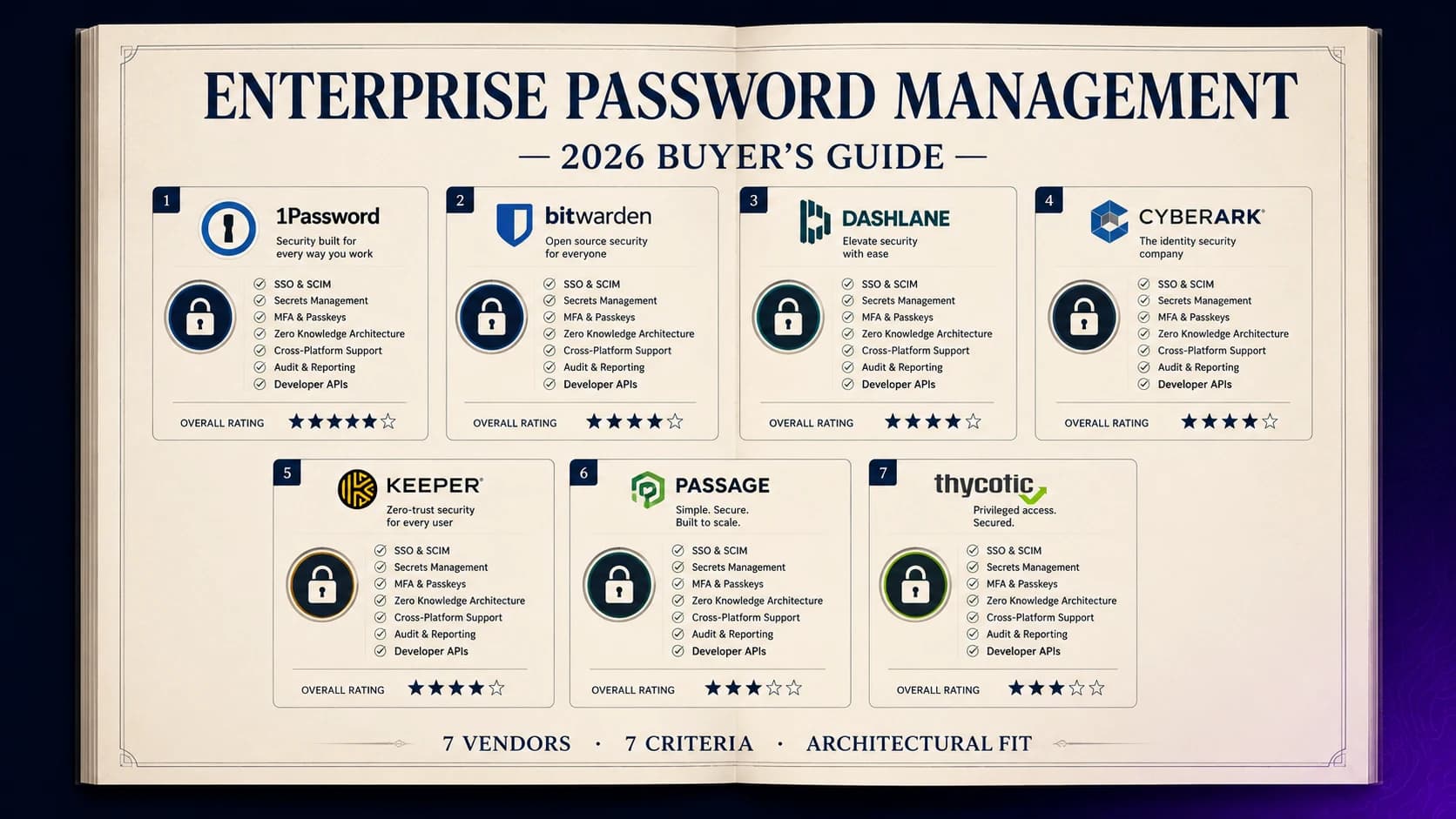
Enterprise password management software handles the password reality enterprises can't yet escape — legacy applications, frontline workers, contractor populations, and the long tail of systems that won't go passwordless this decade. The 2026 buyer's guide compares the major vendors, the evaluation criteria that actually matter, and the architectural fit decisions for different workforce profiles.
Enterprise password management in 2026 is in an awkward strategic position. The passwordless authentication category (passkeys, hardware FIDO2 keys, deviceless cards) is mature enough that most security architects know it's the right destination. Migration to passwordless is well-understood, well-tooled, and well-supported by major vendors. And yet — the majority of enterprises in 2026 are years away from completing the passwordless migration across the full workforce surface. Legacy applications still require passwords. Contractor populations on unmanaged devices still authenticate via password. The long tail of SaaS applications that haven't adopted SSO or SCIM still maintain their own password databases. Frontline workers in segments where deviceless FIDO2 cards aren't yet deployed still authenticate via password.
The result is that "password management" in 2026 means hardened management of the password layer that still exists — not because enterprise architects don't know passwordless is better, but because the migration is multi-year and the password attack surface needs to be managed during the transition. The buyer's guide for this category in 2026 is therefore not "which password manager is best" in isolation — it is "which password manager fits your specific transition state and the workforce segments still depending on passwords for the next 3-5 years."
This piece is the 2026 enterprise buyer's guide for password management software. The companion pieces handle adjacent territory: Password Complexity vs Strength covers the policy architecture, Risks of Weak Passwords covers the threat landscape, PAM for Enterprise 2026 covers the privileged-account adjacent category, and Best IGA Solutions and Best ILM Solutions cover the broader governance and lifecycle layers. This piece is the workforce-password-specific layer.
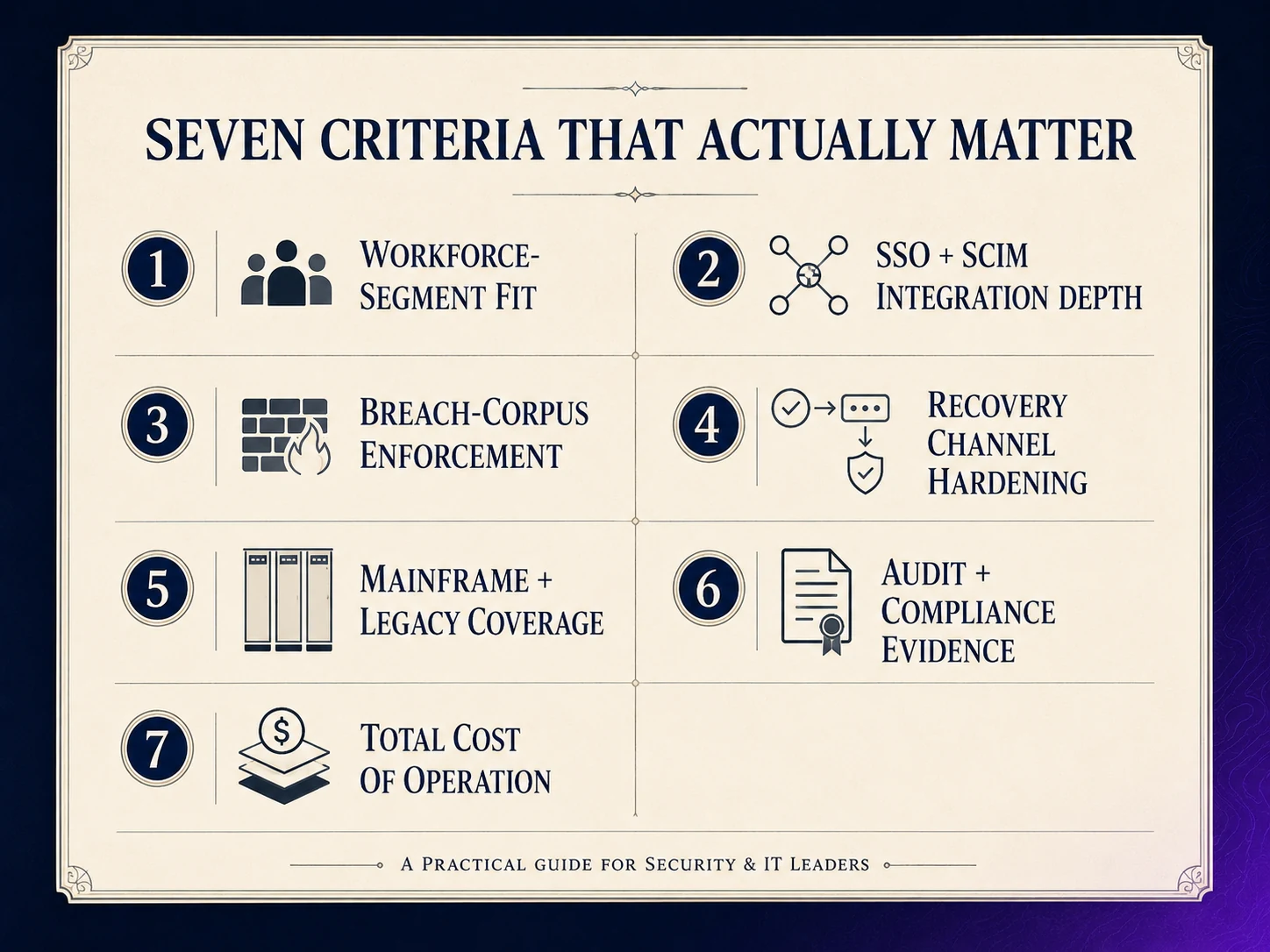 Seven criteria. The evaluation that actually predicts deployment success — not the vaulting-feature comparison most evaluations fixate on.
The evaluation criteria that actually matter
Enterprise password management buyer evaluations frequently fixate on vaulting features (encryption strength, key derivation, hardware-security-module support) that have largely commoditized across the major vendors. The criteria that actually differentiate vendors in 2026 enterprise deployments are operational and integration-focused, not vaulting-cryptographic.
Criterion 1: Workforce-segment fit. The password manager has to work for the actual workforce segments the enterprise has — desk workers, frontline workers on shared workstations, contractors on unmanaged devices, executives, partner-organization users, customer-service representatives at call centers. The major vendors have varying coverage. 1Password Teams handles desk workers cleanly and adds frontline coverage with shared vaults. LastPass Enterprise has broad coverage but recent breach history. Bitwarden Enterprise has strong open-source posture and works well for technical workforces. Dashlane Business covers desk workers well, frontline less so. Keeper has strong policy enforcement and broad workforce coverage. NordPass Business is a newer entrant with good UX but less integration depth. Avatier Password Station integrates with the broader Avatier Identity Anywhere platform for workforce segments outside the desk-worker default.
Criterion 2: SSO and SCIM integration depth. The password manager doesn't replace the IdP — it supplements it for the workforce population that still uses passwords. The integration with the IdP via SAML/OIDC (so users sign into the password manager via SSO rather than maintaining a separate credential) and via SCIM (so users are provisioned into the password manager from the IdP automatically as part of joiner workflows) is operationally critical. Vendors vary substantially here. The 2026 evaluation should require demos against the specific IdP the enterprise runs (Microsoft Entra ID, Okta, Ping, ForgeRock, Avatier Identity Anywhere) rather than trusting the marketing-page integration claims.
Criterion 3: Breach-corpus enforcement at password creation. Modern password management includes runtime checking of new passwords against breach corpora — the password the user wants to set is matched against Have I Been Pwned, vendor-curated breach feeds, and threat-intelligence sources. Passwords that match known-compromised credentials are rejected. The depth and freshness of the breach-corpus integration varies by vendor; the architectural pattern is covered in our Password Complexity vs Strength piece. The evaluation should verify that the vendor actually rejects breach-matched passwords at creation time, not just at scheduled audit time.
Criterion 4: Recovery channel hardening. When a user forgets their master password or loses access to their password manager, the recovery flow that re-issues access is the highest-risk authentication event for that account. Recovery flows that rely on knowledge-based questions ("mother's maiden name") or unstructured help-desk verification are subject to the Storm-2949 social-engineering pattern — covered in our Storm-2949 governance failure analysis. The 2026 evaluation should require workflow-verified recovery (the help-desk agent verifies the caller against the lifecycle-managed identity using a workflow-generated code, not knowledge questions). Most vendors offer this; the deployment quality varies.
Criterion 5: Mainframe and legacy-application coverage. Enterprises with mainframe estates (RACF, ACF2, Top Secret) or legacy applications that predate modern authentication have password populations that most consumer-grade password managers don't handle natively. The integration patterns are: native connector support (the password manager understands the legacy auth protocol), pass-through credential injection (the user retrieves the password from the vault and pastes it manually), and orchestrated provisioning (lifecycle workflows push password updates into the legacy system). Most password managers handle only the consumer-style flows; enterprises with significant legacy estate should evaluate the integration patterns explicitly. The Mainframe Identity Modernization piece covers the mainframe-side architecture this depends on.
Criterion 6: Audit and compliance evidence. The password manager produces audit data the enterprise's compliance team needs — credential creation events, access events, rotation events, recovery events, sharing events, policy violation events. The format and depth varies by vendor. SOC 2 audit evidence, HIPAA compliance reporting, PCI DSS Requirement 8 evidence, NIST 800-53 control mapping — these are vendor-specific deliverables. The evaluation should verify the audit data depth matches the enterprise's specific regulatory environment.
Criterion 7: Total cost of operation. License cost is the visible component, but enterprise password manager TCO is dominated by deployment effort, integration cost, user training, and ongoing administrative overhead. The 2026 evaluation should model three-year TCO including these soft costs, not just the per-seat license multiplied by user count. Procurement-led modeling against the four cost categories (license, implementation, integration, operational) produces materially different vendor rankings than license-only evaluation.
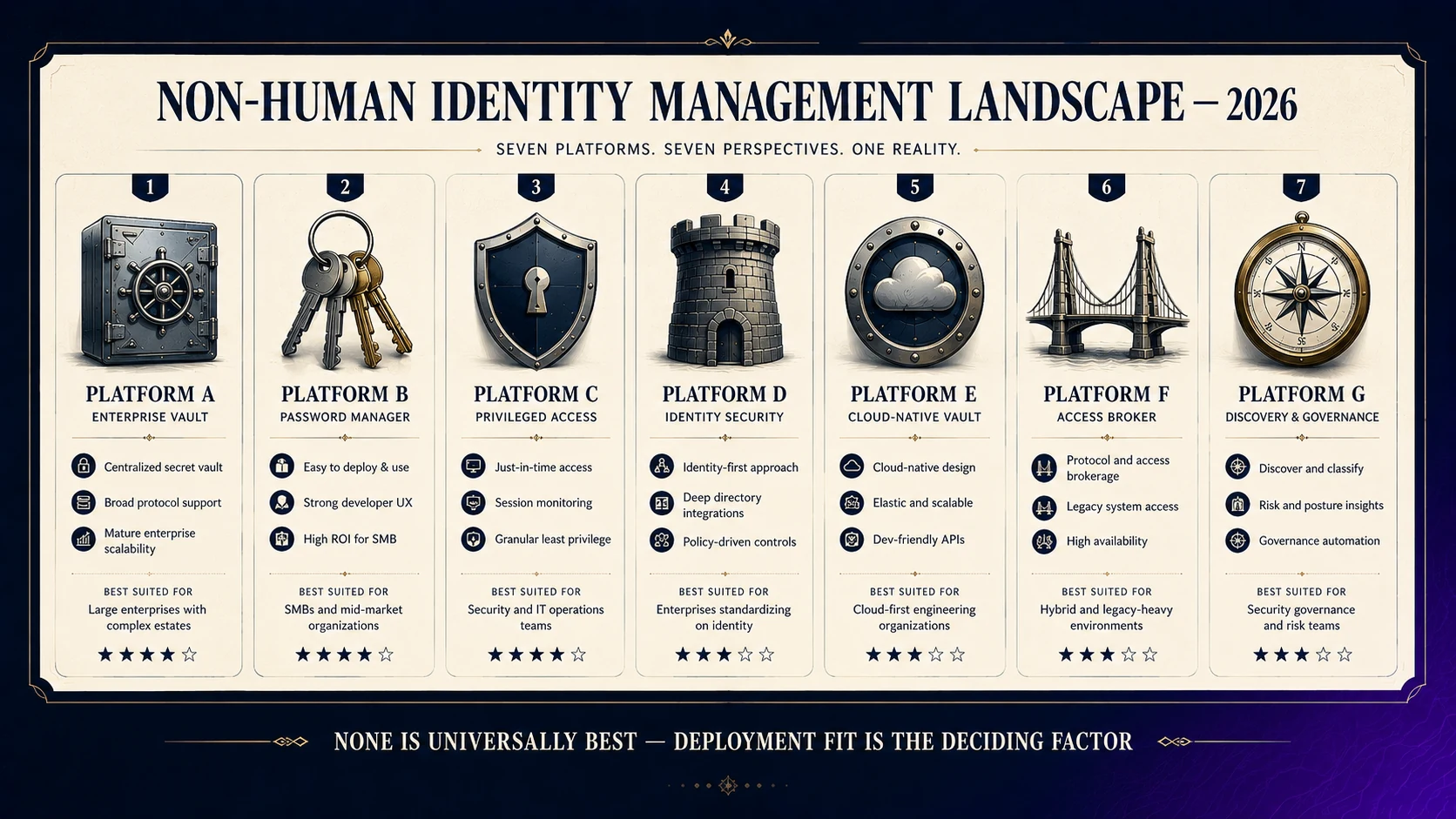 Seven platforms, seven perspectives, one reality. None of these is universally best — the right choice is the one whose strongest deployment fit matches the enterprise profile.
The vendor landscape, by deployment fit
The 2026 enterprise password management vendor landscape has roughly seven significant players, each with a distinct deployment fit. None of them is universally "best" — the right choice depends on workforce profile, existing IdP, regulatory environment, and migration trajectory.
1Password Teams / Business. Strong UX, broad SSO integration, increasingly common in tech-forward enterprises. Best fit for desk-worker-dominant workforces with managed devices and the major IdPs. Mid-tier pricing. Frontline workforce coverage is improving but historically weaker than the desk-worker experience.
LastPass Enterprise. Long-established player with the broadest enterprise integration history. Recent (2022-2023) security incidents created real customer attrition; the deployment posture has hardened substantially since. Best fit for enterprises with existing LastPass deployments evaluating whether to stay or migrate, or new deployments where the integration breadth outweighs the post-incident reputation risk.
Bitwarden Enterprise. Open-source posture (codebase is auditable), strong technical-user UX, good self-hosting option for enterprises that don't want third-party SaaS for credential storage. Best fit for technical-workforce-heavy enterprises, regulated industries that need self-hosting, and enterprises with strong internal IT capability.
Dashlane Business. Strong UX for desk workers, good password-strength enforcement defaults, weaker frontline and mainframe coverage. Best fit for mid-market enterprises with primarily desk-worker workforces and existing Dashlane brand familiarity from consumer adoption.
Keeper Business. Strong policy enforcement, broad compliance audit support, good for regulated industries. Best fit for enterprises in healthcare, financial services, and government workloads where the audit and compliance posture differentiation matters.
NordPass Business. Newer entrant with strong UX, less integration depth, growing capability breadth. Best fit for SMB-to-mid-market with strong UX preference and simpler integration requirements.
Avatier Password Station. Workforce password management layer in the Avatier Identity Anywhere platform. Best fit for enterprises with mainframe estate (RACF/ACF2/Top Secret native connectors), workforce segments needing deviceless FIDO2 alongside password coverage (the Identity Challenge Card composition), and workflow-verified recovery requirements (post-Storm-2949 environments). Avatier participates in the broader IGA category — our Best IGA Solutions piece covers the governance-layer comparison.
The pattern that fails is treating these as interchangeable. The pattern that works is matching the vendor's strongest deployment fit to the enterprise's actual profile.
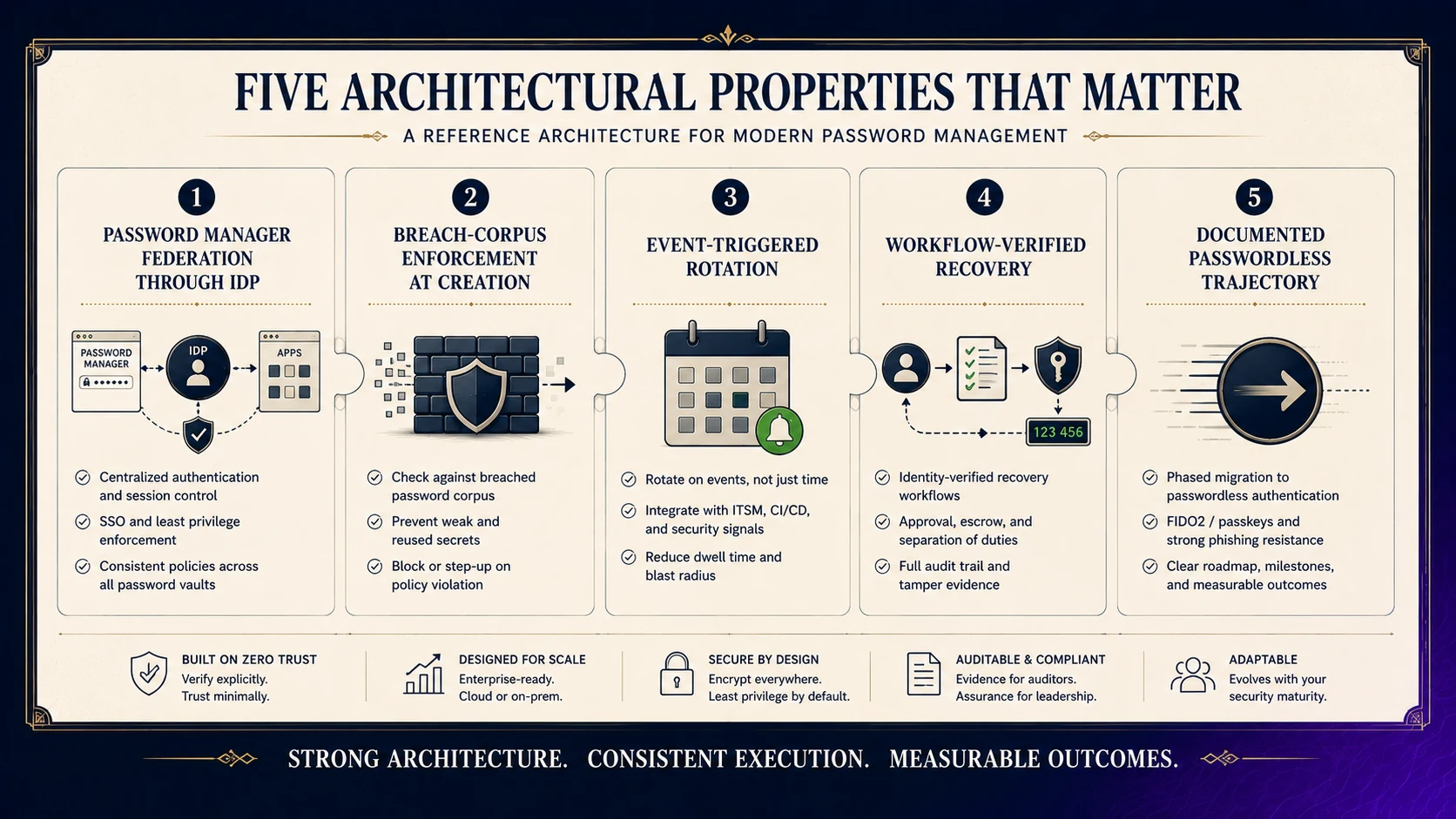 Five properties, one architecture. The deployment that ships with all five gets ahead of the password-management problem; the deployment that ships with two or three keeps fighting it.
The architecture that ships clean
Enterprise password management deployments that ship clean and survive five years of operational reality share five design properties. The properties are independent of which vendor is selected.
Property 1: Password manager federation through the IdP. Users sign into the password manager via the corporate IdP (SAML or OIDC), not via a separate master password. This eliminates a separate credential the user has to maintain and brings the password manager under the same MFA and conditional-access policies as everything else. SCIM provisions users into the password manager automatically from HRIS-driven lifecycle workflows.
Property 2: Breach-corpus enforcement at creation time. Every password the user creates or rotates is checked against current breach corpora at the moment of creation. Breach-matched passwords are rejected with clear UX explanation. The architecture is described in detail in our Password Complexity vs Strength piece — the runtime credential firewall pattern.
Property 3: Event-triggered rotation, not calendar-triggered. Passwords rotate when there's a real risk signal (the user's credential appears in a breach disclosure, the user's role changes substantially, the user offboards), not on an arbitrary calendar schedule. Calendar-triggered rotation produces user-frustration patterns (sequential passwords) that the credential firewall has to fight. Event-triggered rotation produces meaningful security improvement without the friction.
Property 4: Workflow-verified recovery. When users lose access to the password manager, the recovery flow runs through workflow-verified help-desk verification — the agent verifies the caller against the lifecycle-managed identity using a workflow-generated code, not knowledge questions. This closes the Storm-2949 social-engineering vector that defeats password-manager recovery as effectively as it defeats any other recovery flow.
Property 5: Passwordless migration trajectory documented and tracked. The password manager doesn't pretend that passwords are the long-term architecture. The deployment includes a documented trajectory for which workforce segments migrate to passwordless on what timeline. Desk workers usually go first via platform passkeys; frontline workers transition via the Avatier Identity Challenge Card (or equivalent deviceless FIDO2 card); legacy applications either get federation upgrades or remain on password indefinitely. The password manager's role decreases over time for the segments that migrate; it remains load-bearing for the segments that don't.
The five properties produce a deployment where the password manager fills the gap the passwordless transition leaves rather than competing with it. The architectural test is whether the password manager and passwordless transition are owned by the same team with the same trajectory — when they're owned by separate teams with separate roadmaps, the result is usually shadow password management and incomplete passwordless adoption.
What Avatier ships toward this pattern
Avatier Password Station is the workforce password management layer in the Avatier Identity Anywhere platform. The architecture is designed to compose with the broader platform — SSO and SCIM integration with the IdP, breach-corpus enforcement at password creation, event-triggered rotation tied to lifecycle and threat-intelligence events, workflow-verified recovery (the architecture that closes the Storm-2949 vector), and explicit composition with passwordless adoption.
For enterprises with mainframe estate, Avatier's native RACF, ACF2, and Top Secret connectors handle the mainframe-side credential population that most general-purpose password managers don't reach. The credentials live in Password Station, the policy enforcement lives in Password Station, and the lifecycle workflows that govern joiner/mover/leaver events on mainframe identities run through the same Avatier Identity Anywhere Lifecycle Management platform that governs the modern stack.
For workforce segments where passwords aren't the right architecture in 2026 — frontline shared workstations, contractor populations without managed devices, defense facilities where phones aren't viable — the Avatier Identity Challenge Card provides FIDO2-compatible deviceless authentication. The two products compose: passwords for the segments where they're still the right pattern, deviceless FIDO2 for the segments transitioning to passwordless, with the lifecycle and workflow infrastructure shared across both.
The Avatier Trust Center publishes our compliance posture (SOC 2 Type II zero exceptions, ISO/IEC 27001:2022, PCI DSS v4.0.1, CSA STAR Level 1, NIST 800-53 Rev. 5 aligned, CISA Secure-by-Design Pledge signatory). The architectural pattern works regardless of vendor — the point of this piece is not that you have to buy Avatier — but the integrated pattern of IdP-federated password manager + breach-corpus enforcement + event-triggered rotation + workflow-verified recovery + documented passwordless trajectory is what separates an enterprise that has actually solved the password layer from one that has merely deployed a vault and called the problem solved.
The honest closing
Enterprise password management in 2026 is not a problem solved by deploying a password vault. It is the workforce-segment-specific operational layer that handles the password reality enterprises can't yet escape — legacy applications, frontline workers, contractors, partner users, and the long tail of systems that won't go passwordless this decade. The 2026 vendor landscape has seven significant players, each with a distinct deployment fit. The right choice depends on workforce profile, existing IdP, regulatory environment, mainframe estate, and migration trajectory — not on which vendor has the strongest marketing position. The architectural decisions that matter are the integration with the IdP, the breach-corpus enforcement at creation, the event-triggered rotation policy, the workflow-verified recovery, and the documented composition with passwordless adoption. The enterprises that get these decisions right will produce a password layer that hardens the attack surface during the multi-year passwordless transition. The enterprises that treat password management as a checklist item separate from the broader identity architecture will end up with shadow password management, incomplete passwordless adoption, and the worst of both worlds.
ABOUT THE AUTHOR

More from Buyer's Guides

Outcome-Based Software Pricing: A CFO's Guide to Buying Identity in the AI Era
Outcome-based software pricing charges for completed, verified, audited work instead of seats, modules, or long commitments. In an AI era where the best technology can change in a quarter, it is the pricing model that lets a CFO keep options open and make every vendor prove its value.
IAM Vendors in 2026: How the Market Breaks Down
A category-level guide to how the IAM vendor market segments into suites, point solutions, and platform plays, plus the criteria and red flags that separate real capability from marketing claims.
SailPoint vs Avatier: The 2026 Enterprise Pricing Model Comparison
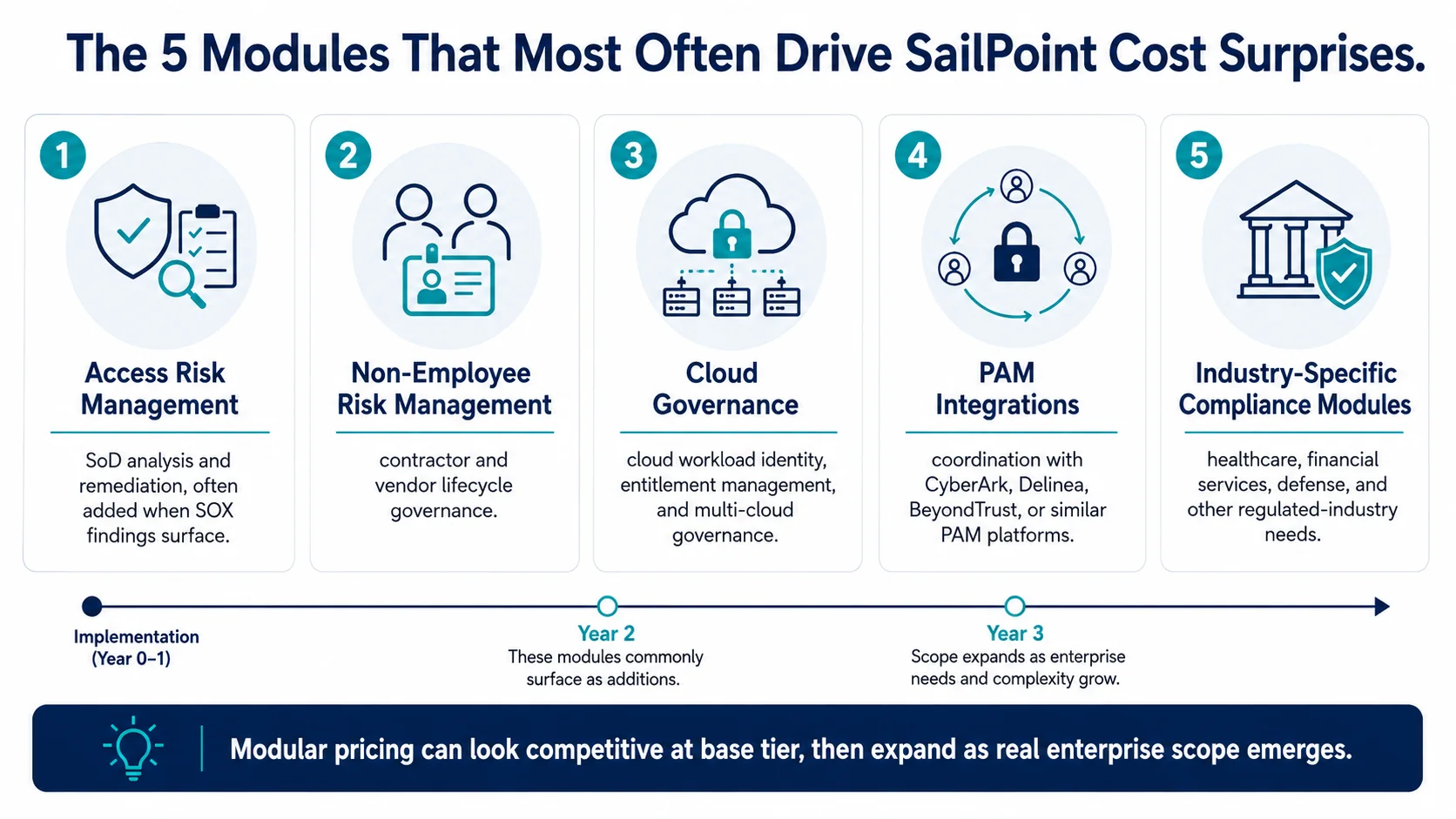
Enterprise IAM buyers evaluating SailPoint against Avatier are comparing two fundamentally different pricing philosophies — modular per-capability pricing with premium tiers and per-connector charges versus all-inclusive licensing that bundles the same capability set into the base license. The 2026 enterprise reference on the structural pricing differences, the modules that drive most of the SailPoint cost surprises, the Avatier all-inclusive positioning, and the buyer-side comparison discipline that produces defensible vendor selection instead of feature-checklist theater.