Identity Security Posture Management (ISPM) for Enterprise 2026
ISPM is the emerging analyst category that sits above IGA and beside ITDR — the preventive posture audit, drift detection, and identity-asset inventory layer that answers 'is our identity infrastructure currently configured the way our policy says it should be.' The 2026 enterprise reference on the evaluation domains, vendor landscape, and integration architecture.
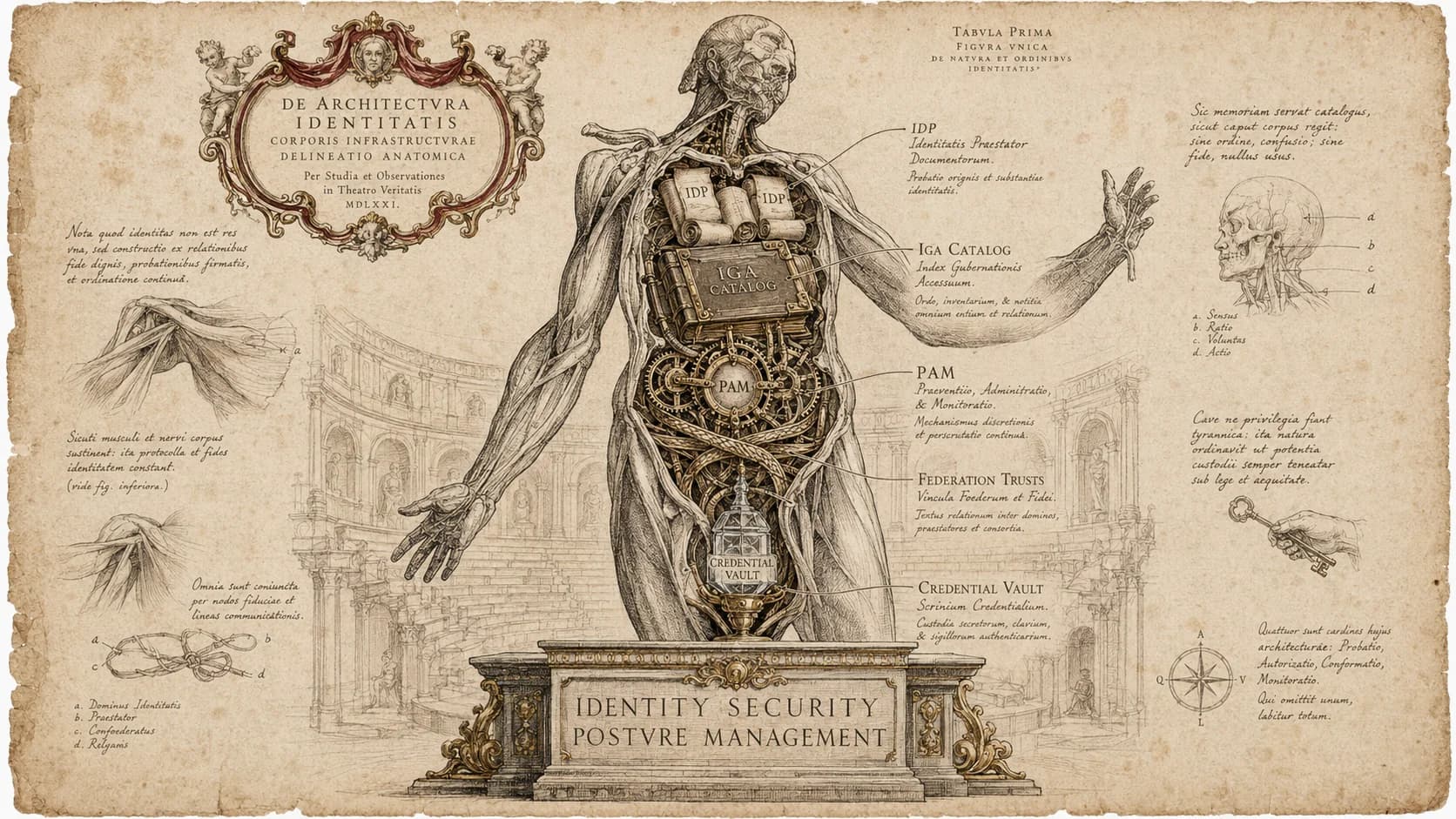
ISPM is the emerging analyst category that sits above IGA and beside ITDR — the preventive posture audit, drift detection, and identity-asset inventory layer that answers 'is our identity infrastructure currently configured the way our policy says it should be.' The 2026 enterprise reference on the evaluation domains, vendor landscape, and integration architecture.
- ISPM is the analyst category — coalescing in Gartner coverage through 2025-2026 — that evaluates whether identity infrastructure is currently configured the way policy says it should be, distinct from IGA's governance role and ITDR's detection role.
- ISPM has four evaluation domains: configuration posture (are IdPs, IGA, PAM configured to baseline), entitlement posture (do current entitlements match policy), access pattern posture (do access patterns indicate misconfiguration or shadow access), and identity inventory posture (is every identity in the catalog with current attributes).
- The vendor landscape in mid-2026 includes Authomize, Veza, Silverfort, Permiso, Push Security, Sweet Security, and Reco — each with different domain emphases, and none yet a clear category leader; Gartner Magic Quadrant coverage is forming but not finalized.
- ISPM surfaces findings the other layers miss: orphaned admin accounts from prior integrations, shadow access paths through nested group memberships, IdP configuration drift away from baseline, service accounts with credentials not rotated, dormant entitlements that should have been removed.
- The 2026 reference architecture composes ISPM (preventive posture) above IGA (governance workflow) and beside ITDR (detection and response) — the three layers together cover the identity-security surface that any one of them covers only partially.
Identity security has three load-bearing analyst categories in 2026, and the third — Identity Security Posture Management, or ISPM — is the newest and least settled. The first, Identity Governance and Administration (IGA), is mature: provisioning workflows, certification campaigns, access requests, segregation-of-duty controls, lifecycle automation. The second, Identity Threat Detection and Response (ITDR), emerged in 2022-2024 and matured rapidly through 2025: real-time detection of credential compromise, federation abuse, MFA-fatigue patterns, anomalous authentication. The third, ISPM, is the preventive posture-audit layer that sits beside the other two — the system that asks "given everything IGA has done and everything ITDR is watching for, does the current configuration of our identity infrastructure actually match what our policy says it should be."
Gartner's coverage of ISPM has been intensifying through 2025 and into 2026 — Magic Quadrant discussions are forming, market guides have been published, and the vendor landscape has consolidated around a recognizable set of players. The category isn't fully settled yet, but it has graduated from "emerging" to "established" in the analyst framing, and enterprise procurement is starting to budget for it as a distinct line item rather than as a feature of adjacent categories.
This piece is the 2026 enterprise reference on ISPM — what it does, how it differs from IGA and ITDR, what findings it produces, where the vendor landscape stands, and how the architectural composition works. The companion pieces cover adjacent territory. The Best IGA Solutions buyer's guide covers the workflow layer ISPM evaluates the output of; the ITDR piece covers the detection layer that runs alongside ISPM; the Service Account Governance / NHI piece covers the non-human identity inventory ISPM specifically scrutinizes; the PAM piece covers the privileged-access layer that produces some of ISPM's highest-priority findings. This piece is the ISPM-specific layer.
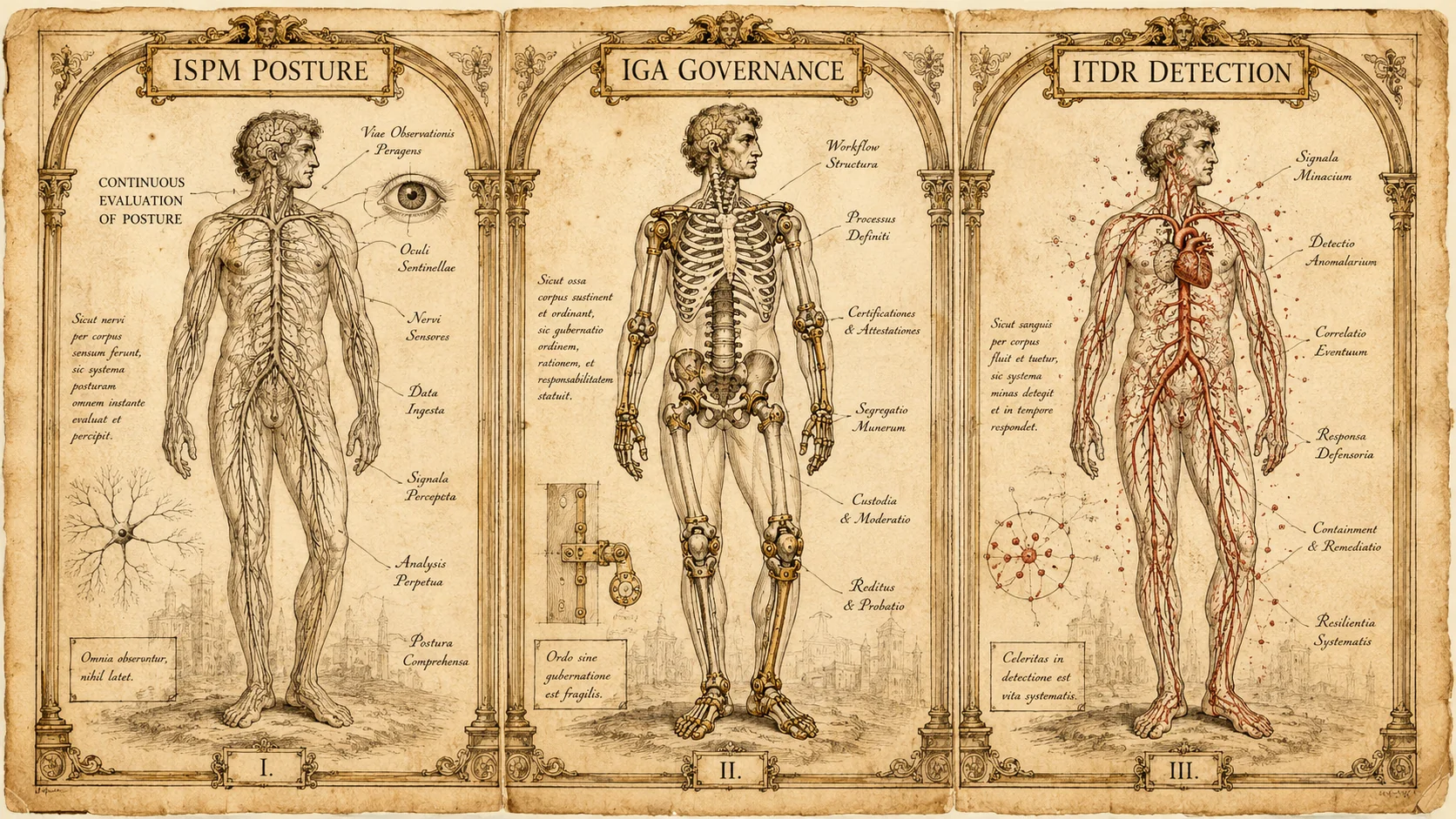 ISPM sits beside IGA and ITDR, evaluating the same infrastructure through a different lens. The three layers together cover the identity-security surface no single layer covers alone.
Where ISPM sits relative to IGA and ITDR
The three identity-security analyst categories evaluate the same infrastructure but answer different questions. Understanding what each is for clarifies why a 2026 enterprise architecture wants all three rather than collapsing them.
| Category | Primary question | Time orientation | Output | Action class |
|---|---|---|---|---|
| IGA | Are access changes following documented governance? | Real-time workflow | Provisioning events, certifications, access reviews | Workflow execution |
| ITDR | Is identity infrastructure under active attack? | Real-time detection | Alerts on anomalies and known threat patterns | Incident response |
| ISPM | Is identity infrastructure currently configured per policy? | Continuous evaluation, prospective | Posture findings, drift reports, misconfiguration backlog | Remediation projects |
IGA answers the workflow question. Did the access change happen through documented process? Was the certification campaign completed? Was the segregation-of-duty rule enforced? IGA is the system through which the identity envelope is supposed to be maintained. When IGA is operating, the workflow records exist for audit; when IGA is not operating, the workflow records don't exist and the audit position is weak. IGA owns the workflow.
ITDR answers the threat question. Is the identity infrastructure under active attack right now? Is this authentication pattern consistent with credential compromise? Is the federation broker behaving anomalously? ITDR is reactive — by the time an alert fires, an attack is already underway, and the response window is short. ITDR owns the detection.
ISPM answers the posture question. Given everything IGA has done and given everything ITDR isn't currently flagging, does the actual configuration of the identity infrastructure match what the organization's policy says it should be? ISPM is preventive — the findings it produces aren't active incidents; they're latent vulnerabilities that haven't been exploited yet. The response window is the remediation cycle (weeks, sometimes months), not the incident-response cycle (hours). ISPM owns the posture audit.
The three categories aren't substitutes for each other. IGA could be operating perfectly and ISPM still finds drift — because integration gaps, manual workarounds, and system-level changes that bypass IGA produce state IGA didn't cause. ITDR could be quiet and ISPM still finds attack surface — because the absence of active threats doesn't mean the configuration is sound. The 2026 reference architecture composes all three.
The four ISPM evaluation domains
ISPM platforms vary in their emphasis across four evaluation domains. Mature 2026 ISPM deployments cover all four; less-mature deployments focus on one or two and supplement with other tooling for the rest.
Configuration posture. Is the identity infrastructure configured according to baseline? IdP settings (MFA requirements, session lifetimes, conditional access policies, password policies). IGA settings (certification campaign frequency, SoD rule enforcement, lifecycle automation rules). PAM settings (session recording, just-in-time elevation rules, credential rotation cadence). Federation settings (trust relationships, signing certificates, audience restrictions). Directory settings (group nesting limits, permission delegation, security boundary). The configuration posture domain catches drift — settings that diverged from baseline because someone made a one-off change, because an upgrade reset a value, because a vendor default changed.
Entitlement posture. Do current entitlements match policy? The entitlement inventory across applications, directories, cloud platforms, and SaaS systems. Each entitlement should have a documented business justification, a current owner, an active business need, and an attribute basis (the user has this entitlement because they're in this role / this project / this clearance level). Entitlement posture analysis catches entitlements that no longer have justification — the project ended, the role changed, the clearance expired — but the entitlement persists.
Access pattern posture. Do current access patterns indicate misconfiguration or shadow access? Even when entitlements are technically valid, the access patterns might reveal configuration problems: a user accessing resources their role shouldn't need, a service account accessing systems outside its workload scope, transitive permissions through nested groups producing access the direct entitlement model didn't anticipate, cross-application authorization patterns that produce shadow administrative access. Access pattern posture analysis is the layer that catches what entitlement-only analysis misses — the access path that exists not because of any single grant but because of how grants compose across systems.
Identity inventory posture. Is every identity in the catalog with current attributes? The inventory question that the Service Account Governance / NHI piece covers for service accounts specifically extends to all identity classes: human users, service accounts, AI agents, application identities, system accounts, machine identities, certificates, secrets. Identity inventory posture analysis catches identities that exist in target systems but not in the catalog (shadow identities), identities in the catalog that no longer exist in target systems (orphan catalog entries), and identities whose attributes have diverged between catalog and target system (attribute drift).
The four domains compose into a complete posture picture. Configuration tells you whether the infrastructure is set up correctly. Entitlements tell you whether the grants are justified. Access patterns tell you whether the realized access matches the intended access. Inventory tells you whether the catalog reflects reality. Each domain catches a different class of finding; the composition catches the overall posture.
The 2026 ISPM vendor landscape
The ISPM market in mid-2026 is consolidating around a recognizable set of vendors, but no single vendor dominates yet. Gartner Magic Quadrant coverage is forming — recent market guides discuss the category, but the formal MQ that procurement teams want hasn't fully landed. The leaders' quadrant is unsettled. The 2026 enterprise procurement pattern is to evaluate three to five vendors, run proofs-of-concept against actual environments, and pick based on the specific evaluation domains the organization prioritizes.
| Vendor | Configuration posture | Entitlement posture | Access pattern posture | Identity inventory | Distinguishing emphasis |
|---|---|---|---|---|---|
| Authomize | ✓ | ✓ | ✓ | ✓ | Broad SaaS coverage, mature IGA-adjacent positioning |
| Veza | ✓ | ✓ | ✓ | ✓ | Authorization-graph-centric, deep entitlement analysis |
| Silverfort | ✓ | partial | ✓ | ✓ | Network-layer identity controls, MFA-everywhere positioning |
| Permiso | ✓ | ✓ | ✓ | ✓ | Cloud-native focus, behavioral analytics |
| Push Security | ✓ | ✓ | ✓ | partial | Browser-extension data collection, SaaS-shadow-IT focus |
| Sweet Security | ✓ | partial | ✓ | ✓ | Runtime correlation, cloud-workload-identity overlap |
| Reco | ✓ | ✓ | ✓ | partial | SaaS-first, business-context graph |
The vendor differentiation matters because the evaluation domains the organization prioritizes drive the vendor selection. An organization with strong existing IGA might prioritize a vendor with deep configuration-posture and access-pattern-posture capabilities, accepting that the IGA platform owns entitlement management. An organization heavy on SaaS sprawl might prioritize a vendor with SaaS-coverage breadth. An organization deep in cloud-native infrastructure might prioritize a vendor with cloud-workload-identity expertise.
The 2026 procurement caution is that the category is still solidifying. Vendors are repositioning, capabilities are evolving rapidly, and the analyst framing is moving. Procurement decisions made on 2025 vendor capabilities may look different against 2027 vendor capabilities. The pragmatic discipline is to pick a vendor whose architecture is open enough to swap or augment if the category landscape shifts, rather than picking on current feature parity alone.
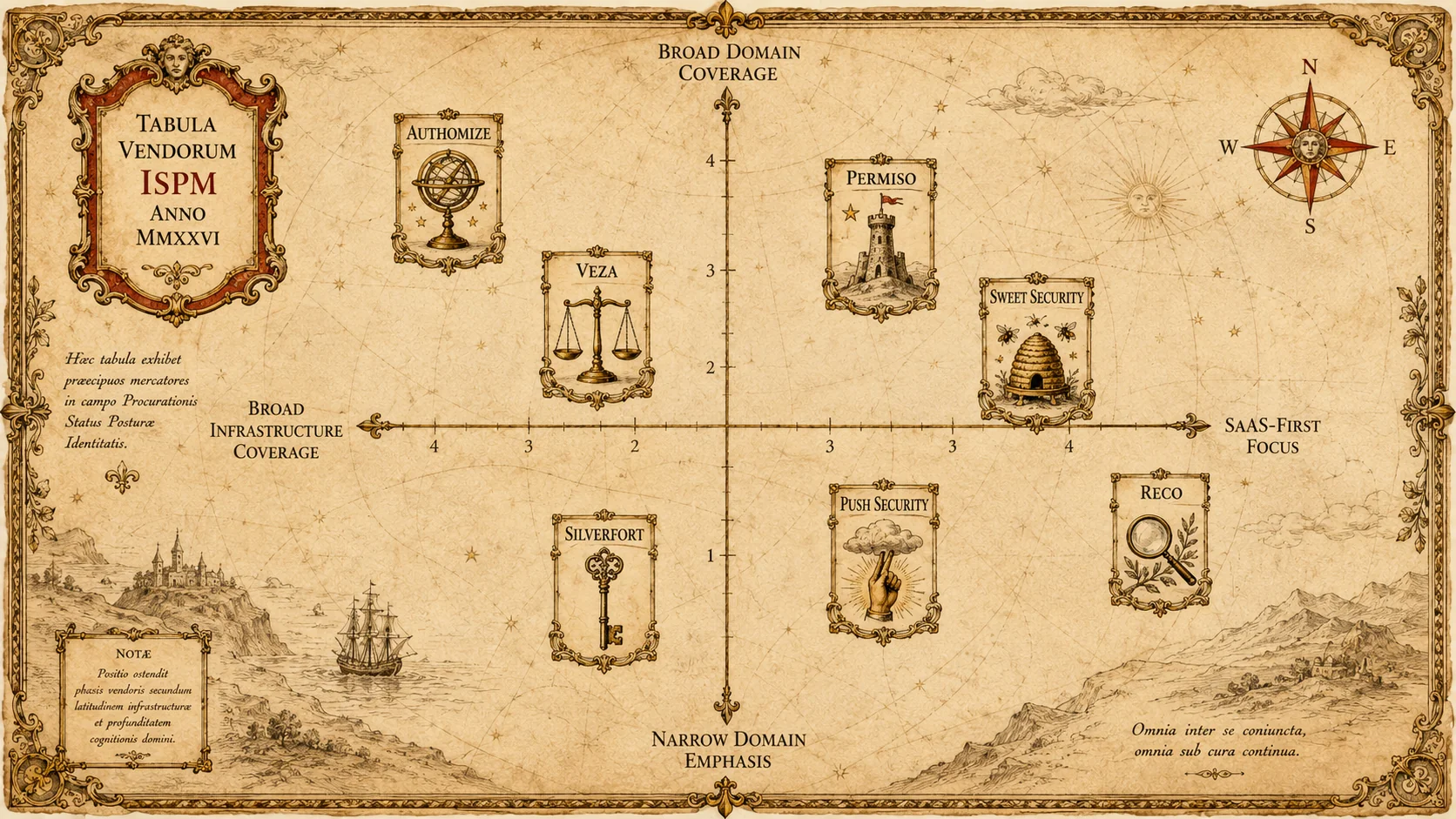 Vendor positioning in mid-2026. The landscape consolidates around recognizable players but the leader position is unsettled. Procurement should plan for the category to keep moving.
The six findings ISPM tools surface
Six finding categories recur across 2026 ISPM deployments. Each is an attack surface that ISPM surfaces preventively, before it becomes the kind of incident that shows up in breach reports.
Orphaned admin accounts. Accounts with administrative privileges that no longer correspond to active users. Created during integrations, migrations, or one-off projects and never cleaned up. The accounts often have weak credentials (never rotated, sometimes still on the default password) and broad permissions (administrative-level by definition). When attackers find them — through credential spraying, breach-corpus matches, or insider knowledge — the result is immediate privileged access. ISPM finds these by cross-referencing privileged-account inventories against current active-user records and surfacing the gap.
Shadow access paths. Entitlement combinations that produce unintended access through nested group memberships, transitive permissions, or cross-application authorization patterns. A user might have legitimate membership in three groups, none of which individually grants administrative access, but the intersection produces administrative access because of how the target system's authorization model composes. Direct entitlement analysis misses these; access pattern analysis catches them. The Storm-2949 incident pattern documented in our governance failure analysis included exactly this class of shadow access.
IdP configuration drift. IdP settings that diverged from baseline. MFA requirements weakened during a rollout and never restored. Session lifetimes extended for a debugging session and forgotten. Conditional access policies disabled to troubleshoot an outage and not re-enabled. Federation trusts added for a vendor that never went into production. Each individual drift looks small; the cumulative drift produces an IdP configuration substantially weaker than the baseline policy specifies. ISPM finds these by comparing current configuration state against the documented baseline.
Unrotated service account credentials. Service accounts with passwords, certificates, or API keys that haven't rotated within the required cadence. The credential-rotation requirement exists because long-lived credentials accumulate exposure — copies in scripts, in CI/CD systems, in developer notes, in backup files, in monitoring tools. Each copy is an attack surface. ISPM finds credentials past their rotation deadline by reading the credential metadata (where the lifecycle metadata is available) and flagging the gaps.
Dormant entitlements. Access that the user no longer needs, granted for a past role or project and never removed. The user moved to a new role; the old role's entitlements were never revoked. The user finished a project; the project-specific access was never removed. The user took a leave of absence and came back; some entitlements were suspended during leave and restored automatically rather than re-evaluated. ISPM finds these by analyzing entitlement-vs-current-attribute alignment and surfacing the entitlements without current justification.
Cumulative segregation-of-duty violations. SoD rules typically apply at the grant moment — when a new entitlement is requested, the IGA system checks whether the combination of the requested entitlement and the user's existing entitlements violates an SoD rule. But entitlements can be added by paths IGA doesn't see — direct grants in target systems, role membership changes outside IGA, inherited permissions through organizational restructures. The user can end up in a SoD-violating state without any individual grant having tripped the SoD rule. ISPM finds these by evaluating the current entitlement state against the full SoD rule set, regardless of how the state was reached.
The six findings share a structural property: they exist because the system-of-record (the catalog, the policy baseline, the SoD rule set) and the system-of-reality (the actual configuration of the identity infrastructure) have diverged. ISPM is the layer that catches divergence preventively.
The 2026 reference architecture: how ISPM composes with IGA and ITDR
The 2026 reference architecture deploys ISPM as a distinct layer alongside IGA and ITDR, with explicit integration patterns that connect the three.
ISPM ↔ IGA. ISPM consumes IGA's authoritative governance state — workflow records, certification campaign results, segregation-of-duty rules, lifecycle event history — as one of its evaluation inputs. ISPM findings flow back into IGA's remediation workflows — when ISPM identifies orphaned admin accounts, those flow into IGA's deprovisioning workflow; when ISPM identifies dormant entitlements, those flow into IGA's recertification campaigns; when ISPM identifies SoD violations, those flow into IGA's exception or remediation queue. The integration is two-way: IGA provides the policy baseline, ISPM evaluates against it, findings come back to IGA for closed-loop fix.
ISPM ↔ ITDR. ISPM and ITDR consume overlapping signal sources but evaluate them through different lenses. ISPM might flag a federation broker configuration as drifted from baseline; ITDR might separately flag anomalous authentications through that broker. The two findings together produce a much stronger signal than either alone — the broker is misconfigured AND it's being used anomalously. The mature 2026 integration correlates ISPM findings with ITDR alerts to prioritize both. Drifted configurations with active anomalies get top-priority remediation; drifted configurations without anomalies get scheduled remediation; clean configurations with anomalies get incident response.
ISPM ↔ PAM. ISPM specifically scrutinizes the privileged-access surface — orphaned admin accounts, drifted PAM configurations, dormant privileged entitlements. The PAM piece covers the PAM-specific architecture; ISPM is the audit layer that verifies PAM is operating as designed and that the privileged-access envelope hasn't been compromised by drift or misconfiguration.
ISPM ↔ Service Account / NHI Governance. ISPM is the audit layer for the service account and non-human identity catalog covered in the Service Account Governance / NHI piece. The catalog asserts what the inventory should be; ISPM verifies that the inventory matches reality.
The composition matters more than any single integration. ISPM as a standalone tool produces findings backlog without closed-loop remediation. ISPM integrated with IGA, ITDR, PAM, and the NHI catalog produces a continuous-improvement loop where findings drive remediation, remediation changes the baseline state, and the next ISPM evaluation operates against the improved state.
The 2026 reference path
Deploy ISPM as a distinct layer alongside IGA and ITDR. The three categories together cover the identity-security envelope that no single category covers alone — preventive posture audit (ISPM), governance workflow (IGA), detective response (ITDR). The architecture isn't fully mature until all three are operating.
Pick a vendor based on the evaluation domains you prioritize. The vendor landscape is consolidating but unsettled. Authomize and Veza have the broadest domain coverage; Silverfort and Permiso have specific architectural emphases; Push Security and Reco have SaaS-first orientations; Sweet Security has cloud-workload focus. The 2026 procurement discipline is to pick on the domains you need depth in, not on category feature parity alone.
Plan the closed-loop integration with IGA. ISPM findings without closed-loop remediation produce backlog without progress. The mature 2026 deployment routes ISPM findings into IGA's recertification, access review, and remediation workflows automatically, with explicit ownership and SLA per finding category.
Plan the correlation with ITDR. ISPM findings combined with ITDR alerts produce stronger signal than either alone — the drift that's actively being exploited gets top-priority remediation; the drift without exploitation gets scheduled remediation. The correlation requires shared identity model and shared incident-management tooling.
Accept that the ISPM category will keep moving. Gartner's analyst framing is consolidating but not finalized. Vendor capabilities are evolving rapidly. The 2026 procurement decision should anticipate the category continuing to develop through 2027 and 2028 — pick a vendor whose architecture is open enough to swap or augment if the landscape shifts.
ISPM is one of the high-leverage architectural additions available to enterprise identity programs in 2026. The category fills a gap that IGA and ITDR don't cover alone, the vendor landscape is mature enough to procure, and the findings ISPM surfaces are the kind that show up in breach reports when they're not caught preventively. Deploy it deliberately.
ABOUT THE AUTHOR

More from IAM & Identity Governance

SCIM Provisioning: The Standard Behind Automated Identity Sync (2026)
SCIM is the RESTful, JSON-based standard that automates identity provisioning and deprovisioning between a source of truth and downstream apps. What it is, how it works, and what it does not solve.
What Identity-Management Failure Actually Costs (2026)
The cost of identity-management failure is not a single line item — it is a breach that starts with a compromised or over-provisioned credential, the downtime while responders lock the environment down, the compliance penalties that follow inadequate access controls, and the customer and market trust that erodes long after the incident closes. This 2026 reference separates the cost of IAM failure from the cost of the IAM program, gives extractable answers to how each failure channel becomes real money, and covers the controls that lower the risk without ever eliminating it.

CIAM vs. Workforce Identity Management: 2026 Reference
A senior practitioner's 2026 comparison of CIAM (customer identity) and workforce identity management — what actually differs, when to use each, how they sit in an enterprise architecture, and the one governance model underneath both.