Password Complexity vs Password Strength: What 2026 Got Right
Complexity rules don't measure what attackers actually exploit. Strength does. The architecture that produces strong workforce passwords without the 'Spring2026!' rotation theater that wastes everyone's time.
Complexity rules don't measure what attackers actually exploit. Strength does. The architecture that produces strong workforce passwords without the 'Spring2026!' rotation theater that wastes everyone's time.
The password complexity debate in 2026 should be over. NIST 800-63B has been clear since 2017 that composition-based complexity rules ("must contain uppercase, lowercase, number, symbol") are an outdated proxy for actual password strength. Every major standards body — NIST, NCSC, the FIDO Alliance, the major IdP vendors — has updated their guidance to reflect what attackers actually exploit. And yet, the majority of enterprises in 2026 are still running 1990s composition rules, forcing 90-day rotation theater, and producing the exact same predictable patterns ("Spring2026!" "Company2026!") that fill the breach corpora.
This piece is the operational refresh on the strength-versus-complexity question for a 2026 audience. The debate isn't intellectual — it's about which architecture you fund and which policy you write. The complexity-rule architecture has measurable downsides: helpdesk burden, credential reuse, predictable patterns, false sense of security. The strength architecture has measurable upsides: actual breach-attack resistance, lower helpdesk volume, NIST/SOC 2/PCI alignment, and the integration surface that makes the rest of the password governance stack work.
The companion pieces — Risks of Weak Passwords covers why weak passwords persist, Best ILM Solutions covers the lifecycle layer that integrates with the credential firewall, and on the ICC side Best Passwordless covers the segments where the password surface goes away entirely. This piece is the policy-and-architecture argument that sits underneath all of them.
What complexity rules actually measure (and don't)
Composition-based complexity rules measure character variety. Strong rules measure entropy — the actual difficulty of cracking the credential through brute-force or dictionary attacks. The two are correlated, but only weakly, and the correlation breaks down in the cases that matter most.
Consider the classic example: "P@ssw0rd!123" satisfies every typical complexity requirement — uppercase, lowercase, number, special character, 12 characters long. It also appears in every breach corpus going back to 2010, which means an attacker running a credential-stuffing attack against your IdP will try it within the first hundred attempts. The complexity score is high; the actual strength is zero.
Compare to "correct horse battery staple" — the example XKCD made famous. It contains four common English words. It violates every composition rule (no uppercase, no number, no special character). It is also 28 characters long and contains no predictable structural patterns, which means a brute-force attack would take longer than the age of the universe to enumerate it. The complexity score is low; the actual strength is enormous.
These aren't edge cases. They're the canonical examples of the gap between what complexity rules measure and what attackers actually exploit. The complexity-rule architecture optimizes for the wrong target.
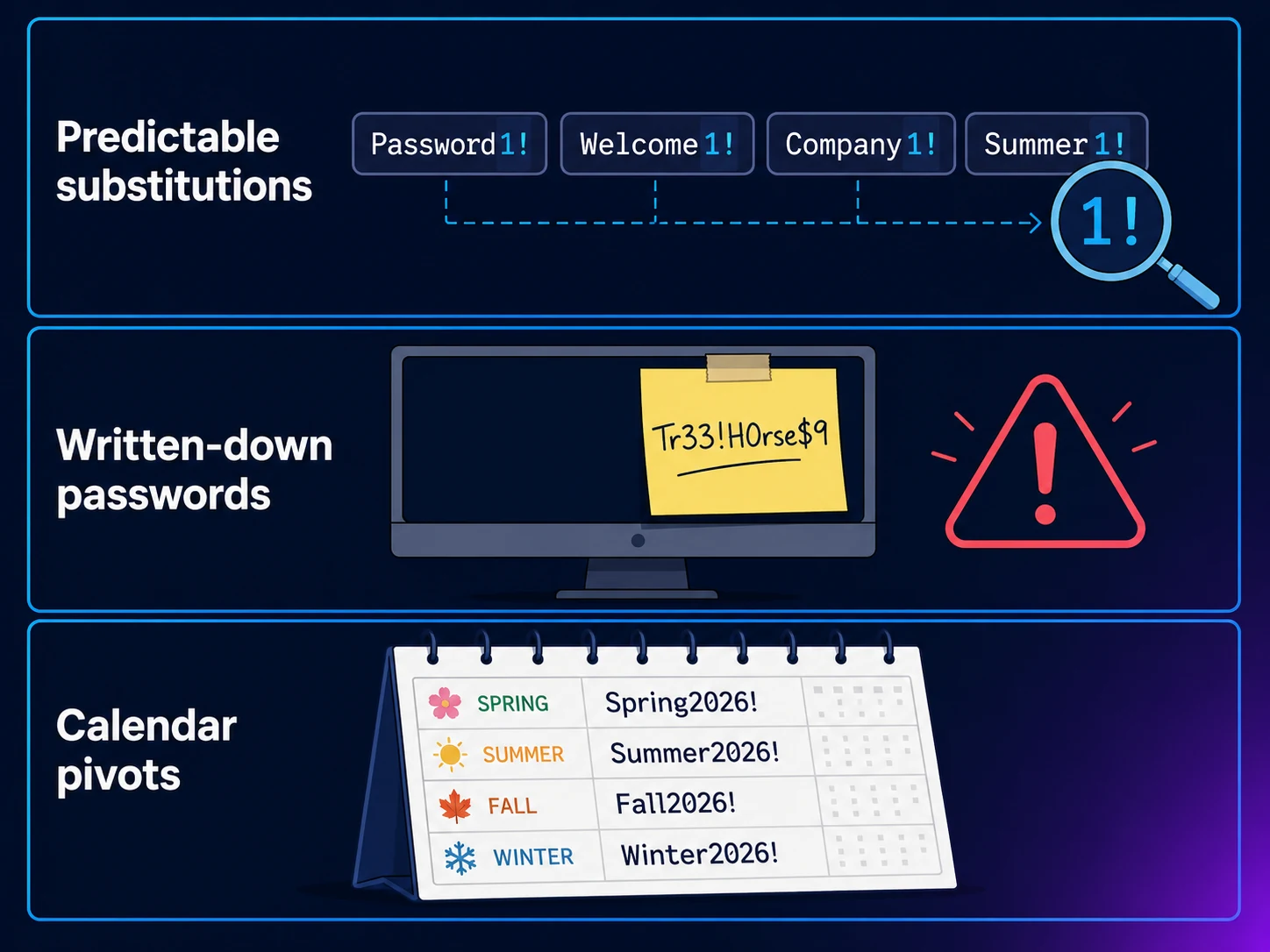 Complexity rules push every user toward the same predictable patterns. The attackers know the patterns. The compliance auditors don't ask whether the rule produced strong passwords or just compliant-looking ones.
The three failure modes of composition rules
Composition rules fail at producing strong passwords for three structural reasons that have been documented in operational research since the early 2010s.
Predictable patterns. When forced to satisfy composition rules, users adopt predictable behaviors. They capitalize the first letter (because the rule says "must contain uppercase"). They append numbers at the end (because the rule says "must contain a number"). They substitute symbols for letters in well-known ways (a→@, i→!, e→3). These patterns are well-known to attackers — the major cracking tools (Hashcat, John the Ripper) have built-in rules that generate these transformations from dictionary words automatically. A composition-compliant password that follows these patterns is effectively a dictionary password with predictable decoration.
The human factor. Composition rules produce passwords that are hard to remember, because they don't follow natural language patterns. Users respond predictably: they write the passwords down, they reuse passwords across services, they make minimal incremental changes when forced to rotate (Spring2026! becomes Spring2027!), and they generate helpdesk volume when they forget. Each of these behaviors degrades the security posture more than the composition rule improved it.
False sense of security. Composition rules give organizations a checkbox to satisfy without addressing actual password vulnerability. The audit passes because the policy enforces complexity. The credential-stuffing attack succeeds because the policy doesn't enforce breach-corpus exclusion. The compliance posture and the security posture are different things; composition rules conflate them.
The honest framing is that composition rules were a reasonable guess in 1995 when the threat model was offline brute-force attacks against captured password hashes. They are not a reasonable guess in 2026 when the threat model is online credential stuffing against billions of leaked credentials. The threat model moved; the rule didn't.
What password strength actually means
Strength in 2026 is the result of four factors integrated together, not a single rule.
Length is the single highest-leverage factor. Each additional character exponentially increases the number of possible combinations an attacker must enumerate. A 16-character password composed of lowercase letters alone is mathematically stronger than an 8-character password with mixed case, numbers, and symbols. The NIST 800-63B guidance moves the minimum from 8 to 12-14 characters in enterprise practice, with no maximum below 64. Length is the cheap mathematical win.
Uniqueness — specifically, exclusion from the public breach corpus — is the second highest-leverage factor. A password's strength is zero if it's already in the attacker's wordlist. Breach-corpus checking at credential creation time prevents the user from picking a credential that's already known. The ALIEN TXTBASE collection, HaveIBeenPwned's Pwned Passwords, and the major commercial feeds together contain billions of leaked credentials. Checking against them is operationally cheap (hash comparison, no need to share credentials with the corpus provider). The breach-corpus check is the single highest-impact addition to enterprise password policy since the 2010s.
Unpredictability — exclusion from common dictionary words, common substitution patterns, and predictable structural transforms — is the third factor. A credential firewall that rejects "Company2026!" should also reject "Company2027!" at the next rotation, because the structural transform is predictable. The policy logic for this is straightforward but needs to be enforced at runtime.
Contextual exclusion — exclusion of values that an attacker could easily guess about the user — is the fourth factor. Passwords containing the username, the company name, the user's job title, or other publicly-knowable facts about the user should be rejected. The policy logic here is contextual; the credential firewall needs to know about the user to enforce it.
These four factors integrated together produce passwords that are strong against the attacks attackers actually run. None of the four is a composition rule. The composition rule is what enterprises continue to enforce because it's been the rule for thirty years; the four strength factors are what produce actual security.
How long it takes a hacker to brute force a password in 2026
The clearest way to see why length dominates strength is to look at the actual time-to-crack for real 2026 attacker hardware against a real 2026 password hash.
Model. The numbers below assume an attacker with a 16 × NVIDIA RTX 5090 GPU rig — a realistic mid-range attacker configuration in 2026, capable of running massively parallel hash computation. The target hash is bcrypt with a work factor of 10, the mainstream defensive hash for password storage in modern web and enterprise applications. bcrypt at cost 10 is deliberately slow relative to raw hash functions like MD5 or SHA-1, so these numbers represent a defended target, not a naive one. Attackers running against faster hashes (MD5, SHA-1, unsalted stores) reach these times orders of magnitude faster.
| Length | Numbers only | Lowercase letters | Upper + lowercase | Numbers + upper + lowercase | Numbers + upper + lowercase + symbols |
|---|---|---|---|---|---|
| 4 | Instantly | Instantly | Instantly | Instantly | Instantly |
| 5 | Instantly | Instantly | 46 mins | 2 hours | 3 hours |
| 6 | Instantly | 37 mins | 2 days | 5 days | 1 week |
| 7 | Instantly | 16 hours | 3 months | 10 months | 2 years |
| 8 | Instantly | 2 weeks | 12 years | 50 years | 132 years |
| 9 | 2 hours | 1 year | 636 years | 3k years | 9k years |
| 10 | 20 hours | 32 years | 33k years | 191k years | 645k years |
| 11 | 1 week | 839 years | 1m years | 11m years | 45m years |
| 12 | 3 months | 21k years | 89m years | 737m years | 3bn years |
| 13 | 2 years | 567k years | 4bn years | 45bn years | 221bn years |
| 14 | 23 years | 14m years | 241bn years | 2tn years | 15tn years |
| 15 | 229 years | 383m years | 12tn years | 175tn years | 1qd years |
| 16 | 2k years | 9bn years | 653tn years | 10qd years | 75qd years |
| 17 | 22k years | 259bn years | 33qd years | 675qd years | 5qn years |
| 18 | 228k years | 6tn years | 1qn years | 41qn years | 372qn years |
Reading the table. Follow any column downward and watch how much faster time-to-crack grows with length than with complexity. A 12-character all-lowercase password (21,000 years) is meaningfully stronger than an 8-character all-symbols-included password (132 years). A 14-character password of any character set is functionally unbreakable against this attacker configuration. Meanwhile, the traditional composition-rule minimum — 8 characters with upper, lower, numbers, and symbols — sits at 132 years, which sounds strong until you notice that 12 characters of any composition, including lowercase-only, beats it.
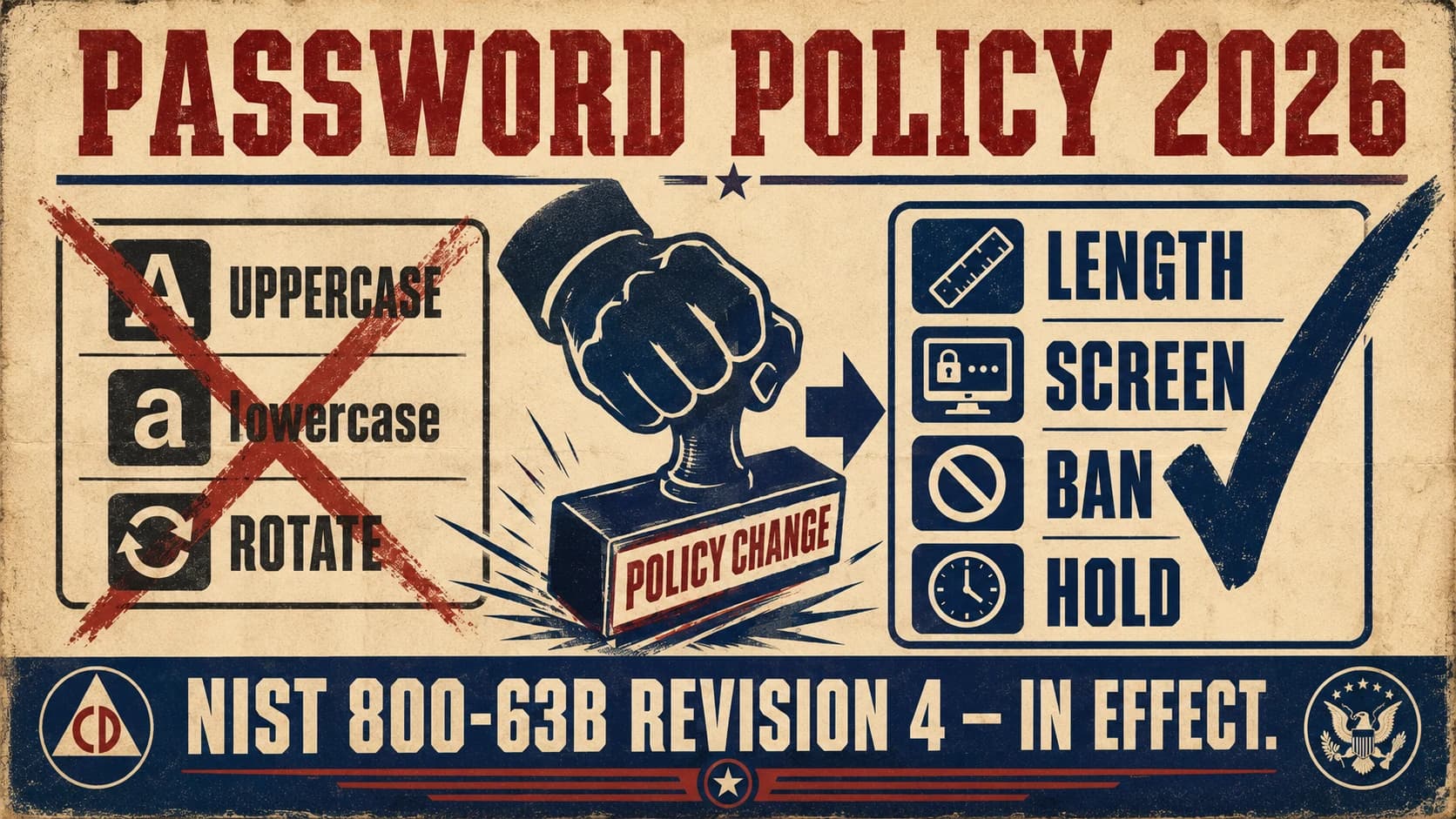
What this means for password firewall policy. The traditional 8-character composition-rule minimum is not defensible in 2026 against a well-resourced offline attacker. NIST 800-63B guidance moves the minimum from 8 to 12-14 characters for exactly this reason — length dominates the strength equation. The four strength factors above — length, uniqueness (breach-corpus exclusion), unpredictability (structural pattern exclusion), and contextual exclusion — compose into policy that produces credentials that land in the green cells of this table for realistic attacker configurations.
Caveats. Two important context notes. First, these numbers assume the attacker has the hash — meaning the credential store was already compromised at the storage layer. Runtime authentication defense (rate-limiting, credential stuffing detection, MFA) is what stops the attacker from reaching the hash in the first place; strong password policy is what stops the attacker who has the hash from cracking it. Both layers matter. Second, the numbers assume brute-force enumeration against random character combinations. Attackers with dictionary and pattern-based wordlists reach common passwords orders of magnitude faster than the raw-brute-force numbers suggest — which is why breach-corpus exclusion and structural-pattern exclusion matter as much as length. The Weak Passwords piece covers the dictionary and pattern-based attack surface in depth; the Password Policy for Enterprise Authentication piece covers the NIST 800-63B Rev. 4 policy alignment.
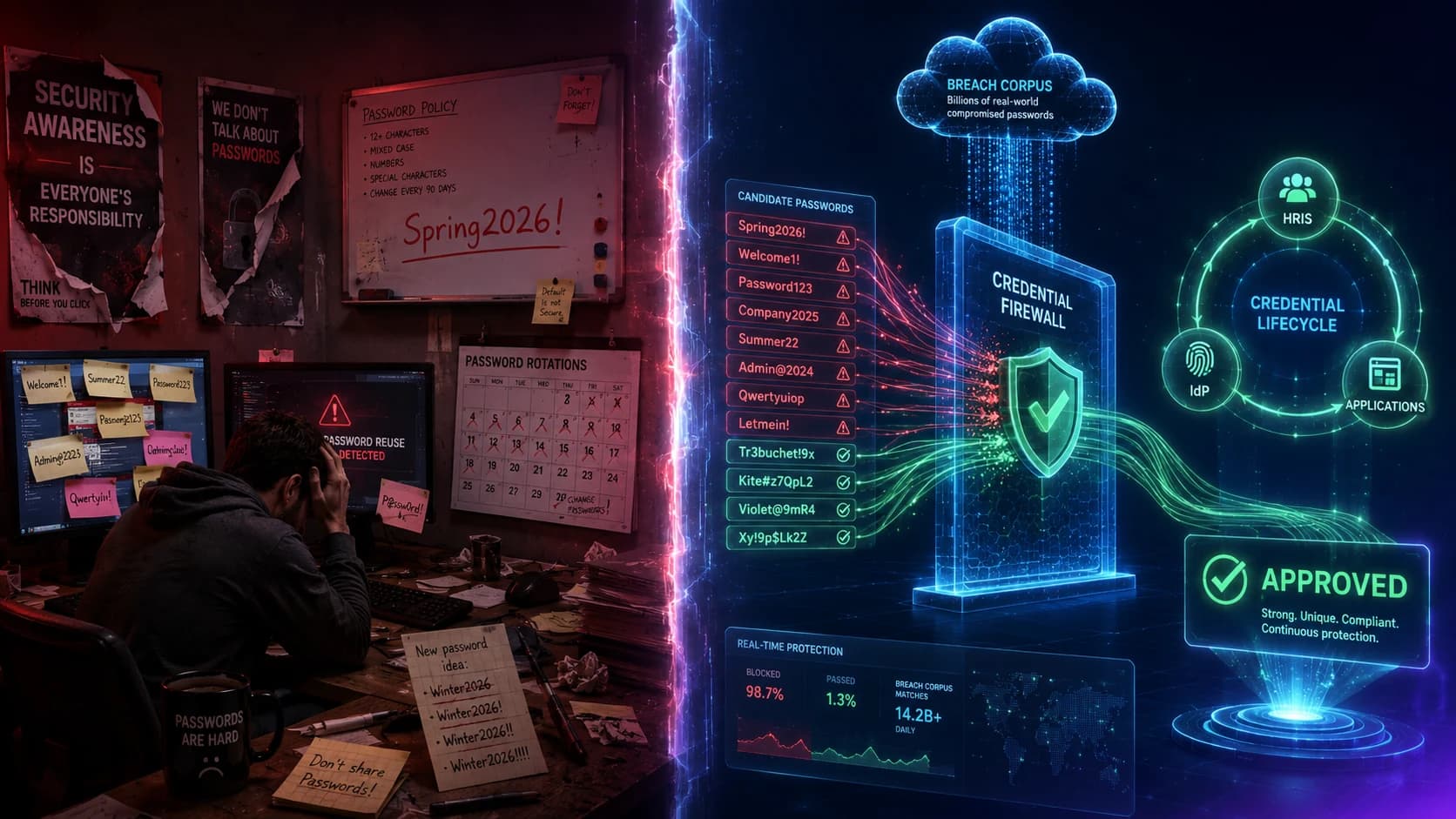
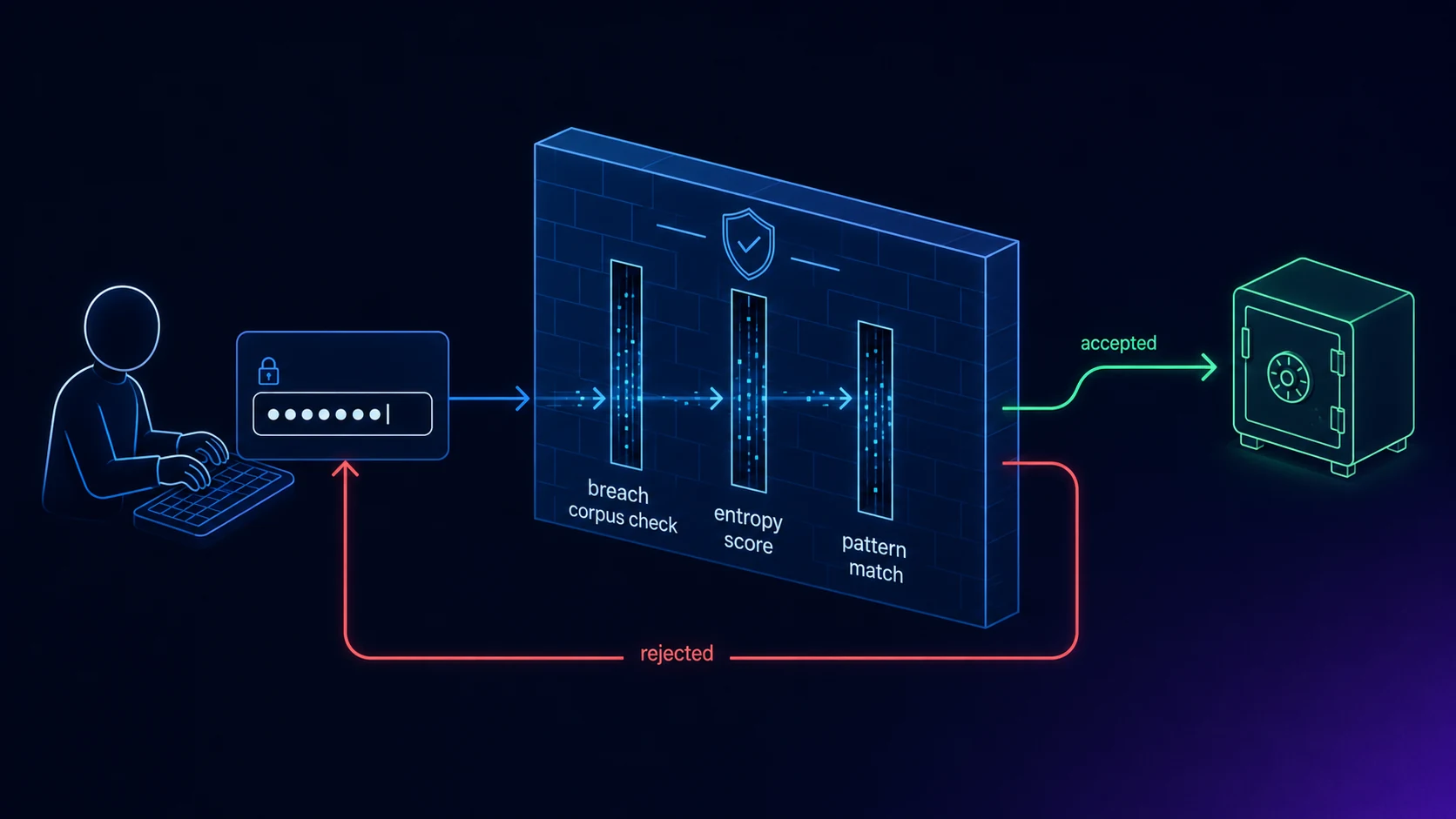 The credential firewall enforces strength at runtime — the password gets checked against breach corpora, scored for entropy, and pattern-matched before it ever reaches the identity store. Composition rules at submission time are theater; runtime enforcement is the control that actually does the work.
The credential firewall — runtime enforcement of strength
The architectural pattern that produces strong workforce passwords in 2026 is the credential firewall: a runtime control that checks every candidate password against policy at every creation point. The four strength factors above are the policy; the credential firewall is the enforcement.
The credential firewall has to be at every creation point or it doesn't work. A policy that fires at the user-facing reset page but not at the helpdesk-driven admin reset has a gap. A policy that fires at the IdP but not at a legacy application's local credential store has a gap. A policy that fires at human-driven changes but not at automation-driven provisioning has a gap. The architectural test is whether a non-compliant credential can ever reach the directory through any path; if yes, the firewall is incomplete.
The breach-corpus check is the single most impactful firewall capability. Implementations include Avatier Password Bouncer (which ships the check natively integrated with the rest of Identity Anywhere), Specops Password Policy (which integrates with Active Directory's password policy), HaveIBeenPwned's Pwned Passwords API (the largest public corpus, free for query, used by many commercial implementations under the hood), and several vendor-curated commercial feeds. The check is computationally cheap — a hashed comparison against a corpus index — and the corpus is updated frequently as new breaches are disclosed.
The companion pieces on this site cover the architectural integration. Risks of Weak Passwords covers where weak credentials actually come from in practice and the four-control architecture (firewall + lifecycle + event-triggered rotation + passwordless-for-movable-segments). Best ILM Solutions covers the lifecycle platform that integrates the firewall with HRIS-driven joiner/mover/leaver events. The strength architecture is the runtime enforcement; the lifecycle architecture is the surrounding integration that prevents the strength from decaying over time.
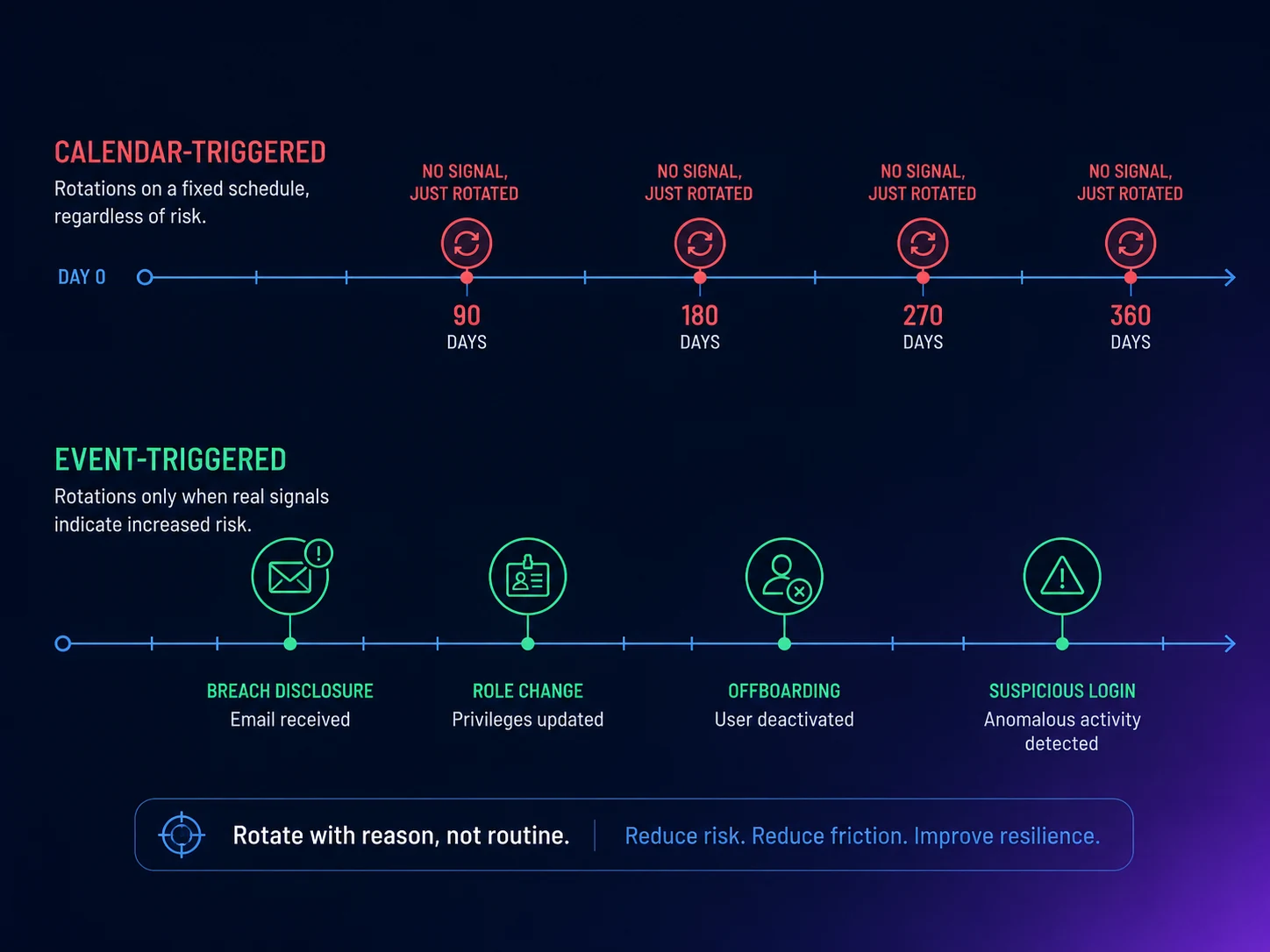 Calendar-triggered rotation rotates every account on a fixed cadence regardless of risk signal. Event-triggered rotation rotates the affected accounts when something actually changed. The first is theater; the second is the control that survives audit scrutiny.
Event-triggered rotation replaces calendar-triggered rotation
The 2026 rotation pattern is event-triggered, not calendar-triggered. The events that trigger rotation include credential appearance in a new breach corpus, anomalous account activity (impossible-travel sign-ins, unusual application access, high-volume failed-auth attempts), explicit security incidents on related accounts, role changes that cross privilege boundaries, and offboarding for any shared credentials the departing user had access to.
The shift away from forced 90-day rotation is one of NIST 800-63B's most consequential recommendations and one of the most resisted in enterprise practice. The operational evidence over a decade is unambiguous: forced rotation produces incremental changes that are weaker than the original credential, increases helpdesk volume, and does not measurably reduce breach incidence. Event-triggered rotation captures the actual risk events without the human-overhead cost.
The implementation requires continuous monitoring of the credential surface for the trigger events — breach-corpus subscriptions for the leaked-credential trigger, anomaly detection on the identity-event stream for the suspicious-activity trigger, integration with the lifecycle platform for the role-change and offboarding triggers. Avatier ships the integration in Identity Anywhere; the architectural pattern works regardless of vendor.
The communication change matters as much as the technical change. Employees who have been told for a decade that they need to rotate every 90 days will not believe overnight that the rule has changed. Pair the policy update with clear messaging about what does trigger rotation (breach exposure, anomalous activity, role change, offboarding) and what does not (the calendar). The transition takes a quarter or two to settle; the helpdesk-volume reduction is immediate.
What this looks like for an enterprise architect
The implementation sequence that works for an enterprise upgrading password policy in 2026 is concrete and bounded.
Step 1: Audit every credential creation point. Document the paths a credential can enter the directory — user self-service reset, administrative reset by helpdesk, API-driven provisioning, HRIS onboarding, CI/CD service-account creation, password import/migration. The audit alone usually surfaces three or four gaps an enterprise didn't know about — typically a legacy application with its own credential store, a CI/CD pipeline that provisions service accounts directly, or an HR import workflow that sets initial passwords without firewall enforcement.
Step 2: Deploy the credential firewall at every creation point. Close the gaps surfaced in the audit. The firewall has to fire at every path; otherwise non-compliant credentials slip through. This is where most enterprise deployments either succeed or partial-fail — partial deployments produce a false sense of security worse than no deployment.
Step 3: Subscribe to the breach corpus and enable the leaked-credential check. Hash-based comparison against the corpus is computationally cheap and the data feeds are operationally affordable. The check should fire at every credential creation point — user reset, admin reset, API-driven provisioning. The breach corpus is the single highest-impact addition.
Step 4: Integrate with the joiner/mover/leaver lifecycle. The HRIS source-of-truth integration is the operational core; without it, lifecycle events don't propagate to the credential infrastructure and stale credentials accumulate. Joiner → credential through firewall. Mover at privilege-boundary crossing → forced credential rotation through firewall. Leaver → revoke all credentials including service-account credentials the departing employee created.
Step 5: Switch from calendar rotation to event-triggered rotation. Update the policy, communicate the change to the workforce, and monitor the helpdesk-volume reduction. The four trigger events are breach exposure, anomalous activity, role change, and offboarding — all of which represent actual risk; the calendar does not.
Step 6: Identify segments that can move to passwordless. The remaining password surface gets the firewall; the segments that move to passwordless (typically desk workers on managed laptops and privileged accounts) reduce the password surface entirely. The companion Best Passwordless Solutions guide covers the workforce-segmented framing.
What Avatier ships toward this pattern
Avatier Password Bouncer enforces the credential firewall at every creation point — user self-service, administrative reset, API-driven provisioning, password import, programmatic rotation. The breach-corpus check fires at every creation point with hash-based comparison against the ALIEN TXTBASE collection, HaveIBeenPwned Pwned Passwords, and commercial feeds. The previous-credential and structural-transform checks fire on every reset, so "Spring2026!" → "Spring2027!" gets rejected.
Avatier Identity Anywhere Lifecycle Management integrates the firewall with HRIS-driven joiner/mover/leaver events. New hire in Workday/SuccessFactors/UKG → IdP creates account → user receives enrollment link → user picks a credential that passes through the firewall before being stored. Role change at privilege-boundary crossing → forced credential rotation through firewall. Termination → all credentials revoked within minutes, including service-account credentials the departing employee created.
Avatier Identity Anywhere Compliance Auditor handles event-triggered rotation. Breach-corpus subscription for the leaked-credential trigger. Identity-event-stream anomaly detection for the suspicious-activity trigger. Lifecycle-platform integration for the role-change and offboarding triggers. The auditor publishes the events the rest of the platform consumes.
The Avatier Trust Center publishes the compliance posture (SOC 2 Type II zero exceptions, ISO/IEC 27001:2022, PCI DSS v4.0.1, CSA STAR Level 1, NIST 800-53 Rev. 5 aligned, CISA Secure-by-Design Pledge signatory). The architectural pattern works regardless of vendor; the integrated platform pattern is what makes the layers cooperate.
The honest closing
Composition-based complexity rules are the password policy your enterprise wrote in 1995 and never updated. They optimize for the wrong target. They produce predictable patterns that fill the breach corpora. They create helpdesk burden and false security. They are not what NIST, NCSC, or the FIDO Alliance recommends in 2026.
The strength architecture is what produces actual security: long passwords with breach-corpus exclusion enforced at every creation point, lifecycle-integrated rotation triggered by events rather than the calendar, and the integration surface that makes the rest of the password governance stack work. The enterprises that adopt this architecture will not be the ones whose 2027 breach reports cite "compromised credentials" as the initial-access vector.
The architecture is the fix. The complexity-rule policy was never going to do the job.
ABOUT THE AUTHOR

More from Pillar 1: Password Firewall

Password Aging Policies in 2026: What NIST Actually Says
Mandatory password rotation on a fixed calendar is no longer best practice — NIST SP 800-63B favors length and breach screening over forced expiration, and here's what to do instead.
Weak Passwords in 2026: Architecture, Not Awareness
Why weak passwords persist in 2026 despite decades of training — and the policy-enforcement, credential-firewall, and lifecycle controls that eliminate them at scale.
Password Policy for Enterprise Authentication 2026: The NIST 800-63B Rev. 4 Reference
The password policy that actually reduces risk is not the password policy most enterprises still enforce. NIST 800-63B Rev. 4 (finalized 2025) dismantles the composition rules and periodic-reset mandates that defined the 2000s and codifies a fundamentally different discipline — length over complexity, breach-corpus screening, banned-list enforcement, no forced periodic rotation. The 2026 enterprise reference on the modern password policy, the AAL1/2/3 assurance-level mapping, the enforcement architecture that operationalizes it, and the migration path from the legacy policy every enterprise still carries.