Blockchain-Based IAM for the Enterprise: What's Real, What's Hype, and What to Deploy in 2026
A decade after the first blockchain identity white papers, the technology has sorted itself into two piles: a small set of patterns that genuinely work — verifiable credentials, decentralized identifiers, and wallet-based identity now backed by the EU's eIDAS 2.0 mandate — and a large pile of abandoned projects that tried to put identity itself on a chain. The 2026 enterprise reference on where blockchain-based IAM delivers (portable workforce credentials, reusable verification, cross-organization trust), where it never will (replacing your directory, lifecycle, or governance), and the architecture pattern that connects decentralized credentials to centralized accountability.
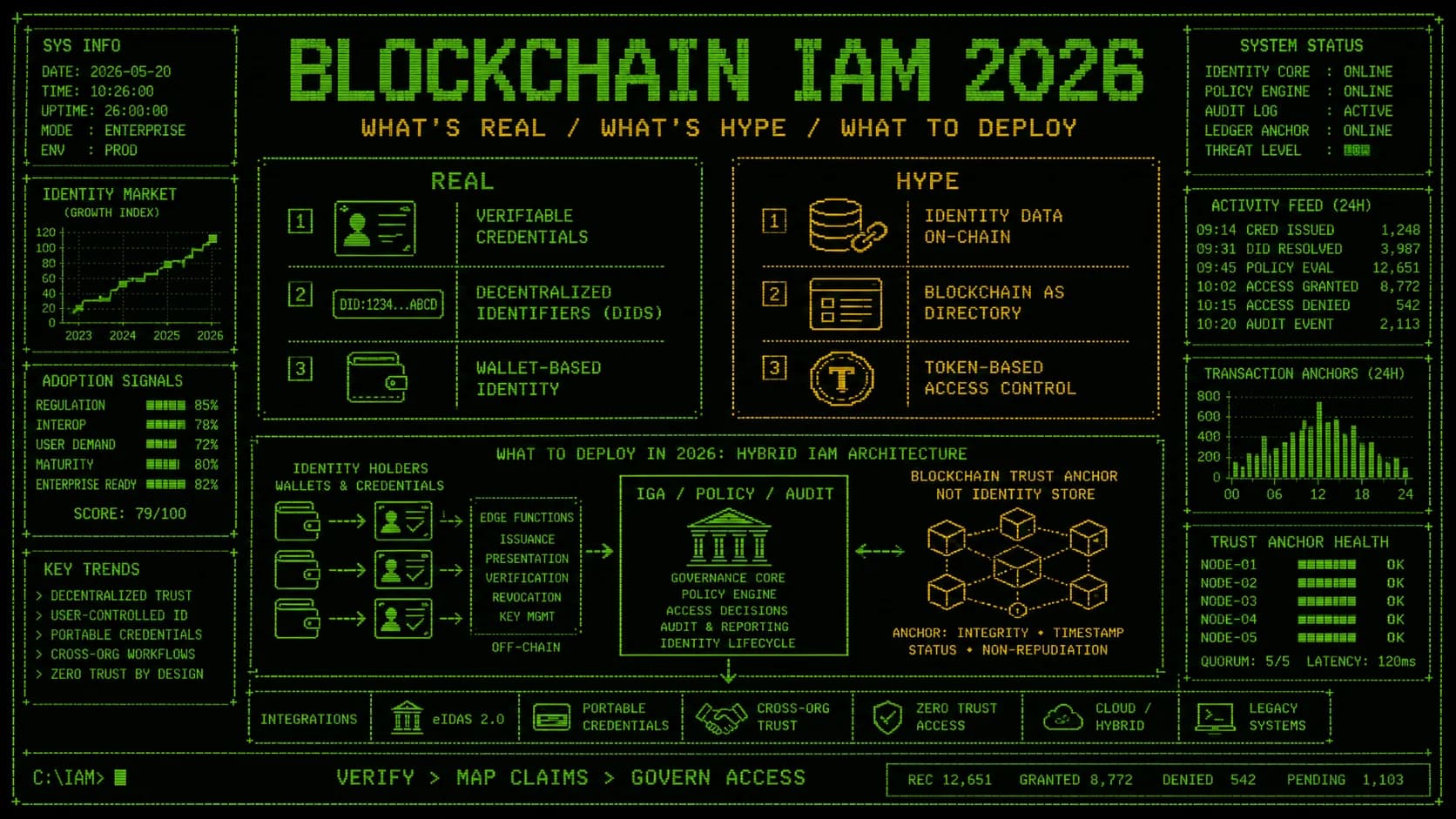
A decade after the first blockchain identity white papers, the technology has sorted itself into two piles: a small set of patterns that genuinely work — verifiable credentials, decentralized identifiers, and wallet-based identity now backed by the EU's eIDAS 2.0 mandate — and a large pile of abandoned projects that tried to put identity itself on a chain. The 2026 enterprise reference on where blockchain-based IAM delivers (portable workforce credentials, reusable verification, cross-organization trust), where it never will (replacing your directory, lifecycle, or governance), and the architecture pattern that connects decentralized credentials to centralized accountability.
- Blockchain-based IAM in 2026 has resolved into a clear split. What works: W3C Verifiable Credentials and Decentralized Identifiers — cryptographically signed, user-held, selectively disclosable credentials, with blockchain (where used at all) anchoring only issuer public keys and revocation registries. What failed: putting identity data on-chain, replacing directories with ledgers, and using tokens as access control. No personal data belongs on an immutable ledger — GDPR's right to erasure alone makes that architecture non-viable.
- Regulation, not crypto enthusiasm, is driving the 2026 momentum. The EU's eIDAS 2.0 regulation mandates that member states offer citizens a European Digital Identity Wallet, and requires very large platforms and key regulated sectors to accept it — putting wallet-based, verifiable-credential identity on the compliance roadmap of any enterprise operating in Europe, whether or not the word blockchain ever appears in the architecture.
- Three enterprise use cases have real traction: portable workforce credentials (verified skills, certifications, and employment history that survive employer changes and compress onboarding verification from days to minutes), reusable identity verification (KYC/background verification performed once and presented many times, cutting per-onboarding verification cost), and cross-organization trust (contractors, supply-chain partners, and M&A populations presenting verifiable credentials from their home organization without point-to-point federation agreements).
- What blockchain-based identity does not replace: your directory, your lifecycle engine, your entitlement catalog, your certification campaigns, or your audit trail. A verifiable credential proves who someone is and what they've earned; it says nothing about what they should access in your environment. Entitlements, least privilege, joiner-mover-leaver automation, and access review remain centralized governance functions — the decentralized layer feeds them better evidence, faster.
- The deployable 2026 architecture is hybrid: decentralized credentials at the edges (verification, onboarding, cross-organization trust), centralized IGA at the core (lifecycle, entitlements, certification, audit). Treat VC acceptance like any other authentication-evidence integration — verify issuer trust, map credential claims to identity attributes, and route everything through the same policy engine and audit trail that govern the rest of the workforce.
A decade after the first blockchain identity white papers promised to decentralize everything, the technology has finally sorted itself into two piles.
In the first pile: a small set of patterns that genuinely work and are quietly being mandated into existence — verifiable credentials, decentralized identifiers, and wallet-based identity, now carried by the EU's eIDAS 2.0 regulation rather than by crypto enthusiasm.
In the second pile: the abandoned projects. Identity data written to chains it could never be erased from. Ledgers pitched as directory replacements. Tokens standing in for access control. Every one of them foundered on the same rocks — privacy law, operational reality, and the stubborn fact that governance requires an accountable party.
If you're evaluating blockchain-based IAM for your enterprise in 2026, the job is telling those piles apart. This is the reference for doing that.
What actually survived: the verifiable credential stack
Strip away the ideology, and the durable output of the decentralized identity movement is a three-part standards stack:
Verifiable Credentials (W3C VC). A cryptographically signed data structure: an issuer attests to claims about a subject — this person holds this license, completed this training, passed this background check — and the holder stores it in a wallet and presents it to verifiers. Two properties make VCs enterprise-relevant: they verify offline against the issuer's public key (no phone-home to the issuer per verification), and they support selective disclosure — proving a claim without revealing the document, age without birthdate, employment without salary.
Decentralized Identifiers (DIDs). Globally unique identifiers resolvable to a document containing public keys and service endpoints — the addressing layer that lets issuers, holders, and verifiers find each other's cryptographic material without a central registry.
The trust anchor — where blockchain actually lives. Here's the correction from the original vision: in every serious 2026 implementation, the ledger holds only issuer public keys, DID documents, and revocation registries. No credentials. No personal data. Nothing subject to GDPR's right to erasure, because an immutable ledger and erasable personal data are architecturally irreconcilable. Some deployments use permissioned ledgers; a growing number use non-blockchain anchors entirely (well-governed key directories) and lose nothing that matters. Blockchain, it turns out, was never the point — portable, cryptographically verifiable, user-held credentials were.
Why 2026 is the inflection: regulation, not enthusiasm
The reason blockchain-based IAM is back on enterprise roadmaps is a compliance clock, not a technology cycle.
The EU's eIDAS 2.0 regulation requires member states to offer citizens a European Digital Identity Wallet (EUDI Wallet) — a government-backed container for verifiable credentials covering identity, licenses, diplomas, and payments authorization — and obligates very large online platforms and key regulated sectors (banking, telecom, and others) to accept it. That's forced bilateral adoption: supply mandated on the government side, acceptance mandated on the enterprise side.
For any enterprise operating in Europe, wallet-based credential acceptance is therefore arriving on a regulatory schedule regardless of anyone's opinion about distributed ledgers. And the architecture the mandate standardizes — VCs, wallets, OpenID for Verifiable Credentials as the presentation protocol — is the same stack the workforce use cases below are built on. Enterprises that build the acceptance capability once get both the compliance obligation and the operational upside.
Parallel, quieter adoption is running in education (digital diplomas as VCs), healthcare (clinician license portability), and financial services (KYC reuse) — sector-by-sector, the way SAML federation spread twenty years ago.
The three enterprise use cases with real traction
1. Portable workforce credentials. Professional licenses, safety certifications, clearance attestations, and completed training issued as VCs that follow the worker across employers. Onboarding verification that takes days of phone calls and document requests compresses to minutes when the credential arrives as a VC verified against the issuing authority's key. Highest-value populations: clinical staff (license verification per facility), contractors in regulated industries (safety and compliance certs), and any role where credential fraud is a real risk. The lifecycle event that begins employment gets faster and better-evidenced — which your auditors will appreciate as much as your recruiters (HRIS-Driven Identity Lifecycle piece).
2. Reusable identity verification. Identity proofing and background verification performed once by a qualified issuer, held by the individual, presented many times. Every re-verification your onboarding process performs today is cost and friction that a presented VC eliminates. The verification-provider market is consolidating around exactly this model — verify once, issue a credential, monetize the reuse.
3. Cross-organization trust without federation agreements. The classic hard problem: contractors, supply-chain partners, joint ventures, and M&A populations who need access before (or without) a point-to-point federation agreement between identity systems. VCs invert the model — the partner organization issues credentials attesting to its workers' status; your systems verify them against the partner's published keys; nobody builds a bilateral trust integration per relationship. For enterprises managing dozens of partner populations, this is the difference between a scaling pattern and a project queue.
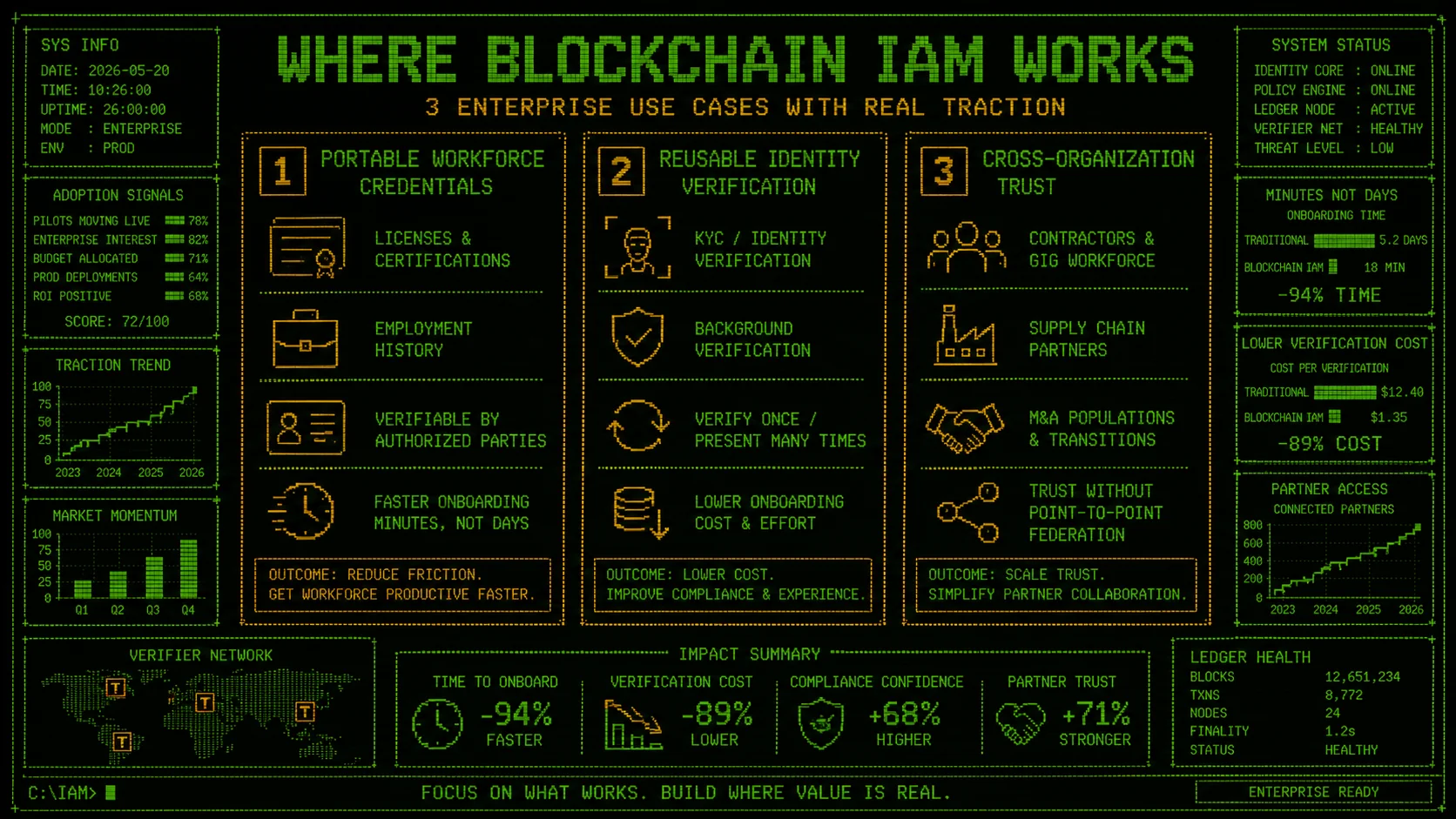 The three use cases with real traction — focus on what works, build where the value is real.
What failed — and why it will keep failing
Name the anti-patterns explicitly, because they still appear in vendor decks:
- Identity data on-chain. Irreconcilable with erasure rights, breach containment, and common sense. Any pitch involving personal data on an immutable ledger ends the meeting.
- The ledger as directory. Directories are high-write, low-latency, access-controlled, and constantly corrected. Ledgers are none of these. The mainframe-era directory you're modernizing (Legacy IAM Modernization Playbook) is a better identity store than any chain.
- Tokens as access control. Possession of a token is not an entitlement decision. Access control requires policy evaluated against current context — role, risk, device state, time — and revocable in one step. Bearer-asset models fail every one of those tests.
- Blockchain infrastructure as a relying-party requirement. Any architecture that requires your partners to run nodes has confused the anchor with the product. Verification requires the issuer's public key — not ledger participation.
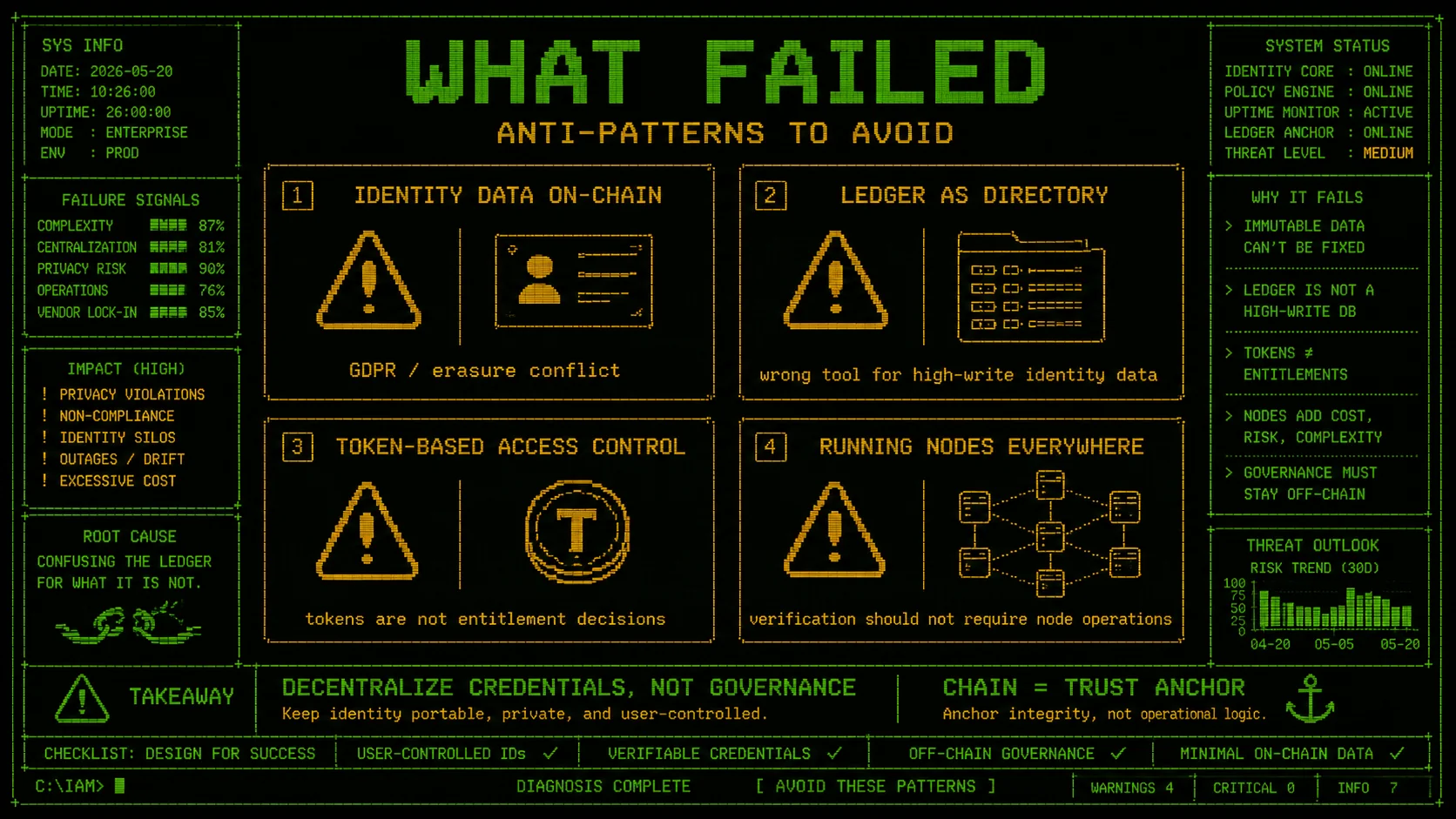 The four anti-patterns that killed the first generation of blockchain identity projects — decentralize credentials, not governance.
The through-line: decentralization is valuable at the credential layer and destructive at the governance layer. Which sets up the architecture that actually deploys.
The hybrid architecture: decentralized edges, governed core
The deployable 2026 pattern connects the two layers cleanly:
At the edges — decentralized credentials as evidence. Wallet-presented VCs flow in through OpenID for Verifiable Credentials at the onboarding and verification touchpoints: joiner proofing, contractor onboarding, license re-verification, partner access requests. Each presentation is verified (issuer signature, revocation status, holder binding) and translated into identity attributes in your identity platform.
At the core — centralized governance, unchanged in authority. Those attributes feed the same machinery that governs everyone else: entitlements resolved through the same policy engine at least privilege (Principle of Least Privilege piece), lifecycle events through the same joiner-mover-leaver automation, access packing into the same certification campaigns (AI Access Certification piece), every decision into the same audit trail, with posture and threat layers watching the whole surface (ISPM piece, ITDR piece).
The design rule: a verifiable credential answers who is this and what have they earned. Your governance platform answers what may they do here, and can we prove control. Neither layer substitutes for the other; the integration is an evidence pipe, not a hand-off of authority.
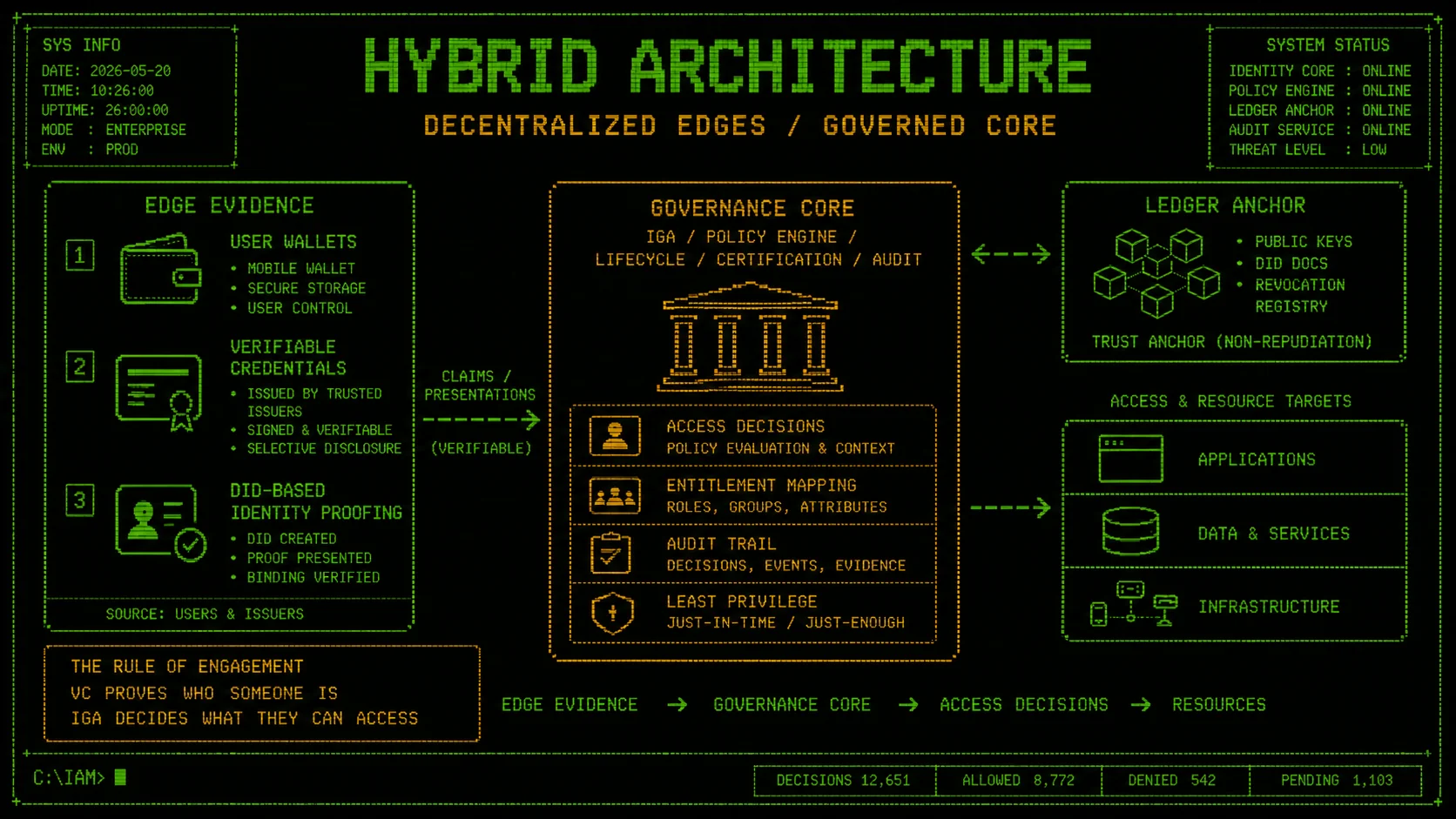 Decentralized edges, governed core — evidence flows in from wallets and credentials; access decisions, lifecycle, certification, and audit stay centralized. Authentication strength is likewise unaffected — workforce login remains phishing-resistant FIDO2 across every segment, including deviceless coverage for frontline populations (Cross-Platform Identity Management piece).
A pragmatic 2026 adoption sequence
- Map your exposure. EU operations or EU-regulated customers → eIDAS 2.0 acceptance goes on the compliance roadmap with a real date. No EU exposure → your driver is operational (verification cost), which sets a higher ROI bar and a slower clock.
- Find the verification pain. Where does identity proofing cost real money or days today? Contractor onboarding, clinical credentialing, seasonal-workforce spikes, and partner access are the usual suspects. That's the pilot.
- Pilot acceptance, not issuance. Accepting VCs into your existing identity platform is a small integration with immediate payback. Becoming an issuer (of employment credentials, for instance) is a heavier lift with ecosystem dependencies — sequence it second.
- Hold the governance line. Every decentralized-identity integration routes through the existing policy engine, lifecycle, certification, and audit trail. The moment a vendor proposes bypassing them, you've found pile two.
- Buy on standards. W3C VC, DIDs, OpenID for Verifiable Credentials, eIDAS 2.0 conformance. Ledger choice is an implementation detail — treat any pitch that leads with the chain instead of the standards as a signal (Selecting an Identity Vendor piece).
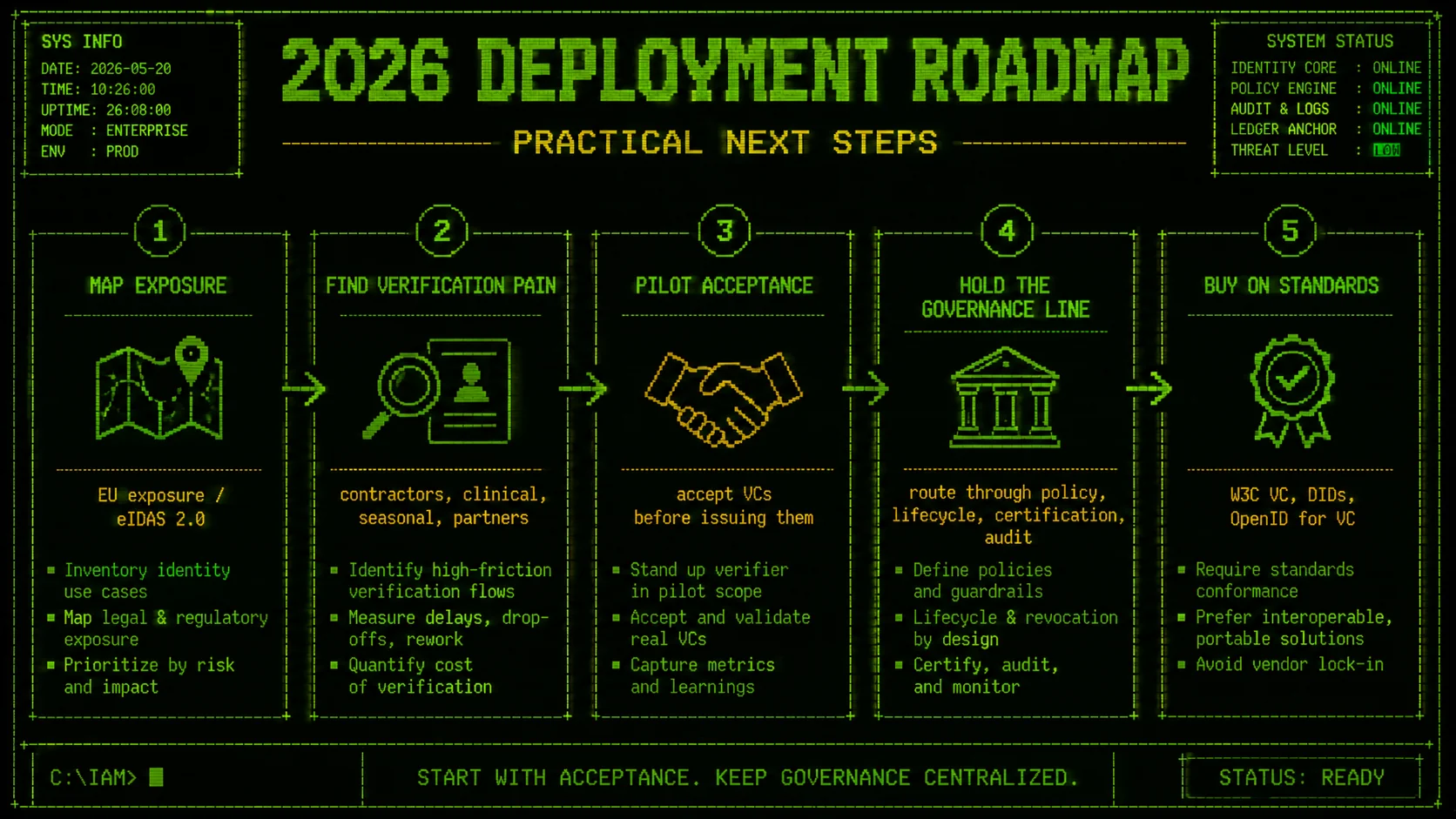 The five-step adoption sequence — start with acceptance, keep governance centralized.
The honest bottom line
Blockchain-based IAM spent a decade overpromising, and the correction was healthy: the chain retreated to a supporting role, and the genuinely valuable idea — portable, verifiable, user-held credentials — matured into standards now being mandated into the European economy and adopted sector-by-sector everywhere else.
For the enterprise, the 2026 posture is neither dismissal nor reinvention. It's a bounded integration: accept verifiable credentials where verification is expensive today, prepare for wallet acceptance where regulation requires it tomorrow, and keep lifecycle, entitlements, certification, and audit exactly where accountability lives — in a governed identity platform that treats the decentralized layer as what it actually is: better evidence, arriving faster, from more places.
ABOUT THE AUTHOR

More from IAM & Identity Governance

Identity Management and Digital Transformation in 2026
Every major transformation initiative — cloud migration, remote and hybrid work, mergers and acquisitions — eventually stalls on the same question: who gets access to what, and who decided? The 2026 strategy reference on identity management as the enabler and the bottleneck of digital transformation, the business case executives actually fund, and what modernization does not fix.

AI and Behavioral Analytics for Identity Monitoring: The 2026 Enterprise Reference
Static identity rules catch the attacks that announce themselves. They miss the ones that log in with valid credentials and behave almost normally. The 2026 reference on AI-driven identity monitoring — what behavioral analytics actually detects, the four telemetry sources that make or break the model, the false-positive economics nobody budgets for, and the honest limits of anomaly detection at enterprise scale.
Security Team Collaboration: A 2026 Framework for Identity Programs
Identity governance fails when it runs as a security-team-only initiative. The 2026 framework for cross-functional collaboration: four stakeholder groups, three coordination models, and how zero trust makes it a shared discipline.