Login Reset Licensing Models: The 2026 Enterprise Cost Structure Reference
Enterprise password reset licensing has three fundamentally different pricing models — per-user subscription, per-reset-event consumption, and modular capability-based licensing — and the fit between model and buyer profile determines whether TCO tracks the vendor's list-price projection or surprises 18-24 months into deployment. The 2026 enterprise reference on the three licensing models, the specific line items that drive cost variance, and the buyer discipline that produces defensible reset-workflow vendor selection.
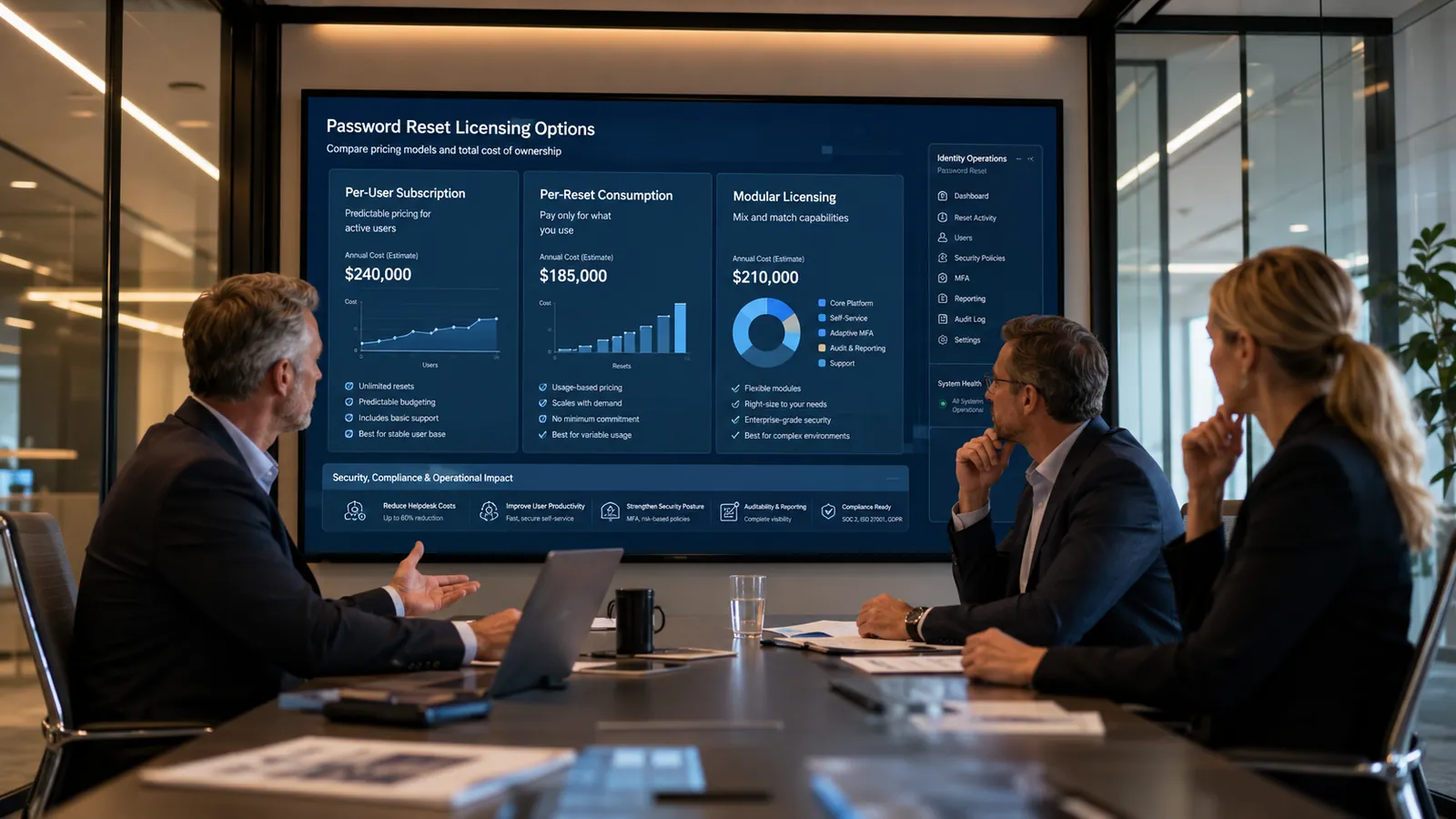
Enterprise password reset licensing has three fundamentally different pricing models — per-user subscription, per-reset-event consumption, and modular capability-based licensing — and the fit between model and buyer profile determines whether TCO tracks the vendor's list-price projection or surprises 18-24 months into deployment. The 2026 enterprise reference on the three licensing models, the specific line items that drive cost variance, and the buyer discipline that produces defensible reset-workflow vendor selection.
- Enterprise password reset licensing has three fundamentally different pricing models. Per-user subscription — flat per-employee per-month or per-year covering SSPR portal + reset workflow. Per-reset-event consumption — charges by reset transaction volume with base infrastructure included. Modular capability-based — base platform priced separately from add-on modules for pre-login reset, deviceless FIDO2, audit-trail integration, and specific connectors. Each model optimizes for different buyer profiles and workforce compositions.
- Six specific line items drive TCO variance across all three models. SSPR portal for logged-in users. Pre-login reset via Windows CredentialProvider for domain-joined workstations. Deviceless FIDO2 for smartphone-unavailable workforce segments. Audit-trail integration with the enterprise IAM audit-log infrastructure. Connector library depth for legacy environments (RACF, iSeries, mainframe). Composition with the broader IAM platform for lifecycle and governance integration.
- The per-user subscription model dominates SaaS-delivered reset infrastructure for stable enterprise workforces. Pricing transparency is high; TCO predictability is good; the trap is per-user pricing that doesn't include the pre-login CredentialProvider (leaving domain-joined workstation cases uncovered) or the deviceless FIDO2 module (leaving frontline segments uncovered). Well-scoped per-user contracts include the full workforce-segment coverage.
- The per-reset-event consumption model suits variable-volume enterprises — retail with seasonal workforces, healthcare with rotating staff, contact centers with high turnover. Reset events map cleanly to workforce size × workforce turnover × password policy complexity. The trap is under-forecasting volume, which produces cost surprises when actual reset volume exceeds contracted volume.
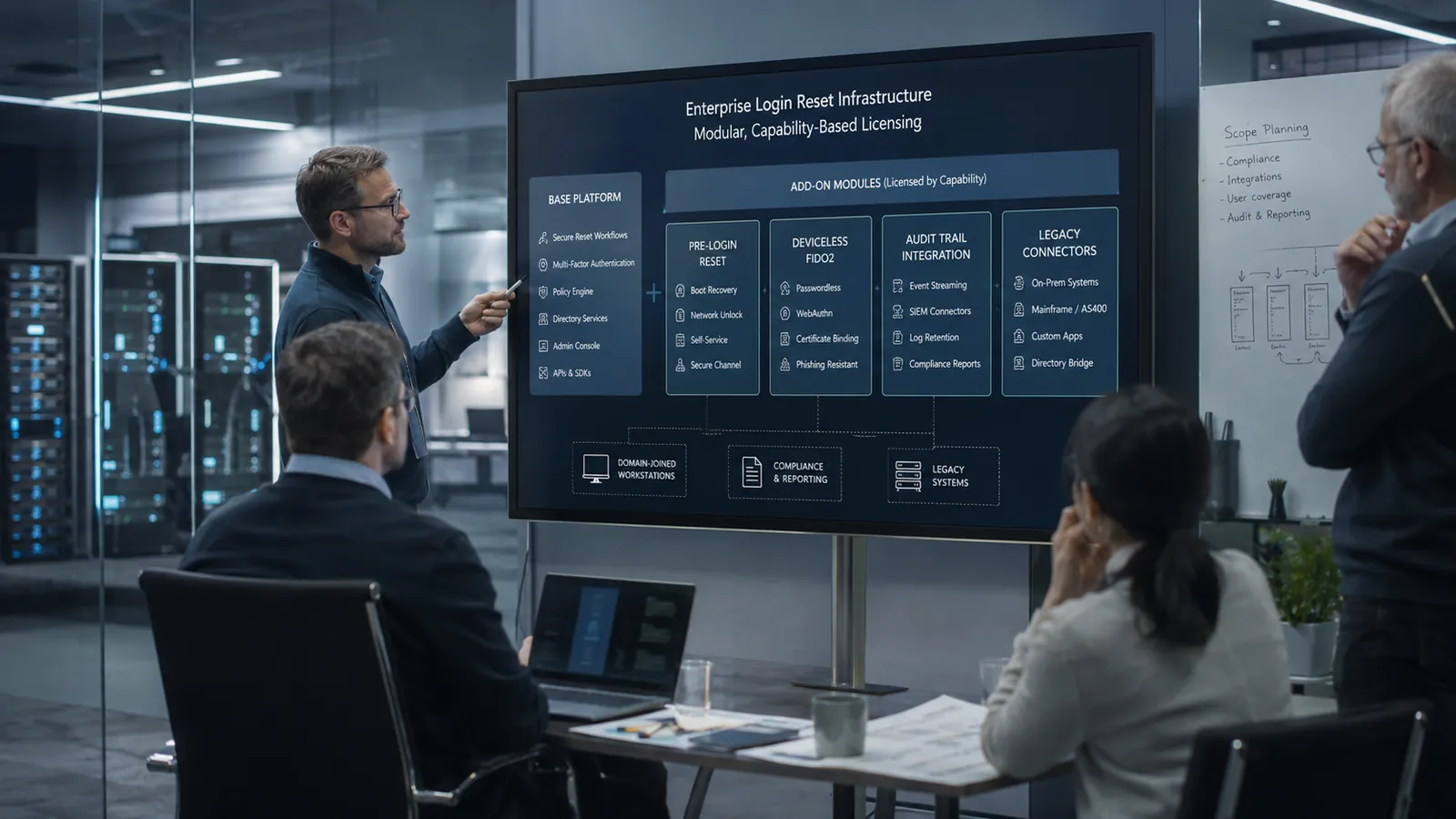
- The modular capability-based model produces the largest TCO variance because base platform pricing is often modest, and add-on module pricing for pre-login, deviceless FIDO2, industry-specific compliance, and specialized connectors accumulates meaningfully at scale. Well-scoped contracts include the full module set anticipated across the deployment horizon; deployments that add modules over 18-24 months produce the cost-surprise pattern covered in the [SailPoint vs Avatier Pricing Comparison piece](/en/blog/sailpoint-vs-avatier-pricing-comparison-2026/).
Enterprise password reset infrastructure is licensed under three fundamentally different pricing models — per-user subscription, per-reset-event consumption, and modular capability-based — and the fit between model and buyer profile determines whether three-year TCO tracks the vendor's list-price projection or surprises 18-24 months into deployment. The licensing model comparison is not a "cheaper vs more expensive" comparison; it's a "which model matches your specific workforce and deployment profile" comparison. Understanding the structural differences is what makes reset-workflow vendor selection defensible under CFO scrutiny.
This piece is the 2026 enterprise reference on password reset licensing models. The three pricing philosophies, the six line items that drive TCO variance, the buyer discipline that produces defensible vendor selection, and the composition with the broader IAM platform that determines whether reset infrastructure is folded into base licensing or sold as separate premium modules. Companion pieces cover adjacent layers — the Password Reset Comprehensive Guide piece covers the four workflow architectures at the reset-workflow level; the SSPR Enterprise Deployment piece covers SSPR deployment discipline; the Enterprise IAM Cost Comparison piece covers the five-driver TCO frame that reset licensing operates within.
The three licensing models
Enterprise password reset infrastructure is licensed under three dominant pricing models in 2026. Each optimizes for different buyer profiles.
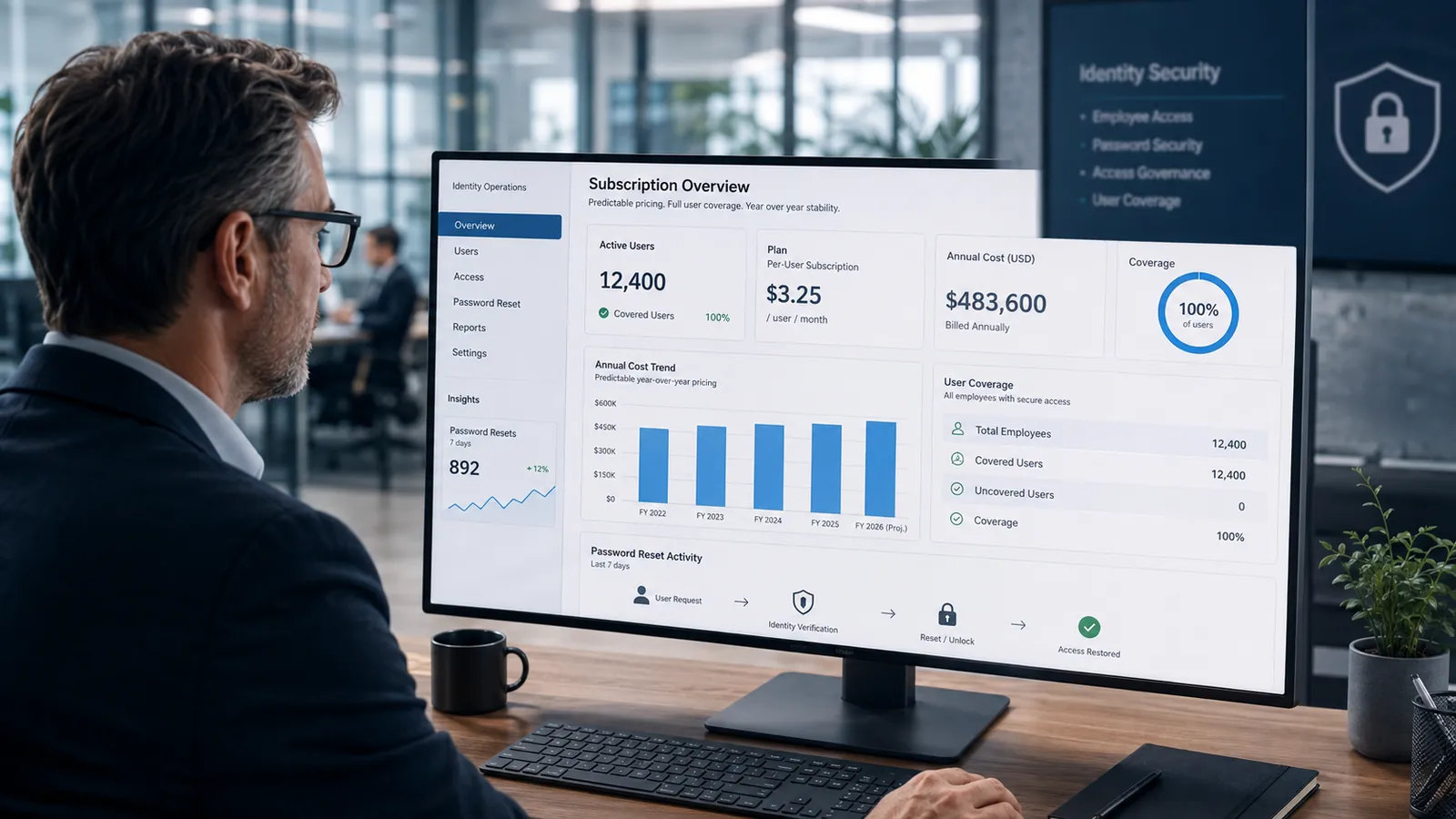
Model 1: Per-user subscription. Flat per-employee per-month or per-year covering SSPR portal + reset workflow + basic audit trail. Typical pricing range: $10-$40 per employee per year for reset-specific licensing. SaaS-delivered vendors dominate this model.
Best fit: enterprises with stable workforces, predictable growth trajectories, and moderate reset volume that scales linearly with workforce size. Buyers who value pricing predictability and no volume-based invoicing surprises.
Common trap: per-user pricing that includes SSPR portal but doesn't include pre-login CredentialProvider (leaving domain-joined workstation cases uncovered) or the deviceless FIDO2 module (leaving smartphone-unavailable frontline segments uncovered). The base subscription looks affordable; the deployment leaves ~30-40% of the workforce without functional reset coverage. Well-scoped per-user contracts include the full workforce-segment coverage.
Model 2: Per-reset-event consumption. Charges by reset transaction volume with base infrastructure included. Common pricing structure: base platform fee + per-reset charge, with tiered pricing at volume thresholds. Reset volume maps cleanly to workforce size × workforce turnover × password policy complexity.
Best fit: variable-volume enterprises — retail with seasonal workforces, healthcare with rotating staff, contact centers with high turnover, financial services with contractor-heavy workforces. Volume-based pricing produces TCO that tracks actual reset activity rather than paying a flat fee independent of usage.
Common trap: under-forecasting volume. Enterprises that anticipate 1,500 reset events annually but produce 3,500 (poor password policy, complex credential silos, seasonal workforce spikes) see meaningful cost surprises when actual reset volume exceeds contracted volume. Consumption pricing rewards accurate forecasting.
Model 3: Modular capability-based. Base platform priced separately from add-on modules. Typical module structure: base platform (SSPR portal + basic reset workflow) + pre-login reset module + deviceless FIDO2 module + industry-specific compliance modules + specialized connector modules. Each module carries its own line item.
Best fit: enterprises with substantial specialized workforce segments — legacy environments requiring specialized connectors (RACF, iSeries, mainframe), regulated industries requiring industry-specific compliance modules, workforce segments requiring deviceless FIDO2 for smartphone-unavailable environments. Base platform pricing is modest; the specialized capabilities are priced as modules that anticipate the full deployment scope.
Common trap: under-scoping which modules will be needed as the deployment matures. The pattern from the SailPoint vs Avatier Pricing Comparison piece applies here — deployments that add modules over 18-24 months produce the cost-surprise pattern that reflects mismatch between initial contract scope and actual deployment scope.
The six line items that drive TCO variance
Six specific line items recur across enterprise reset-workflow deployments and drive TCO variance across all three licensing models. Enumerating them at contract time is what produces defensible three-year TCO comparison.
Line item 1: SSPR portal for logged-in users on other devices. The mainstream reset workflow for users with functional authenticated devices somewhere else (a phone, a tablet, a secondary laptop). Nearly every vendor includes this in base licensing; the price differences are on other line items.
Line item 2: Pre-login reset via Windows CredentialProvider. For domain-joined workstations where users can't reach a portal because they can't log in. Some vendors bundle this into base per-user pricing; some sell as a premium module. Enterprises with substantial domain-joined desktop populations must include this in TCO scope. The Active Directory Login Reset piece covers the architectural depth.
Line item 3: Deviceless FIDO2 for smartphone-unavailable workforce segments. Healthcare bedside clinicians, manufacturing floor operators, contact center shared workstations, defense classified environments where mobile biometric SSPR isn't operationally available. Almost always a separate module or add-on because the credential class is specialized. Enterprises with substantial frontline segments must include this in TCO scope.
Line item 4: Audit-trail integration with enterprise IAM audit-log infrastructure. For SOX / PCI-DSS / HIPAA / NIST framework reporting. Some vendors include; some charge for the enterprise SIEM integration and compliance-ready report generation. Regulated enterprises must include this in TCO scope.
Line item 5: Connector library depth. Reset workflows must reach the target systems where credentials actually live. Active Directory and Entra ID connectors are baseline. LDAP and standard SaaS connectors are usually included. Legacy environments — RACF, iSeries, mainframe — often carry premium pricing in vendor libraries, or require professional-services builds. Enterprises with heterogeneous legacy footprints face meaningful TCO variance here. The RACF User Access Control piece covers the RACF integration depth.
Line item 6: Composition with the broader IAM platform. For lifecycle integration (HRIS-Driven Lifecycle piece) and governance integration (Access Governance × Lifecycle piece). Standalone reset infrastructure produces integration burden downstream; native platform composition avoids the integration burden but changes the vendor selection scope from "reset workflow" to "full IAM platform."

Buyer discipline for reset-workflow vendor selection
Six discipline elements produce apples-to-apples reset-workflow vendor comparison. Enterprises that skip elements report vendor-selection surprises within 12-18 months.
Discipline 1: Enumerate workforce-segment coverage required. SSPR-eligible logged-in users. Domain-joined workstation pre-login cases. Smartphone-unavailable frontline segments. Privileged accounts requiring help desk assisted reset. Every segment needs coverage; the licensing model must include the capabilities for every segment.
Discipline 2: Price the full capability set on the specific licensing model. Per-user subscriptions must include pre-login CredentialProvider + deviceless FIDO2 or the coverage gap surfaces at deployment. Per-reset consumption must anticipate volume patterns for the specific workforce composition. Modular must include the full module set the deployment horizon requires.
Discipline 3: Include connector economics for the specific target-system portfolio. Legacy connectors (RACF, iSeries, mainframe), specialized SaaS connectors, and non-standard integration paths carry premium pricing in most vendor libraries. Enumerate the target-system portfolio and price connector coverage per vendor.
Discipline 4: Include audit-trail integration for the specific compliance framework surface. SOX / PCI-DSS / HIPAA / NIST framework reporting requires SIEM integration + compliance-ready report generation. The SOX Compliance piece, PCI-DSS v4.0.1 piece, and HIPAA §164.312 piece cover the specific requirements.
Discipline 5: Evaluate composition with the broader IAM platform. Standalone reset infrastructure produces lifecycle and governance integration burden downstream. Native platform composition avoids the integration burden.
Discipline 6: Use the three-year TCO frame. Apply the five-driver model from the Enterprise IAM Cost Comparison piece — infrastructure, implementation, ongoing operations, integrations, and hidden compliance surface. Total three-year TCO is the honest comparison; list-price-per-user comparison misleads.
The 2026 reference path
Enumerate workforce-segment coverage before evaluating vendors. SSPR portal, pre-login reset, deviceless FIDO2, help desk assisted reset. Each segment needs coverage.
Match the licensing model to your workforce profile. Per-user subscription for stable workforces with predictable growth. Per-reset consumption for variable-volume workforces with sophisticated forecasting. Modular capability-based for specialized workforce segments where base + specific modules produce better TCO than either alternative.
Include the six line items in TCO comparison. SSPR portal, pre-login CredentialProvider, deviceless FIDO2, audit-trail integration, connector library depth, composition with broader IAM platform.
Apply the six-element buyer discipline. Enumerate coverage. Price full capability set. Include connector economics. Include audit-trail integration. Evaluate platform composition. Use three-year TCO frame.
Point auditors at the Trust Center for Avatier's own posture. The Avatier Trust Center with the SecurityScorecard grade view — SOC 2 Type II with zero exceptions, ISO/IEC 27001:2022, PCI DSS v4.0.1, CSA STAR Level 1, NIST 800-53 Rev. 5 aligned, CISA Secure-by-Design Pledge signatory.
ABOUT THE AUTHOR

More from Buyer's Guides
IAM Vendors in 2026: How the Market Breaks Down
A category-level guide to how the IAM vendor market segments into suites, point solutions, and platform plays, plus the criteria and red flags that separate real capability from marketing claims.
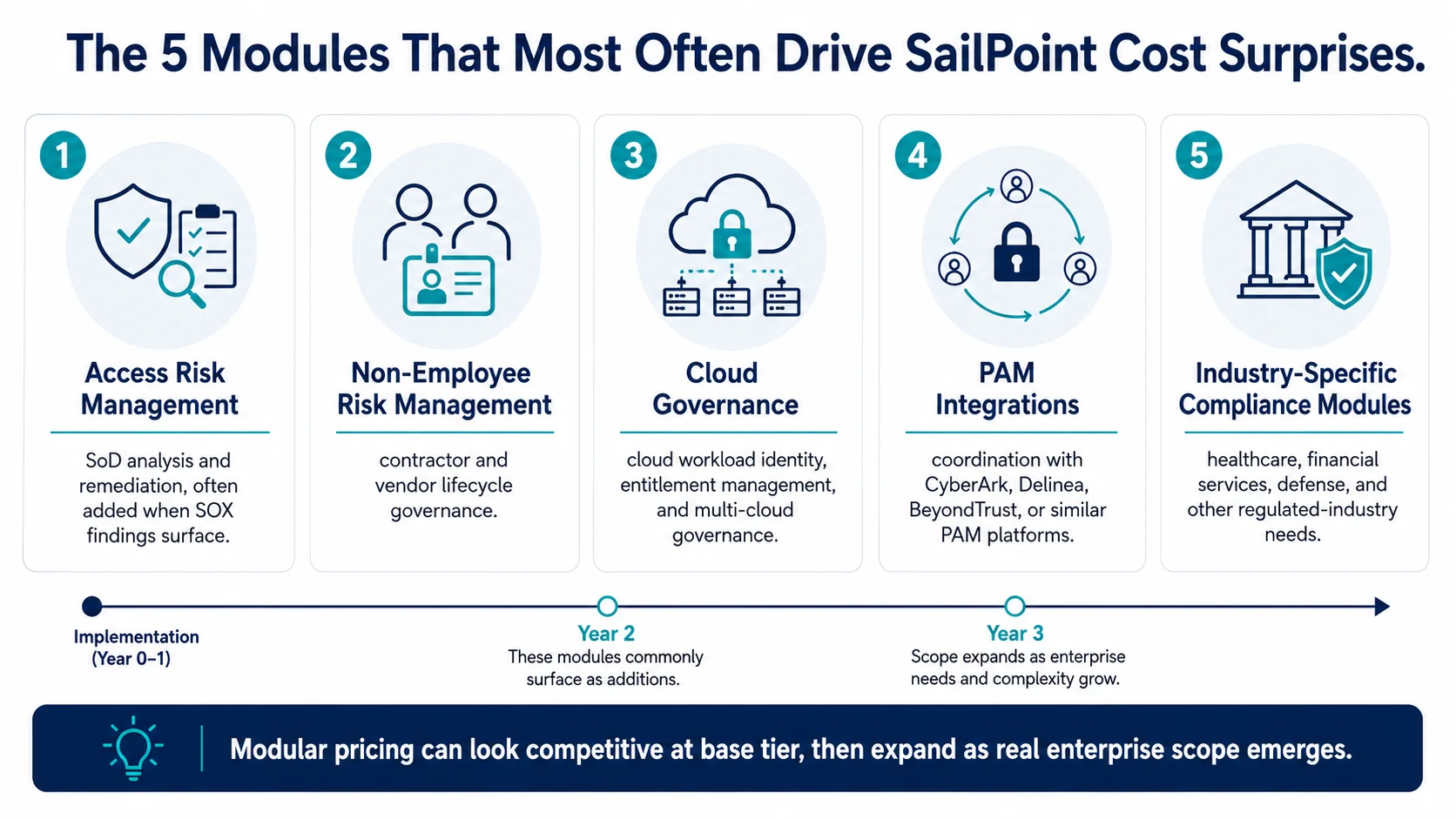
SailPoint vs Avatier: The 2026 Enterprise Pricing Model Comparison
Enterprise IAM buyers evaluating SailPoint against Avatier are comparing two fundamentally different pricing philosophies — modular per-capability pricing with premium tiers and per-connector charges versus all-inclusive licensing that bundles the same capability set into the base license. The 2026 enterprise reference on the structural pricing differences, the modules that drive most of the SailPoint cost surprises, the Avatier all-inclusive positioning, and the buyer-side comparison discipline that produces defensible vendor selection instead of feature-checklist theater.
Avatier vs Okta: The 2026 Enterprise Pricing Model Comparison
Enterprise IAM buyers evaluating Avatier against Okta are comparing two fundamentally different pricing philosophies — all-inclusive licensing that bundles IGA workforce lifecycle and identity governance into base pricing versus a workforce IdP with tiered pricing where governance capability is priced as premium modules above the federation baseline. The 2026 enterprise reference on the structural pricing differences, the specific modules that produce Okta cost variance at scale, and the buyer discipline for defensible vendor selection.