12 Best Identity Lifecycle Management Tools and Solutions for 2026
Twelve identity lifecycle management platforms compared against the operational reality of running joiner/mover/leaver at workforce scale — including mainframe, service-desk verification, and NIST 800-53 alignment.
Twelve identity lifecycle management platforms compared against the operational reality of running joiner/mover/leaver at workforce scale — including mainframe, service-desk verification, and NIST 800-53 alignment.
The current buyer's-guide landscape on identity lifecycle management — the half-dozen articles your CFO might be reading before approving the platform budget — converges on roughly the same shortlist. Microsoft Entra ID Governance, Okta Identity Governance, SailPoint Identity Security Cloud, CyberArk Identity, JumpCloud, Ping Identity. Six platforms in six articles, ranked in slightly different orders, evaluated against substantially the same criteria. Useful as a starting point. Insufficient as a decision basis.
This guide is built differently. We covered the twelve platforms most enterprises will realistically consider, including the ones the public guides leave out. We treated the comparison criteria as the operational reality of running lifecycle at workforce scale — mainframe coverage, service-desk identity verification, NIST 800-53 Rev. 5 alignment, and the honest trade-off each platform makes — rather than as a marketing-collateral feature checklist. And we put Avatier in the comparison alongside everyone else, because the absence of Avatier from the consensus guides is a market-coverage gap, not a capability gap, and the comparison should reflect that.
The structure follows the buyer's-guide cadence we use across MFA, passwordless, and IGA — vendors alphabetical with the standard five-question template per vendor (what it is, how it works, what standards it meets, the honest trade-off, where it fits best), a comparison table sized for actual decisions, an eight-question FAQ, and a four-profile decision aid at the end.
What identity lifecycle management actually is in 2026
Identity lifecycle management is the discipline of taking an organization's HR-driven facts (someone joined, someone changed roles, someone left) and propagating them as configuration changes across the identity surface (the identity provider, the directories, the applications, the entitlements, and the access policies) within a time window short enough that the gap between the HR fact and the access reality stays inside the organization's risk tolerance.
Mature ILM in 2026 has five operational components. An HR integration that treats the HRIS (typically Workday, SAP SuccessFactors, BambooHR, or UKG Pro) as the source of truth for identity facts. A workflow engine that converts HR events into a sequence of access actions. A connector library that talks to the identity providers, directories, and applications the actions need to reach. An access governance layer that captures certifications, segregation-of-duties policies, and audit evidence. And an analytics surface that surfaces orphaned accounts, excessive entitlements, and compliance drift so the lifecycle stays accurate over time.
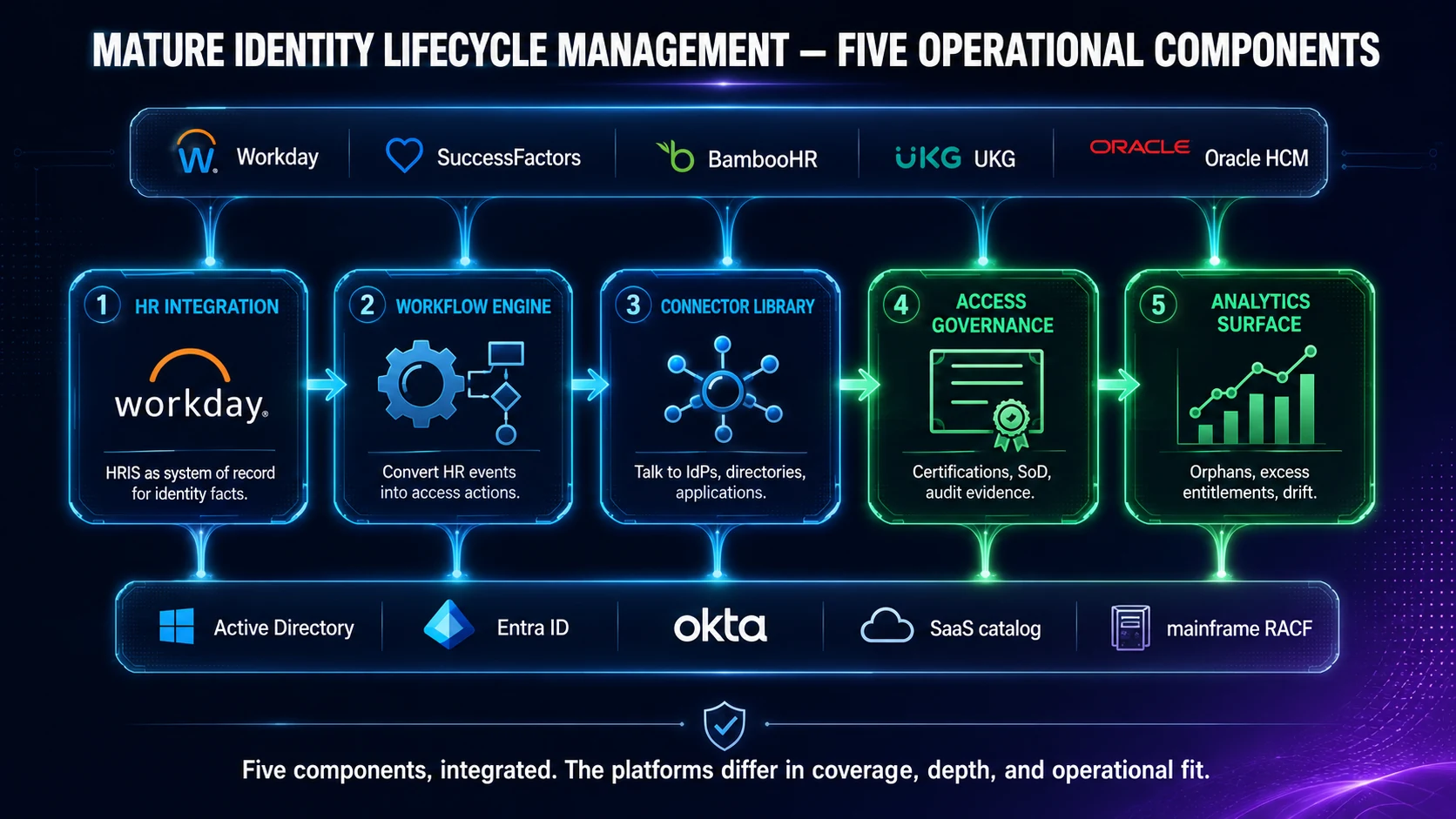 Five components, integrated. The platforms in this guide implement them at substantially different depths — the comparison criteria below reflect where the depth matters.
The platforms in this guide implement those five components with substantial differences in coverage, depth, and operational fit. The differences matter.
The twelve platforms
Listed alphabetically with Avatier first because we think the differentiator framing matters more than alphabetical purity. The rest of the list follows in alphabetical order.
Avatier Identity Anywhere
What it is. A unified identity platform that ships lifecycle management as one of three core capabilities, alongside access governance and self-service password and account management. Avatier targets enterprises that need workforce-scale lifecycle automation, mainframe coverage, and service-desk integration in a single platform.
How it works. Avatier Lifecycle Management runs on the Identity Anywhere platform and integrates with HRIS sources (Workday, SAP SuccessFactors, UKG, BambooHR, Oracle HCM) as the system of record. The workflow engine converts HR events into provisioning actions through a connector library that includes Active Directory, Azure AD/Entra ID, Okta, Google Workspace, Salesforce, ServiceNow, SAP, and over 150 other applications. The native RACF, ACF2, and Top Secret connectors mean mainframe environments are first-class lifecycle citizens, not afterthoughts. Service-desk verification is bound to the lifecycle state through Password Station, which means a service-desk agent receiving a password-reset call can verify the caller against the lifecycle-managed identity before resetting.
What standards it meets. Avatier is a CISA Secure-by-Design Pledge signatory, and the Avatier Trust Center publishes SOC 2 Type II (zero exceptions), ISO/IEC 27001:2022, PCI DSS v4.0.1, CSA STAR Level 1, and NIST 800-53 Rev. 5 alignment. The platform supports the audit evidence common compliance frameworks require — SOX, HIPAA, FERPA, GDPR, CCPA.
The honest trade-off. Avatier's strength is integrated coverage across the lifecycle, governance, and password/account management surfaces in a single platform with strong mainframe and service-desk story. The trade-off is that the platform optimizes for enterprises that want depth in those areas; an organization whose lifecycle problem is cloud-only modern SaaS with no mainframe and no on-premise directories may find more focused tools (JumpCloud, Apono) closer to their constraints.
Where it fits best. Enterprises with mixed estates — modern SaaS plus on-premise directories plus mainframe — that need lifecycle automation to span the full surface, and that want service-desk identity verification bound to the lifecycle state. Banking, insurance, healthcare, government, and large industrials are the typical fit profile.
Apono
What it is. A cloud-first access management platform built around just-in-time, ephemeral access for cloud workloads and developer access patterns. Apono frames the lifecycle problem around access decisions made at request time rather than at HR-event time.
How it works. Apono integrates with cloud IdPs (Okta, Azure AD/Entra ID, Google) and cloud infrastructure (AWS, GCP, Azure, Kubernetes, databases) to grant ephemeral access in response to specific user requests, with policy engines that govern what's grantable to whom. The standing-access surface is intentionally minimized; the platform's bet is that ephemeral grant-and-revoke beats the traditional joiner/mover/leaver cycle for cloud-native workforces.
What standards it meets. SOC 2 Type II, ISO/IEC 27001. NIST 800-53 mapping is documented in customer-specific control mappings rather than as a platform-level claim.
The honest trade-off. Apono's strength is the just-in-time access model for cloud-native workforces, with strong developer experience and minimal standing privilege. The trade-off is that the model assumes a cloud-native operating environment; organizations with significant on-premise infrastructure, mainframe, or legacy applications need to bolt other tools alongside Apono to cover the full lifecycle surface.
Where it fits best. Cloud-native software companies, developer-heavy organizations, and security teams treating standing privilege as an attack surface to minimize. Less fit for traditional enterprises with mixed estates.
ConductorOne
What it is. A modern access governance platform (formerly C1, rebranded mid-2025) that emphasizes least-privilege automation, access reviews, and the operational glue between the IdP and the application layer. ConductorOne treats the lifecycle as a continuous reconciliation problem rather than as a discrete sequence of HR-triggered events.
How it works. ConductorOne ingests identity data from the IdP (Okta, Azure AD/Entra ID, Google), application catalogs (Salesforce, Workday, GitHub, Slack, and ~100 others), and HR sources, and runs continuous policy evaluation against the current state. The platform surfaces access drift, automates access reviews, and orchestrates revocations through the integrated connectors. The lifecycle automation sits on top of the access-governance layer rather than the other way around.
What standards it meets. SOC 2 Type II, ISO/IEC 27001:2022. NIST 800-53 mapping is documented for customers in regulated industries; FedRAMP is not currently authorized.
The honest trade-off. ConductorOne's strength is the modern access-review automation and the continuous-reconciliation pattern that fits how cloud-native teams operate. The trade-off is that the platform leans toward access governance over identity provisioning depth; enterprises whose primary lifecycle problem is end-to-end JML automation across complex provisioning targets often pair ConductorOne with a more provisioning-heavy partner.
Where it fits best. Mid-market and growth-stage software companies, security teams prioritizing continuous access governance over scheduled certifications, and organizations whose application catalog is concentrated in modern SaaS.
CyberArk Identity (with Identity Lifecycle Management)
What it is. A converged identity platform from CyberArk that combines workforce access, customer identity, and lifecycle management on top of CyberArk's privileged access management heritage. The lifecycle module specifically targets enterprises that want PAM and ILM under one roof.
How it works. CyberArk Identity integrates with the HRIS as the source of truth and provisions across Active Directory, Azure AD/Entra ID, and a connector library that covers the major SaaS applications. The differentiator is the integration with CyberArk's PAM platform, which means privileged-account lifecycle (creation, rotation, retirement) happens inside the same control plane as workforce-identity lifecycle.
What standards it meets. SOC 2 Type II, ISO/IEC 27001:2022, FedRAMP Moderate (with Identity Security Platform). PCI DSS support is documented for customers who require it.
The honest trade-off. CyberArk's strength is the deep PAM heritage and the converged platform story for organizations that want privileged-access controls and workforce ILM in one platform. The trade-off is that the workforce ILM features have caught up to but not yet surpassed the workforce-focused leaders (SailPoint, Microsoft, Saviynt); for organizations where workforce JML is the dominant problem and PAM is secondary, the converged framing is less of a benefit.
Where it fits best. Enterprises with significant privileged-account populations (utilities, banking, energy, government) that want to converge PAM and workforce lifecycle on a single platform.
JumpCloud
What it is. A cloud-directory platform that combines directory services, device management, and identity lifecycle management into a single offering targeted primarily at mid-market organizations. JumpCloud's lifecycle story is built around the directory as the integration surface.
How it works. JumpCloud acts as the IdP, the directory, and the lifecycle orchestrator. HR integrations (BambooHR, Workday, UKG) drive user creation, modification, and deletion in the JumpCloud directory, which then propagates changes to integrated applications, devices, and infrastructure. The model collapses several traditionally separate platforms (HR-to-IdP, IdP-to-directory, directory-to-application) into one.
What standards it meets. SOC 2 Type II, ISO/IEC 27001:2022, HIPAA-aligned. NIST 800-53 mapping is documented at the customer level rather than as a platform-level claim.
The honest trade-off. JumpCloud's strength is the simplified architecture and the cost-effective consolidation of multiple identity layers into one platform. The trade-off is that enterprises with existing investments in dedicated IdPs (Okta, Entra ID) and directories (Active Directory) are choosing between consolidating onto JumpCloud or running it as a satellite to existing infrastructure; neither scenario optimizes for the platform's design intent.
Where it fits best. Mid-market organizations (500-5,000 employees) building identity infrastructure from scratch or willing to consolidate, and organizations whose dominant operating model is cloud-first with managed endpoints.
Microsoft Entra ID Governance
What it is. Microsoft's add-on to Entra ID (formerly Azure AD) that provides identity governance, access reviews, entitlement management, and lifecycle workflows. Entra ID Governance sits inside the Microsoft 365 and Azure ecosystem and inherits the integration patterns the broader platform provides.
How it works. Entra ID Governance ingests HR data through HR-driven provisioning connectors (Workday, SAP SuccessFactors) and converts HR events into lifecycle workflows that provision and deprovision across Entra ID, Microsoft 365, and connected SaaS applications. Access reviews, entitlement management, and privileged identity management are integrated capabilities. The platform's strongest pattern is end-to-end automation inside the Microsoft ecosystem.
What standards it meets. SOC 2 Type II, ISO/IEC 27001:2022, FedRAMP High, NIST 800-53 Rev. 5 control mapping documented at platform level. Microsoft publishes detailed audit-evidence guidance.
The honest trade-off. Microsoft's strength is the depth of integration inside the Microsoft ecosystem and the FedRAMP High posture. The trade-off is that the lifecycle workflows are most powerful for organizations already standardized on Entra ID; organizations with multi-IdP estates, significant non-Microsoft application portfolios, or mainframe environments find the connector library deeper for Microsoft targets than for everything else.
Where it fits best. Enterprises standardized on Microsoft 365 and Azure as the primary identity and productivity platform, organizations needing FedRAMP High posture for federal workloads, and IT teams whose existing operational skills align with the Microsoft ecosystem.
Okta Identity Governance
What it is. Okta's identity governance offering that extends the Okta Workforce Identity Cloud with access certifications, entitlement management, and lifecycle workflows. OIG targets enterprises that have standardized on Okta as the IdP and want governance and lifecycle automation in the same control plane.
How it works. OIG inherits Okta's connector library (over 7,000 applications via the Okta Integration Network) and adds workflow automation for provisioning, deprovisioning, and access reviews. HR integrations (Workday, SuccessFactors, UKG) drive the lifecycle; the workflows propagate access changes across the connector library.
What standards it meets. SOC 2 Type II, ISO/IEC 27001:2022, FedRAMP Moderate, NIST 800-53 alignment documented. HIPAA, PCI DSS, and additional framework support documented per customer requirements.
The honest trade-off. Okta's strength is the breadth of the application connector library and the operational maturity of the IdP. The trade-off is that organizations not already standardized on Okta are buying into both the IdP and the governance layer simultaneously, which is a larger commitment than incrementally adding governance to an existing IdP — and the cost structure reflects the converged commitment.
Where it fits best. Enterprises standardized on Okta as the IdP that want to extend into governance and lifecycle in the same platform, and security teams whose application catalog is well covered by the OIN.
OneIdentity (Quest)
What it is. Quest's converged identity platform combining Active Roles for Active Directory administration, Identity Manager for IGA and lifecycle, Safeguard for PAM, and several other components. OneIdentity has deep heritage in Active Directory-centric enterprises.
How it works. OneIdentity Manager handles the HRIS integration, workflow engine, and lifecycle automation. Active Roles handles the AD provisioning depth that pure AD-native tools struggle with. The lifecycle workflows can span on-premise AD, Azure AD/Entra ID, and connected applications through a connector library that includes mainframe extensions.
What standards it meets. SOC 2 Type II, ISO/IEC 27001:2022, NIST 800-53 alignment documented for customers in regulated industries. Common Criteria evaluation available for certain product modules.
The honest trade-off. OneIdentity's strength is the deep AD administration heritage and the converged platform that spans IGA, PAM, and AD management. The trade-off is that the platform's architecture reflects its long history; modern cloud-native deployment patterns are available but the operational model still rewards organizations comfortable with traditional enterprise software lifecycles.
Where it fits best. Large enterprises with deep Active Directory investments that need AD administration, IGA, PAM, and lifecycle automation in a converged platform, and organizations whose operational model fits traditional enterprise software (rather than cloud-native SaaS-first).
Oracle Identity Governance
What it is. Oracle's lifecycle and governance platform within the Oracle Identity Management product family. OIG targets enterprises with significant Oracle application portfolios (E-Business Suite, PeopleSoft, Oracle Cloud) that want lifecycle automation tuned to the Oracle environment.
How it works. OIG integrates with the HRIS (typically Oracle HCM or PeopleSoft for Oracle-aligned enterprises) and provisions across Oracle applications, directories, and connected non-Oracle targets through the Oracle connector library. The platform's strongest pattern is depth within the Oracle ecosystem.
What standards it meets. SOC 2 Type II, ISO/IEC 27001:2022, FedRAMP Moderate (Oracle Cloud Infrastructure), NIST 800-53 alignment documented. Common Criteria available for specific product configurations.
The honest trade-off. Oracle's strength is the depth within the Oracle application stack. The trade-off is that the platform optimizes for enterprises whose identity gravity sits with Oracle; organizations whose primary applications are non-Oracle SaaS find the integration patterns less central to the platform's design.
Where it fits best. Enterprises with substantial Oracle E-Business Suite, PeopleSoft, or Oracle Cloud investments that want lifecycle automation deeply integrated with the Oracle environment.
Ping Identity (PingOne Identity Governance)
What it is. Ping's identity governance and lifecycle offering, integrated with the broader PingOne platform that covers workforce identity, customer identity, and access management. Ping targets enterprises that want a converged identity platform with strong federation heritage.
How it works. PingOne Identity Governance integrates with the HRIS and provisions across the PingOne directory and connected applications through Ping's connector library. The platform inherits Ping's strengths in federation (SAML, OIDC) and adds the lifecycle and governance workflows on top.
What standards it meets. SOC 2 Type II, ISO/IEC 27001:2022, FedRAMP Moderate, NIST 800-53 alignment documented. Strong federation and standards heritage.
The honest trade-off. Ping's strength is the federation depth and the converged platform across workforce and customer identity. The trade-off is that the lifecycle and governance modules are newer than the federation core; organizations whose dominant problem is governance maturity sometimes pair Ping with a dedicated IGA partner (Saviynt, SailPoint) rather than relying on PingOne IG alone.
Where it fits best. Enterprises with significant federation requirements, organizations running both workforce and customer identity on one platform, and security teams whose existing investment in Ping makes the governance extension the natural next step.
Saviynt
What it is. Saviynt's Enterprise Identity Cloud is a converged IGA, PAM, and Application Access Governance platform with significant strength in lifecycle automation and a cloud-first architecture. Saviynt is one of the leaders in the analyst-tracked IGA category.
How it works. Saviynt ingests HR data, application entitlements, and access patterns into a cloud-native platform that runs the lifecycle workflows, access reviews, and segregation-of-duties policies. The application connector library is strong across enterprise SaaS, cloud infrastructure, and a growing set of on-premise targets including some mainframe support through extensions.
What standards it meets. SOC 2 Type II, ISO/IEC 27001:2022, FedRAMP Moderate, NIST 800-53 alignment. HIPAA, PCI DSS, and additional framework support documented.
The honest trade-off. Saviynt's strength is the converged platform breadth and the cloud-native architecture. The trade-off is that the platform's flexibility creates implementation complexity; the deployments that succeed have strong internal IAM expertise and disciplined project management. Enterprises looking for fast time-to-value often need professional services engagement to land the platform well.
Where it fits best. Mid-market and enterprise organizations that want a single platform for IGA, lifecycle, and access governance with cloud-first architecture, and IAM teams capable of running a multi-phase deployment.
SailPoint Identity Security Cloud
What it is. SailPoint's flagship identity security platform combining IGA, lifecycle management, and AI-driven access intelligence into a unified cloud offering. SailPoint is the long-standing analyst leader in the IGA category and one of the most mature platforms in the space.
How it works. SailPoint Identity Security Cloud ingests HR data, application entitlements, and access patterns into a cloud-native platform with AI-driven analytics, risk scoring, and automated decisioning. The connector library is comprehensive across SaaS, cloud infrastructure, on-premise applications, and mainframe environments through extensions. The lifecycle automation runs on top of the access governance and intelligence layers.
What standards it meets. SOC 2 Type II, ISO/IEC 27001:2022, FedRAMP Moderate, NIST 800-53 alignment documented at platform level. HIPAA, PCI DSS, and broad compliance framework support.
The honest trade-off. SailPoint's strength is the depth of the IGA platform and the maturity of the AI-driven access intelligence. The trade-off is that the platform's depth is a multi-year commitment to land well; enterprises that have made the commitment get substantial value, but the platform is not the right fit for organizations seeking quick-wins lifecycle automation as a tactical project.
Where it fits best. Large enterprises with mature IAM organizations that want the deepest IGA platform with AI-driven intelligence, and security teams whose lifecycle problem is part of a broader identity-security program rather than a standalone project.
The comparison table
The columns we picked are the ones that drive real decisions: native HRIS coverage, mainframe support, service-desk verification, NIST 800-53 alignment, FedRAMP posture, and the headline honest trade-off.
| Platform | Native HRIS | Mainframe | Service-Desk Verification | NIST 800-53 | FedRAMP | Honest Trade-Off |
|---|---|---|---|---|---|---|
| Avatier Identity Anywhere | Workday, SuccessFactors, UKG, BambooHR, Oracle HCM | RACF, ACF2, Top Secret (native) | Workflow-tied via Password Station | Rev. 5 aligned | Aligned (not authorized) | Best on mixed estates; less optimized for cloud-only |
| Apono | Workday, BambooHR | Not supported | Not in scope | Customer-mapped | Not authorized | Cloud-native depth, on-premise gaps |
| ConductorOne | Workday, BambooHR, Rippling | Not supported | Not in scope | Customer-mapped | Not authorized | Access-governance depth, lighter on provisioning automation |
| CyberArk Identity | Workday, SuccessFactors, UKG | Through partners | Limited integration | Aligned | Moderate | PAM heritage strong; workforce ILM catching up |
| JumpCloud | BambooHR, Workday, UKG | Not supported | Limited integration | Customer-mapped | Not authorized | Architecture simplification; trade-offs for established estates |
| Microsoft Entra ID Governance | Workday, SuccessFactors | Through partners | Limited integration | Rev. 5 aligned | High | Ecosystem depth; less optimal outside Microsoft estate |
| Okta Identity Governance | Workday, SuccessFactors, UKG | Through partners | Limited integration | Aligned | Moderate | OIN breadth; cost reflects converged commitment |
| OneIdentity (Quest) | Workday, SuccessFactors, Oracle HCM | Available via Active Roles | Limited integration | Aligned | Not authorized | AD heritage strong; traditional operational model |
| Oracle Identity Governance | Oracle HCM, PeopleSoft, Workday | Through Oracle connectors | Limited integration | Aligned | Moderate (OCI) | Oracle ecosystem depth; less central for non-Oracle estates |
| Ping Identity Governance | Workday, SuccessFactors | Through partners | Limited integration | Aligned | Moderate | Federation depth; governance newer than core |
| Saviynt | Workday, SuccessFactors, UKG, Oracle HCM | Available via extensions | Limited integration | Aligned | Moderate | Platform breadth; implementation complexity |
| SailPoint Identity Security Cloud | Workday, SuccessFactors, UKG, Oracle HCM, ADP | Available via extensions | Limited integration | Aligned | Moderate | IGA depth; multi-year commitment to land well |
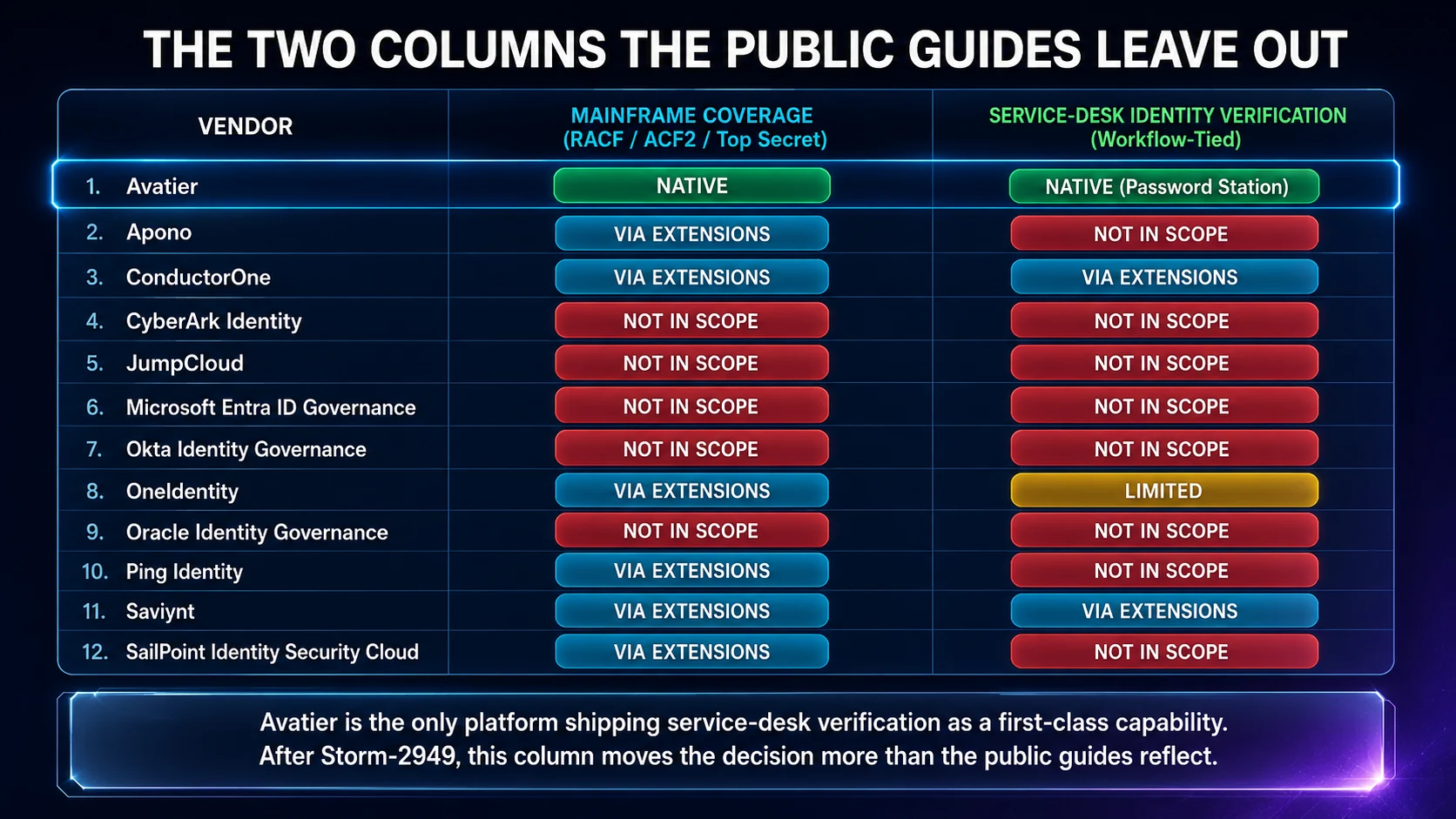 The two columns the public buyer's guides leave out. Mainframe coverage matters for banking, insurance, healthcare, government, and large industrials. Service-desk identity verification matters for everyone post-Storm-2949.
A few comparison notes worth calling out.
The mainframe column. Three platforms — Avatier (native), OneIdentity (via Active Roles plus mainframe connectors), and SailPoint (via extensions) — treat mainframe as a first-class lifecycle target. Everyone else either supports mainframe through third-party connectors or treats it as out of scope. For banking, insurance, government, and healthcare enterprises where mainframe still holds primary records, this column moves the decision more than the public buyer's guides reflect.
The service-desk verification column. Avatier is the only platform in the comparison that ships service-desk identity verification bound to the lifecycle state as a first-class capability through Password Station. Every other platform treats service-desk verification as a separate problem the customer solves with another tool. After Storm-2949, this gap matters more than it used to.
The FedRAMP column. Three platforms (Microsoft High, Okta Moderate, SailPoint Moderate, plus Ping, Oracle, Saviynt, and CyberArk at Moderate) carry FedRAMP authorization. Federal customers and federal-adjacent customers need the authorization, not just the alignment. Commercial customers can usually work with NIST 800-53 alignment plus mapped controls.
What realistic deployment actually looks like
The public buyer's guides tend to underrepresent how long lifecycle deployments actually take and what drives the variance. We've seen the same patterns enough times to share the framing.
The 8-12 week scenario assumes one HRIS source, one downstream IdP, fewer than 25 applications, no mainframe, no significant data-quality remediation needed in the HR source, no FedRAMP requirement, and an internal IAM team that can dedicate sprint capacity. This is achievable for mid-market organizations with modern stacks and is what most vendor "12-week deployment" claims describe.
The 6-9 month scenario assumes 1-2 HRIS sources, 2-3 IdPs (typically AD plus Entra ID plus possibly Okta), 50-150 applications across SaaS and on-premise, light or no mainframe, mid-complexity HR data, one significant compliance framework (SOC 2 or HIPAA), and a partially-dedicated IAM team. This is the typical mid-large enterprise scenario for a focused lifecycle program.
The 12-18 month scenario assumes multi-region HRIS, 3+ IdPs, 200+ applications including mainframe, significant HR data-quality remediation needed, multiple compliance frameworks including federal posture, and a multi-team program with IAM, HR, security, and application owners coordinated. This is the global-enterprise scenario for a strategic lifecycle program.
The variance is real and the planning should reflect it. Vendors that quote you the 8-12 week scenario for a 12-18 month problem are setting up the project for the difficult-conversations meeting six months in. The discipline that lands deployments well is matching the project plan to the actual constraints, not to the vendor's preferred timeline.
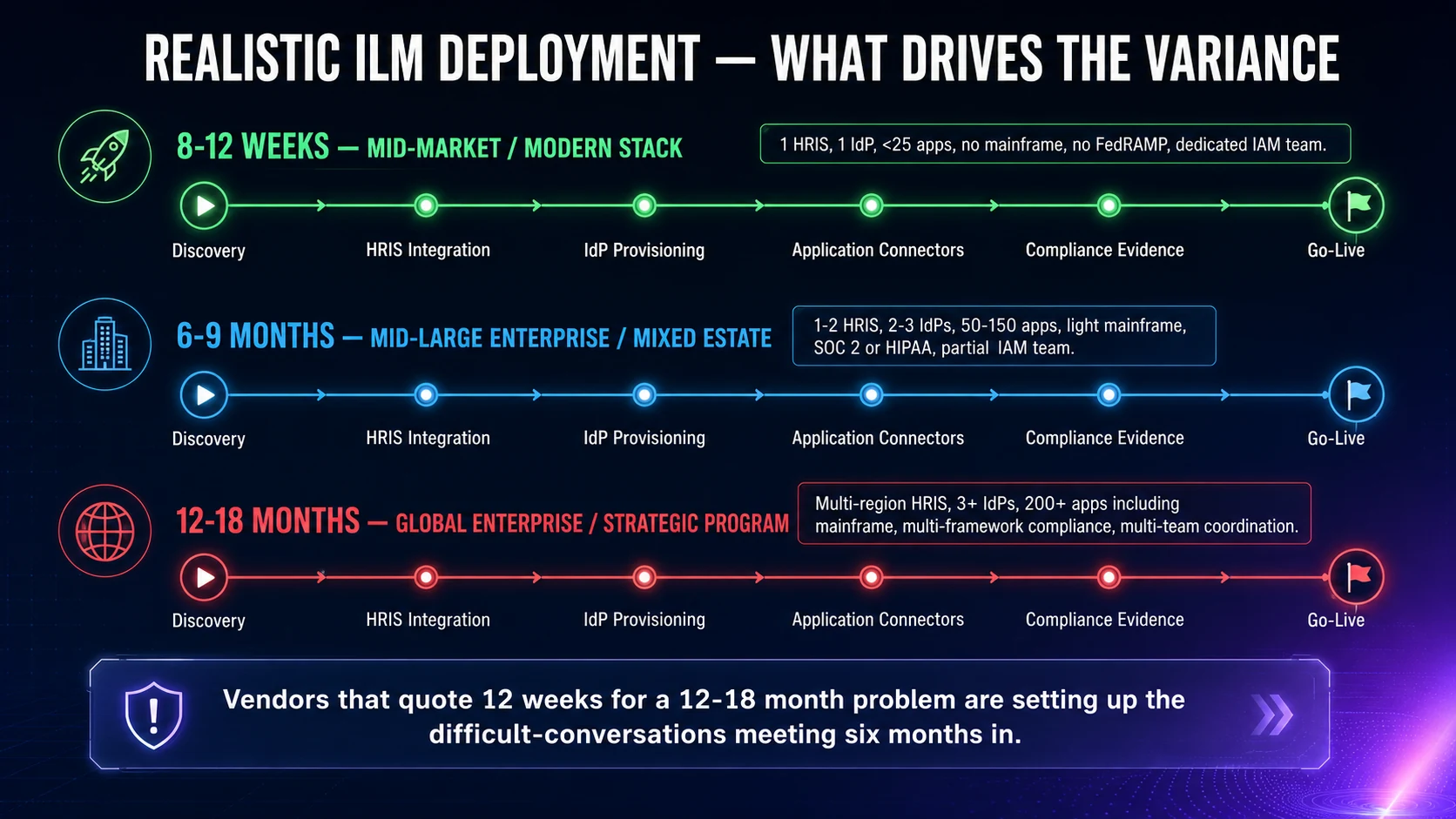 Three deployment scenarios, three different sets of constraints. The discipline that lands deployments well is matching the project plan to the actual constraints, not to the vendor's preferred timeline.
The four decision profiles
A decision aid for narrowing the twelve to a shortlist of three or four. Match your dominant constraint to the profile.
The mixed-estate enterprise. Banking, insurance, healthcare, government, large industrials. Mainframe in scope, on-premise directories in scope, modern SaaS in scope, service-desk integration matters, compliance evidence needs to be tidy. Shortlist: Avatier, SailPoint, OneIdentity. CyberArk if PAM is part of the same project.
The Microsoft-standardized enterprise. Already on Entra ID, Microsoft 365, Azure. Application portfolio is heavily Microsoft-centric. Want governance and lifecycle inside the same control plane. Shortlist: Microsoft Entra ID Governance first, Saviynt and SailPoint as platforms that integrate cleanly with the Microsoft estate while providing depth beyond what Entra ID Governance ships. Avatier if mainframe or service-desk verification matters.
The cloud-native mid-market. SaaS-first, no mainframe, managed endpoints, small-to-medium IAM team. Want the lifecycle problem solved with the least operational overhead. Shortlist: JumpCloud, ConductorOne, Apono. Okta Identity Governance if already on Okta. Saviynt if growth trajectory will outpace the lighter platforms within 24 months.
The federal or federal-adjacent organization. FedRAMP posture required, NIST 800-53 mapping must be platform-level not customer-derived. Shortlist: Microsoft Entra ID Governance (FedRAMP High), Okta Identity Governance, SailPoint, Saviynt, CyberArk Identity, Ping Identity, Oracle Identity Governance — all at FedRAMP Moderate or higher. Avatier remains aligned but not authorized; eligibility depends on the customer's specific FedRAMP requirement.
What this guide deliberately doesn't claim
A few honest framings.
We don't claim any one platform is universally best. The twelve platforms here serve different decision profiles well; the right choice is the one whose strengths align with your constraints and whose trade-off you can live with.
We don't claim the comparison table covers every feature your evaluation should include. We picked six columns that drive real decisions. Your shortlist process should add columns for the application connectors specific to your environment, the deployment-services capacity in your geography, and the cost structure relative to your seat count.
We don't claim Avatier wins every comparison. The honest trade-off column says it directly — Avatier optimizes for mixed-estate depth and is not the right pick for cloud-only modern-SaaS-only organizations. We put Avatier first in the alphabetical list because we wrote the guide, and we wanted you to see the structure of the comparison and what we mean by "the honest trade-off" before you got to the others.
What we do claim is that the comparison criteria in this guide reflect the operational reality of running lifecycle at workforce scale better than the public guides currently in circulation. The six-vendor consensus shortlist that recurs across the public guides is a starting point. The twelve-platform comparison with mainframe coverage, service-desk verification, NIST 800-53 alignment, and the honest trade-off column is closer to the basis a real decision should rest on.
Avatier's trust posture and the architecture context
Avatier is a CISA Secure-by-Design Pledge signatory. The Avatier Trust Center publishes our SOC 2 Type II (zero exceptions), ISO/IEC 27001:2022, PCI DSS v4.0.1, CSA STAR Level 1, and NIST 800-53 Rev. 5 alignment. The lifecycle, governance, and password/account management capabilities Avatier ships run on the same Identity Anywhere platform, which is the architecture context behind the "integrated coverage" claim in the Avatier entry above.
The companion pieces to this guide cover the adjacent decisions an enterprise typically faces in the same program — the IGA Buyer's Guide for the governance layer, the OAuth 2.1 modernization guide for the protocol layer, the Storm-2949 governance failure analysis for the service-desk attack pattern, the Best MFA guide for the authentication layer, and Beyond Foundational MFA for the recovery channel architecture. Together they describe the production-grade identity-security posture for enterprises in 2026.
The lifecycle is the foundation. Get it right and the rest of the program has something to build on.
ABOUT THE AUTHOR

More from Buyer's Guides
IAM Vendors in 2026: How the Market Breaks Down
A category-level guide to how the IAM vendor market segments into suites, point solutions, and platform plays, plus the criteria and red flags that separate real capability from marketing claims.
SailPoint vs Avatier: The 2026 Enterprise Pricing Model Comparison
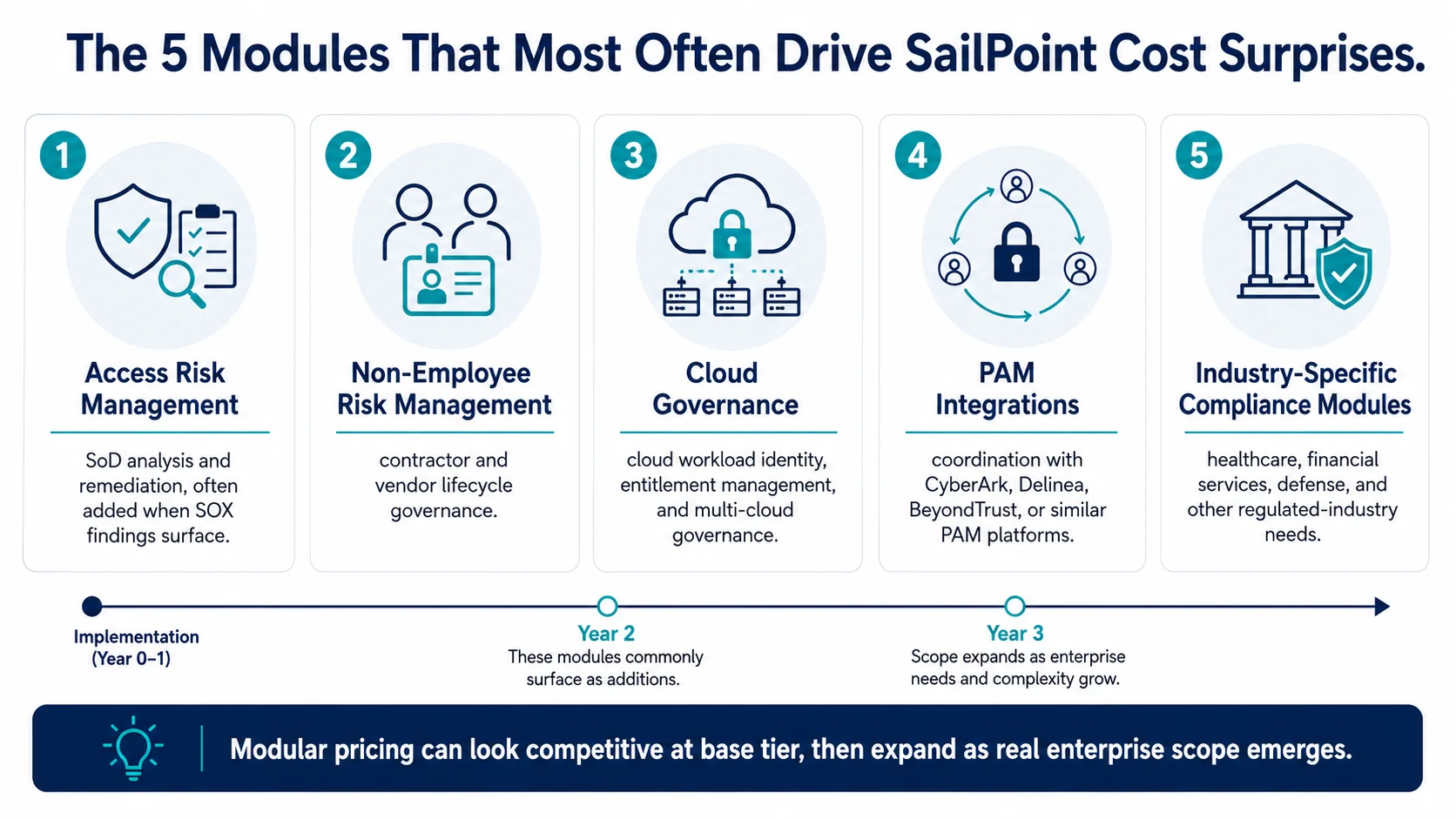
Enterprise IAM buyers evaluating SailPoint against Avatier are comparing two fundamentally different pricing philosophies — modular per-capability pricing with premium tiers and per-connector charges versus all-inclusive licensing that bundles the same capability set into the base license. The 2026 enterprise reference on the structural pricing differences, the modules that drive most of the SailPoint cost surprises, the Avatier all-inclusive positioning, and the buyer-side comparison discipline that produces defensible vendor selection instead of feature-checklist theater.

Login Reset Licensing Models: The 2026 Enterprise Cost Structure Reference
Enterprise password reset licensing has three fundamentally different pricing models — per-user subscription, per-reset-event consumption, and modular capability-based licensing — and the fit between model and buyer profile determines whether TCO tracks the vendor's list-price projection or surprises 18-24 months into deployment. The 2026 enterprise reference on the three licensing models, the specific line items that drive cost variance, and the buyer discipline that produces defensible reset-workflow vendor selection.