Service Account Governance and Non-Human Identity for Enterprise 2026
Non-human identities — service accounts, workload identities, API credentials, automation agents, and the rapidly growing population of AI agent identities — now outnumber human identities in most 2026 enterprises by 10× or more. The reference on what NHI is, where the governance gaps are, and the architecture that brings non-human credentials under the same lifecycle discipline as humans.
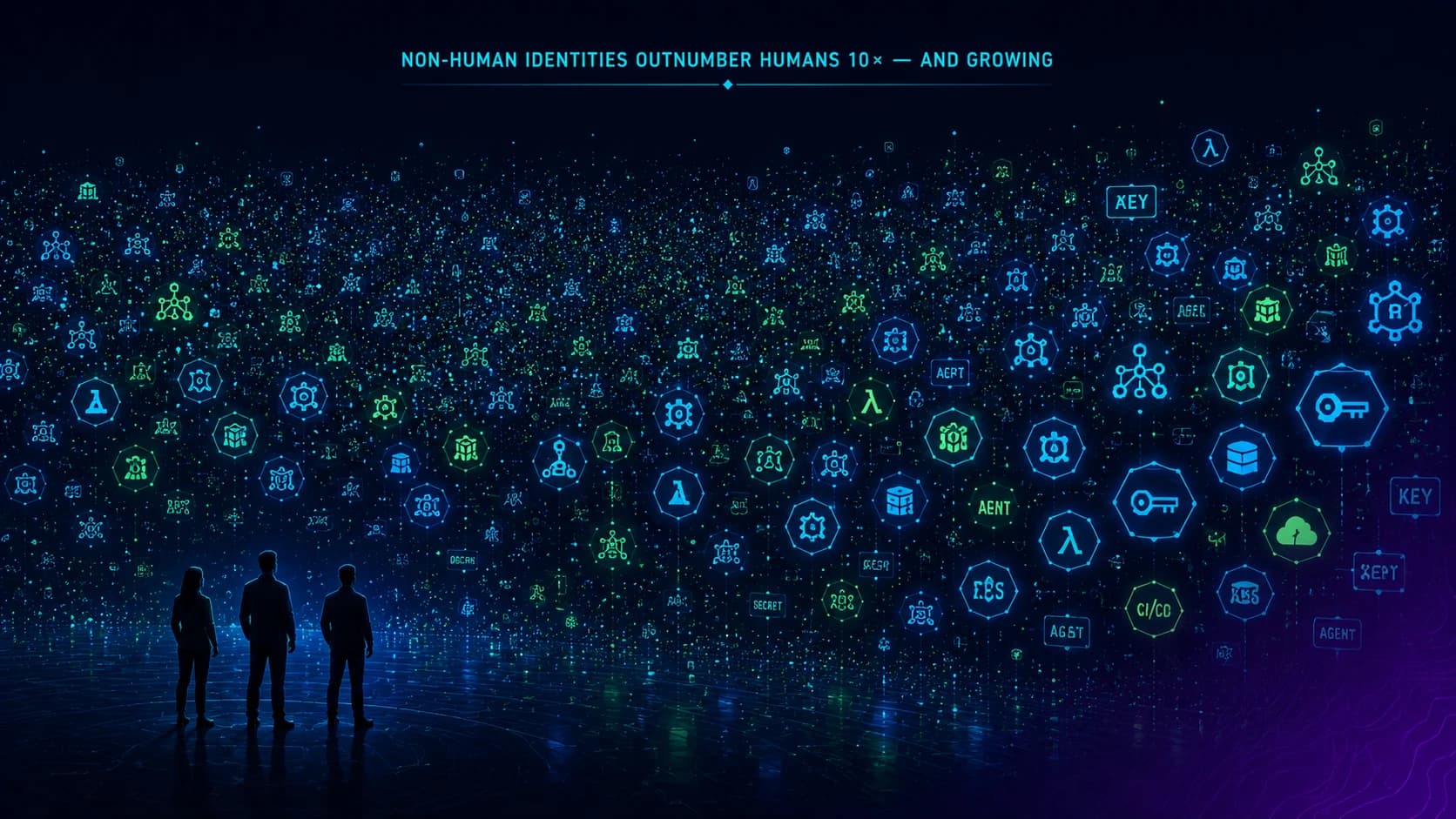
Non-human identities — service accounts, workload identities, API credentials, automation agents, and the rapidly growing population of AI agent identities — now outnumber human identities in most 2026 enterprises by 10× or more. The reference on what NHI is, where the governance gaps are, and the architecture that brings non-human credentials under the same lifecycle discipline as humans.
The numbers that matter aren't subtle. In a 2026 enterprise with 5,000 human employees, you'll typically find 50,000 to 250,000 non-human identities — service accounts, workload identities, API credentials, automation agents, and the rapidly growing population of AI agent identities. The ratio is conservative. In cloud-native environments with heavy microservices adoption, the ratio runs 30× to 50× more non-human identities than human ones. In manufacturing or industrial environments with extensive OT integration, the ratio is even higher.
The strategic implication is straightforward. The identity attack surface is dominated by non-human credentials, but the governance discipline that enterprises have built up — joiner/mover/leaver workflows, access certifications, role-based access control, periodic recertification — was designed for human identities. Non-human identities have been treated as infrastructure to deploy rather than identities to govern, and the failure modes have been showing up in the breach corpus for years. Okta 2023. Microsoft 2024. The Snowflake customer compromises in 2024. The MOVEit cascade. The CircleCI incident. Across all of them, non-human credential compromise was a primary or contributing pathway — service account credentials with elevated privileges, no rotation, no scope review, no offboarding when the underlying workload was decommissioned.
This piece is the 2026 enterprise reference on service account governance and non-human identity. The companion pieces handle adjacent territory: PAM for Enterprise 2026 covers the privileged-credential subset of NHI, the ITDR piece covers the detection layer that watches for NHI abuse, Best IGA Solutions covers the broader governance layer that NHI integrates with, and Best ILM Solutions covers the lifecycle infrastructure. This piece is the NHI-specific layer that runs across all of them.
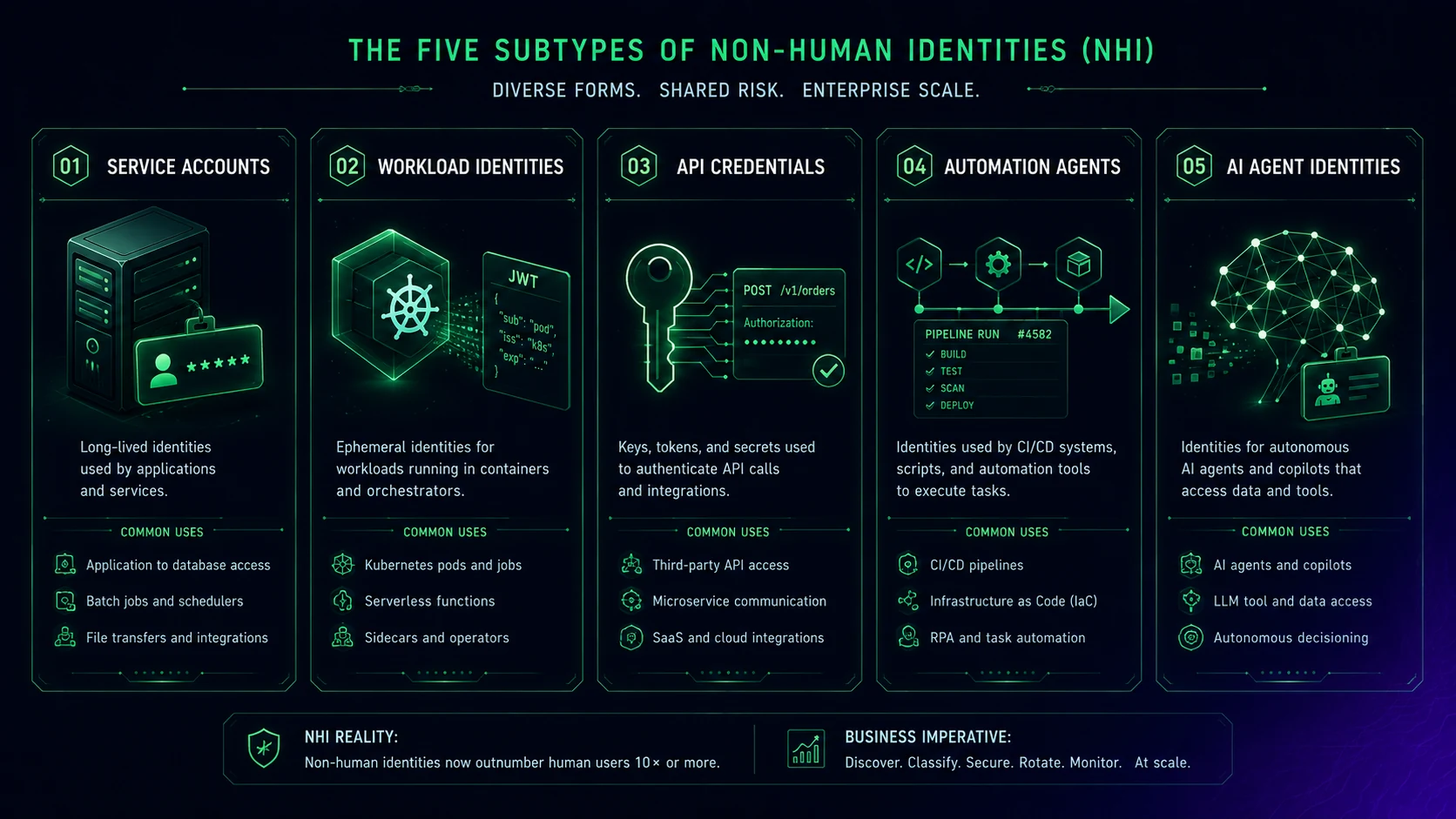 Five subtypes. The category outnumbers humans 10x or more in most 2026 enterprises and is growing fastest in cloud-native and AI-agent territory.
What counts as a non-human identity, and why categorization matters
Non-human identity is a broad umbrella covering several distinct subtypes with different governance challenges. The 2026 enterprise architecture has to recognize the subtypes because the operational patterns differ.
Traditional service accounts are named accounts that processes use to authenticate. The classic pattern is a database server that needs to read from another database — it has a named account (svc_db_replication or similar) with a long-lived password stored in a configuration file. Service accounts predate cloud-native architecture and remain widespread in enterprise environments. The governance challenges are credential rotation (often the password hasn't been changed in years), credential storage (often the password lives in plaintext configuration files), scope creep (the service account accumulated additional permissions over time as new use cases emerged), and ownership ambiguity (the engineer who created it left the company; no one knows what depends on it).
Workload identities are the cloud-native pattern that emerged to replace traditional service accounts. Instead of a long-lived password in a config file, the workload authenticates as itself via platform-native identity mechanisms. Kubernetes service account tokens are the canonical example — a pod authenticates to the Kubernetes API using a JWT issued automatically based on its service account binding. AWS IAM roles assumed by EC2 instances or Lambda functions use the same pattern. Azure managed identities and GCP service accounts do the equivalent. The governance challenge is different — there's no long-lived password to rotate, but the identity scope (what permissions the workload has) still needs governance, audit, and lifecycle management.
API credentials are credentials issued for service-to-service authentication. Internal microservices authenticate to each other using bearer tokens, mTLS certificates, or HMAC-signed requests. Third-party SaaS integrations authenticate to your platform using API keys you issued. Your platform authenticates to third-party SaaS using API keys they issued. The governance challenge is enumeration (how many API keys does the enterprise have outstanding), rotation (when do they expire and who refreshes them), revocation (when a partner integration is deprecated, the API key needs to be deactivated), and scope (what does each key authorize).
Automation agents are the CI/CD and deployment infrastructure identities. GitHub Actions runners with deploy credentials. GitLab CI pipelines with cloud provider credentials. Terraform service accounts with infrastructure write access. Ansible tower service accounts with broad host access. The governance challenges combine traditional service account problems with deployment-pipeline-specific concerns (the credential lives in the CI/CD platform's secret store; the CI/CD platform itself has its own identity scope).
AI agent identities are the newest and fastest-growing subset. LLM-powered agents that authenticate to enterprise systems to take actions (send email, query databases, execute workflows). Agentic AI components that orchestrate multi-step workflows on behalf of users. Autonomous workflow agents that operate without human intervention. The governance pattern is still emerging — there's no settled standard for "what is an AI agent identity in IGA" — but the operational requirements are the same. Enumerate every agent. Govern its scope. Audit its actions. Revoke it cleanly.
The five subtypes share a common property: the identity isn't tied to a person who has an HRIS record, a manager who can certify it, or a job function that defines its scope. Traditional IGA patterns don't apply directly. The governance has to be designed for the subtype, not adapted from human-identity patterns.
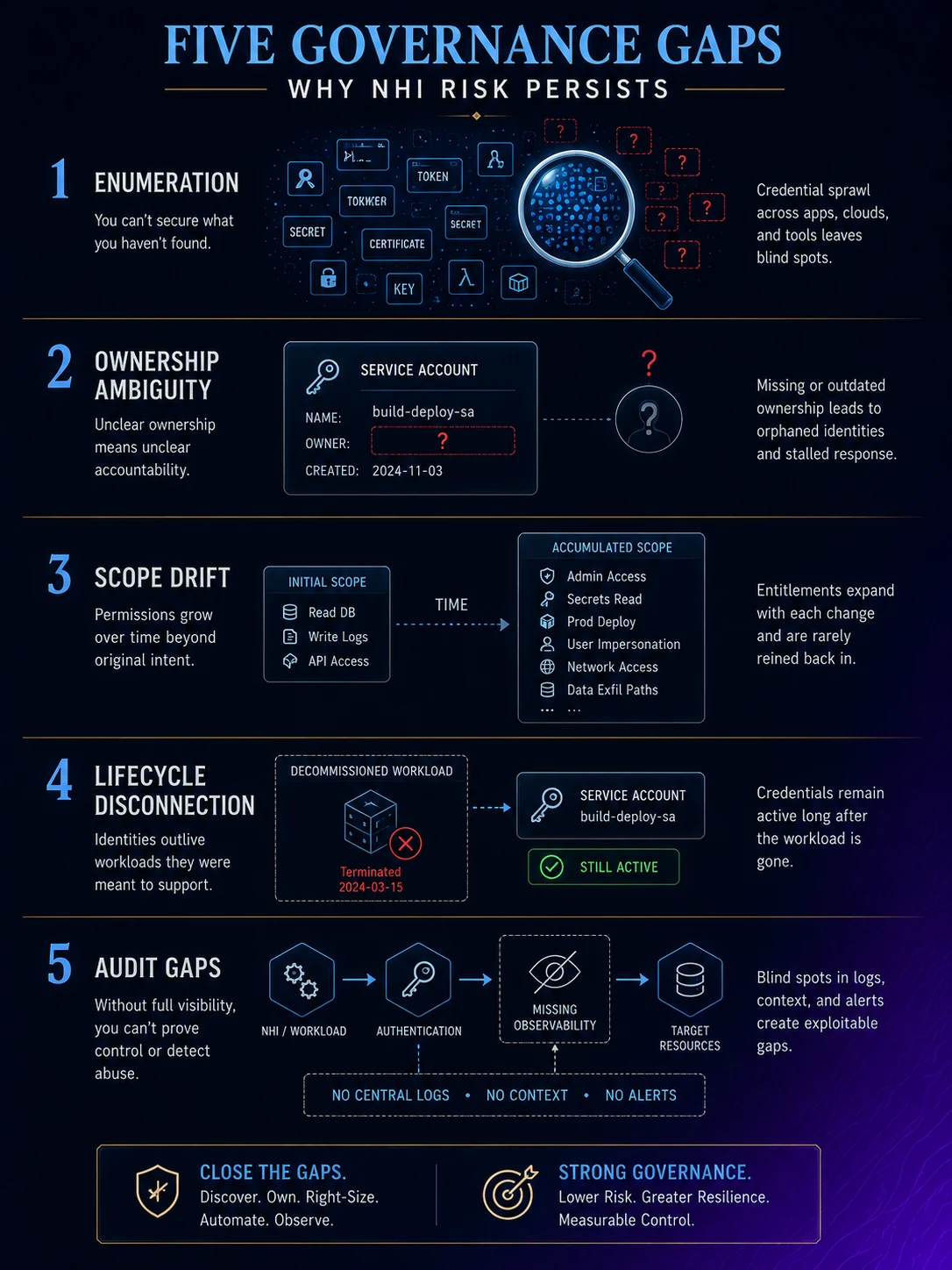 Five gaps, one failure mode. The breach corpus is dominated by NHI compromises traceable to one of these five gaps. Closing them is what NHI governance actually means in practice.
The five governance gaps where NHI fails
Enterprise NHI deployments in 2026 fail at five predictable points. Knowing the gaps in advance is the difference between an NHI governance program that ships value and one that produces compliance findings during audit.
Gap 1: Enumeration. The first failure is not knowing what NHI exists. Service account credentials accumulated over years are scattered across configuration files in code repositories, secret stores in CI/CD systems, environment variables in production servers, and the long memory of senior engineers who haven't documented them. Cloud-native workload identities are theoretically enumerable from the platform's IAM console, but most enterprises haven't run that enumeration recently and have stale entries. API keys issued to partners are documented in spreadsheets that drift from reality. The first step in NHI governance is establishing a complete inventory — and the discovery effort is usually larger than enterprises expect.
Gap 2: Ownership ambiguity. The second failure is not knowing who owns each NHI. A service account created in 2018 by an engineer who left in 2020 has no current owner. The system that depends on it might still work, but no one has a clear "I am responsible for this credential" relationship. When the credential needs to rotate, no one is sure what will break. When it needs to be revoked, no one is sure what depends on it. The governance pattern that works is requiring an owner field on every NHI record, propagated from the deployment manifest or service registry, with automatic escalation when the owner leaves the company or changes teams.
Gap 3: Scope drift. The third failure is permissions accumulation over time. A service account is created with the minimum access it needs. A few months later, an engineer adds a permission to handle a new use case. A year later, another engineer adds another. After five years, the account has dozens of permissions, most of which aren't needed for its actual workload. The standing surface for an attacker who compromises the credential is much larger than the workload requires. The governance pattern is periodic scope certification — the owner reviews the account's current permissions and explicitly removes anything not actively needed.
Gap 4: Lifecycle disconnection. The fourth failure is that NHI lifecycles don't track the workload they support. A service account for an application that was decommissioned in 2022 may still be active in 2026 because nobody remembered to deprovision it. A CI/CD service account for a project that moved to a new pipeline may still have credentials in the old pipeline. An API key issued to a partner that was acquired by a competitor may still be valid. The governance pattern is tying NHI lifecycle events to deployment events — when a service is decommissioned, its identity should be automatically marked for deprovisioning; when a CI/CD project is archived, its credentials should auto-rotate or expire.
Gap 5: Audit and monitoring depth. The fifth failure is insufficient observability of NHI behavior. Human identities have well-developed audit patterns — login events, MFA challenges, access requests, certification cycles. NHI audit data is often thin — what API call did the service account just make, from what source IP, with what payload, returning what result. The governance pattern that works is ITDR-style detection on the NHI traffic, with anomaly detection trained on per-NHI behavior baselines. Our ITDR piece covers the detection layer pattern in depth.
The five gaps compose into the failure mode that produces breach incidents: an NHI nobody knew existed, owned by nobody, with permissions accumulated beyond what's needed, surviving past the workload it served, with no monitoring of its behavior. Closing the five gaps is what NHI governance actually means in practice.
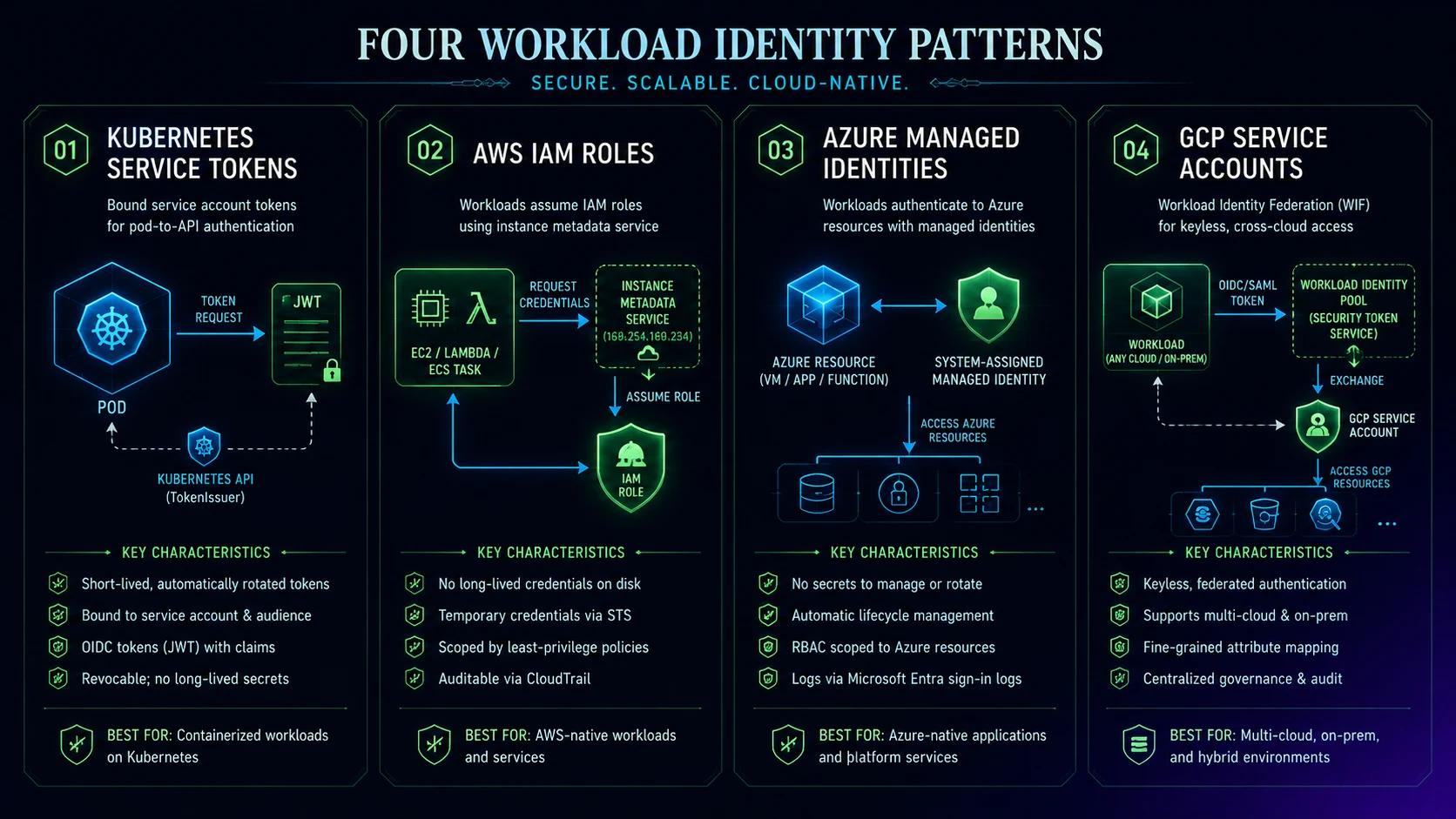 Four cloud-native workload identity patterns. None requires long-lived secret rotation; all require governance at the binding layer (which workload assumes which identity, and with what scope).
The four workload identity patterns that work in 2026
Cloud-native NHI architecture in 2026 has converged on four workload identity patterns that the major platforms support. The choice depends on workload type and platform; the governance principles are similar across all four.
Kubernetes service account tokens. The Kubernetes-native pattern. A pod is bound to a service account at deployment time; the pod's container automatically receives a JWT issued by the cluster's token issuer. The JWT is short-lived (typically an hour) and bound to the specific pod identity. Downstream services that the pod calls verify the JWT against the cluster's token issuer. Governance happens at the service account binding — the cluster admin (or the GitOps pipeline) defines which pods can assume which service accounts, and the service account's permissions are defined by RoleBindings.
AWS IAM roles assumed by compute resources. The AWS-native pattern. An EC2 instance, Lambda function, ECS task, or EKS pod assumes an IAM role at runtime via the AWS metadata service. The role's permissions are defined in IAM policies. The credentials are short-lived (typically an hour) and rotated automatically. Governance happens at the role-assumption configuration — which compute resources can assume which roles, and what policies are attached to each role. AWS IAM Access Analyzer surfaces standing-surface analysis (what permissions are unused).
Azure managed identities. The Azure-native pattern. A managed identity is assigned to an Azure resource (VM, App Service, Function App, Container Instance) at creation. The resource authenticates to Azure services using the managed identity via the platform metadata endpoint. There are two flavors — system-assigned (tied to the resource lifecycle) and user-assigned (independent identity that can be assigned to multiple resources). Governance happens at the identity-to-resource binding and the role assignments.
GCP service accounts and workload identity federation. The GCP-native pattern. Workloads authenticate as service accounts; the service account's permissions are defined in IAM. GCP also supports workload identity federation for cross-cloud and on-prem-to-cloud workloads — a Kubernetes pod, AWS workload, or on-prem application can federate its native identity into GCP service account credentials without holding long-lived GCP keys. This pattern is increasingly important in multi-cloud environments.
The four patterns share a common architectural property: short-lived, platform-issued credentials replace long-lived passwords or API keys. Governance focuses on the binding (which workload assumes which identity) and the scope (what the identity is authorized to do) rather than on rotating long-lived secrets. The 2026 enterprise pattern is to standardize on platform-native workload identity for cloud-native workloads, with traditional service-account passwords retained only for the legacy applications that don't support workload identity.
The architecture that ships clean for enterprise NHI
Enterprise NHI governance programs that ship clean in 2026 share five operational properties.
Property 1: Continuous discovery and inventory. The NHI inventory is continuously refreshed from authoritative sources — cloud provider IAM consoles for workload identities, secret stores (HashiCorp Vault, AWS Secrets Manager, Azure Key Vault) for stored credentials, CI/CD platform secret stores, service catalogs for application service accounts, and code repository scans for hardcoded credentials. The inventory has gaps; the discovery effort surfaces them so they can be remediated.
Property 2: Explicit ownership tracking. Every NHI has a documented owner — typically a team, occasionally a specific engineer. Owner records flow from the deployment manifest or service registry, propagated automatically when ownership changes (team reorganization, engineer departure). Orphaned identities (no owner) are escalated automatically.
Property 3: Scope governance and certification. NHI permissions are reviewed periodically by the owner, with explicit decisions about which permissions to keep and which to remove. The certification cadence is shorter than human IGA (often monthly or quarterly vs annual for humans) because NHI permission drift happens faster.
Property 4: Lifecycle-aware credential management. Long-lived credentials (for legacy systems that don't support workload identity) are vaulted, rotated on a defined schedule, and revoked on workload deprovisioning. Short-lived workload identities are managed at the binding layer — the binding is the lifecycle artifact, not the credential. CI/CD pipelines and deployment automation are tied into the NHI lifecycle so workload deprovisioning cascades into credential revocation.
Property 5: Behavioral monitoring at the ITDR layer. NHI traffic is monitored with the same rigor as human-identity traffic. Per-NHI behavioral baselines are established. Anomalous behavior (unusual API patterns, unexpected source IPs, atypical access scope) triggers detection events and automated response. The detection layer is part of the same ITDR architecture documented in our ITDR piece.
The five properties together produce an NHI governance posture where the category is enumerated, owned, scoped, lifecycle-managed, and observed — the same governance discipline applied to human identities, adapted for non-human-specific operational patterns. The architectural test is whether the program actually ships all five — most enterprises in 2026 have one or two properties in place and gaps in the others, which is where the breach incidents tend to surface.
What Avatier ships toward this pattern
Avatier Identity Anywhere Lifecycle Management treats non-human identities as first-class workloads alongside human identities. The platform supports service-account provisioning workflows that derive source-of-truth from deployment manifests, service registries, and infrastructure-as-code artifacts rather than from HRIS. Certification workflows are configured for the appropriate cadence (more frequent than human-identity certifications) and routed to the appropriate owners (engineering team leads rather than HR-driven managers).
For mainframe environments, Avatier's native RACF, ACF2, and Top Secret connectors handle service-account governance on z/OS workloads — including the historical mainframe service account population that most cloud-native NHI products don't reach. The lifecycle integration ties mainframe service-account provisioning to the same deployment-change workflows that govern modern-stack NHI.
Integration with major PAM platforms (CyberArk, BeyondTrust, Delinea, HashiCorp Vault) covers the credential-vaulting requirements for the legacy NHI subset that still depends on long-lived passwords. The Avatier governance layer drives the lifecycle (who owns the credential, when it should rotate, when it should be revoked); the PAM platform handles the vaulting and session-level protection at runtime.
Integration with the ITDR layer provides the behavioral monitoring property — Avatier's audit telemetry on NHI lifecycle events feeds the detection layer, and the detection signals feed back into governance certifications (an NHI that's behaving anomalously triggers an out-of-cycle scope review by the owner).
The Avatier Trust Center publishes our compliance posture (SOC 2 Type II zero exceptions, ISO/IEC 27001:2022, PCI DSS v4.0.1, CSA STAR Level 1, NIST 800-53 Rev. 5 aligned, CISA Secure-by-Design Pledge signatory). The architectural pattern works regardless of vendor — the point of this piece is not that you have to buy Avatier — but the integrated pattern of continuous discovery + explicit ownership + scope certification + lifecycle-aware credential management + ITDR-layer behavioral monitoring is what separates an enterprise that has actually governed its non-human identity surface from one that has merely audited its IAM console.
The honest closing
Non-human identity is the dominant identity category in 2026 enterprises by population, and the dominant category in the breach-incident corpus by attack-pathway involvement. The governance discipline lagged the category's growth by a decade. Traditional IGA was designed for human identities and doesn't translate cleanly. The 2026 architecture that works treats NHI as a first-class governance domain with patterns adapted from human-identity governance but tuned for the operational differences — source-of-truth from deployment artifacts, certification by owning teams, lifecycle tied to deployment changes, audit through ITDR-style behavioral monitoring. The enterprises that close the five governance gaps (enumeration, ownership, scope, lifecycle, monitoring) will materially reduce their exposure to the attack patterns that dominated the 2023-2025 breach corpus. The enterprises that treat NHI as infrastructure to deploy rather than identities to govern will continue to be where the next wave of incidents surfaces.
ABOUT THE AUTHOR

More from IAM & Identity Governance

Deprovisioning AI Agents: Governed Offboarding with Avatier
Deprovisioning an AI agent retires its identity, credentials, and tool access when its purpose ends. The triggers, a seven-step offboarding runbook, and how Avatier supports it.

What Is Pay Per Identity Action™? Outcome-Based Identity, Explained
Pay Per Identity Action™ is Avatier's outcome-based identity pricing model: you pay only for completed, verified, policy-compliant identity outcomes, not for seats, modules, or services hours.

What Is Agentic Identity? Governing AI Agents as Identities
Agentic identity is the governed identity an AI agent acts under. How it differs from human and machine identity, how delegated authority works, and the lifecycle that keeps agents accountable.