Identity Threat Detection and Response (ITDR) for Enterprise 2026
ITDR is the buzzy adjacent category to IGA — and in 2026 it has become a load-bearing layer for any enterprise that wants to detect identity-based attacks instead of just preventing them. The honest guide to what ITDR is, where it fits relative to IGA, and the architecture that ties identity governance to identity detection.
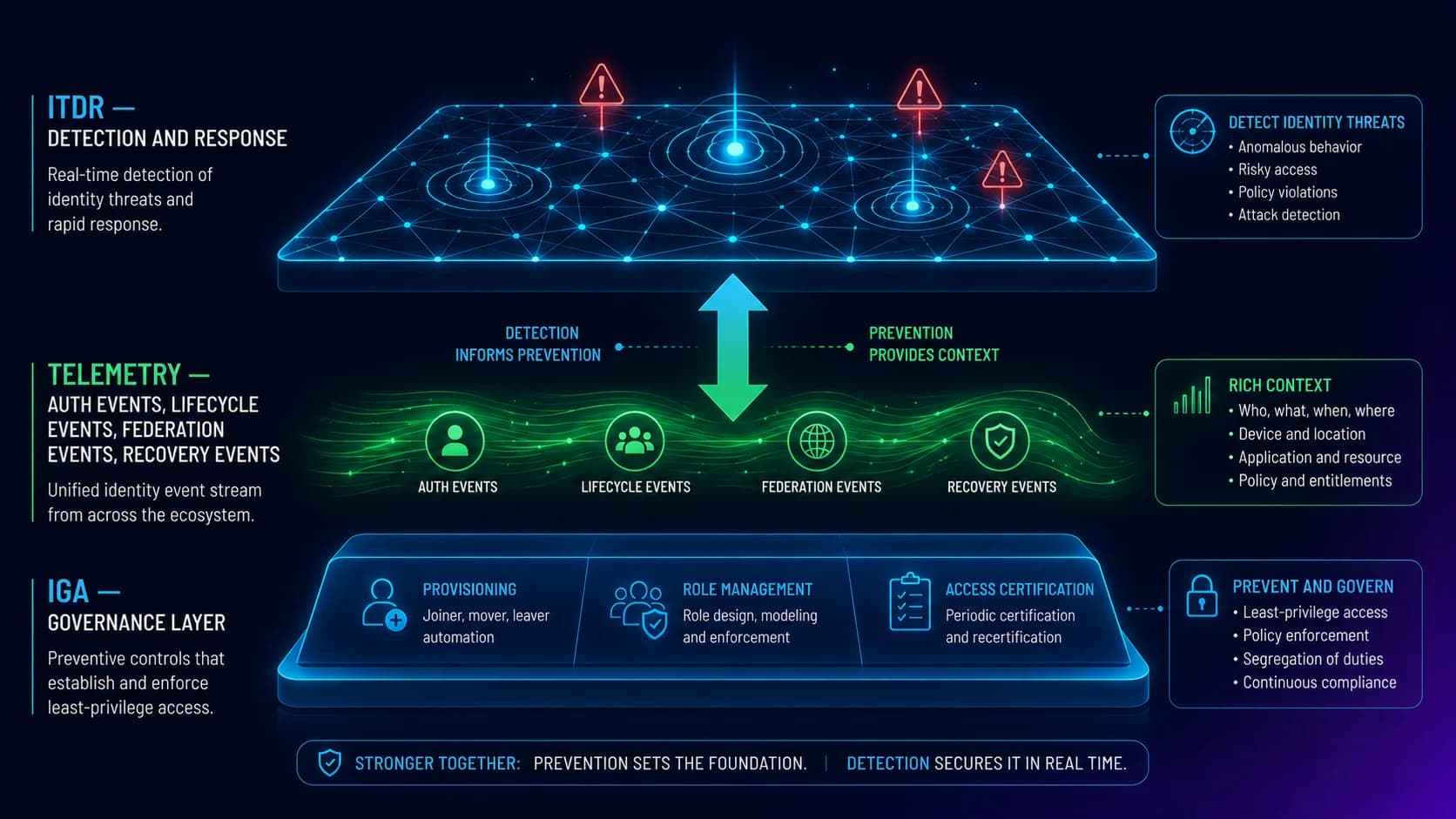
ITDR is the buzzy adjacent category to IGA — and in 2026 it has become a load-bearing layer for any enterprise that wants to detect identity-based attacks instead of just preventing them. The honest guide to what ITDR is, where it fits relative to IGA, and the architecture that ties identity governance to identity detection.
The category that didn't exist in enterprise security architecture diagrams five years ago is now load-bearing. Identity Threat Detection and Response — ITDR — is the runtime detection layer that sits above identity governance, watches for identity-based attacks against the preventive controls, and triggers response playbooks when the prevention layer has been bypassed. In 2026, every meaningful enterprise security architecture has an ITDR layer, whether it is shipped by a dedicated product, federated from the SIEM, or composed across the XDR and identity stack.
The reason ITDR matters now and didn't matter five years ago is the same reason IGA matters: identity has become the primary attack surface. The 2025-2026 Microsoft Digital Defense Report continues to identify identity as the dominant initial-access vector across the breach corpus. The Mandiant M-Trends report similarly identifies credential compromise as the leading attack pattern. The CISA advisories from 2024-2025 consistently flag identity-based attacks against federation infrastructure, OAuth consent grants, recovery channels, and privileged accounts. The preventive controls — strong MFA, governed access provisioning, lifecycle-aligned deprovisioning — reduce but do not eliminate the attack surface. The remaining surface needs detection.
This piece is the operational refresh on ITDR for a 2026 audience. The companion pieces handle adjacent topics: the Storm-2949 governance failure analysis covers the social-engineering attack pattern ITDR detects, the False Positive Reduction in AI piece covers the detection-noise problem ITDR shares with broader SOC tooling, and the Best IGA Solutions piece covers the preventive layer ITDR is the detection complement to. This piece is the ITDR-specific layer that runs above the governance foundation.
What ITDR actually is, and what it isn't
ITDR is a security architecture category, not a single product. The category is defined by the kinds of signals it consumes and the kinds of detections and response actions it produces — not by a single vendor's product taxonomy. The defining characteristics are identity-system telemetry as the primary signal source and identity-specific attack patterns as the primary detection objective.
The signal sources ITDR consumes are the identity stack's runtime telemetry. The authoritative IdP — Microsoft Entra ID, Okta, Ping, ForgeRock, or another — produces authentication events (every login, every MFA challenge, every federated session). The IGA layer produces lifecycle and provisioning events (every access grant, every role assignment, every certification action). The privileged-access management (PAM) layer produces privileged-session events (every elevated session, every credential checkout). The federation broker produces SAML and OAuth events (every consent grant, every token issuance). The recovery channel produces help-desk verification events (every reset, every credential re-enrollment).
The detections ITDR produces are identity-attack-pattern detections. The conventional categorization includes anomalous authentication context (impossible travel, unusual device, behavior shift), credential compromise indicators (credential stuffing, password spray, MFA fatigue), privilege escalation (unexpected grants, role-bypass attempts, runtime SoD violations), federation exploitation (token theft, illicit consent, OAuth scope abuse), and lifecycle anomalies (dormant reactivation, leaver retention, provisioning that diverges from HRIS truth). The response actions ITDR triggers range from passive logging and analyst alerting to active session termination, credential revocation, automated re-authentication challenges, and lifecycle-corrective provisioning rollbacks.
The thing ITDR is not is a replacement for the preventive layer. ITDR detects attacks; it does not prevent them. The strongest ITDR detections still require a governance layer that has provisioned identities correctly, an authentication layer that has deployed phishing-resistant credentials where they fit, and a recovery channel that has workflow-tied verification. ITDR runs above the prevention; it does not substitute for it. An enterprise that deploys ITDR without strong IGA, strong MFA, and a workflow-verified recovery channel is detecting attacks that better prevention could have stopped earlier and cheaper.
The other thing ITDR is not is a distinct product category that exists separately from SIEM, XDR, and IGA. In 2026 most enterprises are running ITDR functionality across multiple products — the SIEM ingests identity events and runs identity-specific correlation rules, the XDR includes identity signals in its endpoint context, the IGA platform produces lifecycle-anomaly signals, and dedicated ITDR products federate the signals into identity-attack-pattern detections. The architectural reality is that ITDR is a detection domain that composes across the stack, not a single tool that owns the domain end-to-end.
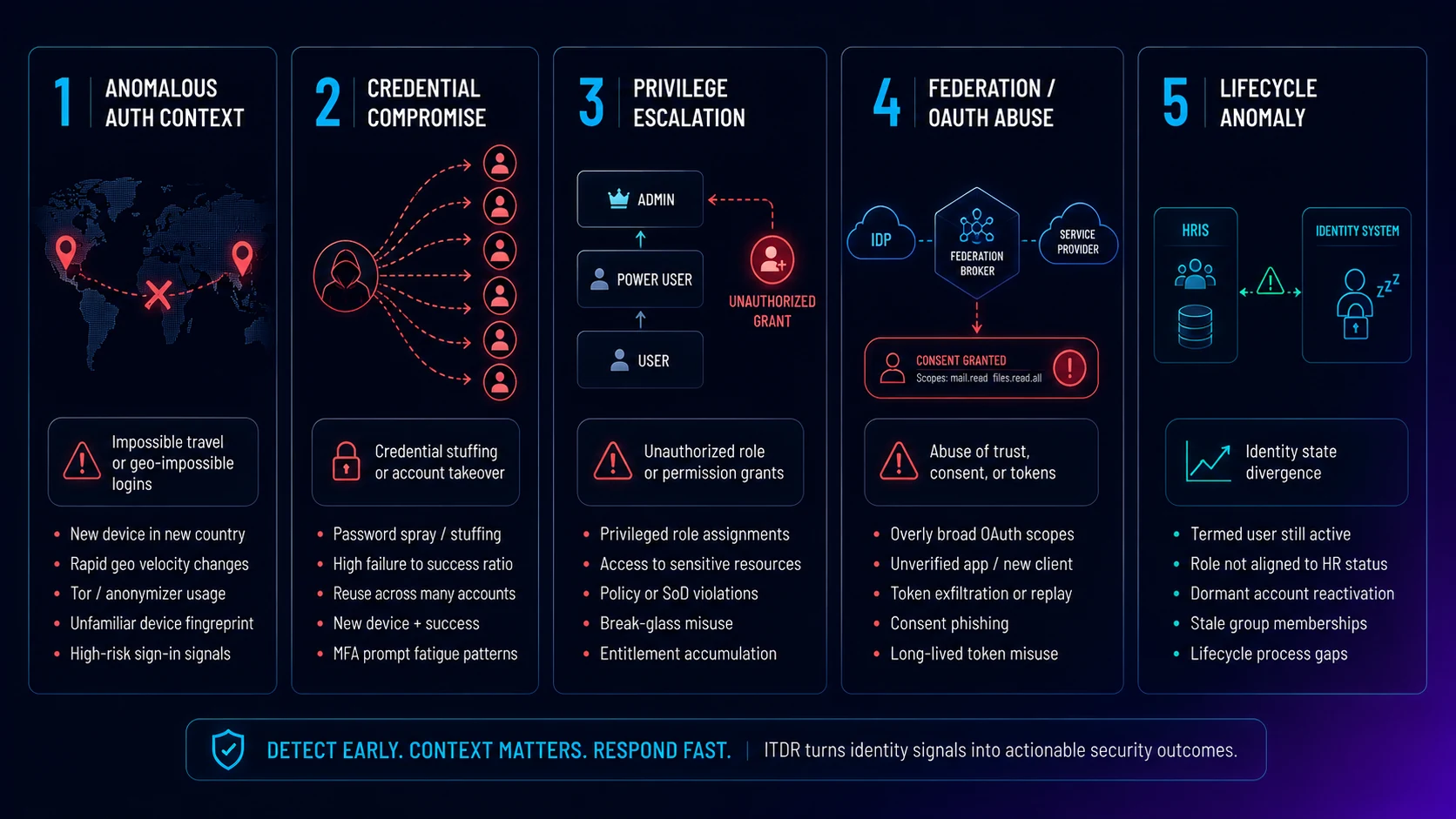 Five detection categories, one architectural pattern. Each is high-signal when the IGA layer provides authoritative context; each is noise when ITDR runs without ground truth underneath.
The five ITDR detection patterns that matter operationally
Enterprise ITDR deployments in 2026 produce useful detection coverage across five categories. The relative importance varies by industry and threat model, but the five categories are consistent across enterprise deployments.
Anomalous authentication context. The most established ITDR detection category. The pattern is to baseline normal authentication context — geography, device fingerprint, time-of-day pattern, behavior pattern — and detect significant deviations. Classic detections include impossible travel (the user authenticates from New York at 10:00 and Madrid at 10:15), unusual device (the user typically authenticates from a managed laptop and now is authenticating from an unknown device), and behavior shift (the user typically signs in at 9 AM and starts authenticating at 3 AM). The detection has been part of major IdPs for years (Microsoft Entra ID's risk-based conditional access, Okta's ThreatInsight, Google Workspace's account compromise detection); the ITDR contribution is correlation across signals that any single IdP doesn't see end-to-end.
Credential compromise indicators. Pattern detection of credential stuffing (many accounts targeted in rapid succession from a single source), password spraying (one common password attempted against many accounts), MFA fatigue (a single user receives many push prompts in a short window), and recovery-channel abuse (many recovery requests from a single source). The detections feed both immediate response (rate limiting, account lockout, additional verification) and longer-term threat hunting (which credential corpora are showing up, which user populations are over-targeted, which attack groups are operating against this environment).
Privilege escalation events. Detection of identity-state changes that produce unexpected access — a service account suddenly getting privileged group membership, a regular user suddenly assigned a domain-administrator role, a recently-disabled account being re-enabled by an unusual actor. The detections are usually high-fidelity (false-positive rate is low because privilege changes are infrequent and expected ones can be allowlisted) but high-stakes (the response action often needs to be fast). The pattern depends on the IGA layer producing accurate ground truth for what privilege grants are expected.
Federation and OAuth exploitation. The detection category that has gotten more consequential since 2023. The pattern is to detect malicious or unauthorized federation activity — illicit consent grants (a user is tricked into granting an attacker-controlled OAuth application broad scopes against their identity), token theft (an attacker captures a session token and reuses it), federation broker abuse (an attacker exploits SAML or OIDC misconfiguration to forge an authenticated session). The CISA advisories from 2023-2025 have repeatedly flagged this category as under-monitored in enterprise environments; the 2026 deployment pattern includes explicit OAuth consent monitoring and federation-event correlation.
Lifecycle anomalies. The detection category most directly dependent on the IGA layer. Pattern detection of provisioning that diverges from HRIS source-of-truth (a user account gets created without a corresponding HRIS hire event), dormant account reactivation (an account that has been unused for months suddenly is authenticating), leaver retention (accounts that should have been deprovisioned at offboarding remain active), and role assignment that doesn't match the user's current role-of-record. The pattern works only if the IGA layer is producing reliable HRIS-aligned ground truth — which is the Best ILM Solutions layer underneath. ITDR without strong lifecycle ground truth produces lifecycle-anomaly noise rather than actionable detection.
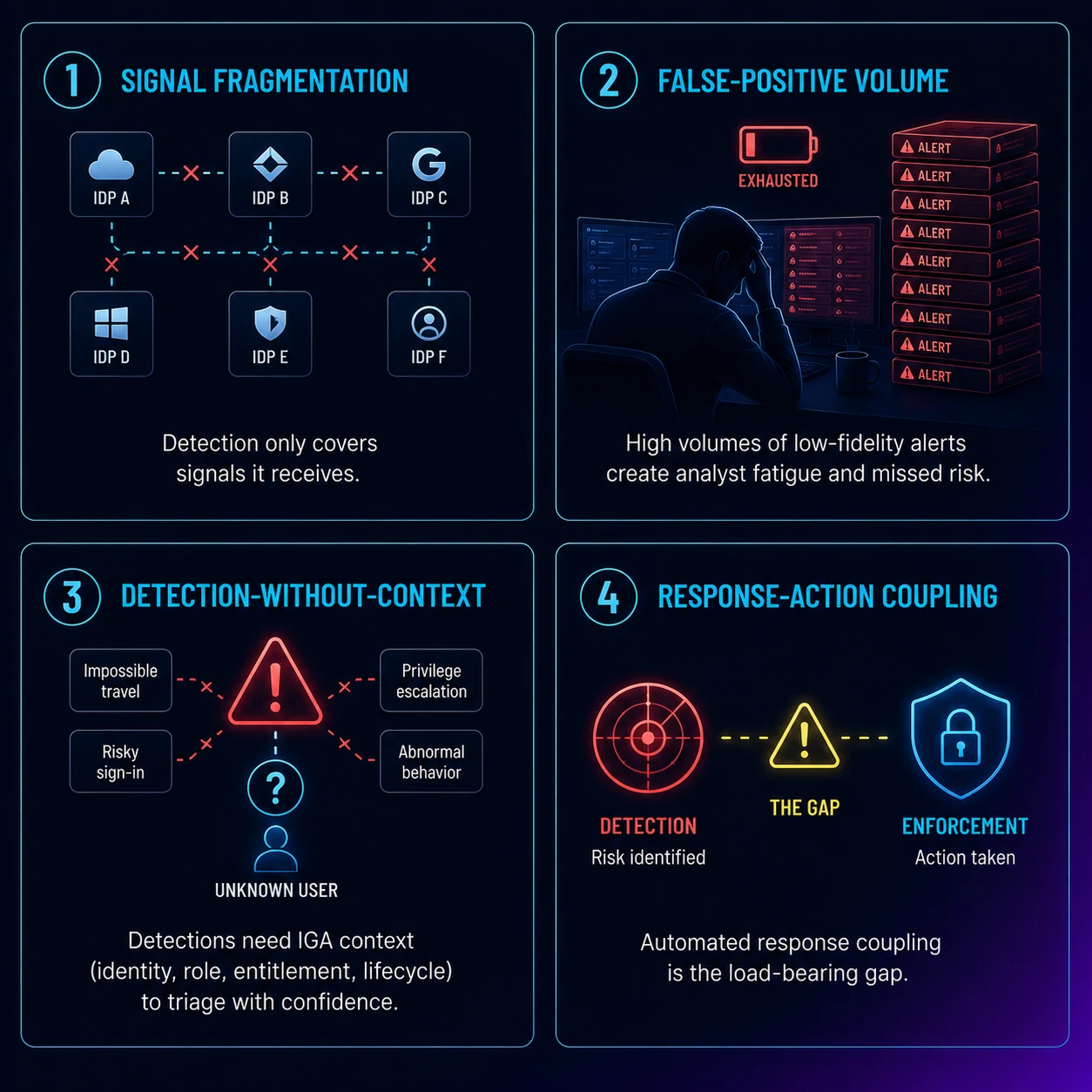 Four predictable breakage modes. Signal fragmentation and false-positive volume are tooling problems; detection-without-context and response-action coupling are architecture problems. The pattern that works is fixing the architecture before scaling the tooling.
Where ITDR breaks in 2026 production
ITDR deployments are not free. The category has predictable operational breakage modes that experienced enterprise security teams plan around.
Signal-source fragmentation. ITDR works only if the signal sources are integrated. Most enterprises have multiple IdPs (a primary plus legacy holdovers), multiple PAM platforms, multiple federation brokers, multiple authoritative HRIS systems, and SaaS applications that maintain their own identity stores. The ITDR layer can only detect on the signals it actually receives; fragmentation produces detection gaps. The remediation is investment in signal-source integration — getting each identity-producing system into the SIEM, the dedicated ITDR product, or the XDR with the right event schema. The investment is often substantial; the payoff is that ITDR detection coverage actually matches the threat surface.
False positive volume. ITDR detections, like any anomaly detection, can produce false positive volume that overwhelms the SOC analyst capacity. The classic example is impossible-travel detections that fire on a user who uses a VPN — the geographic source jumps to the VPN exit node and looks anomalous, even though it isn't. The pattern that works is tiered detection (the cheap detections fire on broad criteria and produce a baseline alert volume; the expensive detections fire on tight criteria and produce a curated alert stream that gets analyst attention) and risk-adjusted response (low-confidence detections trigger passive logging and re-authentication challenges; high-confidence detections trigger active response). The False Positive Reduction in AI piece covers the broader noise architecture that ITDR shares with the SOC.
Detection-without-context blindness. ITDR detections need identity context to be useful. "User X is authenticating from an unusual location" is a low-signal detection if the SOC doesn't know whether User X is a desk worker, a frontline employee, an executive, a contractor, or a service account. The context comes from the IGA layer — user role, employment status, expected location patterns, current project assignments, manager relationships. ITDR deployed without strong IGA-provided context produces detections the SOC cannot triage efficiently; ITDR deployed with the IGA context layer underneath produces detections the SOC can act on.
Response-action coupling failures. Detection is half the loop; response is the other half. ITDR detections that produce only alerts (with no automated response coupling) end up in the SOC alert queue alongside everything else. ITDR detections that produce automated response actions (force re-authentication, revoke session tokens, disable accounts pending investigation) need to be tightly coupled to the IdP and IGA enforcement paths. Most enterprises in 2026 are still working through the response-action coupling — the detections are mostly in place, the automated responses are in flight, the manual workflows for the response actions that aren't yet automated are the current load-bearing layer.
Compliance-versus-security tension. ITDR detections produce identity audit data that is regulated under various data-protection regimes. The behavioral baselining required for the detections can run afoul of privacy expectations or works-council obligations in some jurisdictions. The compliance review of ITDR deployment in EU member states, for example, often surfaces regulatory issues that need explicit consent flows or carve-outs. The pattern that works is bringing legal and compliance into the ITDR deployment from the start, not as a post-hoc review.
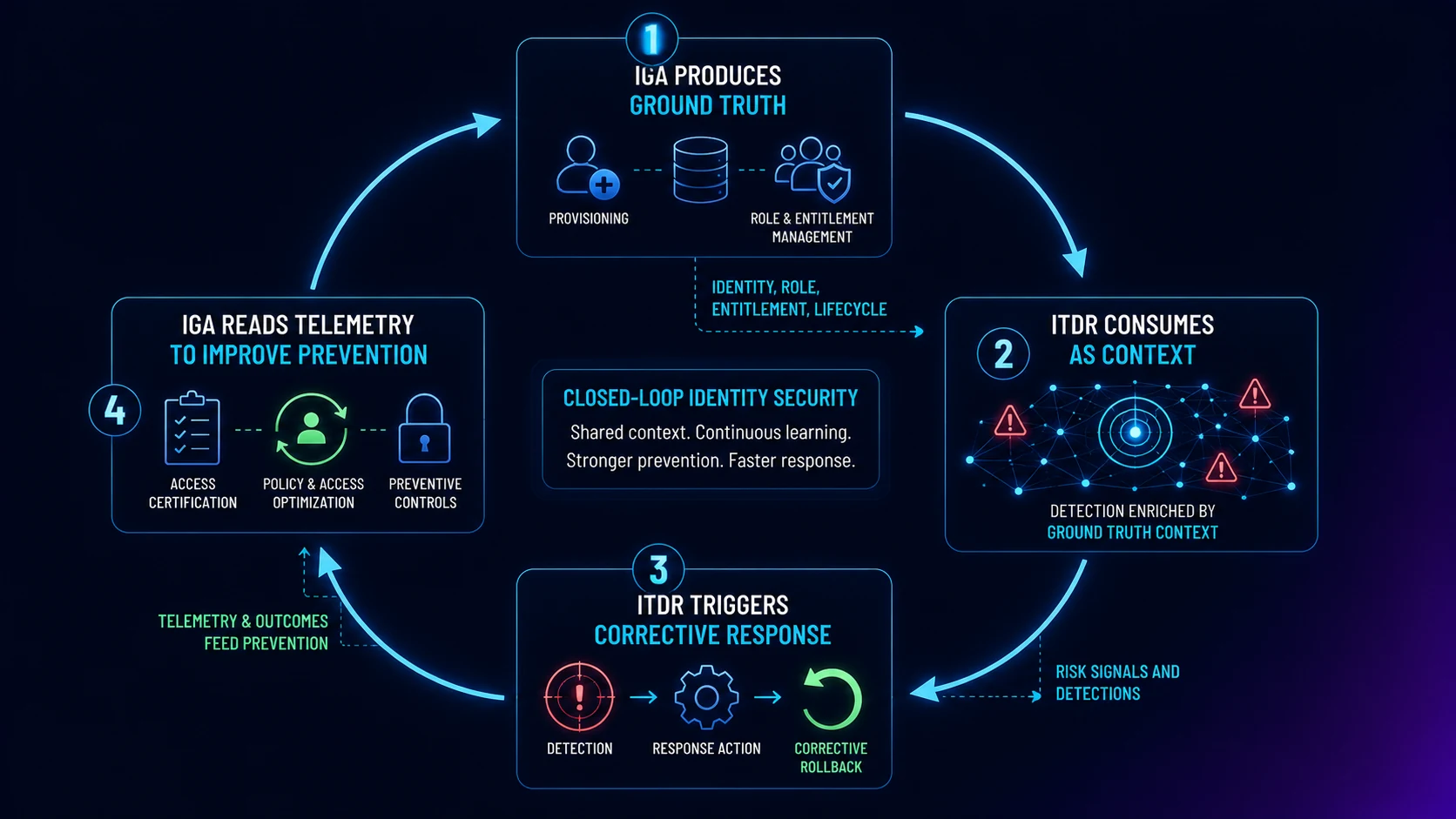 The four-stage feedback loop is what separates ITDR-and-IGA-coexisting from ITDR-and-IGA-as-a-coherent-architecture. Detection informs prevention; prevention provides context; the system gets stronger with each pass through the loop.
The architecture that ties ITDR to identity governance
The strongest enterprise security architectures in 2026 tie ITDR detection to the IGA preventive layer as a feedback loop. The pattern has four stages.
Stage 1: IGA produces governed identity ground truth. The IGA layer maintains the authoritative state of who has access to what, derived from HRIS source-of-truth via the lifecycle integration. The state is updated in real time through joiner-mover-leaver workflows, access certifications, and role updates. Every access grant has a recorded provenance.
Stage 2: ITDR consumes the ground truth as detection context. When ITDR sees an authentication event, a privilege grant, a federation token issuance, or a recovery event, the detection logic compares the event against the IGA-maintained ground truth. The detection signal is more precise because the context is authoritative — "this account just got admin privileges and according to IGA it should not have admin privileges" is a much higher-signal detection than "this account just got admin privileges and we don't know whether that's expected."
Stage 3: ITDR triggers governance-corrective response. When ITDR detects an attack pattern, the response action can include not just immediate containment (session termination, account disable) but also governance-corrective remediation (roll back the unauthorized privilege grant, re-issue the access certification for the affected user population, generate a compliance audit event for the incident). The response loops back into the IGA state, making the governance layer self-correcting against detected attacks.
Stage 4: IGA reads detection telemetry to improve prevention. The detection telemetry from ITDR feeds back into IGA's access-certification cycles and risk-scoring. Users whose accounts are repeatedly flagged for anomalous authentication get more frequent access certifications; access grants that are repeatedly involved in detection events get scrutinized in the next certification cycle; service accounts that are involved in detection patterns get reviewed for unnecessary privilege. The detection layer informs the prevention layer.
The four-stage loop is what separates an enterprise that has ITDR-and-IGA-coexisting-but-not-integrated from an enterprise that has ITDR-and-IGA-as-a-coherent-architecture. The latter is what produces measurable improvement in mean time to detect and mean time to respond for identity-based attacks; the former is what produces the SOC frustration of having ITDR alerts that the IGA platform doesn't act on.
What Avatier ships toward this pattern
Avatier Identity Anywhere produces the identity-system telemetry that ITDR detection layers consume. Authentication events, federated session activity, lifecycle-managed identity changes, privileged-access grants, recovery-channel verification events — all are produced through standard logging interfaces (syslog, SIEM connectors, REST API for event polling) designed for ITDR consumption. The Avatier audit trail is structured to be ITDR-consumable rather than requiring custom parsing on the detection side.
The Avatier Identity Anywhere Lifecycle Management layer produces the HRIS-aligned ground truth that ITDR detections need to identify lifecycle-anomaly patterns and to provide context for anomalous authentication detections. The Password Station workflow-verified recovery produces the audit signals that detect Storm-2949-style social-engineering attacks at the recovery channel — the verification ceremony events flow into the SIEM and ITDR layer with full context.
The platform integrates with major ITDR products and identity-aware detection layers through standard event streams. Microsoft Defender for Identity, CrowdStrike Falcon Identity, Silverfort, Authomize, and the major SIEM/XDR platforms can ingest Avatier audit events through their standard connectors. The integration pattern is event-stream-based rather than vendor-specific API integration, which keeps the architecture composable across the ITDR product the enterprise has chosen.
The Avatier Trust Center publishes our compliance posture (SOC 2 Type II zero exceptions, ISO/IEC 27001:2022, PCI DSS v4.0.1, CSA STAR Level 1, NIST 800-53 Rev. 5 aligned, CISA Secure-by-Design Pledge signatory). The architectural pattern is intentionally vendor-neutral on the detection side — Avatier ships the governance and telemetry layer that any ITDR product can consume, not a competing ITDR platform.
The honest closing
ITDR is the runtime detection complement to identity governance. The category has matured enough in 2026 to be load-bearing in enterprise security architectures, and the analyst coverage has solidified into a stable picture of what the detection-pattern coverage should look like. The deployment is non-trivial — signal-source integration, false-positive management, detection-context provisioning, response-action coupling, and compliance review are all real operational work. The enterprises that integrate ITDR with their IGA layer through the four-stage feedback loop produce measurable improvements in identity-attack detection and response time. The enterprises that deploy ITDR as a standalone tool without the governance-layer integration end up with high detection volume, low actionable signal, and the SOC frustration of alerts the prevention layer doesn't act on. The architecture decisions are about whether ITDR is the detection layer the governance system was designed for or a separate tool the SOC has to operate around.
ABOUT THE AUTHOR

More from IAM & Identity Governance

Deprovisioning AI Agents: Governed Offboarding with Avatier
Deprovisioning an AI agent retires its identity, credentials, and tool access when its purpose ends. The triggers, a seven-step offboarding runbook, and how Avatier supports it.

What Is Pay Per Identity Action™? Outcome-Based Identity, Explained
Pay Per Identity Action™ is Avatier's outcome-based identity pricing model: you pay only for completed, verified, policy-compliant identity outcomes, not for seats, modules, or services hours.

What Is Agentic Identity? Governing AI Agents as Identities
Agentic identity is the governed identity an AI agent acts under. How it differs from human and machine identity, how delegated authority works, and the lifecycle that keeps agents accountable.