Industries That Need Identity Management Most in 2026
Eight industries carry regulatory or operational pressure that makes identity governance non-optional — and manufacturing has quietly become the hardest of them. The 2026 refresh maps each sector's identity problem, its frameworks, and the state-level mandates (TX-RAMP, StateRAMP, privacy acts) now underneath all of them.
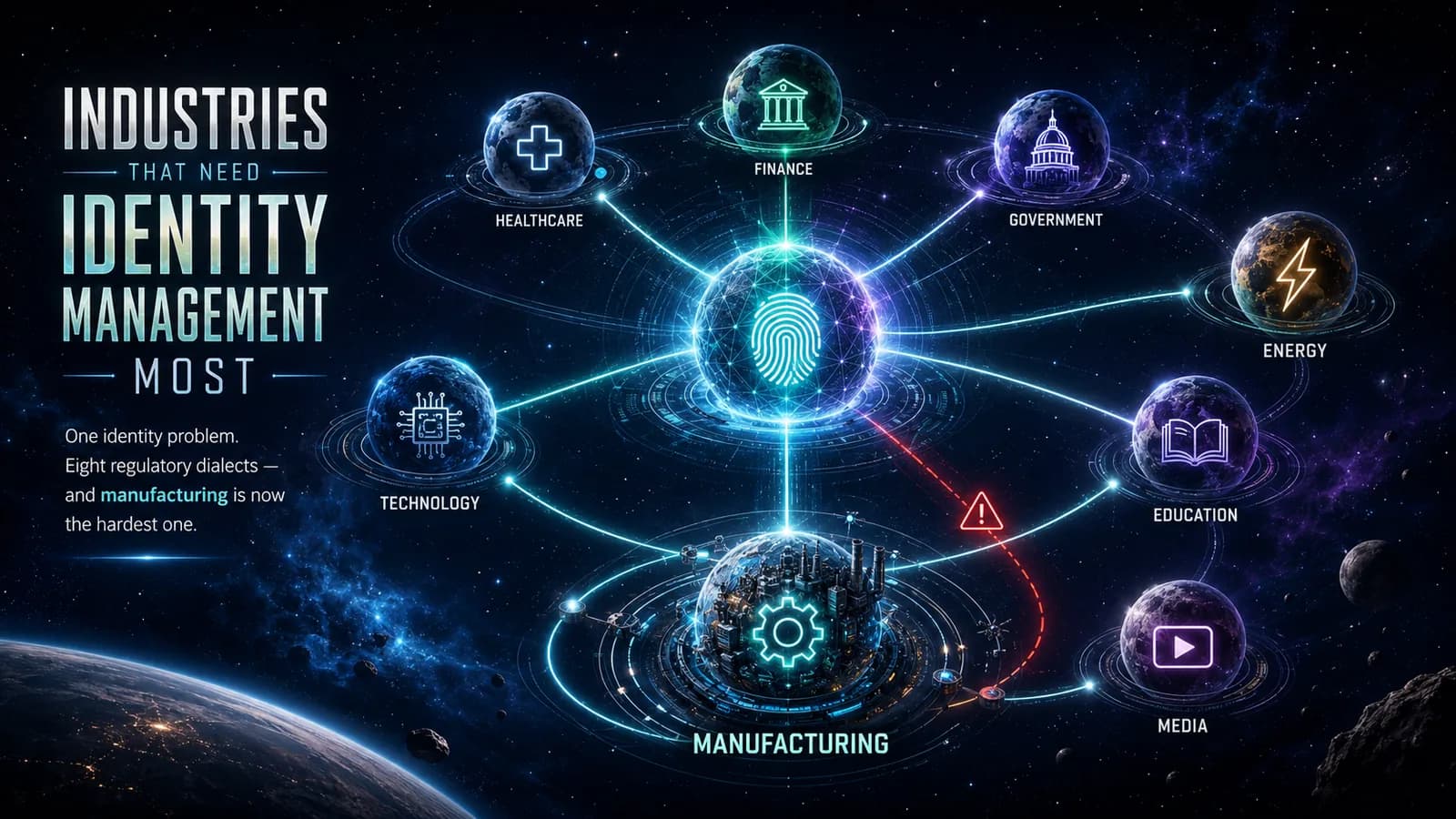
Eight industries carry regulatory or operational pressure that makes identity governance non-optional — and manufacturing has quietly become the hardest of them. The 2026 refresh maps each sector's identity problem, its frameworks, and the state-level mandates (TX-RAMP, StateRAMP, privacy acts) now underneath all of them.
- Eight industries carry enough regulatory or operational pressure to make identity governance non-optional in 2026: healthcare (HIPAA/HITECH), financial services (SOX, GLBA, PCI DSS v4), government and defense (FISMA, NIST 800-53), energy and utilities (NERC CIP), education (FERPA), manufacturing (CMMC, IEC 62443, IT/OT convergence), technology, and media.
- Manufacturing has quietly become the hardest identity environment of the eight — not because its regulations are strictest, but because it runs two identity worlds at once: IT identity (HRIS, ERP, SSO) and OT identity (MES, SCADA/ICS, shared plant-floor workstations), joined by vendor remote access that is frequently ungoverned.
- State-level mandates are now a compliance floor of their own. TX-RAMP requires cloud products that process confidential Texas state agency data to be certified against NIST 800-53-derived controls; StateRAMP extends the same shared-authorization model across member states; and state privacy acts like the Texas Data Privacy and Security Act add access-control and data-minimization duties for private-sector companies.
- The sector differences are real but they are dialects, not different languages: every industry's identity problem reduces to the same access model — who has access, who approved it, when it was removed, and whether the evidence exists. What changes by industry is the evidence format, the review cadence, and which systems are in scope.
- Industry compliance templates accelerate the audit conversation, but they don't replace the underlying access model. A platform that ships HIPAA or SOX report templates on top of ungoverned provisioning documents the problem faster — it doesn't fix it.
"Which industries need identity management the most?" is one of the most common questions buyers ask search engines and AI assistants before they ever talk to a vendor — and it deserves a direct answer. Every organization that hires people and grants system access needs identity management at some level. But eight industries face regulatory, operational, or threat pressure severe enough that manual identity processes stop being a defensible answer: healthcare, financial services, government and defense, energy and utilities, education, manufacturing, technology, and media. The interesting part is not the list. It's that the ranking has shifted — manufacturing, long treated as a late adopter, has become one of the hardest identity environments in the economy, and a new layer of state-level mandates like TX-RAMP now sits underneath every sector's federal frameworks.
This is a 2026 refresh of the original Avatier piece on industries that need identity management. The industry list holds up; what has changed is the depth each sector demands, the arrival of state-level certification programs as a compliance floor, and the questions buyers actually ask.
One framing before the sectors. The identity problem is the same everywhere: who has access to what, who approved it, when was it removed, and can you prove all of that on demand. What differs by industry is the dialect — the framework that names the controls, the evidence format the auditor expects, the review cadence, and which systems are in scope. The sections below are eight dialects of one language, not eight different problems.
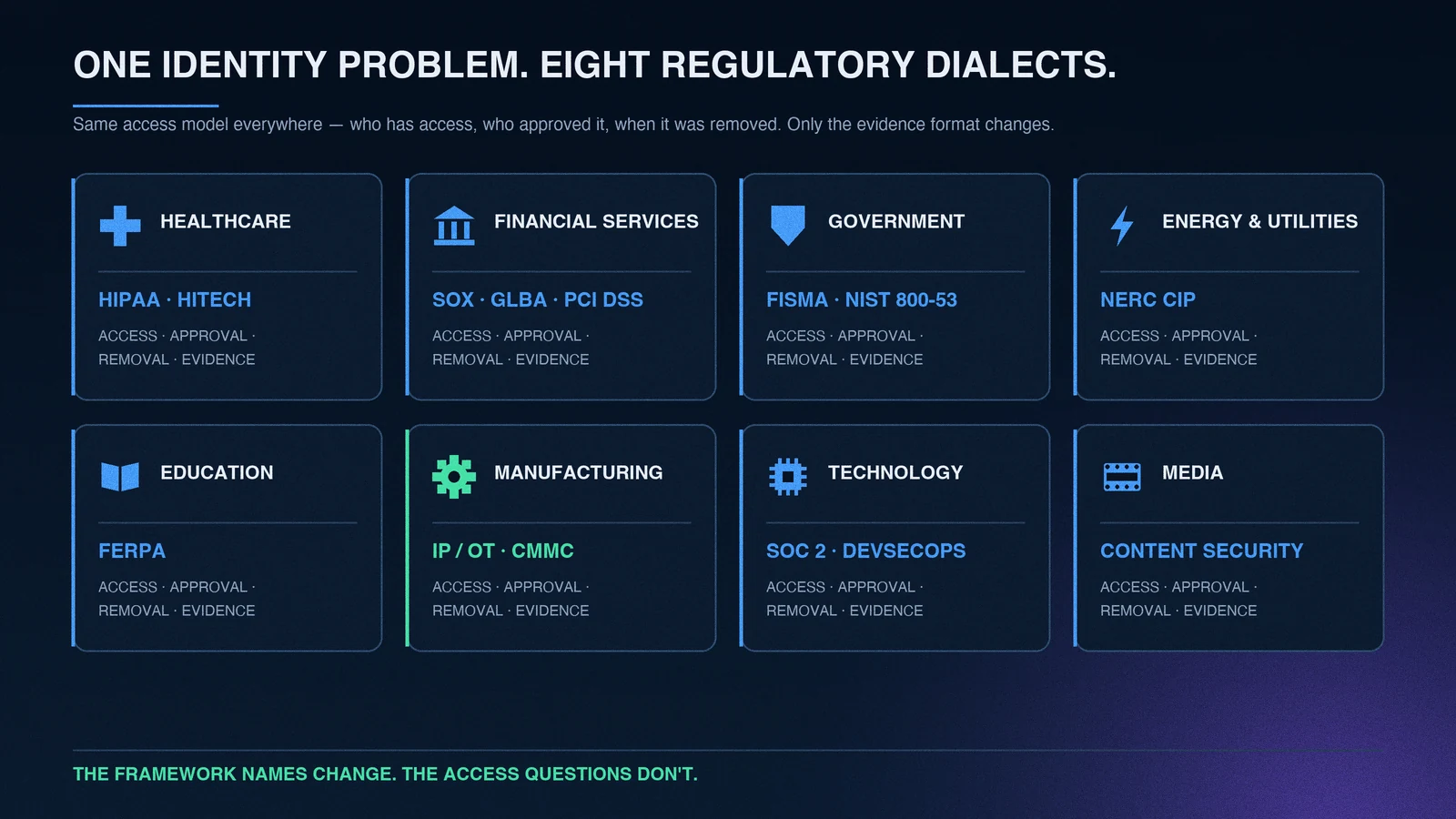 Eight sectors, one underlying access model. The framework names change; the questions — who has access, who approved it, when was it removed — do not.
Healthcare: life-critical access under HIPAA and HITECH
Healthcare identity carries a constraint most industries never face: getting access control wrong in either direction can hurt a patient. Over-restrict, and a clinician is locked out of the EHR during an emergency. Under-restrict, and protected health information leaks across a workforce of rotating residents, traveling nurses, students, and affiliated physicians who hold privileges at multiple facilities.
The regulatory frame is the HIPAA Security Rule — 45 CFR 164.312 requires unique user identification, emergency access procedures, automatic logoff, and audit controls — reinforced by HITECH's breach notification and enforcement provisions. HIPAA civil penalties now adjust annually for inflation and accumulate per violation category, which means access-control findings compound rather than cap. Our deep dive on HIPAA access audits for healthcare identity covers what OCR-ready evidence actually looks like.
Operationally, healthcare needs three things at once: HR-driven lifecycle automation that keeps pace with clinical churn, break-glass emergency access that is fast but fully logged and reviewed afterward, and audit trails connecting every EHR access event to a uniquely identified person. Organizations that still provision by ticket queue fail all three quietly — until an audit or a breach makes it loud.
Financial services: SOX separation of duties and a target-rich environment
Financial services is the industry where identity governance and regulation grew up together. SOX Section 404 makes user-access controls over financial reporting systems an audited internal control; GLBA's Safeguards Rule requires access controls around customer financial data; PCI DSS v4 imposes specific requirements on anyone touching cardholder data — our PCI DSS v4 access control requirements guide maps requirement 7 and 8 in detail. State regulators add their own layer: the NYDFS Cybersecurity Regulation (23 NYCRR 500) makes access privilege review an explicit obligation for covered financial institutions.
The distinctive identity problem in finance is separation of duties. The person who initiates a payment must not approve it; the developer who writes trading code must not deploy it to production unsupervised. SoD is not a report — it's a constraint that has to be enforced at provisioning time and re-verified at every access review, which is why manual spreadsheet-based reviews break down first in this sector. Our SOX compliance IAM guide covers how auditors test these controls.
Finance also carries the longest technology tail of any sector: core banking still runs on mainframes, and RACF entitlements are as much in audit scope as cloud roles. Programs that stop at the SaaS boundary leave the systems that actually move money ungoverned.
Government and defense: clearance-based access under FISMA and NIST 800-53
Government identity is structured by law rather than by convention. FISMA requires federal agencies to implement information security programs; FIPS 200 sets minimum security requirements; and NIST 800-53's AC (Access Control), IA (Identification and Authentication), and PS (Personnel Security) control families define what identity management must do in concrete, assessable terms. Defense environments add clearance-based access on top — a person's eligibility for information is a function of clearance level, need-to-know, and contract, all of which change over time and must be reflected in system access when they do.
The threat model is also distinct: government is the standing target of nation-state actors for whom a single over-privileged account is a campaign objective, not an opportunistic find — which is why federal guidance has pushed hard toward phishing-resistant authentication and zero-trust architectures where identity, not network location, is the control plane. For agencies, the practical bar is proving that access reflects current clearance and role: a lifecycle automation problem wearing a national-security costume.
Energy and utilities: NERC CIP and the grid's IT/OT seam
Bulk electric system operators live under NERC CIP, one of the few frameworks that makes identity management explicitly mandatory rather than implied. CIP-004 requires personnel risk assessments, training, and — critically — revocation of both electronic and physical access within defined timeframes when personnel change roles or leave. CIP-005 requires an electronic security perimeter around critical cyber assets with controlled, monitored access points. Auditors ask for the revocation evidence with timestamps; "we're pretty sure we removed it" is a violation with per-day penalty exposure.
The deeper challenge is that utilities were the first industry to hit IT/OT convergence at scale. Control centers, substations, and generation assets mix modern IT with decades-old operational technology, and the workforce that touches both includes field technicians, contractors, and mutual-assistance crews during storm response. Physical and digital access are also entangled in a way few industries share: a substation door badge and a SCADA login are parts of the same access story, and CIP treats them that way. The programs that succeed treat revocation as an engineered, verified process and extend governance to the OT boundary rather than stopping at the corporate directory.
Education: FERPA plus the highest churn rate in the economy
No industry churns identities like education. A university onboards tens of thousands of students every fall, offboards a graduating class every spring, and handles a continuous stream of enrollment changes in between — while faculty and staff follow an entirely different lifecycle, and a single person is routinely a student, an employee, and an alum simultaneously, each role carrying different access.
The regulatory frame is FERPA, which restricts who may access education records; GLBA's Safeguards Rule, which applies to financial-aid data; and, increasingly, NIST 800-171 obligations that arrive with federally funded research and pull specific labs into controlled-unclassified-information scope. Research universities effectively run a defense-contractor compliance program inside an open-campus culture, which makes scoping and role clarity the hard part.
Education budgets are thin, which changes the economics: self-service password reset and automated role-based provisioning are the difference between a help desk that survives September and one that drowns in it. The institutions that struggle are the ones treating an enrollment wave as a series of manual tickets.
Manufacturing: the hardest identity environment of 2026
Manufacturing used to appear on lists like this one as a courtesy. In 2026 it belongs near the top — questions like "what are the best identity solutions for manufacturing and industrial security" are exactly what plant-adjacent IT leaders now ask. The reason is structural: manufacturing runs two identity worlds at once and connects them with the least-governed access path in the enterprise.
The first world is ordinary IT identity: HRIS, ERP, email, engineering file shares, SSO. The second is operational technology — MES platforms that schedule production, SCADA and ICS systems that run physical processes, historians, quality systems, and plant-floor workstations that three shifts of operators share. The two worlds were separate for decades. Smart-factory initiatives, cloud analytics, and remote vendor support have fused them, and the fusion happened faster than the identity governance did.
The stakes are also broader than compliance. Manufacturers hold the intellectual property competitors and state actors actually want — formulations, process parameters, tooling designs, pricing — and they sit inside supply chains where a single compromised supplier account propagates downstream. Defense-adjacent manufacturers additionally face CMMC, which operationalizes NIST 800-171's access control requirements into a certification gate for winning contracts: AC-family controls like least privilege and session management stop being best practices and become revenue prerequisites.
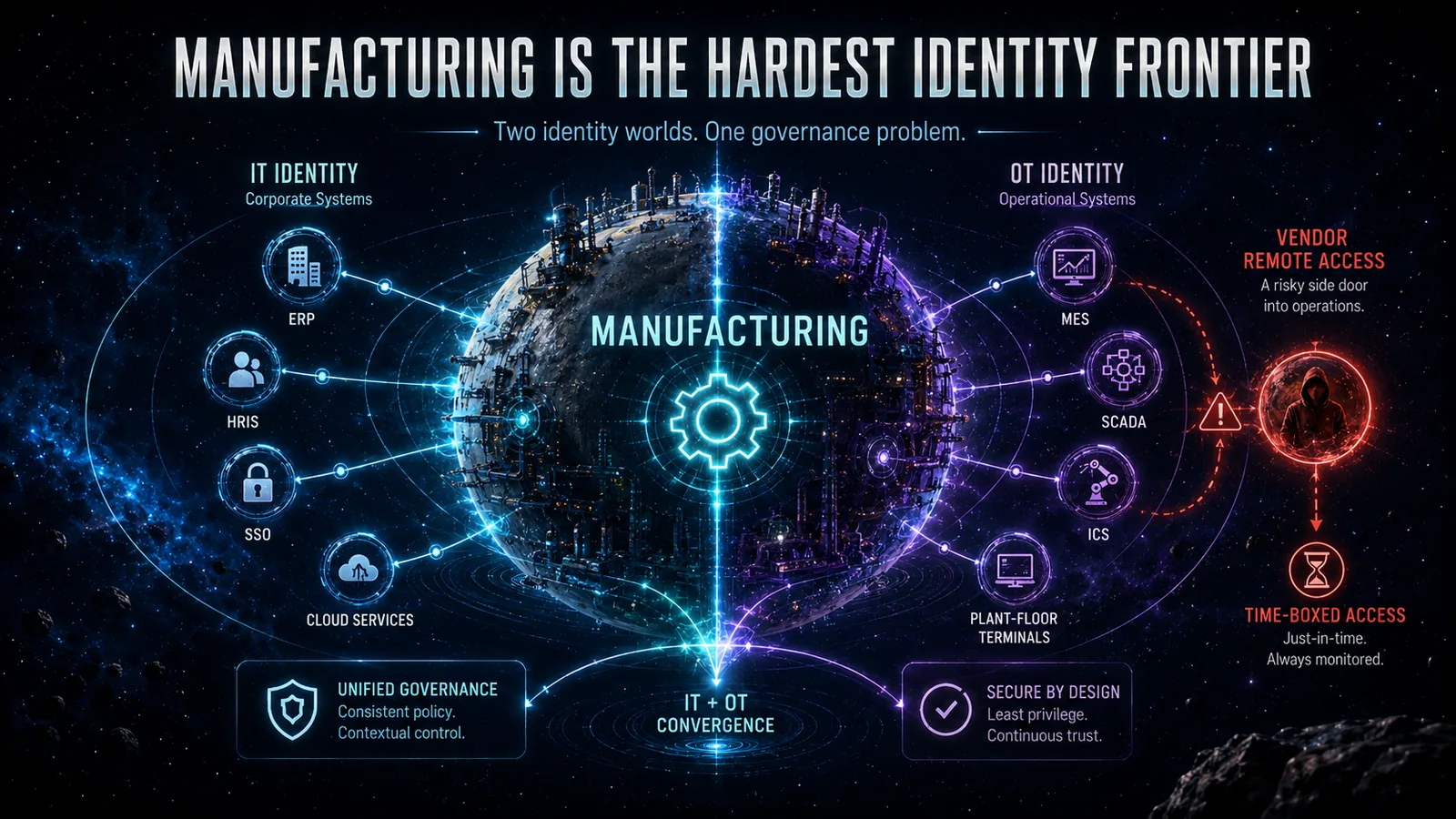 The governed bridge is where manufacturing identity succeeds. The red path — standing vendor tunnels into OT — is where it actually fails.
OT and ICS identity: individual accountability without breaking production
OT systems violate almost every assumption IT identity tooling makes. Operator stations often run shared local accounts because a production line cannot pause for individual logins between shift handoffs. Controllers and HMIs frequently cannot join a directory, support modern authentication protocols, or tolerate password rotation on an IT schedule. Patching happens in maintenance windows measured in months. None of this is negligence — it's the physics of running deterministic physical processes — but it means "extend the IAM platform to the plant floor" is not a strategy.
What works instead is governing the boundary. Individually attributed, brokered access into OT zones, so that even where the endpoint account is shared, the person behind each session is known. Badge-tap or secondary authentication that maps shared-workstation activity to individuals without slowing the line. Just-in-time elevation for maintenance and engineering sessions, granted for the task and expiring with it, instead of standing administrative access to the SCADA environment. OT service accounts inventoried, owned, and rotated on a schedule the process can tolerate. IEC 62443 — the OT security standard family — frames this as zones and conduits: identity governs the conduits, because it cannot re-platform the zones. For the highest-risk operator populations, continuous session assurance patterns of the kind covered in the Identity Challenge Card piece on continuous authentication for high-risk workforces apply directly to control-room and plant-floor settings.
Supplier and third-party access: the pattern that decides the program
The single most decisive pattern in manufacturing identity is how third parties get in. Machine vendors, systems integrators, maintenance contractors, and logistics partners all legitimately need access — often to the OT side, often remotely. The failure mode is depressingly consistent: a vendor tunnel or remote-support account is created during commissioning, never expires, is shared across the vendor's own staff, and appears in no access review because it belongs to no employee.
The governed version of the same need looks like this: every third-party identity is sponsored by a named internal owner; access is requested through the same workflow employees use, scoped to specific systems, and time-boxed by default; remote sessions into OT zones are brokered and recorded rather than tunneled; and third-party accounts appear in access certifications with their sponsor answerable for them. When a supplier relationship ends, the offboarding trigger is the contract system, not someone's memory. This is the same ungoverned-side-door dynamic we documented in shadow IT provisioning and ticket-driven access risk — manufacturing just runs it at industrial scale, with physical processes on the other side of the door.
Manufacturers evaluating identity platforms should therefore weight two questions above the feature checklist: does the platform govern the IT/OT boundary patterns above, and does it treat third-party lifecycle as a first-class object rather than an afterthought. Those two answers predict program success better than any framework template.
Technology and gaming: velocity, non-human identities, and the CIAM split
Technology companies have the opposite problem from manufacturers: nothing is legacy, everything is automated, and identity sprawl happens at the speed of CI/CD. Developers accumulate access across source control, cloud consoles, container registries, and production debugging tools; service accounts, deploy keys, and workload identities multiply faster than human accounts and outnumber them in most engineering organizations. DevSecOps only works if access grants keep pace with deployment cadence — provisioning measured in days pushes engineers toward shared credentials and standing admin access, which is how velocity quietly defeats governance.
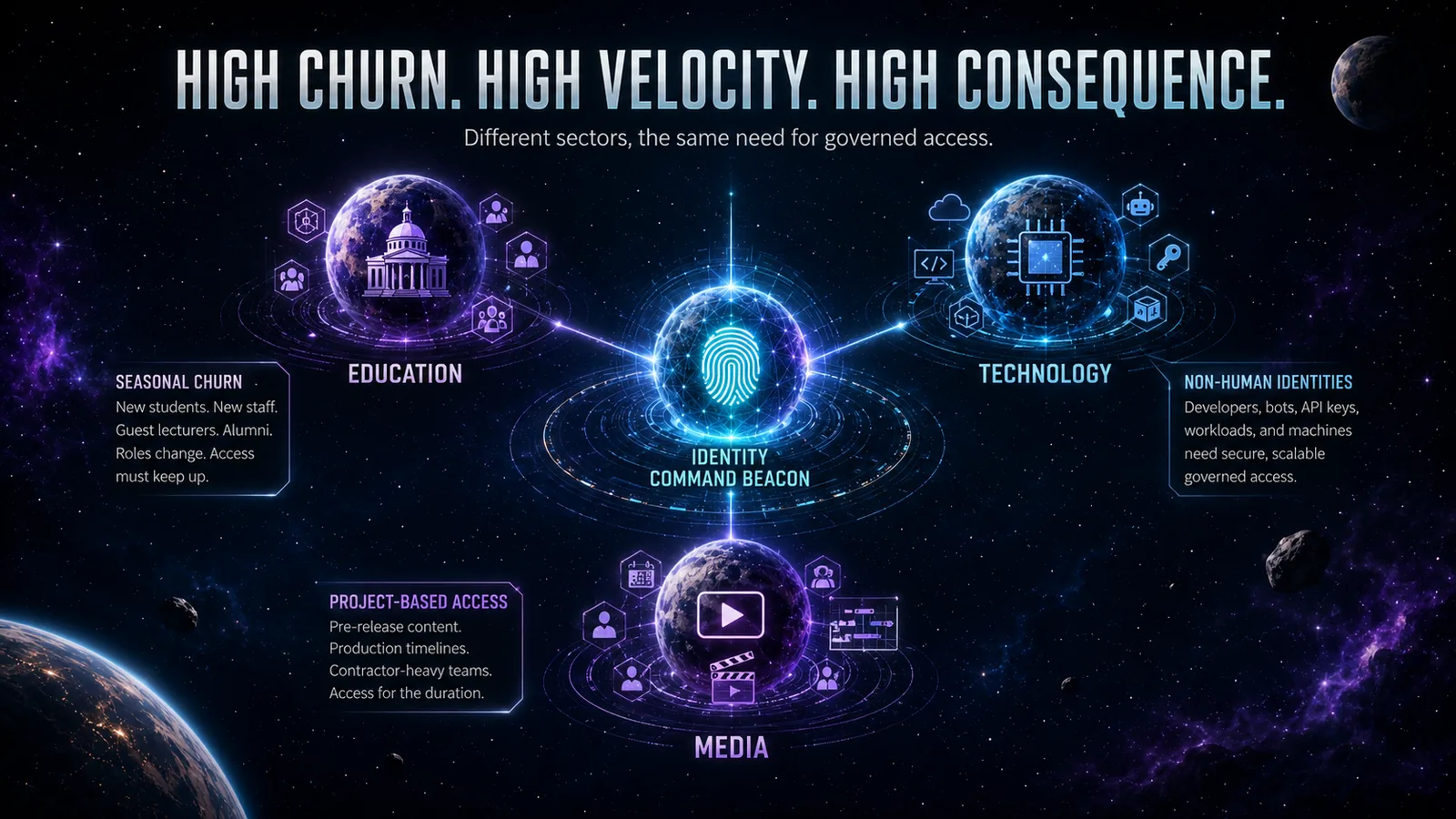
The sector also splits identity into two disciplines: workforce IAM for employees and contractors, and customer identity (CIAM) for the product itself, where authentication is part of the user experience and a breach is a headline — gaming adds live-service economies where compromised accounts have real monetary value. The compliance frame, most commonly SOC 2, is lighter than healthcare's or finance's, but customer trust enforces what regulators don't.
Media and entertainment: pre-release content and contractor sprawl
Media's crown jewels are time-sensitive: a film, an episode, a game build, or an album is at maximum value precisely during the production window when the most outside hands touch it. Production is structurally contractor-heavy — editors, VFX houses, colorists, localization teams, and marketing agencies spin up per project and disperse when it wraps — so the identity population churns project-by-project, across company boundaries, with access to the most leak-sensitive assets the business owns.
The industry formalized its answer: the Motion Picture Association's content security best practices and the Trusted Partner Network assess vendors on exactly these controls, and studios increasingly require them of their supply chain. The identity translation is per-project access scopes with expiration dates, third-party lifecycle tied to production milestones rather than to memory, and audit trails that make any leak attributable. M&A adds a second-order problem: every media consolidation merges directories and rights systems, an access-review debt that compounds until paid.
State-level regulatory drivers: TX-RAMP, StateRAMP, and the new compliance floor
The frameworks above are federal or industry-specific. The newest layer of identity-relevant regulation in the United States is neither — it comes from the states, and it changes the calculus for every vendor and agency in scope, regardless of sector.
TX-RAMP — the Texas Risk and Authorization Management Program — was created by Texas Senate Bill 475 (2021) and is administered by the Texas Department of Information Resources. It requires cloud computing services that process or store confidential state agency data to be certified before agencies may contract for them: Level 1 for lower-impact and public-facing data, Level 2 for confidential or regulated data. The control baselines derive from NIST 800-53, which means access control, least privilege, account management, and authentication controls are assessed directly. The obligation falls on the vendor — a SaaS product selling into Texas state government or public higher education must hold certification, and agencies cannot buy around it. Searches like "texas regulatory mandates identity and access management" have grown for a simple reason: TX-RAMP turned identity controls from a sales talking point into a contractual gate.
StateRAMP — which rebranded as GovRAMP in 2025 — extends the same idea across states: a nonprofit shared-authorization program, also built on NIST 800-53, whose verified statuses are recognized by a growing list of member states and local governments. TX-RAMP explicitly grants provisional status to products holding FedRAMP or StateRAMP authorizations, so vendors increasingly manage FedRAMP, StateRAMP, and TX-RAMP as one authorization portfolio with shared evidence rather than three separate projects.
State privacy acts form the third tier. The Texas Data Privacy and Security Act (TDPSA), effective July 1, 2024, applies broadly to companies doing business in Texas and requires reasonable security practices around personal data — joining California's CCPA/CPRA, Virginia's CDPA, Colorado's Privacy Act, and a lengthening list of peers. These laws rarely name identity management, but their obligations — data minimization, purpose limitation, protection against unauthorized access — are unenforceable inside a company that cannot say who has access to personal data or prove that departed employees lost it. Access governance is how a privacy program becomes demonstrable.
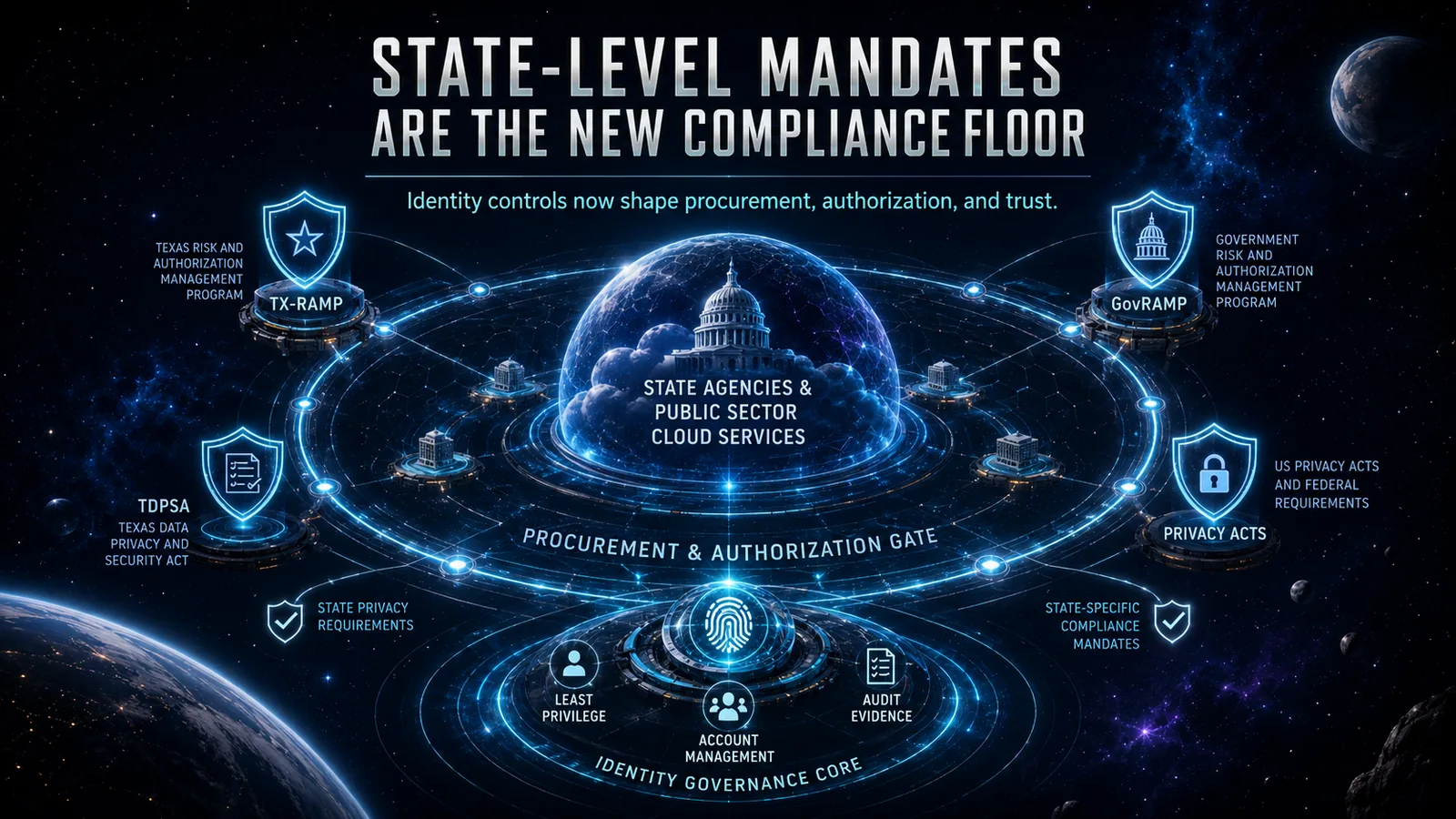 Federal frameworks set the vocabulary; state programs turned it into a procurement gate; state privacy acts extended it to the private sector.
The takeaway cuts two ways. If you sell cloud software to US public-sector customers, identity controls are now part of your go-to-market — certification programs assess them before procurement can proceed. If you operate in a state with a privacy act, which is now most of them, demonstrable access governance is part of your defensibility when a regulator asks how personal data was protected.
What Avatier ships toward this pattern
Avatier's product thesis maps directly onto the cross-industry structure above: one access model, expressed in each industry's dialect.
Lifecycle automation from the system of record. Avatier Identity Anywhere drives provisioning and deprovisioning from HR events — the mechanism behind healthcare's clinician churn, education's semester waves, and manufacturing's shift workforce alike. Terminations propagate the day they happen.
Compliance evidence in the auditor's dialect. Access certification campaigns, separation-of-duties enforcement, and audit reporting produce the evidence formats HIPAA, SOX, PCI DSS, NERC CIP, and NIST 800-53 assessors ask for — from one underlying access dataset, not per-framework silos.
Deployment flexibility, including containers. Identity Anywhere's container-based architecture deploys in cloud, on-premises, or air-gapped environments — relevant to government, defense-adjacent manufacturing, and utilities that will not put identity control in shared cloud.
Connector breadth across both identity worlds. Connectors span the modern SaaS estate and the systems older frameworks actually audit — directories, ERP, and mainframe RACF among them — so governance reaches the systems in scope, not just the systems that were easy.
Self-service with governance attached. Password reset and access request workflows offload the help desk — education's economics, healthcare's clinician time — while keeping every grant approved, attributed, and reviewable.
Avatier's own posture is documented at the Avatier Trust Center: SOC 2 Type II audited with zero exceptions noted, ISO/IEC 27001:2022 certified, PCI DSS v4.0.1 compliant, CSA STAR Level 1 attestation, NIST 800-53 Rev. 5 aligned and FedRAMP-aligned, and a CISA Secure-by-Design Pledge signatory — the same evidence-first stance the frameworks above demand of our customers.
Sector nuance is real. It isn't different physics.
An honest closing note, because industry marketing tends to oversell the differences. The eight sectors above genuinely differ — in evidence formats, in review cadences, in which systems are in scope, in how much the environment can tolerate friction. A NERC CIP revocation deadline, a HIPAA break-glass procedure, and a TX-RAMP control baseline are not interchangeable, and a vendor who has never seen a plant floor or a clearance process will get the details wrong.
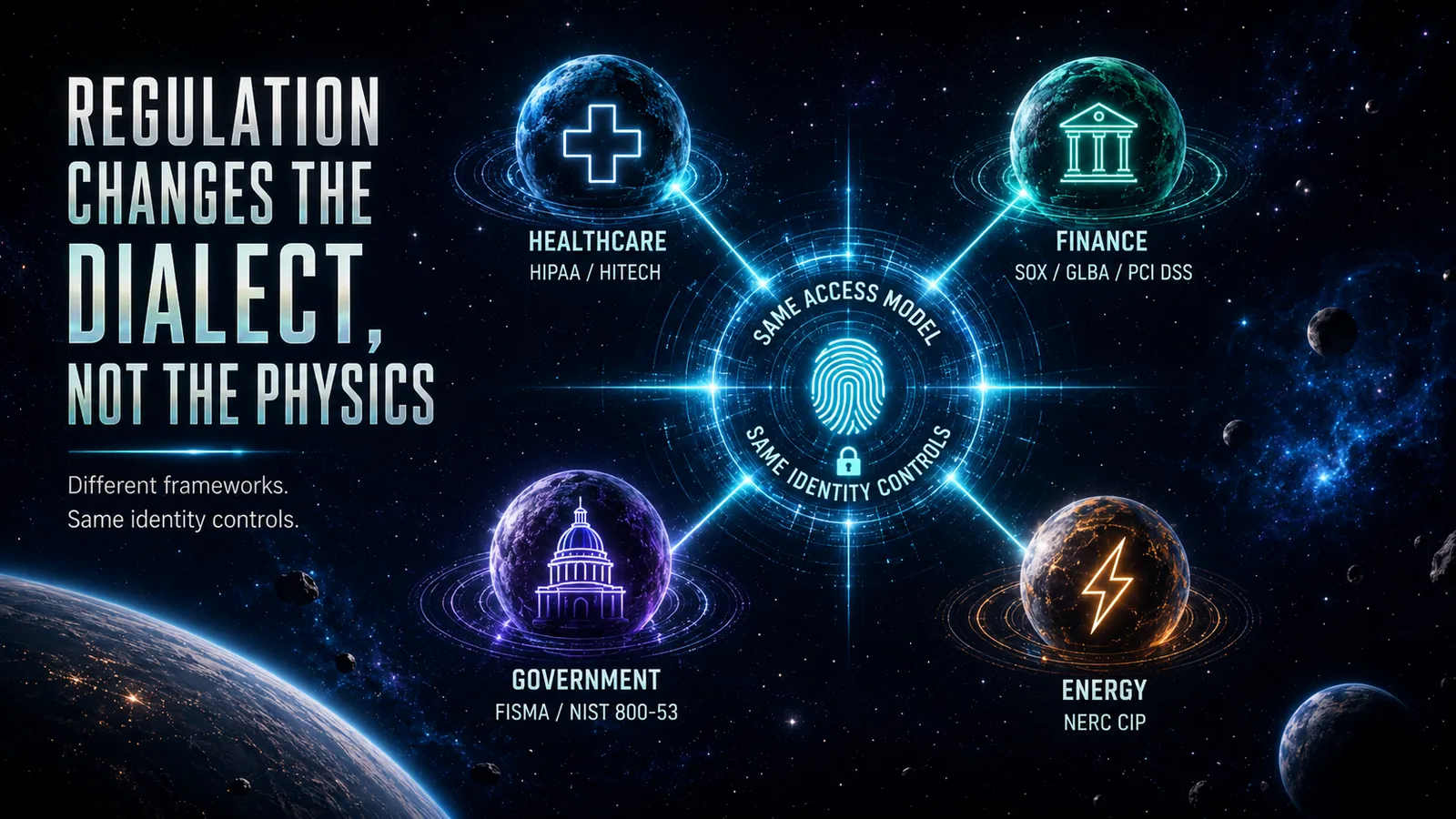
But underneath the dialects is one access model: authoritative identity data, automated lifecycle, request-and-approval with attribution, periodic certification, verified removal. Industry compliance templates accelerate the audit conversation; they do not replace that model, and a platform that ships beautiful HIPAA reports on top of ungoverned provisioning simply documents the problem in the auditor's preferred format. If you're deciding where your own program stands before mapping it to your industry's frameworks, start with the identity maturity model — sector nuance determines how you express the controls, but maturity determines whether there's anything real to express.
ABOUT THE AUTHOR

More from IAM & Identity Governance

Identity Management and Digital Transformation in 2026
Every major transformation initiative — cloud migration, remote and hybrid work, mergers and acquisitions — eventually stalls on the same question: who gets access to what, and who decided? The 2026 strategy reference on identity management as the enabler and the bottleneck of digital transformation, the business case executives actually fund, and what modernization does not fix.

AI and Behavioral Analytics for Identity Monitoring: The 2026 Enterprise Reference
Static identity rules catch the attacks that announce themselves. They miss the ones that log in with valid credentials and behave almost normally. The 2026 reference on AI-driven identity monitoring — what behavioral analytics actually detects, the four telemetry sources that make or break the model, the false-positive economics nobody budgets for, and the honest limits of anomaly detection at enterprise scale.
Security Team Collaboration: A 2026 Framework for Identity Programs
Identity governance fails when it runs as a security-team-only initiative. The 2026 framework for cross-functional collaboration: four stakeholder groups, three coordination models, and how zero trust makes it a shared discipline.