Cloud Infrastructure PAM: Vaulting and Sessions in 2026
Cloud infrastructure PAM controls privileged sessions into AWS, Azure, and GCP — vaulting root credentials and enforcing just-in-time elevation instead of standing admin roles.
Cloud infrastructure PAM controls privileged sessions into AWS, Azure, and GCP — vaulting root credentials and enforcing just-in-time elevation instead of standing admin roles.
- Cloud infrastructure PAM controls the runtime privileged session into cloud provider accounts — vaulting root/admin credentials, brokering console and CLI access, and enforcing just-in-time elevation rather than standing admin roles.
- Cloud PAM differs from on-prem PAM because the perimeter is API-driven and elastic: cloud accounts spin up and tear down constantly, credentials are often short-lived tokens rather than static passwords, and the provider's own IAM layer sits underneath whatever PAM control plane is layered on top.
- Zero standing privilege — no user or service holding permanent cloud-admin rights — is the 2026 deployment pattern for the highest-impact cloud operations, with elevation granted per-task and expiring automatically.
- Break-glass access for cloud outages needs its own path outside the normal JIT approval workflow, because the JIT system itself may depend on the cloud infrastructure that's down.
- Cloud PAM is not the same discipline as CIEM — PAM controls the privileged session at the moment of use; CIEM maps and right-sizes the standing entitlements that make that session possible in the first place. Enterprises need both, not one instead of the other.
Privileged Access Management for cloud infrastructure is the discipline of controlling the runtime session an admin, engineer, or automated identity uses to reach root or elevated privilege inside AWS, Azure, or GCP — not the standing permissions attached to their role, but what happens the moment they actually use elevated access. It differs from traditional PAM in one structural way: the perimeter it protects is API-driven, elastic, and governed underneath by the cloud provider's own IAM layer, which means the PAM control plane has to work with that native layer rather than replace it. A vault that rotates a static domain-admin password on-prem is solving a fundamentally different engineering problem than one brokering a short-lived AWS STS token that expires in an hour by design.
This is the 2026 update of Avatier's original cloud infrastructure PAM piece, which covered the basic case for securing AWS, Azure, and GCP access. This version narrows the scope deliberately: it is about vaulting, session control, and just-in-time elevation into cloud infrastructure — not about entitlement sprawl or who-has-access-to-what analysis, which is a distinct problem covered in our CIEM piece. If you're trying to figure out why a cloud IAM role has 40 permissions nobody remembers granting, that's CIEM's territory. If you're trying to figure out how to stop someone from holding a standing root credential indefinitely, that's this piece.
How cloud PAM differs from on-prem PAM
The mechanics of vaulting, session brokering, JIT elevation, and session recording are conceptually the same whether the target is a Windows domain controller or an AWS management account. What changes is the environment those mechanics operate inside.
The resources are ephemeral. An on-prem PAM deployment protects a relatively stable inventory — the same domain controllers, the same database servers, added to or removed from over months. Cloud infrastructure churns constantly: containers spin up and terminate in minutes, auto-scaling groups add and remove instances continuously, infrastructure-as-code pipelines create and destroy entire environments on a schedule. A PAM system built around a static asset inventory falls behind immediately in this environment; cloud PAM has to discover privileged targets dynamically rather than maintain a fixed list.
Credentials are frequently not passwords. Cloud providers increasingly issue short-lived tokens rather than long-lived static secrets — AWS STS session tokens, Azure Managed Identity tokens, GCP Workload Identity Federation credentials. These expire on their own, often within an hour, which is philosophically aligned with what PAM vaulting tries to achieve through rotation — except the provider is already doing it natively. Cloud PAM's job shifts from "rotate the secret on a schedule" to "broker and audit the token-issuance event itself," which is a different engineering surface than classic password vaulting.
The privileged surface is provider-native and fragmented. AWS IAM, Azure RBAC and Entra, and GCP IAM each define privilege differently, log sessions differently, and expose different native elevation primitives (AWS IAM Roles Anywhere and temporary credentials, Azure Privileged Identity Management, GCP's temporary elevated access). A cloud PAM control plane has to normalize across three fundamentally different privilege models rather than one consistent protocol the way SSH does for most on-prem Linux estates.
The blast radius is often larger and faster. A compromised cloud-org-admin credential can modify IAM policy globally, spin up compute for lateral movement, exfiltrate data across every connected storage service, and alter billing — all through API calls that execute in seconds, often faster than an attacker moving laterally through an on-prem network.
Vaulting patterns for cloud credentials
Vaulting in the cloud context covers several distinct credential types, each with a different pattern.
Static long-lived credentials — the AWS root account password, an Azure global-admin password, service-account keys with no expiration — are the highest-risk category precisely because cloud providers increasingly discourage their use and many organizations still have them. The vaulting pattern here mirrors classic PAM: the credential lives in the vault, is checked out through an authenticated request, is rotated on a schedule and after every use, and the user never sees the literal secret. Root and org-admin credentials should be vaulted with the tightest possible access — ideally a break-glass-only pattern rather than routine checkout, since routine cloud-admin work should not require the account root credential at all.
Short-lived provider-issued tokens shift the vaulting problem from secret storage to session brokering. Instead of storing an AWS access key, the PAM platform brokers the AssumeRole call that issues a temporary STS token scoped to the specific task, records that the elevation happened and why, and lets the token expire on its own rather than needing active revocation. This is arguably a cleaner pattern than static-secret vaulting because the credential's lifetime is bounded by design rather than by a rotation policy someone has to remember to enforce.
Service-account and workload credentials for non-human identities — CI/CD pipelines, application service accounts, automation scripts — are frequently the largest population in a mature cloud estate and the most likely to be discovered scattered across configuration files, environment variables, and infrastructure-as-code repositories rather than centrally inventoried. The 2026 pattern favors workload identity federation over stored secrets wherever the cloud provider supports it: the workload authenticates as itself through a federated trust relationship (a Kubernetes service account token exchanged for a cloud-native credential, for example) rather than holding a long-lived key that has to be vaulted, rotated, and eventually discovered as a stray secret in a repository scan.
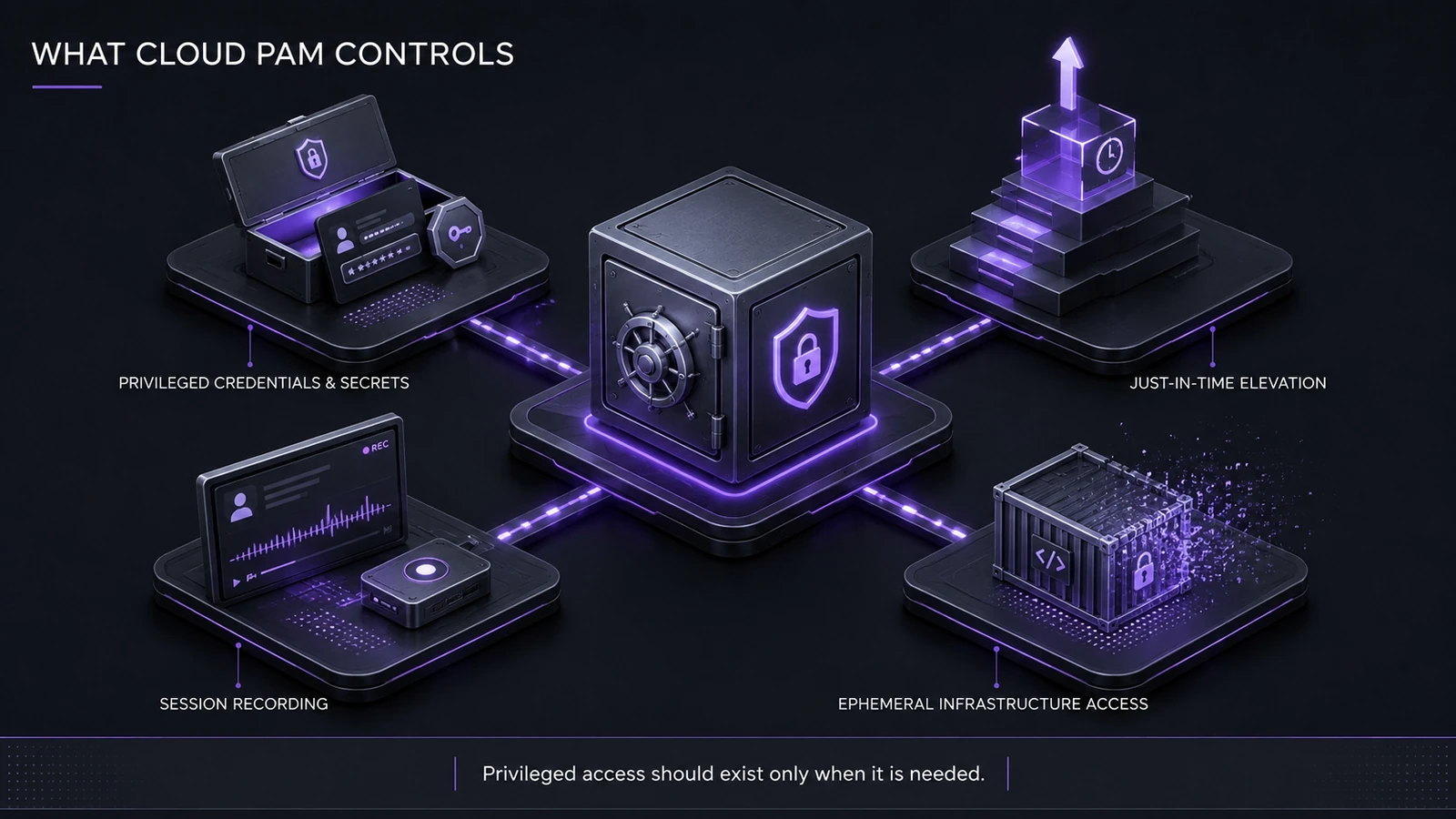 Four distinct control surfaces — credentials, elevation, session recording, and ephemeral infrastructure — that cloud PAM has to cover simultaneously.
Just-in-time elevation and zero standing privilege
Just-in-time elevation is the pattern of granting privileged cloud access only for the duration of a specific task, scoped to the specific operation, with automatic expiration. Zero standing privilege (ZSP) is the more aggressive version of the same idea: no user or automated identity holds a permanent cloud-admin role at all, only JIT-granted elevation.
The mechanics are straightforward in principle. An engineer who needs to modify a production security group requests elevation, states the reason (often tied to a change ticket), gets automatic or manager-approved sign-off depending on the sensitivity of the operation, receives time-boxed access — often literally a temporary IAM role assumption or a scoped policy attached for a defined window — and the privilege expires automatically when the window closes or the task completes, whichever comes first.
The case for ZSP is strongest in cloud environments specifically because standing cloud-admin credentials are unusually attractive attack targets: they're often reachable from anywhere with the right key, and the actions available through them (spinning up compute, modifying IAM policy, accessing every connected storage bucket) are broader in scope than what a single on-prem domain-admin account typically touches. When no one holds standing org-admin rights, there's no standing org-admin account for an attacker to phish, credential-stuff, or push-bomb into.
The trade-off is real and worth naming honestly: JIT/ZSP adds friction to legitimate operations, and that friction is exactly what makes it effective. Teams that implement it without automating the routine-approval path end up with engineers routing around it during incidents, which recreates the standing-privilege problem informally. The 2026 pattern that works is auto-approval for well-scoped, low-risk elevation requests (read access to logs, restart of a known service) paired with manager or security-team approval for the operations that actually carry material risk (IAM policy changes, cross-account access, production data access). For the deployment mechanics in more depth, see our just-in-time access and zero standing privilege piece.
Session recording and monitoring in cloud environments
Session recording in cloud infrastructure has to account for several access modalities that don't exist in a purely on-prem PAM deployment: console sign-ins through the provider's web UI, CLI sessions using temporary credentials, and direct API calls made by automation rather than a human at a keyboard.
Console sessions are the most straightforward to record because the provider's own audit trail (AWS CloudTrail, Azure Activity Log, GCP Cloud Audit Logs) already captures every console action taken under a given identity, timestamped and attributable. The PAM layer's job is to correlate that native audit trail with the brokered elevation event — this person requested JIT access at this time, for this stated reason, and here's exactly what they did with it — rather than duplicating the logging the provider already does well.
CLI and API sessions benefit from the same correlation approach but require more deliberate instrumentation, since a scoped temporary token used from the command line doesn't inherently distinguish "routine automated task" from "human operator running ad hoc commands with elevated privilege" without additional context from the PAM layer that issued the token.
Command-level and query-level policy enforcement goes a step further than passive recording — blocking specific high-risk API calls (bulk IAM policy modification, mass resource deletion) even within an already-approved elevated session, or requiring a second approval mid-session for an operation that crosses a defined risk threshold. This is a meaningfully more mature control than simple after-the-fact recording, and it's where cloud PAM increasingly draws on the provider's own policy engine (AWS SCPs, Azure Policy, GCP Organization Policy) rather than trying to intercept every API call independently.
The forensic value of comprehensive session recording compounds during incident response: when a cloud-admin credential is suspected of compromise, the difference between "we can reconstruct exactly what that session did" and "we're inferring from provider logs after the fact" is often the difference between a contained incident and an extended, uncertain investigation.
Break-glass patterns for cloud outages
Break-glass access is the emergency path used when the normal JIT approval workflow is unavailable or when the delay it introduces during an active incident is unacceptable. Cloud infrastructure adds a specific wrinkle: the PAM control plane, the identity provider issuing approvals, and the ticketing system routing the request may themselves be hosted on the cloud platform that's currently degraded.
A break-glass credential that depends on the infrastructure it's meant to rescue isn't a break-glass credential — it's a single point of failure with an emergency-sounding name. The working pattern vaults a small number of true emergency credentials separately from the routine PAM control plane, often with an offline or out-of-band component (a hardware token in a physical safe, a credential split across multiple key custodians), used only when the primary elevation path is confirmed unavailable, and instrumented to alert immediately the moment one is checked out.
Every break-glass use should trigger a mandatory post-incident review — not as a compliance formality, but because break-glass access is by definition the moment when normal controls were bypassed, and that's exactly the window an attacker would try to exploit if they'd compromised the break-glass path itself. For the full pattern including approval structures and audit requirements, see our break-glass emergency access piece.
Multi-cloud PAM consistency challenges
Enterprises running AWS, Azure, and GCP simultaneously face a consistency problem that single-cloud deployments don't: each provider's native privilege model, session-logging format, and elevation mechanism is different, and a security team auditing three disconnected native control sets ends up with three different blind spots rather than one coherent picture.
AWS IAM's role-assumption model, Azure's RBAC-plus-Entra-PIM combination, and GCP's IAM-plus-Organization-Policy stack each require genuinely different configuration to achieve the same conceptual outcome — JIT elevation with session recording. A policy defined as "grant 2-hour elevated access to production compute, log every action, alert on IAM policy changes" has to be translated into three structurally different implementations, and drift between those implementations over time is one of the more common ways multi-cloud PAM programs quietly degrade.
The 2026 pattern favors a PAM control plane that normalizes policy definition and audit output across providers — defining the elevation and recording policy once, in provider-neutral terms, and translating it into each provider's native mechanism underneath, with a single consolidated audit trail rather than three separate logs to reconcile manually during an investigation. See our multi-cloud identity management piece for the broader architecture this normalization sits inside.
Cloud PAM vs. CIEM: two layers, not one
Cloud PAM and CIEM (Cloud Infrastructure Entitlement Management) get conflated often enough that it's worth being explicit about the boundary, because they solve different problems and neither substitutes for the other.
PAM controls the privileged session at the moment of use: vaulting the credential, brokering the connection, enforcing just-in-time elevation, recording what happened. It answers the question "what is this identity doing right now, and is that controlled and observable?" CIEM maps and right-sizes the standing entitlements underneath — the thousands of fine-grained permissions attached to IAM roles and policies that determine what any given session is even authorized to attempt in the first place. It answers the question "does this identity's standing access match what it actually needs?"
A cloud-admin role can be fully vaulted, session-recorded, and JIT-gated by PAM while still being drastically over-permissioned from a CIEM standpoint — holding write access to storage buckets it hasn't touched in a year, or inherited permissions from a nested group nobody has audited. Conversely, an entitlement set that's been perfectly right-sized by CIEM still needs PAM's runtime controls, because right-sized standing access is still standing access that benefits from vaulting and session recording when it's actually exercised.
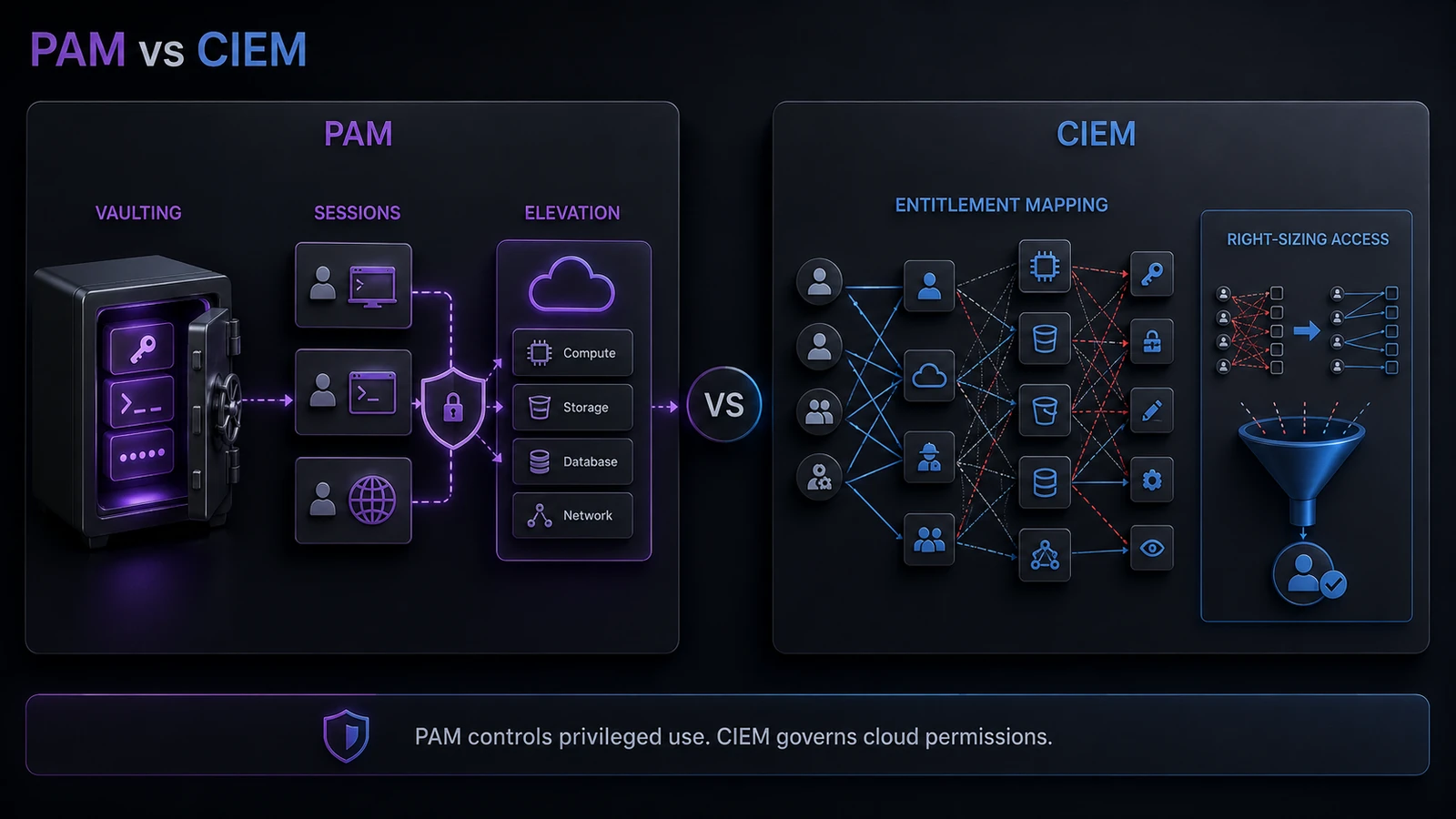 PAM and CIEM sit on top of the same cloud accounts but answer different questions — one about runtime session control, the other about standing entitlement scope.
Enterprises that treat these as the same discipline typically end up under-invested in one or the other — deploying a vault and calling cloud privilege "handled" while entitlement sprawl accumulates unmonitored underneath, or running a thorough entitlement-mapping exercise that never gets paired with session-level controls on how that access is actually exercised. The architectures that hold up in 2026 run both, with the two layers informing each other: CIEM's right-sizing work narrows what PAM needs to broker, and PAM's session logs give CIEM real usage data to base right-sizing decisions on. For the entitlement-mapping side of this problem in full, see our dedicated CIEM piece.
Rolling out cloud PAM: a practical sequence
Most successful cloud PAM deployments follow a similar sequence rather than vaulting everything and enforcing JIT elevation on day one.
Discover privileged access first. Before enforcing anything, inventory what privileged access actually exists across every cloud account — root credentials, IAM users with admin policies attached, service accounts with broad permissions, cross-account roles. This discovery step routinely surfaces access nobody remembered existed, which is worth finding before building controls around an incomplete picture.
Vault the highest-risk secrets. Root account credentials, org-admin passwords, and long-lived service-account keys get vaulted first, since these are both the highest-blast-radius credentials and the ones with no natural expiration to fall back on.
Enforce JIT elevation for the sensitive operations. Rather than gating every cloud action behind an approval workflow immediately, start with the operations that carry the most risk — IAM policy changes, production data access, cross-account role assumption — and expand JIT coverage from there as the approval workflow proves it doesn't create unacceptable friction for routine work.
Record and review sessions continuously. Session recording should be running from the start, not bolted on after an incident makes the gap obvious. The review discipline — someone actually looking at session logs on a regular cadence, not just storing them for a hypothetical future investigation — is what turns recording from a compliance checkbox into an actual detection capability.
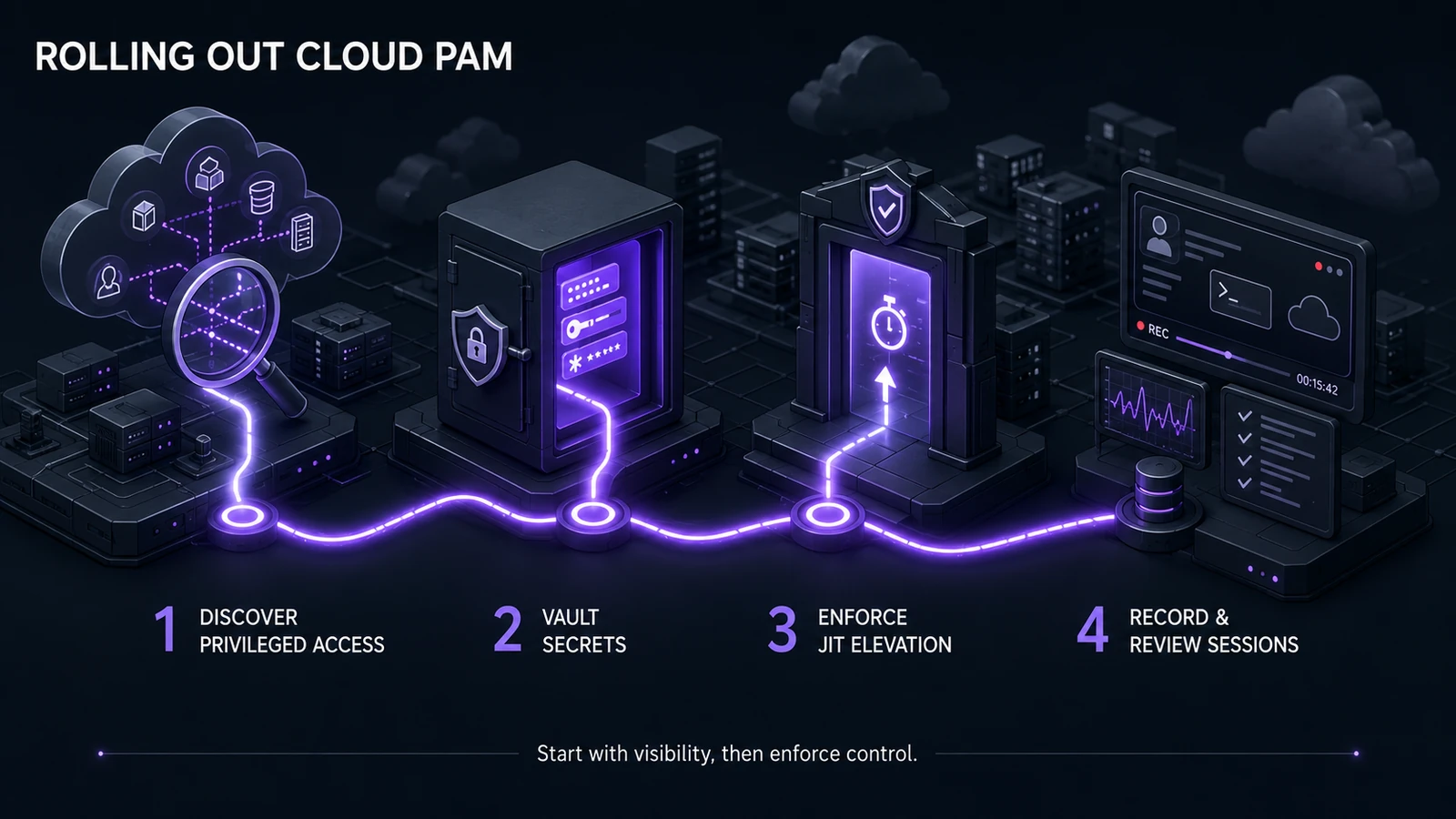 The sequence matters — discovery before enforcement, highest-risk credentials first, then expanding JIT coverage as the workflow proves out.
What Avatier ships toward this pattern
Avatier Identity Anywhere does not compete as a cloud PAM vault or session broker — it integrates with the dedicated PAM and secrets-management platforms enterprises already run (CyberArk, BeyondTrust, HashiCorp Vault, and cloud-native options) through standard federation and provisioning interfaces, providing the governance layer above them.
Avatier Identity Anywhere Lifecycle Management drives the provisioning lifecycle for cloud-privileged identities from HRIS source-of-truth: a joiner workflow creates a new cloud platform engineer's JIT-eligible role in the PAM system, a mover workflow updates scope when they change teams, and a leaver workflow revokes JIT eligibility immediately at offboarding — closing the gap where a departed engineer's elevation-request rights linger past their last day.
Access certification in Avatier IGA treats cloud-admin and JIT-eligible roles as a distinct, higher-frequency review category, with certification cycles that specifically ask "has this identity actually used its JIT elevation rights in the review period, and does that usage still match their current role?" — pulling directly from the session-recording data the PAM layer generates. Recovery flows for cloud-privileged accounts tie through Password Station's workflow-verified reset pattern, closing the same social-engineering vector on cloud-admin recovery that would otherwise undermine every other control described in this piece.
The Avatier Trust Center publishes Avatier's current compliance posture: SOC 2 Type II audited with zero exceptions noted, ISO/IEC 27001:2022 certified, PCI DSS v4.0.1 compliant, CSA STAR Level 1 attestation, NIST 800-53 Rev. 5 aligned, and CISA Secure-by-Design Pledge signatory.
What cloud PAM alone does not solve
Cloud infrastructure PAM controls the runtime session — vaulting the credential, brokering the connection, enforcing just-in-time elevation, recording what happened. It is a necessary layer and, on its own, an incomplete one.
PAM does not fix entitlement sprawl. A role can be perfectly vaulted and session-recorded while still holding permissions it hasn't used in a year — that's CIEM's job, not PAM's, and skipping it leaves a standing over-permissioning problem PAM was never designed to catch. PAM does not replace identity governance. Deciding who should be eligible for cloud-admin JIT elevation in the first place — tied to role, tied to HRIS-verified employment status, revoked automatically at offboarding — is a governance workflow question that sits above the PAM control plane, not inside it. And PAM does not, by itself, catch configuration drift in the cloud accounts themselves — a misconfigured storage bucket or an overly permissive security group is a posture problem that a well-vaulted admin session can still create if the underlying policy allows it.
The honest architecture for 2026 treats cloud PAM as one layer in a stack: governance decides who's eligible, PAM controls the session when they act, CIEM keeps the standing entitlements right-sized, and posture management watches for drift across all of it. Enterprises that deploy PAM and stop there have solved the session-control problem and left the other three open.
ABOUT THE AUTHOR

More from Access Management
PIM vs PAM vs PUM: Privileged Access Defined for 2026
PIM, PAM, and PUM get used interchangeably and mean three different things. PIM manages who holds privileged identity and which roles carry it. PAM controls how privilege is exercised through vaulting, session control, and just-in-time elevation. PUM manages the shared privileged accounts nobody personally owns. The 2026 reference on distinguishing the three terms, where they overlap, and where to start.

DNS as Identity Infrastructure: A 2026 Reference
DNS resolution, DNSSEC integrity, and DNS poisoning as a credential-harvesting vector — the 2026 reference on treating DNS as identity infrastructure, not network plumbing.
Password Hash Synchronization in 2026: Hybrid AD to Entra ID
Password hash synchronization keeps on-prem Active Directory and Microsoft Entra ID authoritative together — how the sync cycle works, its security tradeoffs, and where it fits against federation.