Ai4 2026: Why Identity Security Is the Conversation the AI Industry Needs — Meet Avatier at Booth #1053
Ai4 2026 lands in Las Vegas August 4-6 with three full tracks on AI agents, a cybersecurity track, and an oversight track on AI governance and model risk. The agenda is telling you something: the enterprise AI conversation has shifted from what models can do to what agents are allowed to do — and that is an identity question. Avatier will be at Booth #1053 with live demos, product announcements, and a point of view on why every autonomous agent needs the same lifecycle, governance, and least-privilege discipline you apply to human identities.
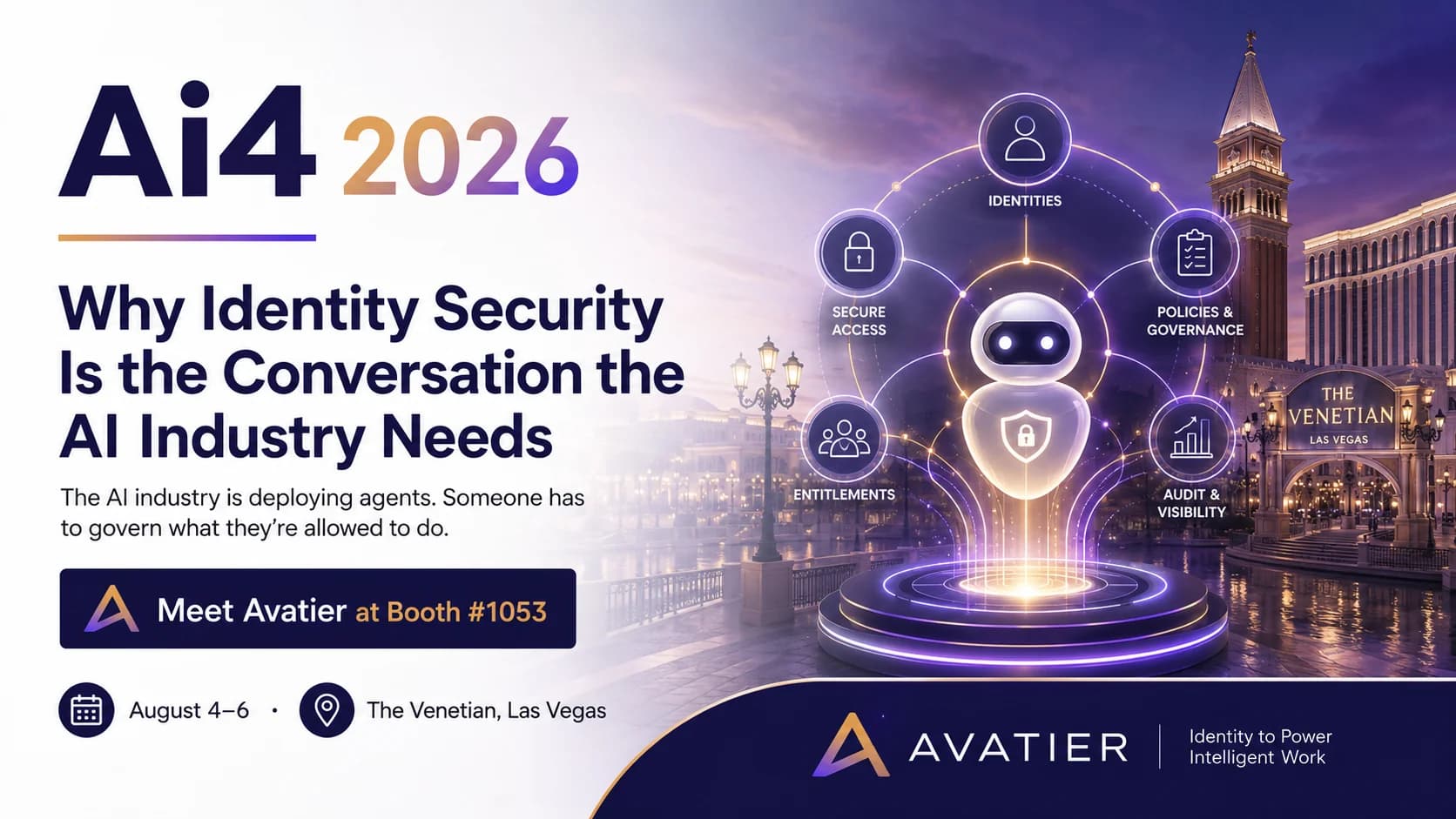
Ai4 2026 lands in Las Vegas August 4-6 with three full tracks on AI agents, a cybersecurity track, and an oversight track on AI governance and model risk. The agenda is telling you something: the enterprise AI conversation has shifted from what models can do to what agents are allowed to do — and that is an identity question. Avatier will be at Booth #1053 with live demos, product announcements, and a point of view on why every autonomous agent needs the same lifecycle, governance, and least-privilege discipline you apply to human identities.
- Ai4 2026 runs August 4-6 at The Venetian in Las Vegas — America's largest AI conference, with thousands of attendees, more than a thousand speakers, and hundreds of exhibits. The 2026 agenda includes three dedicated tracks on AI agents, a cybersecurity job-function track, an oversight track covering AI explainability, governance, and model risk, and an AI Policy Summit. Avatier will be exhibiting at Booth #1053.
- The agenda shift is the story. Previous AI conference cycles centered on model capability — what LLMs can generate, summarize, and predict. The 2026 cycle centers on agents: software that plans, calls tools, executes multi-step workflows, and acts on systems of record. The moment software acts, the question stops being a model question and becomes an identity question — what is this agent allowed to do, who granted it, when does the grant expire, and who reviews it.
- Most enterprise AI programs have no answer. Agents inherit over-scoped service accounts or shared API keys, live outside the joiner-mover-leaver lifecycle, never appear in certification campaigns, and act with credentials no one rotates. That is the same non-human identity governance gap enterprises already carry — multiplied by autonomy. The identity disciplines that fix it already exist: lifecycle automation, least-privilege entitlements, certification, and identity threat detection, applied to agents as first-class identities.
- Five questions to ask every AI vendor on the Ai4 show floor: What identity does your agent act under? How is the agent's access scoped and where is that policy enforced? What is the agent's credential lifecycle? Where does the agent's activity land for audit and certification? What happens when the agent is compromised or misbehaves — can you revoke it in one step?
- At Booth #1053 Avatier will run live demos of Identity Anywhere, make product announcements at the show, schedule one-on-one meetings, and run booth giveaways. If you are bringing an AI agent program to production in 2026-2027, come talk to us about the identity governance foundation it will depend on — before the audit finding starts the conversation for you.
This August, the enterprise AI world converges on Las Vegas. Ai4 2026 — America's largest AI conference — runs August 4-6 at The Venetian, with thousands of attendees, more than a thousand speakers, and hundreds of exhibits. The speaker roster reads like the field's short history: Nobel laureate Geoffrey Hinton, Fei-Fei Li, Andrew Ng, alongside the executives actually deploying AI inside banks, hospitals, logistics networks, and government agencies.
Avatier will be there, at Booth #1053, all three days.
I want to explain why an identity management company belongs at an AI conference — because the answer is also the most important thing happening in enterprise security right now, and most AI programs haven't noticed it yet.
The agenda shift: from models to agents
Look at what Ai4 is actually programming in 2026. Not one track on AI agents — three: agent applications and use cases, agent deployment at scale, and agent foundation and strategy. Alongside them, a cybersecurity job-function track, a risk and compliance track, an oversight track on AI explainability, governance, and model risk, and an AI Policy Summit.
That agenda is a signal. The center of gravity in enterprise AI has moved from what models can generate to what agents are allowed to do. A model answers questions. An agent takes actions — it plans a workflow, calls tools, reads and writes systems of record, provisions resources, sends communications, and chains those steps together with a degree of autonomy that gets wider every quarter.
And the moment software acts, the interesting question stops being a model question. It becomes an identity question:
- What identity is this agent acting under?
- Who granted it that access, and on what basis?
- What is it actually entitled to do — and is that more than it needs?
- When does the grant expire, and who reviews it?
- If it's compromised or misbehaving, how fast can you shut it off?
Every security leader reading those five questions recognizes them. They are the questions we have asked about human users for twenty-five years, and about service accounts for the last ten. The AI industry is about to relearn, at speed, everything the identity industry already knows.
The governance gap nobody demos
Here is what we see in real enterprise AI agent deployments in 2026, across the customer conversations we're having:
Agents inherit credentials instead of receiving identities. The fastest path to a working agent is handing it an existing service account or a shared API key — usually one scoped far beyond what the agent needs, because it was scoped for something else. The agent works on day one. The over-provisioning is invisible until it isn't.
Agents live outside the lifecycle. Human identities flow through joiner-mover-leaver events driven by the HRIS (HRIS-Driven Identity Lifecycle piece). Agents get created in an afternoon by a developer with a deadline, and nothing ever tells the identity system they exist. There is no mover event when the agent's purpose changes, and no leaver event when the pilot ends. The agent's access outlives the project — sometimes by years. This is the classic orphaned-account problem, except the orphan can take ten thousand actions an hour.
Agents never appear in certification campaigns. Access reviews cover the identities the IGA system knows about. An agent running on a borrowed API key is invisible to certification by construction — the reviewer sees the service account, not the autonomous workload behind it, and approves it because it "looks like infrastructure" (Access Review — What the Auditor Actually Wants piece).
Agent credentials don't rotate. Static keys embedded in agent configuration are the new passwords-in-scripts. We spent a decade dragging secrets out of code; agentic frameworks are quietly putting them back.
None of this is an argument against agents. It's an argument that the non-human identity problem enterprises already carry — the one we documented in the Service Account Governance piece — is about to be multiplied by autonomy. Service accounts execute the instructions they're given. Agents decide what to do next. The blast radius of an over-scoped credential grows with every increment of autonomy you grant the software holding it.
The good news: this problem is already solved — for people
The identity industry doesn't need to invent a new discipline for agents. It needs to extend the disciplines that already work:
Lifecycle. Every agent gets onboarded like a joiner: a registered identity with a named human owner, a documented purpose, a scoped entitlement set, and an expiration date. When the purpose changes, a mover event re-resolves the entitlements. When the project ends, a leaver event revokes everything — automatically, not when someone remembers.
Least privilege. Agent entitlements resolve through the same policy engine as human entitlements, scoped to the minimum set the declared purpose requires (Principle of Least Privilege piece). Just-in-time elevation replaces standing privilege for the sensitive operations (Just-in-Time Access piece).
Certification. Agents appear in access review campaigns as first-class identities, with their owner as the accountable reviewer. AI-augmented certification is exactly the right tool here — the review volume for agent identities will dwarf human review volume, and anomaly-focused review is the only way it scales (AI Access Certification piece). There is a pleasant symmetry in using AI to govern AI.
Detection and response. Agent behavior is baselined and monitored like user behavior. An agent suddenly touching systems outside its historical pattern is the same signal as an account takeover — and it should flow into the same identity threat detection and response pipeline (ITDR piece), with single-step revocation as the containment action. Posture management closes the loop, continuously auditing for the over-scoped, expired, and ownerless agent identities that accumulate between reviews (ISPM piece).
One governance architecture. Two populations — human and non-human — with agents as the newest and fastest-growing cohort of the second. That's the point of view we're bringing to the show floor.
Five questions to ask every AI vendor at Ai4
If you're attending Ai4 2026 and evaluating agentic platforms, here is the identity due-diligence script. Ask these at every booth that demos an agent:
| # | Question | What a good answer sounds like | What a bad answer sounds like |
|---|---|---|---|
| 1 | What identity does your agent act under? | Each agent instance holds a distinct, registered identity with a named owner | It uses your service account / API key |
| 2 | How is the agent's access scoped, and where is the policy enforced? | Entitlements resolve through your policy engine; least privilege by default | The agent can do whatever the integration user can do |
| 3 | What is the credential lifecycle? | Short-lived credentials, automatic rotation, expiry by default | You paste a key into the config |
| 4 | Where does agent activity land for audit and certification? | Every action attributed to the agent identity, streamed to your SIEM and IGA | Logs are in our dashboard |
| 5 | What happens when the agent misbehaves? | Single-step revocation of the agent identity kills all access instantly | You'd rotate the shared key (and break everything else using it) |
Vendors with real answers to these five questions are building for the enterprise. Vendors without them are building a future audit finding. The same evaluation discipline we laid out in Selecting an Identity Vendor applies — the population being governed is just newer.
What Avatier is bringing to Booth #1053
We're not coming to Las Vegas to watch. Here's what's happening at the booth:
Live demos. The governance foundation everything above depends on, running live: user lifecycle management with the shopping-cart access request experience, group self-service that kills the group-management ticket queue, credential governance across all six pillars — Password Firewall through Hybrid Passwordless — and MFA Insurance, the offline backup factor built on the Identity Challenge Card. Agent governance only works on top of an identity layer that already functions; come see what that layer looks like when it does. Bring your hardest workflow; we like those.
Product announcements. We're making announcements at the show. I'm not going to preview them here — that's what the booth is for. Come by early in the week.
One-on-one meetings. The team is taking scheduled meetings at the booth all three days. If you want a guaranteed slot rather than walk-up availability, book your demo time now — pick a slot directly on our calendar and we'll have it held before the show.
Booth giveaways. Stop by Booth #1053 to take part. That's all you have to do.
You can watch the countdown on our Ai4 event page.
Planning your three days
A few practical notes for attendees, especially first-timers:
Arrive Sunday if you can. The week opens before the expo floor does — the leadership summit programming begins ahead of the main conference, and the official kickoff reception is Sunday evening, August 2 at 5pm. The reception is the least crowded networking window of the entire week.
Know the floor hours before you plan. The exhibit hall opens to attendees at 10:15am each day, once the morning keynote lets out — mornings before that are keynote time, not booth time. Tuesday and Wednesday the hall runs to 6pm and closes with the exhibit hall reception from 5–6pm, which is the highest-traffic hour of each day and the best window for informal booth conversations. Thursday is the short day: the hall closes at 4pm with no reception and teardown starts immediately, so anything you want to see on the floor Thursday needs to happen before mid-afternoon.
The floor is huge — route it. With hundreds of exhibits, wandering costs you half a day. Pick the eight to ten booths that matter for your roadmap, book meetings in advance where vendors offer it, and treat the rest as serendipity. (Booth #1053 routes nicely between sessions. Just saying.)
Balance keynotes against tracks. The headline talks — Hinton, Li, Ng, and the enterprise operator sessions — set the strategic frame and fill up fast. But the operational substance for security and identity leaders lives in the cybersecurity track, the three agent tracks, and the oversight and governance sessions. That's where the questions in this piece are going to get asked out loud.
Bring your identity team's questions. The most valuable thing you can carry home from Ai4 isn't a vendor list — it's a clear picture of the governance work your AI roadmap creates. The five-question script above is a good starting kit.
The conversation we want to have
Every technology wave eventually meets the identity layer. Client-server met it with directories. The web met it with SSO and federation. Cloud met it with CIEM and multi-cloud governance (Multi-Cloud Identity Management piece). SaaS met it with lifecycle automation and certification.
Agentic AI is meeting it right now — faster than any wave before it, because agents multiply both the number of identities and the consequences of governing them badly.
I've spent three decades building identity automation, and I can tell you the pattern: the organizations that build the governance layer alongside the new technology ship faster and audit cleaner than the ones that bolt it on after the first incident. The enterprises walking the floor at The Venetian this August are deciding, mostly without realizing it, which of those two groups they'll be in.
Come to Booth #1053 and let's make it a deliberate decision. August 4-6. Las Vegas. We'll see you there.
ABOUT THE AUTHOR

More from IAM & Identity Governance

Identity Management and Digital Transformation in 2026
Every major transformation initiative — cloud migration, remote and hybrid work, mergers and acquisitions — eventually stalls on the same question: who gets access to what, and who decided? The 2026 strategy reference on identity management as the enabler and the bottleneck of digital transformation, the business case executives actually fund, and what modernization does not fix.

AI and Behavioral Analytics for Identity Monitoring: The 2026 Enterprise Reference
Static identity rules catch the attacks that announce themselves. They miss the ones that log in with valid credentials and behave almost normally. The 2026 reference on AI-driven identity monitoring — what behavioral analytics actually detects, the four telemetry sources that make or break the model, the false-positive economics nobody budgets for, and the honest limits of anomaly detection at enterprise scale.
Security Team Collaboration: A 2026 Framework for Identity Programs
Identity governance fails when it runs as a security-team-only initiative. The 2026 framework for cross-functional collaboration: four stakeholder groups, three coordination models, and how zero trust makes it a shared discipline.