Attribute-Based Access Control: When RBAC Isn't Enough (2026)
ABAC evaluates subject, resource, and environment attributes against policy at request time, not a fixed role. The 2026 reference on what ABAC does differently, and where it earns its complexity.
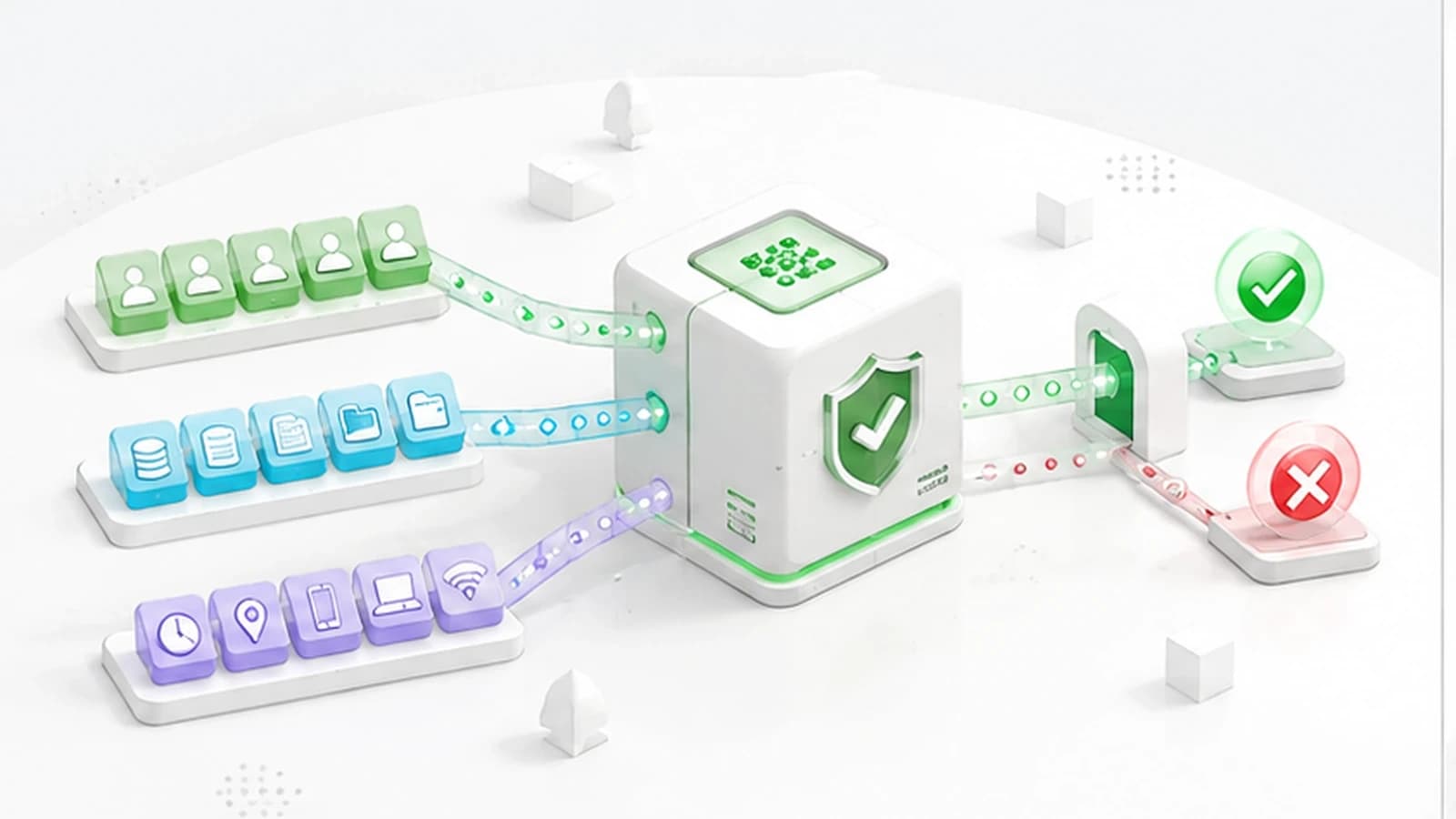
ABAC evaluates subject, resource, and environment attributes against policy at request time, not a fixed role. The 2026 reference on what ABAC does differently, and where it earns its complexity.
- Attribute-based access control (ABAC) grants or denies a request by evaluating attributes of the subject, the resource, and the environment against a policy at the moment the request is made — a dynamic, request-time decision instead of RBAC's static, assignment-time one.
- The mechanical difference from RBAC is not that ABAC is 'better' — it's that RBAC checks which roles a user was assigned, once, while ABAC checks the full context of a specific request, every time. RBAC answers 'what roles does this person hold?'; ABAC answers 'does this request satisfy policy right now?'
- An ABAC policy is built from four composable parts: subject attributes (who is asking), action (what they want to do), resource attributes (what they want it on), and condition (the environmental context that must hold — time, location, device posture, transaction amount, data sensitivity).
- ABAC earns its complexity in healthcare, finance, and multi-tenant SaaS, where access needs depend on context that changes faster than a role catalog can track. Small, stable organizations with well-defined job functions usually get more governance value from RBAC alone.
- Most mature 2026 architectures don't choose one model — they run RBAC as the coarse baseline (job-function access) with ABAC layered on top as the fine-grained, context-sensitive overlay. ABAC's biggest operational risk isn't the model itself; it's policy sprawl and stale attribute data, which require their own audit discipline.
Attribute-based access control (ABAC) is an access-control model that grants or denies a specific request by evaluating attributes — of the subject making the request, the resource being requested, and the environment surrounding the request — against policy at the moment the request happens. That's the mechanical difference from RBAC: role-based access control checks which roles a user was assigned, a decision made once at provisioning time. ABAC checks the full context of the specific request, a decision made fresh every time. RBAC asks "what roles does this person hold?" ABAC asks "does this exact request, right now, satisfy policy?"
This piece is the 2026 update of Avatier's original ABAC explainer, first published August 2025 (legacy URL: https://www.avatier.com/blog/attribute-based-access-control/, since retired in favor of this reference). It assumes you already have a working notion of what RBAC is — if you need that grounding first, the Role-Based Access Control (RBAC) 2026 guide covers roles, permissions, and role hierarchy from the ground up. This piece stays focused on what ABAC does differently: attribute-driven, request-time, dynamic policy evaluation, not another walkthrough of roles and permissions.
What ABAC Actually Is
Every ABAC decision runs the same evaluation: take the incoming request, gather the relevant attributes, and check them against policy. Subject attributes describe who is asking — job title, department, security clearance, employment status, group membership, sometimes a computed trust or risk score. Resource attributes describe what they're asking for — a record's data classification, its owner, a regional or tenant tag, a project association. Environment attributes describe the surrounding context of the request itself — time of day, network location, device posture, and, in more mature deployments, a real-time risk signal drawn from behavioral analytics. A policy engine pulls all three categories together with the requested action and returns a single answer: allow or deny.
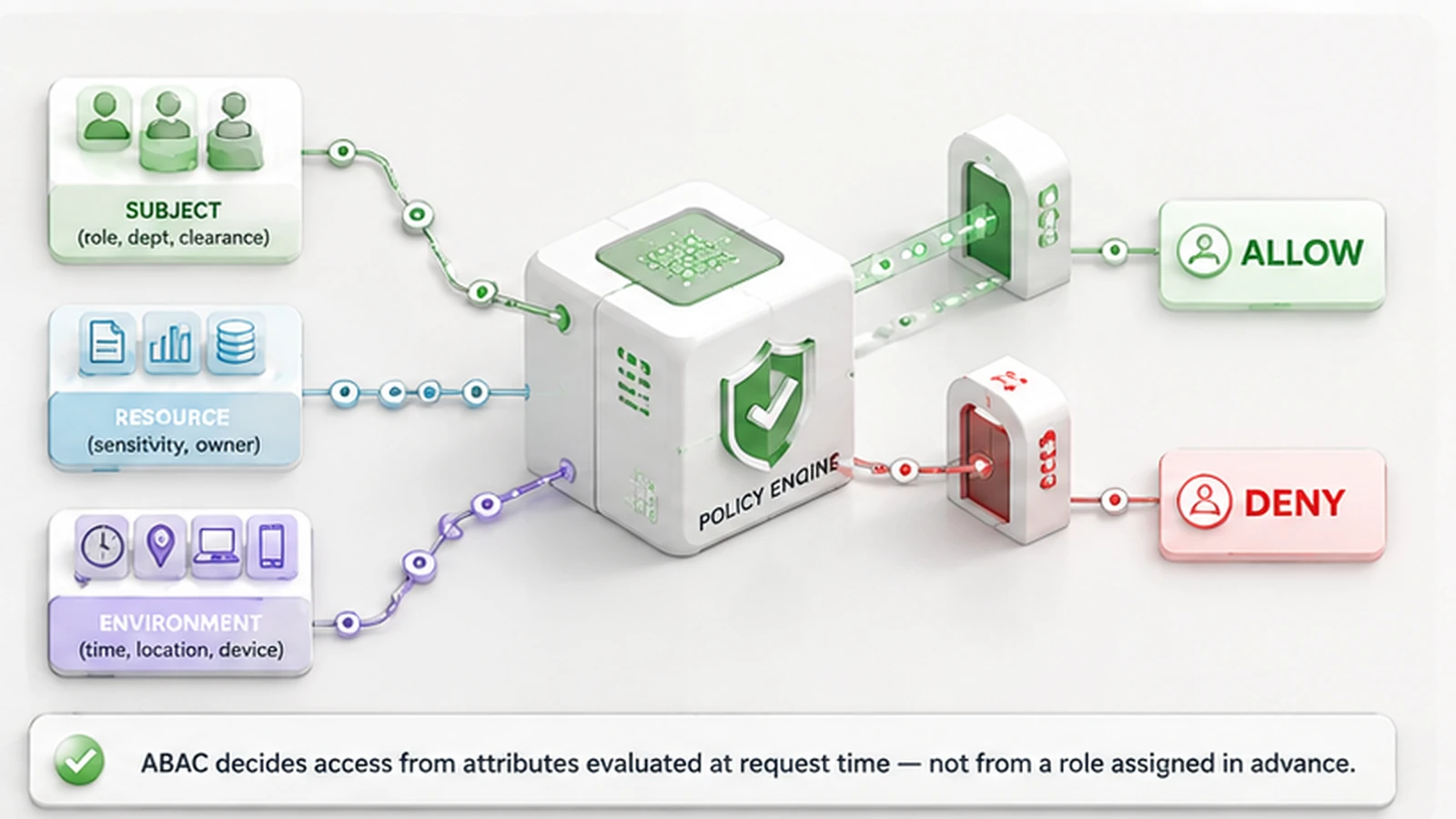 Three attribute sources, one policy engine, evaluated fresh at every request — the mechanical core of every ABAC decision.
The defining property is when that evaluation happens. RBAC's access decision is baked in at assignment time — a user is put into a role, and from that point forward, every request they make against systems that role covers is allowed, until someone changes the assignment. ABAC's access decision is made at request time, every time, against the attributes as they currently stand. Nothing is pre-computed and cached in the sense a role assignment is; the policy engine re-derives the answer on each request from the attributes available at that moment. That's what lets ABAC express access rules that depend on things that change faster than an administrator could reasonably re-assign roles — the hour of day, the specific record being touched, the device the request is coming from.
How ABAC Differs From RBAC, Mechanically
It's worth being precise about the comparison, because "ABAC is more advanced than RBAC" is a common but misleading framing. ABAC isn't a strictly better version of RBAC — it's a different mechanism with different tradeoffs, and the right choice depends on what your access decisions actually depend on.
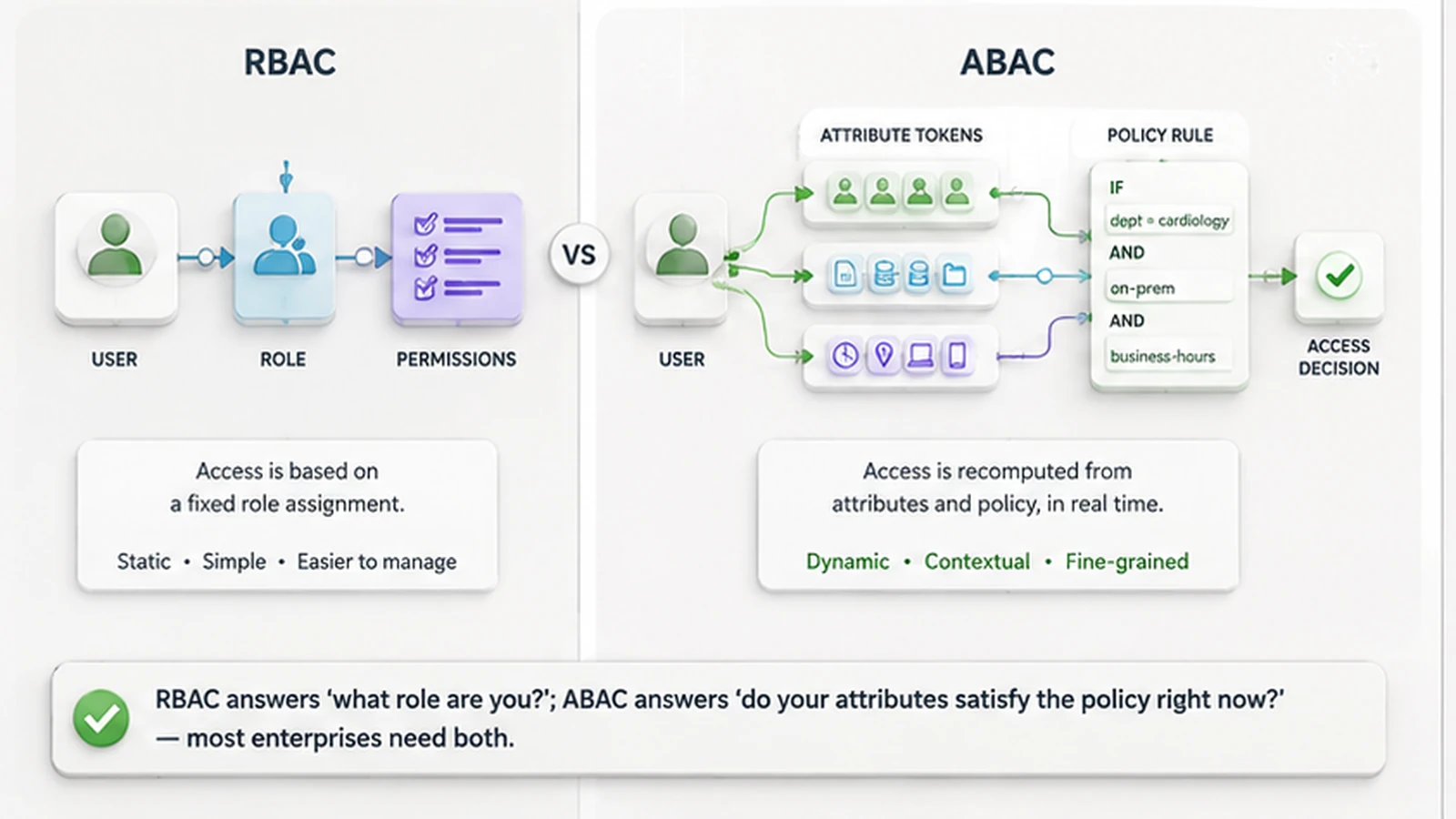 RBAC resolves access once, at assignment. ABAC resolves it again, from scratch, on every single request — that timing difference is the whole mechanical story.
RBAC's unit of decision is the role: a coarse bucket of permissions tied to a job function, assigned to a user, checked by lookup. It's simple to reason about — you can read a role definition and know exactly what it grants — and it's simple to audit, because the artifact an auditor reviews is a stable role catalog rather than a live policy engine. Its limitation is precision: any access rule that depends on something finer-grained than "does this person hold this job function" either doesn't fit RBAC cleanly, or gets forced in by minting a new bespoke role for every edge case, which is how role explosion happens.
ABAC's unit of decision is the request: a specific subject, wanting a specific action, on a specific resource, under specific conditions. It handles precision RBAC can't express — same role, different outcome depending on which record, what time, which device — without multiplying the number of roles. The cost is that the artifact an auditor reviews is no longer a static list but a rule set that has to be evaluated (or simulated) to know what it actually permits for a given case, and that evaluation happens against attribute data that has to be trustworthy and current for the decision to be correct. Neither model dominates the other; they trade static simplicity for dynamic precision, or the reverse, and which side of that trade you want depends entirely on whether your access rules are genuinely about job function or genuinely about context.
Anatomy of an ABAC Policy: Subject, Action, Resource, Condition
An ABAC policy is built from four composable parts, and getting comfortable with the shape of one demystifies most of what looks abstract about the model. Subject is who is making the request — expressed as an attribute match, like department = "Finance" or clearance >= "confidential", rather than a named individual. Action is what they want to do — read, write, approve, delete, export. Resource is what they want to do it to, expressed the same way as the subject: classification = "PHI" or region = "EU". Condition is the environmental context that has to hold for the request to be allowed — time between 07:00-19:00, network = corporate-VPN, transaction_amount < 50000.
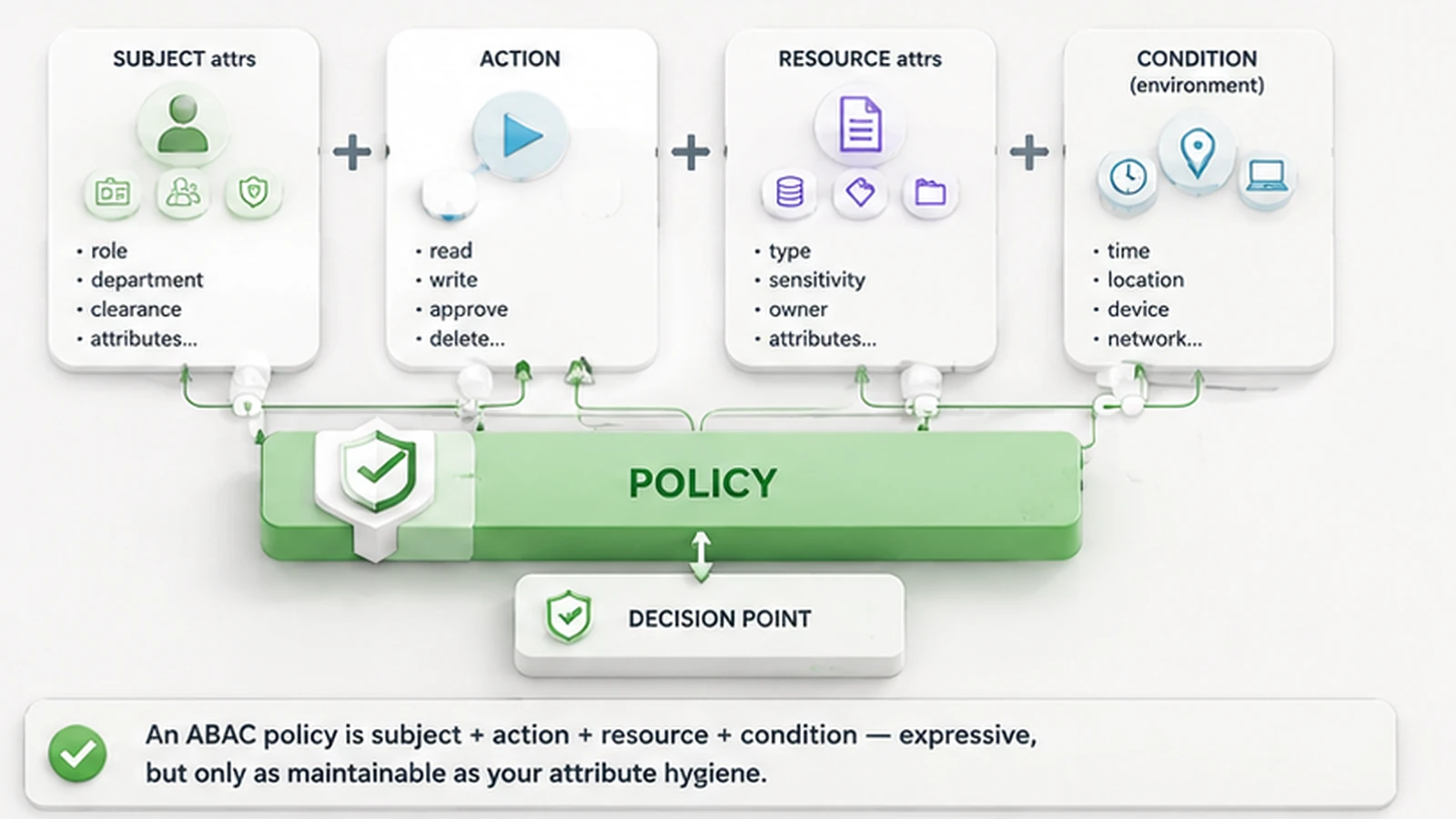 Subject, action, resource, condition — four attributes-and-rules building blocks that compose into a single evaluable policy statement.
Put together, a single policy might read: subject with department = "Claims" AND action = "approve" AND resource with type = "claim" AND amount <= 10000 AND condition time within business hours — allow. Change the dollar threshold, add a device-posture condition, or scope the resource to a specific region, and you've changed the policy without touching a role definition anywhere. That composability is ABAC's core value: the same four building blocks express both simple rules and highly specific ones, and changes to context or resource sensitivity are handled by editing conditions, not by re-architecting a role catalog.
Where ABAC Earns Its Complexity — and Where RBAC Alone Still Wins
ABAC's overhead is worth paying when access genuinely depends on context that a role catalog can't reasonably track. Healthcare is the clearest case: a clinician's access to a patient chart legitimately depends on whether they're on that patient's current care team today, not on their job title in general — "physician" as a role says nothing about which of thousands of patient records a specific physician should see right now. Finance is similar: a trader's authority might depend on the instrument, the position size, and the time of day, and a loan officer's approval authority might scale with transaction amount in ways no fixed role hierarchy captures cleanly. Multi-tenant SaaS adds a structural dimension RBAC alone can't express at all — the same "Support Engineer" role has to behave differently depending on which customer's data is in scope, with region and residency constraints layered on top. In each of these, context-sensitive step-up controls often pair with ABAC directly; the Adaptive Authentication and Risk-Based MFA piece on ICC covers how a computed risk score becomes an environment attribute an ABAC policy can condition on.
RBAC alone is still the right call for a large share of organizations, and it's worth saying plainly: complexity you don't need is a cost, not a feature. A small or mid-sized company with well-defined, relatively stable job functions — where "Accounts Payable Clerk" really does mean the same access for every person who holds that title, and that mapping doesn't change week to week — gets more governance value from a clean role catalog than from a policy engine it now has to build, test, and maintain. The tell is whether context, not job function, is doing the real work in your access rules. If every access decision can be fully and durably described as "this job function gets this access," adding ABAC buys operational overhead without buying anything a well-designed role model doesn't already provide. Context-aware policy specifically — the environment-attribute half of ABAC — is covered in more depth in the Context-Aware Security and Access Policy piece, which is the piece to read next if the "environment" attribute category is the part driving your evaluation.
Hybrid Models: RBAC as Baseline, ABAC as Overlay
Most mature 2026 architectures don't pick a side. They run RBAC as the coarse baseline — a role grants broad access to a category of systems or data by job function, which is what keeps the access model governable, auditable, and explainable to a reviewer in plain English — and layer ABAC conditions on top for the cases that need context-sensitivity RBAC can't express structurally. A "Claims Adjuster" role might grant baseline access to the claims system; an ABAC condition on top restricts that access to claims in the adjuster's assigned region, requires a satisfied MFA step-up above a dollar threshold, and blocks access outside a defined working-hours window. The role answers "does this person do this kind of work"; the attributes answer "does this specific request, right now, meet the bar."
This layering pairs naturally with two other patterns already in most 2026 identity architectures. The role sets the floor of what someone can request; the Principle of Least Privilege reference covers the discipline of keeping that floor genuinely minimal rather than padded "to be safe." And for the highest-sensitivity operations, an ABAC condition can require that a request come through an active elevation window rather than standing access at all — the pattern covered in the Just-in-Time Access and Zero Standing Privilege piece, where "is this session currently elevated" is itself just another environment attribute the policy engine checks. The practical upshot: you don't have to choose RBAC or ABAC as your access-control identity. Most organizations that do this well treat RBAC as the schema and ABAC as the set of exceptions and refinements layered carefully on top of it, and reserve ABAC's added complexity for the specific decisions that actually need it.
Implementation and Attribute-Hygiene Pitfalls
ABAC's failure modes are different in character from RBAC's, and they're worth naming explicitly because they don't announce themselves the way role explosion does.
Policy sprawl is the ABAC analog of role explosion, and it's arguably harder to catch. Because policies compose from attributes rather than sitting in a flat catalog, overlapping, redundant, or quietly conflicting rules can accumulate without anyone noticing — two policies that both apply to the same request, with subtly different conditions, can produce a decision that surprises the person who wrote either one. Without a named policy owner and a regular review cadence — the same discipline a role catalog needs — a growing rule set eventually becomes something nobody can predict without running a request through the engine and watching what comes out.
Stale attributes are the more insidious risk, because ABAC's decisions are only as good as the data feeding them. A subject attribute that says an employee is "active" after they've actually been terminated, a resource classification that was never updated after a data-sensitivity reclassification, an environment signal that's cached longer than it should be — each of these produces a policy engine that is evaluating perfectly correct logic against wrong inputs, and returning wrong decisions with total confidence. This is the sharpest version of the general rule: ABAC does not replace the need for clean, current, well-governed attribute data; it depends on it more directly, and more continuously, than RBAC ever did.
Audit complexity follows from both of the above. Explaining a single RBAC decision to an auditor is a lookup: here's the role, here's what it grants. Explaining a single ABAC decision means reconstructing the attribute state at the moment of the request and walking through which policy or policies applied — which is why production ABAC deployments need policy simulation and decision-logging as first-class capabilities, not an afterthought bolted on when the first audit request arrives. Build the explainability tooling alongside the policy engine, not after.
What Avatier Ships Toward This Pattern
Avatier Identity Anywhere is built around the hybrid pattern described above: a governable role catalog as the baseline, with conditional logic layered on top so that access requests, approval workflows, and entitlement grants can account for context rather than treating every holder of a role identically. Attributes that drive that conditional logic — department, employment status, clearance level, project assignment — flow from authoritative HR and lifecycle sources, so the subject side of the evaluation stays current as people join, move, and leave rather than drifting the way manually maintained attribute stores do. Approval workflows and access requests can be scoped by resource sensitivity and by environmental conditions like time-bound and just-in-time elevation windows, giving administrators the request-time precision ABAC is built for without abandoning the auditable role structure that makes the whole system reviewable.
For regulated customers, the point is that both halves of this hybrid model are auditable, and so is the vendor running it. Avatier's own control posture is published at the Avatier Trust Center: SOC 2 Type II with zero exceptions, ISO/IEC 27001:2022 certified, PCI DSS v4.0.1 compliant, CSA STAR Level 1, NIST 800-53 Rev. 5 aligned, FedRAMP-aligned, FIDO2-compatible, and a signatory of the CISA Secure-by-Design Pledge.
What ABAC Does Not Solve
ABAC is a genuinely more precise access-control mechanism than RBAC alone, and it is not a cure-all, and it's worth closing on that honestly rather than overselling the model. ABAC does not replace the need for good attribute data governance — it depends on it more, not less, than RBAC does, because every policy decision is only as trustworthy as the attributes it evaluates at that instant. Garbage attributes in, garbage access decisions out, and unlike a stale role assignment that at least fails in a visible, auditable way, a stale attribute can fail silently, producing confidently wrong decisions that look correct until someone investigates.
ABAC also does not reduce policy complexity in any absolute sense — it relocates it, from a role catalog that grows unwieldy through role explosion to a policy set that grows unwieldy through sprawl if it isn't actively owned and reviewed. That complexity needs its own audit discipline: named policy owners, a review cadence, decision logging, and simulation tooling that lets you answer "what would this policy actually allow" before a real request finds out the hard way. Adopting ABAC without building that discipline in from the start just trades one governance problem for a less-familiar one.
The 2026 reference posture is the same one that closes out the RBAC piece from the other direction: get the fundamentals right first. A clean role catalog for the access that genuinely maps to job function, ABAC conditions layered on top for the access that genuinely depends on context, attribute data governed with the same rigor as the role catalog it complements, and audit tooling built for both models from day one rather than retrofitted after the first finding. Get that composition right, and ABAC does exactly what it's for — precision RBAC structurally cannot express — without becoming the next generation's version of role explosion.
ABOUT THE AUTHOR

More from Access Management

Securing Microservices: Identity as the New Perimeter (2026)
How service-to-service authentication, mTLS, and workload identity replace the network perimeter microservices architectures outgrew — the 2026 reference for CISOs and platform teams.

How to Implement Self-Service Access Requests: The 2026 Guide
Self-service access requests only work when the full workflow is designed as one governed loop — request capture, policy-driven approval routing, automated provisioning, and closed-loop access confirmation. This is the 2026 practitioner guide to implementing an access request system that is fast for users and defensible under audit: the request-to-access pipeline, the design decisions that keep self-service from becoming rubber-stamp risk, and the operational discipline that makes it hold up.

Enterprise RBAC Implementation: Best Practices for 2026
The operational companion to the RBAC fundamentals reference — how to actually implement enterprise role-based access control well. Rollout sequencing, role design that avoids explosion, least-privilege enforcement in practice, entitlement modeling, provisioning integration, access reviews, and the pitfalls that sink real programs.