The Hidden Costs of Identity Management: The 2026 Enterprise Reference
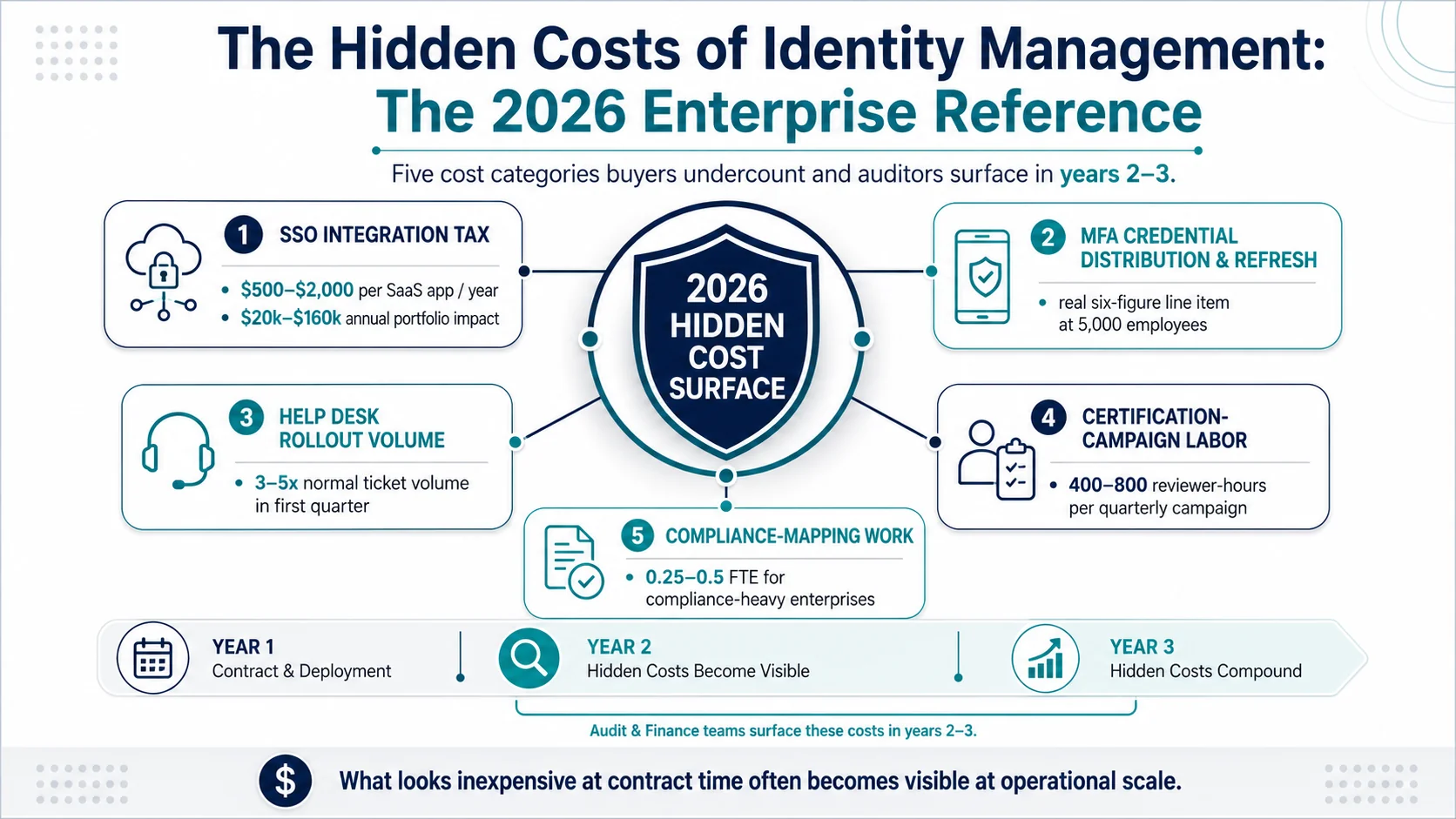
Enterprise IAM has five hidden cost categories that auditors surface and buyers systematically undercount — the SSO integration tax per SaaS application, MFA credential distribution and refresh, help desk rollout volume, certification-campaign labor, and the ongoing compliance-mapping work that keeps audit-ready posture defensible. The 2026 enterprise reference on what each hidden cost actually costs at scale, why they surface only in year 2, and the deployment discipline that minimizes them.
Enterprise IAM has five hidden cost categories that auditors surface and buyers systematically undercount — the SSO integration tax per SaaS application, MFA credential distribution and refresh, help desk rollout volume, certification-campaign labor, and the ongoing compliance-mapping work that keeps audit-ready posture defensible. The 2026 enterprise reference on what each hidden cost actually costs at scale, why they surface only in year 2, and the deployment discipline that minimizes them.
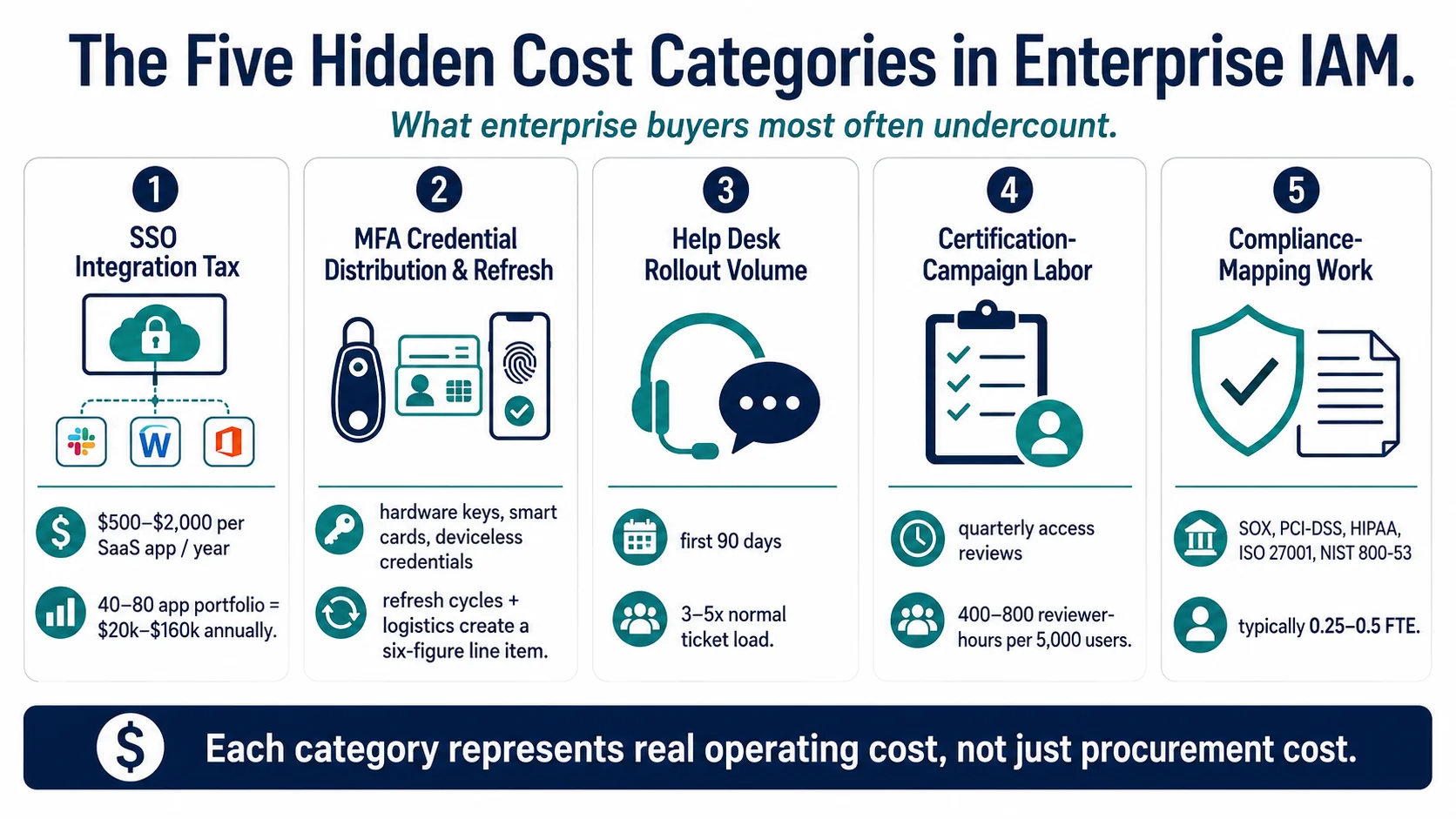
- Enterprise IAM has five hidden cost categories that auditors consistently surface and buyers systematically undercount at contract time. Each surfaces in years 2-3 of deployment; each represents 10-25% of ongoing yearly TCO on typical enterprise deployments. Well-scoped contracts include them; comparisons that omit them mislead vendor selection and buyer expectations.
- Hidden cost 1: SSO integration tax per SaaS application. Most enterprises assume federation is free at the platform layer, then discover their SaaS vendors charge SSO tax on non-enterprise tiers — typically $500-$2,000 per application per year. A 40-80 SaaS application portfolio (typical enterprise scale) is $20k-$160k annually in SSO tax. On-premises applications with non-standard integration produce $10k-$50k per custom connector build.
- Hidden cost 2: MFA credential distribution and refresh. Hardware FIDO2 keys, smart cards, or deviceless FIDO2 credentials for smartphone-unavailable segments carry per-unit cost plus logistics. A 5,000-employee deployment with hardware credentials for privileged users and deviceless for frontline is a real six-figure line item that shows up in Y2 when initial batches need refresh. The [Phishing-Resistant MFA piece on ICC](https://identitychallengecard.avatier.com/en/blog/phishing-resistant-mfa-enterprise-2026/) covers the credential-class mix.
- Hidden cost 3: Help desk volume during rollout. First quarter of any IAM cutover produces 3-5x normal help desk ticket volume as the workforce adjusts to new authentication flows, hits false-rejection cases, and encounters edge cases the pilot didn't surface. Temporary staffing, contract support, or overtime is a real Y1 cost attributed to 'change management' but IAM-driven. Well-planned rollouts pre-scale help desk capacity for the first 90 days.
- Hidden cost 4: Certification-campaign labor at scale. A mature deployment with quarterly campaigns across 5,000 users is 400-800 reviewer-hours per campaign — 0.5-1.0 FTE annualized. AI-augmented certification ([AI Access Certification piece](/en/blog/ai-access-certification-campaigns-enterprise-2026/)) reduces the reviewer burden substantially but doesn't eliminate it. The residual reviewer-engagement work is a real ongoing cost that scales with entitlement count and workforce size.
- Hidden cost 5: Compliance-mapping work. The ongoing effort to map IAM controls to SOX §404, PCI-DSS v4.0.1, HIPAA §164.312, ISO 27001, NIST 800-53, and industry-specific frameworks. Typically 0.25-0.5 FTE for compliance-heavy enterprises, near-zero for lightly-regulated organizations. Variance is large; scoping this correctly to your specific regulatory profile prevents meaningful cost surprises.
Enterprise IAM total cost of ownership is systematically undercounted at contract time. The list-price-per-user comparison that anchors initial vendor evaluations captures one input to one of five actual cost drivers. Buyers who anchor on list price get surprised 18-24 months into deployment when the other four drivers surface at their full operational scale — and the surprise looks like "the vendor cost more than we budgeted" when the operational reality is "we compared list price when we should have compared TCO."
This piece is the 2026 enterprise reference on the five hidden cost categories that recur across audit engagements and buyer post-mortems. What each hidden cost actually costs at enterprise scale, why they surface in years 2-3 of deployment, and the deployment discipline that minimizes each category. Companion pieces cover adjacent layers — the Enterprise IAM Cost Comparison piece covers the five-driver TCO frame; the SailPoint vs Avatier Pricing Comparison piece covers the modular-vs-all-inclusive pricing philosophy difference; the Best IGA Solutions piece covers the vendor-landscape comparison.
Hidden cost 1: SSO integration tax per SaaS application
Enterprise IAM platforms federate at the platform layer for free — the base subscription includes SAML 2.0 and OpenID Connect federation to any target application that supports these standards. What buyers frequently miss is that most SaaS vendors charge for SSO support on their platforms, and the charge is typically only available at enterprise tiers.
The pricing pattern. SaaS vendors commonly structure pricing so that mid-tier subscriptions don't include SSO, and enterprise-tier subscriptions that do include SSO are priced meaningfully higher. The delta between mid-tier and enterprise-tier is effectively the "SSO tax" the SaaS vendor charges. Typical range is $500-$2,000 per SaaS application per year, with substantial variance by vendor. The OAuth 2.0 vs OpenID Connect piece covers the federation protocols; the SSO Architecture piece on ICC covers workforce SSO architecture.
The multiplier. A typical enterprise application portfolio includes 40-80 SaaS applications when the full portfolio is enumerated — not just the strategic platforms, but the long tail of departmental SaaS, industry-specific tools, and legacy SaaS that came in through acquisition or shadow IT. Multiply the per-application SSO tax across the full portfolio and the total is $20k-$160k annually.
The trap. Buyers commonly enumerate only the strategic platforms in their SSO tax budget, then discover the long tail during rollout as additional applications need federation. The cost climbs from the strategic-only estimate toward the full-portfolio actual.
On-premises applications produce a different cost category. Enterprise applications without standard SAML/OIDC support — homegrown internal applications, older commercial applications without modern APIs, industry-specific systems with limited integration paths — require custom connector work. Typical range: $10k-$50k per custom connector build when the IAM vendor's out-of-box library doesn't cover the specific application. The Shadow IT Provisioning piece covers the broader shadow-IT access-risk surface.
Deployment discipline that minimizes this cost. Enumerate the full SaaS application portfolio at contract time, not just strategic platforms. Budget SSO tax across the enumerated portfolio using per-application vendor pricing research. For on-premises applications, budget custom connector work for each non-standard integration. The IAM vendor's out-of-box connector library coverage matters here — vendors with deeper connector libraries reduce custom connector requirements meaningfully.
 The SSO tax mechanic. Enterprise-tier SaaS pricing prices SSO as a premium capability, not a baseline feature. Well-scoped IAM deployments budget the tax across the full portfolio, not just strategic platforms.
Hidden cost 2: MFA credential distribution and refresh
Modern phishing-resistant MFA requires physical or platform credentials that carry per-unit cost plus logistics. Three factors compose the credential cost line item.
Per-unit hardware cost. Hardware FIDO2 keys (YubiKey, Feitian, Google Titan, and equivalent) typically run $25-$60 per unit depending on model and features. Smart cards run $10-$30 per unit. Deviceless FIDO2 credentials via the Identity Challenge Card for smartphone-unavailable segments carry their own economics. Platform biometric authentication (Face ID, Touch ID, Windows Hello for Business, Android biometric) uses hardware the workforce already has, so per-unit cost is zero at the credential layer.
Logistics. Enterprise-scale credential distribution requires a dedicated logistics workflow — packaging, distribution to the workforce, replacement on physical loss or damage, refresh at end-of-life cycles, disposal of retired credentials with security-sensitive processing. Well-run programs treat credential logistics as a supply-chain function.
Refresh economics. Hardware credentials have effective lifespans of 3-5 years for most deployments; older hardware fails, form factors get superseded, security capabilities improve. A 5,000-employee enterprise with 3,000 hardware-credentialed users refreshes 600-1,000 units annually as batches age.
The composed line item. A 5,000-employee enterprise with hardware credentials for privileged users (typically 5-15% of workforce), deviceless credentials for frontline segments (variable by industry), and mainstream mobile biometric for the majority produces a real six-figure hardware-credential line item that shows up in Y2 when initial deployment batches need refresh.
Well-scoped programs anticipate the credential mix. The Phishing-Resistant MFA piece on ICC covers the credential-class composition — platform passkeys + biometric as the universal baseline, hardware FIDO2 keys for step-up on privileged and high-assurance workflows, Identity Challenge Card for deviceless workforce segments. The Hardware FIDO2 Keys vs Passkeys piece covers the specific credential-class comparison.
Hidden cost 3: Help desk volume during initial rollout
The first quarter of any IAM cutover produces 3-5x normal help desk ticket volume as the workforce adjusts. Four factors combine.
Workforce adjustment to new authentication flows. Users who have used passwords for a decade need to learn passkey enrollment, biometric setup, and adaptive-authentication step-up prompts. Not every user succeeds on the first attempt. Password-manager migration, browser passkey sync, and cross-device credential syncing produce their own adjustment friction.
Biometric false-rejection cases. Mobile biometric sensors have specified false-rejection rates (1-3% depending on device class), and users hitting the false-rejection produce help desk tickets that look like authentication problems but are actually expected biometric-system behavior. The OTP Failure Case Scenarios piece on ICC covers biometric false-rejection at scale and the operational discipline that handles it.
Edge cases the pilot didn't surface. Users with device configurations, workforce roles, or usage patterns that weren't represented in the pilot population hit edge cases in production. Rotating workforce, seasonal contractors, international travel, and shared-station environments each produce edge cases that pilots frequently don't capture.
Communication gaps. Users who didn't read the cutover communication, or who received communication that wasn't targeted to their specific role, produce clarification tickets. Change-management discipline matters here — role-targeted communication reduces confusion tickets meaningfully.
The composed cost. Temporary staffing, contract support, or overtime is a real Y1 cost that gets attributed to "change management" rather than IAM but is IAM-driven. Well-planned rollouts pre-scale help desk capacity for the first 90 days and the cost is budgeted; poorly-planned rollouts produce ticket-queue backlog and workforce frustration that persists 60-90 days beyond the cutover.
Deployment discipline that minimizes this cost. Pilot with representative populations that include edge cases (rotating workforce, seasonal contractors, international users, shared stations). Communicate to targeted role populations rather than to the whole workforce with generic language. Pre-scale help desk capacity for the first 90 days. Use platform passkey + biometric as the universal baseline where possible — the user experience is meaningfully simpler than hardware credentials or push OTP for the majority of the workforce.
 Four factors compound during the first 90 days. Well-planned rollouts pre-scale help desk capacity and the cost is budgeted; poorly-planned rollouts produce ticket-queue backlog and workforce frustration that persists two to three months beyond the cutover date.
Hidden cost 4: Certification-campaign labor at scale
Access certification is a compliance requirement across every major audit framework (SOX §404, PCI-DSS v4.0.1, HIPAA §164.312, ISO 27001, NIST 800-53). Reviewer-time cost scales with entitlement count and workforce size.
The scale numbers. A mature deployment with quarterly campaigns across 5,000 users is 400-800 reviewer-hours per campaign — 0.5-1.0 FTE annualized just for reviewer time. Larger deployments (15,000+ users, quarterly campaigns) scale linearly.
What drives the labor. Certification quality requires reviewers to actually reason about entitlements — not click "approve all." Reviewer engagement — reading the entitlement description, comparing against the reviewee's current role, deciding retain or revoke — takes time per entitlement. Poor-quality "checkbox" reviews take less time but produce audit findings that require remediation later. The Access Review Auditor vs Checkbox piece covers what quality certification looks like versus checkbox theater.
AI-augmented certification reduces the reviewer burden substantially. The AI Access Certification piece covers how AI risk-scoring and pattern analysis reduce reviewer-time-per-entitlement while improving certification quality — the reviewer focuses on the entitlements the AI flags as high-risk or anomalous, not on the birthright entitlements where the AI has high confidence. AI augmentation doesn't eliminate the reviewer burden — the residual reviewer-engagement work is still real cost that scales with entitlement count.
The composed line item. Certification labor is a real 0.5-1.0 FTE annualized cost for mature enterprise deployments. Well-scoped programs include this in Y2-3 operating budget; comparisons that omit it undersell mature IAM programs and oversell immature ones.
Hidden cost 5: Compliance-mapping work
The ongoing effort to map IAM controls to specific compliance frameworks is a real ongoing cost that scales with regulatory scope.
The framework surface. SOX §404 for financial reporting systems (SOX Compliance piece). PCI-DSS v4.0.1 Requirements 7, 8, and 10 for card-data environments (PCI-DSS v4.0.1 piece). HIPAA §164.312 for healthcare access controls (HIPAA §164.312 piece). ISO 27001 Annex A for organizations pursuing certification. NIST 800-53 Rev. 5 for federal-adjacent and defense-industry deployments. Industry-specific frameworks (financial-services regulatory frameworks, healthcare specialty frameworks, defense-industry frameworks).
What the labor covers. Mapping IAM controls to specific framework requirements. Producing audit-evidence packages that demonstrate control operation. Responding to audit findings and remediating gaps. Updating control mappings as frameworks evolve (PCI-DSS v4.0 to v4.0.1 required specific mapping updates in 2024-2025; SOX §404 mapping updates track PCAOB guidance evolution).
The scale. Typically 0.25-0.5 FTE for compliance-heavy enterprises with multiple framework alignment requirements. Near-zero for lightly-regulated organizations with narrow framework scope. Variance is large; scoping this correctly to your specific regulatory profile prevents meaningful cost surprises.
Deployment discipline that minimizes this cost. Choose IAM platforms with mature framework-alignment tooling that reduces mapping burden. Align the deployment architecture with framework requirements from day one rather than retrofit-mapping to frameworks post-deployment. Use platforms with strong control-evidence generation capability so audit-response cycles are faster. The ISPM piece covers the posture-audit tooling that supports continuous compliance mapping.
 Compliance-mapping labor scales with regulatory scope. Well-scoped programs choose platforms with mature framework-alignment tooling and align architecture with framework requirements from day one; retrofit-mapping to frameworks post-deployment produces the labor spike this category represents.
Why the pattern surfaces in years 2-3
All five hidden costs share a temporal pattern — they surface in years 2-3 of deployment rather than year 1. Understanding why produces better budgeting discipline.
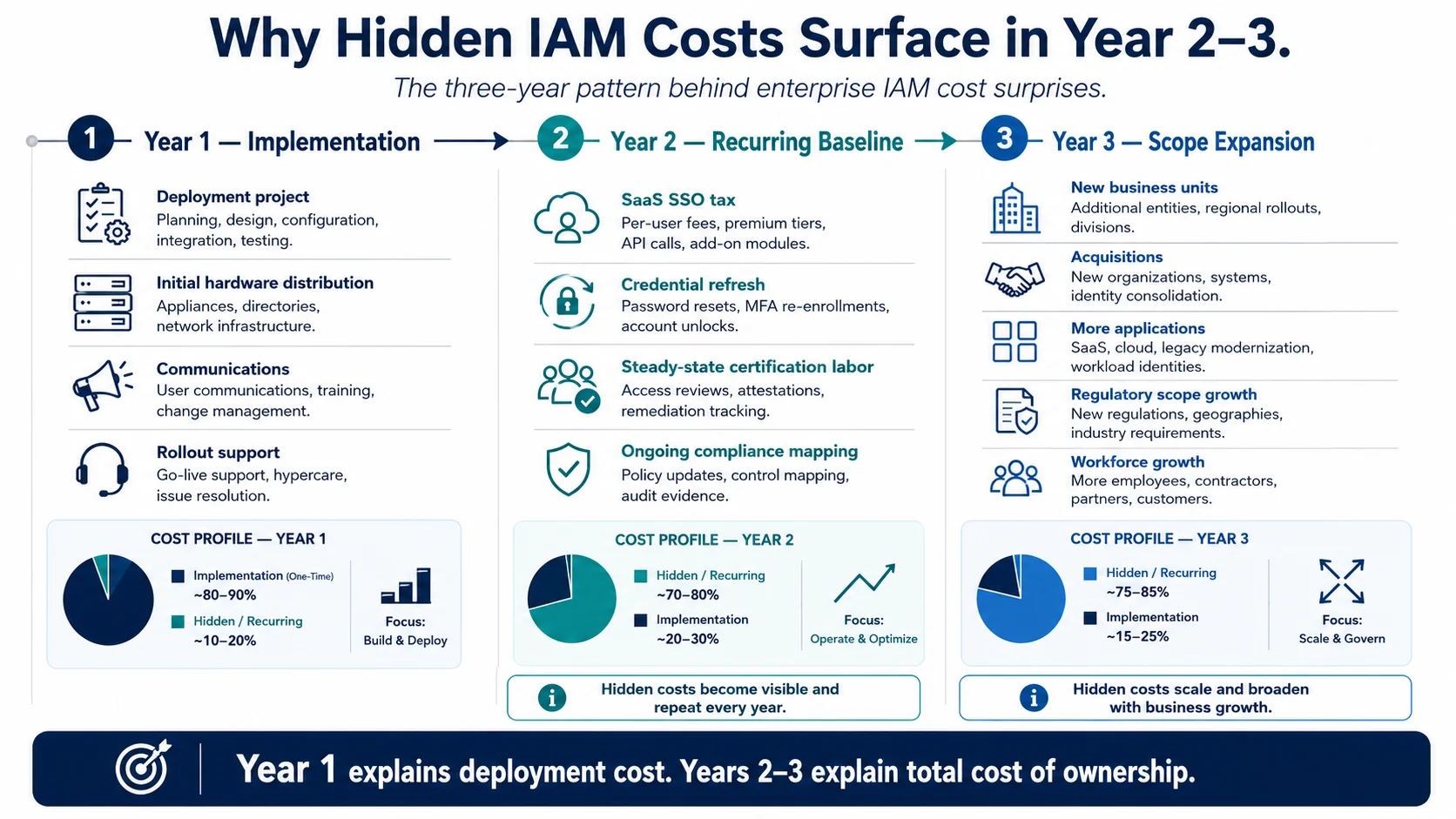
Year 1 dominates in implementation. Year 1 cost is heavily weighted to implementation — the deployment project, initial hardware distribution, initial help desk rollout. The recurring hidden costs are small in Y1 relative to the implementation load.
Year 2 exposes the recurring baseline. With implementation behind, the recurring costs become the dominant TCO component — ongoing SSO tax across the SaaS portfolio, hardware credential refresh at 3-5 year intervals hitting Y2 for some segments and Y3 for others, certification labor at steady-state, compliance mapping at steady-state.
Year 3 exposes scope expansion. Deployments that expand scope (new business units, acquisition integration, regulatory-scope expansion, workforce growth) produce cost expansion. The recurring baseline plus expansion is where TCO surprises materialize.
The framing implication. Year 1 TCO alone is a misleading vendor-selection metric. The three-year TCO frame (Enterprise IAM Cost Comparison piece) captures the actual cost profile.
The 2026 reference path
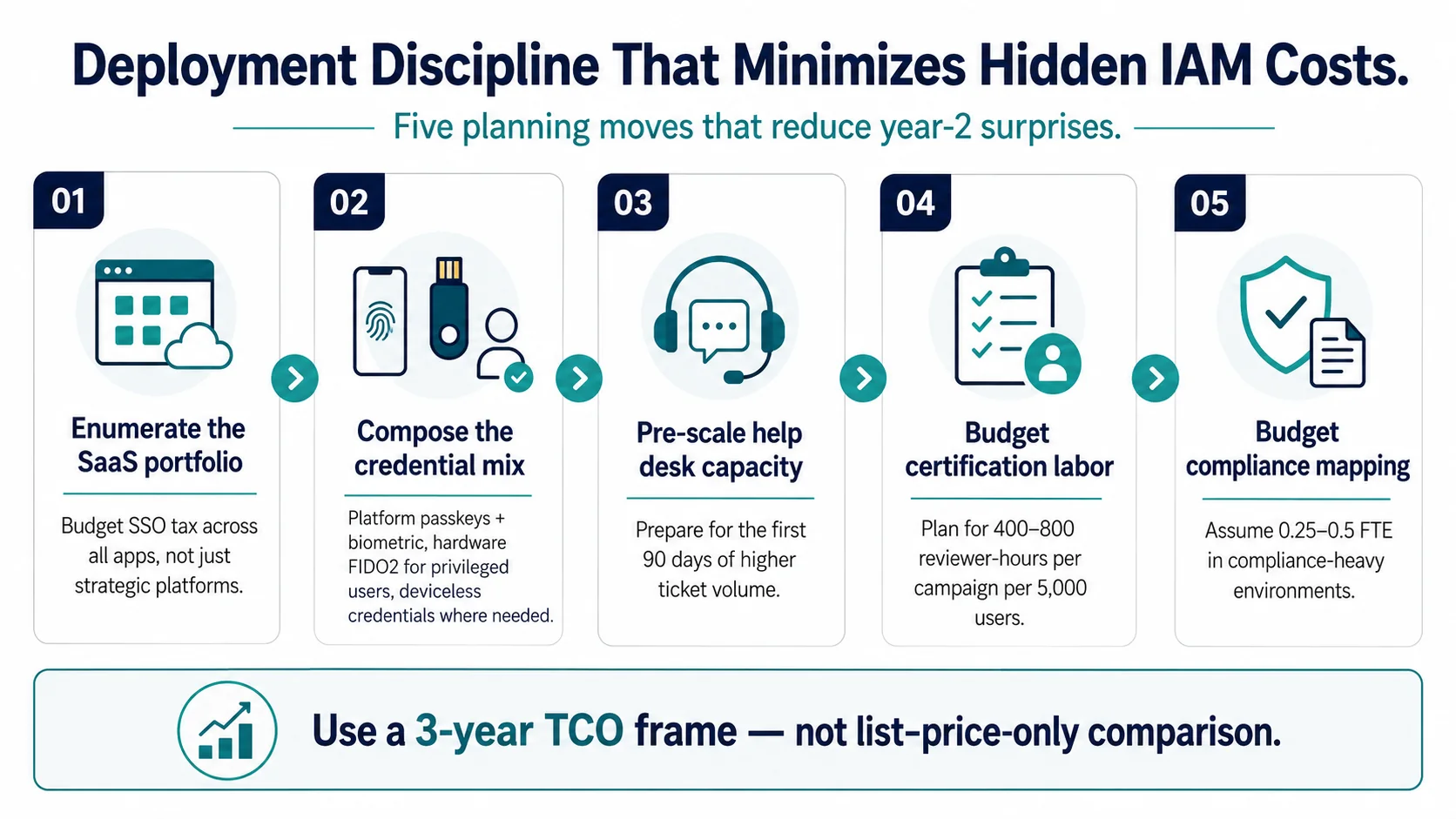
Enumerate the SaaS application portfolio at contract time. Budget SSO tax across the full enumerated portfolio, not just strategic platforms. Include custom connector work for on-premises applications with non-standard integration.
Compose the MFA credential mix explicitly. Platform passkeys + biometric as the universal baseline. Hardware FIDO2 for privileged step-up. Identity Challenge Card for smartphone-unavailable segments. Budget per-unit hardware cost, logistics, and 3-5 year refresh cycles.
Pre-scale help desk capacity for the first 90 days of cutover. Communicate to targeted role populations. Pilot with representative populations that include edge cases.
Budget certification-campaign labor at 400-800 reviewer-hours per campaign per 5,000 users. Deploy AI-augmented certification (AI Access Certification piece) to reduce per-entitlement reviewer time while maintaining certification quality.
Budget compliance-mapping labor at 0.25-0.5 FTE for compliance-heavy environments. Choose IAM platforms with mature framework-alignment tooling. Align deployment architecture with framework requirements from day one.
Use the three-year TCO frame from the Enterprise IAM Cost Comparison piece — the five-driver model plus the five hidden costs this piece covers is the honest cost profile.
Point auditors at the Trust Center for Avatier's own posture. The Avatier Trust Center with the SecurityScorecard grade view — SOC 2 Type II with zero exceptions, ISO/IEC 27001:2022, PCI DSS v4.0.1, CSA STAR Level 1, NIST 800-53 Rev. 5 aligned, CISA Secure-by-Design Pledge signatory.
ABOUT THE AUTHOR

More from Buyer's Guides
IAM Vendors in 2026: How the Market Breaks Down
A category-level guide to how the IAM vendor market segments into suites, point solutions, and platform plays, plus the criteria and red flags that separate real capability from marketing claims.
SailPoint vs Avatier: The 2026 Enterprise Pricing Model Comparison
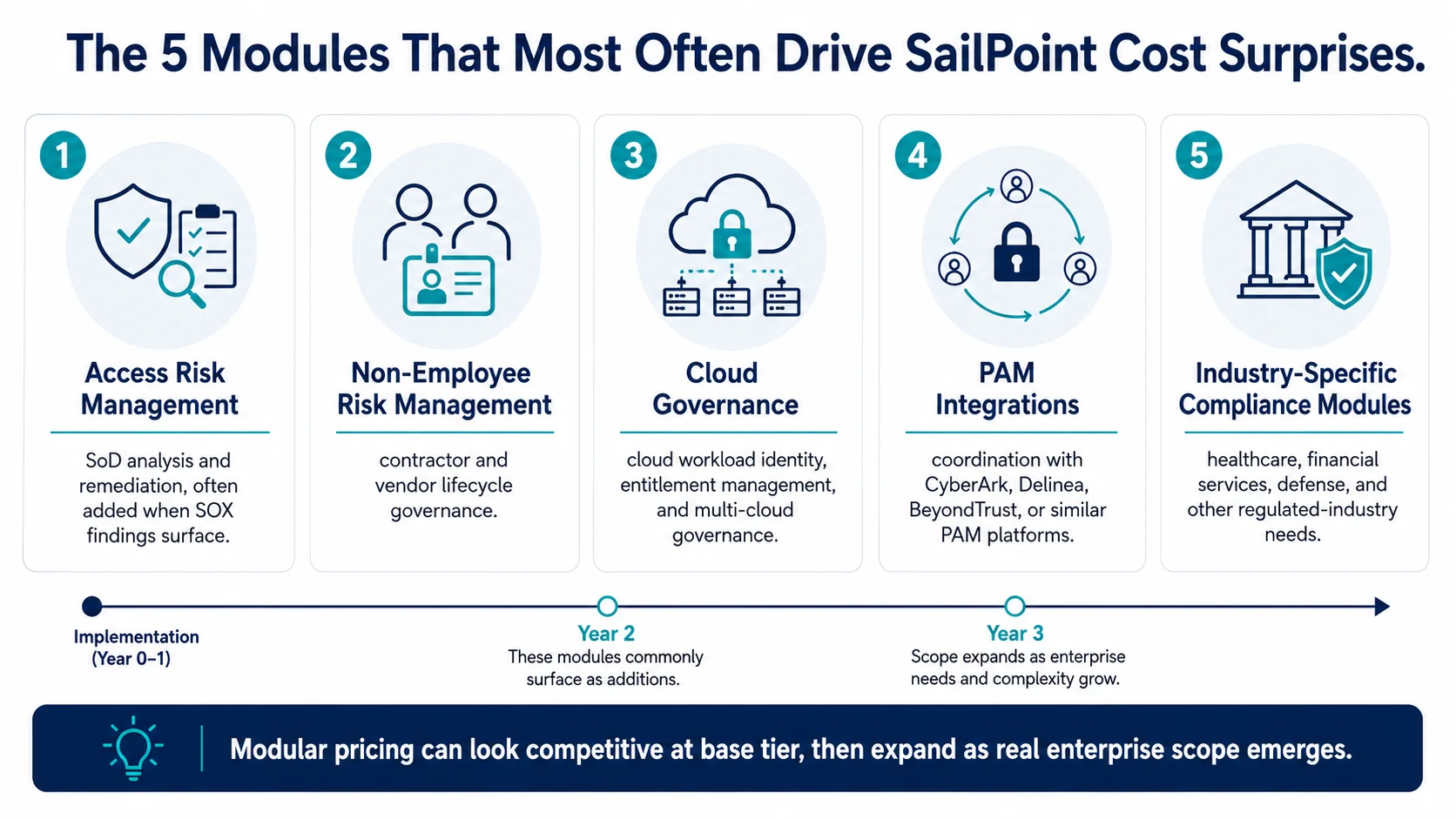
Enterprise IAM buyers evaluating SailPoint against Avatier are comparing two fundamentally different pricing philosophies — modular per-capability pricing with premium tiers and per-connector charges versus all-inclusive licensing that bundles the same capability set into the base license. The 2026 enterprise reference on the structural pricing differences, the modules that drive most of the SailPoint cost surprises, the Avatier all-inclusive positioning, and the buyer-side comparison discipline that produces defensible vendor selection instead of feature-checklist theater.

Login Reset Licensing Models: The 2026 Enterprise Cost Structure Reference
Enterprise password reset licensing has three fundamentally different pricing models — per-user subscription, per-reset-event consumption, and modular capability-based licensing — and the fit between model and buyer profile determines whether TCO tracks the vendor's list-price projection or surprises 18-24 months into deployment. The 2026 enterprise reference on the three licensing models, the specific line items that drive cost variance, and the buyer discipline that produces defensible reset-workflow vendor selection.