HRIS-Driven Identity Lifecycle for SAP SuccessFactors and Workday 2026
Modern identity governance treats the HRIS — SAP SuccessFactors, Workday, BambooHR, ADP — as the authoritative source of truth for who works at the organization, what role they hold, and when their access should change. The 2026 enterprise reference on the integration patterns, schema discipline, and architecture that survives HRIS upgrades.
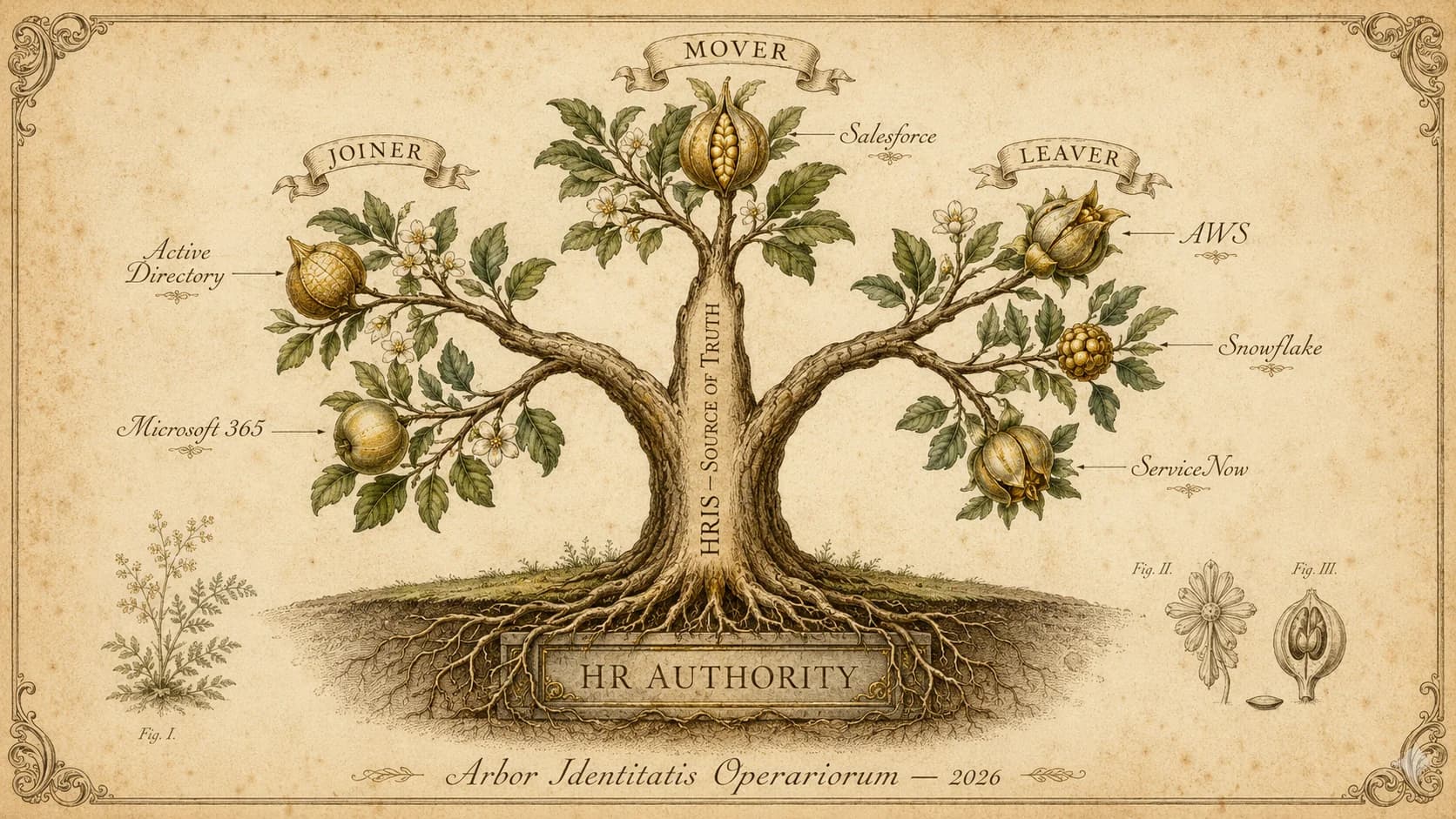
Modern identity governance treats the HRIS — SAP SuccessFactors, Workday, BambooHR, ADP — as the authoritative source of truth for who works at the organization, what role they hold, and when their access should change. The 2026 enterprise reference on the integration patterns, schema discipline, and architecture that survives HRIS upgrades.
- The HRIS — SAP SuccessFactors, Workday, BambooHR, ADP, UKG — is the authoritative source of truth for workforce identity in 2026 enterprise IAM architectures: every joiner, mover, and leaver event in identity originates from an HRIS event.
- Four integration patterns dominate: SCIM 2.0 push (HRIS sends events to IAM), delta synchronization pull (IAM polls HRIS for changes since last sync), full reconciliation (periodic complete-state comparison to catch drift), and webhook event streams (HRIS publishes events to a message broker IAM consumes).
- Schema mapping discipline determines whether the integration survives HRIS upgrades — the mapping has to handle field renames, value-set changes, organizational restructures, and the corner-case attributes (contractor flag, leave-of-absence status, dual-role assignments) that HRIS vendors restructure between major releases.
- Common failure modes — orphaned access after delayed leaver events, mover events that add new entitlements without removing old ones, recertification noise from HRIS attribute drift, contractor-vs-employee handling that misroutes entire user populations — concentrate at the schema and reconciliation layer.
- The 2026 reference architecture composes SCIM 2.0 push for real-time events, delta synchronization as backup for missed events, full reconciliation on a defined cadence to catch drift, and explicit recertification workflows tied to HRIS attribute changes rather than calendar dates.
Modern enterprise IAM architectures stopped storing workforce identity locally years ago. The HRIS — SAP SuccessFactors at most large enterprises, Workday at the rest, BambooHR or ADP at mid-market, UKG at certain industry segments — owns the authoritative answer to "who works at this organization, in what role, reporting to whom, in what location, with what employment classification." IAM consumes that answer. The joiner, mover, and leaver events that drive identity lifecycle originate in the HRIS and propagate to IAM through an integration layer.
The pattern is now load-bearing for compliance. SOX and similar financial-controls regimes expect access changes to follow documented role changes; the documented role changes live in the HRIS. SOC 2 and ISO 27001 audits expect provisioning workflows tied to authoritative HR records. NIST 800-53 and FedRAMP environments expect lifecycle automation that produces auditable trails. The HRIS-driven pattern produces those trails naturally because every IAM-side event has an HRIS-side origin event with a documented business reason.
This piece is the 2026 enterprise reference on HRIS-driven identity lifecycle — the integration patterns that move events from HRIS to IAM, the schema mapping discipline that translates HR attributes into access decisions, the failure modes that surface in incident reports, and the architecture that survives HRIS upgrades. The companion pieces handle adjacent territory. The Best Identity Lifecycle Management buyer's guide compares the vendor landscape; the Best IGA Solutions piece covers the broader governance layer this composes with; the PAM piece covers the privileged-access-specific layer that has its own lifecycle. This piece is the HRIS-integration-specific treatment.
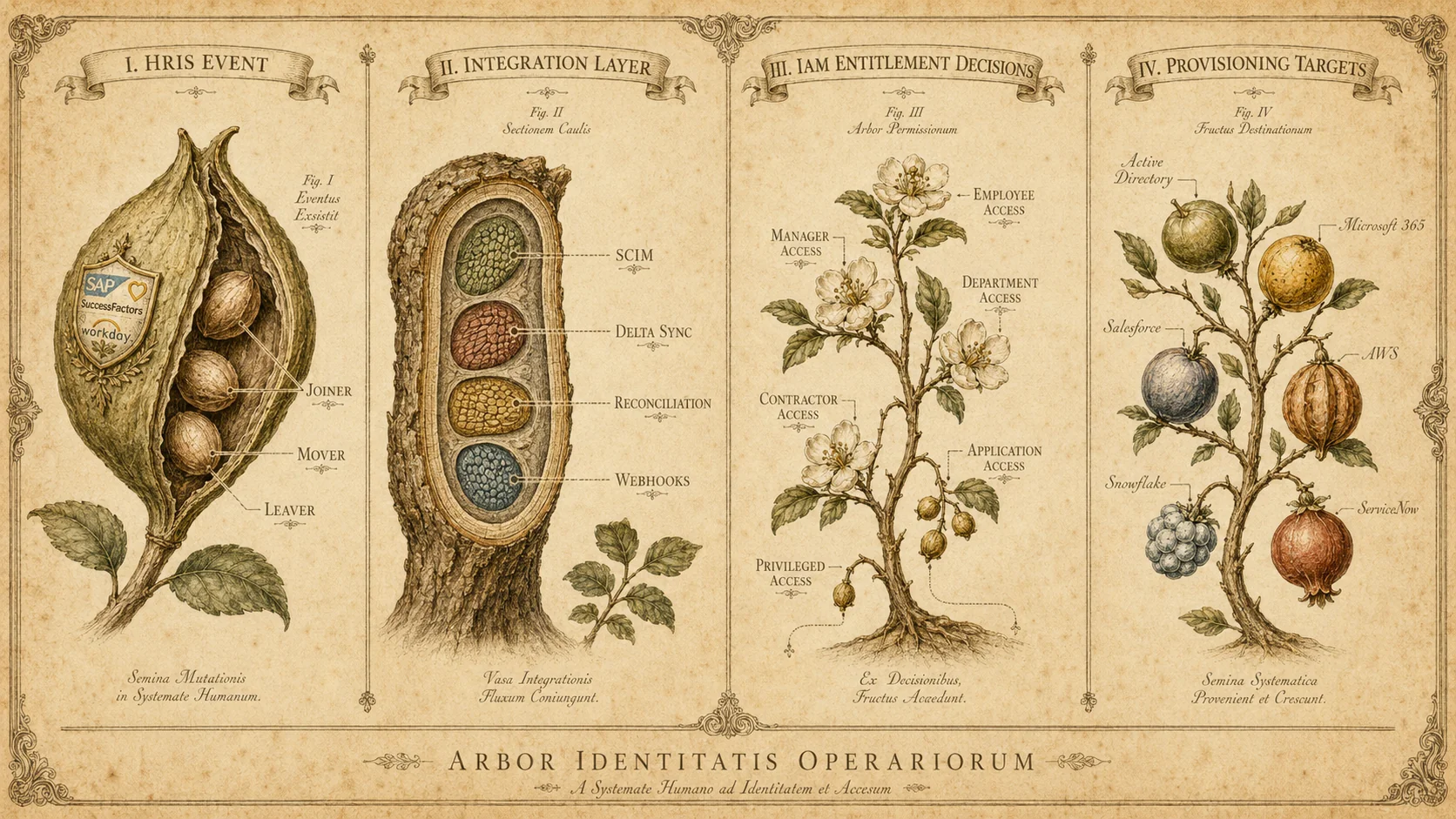 Four stages, one direction. HRIS events drive integration-layer translation, which drives entitlement decisions, which drive provisioning targets. The architecture works because the authority is unambiguous.
Why the HRIS is the authoritative source of truth
The instinct to make IAM the source of truth for workforce identity — the legacy pattern from a generation ago — fails three operational tests in 2026 enterprise environments.
The HR authority test. Employment records are legally and operationally HR-owned. Employment contracts are filed in HR. Payroll tax compliance is HR-driven. Benefits enrollment is HR-driven. Regulatory reporting (EEO-1, ACA, country-specific employment reports) flows through HR. When the legal record of who works at the organization disagrees with the IAM record, the legal record wins. Making IAM the source of truth means perpetually reconciling against HR with HR winning every disagreement — which means IAM isn't really the source of truth, it's just a copy that's perpetually wrong.
The timeliness test. HR processes catch lifecycle events at the right moment. Joiners are entered before start date because payroll, benefits, and IT need lead time. Leavers are entered with termination effective date because final paycheck and benefits termination depend on it. Movers are entered through formal role-change workflows that include manager approval and effective date. IAM-side processes typically lag — IT only learns about a new hire when the manager submits a ticket, only learns about a termination when someone notices the person isn't responding to emails, only learns about a role change when access requests fail. HRIS-driven lifecycle inverts this — IAM learns about the event when HR records it, not when downstream effects become visible.
The attribute completeness test. Effective access decisions require attributes IAM doesn't naturally have: job role, organizational unit, cost center, manager hierarchy, location, employment classification, contractor-vs-employee, work authorization status. The HRIS has these attributes because the business processes that depend on them are HR processes. IAM systems that try to maintain these attributes locally drift out of sync with the authoritative HR values; access decisions based on the drifted local copy are wrong in proportion to the drift. HRIS-driven lifecycle uses the HR values directly, eliminating the drift class entirely.
The three tests compound. HR owns the authority; HR processes catch events at the right time; HR has the attributes IAM needs. The HRIS-driven pattern aligns IAM with the structural facts of how enterprises actually work, rather than trying to maintain a parallel reality in the identity layer.
SAP SuccessFactors vs Workday vs the rest: integration profile
The two HRIS platforms that dominate enterprise IAM integration discussions are SAP SuccessFactors and Workday. The mid-market and segment-specific platforms — BambooHR, ADP Workforce Now, UKG Pro (formerly UltiPro), Oracle Cloud HCM, Ceridian Dayforce — each have their own integration profiles. The 2026 enterprise pattern usually has to handle at least one major platform; many enterprises handle two or three (post-acquisition, multi-region, parent-company-vs-subsidiary).
| Platform | SCIM 2.0 support | Delta API quality | Webhook support | Schema stability | Common integration pattern |
|---|---|---|---|---|---|
| SAP SuccessFactors | ✓ via Identity Authentication Service | ✓ OData API with delta tokens | ✓ Intelligent Services Events | Moderate — schema evolves with quarterly releases | OData delta + Intelligent Services webhooks |
| Workday | ✗ partial — REST API requires custom mapping | ✓ Web Services API | ✗ no native webhooks — pull-based | High — Workday Report-as-a-Service stable | RaaS pull + scheduled reconciliation |
| BambooHR | ✗ no SCIM | ✓ REST API with changedSince | ✓ webhooks for major events | High — simpler schema | Webhook + REST reconciliation |
| ADP Workforce Now | ✓ ADP Marketplace SCIM connectors | ✓ ADP API | ✗ limited | Moderate | Marketplace SCIM connector |
| UKG Pro | ✓ partial | ✓ REST API | ✓ webhook support | Moderate | REST polling + webhooks |
| Oracle Cloud HCM | ✓ partial | ✓ REST API | ✓ partial | High | REST polling + scheduled reconciliation |
The platform-specific patterns matter because the integration architecture depends on what the HRIS actually provides. SuccessFactors provides robust OData APIs with delta tokens and a webhook system (Intelligent Services Events) that publishes events to subscribers — the 2026 pattern composes OData delta polling for backup with Intelligent Services webhooks for real-time. Workday provides Web Services and Report-as-a-Service but no native webhooks, so the pattern is pull-based on a tight schedule (every 5-15 minutes for real-time-feel) with scheduled full reconciliation. BambooHR is structurally simpler — the REST API and webhooks compose cleanly for most use cases.
The architectural decision in 2026 deployments is rarely "which HRIS" — that's already decided by HR. The decision is which integration pattern the HRIS actually supports and how to compose the available primitives into a complete lifecycle pipeline.
The four integration patterns and when to use each
Four integration patterns dominate 2026 deployments. Mature architectures compose all four; less-mature architectures pick one and discover the failure modes the others would have caught.
SCIM 2.0 push. The HRIS — or a SCIM-compatible adapter in front of the HRIS — sends provisioning events to the IAM platform via the SCIM REST API. The IAM platform implements /Users and /Groups endpoints that accept Create, Update, and Delete operations. SCIM push is the real-time pattern: events propagate from HR action to IAM state in seconds to minutes. The advantages are simplicity and standardization — SCIM 2.0 is a published RFC with broad ecosystem support. The disadvantages are HRIS-side variation in how completely SCIM is implemented (Workday's SCIM support is partial; many mid-market platforms don't support SCIM at all) and the operational fragility of any single-protocol approach (missed events, network partitions, HRIS-side queue overflow).
Delta synchronization (pull). The IAM platform polls the HRIS API on a schedule and fetches records changed since the last sync. Most HRIS APIs support some form of change-tracking — OData delta tokens in SuccessFactors, changedSince timestamps in BambooHR, Report-as-a-Service in Workday with last-updated filters. Delta sync is slightly less real-time than SCIM push (events propagate at the poll interval, typically 5-60 minutes), but is more robust to missed events because the next poll catches what the last poll missed. The 2026 pattern is to run delta sync as the always-on backup that catches any events SCIM push drops.
Full reconciliation. The IAM platform periodically (daily or weekly) compares its complete identity inventory against the HRIS complete inventory and catches any drift. Full reconciliation is the only pattern that detects bidirectional drift — records that exist in IAM but not in HR (orphans), records that exist in HR but not in IAM (missing provisioning), and records that exist in both but with diverged attributes (stale schema). The cost is computational — full reconciliation against tens of thousands of users in real-time isn't free — so the cadence is weekly or daily, not minute-level. The 2026 pattern uses full reconciliation as the audit-trail backstop that ensures the system stays consistent over time.
Webhook event streams. The HRIS publishes events to a message broker (Kafka, AWS EventBridge, Azure Event Grid, Google Pub/Sub) and the IAM platform consumes them. Webhooks have higher throughput and more flexibility than SCIM push because the message broker handles delivery semantics — retries, dead-letter queues, fan-out to multiple consumers. The 2026 pattern uses webhooks for high-volume real-time integration (large enterprises with thousands of events per hour) and for cases where multiple downstream systems consume the same event stream.
The 2026 mature architecture composes all four. SCIM push (or webhooks) for normal-case real-time events. Delta synchronization as backup for missed events and for HRIS systems with weaker push support. Full reconciliation on a defined cadence for drift detection. Webhooks specifically for high-volume cases or multi-consumer event streams.
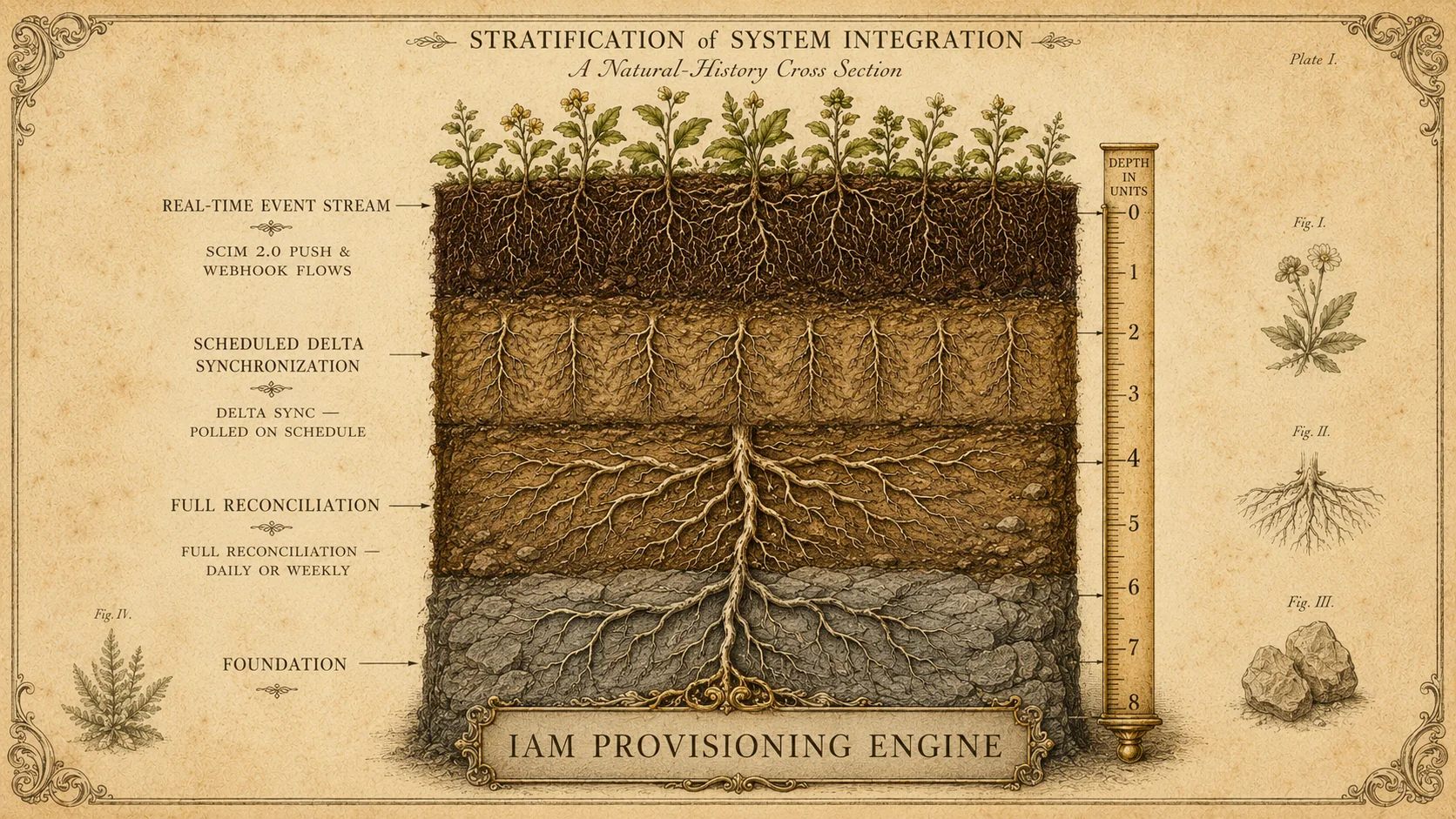 Four patterns, one pipeline. The composition is what produces reliability — no single pattern catches all events; the four together catch substantially more than any one alone.
Schema mapping discipline: what survives HRIS upgrades
The integration layer is only as good as the schema mapping that translates HRIS attributes into IAM-side decisions. The mapping is where most HRIS-integration incidents originate — not in the protocol layer (SCIM push works or doesn't, deterministically), but in the semantic layer where HRIS attribute values get interpreted as IAM access decisions.
Field renames. HRIS vendors rename fields between major releases. SuccessFactors quarterly releases sometimes rename fields. Workday tenant configurations evolve over time. BambooHR adds and removes custom-field types. Mapping that hardcodes field names breaks at the next upgrade; mapping that uses stable identifiers (field GUIDs in SuccessFactors, Report fields in Workday, custom field IDs in BambooHR) survives. The architectural discipline is to use stable identifiers wherever the HRIS provides them and to wrap field-name lookups in a single mapping layer that can be updated in one place when renames happen.
Value-set changes. HRIS vendors restructure value sets between major releases. The "employee class" field might have values ("FT", "PT", "Intern", "Contractor") in one release and ("Full-Time Regular", "Part-Time Regular", "Intern", "Contingent Worker — Onsite", "Contingent Worker — Offsite") in a later release. IAM logic that hardcodes the original value set produces wrong access decisions after the upgrade. The architectural discipline is to maintain the value-set mapping in configuration rather than code, and to alert when new values appear that the mapping doesn't recognize.
Organizational restructures. Organizational hierarchies change. Departments merge or split. Cost centers reorganize. Manager-of-manager chains shift. IAM access decisions tied to organizational position have to handle the restructure cleanly — the user's access should follow them through the restructure without manual re-provisioning. The architectural discipline is to use stable organizational identifiers (org unit GUIDs, not names) and to design access decisions around current attributes rather than historical attributes.
Corner-case attributes. The attributes that HRIS vendors restructure most are the ones IAM cares about most: contractor-vs-employee flag, leave-of-absence status, dual-role assignments, temporary-acting-role designations, expatriate/assignment status. The mappings around these attributes have to handle the corner cases explicitly — what happens to access when an employee goes on leave (suspended? maintained? partially removed?). The architectural discipline is to write the corner-case behavior as policy with explicit business-stakeholder sign-off, not as inferred behavior buried in mapping code.
The schema mapping is the load-bearing layer of HRIS-driven lifecycle. Most enterprises that have HRIS-driven lifecycle working in production have invested substantially in the schema mapping discipline. Most enterprises that struggle with HRIS-driven lifecycle have under-invested in it.
The five failure modes that produce HRIS-integration incidents
Five failure modes recur in 2026 HRIS-integration incident reports. Each has a known mitigation; the failure is usually skipping the mitigation rather than not knowing it exists.
Orphaned access after delayed leaver events. The leaver event fires in the HRIS — termination date entered, last day worked recorded — but the propagation to IAM is delayed, partial, or missed entirely. The departed employee retains access. The mitigation is the layered integration pattern — SCIM push catches most leavers in seconds; delta sync catches whatever SCIM dropped within the poll interval; full reconciliation catches the remainder at the daily or weekly cadence. The mature 2026 architecture closes the leaver-event-to-access-removal window to under 24 hours at the 99th percentile, often under one hour at the median.
Mover events that stack entitlements. The user changes role (analyst → senior analyst → manager → senior manager) and the IAM platform interprets each role change as adding new entitlements without removing prior-role entitlements. After three role changes, the user has the entitlements of all four roles. The mitigation is mover-specific logic that explicitly removes prior-role entitlements that aren't carried in the new role. The architectural pattern is to compute the target entitlement set based on the current HRIS attributes, then diff against the current entitlement set, and apply both additions and removals.
Recertification noise from HRIS attribute drift. Small attribute changes in the HRIS (department-name normalization, cost-center reorganization, manager hierarchy shifts) trigger recertification workflows that produce nothing actionable. Recertification fatigue grows. Managers click through certifications without reviewing them. The architectural discipline is to tie recertification triggers to material attribute changes (role change, organizational unit change, manager change) rather than to every attribute change, and to suppress recertification when the change is a cosmetic reorganization that doesn't affect access semantics.
Contractor-versus-employee misrouting. The HRIS distinguishes employee classes (full-time regular, part-time regular, intern, contractor, contingent worker, vendor) but the IAM mapping doesn't capture all variants. Contractors might get employee-level access, or employees with edge-case classifications might get contractor-restricted access. The mitigation is explicit mapping for every employee class the HRIS supports, with default-deny when an unknown class appears. The architectural discipline is to alert when new employee classes appear in the HRIS rather than silently mapping them to a fallback class.
Dual-role users handled inconsistently. The HRIS supports a user being in two roles simultaneously — during role transitions, for matrix-managed positions, for acting assignments. The IAM mapping picks one role and discards the other, producing access errors. The architectural discipline is to model dual-role users explicitly in the IAM platform — both role entitlements are granted, the access decisions union the two role's entitlements, recertification covers both roles.
The five failure modes share a common cause: the integration was designed for the simple case and didn't account for the corner cases. The 2026 mature integrations design for the corner cases explicitly because the corner cases are where incidents happen.
HRIS upgrade survivability
HRIS vendors push major releases regularly — SuccessFactors quarterly, Workday twice annually (R1 in March, R2 in September), BambooHR continuously, ADP and UKG on their own schedules. Each release has the potential to break field mappings, value-set assumptions, API behaviors, and integration patterns the IAM platform depends on. The integrations that survive upgrades have explicit upgrade-survivability discipline; the integrations that don't, don't.
The architectural discipline has three parts. First, pre-upgrade testing in a staging environment that mirrors production — the IAM platform connects to the staged HRIS upgrade and exercises every integration path, with alerts for any deviation from baseline behavior. Second, schema versioning — the mapping configuration is versioned in source control with explicit per-release variants when needed, so a regression can be rolled back without rebuilding the entire mapping. Third, alerting on integration-layer anomalies — counts of records by employee class, by organizational unit, by role; sudden changes in these counts signal mapping breakage even when individual events look fine. The mature 2026 integrations catch upgrade-induced breakage within the first hour of the upgrade taking effect, not at the next monthly audit.
The 2026 reference path
Treat the HRIS as the authoritative source of truth for workforce identity. Drive joiner-mover-leaver from HRIS events. Implement the four integration patterns — SCIM push (or webhooks), delta synchronization, full reconciliation, and high-volume event streams where appropriate — composed into one unified pipeline. Invest in the schema mapping discipline because that's where the integration breaks. Design explicitly for the corner cases (contractors, dual-role users, leave-of-absence, expatriate assignments) because the corner cases are where incidents happen.
Compose with the broader IGA layer. The Best IGA Solutions piece covers the governance platform that HRIS-driven lifecycle feeds into. The Best Identity Lifecycle Management piece compares vendor approaches in the specific lifecycle subspace. The PAM piece covers the privileged-access lifecycle that has its own additional discipline.
Compose with the non-human identity layer. The Service Account Governance / NHI piece covers the parallel lifecycle for service accounts and AI agents, which doesn't come from the HRIS but follows analogous patterns.
Build upgrade survivability. HRIS releases happen on the vendor's schedule, not the IAM team's, and unprepared integrations break on each release. Pre-upgrade testing, schema versioning, integration-layer anomaly alerting — the disciplines that distinguish surviving integrations from broken ones.
HRIS-driven identity lifecycle is the structural foundation of modern enterprise IAM. The architecture has been settling for a decade; the 2026 pattern is mature. The implementation discipline determines whether the architecture produces reliable lifecycle automation or perpetual reconciliation overhead. Choose the discipline.
ABOUT THE AUTHOR

More from IAM & Identity Governance

Identity Management and Digital Transformation in 2026
Every major transformation initiative — cloud migration, remote and hybrid work, mergers and acquisitions — eventually stalls on the same question: who gets access to what, and who decided? The 2026 strategy reference on identity management as the enabler and the bottleneck of digital transformation, the business case executives actually fund, and what modernization does not fix.

AI and Behavioral Analytics for Identity Monitoring: The 2026 Enterprise Reference
Static identity rules catch the attacks that announce themselves. They miss the ones that log in with valid credentials and behave almost normally. The 2026 reference on AI-driven identity monitoring — what behavioral analytics actually detects, the four telemetry sources that make or break the model, the false-positive economics nobody budgets for, and the honest limits of anomaly detection at enterprise scale.
Security Team Collaboration: A 2026 Framework for Identity Programs
Identity governance fails when it runs as a security-team-only initiative. The 2026 framework for cross-functional collaboration: four stakeholder groups, three coordination models, and how zero trust makes it a shared discipline.