Shadow IT Provisioning: The Access Risk Living in Your Ticketing System 2026
Most enterprise access doesn't flow through the IGA platform — it flows through Slack DMs, ServiceNow tickets routed to direct grant, manager spreadsheets, tool-side admin self-service, and vendor SaaS self-provisioning. The 2026 enterprise reference on shadow IT provisioning, why it bypasses even mature IGA programs, and the architectural pattern that captures it without breaking the operational flow.

Most enterprise access doesn't flow through the IGA platform — it flows through Slack DMs, ServiceNow tickets routed to direct grant, manager spreadsheets, tool-side admin self-service, and vendor SaaS self-provisioning. The 2026 enterprise reference on shadow IT provisioning, why it bypasses even mature IGA programs, and the architectural pattern that captures it without breaking the operational flow.
- Five informal provisioning paths bypass even mature IGA programs in 2026: Slack/Teams DM requests, ServiceNow tickets routed to direct grant rather than IGA workflow, manager Excel exports re-uploaded to target systems, tool-side admin self-service in the target application's own UI, and vendor SaaS self-provisioning that the IGA platform never sees.
- The audit risk grows in proportion to ungoverned provisioning volume — the catalog the IGA layer maintains diverges from the actual entitlement state in target systems, and segregation-of-duty rules can't be enforced on access the IGA layer doesn't know about.
- Shadow provisioning is mostly not malicious — it's the path of least resistance for managers, admins, and end users who need access fast and find the IGA workflow either slow, complicated, or simply not the muscle-memory path.
- The architectural pattern that captures shadow provisioning has three components: target-system reconciliation (compare actual entitlements against IGA-known entitlements and surface the delta), ticket-system integration (route all access tickets through IGA approval even when initiated outside), and governed self-service (make the right path the easy path so shadow paths lose their appeal).
- The 2026 reference architecture composes ISPM-layer reconciliation findings, IGA-layer self-service portals, ticket-system policy enforcement, and target-system access reviews that don't depend on the IGA catalog being complete — the architecture works even when shadow provisioning has produced gaps.
Walk the floor of any mature IAM program in 2026 and the unspoken truth surfaces fast: most access doesn't flow through the IGA platform. It flows through Slack DMs ("hey can you give me access to the staging environment, I need to test something"), through ServiceNow tickets that route straight to a system admin with no IGA approval step, through manager Excel exports re-uploaded to Salesforce or Snowflake when a team reorganizes, through tool-side admin self-service in the target application itself, through vendor SaaS systems that handle their own user creation outside the central identity platform. The IGA catalog shows a clean, governed entitlement state. The actual target systems show a more chaotic reality.
This isn't a failure of the IGA platform. It's the structural pattern that exists in every enterprise with high operational tempo and varied tool landscape. People who need access fast take the path that gets them access fast. When the IGA path is slow, the informal paths win. When the IGA path doesn't cover a system, the system's own admin UI becomes the provisioning path. When the IGA path is complicated, the muscle-memory channel wins. Most shadow provisioning is not malicious; it's the path of least resistance.
The audit risk, however, is real and growing. The 2026 audit pattern is to ask "what's your reconciliation rate between the IGA catalog and actual target-system entitlements," and organizations with high shadow provisioning have uncomfortable answers. Segregation-of-duty rules can't fire on entitlements the IGA layer doesn't know about. Certification campaigns leave shadow entitlements uncertified. Lifecycle deprovisioning misses what wasn't IGA-provisioned in the first place. This piece is the 2026 enterprise reference on shadow IT provisioning — the five informal paths, why they exist, what the audit risk actually is, and the architectural pattern that captures shadow provisioning back into the governance envelope without disrupting the operational flow that produces it.
The companion pieces handle adjacent territory. The Best IGA Solutions buyer guide covers the IGA platforms that anchor the governance envelope. The ISPM piece covers the posture-audit layer that surfaces shadow-provisioning findings. The Service Account Governance / NHI piece covers the parallel shadow-service-account problem. The HRIS-Driven Lifecycle piece covers the HR-driven workflow that, when operational, reduces the volume of shadow provisioning by giving the IGA path a credible automated foundation. This piece is the shadow-specific layer.
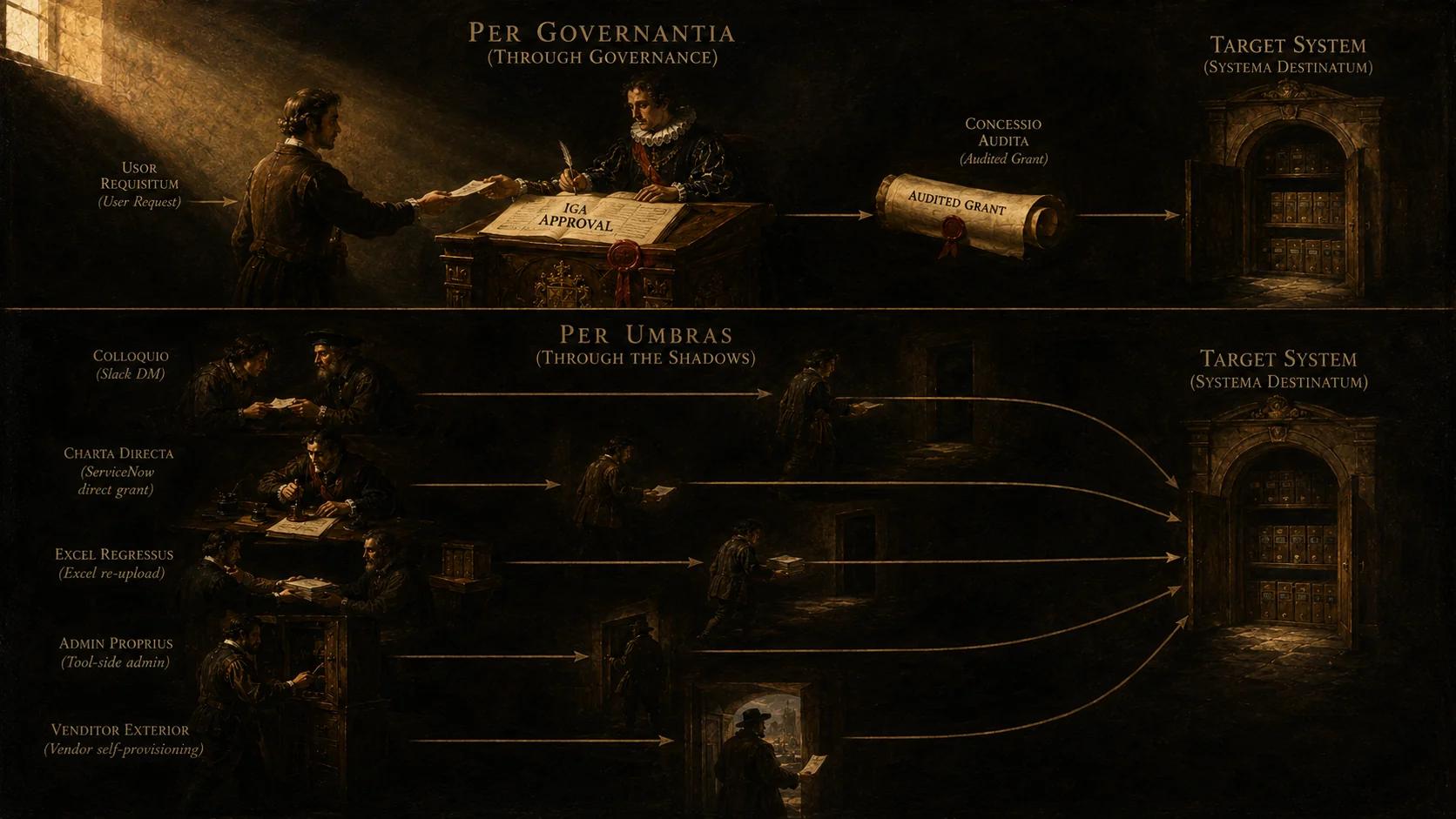 Two flows, one target. The governed path is what the IGA platform sees; the shadow paths are what produces most of the actual entitlement state. The architectural question is capture, not prevention.
The five informal provisioning paths
Five paths recur across 2026 enterprise environments. The relative volume varies by industry, organizational maturity, and tool landscape — but the five categories are consistent.
Slack and Teams DM requests. The most common shadow path in modern enterprises. A user needs access to a system, sends a DM to a colleague who has access ("can you add me to the staging-environment-admins group, I need to test something"), and the colleague — usually with the relevant admin privilege in the target system — grants the access directly. The interaction lives in the messaging system, the access happens in the target system, and the IGA layer is never involved. No ticket, no approval workflow, no audit trail in the IGA layer. The colleague granting the access often doesn't realize they're bypassing governance; they're being helpful.
ServiceNow tickets routed to direct grant. Many enterprises have ITSM platforms (ServiceNow, Jira, Freshservice, Ivanti, BMC Remedy) where access requests land as tickets. The mature 2026 pattern is for those tickets to route through IGA approval — the ITSM platform integrates with the IGA platform so every access ticket becomes an IGA request. The shadow pattern is when the tickets bypass that integration. The ticket goes to a system administrator queue, the admin fulfills the request directly in the target system, and the ITSM ticket is closed with "completed." The audit trail is the ITSM ticket, not the IGA workflow record. Segregation-of-duty rules don't fire because the IGA layer never saw the request.
Manager Excel exports re-uploaded to target systems. Common in environments where managers are responsible for team-level access decisions and target systems support bulk import. A manager exports the current entitlement state for their team to Excel, edits it (adding new team members, removing departed ones), and re-uploads the edited file to the target system. The target system performs the bulk update. The IGA platform sees nothing — it wasn't in the path. Salesforce, Snowflake, certain ERP systems, and cloud platform IAM systems commonly support this pattern, which makes them frequent shadow-provisioning vectors.
Tool-side admin self-service. Most enterprise applications have their own admin UI that supports user creation, role assignment, and entitlement management directly inside the application. An application admin who needs to grant access does it in the app's UI rather than through the IGA platform. The application's admin UI is faster, more familiar, and produces the same operational outcome — but it bypasses central governance. The pattern is especially common in SaaS applications where each app has its own admin interface and the integration with central IGA is partial or absent.
Vendor SaaS self-provisioning. Newer SaaS applications, especially those acquired through team-level procurement without going through central IT, often handle their own user lifecycle entirely. The SaaS vendor provisions new users on Sign Up, manages roles within the application, and handles deprovisioning when the user's company terminates the contract. Central identity has no visibility into the user roster, the role assignments, or the entitlement history. The IGA platform doesn't know the application exists at all in many cases.
The five paths share a common property: each produces target-system entitlement state that the IGA layer doesn't see. The volume varies by path — Slack DM requests are usually higher-volume than manager Excel re-uploads — but each contributes to the gap between catalog and reality.
Why shadow provisioning exists in mature IGA programs
The naive instinct is to treat shadow provisioning as discipline failure — people choosing not to follow process. The structural reality is different. Shadow provisioning persists in mature IGA programs because the IGA path is structurally uncompetitive against the informal paths for three reasons.
Speed. The IGA workflow involves request submission, manager approval, security review (sometimes), provisioning queue, and grant. The typical end-to-end time is hours to days. The Slack DM path produces the access in minutes. When a user has work to do today, the IGA path's speed disadvantage drives behavior. Mature programs that reduce IGA workflow latency — auto-approval for low-risk routine requests, automated provisioning queue execution, ITSM integration that bypasses redundant queues — narrow the speed gap. Programs that haven't done this reduction work see persistent shadow volume.
Coverage. The IGA workflow covers only systems the platform integrates with. New SaaS applications, niche team tools, vendor-managed systems often live outside the integrated landscape. When a user needs access to an uncovered system, the IGA path simply isn't an option — they go to the system's own admin UI by necessity, not by preference. Mature programs continuously expand integration coverage so the IGA path stays competitive with the actual tool landscape. Programs that let integration coverage stagnate see growing shadow volume as the tool landscape expands faster than integration.
UX. The IGA workflow's user-facing interface determines whether end users actually use it. The 47-field access request form, the unclear approval routing, the unfamiliar self-service portal produce muscle-memory aversion. The Slack DM path is well-understood by everyone. The IGA portal often is not. Mature programs invest in self-service UX so the IGA portal is genuinely fast and easy for routine requests — the Avatier post on eliminating security risk by automating group management covers the group-membership self-service dimension of this. Programs that treat the IGA portal as enterprise-IT compliance infrastructure rather than user-facing product see persistent shadow volume.
The three structural drivers compose. When the IGA path is slow, coverage-limited, and UX-clumsy, shadow provisioning is operationally rational. The architectural answer isn't to forbid shadow provisioning (the volume is too high and the use cases too varied to prevent through policy alone) but to make the IGA path competitive and to capture the shadow paths back into the governance envelope.
The audit risk that grows with shadow volume
The compliance and audit consequences of shadow provisioning scale with the shadow volume. The 2026 audit pattern is increasingly sophisticated — auditors are asking the reconciliation question explicitly, and answers that don't hold up well produce findings.
| Audit consideration | Shadow provisioning impact |
|---|---|
| IGA catalog accuracy | Catalog shows the entitlements IGA granted; misses shadow entitlements |
| Segregation-of-duty enforcement | SoD rules can only fire on IGA-visible entitlements |
| Certification campaign coverage | Campaigns review IGA-known entitlements; shadow entitlements uncertified |
| Lifecycle deprovisioning | Leaver workflow removes IGA-known access; shadow access persists |
| Audit-trail completeness | IGA audit trail is the formal record; shadow entitlements have no IGA-side trail |
| Compliance attestation | SOX, HIPAA, SOC 2, ISO 27001 attestations depend on accurate state |
| Forensic investigation | Shadow entitlements complicate "who had access when" forensic questions |
| Insider-threat detection | ITDR behavioral baselines depend on accurate entitlement context |
The cumulative risk is structural. An organization with 30% shadow provisioning has a 30% gap in every column of the table — the IGA catalog is 30% inaccurate, SoD enforcement is 30% incomplete, certification coverage is 30% short. The audit consequences compound. The Storm-2949 incident pattern documented in the governance failure analysis included shadow provisioning as a contributing factor — entitlements that existed in target systems but not in the governance catalog, exploitable when the active attack surfaced them.
The 2026 audit framing is increasingly direct: auditors ask "what's your reconciliation rate between IGA catalog and actual target-system entitlements" and "how often do you reconcile." Organizations that reconcile continuously and have high accuracy rates produce clean audit positions. Organizations that don't reconcile, or reconcile annually with low accuracy, produce findings.
The three-component architecture that captures shadow provisioning
The architectural pattern that captures shadow provisioning has three composable components. None is sufficient alone; the combination produces the operational coverage that closes the gap.
Component 1: Target-system reconciliation. The IGA platform — or an ISPM tool composed with the IGA platform — periodically reads the actual entitlement state from each target system and compares it against the IGA-known state. Entitlements in the target system but not in IGA are shadow provisions; they get surfaced for owner identification, justification, and either catalog import (the access is legitimate and should be governed going forward) or removal (the access shouldn't exist). Entitlements in IGA but not in the target system are stale catalog records; they get cleaned up. Entitlements that exist in both but with diverged attributes get reconciled. The reconciliation cadence depends on the target system's volatility — high-change systems daily, low-change systems weekly or monthly. The ISPM piece covers this finding category as a posture-audit output.
Component 2: Ticket-system integration. Every access ticket that lands in the ITSM platform routes through IGA approval before producing the target-system grant, regardless of how the ticket was initiated. The integration intercepts the ticket, evaluates whether IGA already covers the requested access, and either auto-fulfills through the IGA workflow (for routine requests with clean signals) or routes to explicit approval (for non-routine requests). The architectural test is whether a system administrator who tries to fulfill an access ticket by directly granting in the target system gets blocked or alerted — the integration enforces that the IGA path is the only path. The ITSM systems that integrate cleanly (ServiceNow, Jira Service Management, Freshservice, Ivanti Neurons for ITSM) are common targets; the integration depth varies by IGA platform.
Component 3: Governed self-service. The IGA platform's user-facing self-service portal is genuinely fast and easy for routine requests — the same speed as the Slack DM path, the same UX simplicity. When a user needs access, the IGA portal is the path of least resistance, not the path of greatest friction. The Avatier post on eliminating security risk by automating group management covers the group-membership self-service dimension specifically — when users can request and self-manage group membership through a fast self-service path, the informal-channel volume on group requests collapses naturally. Extending the same UX discipline across the broader access request landscape is what makes the IGA path universally competitive.
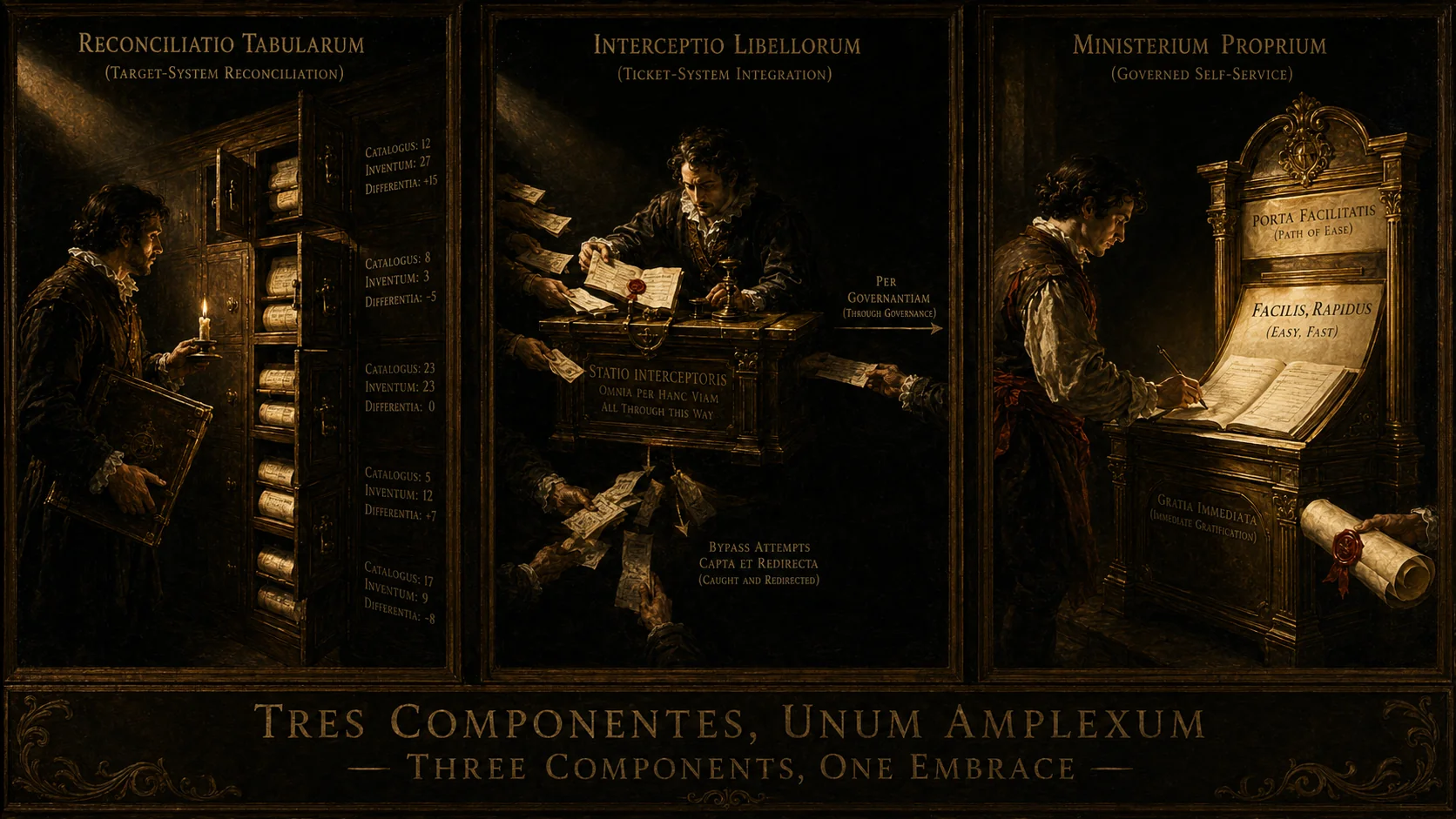 Three components, one envelope. Reconciliation catches what already happened; integration prevents future tickets from bypassing; self-service makes the right path the easy path.
The 2026 reference path
Run target-system reconciliation continuously. The IGA platform or an integrated ISPM tool compares actual entitlement state against the IGA catalog on a defined cadence — high-change systems daily, others weekly. Findings flow into recertification workflows for owner identification and either catalog import or removal. The ISPM piece covers the posture-audit layer this composes with.
Integrate the ITSM platform with IGA. Every access ticket routes through IGA approval before producing target-system grants. System administrators who try to bypass the integration by directly granting in target systems get blocked or alerted. The architecture treats every ticket as a potential IGA request.
Make governed self-service competitive on speed, coverage, and UX. The IGA portal is the path of least resistance, not the path of greatest friction. Auto-approval for routine low-risk requests. Coverage across the actual tool landscape (continuously expanded as new systems enter the environment). Clean UX that matches the muscle-memory ease of the informal channels it's competing against. The Avatier group enforcer post covers the group-management dimension specifically.
Compose with the parallel architecture for service accounts and AI agents. The Service Account Governance / NHI piece covers the equivalent shadow problem in non-human identities — service accounts and AI agents that exist in target systems without a corresponding catalog entry.
Compose with the broader risk-evaluation layer. The ITDR piece covers behavioral detection that catches active misuse of shadow-provisioned access. The Best IGA Solutions buyer guide covers the platform-level evaluation for the IGA layer this architecture depends on.
Shadow IT provisioning is the access risk that lives in plain sight in nearly every enterprise environment. The volume is high, the audit consequences are real, and the architectural pattern that captures it back into governance is well-understood. The implementation discipline is the gap. Close it deliberately — the audit cycles of the next few years will reward the closure and surface the gaps that remain.
ABOUT THE AUTHOR

More from IAM & Identity Governance

Deprovisioning AI Agents: Governed Offboarding with Avatier
Deprovisioning an AI agent retires its identity, credentials, and tool access when its purpose ends. The triggers, a seven-step offboarding runbook, and how Avatier supports it.

What Is Pay Per Identity Action™? Outcome-Based Identity, Explained
Pay Per Identity Action™ is Avatier's outcome-based identity pricing model: you pay only for completed, verified, policy-compliant identity outcomes, not for seats, modules, or services hours.

What Is Agentic Identity? Governing AI Agents as Identities
Agentic identity is the governed identity an AI agent acts under. How it differs from human and machine identity, how delegated authority works, and the lifecycle that keeps agents accountable.