The Principle of Least Privilege: Why It Matters for Enterprise Access Control 2026
Least privilege is the foundational principle every enterprise access program claims to follow and almost none actually achieves. The 2026 enterprise reference on what least privilege actually means operationally, the four architectural patterns that produce it, the failure modes that explain why most programs miss the target, and how least privilege composes with JIT access and Zero Standing Privilege to produce the modern access envelope.
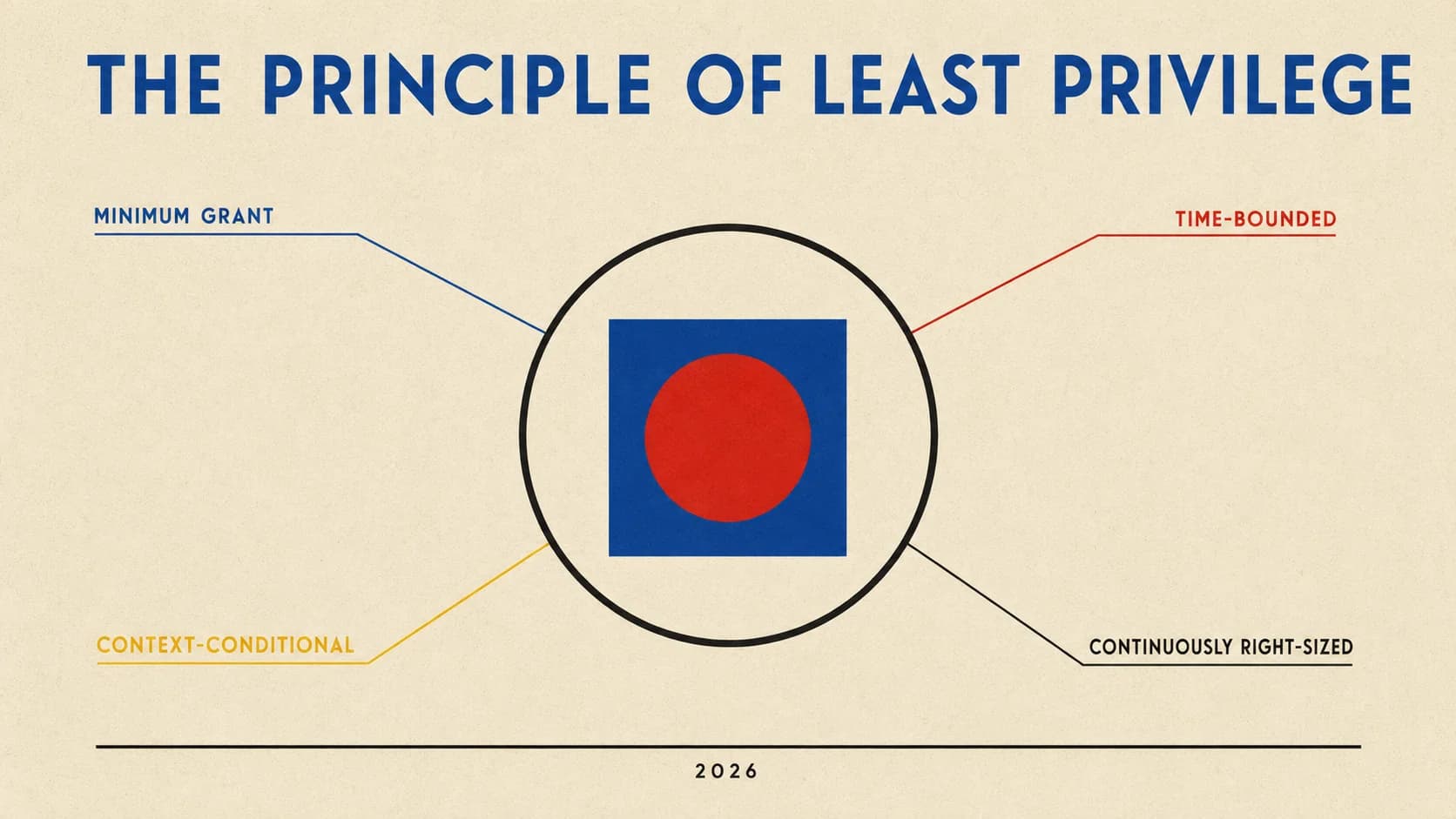
Least privilege is the foundational principle every enterprise access program claims to follow and almost none actually achieves. The 2026 enterprise reference on what least privilege actually means operationally, the four architectural patterns that produce it, the failure modes that explain why most programs miss the target, and how least privilege composes with JIT access and Zero Standing Privilege to produce the modern access envelope.
- Least privilege is the principle that every identity (human or machine) gets only the permissions required for its current task scope — no broader. It's universally cited and almost never achieved in practice; the gap between stated policy and operational reality is where most enterprise access risk concentrates.
- Four architectural patterns produce least privilege in 2026 deployments: (1) role-based baselining with strict minimum-grant logic, (2) just-in-time elevation per the [JIT/ZSP architecture](/en/blog/just-in-time-access-zero-standing-privilege-2026/), (3) attribute-conditional grants that limit permissions by context (time, location, device, sensitivity), (4) continuous right-sizing that removes unused permissions automatically.
- Four failure modes explain why most programs miss the target: (1) accumulated entitlements from years of role changes and project assignments that nobody removes, (2) over-broad initial grants because the requester didn't know what specific scope they'd need, (3) shadow provisioning that bypasses the IGA layer's least-privilege enforcement, (4) standing privilege as the default access pattern for convenience.
- Least privilege composes with Zero Standing Privilege (the architectural target) and Just-in-Time access (the operational mechanism) to produce the modern access envelope. The [JIT/ZSP piece](/en/blog/just-in-time-access-zero-standing-privilege-2026/) covers the composition layer in depth.
- The 2026 reference architecture treats least privilege as a continuous discipline, not a one-time provisioning decision. The IGA platform handles baseline grants with minimum-scope logic; the PAM platform handles privileged-access scoping; CIEM handles cloud-entitlement right-sizing; ISPM audits for drift; ITDR detects misuse of over-broad permissions. Five layers compose into operational least privilege.
The principle of least privilege is one of the most-cited concepts in access management and one of the least-achieved in operational practice. Every enterprise access program claims to follow it. Almost no enterprise access program actually achieves it. The gap between the stated policy ("we grant only the access required") and operational reality (the average enterprise user holds entitlements they haven't used in years) is where most enterprise access risk concentrates.
The principle dates from 1975. Saltzer and Schroeder's foundational paper "The Protection of Information in Computer Systems" listed least privilege as one of eight design principles for secure systems. Half a century later, the principle is universally accepted and structurally hard to operationalize. The architectural patterns that produce it have matured substantially through the 2020s. The discipline required to deploy them is the gap most programs haven't closed.
This piece is the 2026 enterprise reference on what least privilege actually means operationally, the four architectural patterns that produce it in practice, the failure modes that explain why most programs miss the target despite stated commitment, and the composition with Just-in-Time access and Zero Standing Privilege that defines the modern access envelope. The companion pieces cover adjacent layers: the JIT/ZSP piece covers the operational mechanism that enforces least privilege for high-impact entitlements; the MFA vs IGA piece covers the toxic-entitlement-accumulation pattern that violates least privilege; the Shadow IT Provisioning piece covers the gap that bypasses least-privilege enforcement; the CIEM piece covers cloud-specific least-privilege right-sizing; the ISPM piece covers the posture-audit layer that catches drift.
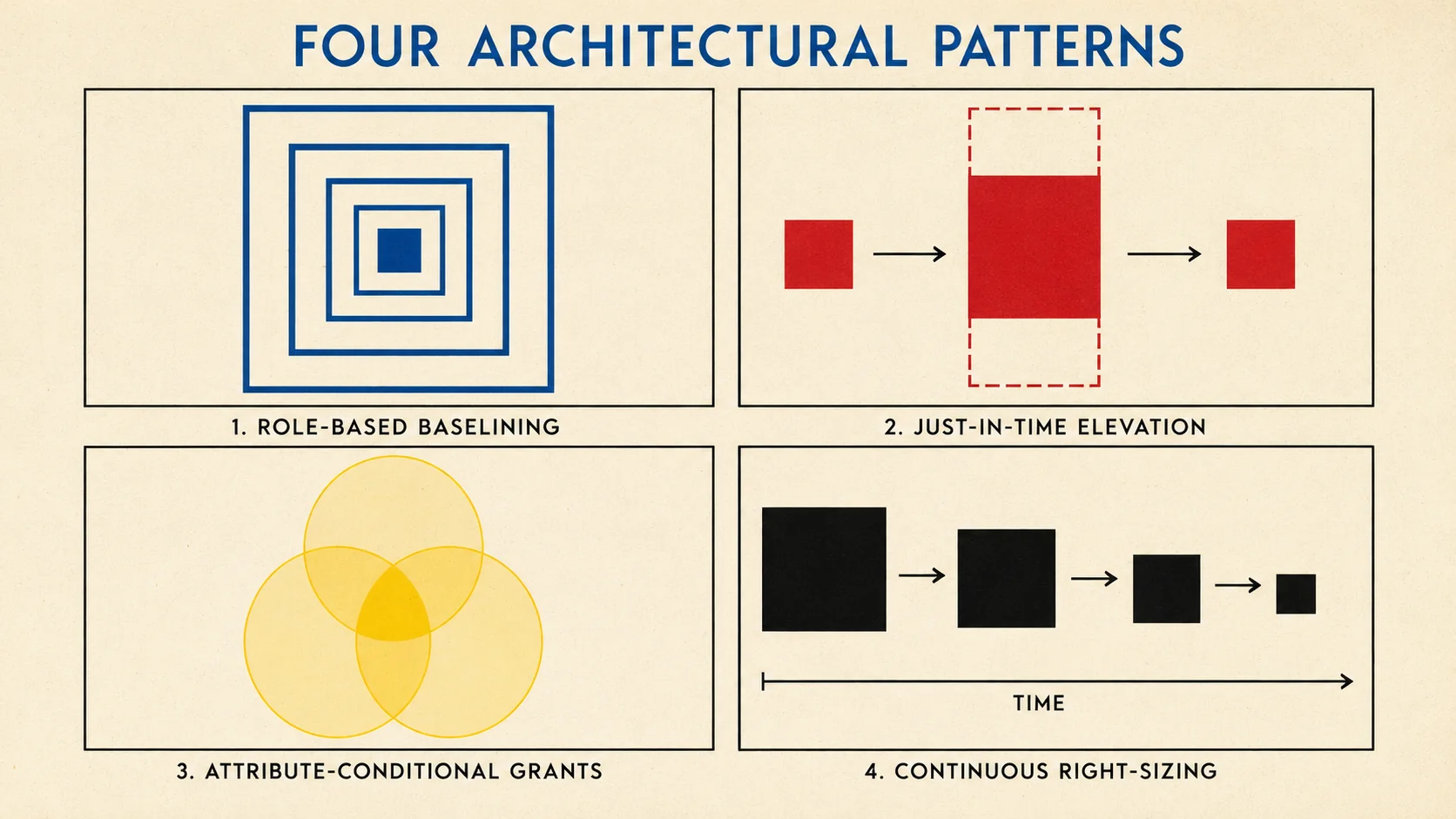 Four architectural patterns, one operational outcome. Each pattern addresses a different dimension of the principle; composition is what produces least privilege as a continuous state rather than a one-time provisioning decision.
What least privilege actually means operationally
The principle is concisely stated: every identity gets only the permissions required for its current task scope. The implementation is where the difficulty lives.
Three operational properties define genuine least privilege in 2026 deployments:
The initial grant is bounded to demonstrated need. When a user requests access — to a system, to a permission scope, to a privileged capability — the grant matches the demonstrated need, not the conceivable future need. The temptation to grant broader access "in case the user needs it later" produces accumulated over-privilege that's the dominant pattern in non-least-privilege programs. Mature programs enforce minimum-grant logic at request time: the access request workflow asks "what specific task requires this access" and grants only the scope that task requires.
The grant is reviewed and adjusted as task scope changes. Static grants are the enemy of least privilege. When a user moves to a new role, the new role's access requirements differ from the prior role's; the prior role's entitlements should be removed, not retained alongside the new role's grants. When a user finishes a project, the project-specific entitlements should be removed. When a system is decommissioned, the access to that system should be removed across all users. The CGov HRIS-Driven Lifecycle piece covers the lifecycle-automation foundation that produces mover and leaver hygiene.
The grant is removed when the task completes. For high-impact entitlements — administrative access, financial-system access, PHI/PII access, production-system access — the grant should not persist as standing privilege. The Just-in-Time access pattern documented in our JIT/ZSP piece provides the operational mechanism: grant at the moment of need, revoke when the task completes, no permanent over-privileged state.
The three operational properties together define the gap between "least privilege as policy" and "least privilege as operational reality." Programs that satisfy all three produce continuously least-privileged access state; programs that satisfy one or two have systematic drift even with stated policy commitment.
The four architectural patterns that produce least privilege
Four composable architectural patterns produce least privilege in 2026 mature deployments. Each addresses a different dimension of the principle; the composition is what produces the operational outcome.
1. Role-based baselining with strict minimum-grant logic. Every role definition starts from "what's the absolute minimum this role needs to function" rather than "what's a reasonable set of permissions for this role." Narrow role definitions compose appropriately when a user holds multiple roles; over-broad role definitions produce duplicate-and-extra-access patterns when composed. The discipline is in role definition, not in role granting.
The architectural test is whether the role catalog has been audited for minimum-grant compliance. A role labeled "Customer Service Analyst" that includes write access to the customer's billing record is not minimum-grant if billing-record writes are a separate role's territory. A role labeled "Developer" that includes production deployment is not minimum-grant if production deployment should be a separate JIT-elevated capability.
The Best IGA Solutions piece covers the platform-layer support for role-based baselining at scale.
2. Just-in-Time elevation. For high-impact entitlements, the access is not held as standing privilege but requested at the moment of need, granted with explicit time-bounded scope, and revoked automatically when the time expires or the task completes. The JIT/ZSP piece covers this pattern in detail — the four architectural components (time-bounded access, workflow-attested elevation, risk-evaluated approval, auto-revocation) and the five workforce segments where the pattern is operationally mature in 2026 (privileged operators, engineering production access, financial-system operators, incident response, AI agents).
The architectural test is whether high-impact entitlements default to JIT or default to standing privilege. Deployments where domain admin access requires JIT request + approval are operating in the JIT pattern; deployments where domain admin access is held continuously by the admin group are operating in the standing-privilege pattern.
3. Attribute-conditional grants. The permission applies only under specific contextual conditions: during business hours, from a managed device, from a trusted geography, against resources within a specific sensitivity classification, when the user's recent risk signals are clean. The conditions narrow the effective permission set without removing the user's ability to use the permission when appropriate.
The operational implication is that the user can have a documented entitlement that confers different effective access in different contexts. The same "Finance Analyst" entitlement might grant full balance-sheet query access from a managed workstation during business hours and read-only access from a personal device after hours. The CGov Adaptive Authentication piece on ICC covers the risk-signal infrastructure that feeds attribute-conditional grant logic.
4. Continuous right-sizing. The platform observes which permissions are actually used vs granted over a measurement window (typically 30-90 days) and recommends or automatically removes the unused ones. The cloud-specific version of this pattern is the core CIEM capability covered in our CIEM piece; the on-prem and SaaS versions are increasingly available in modern IGA platforms.
The architectural test is whether the platform produces measurable drift correction over time. Programs running continuous right-sizing should see the gap between granted and used permissions narrow quarter over quarter; programs without this pattern see the gap grow as entitlements accumulate faster than they're cleaned up.
The four failure modes that produce non-least-privileged programs
Four operational failure modes explain why most enterprise programs miss the least-privilege target despite stated commitment. Each is operationally addressable; each is also extremely common.
Accumulated entitlements. Over years of role changes, project assignments, and one-off grants, users accumulate permissions the program never removes. The user might have started as a customer-support analyst, moved to product management, then to engineering, then to finance — each transition adding new role entitlements without removing the prior ones. The pattern produces users whose effective permission set reflects years of accumulated grants rather than their current job. The CGov MFA vs IGA piece on ICC documents this as "toxic entitlement accumulation" — the attack pattern MFA cannot stop because the issue isn't credential compromise but accumulated grants the program never cleaned up.
The mitigation is mover-event automation: when the HRIS records a role change, the lifecycle workflow computes the new role's entitlement set, diffs against the user's current entitlements, and removes the deltas. The HRIS-Driven Lifecycle piece covers this pattern in depth.
Over-broad initial grants. The requester doesn't know what specific scope they'll need, so they ask for broad access and get it. The pattern is operationally rational from the requester's perspective (broader is easier than re-requesting) and operationally costly from the security perspective (the breadth produces standing exposure). The mitigation is request-time guidance — the IGA workflow asks "what specific task requires this access" and offers narrower scopes that match common task patterns, with the option to request additional scope if the narrower one proves insufficient. The friction is intentional; it produces narrower initial grants that compose with the JIT pattern for the cases where elevation actually becomes necessary.
Shadow provisioning bypassing the IGA layer. Slack DM requests, ServiceNow tickets routed to direct grants, manager Excel re-uploads — all of which produce grants that never went through the IGA's least-privilege enforcement. The Shadow IT Provisioning piece covers this pattern: most enterprise access flows through informal channels that don't apply the access policy. The mitigation is the three-component capture architecture documented in that piece — target-system reconciliation, ticket-system integration, and governed self-service that's fast enough to compete with the informal paths.
Standing privilege as convenient default. Administrators hold permanent elevation rather than JIT elevation because permanent is operationally easier. Service accounts have broad standing scope because the workflow that scoped them was simpler to write than the workflow that would have scoped them narrowly. The pattern is convenience-driven; the mitigation is the JIT/ZSP architectural pattern documented in our JIT/ZSP piece, which treats standing privilege as the legacy default to be replaced rather than the operational default to be tolerated.
The four failure modes compound. Accumulated entitlements grow faster when shadow provisioning adds new grants without lifecycle-attached removal. Over-broad initial grants become accumulated entitlements over time. Standing privilege becomes the default when there's no JIT mechanism to provide an alternative. The mitigations have to layer — fixing one pattern without the others leaves the cumulative drift uncorrected.
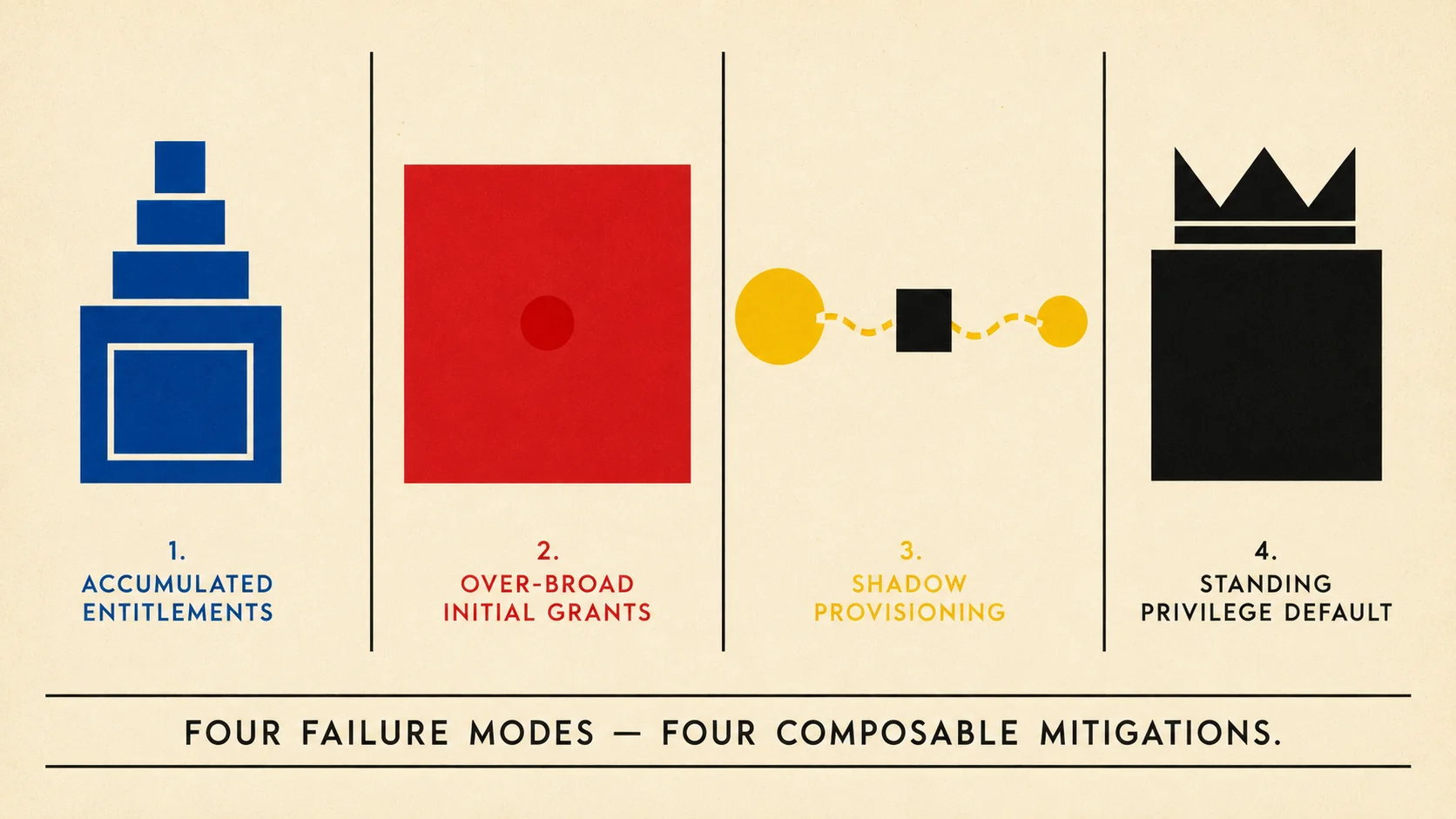 Four failure modes that compound. The mitigations have to layer — fixing one without the others leaves the cumulative drift uncorrected and the program out of compliance with its stated least-privilege policy.
How least privilege composes with JIT and Zero Standing Privilege
Three concepts work together to produce the modern access envelope. Understanding their relationship clarifies what role each plays.
Least privilege is the principle. It says: every identity should hold only the permissions required for its current task scope. It's a property of the access state, not a mechanism for producing the state. The principle predates JIT and ZSP by decades.
Just-in-Time (JIT) access is the operational mechanism. It produces least privilege for high-impact entitlements by granting access at the moment of need and revoking when the task completes, rather than holding access as standing privilege. JIT is the implementation pattern; least privilege is the principle JIT implements.
Zero Standing Privilege (ZSP) is the architectural target. It defines the architectural state where JIT is the only access pattern — no permanent over-privileged access exists anywhere in the environment. ZSP is the destination; JIT is the road; least privilege is the reason for the journey.
Most 2026 mature deployments achieve least privilege for specific workforce segments through JIT, with ZSP as the target for the highest-risk segments (privileged operators, financial-system access, defense workforces, AI agents). The broader workforce typically operates with standing entitlements at the role-baseline scope — least privilege achieved through role-based baselining + attribute-conditional grants + continuous right-sizing, without the operational friction of JIT for every routine access.
The JIT/ZSP piece covers the composition in detail with the four architectural patterns and the five workforce segments where JIT is operationally mature.
The 2026 reference architecture
Five layers compose into operational least privilege:
Layer 1: IGA workflow with minimum-grant role baselining. The IGA platform handles access requests with request-time scope guidance, runs certification campaigns that catch accumulated entitlements, enforces segregation-of-duty rules, and produces audit trails for every grant and revocation. The Best IGA Solutions buyer guide covers the platform layer.
Layer 2: JIT for high-impact entitlements. Domain admins, database admins, infrastructure operators, financial-system operators, incident-response teams — these workforce segments operate on JIT rather than standing privilege. The JIT/ZSP piece covers this layer.
Layer 3: CIEM for cloud-specific least-privilege. Cloud entitlements compose through mechanisms (group inheritance, role assumption, policy composition, conditional logic) that produce effective permissions different from explicitly granted permissions. The CIEM piece covers this layer.
Layer 4: ISPM for continuous posture audit. The ISPM piece covers the posture-audit category that surfaces drift findings (orphaned admin accounts, dormant entitlements, accumulated SoD violations) continuously rather than waiting for periodic certification cycles.
Layer 5: ITDR for behavioral detection of over-broad-permission misuse. When an identity actually exercises an entitlement in a way inconsistent with its baseline behavior, the ITDR piece covers the detection layer that flags the anomaly even if the technical entitlement is valid.
The five layers compose into operational least privilege. Identity programs that have all five layers in production produce continuously least-privileged access state; programs missing any layer have systematic drift in the unaddressed dimension.
The 2026 reference path
Anchor your access program to the principle, not just to the mechanism. Least privilege is the target; JIT, ZSP, role-based baselining, attribute-conditional grants, continuous right-sizing are mechanisms that produce it. Programs that focus on the mechanisms without the principle sometimes deploy partial mechanisms that don't compose into the target state.
Deploy the four architectural patterns together. Role-based baselining without JIT leaves high-impact entitlements as standing privilege. JIT without role-based baselining leaves the broader workforce over-privileged at standing scope. Attribute-conditional grants without continuous right-sizing produces a snapshot of conditional context that drifts over time. Continuous right-sizing without role-based baselining keeps producing right-sizing recommendations against an over-broad baseline.
Address the four failure modes explicitly. Accumulated entitlements — fix with HRIS-driven mover-event automation. Over-broad initial grants — fix with request-time scope guidance. Shadow provisioning — fix with the three-component capture architecture from the Shadow IT piece. Standing privilege as default — fix with JIT for high-impact entitlements per the JIT/ZSP piece.
Compose the five-layer architecture. IGA workflow + JIT + CIEM + ISPM + ITDR. The composition is what produces operational least privilege; individual layers cover individual dimensions but the principle requires all five.
Measure the gap between granted and used permissions as a continuous metric. The gap is the right-sizing opportunity. Programs that measure it find actionable insight; programs that don't have uncomfortable answers when the auditor asks how close to least privilege they actually are.
Least privilege has been the foundational access-management principle since 1975. Half a century later, it remains the most-cited principle in identity security and the least-achieved in operational practice. The architecture to produce it has matured substantially; the deployment discipline is the gap. Close it deliberately — the audit cycles, the breach-cost economics, and the operational reality of 2026 enterprise security all reward the closure.
ABOUT THE AUTHOR

More from Access Management

PIM vs PAM vs PUM: Privileged Access Defined for 2026
PIM, PAM, and PUM get used interchangeably and mean three different things. PIM manages who holds privileged identity and which roles carry it. PAM controls how privilege is exercised through vaulting, session control, and just-in-time elevation. PUM manages the shared privileged accounts nobody personally owns. The 2026 reference on distinguishing the three terms, where they overlap, and where to start.

DNS as Identity Infrastructure: A 2026 Reference
DNS resolution, DNSSEC integrity, and DNS poisoning as a credential-harvesting vector — the 2026 reference on treating DNS as identity infrastructure, not network plumbing.
Password Hash Synchronization in 2026: Hybrid AD to Entra ID
Password hash synchronization keeps on-prem Active Directory and Microsoft Entra ID authoritative together — how the sync cycle works, its security tradeoffs, and where it fits against federation.