IaaS Identity Management: The 2026 Deployment Challenges Reference
Infrastructure-as-a-Service breaks identity models built for one directory. The 2026 reference on multi-cloud fragmentation, compliance auditability, and provisioning automation at IaaS scale.

Infrastructure-as-a-Service breaks identity models built for one directory. The 2026 reference on multi-cloud fragmentation, compliance auditability, and provisioning automation at IaaS scale.
- IaaS environments fragment identity by design — each provider ships its own role/policy model, and none federate natively, so the same person ends up as three unrelated identities across three accounts.
- Compliance auditability at IaaS scale fails when evidence collection stays manual — event volume outpaces quarterly access reviews, and drift goes undetected until an auditor finds it.
- Legacy on-prem directories (AD, LDAP) and IaaS role models drift apart the moment either changes unless a provisioning bridge keeps them synchronized on every lifecycle event.
- Zero trust for cloud infrastructure access means re-evaluating every request against current identity and device signal — not extending a VPN-era perimeter model into the IaaS account boundary.
- None of this is solved by adding another point tool. It requires a governance layer that sits above the IaaS providers' native IAM constructs, not one more directory to reconcile.
Infrastructure-as-a-Service deployments break identity management in a specific, predictable way: every IaaS provider ships its own role, policy, and account model, and none of them federate with the others natively. The result is that the same engineer, service account, or CI/CD pipeline ends up as three or four unrelated identities scattered across separate provider accounts — with no single place to see what any one of them can actually reach. Solving it takes a governance layer that sits above each provider's native IAM constructs and a provisioning pipeline that keeps a legacy directory and every cloud role binding synchronized on every lifecycle event, not another point tool bolted onto the pile.
This is the 2026 update of Avatier's original The Unexpected Challenges of IaaS Deployment piece. The core problem it identified — that IaaS adoption outruns the identity controls built for it — hasn't gone away; if anything, the number of provider accounts, projects, and subscriptions an enterprise identity team now has to track has grown. This refresh replaces the original's vendor-attributed statistics with a plain description of the mechanics: what actually fragments, why manual audit prep fails at this scale, and what a working provisioning bridge looks like between legacy directories and IaaS role models.
Why IaaS breaks identity models built for on-prem or SaaS
On-prem identity management assumes a single directory — Active Directory or LDAP — as the authoritative source for who exists and what they can reach. SaaS identity management assumes a single application boundary, with the vendor's user/permission model as the unit of administration. IaaS fits neither assumption. It's raw compute, storage, and network capacity provisioned across accounts that a platform team spins up for a project, a region, a compliance boundary, or simply because a new provider offered better pricing for one workload.
Each account is its own identity domain. The role-and-policy documents, the trust boundaries, the default deny/allow posture — all of it is scoped to that account, not to the enterprise. Nothing forces two IaaS accounts, even from the same provider, to share an understanding of who a given user is. An identity team that grew up governing a single Active Directory forest now has to reconcile identity across a set of accounts that were never designed to talk to each other, added incrementally as the infrastructure footprint grew.
The practical effect shows up first in offboarding. A departing employee's AD account gets disabled the same day, as it always has — but the matching access in whichever IaaS accounts they touched over the past two years frequently doesn't get revoked on the same timeline, because nothing connects "AD account disabled" to "remove this person's role bindings in every cloud account they ever had access to." That gap is where a meaningful share of post-departure access findings originate, not from a sophisticated attack but from a workflow step that was never wired up.
Multi-cloud identity fragmentation across IaaS providers
Fragmentation isn't a side effect of poor planning — it's structural. The major IaaS providers each built their identity model independently, years apart, solving different design problems. One centers on role-and-policy JSON documents scoped to an account. Another ties access to a tenant-level directory with conditional-access policy layered on top. A third organizes identity around a resource hierarchy with org-policy inheritance flowing down from the top. None of these three models maps one-to-one onto either of the others — a "role" in one system isn't the same shape of object as a "role" in another, and a policy written for one provider's evaluation engine has to be re-expressed, not copied, to mean the same thing somewhere else.
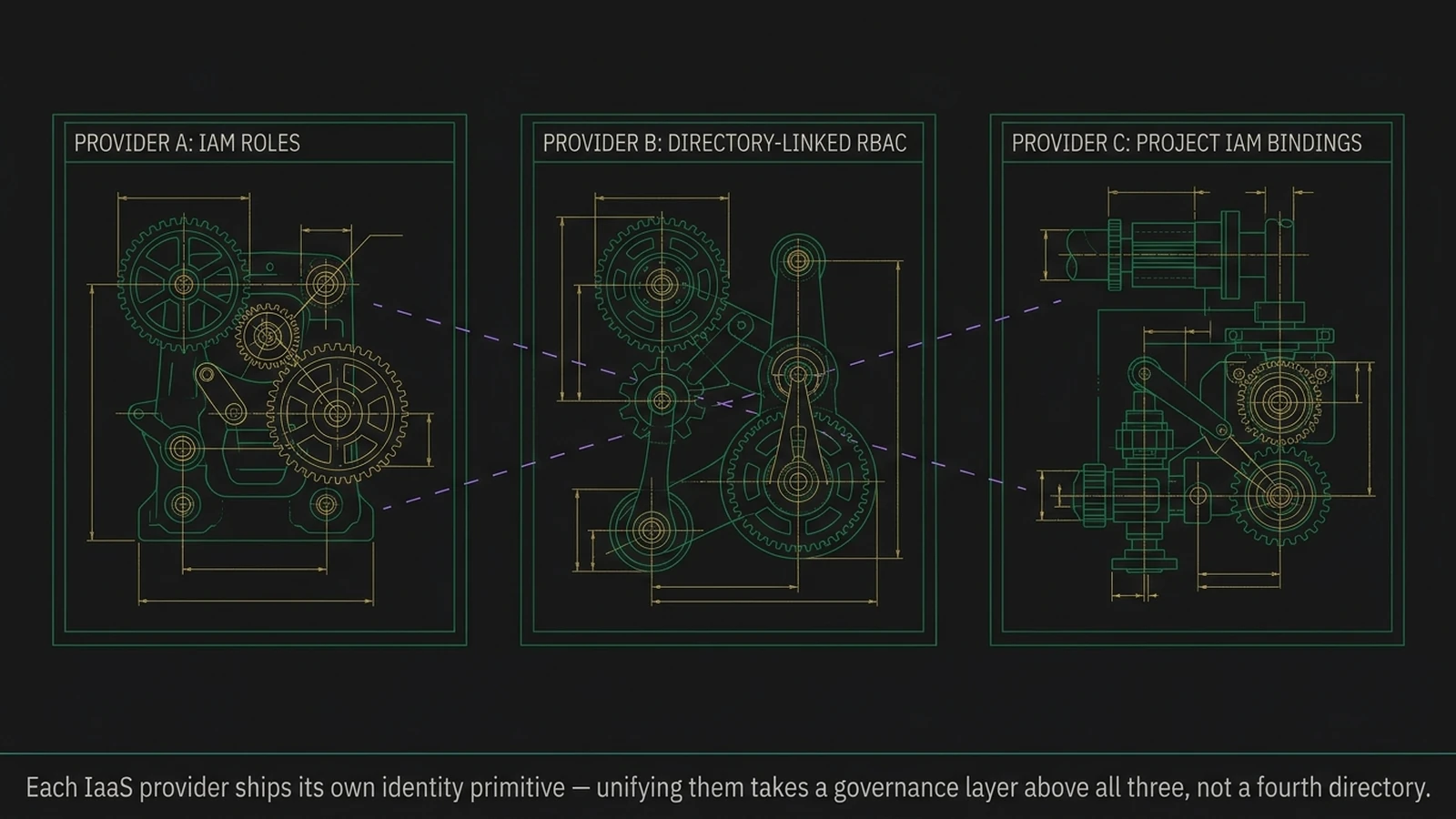 Each IaaS provider's identity model was built independently — unifying access decisions across all three takes a governance layer above them, not a fourth directory to keep in sync.
The compounding factor is that fragmentation doesn't stay at the provider level — it multiplies inside each provider too. Individual teams spin up their own subscriptions, projects, or accounts for a proof of concept, and those accounts frequently outlive the project. Each one is a fresh identity silo the central team has to discover before it can be governed at all. An enterprise running production workloads across two or three IaaS providers, with each provider hosting a dozen or more accounts, can easily be governing several dozen distinct identity domains without ever having decided to build a "multi-cloud identity strategy" — it accumulated one account at a time.
The fix isn't picking a "winning" provider's model and forcing the others to conform to it — that fight is not winnable, and it isn't the identity team's fight to have. The workable pattern is a governance layer that reads each provider's native identity and access data through its own API, normalizes it into a single view of who-has-access-to-what, and pushes provisioning and deprovisioning actions back down through each provider's own control plane. The provider-specific model stays intact underneath; the enterprise gets one place to ask the question that actually matters.
Compliance and audit automation at IaaS scale
NIST 800-53-aligned control expectations, HIPAA §164.312's documented-verification requirement, and GDPR's accountability principle don't carve out an exception for infrastructure that happens to run in a cloud provider's data center instead of the enterprise's own. If a workload touching regulated data runs in an IaaS account, that account's access controls are in scope for the same audit that covers the on-prem systems — whether or not the account was provisioned through the identity team's usual intake process.
The failure mode this produces is specific: quarterly access-review spreadsheets and screenshot-based evidence gathering, the standard on-prem audit-prep motion, don't scale to IaaS event volume. Role assignments change more often, service accounts proliferate faster than human accounts, and infrastructure gets torn down and rebuilt on a much shorter cycle than an on-prem server refresh. By the time a quarterly review catches up, the environment it's reviewing has already moved on. Auditors increasingly ask for continuous evidence rather than a point-in-time snapshot precisely because point-in-time snapshots miss drift that happened in between.
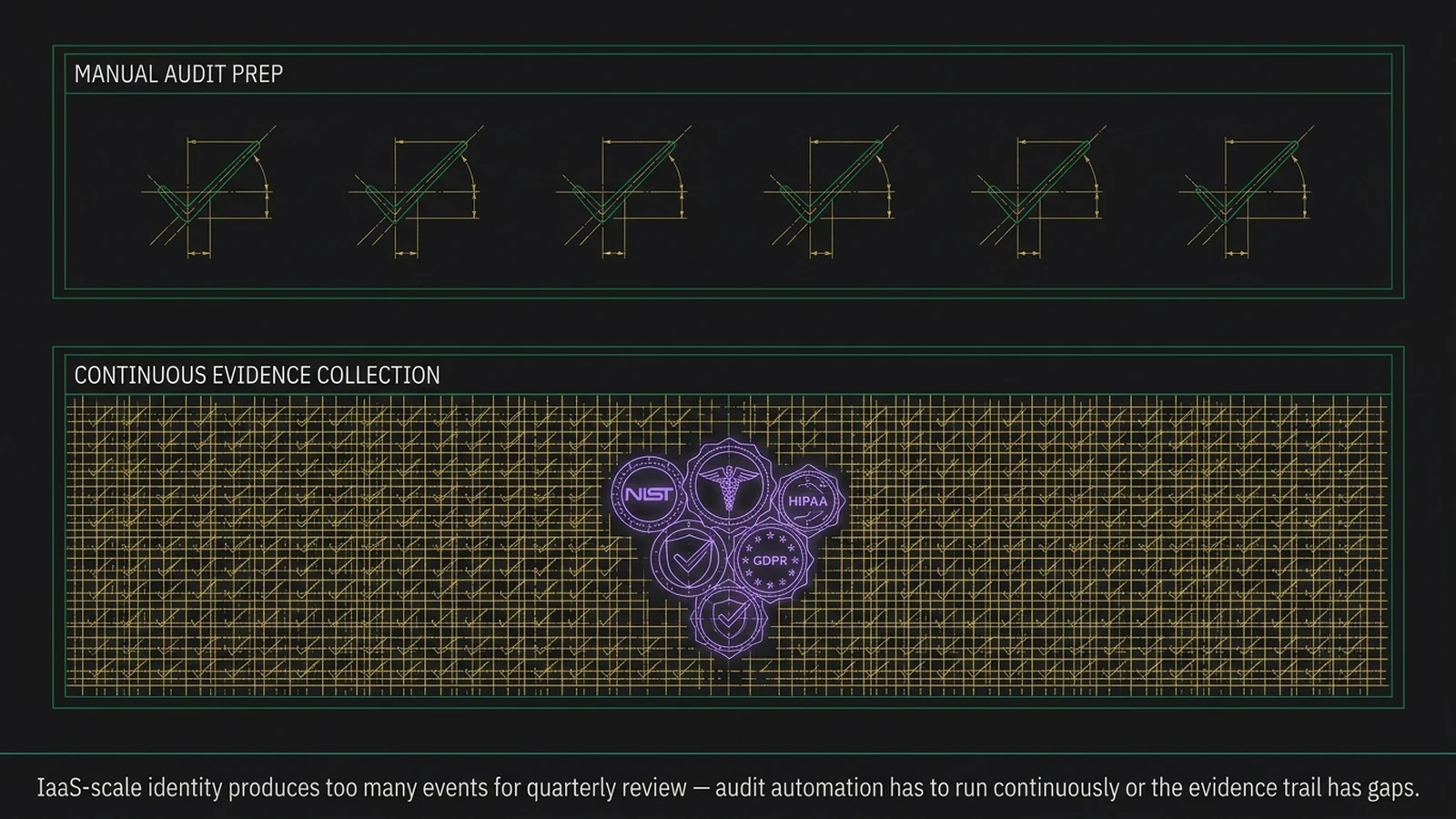 IaaS-scale identity produces more access events than a quarterly review can absorb — audit automation has to run continuously or the evidence trail has gaps by the time the auditor asks for it.
Continuous evidence collection means every access grant, role change, and privileged action across every IaaS account logs to a system that the compliance program can query directly, rather than requiring someone to reconstruct the history from provider console logs after the fact. It also means drift — an entitlement that was appropriate when granted but no longer matches the person's current role — gets flagged by a recurring certification process instead of surfacing for the first time when an auditor asks a pointed question. Neither of these requires new regulation-specific tooling per framework; NIST, HIPAA, and GDPR all converge on the same underlying evidence: who has access, why, when it was granted, when it was last reviewed, and whether it was revoked when it should have been.
Bridging legacy on-prem identity into IaaS environments
Most enterprises adopting IaaS at scale still run Active Directory or LDAP as their actual system of record for workforce identity — the HRIS feeds it, help desk workflows assume it, and decades of application integration depend on it. IaaS adoption doesn't replace that directory; it adds a second identity surface that has to stay synchronized with the first one or the two drift apart within weeks.
The drift is asymmetric and predictable. New-hire provisioning tends to get built early, because the business feels the pain of a slow start date directly. Deprovisioning tends to lag, because nobody feels the pain of an orphaned IaaS role binding until a penetration test or an auditor finds it. A termination event that reliably disables the AD account the same day frequently doesn't reach the IaaS side at all unless someone built that specific integration — and "someone built that specific integration" is doing a lot of work in an environment with two or three IaaS providers, each requiring its own connector.
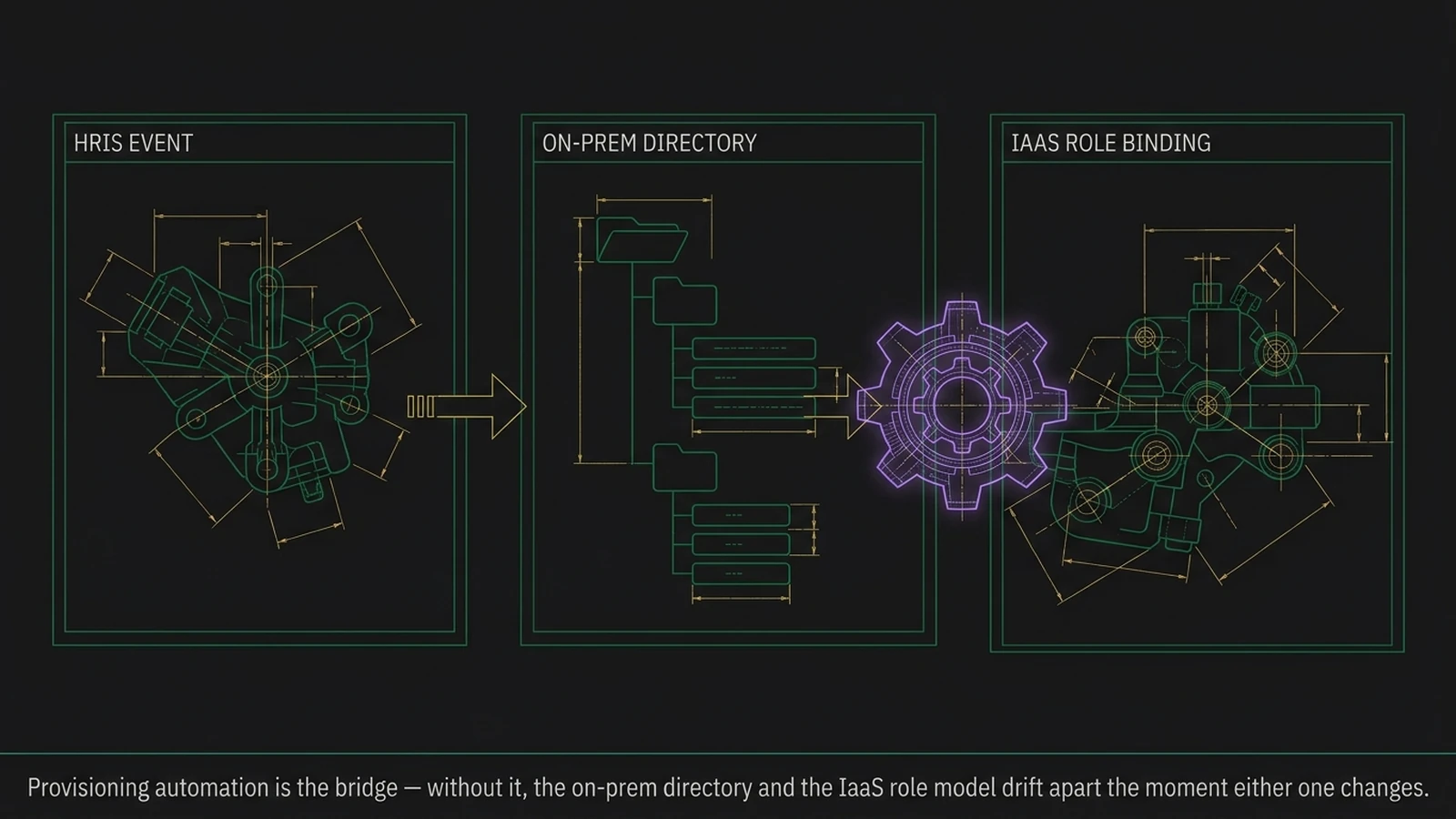 One lifecycle event should reach every system an identity touches on the same day — the gap between the AD account being disabled and the IaaS role being revoked is where orphaned access accumulates.
The pattern that closes the gap treats the HRIS event, not the AD account change, as the actual trigger. A provisioning layer subscribed to the same lifecycle event that updates AD applies the matching action — grant or revoke — to every connected IaaS account in the same pass, through each provider's own API. That keeps the legacy directory and the cloud role model as two projections of the same underlying event stream instead of two systems someone has to remember to update in parallel. It also means a new IaaS provider added to the environment is one more downstream connector to wire into the existing pipeline, not a new manual process to invent from scratch.
Provisioning automation for IaaS workloads
Provisioning automation is the mechanism, not just the policy, that makes the legacy-to-IaaS bridge above actually hold. Manual provisioning — an admin logging into each IaaS console and replicating an access change by hand — is slow relative to how quickly IaaS projects spin up, inconsistent between one provider's console and another's, and the most direct path to the orphaned-access and over-provisioned-role findings that show up when someone finally audits an IaaS environment closely.
Automated provisioning reads the authoritative signal — a role change in the HRIS, a project assignment, a termination — and translates it into the specific role binding or revocation each connected IaaS account needs, applied through the provider's own API rather than a human retyping the same change three times. Because the translation happens in code, it's consistent every time it runs, and it happens on the same day as the triggering event instead of whenever an admin gets to the ticket.
Automation doesn't remove the judgment calls — it moves them upstream, into the policy that decides what a given role or project assignment should grant, rather than leaving them to whoever happens to be provisioning the account that week. A workload requiring elevated privileges (database admin access, network configuration, IAM administration itself) still needs a human decision and an approval trail; what automation removes is the manual replication step where errors and delay actually accumulate. The service accounts and CI/CD pipelines that increasingly outnumber human identities in IaaS environments benefit even more directly — they have no HR event to trigger cleanup at all unless the provisioning pipeline treats project or workload retirement as its own lifecycle trigger.
Zero trust for cloud infrastructure access
The perimeter-era assumption that being inside the corporate network implied a baseline of trust never mapped cleanly onto IaaS, because the infrastructure is reachable by design from outside any corporate network boundary. Zero trust for cloud infrastructure access means evaluating every request against current identity, device posture, and context signal at request time — not granting standing access once and leaving it in place indefinitely because the account was provisioned correctly six months ago.
In practice, that shows up as a handful of concrete changes to how access is issued. Short-lived, automatically rotated credentials replace long-lived static keys that, once leaked, remain valid until someone notices. Conditional access policies account for signals like device compliance posture and anomalous access location rather than treating a valid credential as sufficient on its own. Privileged operations — anything touching IAM configuration, network security groups, or production data stores — require step-up authentication at the moment of use rather than resting on a standing admin role that's always active whether or not it's being used.
None of this is unique to IaaS as a concept, but IaaS is where the gap between the perimeter model and the zero-trust model shows up most concretely, because the infrastructure itself has no perimeter to speak of. An account with a static, long-lived credential and a standing privileged role is functionally the same risk whether it sits on-prem or in an IaaS account — but the IaaS account is reachable from anywhere the moment that credential leaks, with none of the network-segmentation friction that might have slowed an attacker down inside a traditional data center.
What Avatier ships toward this pattern
Avatier Identity Anywhere is built as the governance layer described throughout this piece — a single provisioning and certification workflow that reaches into on-prem Active Directory/LDAP and IaaS provider accounts alike through native connectors, rather than requiring the identity team to build and maintain a separate manual process per environment. HRIS-driven lifecycle events trigger provisioning and deprovisioning consistently everywhere an identity holds access, on the same day, instead of reaching the on-prem directory first and the cloud accounts eventually.
Certification campaigns run against the normalized view across every connected IaaS account, so a quarterly (or continuous) access review doesn't require separately exporting and reconciling data from each provider's own console. Every provisioning action and certification decision produces an audit-trail entry that compliance reporting can query directly, aimed at the continuous-evidence pattern this piece describes rather than a point-in-time reconstruction exercise. For privileged operations in cloud environments, deviceless FIDO2 step-up authentication is available through Identity Challenge Card for workforce segments — platform engineers on shared workstations, contractors, on-call rotations — where a registered personal smartphone isn't a safe operational assumption.
The Avatier Trust Center documents the compliance posture behind these claims directly: SOC 2 Type II with zero exceptions, ISO/IEC 27001:2022 certified, PCI DSS v4.0.1 compliant, CSA STAR Level 1, and NIST 800-53 Rev. 5 aligned, with FedRAMP-aligned controls and FIDO2-compatible authentication paths for federal and federal-adjacent deployments.
What this does not solve
A governance layer above fragmented IaaS accounts does not resolve the underlying inconsistency between providers' native identity models — it works around it. Anyone administering access directly through a provider's own console, outside the governance layer, can still create the exact drift this piece describes, and no amount of provisioning automation catches a change made through a side door it was never told about.
It also doesn't replace the judgment work of deciding what a role should actually grant. Automation executes a provisioning decision faster and more consistently than a human replicating it by hand across consoles, but the decision itself — whether this project assignment should include database admin access, whether this contractor needs write access or read-only — still requires someone who understands the workload to define the policy correctly in the first place. Automation that faithfully executes a badly-scoped policy just distributes the mistake to every connected account instead of one.
And it doesn't eliminate the discovery problem of shadow IaaS accounts spun up outside any provisioning process at all. A governance layer can only govern what it knows exists; an account created by an individual engineer for a weekend proof of concept, paid for on a personal card or an untracked departmental budget, sits outside the identity team's view entirely until something — a security scan, a billing review, an incident — surfaces it. Closing that gap is an organizational and financial-governance problem as much as an identity one, and no provisioning pipeline solves it by itself.
ABOUT THE AUTHOR

More from IAM & Identity Governance

Identity Management and Digital Transformation in 2026
Every major transformation initiative — cloud migration, remote and hybrid work, mergers and acquisitions — eventually stalls on the same question: who gets access to what, and who decided? The 2026 strategy reference on identity management as the enabler and the bottleneck of digital transformation, the business case executives actually fund, and what modernization does not fix.

AI and Behavioral Analytics for Identity Monitoring: The 2026 Enterprise Reference
Static identity rules catch the attacks that announce themselves. They miss the ones that log in with valid credentials and behave almost normally. The 2026 reference on AI-driven identity monitoring — what behavioral analytics actually detects, the four telemetry sources that make or break the model, the false-positive economics nobody budgets for, and the honest limits of anomaly detection at enterprise scale.
Security Team Collaboration: A 2026 Framework for Identity Programs
Identity governance fails when it runs as a security-team-only initiative. The 2026 framework for cross-functional collaboration: four stakeholder groups, three coordination models, and how zero trust makes it a shared discipline.