POSTS IN

Access Management

Role-based access control, OAuth, SAML, federation, and SSO — the structural plumbing of access decisions.

Showing 8

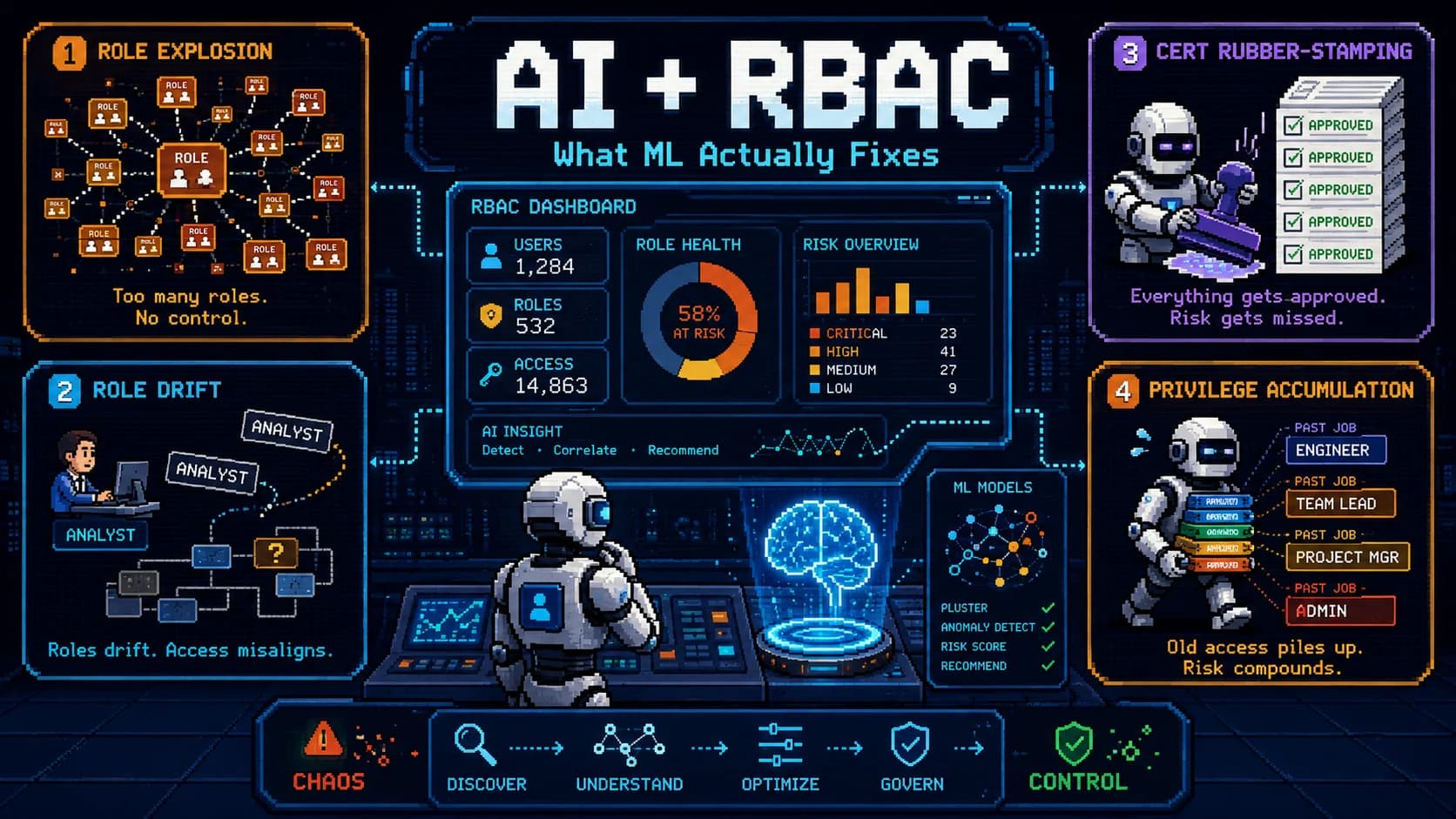
AI and role-based access control 2026 enterprise reference — the four RBAC failure modes machine learning attacks (role explosion where role count outgrows the workforce, role drift where definitions diverge from actual job function, certification rubber-stamping where reviewers approve everything because everything looks the same, and privilege accumulation where movers keep prior-role entitlements), what AI-assisted role mining and entitlement clustering actually produce, where human judgment remains mandatory for business context, and why running role mining on unclean entitlement data industrializes the existing mess rather than fixing it.
Access Management

AI and Role-Based Access Control: What Machine Learning Actually Fixes in RBAC (2026)

RBAC's problems are well documented and thirty years old: role explosion, role drift, rubber-stamped certifications, and privilege that only ever accumulates. AI is the first tool that attacks them at the scale they occur — but only three of the four are genuinely solvable by a model. The 2026 reference on AI-assisted role mining, entitlement clustering, certification triage, and predictive provisioning: what each one actually does, where the human stays in the loop, and why role mining on bad data just industrializes the mess.

17 de julio de 2026Ekna Padmaraj
Read more
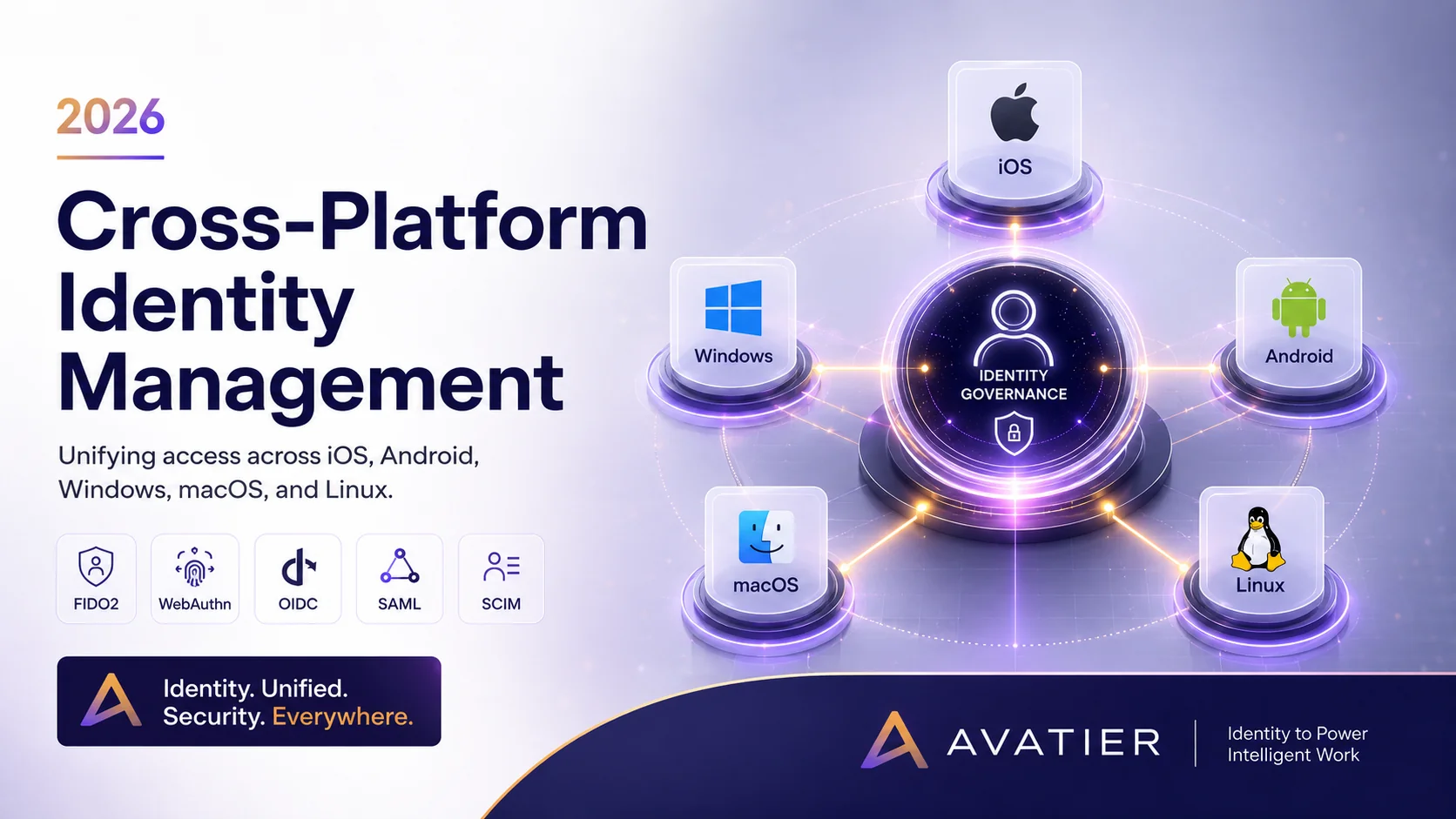
Cross-platform identity management 2026 enterprise reference — unifying authentication and identity governance across iOS, Android, Windows, macOS, Linux, and shared frontline devices. Covers the platform-agnostic identity architecture built on FIDO2/WebAuthn, OIDC, SAML, and SCIM standards, the passkey ecosystem fragmentation between iCloud Keychain, Google Password Manager, and Windows Hello, the per-platform security capability mapping (Secure Enclave, StrongBox, TPM), the workforce segments that platform-bound authentication excludes, and the unified policy engine that produces one identity experience across every device class.
Access Management

Cross-Platform Identity Management: Unifying Access Across iOS, Android, Windows, macOS, and Linux in 2026

The average enterprise workforce now authenticates from three or more platforms daily — iOS, Android, Windows, macOS, Linux, and shared frontline devices — and every platform ships its own credential store, biometric stack, and passkey ecosystem. The 2026 reference on unifying identity across all of them: the platform-agnostic architecture, the passkey fragmentation problem nobody warned you about, per-platform security capability mapping, the workforce segments platform-bound authentication leaves behind, and the deployment discipline that produces one identity experience instead of five.

16 de julio de 2026Henrique Ferreira
Read more
Passwordless login enterprise 2026 — where passwordless actually lives operationally after passkeys reached mainstream enterprise deployment through 2025, the WebAuthn credential architecture that makes 'passwordless' cryptographically meaningful rather than just cosmetic, the platform-native passkey systems (iCloud Keychain, Google Password Manager, Microsoft Entra ID) that cover the majority of workforce devices, the sync-vs-device-bound trade-off that shapes deployment decisions, the hardware FIDO2 authenticator path for AAL3 use cases in regulated industries, the recovery-account problem that determines whether a passwordless deployment succeeds or produces a support-burden crisis, the cross-device UX patterns that address the fundamental multi-device reality of enterprise workforce, and the migration architecture from the legacy password-first environment every enterprise still operates.
Access Management

Passwordless Login: The Future is Here — 2026 Enterprise Reference on Passkey Adoption, FIDO2, and the Path Beyond Passwords

Passwordless is no longer future-tense. Passkey adoption reached mainstream enterprise deployment in 2025, hardware FIDO2 keys are the AAL3 credential across regulated industries, and platform-native passkey systems (iCloud Keychain, Google Password Manager, Microsoft Entra ID) cover the majority of workforce devices. The 2026 enterprise reference on where passwordless actually lives operationally, the sync-vs-device-bound trade-offs, the recovery-account problem that determines whether the deployment succeeds, and the cross-device UX patterns that make passwordless work at workforce scale.

1 de julio de 2026Henrique Ferreira
Read more
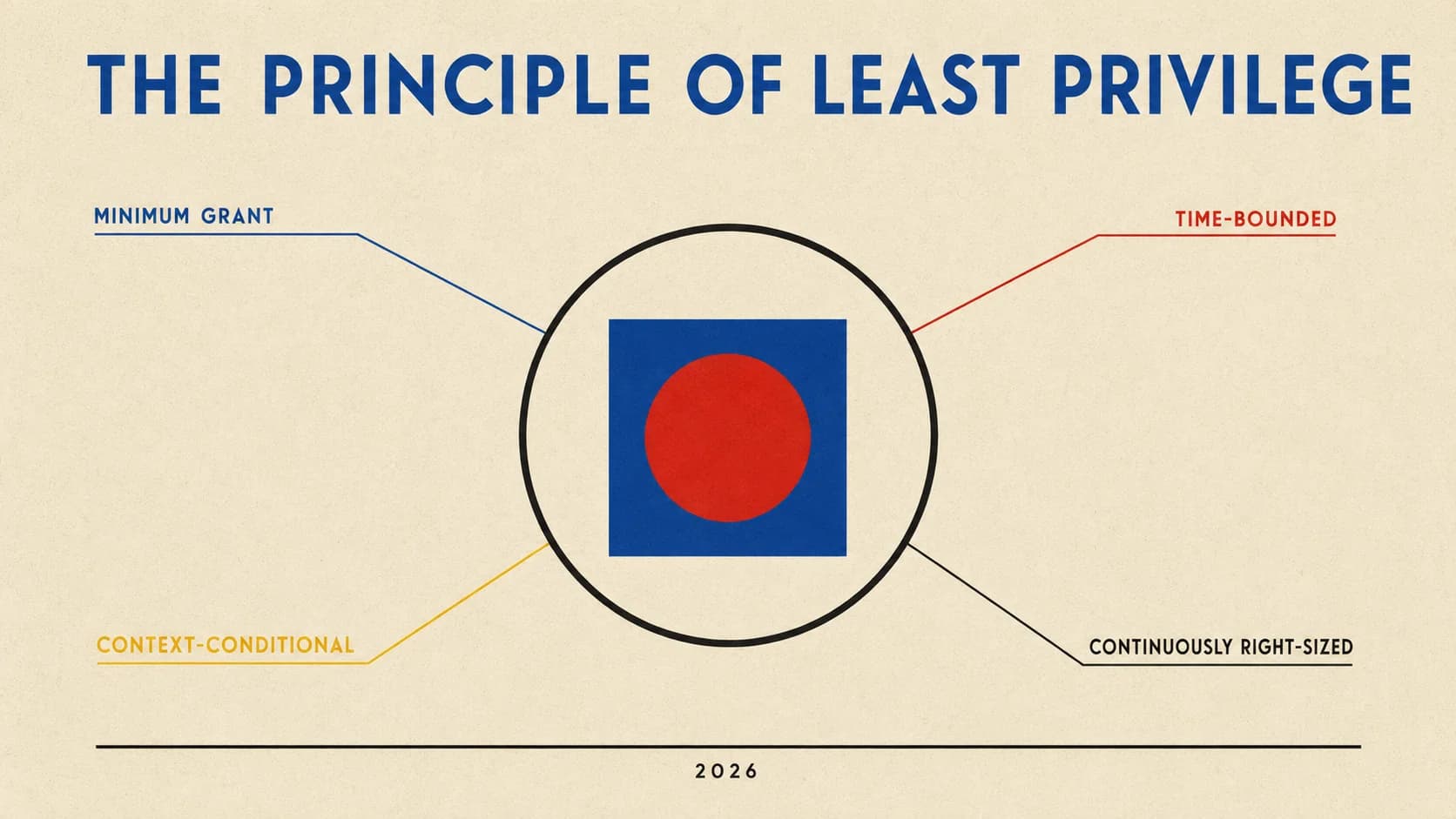
The principle of least privilege for enterprise access control 2026 — the foundational access-management principle defined operationally (every identity gets only the permissions required for its current task scope), the four architectural patterns that produce least privilege in practice (role-based baselining, just-in-time elevation, attribute-conditional grants, continuous right-sizing), the failure modes that explain why most programs miss the target despite stated commitment, and the composition with JIT access and Zero Standing Privilege that defines the modern access envelope.
Access Management

The Principle of Least Privilege: Why It Matters for Enterprise Access Control 2026

Least privilege is the foundational principle every enterprise access program claims to follow and almost none actually achieves. The 2026 enterprise reference on what least privilege actually means operationally, the four architectural patterns that produce it, the failure modes that explain why most programs miss the target, and how least privilege composes with JIT access and Zero Standing Privilege to produce the modern access envelope.

30 de junio de 2026Leonardo Cuenca
Read more
Just-in-time access and zero standing privilege for enterprise 2026 — the architectural shift from standing privilege (users hold permanent entitlements regardless of whether they're using them right now) to Zero Standing Privilege (nobody has permanent privileged access; entitlements are granted at the moment of need and revoked automatically when the task completes), the four architectural patterns that enable JIT (time-bounded access, workflow-attested elevation, risk-evaluated approval, auto-revocation), the five workforce segments where the pattern is operationally mature, and the operational pitfalls that produce broken-glass scenarios when JIT is deployed without the necessary fallback paths.
Access Management

Just-in-Time Access and Zero Standing Privilege for Enterprise 2026

Standing privilege is the legacy pattern — users (and service accounts, and AI agents) hold permanent entitlements regardless of whether they're using them right now. Zero Standing Privilege flips the model: nobody has permanent privileged access; access is granted at the moment of need and revoked automatically when the task completes. The 2026 enterprise reference on JIT access architecture, the workforce segments where it's operationally mature, and where the pattern breaks.

25 de junio de 2026Leonardo Cuenca
Read more
Privileged Access Management for enterprise 2026 — the discipline covering the small but high-impact population of privileged identities, the four core capabilities (vaulting, session brokering, just-in-time elevation, session monitoring), where PAM overlaps and diverges from IGA, and the integrated architecture that secures the privileged surface across modern and mainframe environments.
Access Management

Privileged Access Management (PAM) for Enterprise in 2026

Privileged Access Management is the discipline that governs the small population of identities with disproportionately large blast radius — domain admins, mainframe operators, financial-system controllers, security tools, service accounts. The 2026 reference on what PAM actually covers, where it overlaps and diverges from IGA, and the architecture that gets both right.

15 de junio de 2026Marcelo Victor
Read more

Savings Calculator

Password Reset Cost Calculator

Enter your company size and see how much your help desk spends on password resets — and how much Avatier Credential Governance saves.

Horizon
Total Resets per Year
18,000
Annual Cost Without Automation
$500,000

Avatier Credential Governance reduces your cost by

$350,000

Over 1 year

See the full methodology and sources →