Cross-Platform Identity Management: Unifying Access Across iOS, Android, Windows, macOS, and Linux in 2026
The average enterprise workforce now authenticates from three or more platforms daily — iOS, Android, Windows, macOS, Linux, and shared frontline devices — and every platform ships its own credential store, biometric stack, and passkey ecosystem. The 2026 reference on unifying identity across all of them: the platform-agnostic architecture, the passkey fragmentation problem nobody warned you about, per-platform security capability mapping, the workforce segments platform-bound authentication leaves behind, and the deployment discipline that produces one identity experience instead of five.
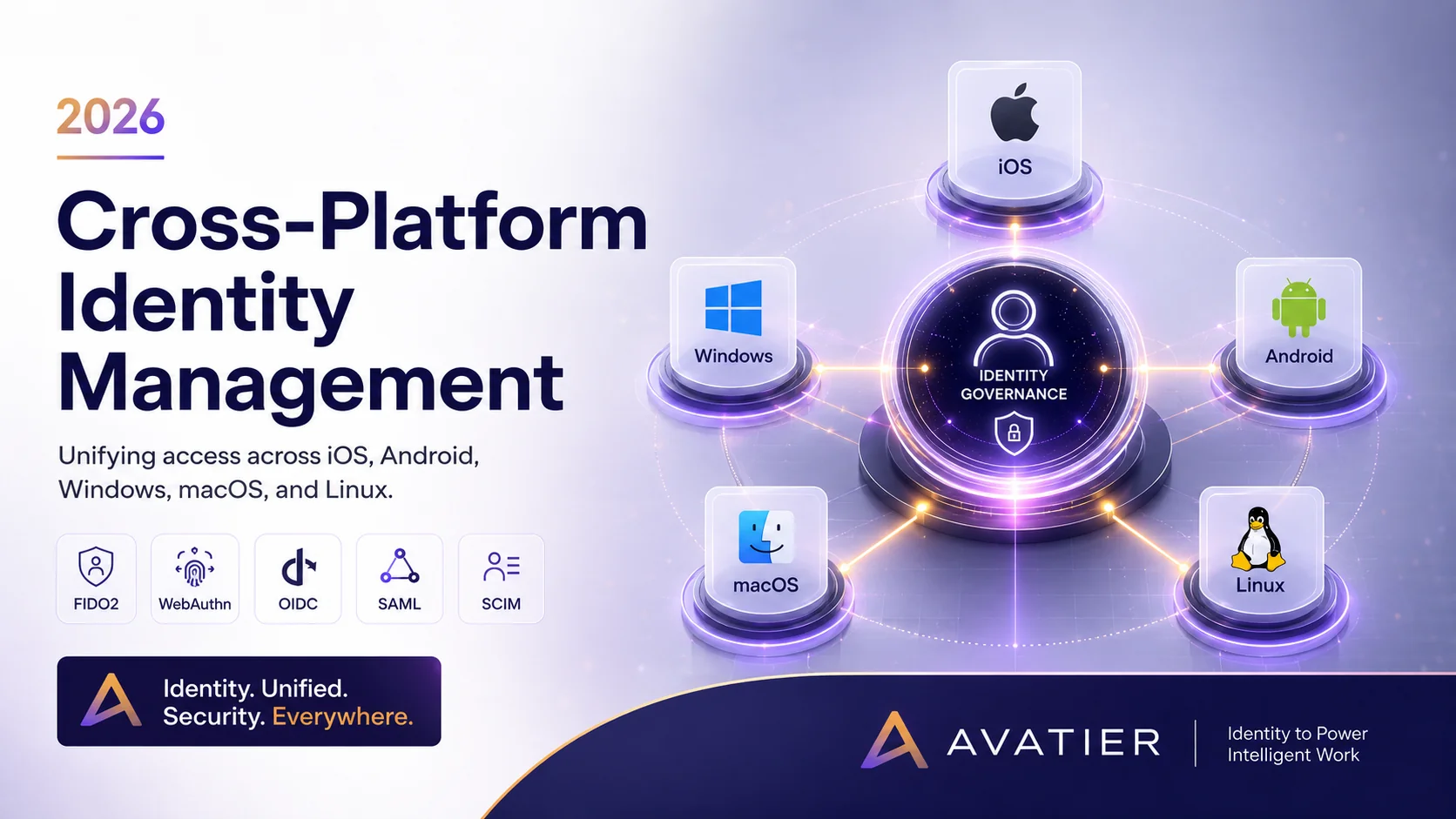
The average enterprise workforce now authenticates from three or more platforms daily — iOS, Android, Windows, macOS, Linux, and shared frontline devices — and every platform ships its own credential store, biometric stack, and passkey ecosystem. The 2026 reference on unifying identity across all of them: the platform-agnostic architecture, the passkey fragmentation problem nobody warned you about, per-platform security capability mapping, the workforce segments platform-bound authentication leaves behind, and the deployment discipline that produces one identity experience instead of five.
- Enterprise workforces authenticate from three or more platforms daily, and each platform ships its own credential store, biometric stack, and passkey ecosystem — iCloud Keychain on iOS/macOS, Google Password Manager on Android, Windows Hello on Windows. Platform-bound identity produces fragmented policy, inconsistent user experience, credential silos, and security gaps at every seam. The 2026 architecture unifies identity above the platform layer, not inside it.
- The unification layer is standards, not vendors: FIDO2/WebAuthn for phishing-resistant authentication on every platform, OIDC and SAML for federation, SCIM for provisioning. Platform-native security hardware (Secure Enclave, Android StrongBox, TPM) is leveraged per-device, but policy, lifecycle, and audit resolve through one identity platform so the same user gets the same entitlements and the same step-up rules regardless of device.
- Passkey fragmentation is the 2026 problem the 2024 passkey pitch didn't mention. Synced passkeys bind to ecosystem accounts (Apple ID, Google account, Microsoft account) — a workforce split across ecosystems ends up with credentials that don't follow the user across platform boundaries. The fixes: cross-ecosystem passkey strategy, hardware FIDO2 keys for cross-platform portability, and deviceless FIDO2 for the segments no personal-device credential reaches.
- Platform-bound authentication systematically excludes real workforce segments: manufacturing floors and clinical units on shared workstations, contact centers where phones are prohibited, deskless workers without corporate devices, and BYOD-refusal populations. Cross-platform strategy is incomplete until it covers the no-platform case — deviceless authentication that works identically on every device because it depends on none of them.
- The deployment discipline: inventory authentication surfaces per platform, converge on one policy engine with per-platform capability mapping, deploy passkeys plus hardware and deviceless FIDO2 by segment, integrate UEM/MDM signals into conditional access, and unify SSPR and account recovery so the reset path is as cross-platform as the login path. Enterprises that unify report lower help desk volume and materially fewer identity security incidents than platform-siloed peers.
The average enterprise employee now works across three or more platforms every day — a corporate Windows or macOS laptop, a personal or managed smartphone, a tablet, a browser session on someone else's machine, sometimes a shared workstation on a production floor. Each of those platforms ships its own credential store, its own biometric stack, its own passkey ecosystem, and its own opinion about how authentication should work.
Left unmanaged, that produces the pattern security teams know too well: five credential silos, five policy surfaces, five user experiences, and security gaps at every seam between them. Platform-siloed identity doesn't just frustrate users — it fragments the audit trail, multiplies help desk volume, and hands attackers the weakest platform as the entry point to all of them.
This is the 2026 reference on unifying identity across platforms: the architecture, the passkey fragmentation problem that arrived with the passkey era, the per-platform capability map, the workforce segments platform-bound authentication excludes, and the deployment sequence that gets you to one identity experience.
Why platform-bound identity fails at enterprise scale
The consumer ecosystems solved identity brilliantly — inside their own walls. Apple ID with iCloud Keychain delivers a nearly frictionless experience across iPhone, iPad, and Mac. Google does the same across Android and Chrome. Microsoft does it across Windows and Entra ID.
The enterprise problem is that your workforce doesn't live inside one wall. Finance runs Windows. Design runs macOS. Field teams run iOS and Android in whatever mix personal preference produced. Engineering keeps Linux workstations. The warehouse runs shared scanners, and the clinic runs shared workstations on wheels.
Platform-bound identity in that reality produces four failure modes:
Credential silos. The same user holds different credentials on different platforms, each with its own strength, recovery path, and expiration behavior. Attackers target the weakest silo; auditors struggle to assemble one picture of who can access what.
Policy drift. Step-up rules configured in one ecosystem's console never quite match the rules in the next one. The gap between intended policy and enforced policy grows with every platform-specific exception.
Experience fragmentation. Users learn one authentication flow on their phone and face a different one on their desktop. Every inconsistency generates help desk volume — and the password-reset portion of that volume alone runs $480 per employee per year at the enterprise average (Password Help Desk Cost Analysis piece).
Coverage holes. Platform-bound authentication assumes every user has a platform — a personal, persistent device with biometric hardware. Entire workforce segments don't fit that assumption, and they end up on the weakest fallback: shared passwords.
The unification architecture: standards above platforms
The correct response to platform diversity is not picking a winner — it's unifying above the platform layer with open standards, and treating each platform's native security hardware as an enforcement asset rather than a policy authority.
The standards layer. Four standards do the heavy lifting in 2026:
- FIDO2/WebAuthn — phishing-resistant, public-key authentication supported natively by every major OS and browser. This is the one authentication standard that genuinely spans platforms.
- OIDC and OAuth 2.0 — federation and delegated authorization for modern applications (OAuth 2.0 vs OIDC piece).
- SAML 2.0 — federation for the substantial enterprise app estate that predates OIDC.
- SCIM — cross-platform provisioning and deprovisioning, so lifecycle events propagate to every connected system regardless of platform (Access Governance and Lifecycle Integration piece).
The policy layer. One policy engine expresses access rules once — privileged actions from unmanaged devices require step-up; new-device logins require phishing-resistant factors; shared-workstation sessions expire at shift end — and compiles them into per-platform enforcement. This is the difference between five parallel policy sets that drift and one policy with five enforcement dialects.
The platform hardware layer. Each platform brings real security hardware, and the unified architecture uses all of it:
| Platform | Key protection | Biometric | Device trust signal | Enterprise notes |
|---|---|---|---|---|
| iOS / iPadOS | Secure Enclave | Face ID / Touch ID | MDM-managed state, device attestation | Most uniform hardware base |
| Android | StrongBox / TEE | Fingerprint / face (varies) | Play Integrity, UEM state | Widest device-quality variance — verify per fleet |
| Windows | TPM 2.0 | Windows Hello (face/fingerprint/PIN) | Entra join state, TPM attestation | Windows Hello for Business = per-device credential |
| macOS | Secure Enclave | Touch ID | MDM-managed state | Often the least-governed corporate platform |
| Linux | Varies (TPM where present) | Rare | Configuration mgmt state | Lean on hardware keys + certificates |
The rule: platform biometrics and secure elements protect keys locally; the identity platform decides what those keys are allowed to do. Keeping those roles straight is what makes the architecture cross-platform instead of five-platform.
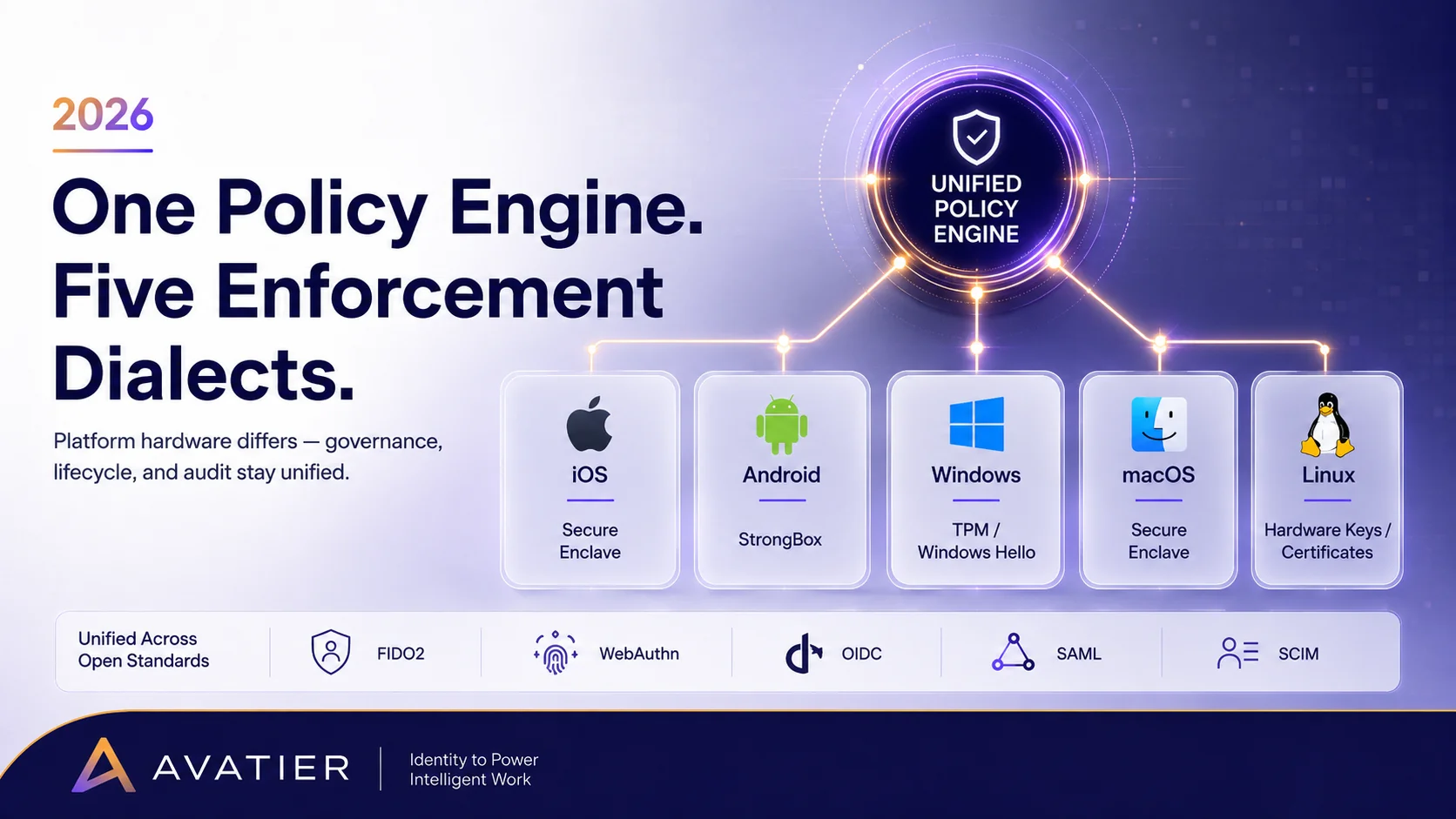 One policy engine, five enforcement dialects — each platform's security hardware enforces locally while policy intent, lifecycle, and audit resolve in one place.
The passkey fragmentation problem
Passkeys made FIDO2 mainstream — and introduced the 2026 problem the 2024 pitch decks skipped: synced passkeys bind to ecosystem accounts, not to your enterprise.
A passkey created on an employee's iPhone syncs through iCloud Keychain to their Apple devices. It does not follow them to their Windows desktop. Cross-device authentication (the QR-code-plus-Bluetooth flow) bridges the gap one login at a time, but it's friction users learn to resent, and it quietly reintroduces the phone-dependency problem for desktop authentication.
For a workforce distributed across ecosystems — which is every workforce — the practical 2026 passkey strategy is segmented:
- Synced passkeys where a user's device set lives cleanly inside one ecosystem. Lowest friction, excellent security, zero additional hardware.
- Hardware FIDO2 security keys where credentials must cross ecosystem boundaries — one key authenticates on iOS (NFC), Android (NFC/USB), Windows, macOS, and Linux identically. Portability is the feature; per-unit cost and loss-management are the price (Hardware FIDO2 Keys vs Passkeys on ICC).
- Deviceless FIDO2 for the segments where neither personal devices nor issued hardware fit — covered next, because this is the coverage hole most cross-platform strategies never close.
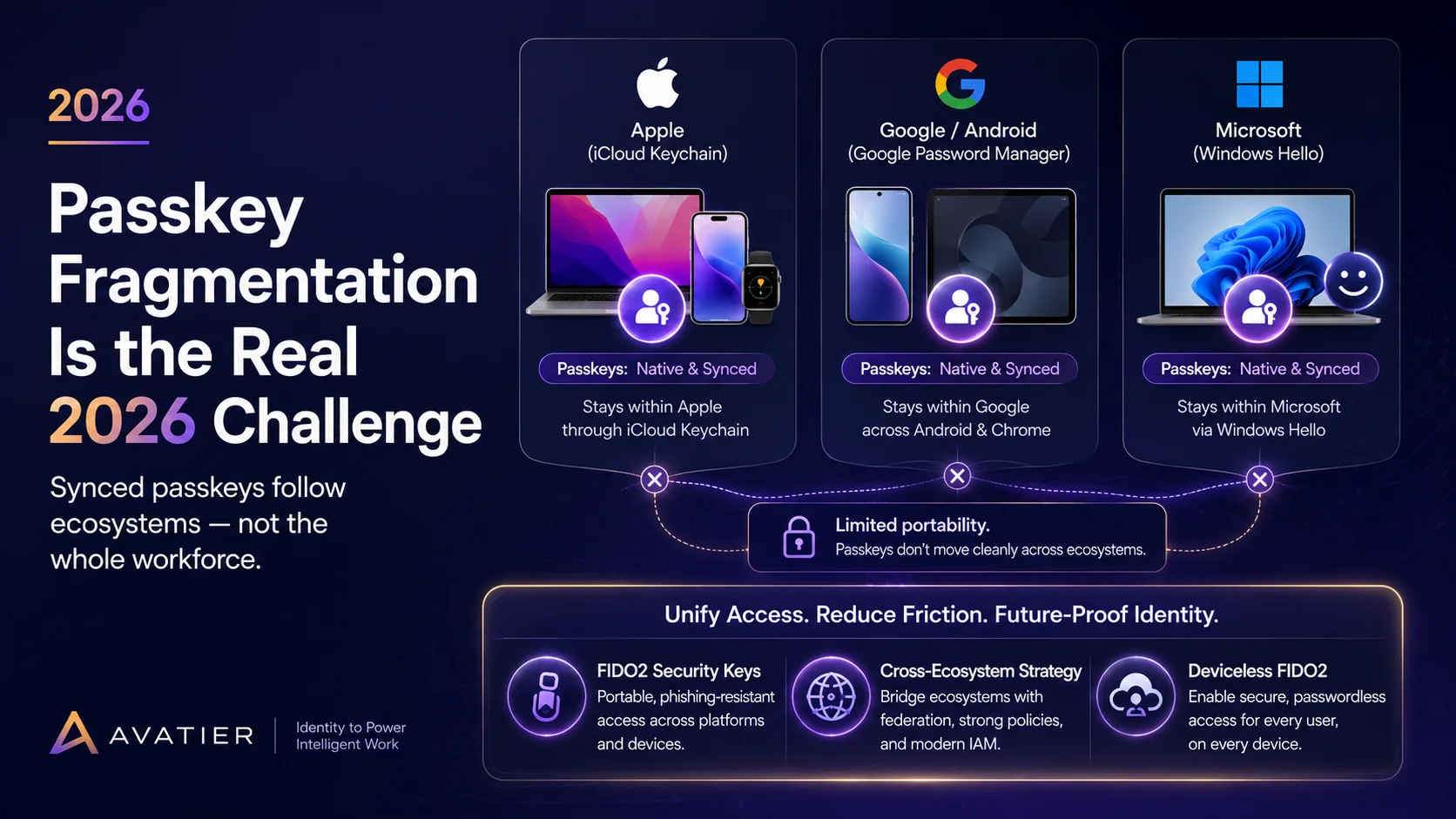 Synced passkeys follow ecosystems, not the whole workforce — the practical fix is segmented: synced passkeys, hardware keys, and deviceless FIDO2.
Enrollment and recovery deserve equal design attention: every additional credential per user multiplies the recovery surface, and account recovery is where phishing-resistant deployments get quietly un-phishing-resisted. Recovery flows must meet the same bar as login flows (Password Reset Comprehensive Guide piece).
The no-platform workforce: cross-platform's forgotten segment
Every cross-platform strategy document we review has the same blind spot: it assumes each user has a platform — a personal, persistent, biometric-capable device. Four workforce segments break that assumption:
- Shared-device frontline environments. Manufacturing floors, clinical units, retail POS, warehouse scanning. The device belongs to the shift, not the person. Platform credentials bound to a device identity don't map to per-user accountability.
- Phone-prohibited environments. Contact centers, cleanrooms, classified and secure facilities. Smartphone-dependent MFA is banned by written policy, not by preference.
- Deskless and seasonal workers. Issuing and lifecycle-managing corporate hardware per short-tenure worker is uneconomic, and BYOD enrollment rarely reaches this population.
- BYOD refusal. A growing share of employees decline corporate profiles on personal devices — a position labor agreements increasingly formalize.
These segments historically landed on the weakest fallback in the stack: shared passwords, spoken over shoulders and taped under keyboards. A cross-platform identity strategy is incomplete until the no-platform case authenticates as strongly as the flagship-device case.
This is where deviceless authentication enters the architecture: a credential that works identically from any device because it depends on none of them. Identity Challenge Card implements deviceless FIDO2 following the hardware-bound plus secret-validator pattern NIST specifies for its highest authenticator assurance level — no smartphone, no per-user issued electronics, no platform ecosystem membership required. From the policy engine's perspective it's simply another phishing-resistant FIDO2 factor, which is exactly the point: one policy surface, every workforce segment.
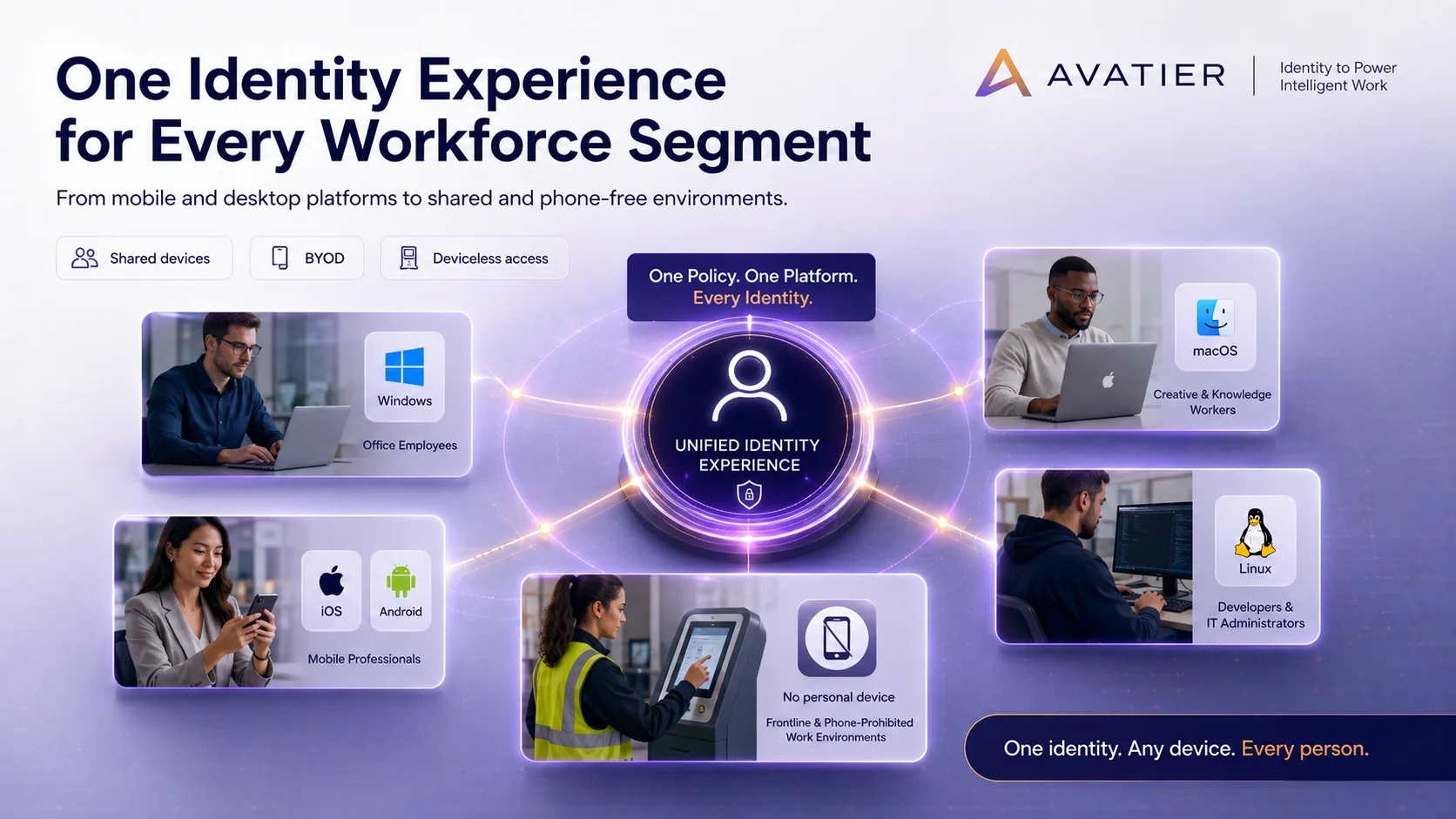 One identity experience across every segment — including the shared-device and phone-prohibited populations that platform-bound authentication leaves behind.
UEM/MDM and conditional access: the device-trust bridge
Cross-platform identity and unified endpoint management are converging disciplines. The identity platform decides who gets access; the UEM/MDM layer knows what device state they're coming from. In 2026 the integration pattern is:
- UEM (Intune, Jamf, Workspace ONE, and peers) maintains per-device compliance state across all platforms.
- Device state flows into the identity platform as a risk signal — managed vs. unmanaged, patched vs. stale, attested vs. unknown.
- Conditional access policy consumes the signal uniformly: the same "unmanaged device → step-up + no privileged actions" rule enforces on an iPhone, a Pixel, a ThinkPad, and a MacBook without four separate configurations.
The trap to avoid: making device management a prerequisite for identity coverage. The no-platform segments above will never be UEM-enrolled — the policy engine needs a deviceless-strong path for them, or the conditional access model silently reverts them to exceptions, and exceptions become the breach narrative.
Deployment discipline: the sequence that works
Enterprises that reach genuinely unified cross-platform identity follow a recognizable sequence:
1. Inventory authentication surfaces per platform. Every app × platform × user-segment combination, with its current credential type. The inventory always surfaces surprises — the macOS fleet outside MDM, the Linux jump hosts on shared keys, the tablet fleet authenticating through a legacy portal.
2. Converge on one policy engine. Express policy once; map enforcement per platform. Retire per-ecosystem policy authority deliberately — it will not retire itself.
3. Deploy phishing-resistant credentials by segment. Synced passkeys for single-ecosystem users, hardware keys for cross-ecosystem and high-privilege users, deviceless FIDO2 for frontline, phone-prohibited, and BYOD-refusal segments. The segmentation math matters more than the flagship demo (Passkey Deployment Playbook on ICC).
4. Unify SSPR and recovery across platforms. The reset path must be as cross-platform as the login path — reachable from a locked Windows workstation (Active Directory Login Reset piece), a mobile browser, and a shared kiosk, with verification strength matched to login strength (SSPR Enterprise Deployment piece).
5. Close the loop with governance. Cross-platform access still accumulates; certification campaigns and posture management need visibility across every platform's grants, not just the flagship directory (ISPM piece).
The payoff is measurable on both sides of the ledger: unified deployments cut password-driven help desk volume 60-80% when SSPR and passwordless land together (Password Help Desk Cost Analysis piece), and they remove the weakest-platform entry point that platform-siloed estates hand to attackers.
Where cross-platform identity goes next
Three trajectories worth planning for:
Passkey portability matures. Credential-exchange work in the FIDO Alliance ecosystem is moving toward import/export between passkey providers. Enterprises should track it — but architect for today's fragmentation, not tomorrow's roadmap.
Agentic AI becomes a platform. AI agents acting on enterprise systems are, functionally, a new platform class with its own credential problem — and the same unification rule applies: one identity layer, one policy engine, agents as governed identities (Service Account Governance piece, Identity for AI Agents on ICC).
Deviceless coverage becomes table stakes. As regulators and auditors stop accepting "that population uses shared passwords" as an answer, the no-platform segments move from footnote to requirement. The enterprises that unified early will already be covered.
Cross-platform identity management in 2026 is not about supporting many platforms. It's about making the platform irrelevant to the security outcome — one identity, one policy, one audit trail, on whatever glass the workday happens to touch.
ABOUT THE AUTHOR

More from Access Management
PIM vs PAM vs PUM: Privileged Access Defined for 2026
PIM, PAM, and PUM get used interchangeably and mean three different things. PIM manages who holds privileged identity and which roles carry it. PAM controls how privilege is exercised through vaulting, session control, and just-in-time elevation. PUM manages the shared privileged accounts nobody personally owns. The 2026 reference on distinguishing the three terms, where they overlap, and where to start.

DNS as Identity Infrastructure: A 2026 Reference
DNS resolution, DNSSEC integrity, and DNS poisoning as a credential-harvesting vector — the 2026 reference on treating DNS as identity infrastructure, not network plumbing.

Password Hash Synchronization in 2026: Hybrid AD to Entra ID
Password hash synchronization keeps on-prem Active Directory and Microsoft Entra ID authoritative together — how the sync cycle works, its security tradeoffs, and where it fits against federation.