Password Help Desk Cost Analysis: The 2026 $480-Per-Employee Reference
Password-related help desk calls cost the average enterprise $480 per employee per year — a hidden line item that dominates IT operational cost at scale and produces $2.4M in annual burn for a 5,000-employee enterprise. The 2026 enterprise reference on the specific cost components, the volume drivers that scale the number by industry, the SSPR and passwordless architectural interventions that reduce it 60-80%, and the CFO-defensible ROI model that justifies the reduction investment.
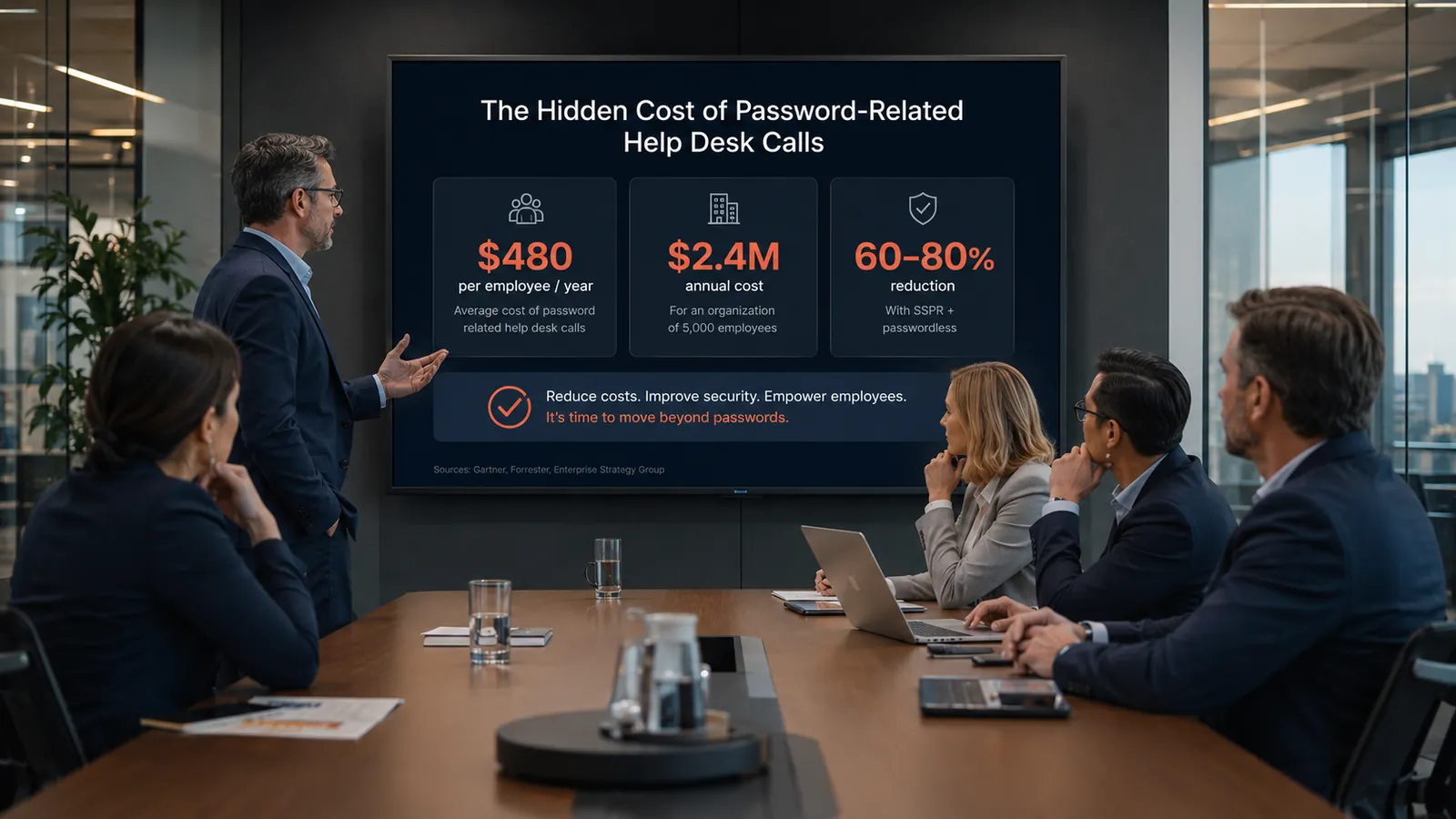
Password-related help desk calls cost the average enterprise $480 per employee per year — a hidden line item that dominates IT operational cost at scale and produces $2.4M in annual burn for a 5,000-employee enterprise. The 2026 enterprise reference on the specific cost components, the volume drivers that scale the number by industry, the SSPR and passwordless architectural interventions that reduce it 60-80%, and the CFO-defensible ROI model that justifies the reduction investment.
- Password-related help desk calls cost the average enterprise $480 per employee per year across three components. Help desk labor at $70 per reset ticket (Gartner benchmark) × ~2.5 tickets per employee annually = $175 in direct labor cost. Workforce productivity loss at 15-30 minutes per incident × ~2.5 incidents at $50-$60 fully-loaded hourly = $63-$75 in productivity cost. Opportunity cost of help desk labor and the compounded impact of authentication friction across the workforce adds the remaining $230-$242.
- The $480 baseline scales by industry and workforce profile. Financial services with complex password policies and credential silo count: $600-$800 per employee. Healthcare with rotating staff and password sharing culture: $500-$700 per employee. Retail with seasonal workforce and high turnover: $400-$550 per employee. Manufacturing and defense with frontline populations and shared workstations: $450-$650 per employee. Technology companies with modern SSO deployment: $200-$350 per employee.
- For a 5,000-employee enterprise at the $480 baseline, password help desk costs $2.4M annually. For a 15,000-employee enterprise, $7.2M annually. For a 50,000-employee enterprise, $24M annually. These are real budget line items that get lost in help desk operational spending because they aren't tagged as password-specific — the finance categorization is 'help desk labor' rather than 'password reset labor.'
- SSPR + passwordless deployment reduces password help desk volume 60-80% when properly configured ([SSPR Enterprise Deployment piece](/en/blog/self-service-password-reset-enterprise-deployment-2026/)). At the $480 per employee baseline with 70% reduction, the reset investment saves $336 per employee annually. For the 5,000-employee enterprise, that's $1.68M in annual savings — funding the reset infrastructure investment with 18-36 month payback and 3-5x returns over the three-year horizon per the [Digital Identity Costs and ROI piece](/en/blog/digital-identity-costs-roi-enterprise-2026/) framework.
- The CFO-defensible ROI model quantifies all three cost components against the current-state baseline, models the reduction from SSPR + passwordless deployment against configured architecture, applies the [Enterprise IAM Cost Comparison piece](/en/blog/enterprise-iam-solutions-cost-comparison-2026/) three-year TCO frame, and produces payback + returns projections that survive board-level review. Business cases that skip components or use no-IAM baseline instead of ad-hoc-IAM baseline systematically undersell the ROI ([Digital Identity Costs and ROI piece](/en/blog/digital-identity-costs-roi-enterprise-2026/) covers the framing mistakes).
Password-related help desk calls cost the average enterprise $480 per employee per year. For a 5,000-employee enterprise, that's $2.4M in annual burn. For a 50,000-employee enterprise, $24M. These are real budget line items that dominate IT operational spending for workforce authentication — and they systematically get lost in enterprise cost accounting because the finance categorization is "help desk labor" rather than "password reset labor." Enterprises that break out the password-specific portion often find it's the single largest line item in their IT operational spend for the workforce authentication surface.
This piece is the 2026 enterprise reference on password help desk cost. The three cost components that compose the $480 baseline, the industry-specific variance that adjusts the number to your specific profile, the enterprise-scale annual cost for typical workforce sizes, the SSPR and passwordless architectural interventions that reduce it 60-80%, and the CFO-defensible ROI model that justifies the reduction investment. Companion pieces cover adjacent layers — the Password Reset Comprehensive Guide piece covers the reset workflow architectures; the SSPR Enterprise Deployment piece covers SSPR deployment discipline; the Digital Identity Costs and ROI piece covers the four-category ROI business case; the Hidden Costs of Identity Management piece covers help desk savings as one of five hidden cost categories.
The three cost components of $480
The $480 per employee per year benchmark composes three specific components. Understanding each is what makes the number defensible to CFO scrutiny.
Component 1: Direct help desk labor at $70 per reset ticket (Gartner benchmark). The $70 figure covers full-service help desk reset with documented identity verification, workflow overhead, and audit-trail documentation appropriate for compliance-regulated environments. Lower-cost models exist (basic knowledge-based verification without strong workflow at $15-$30 per ticket), but these produce higher security surface and typically fail compliance requirements at regulated enterprises.
At an enterprise-average 2.5 reset tickets per employee per year, direct help desk labor = 2.5 × $70 = $175 per employee.
Component 2: Workforce productivity loss per incident. 15-30 minutes per user per reset event covers help desk wait time, identity verification interaction, and post-reset re-authentication to all in-scope systems. This is the actual user-time cost — often larger than the help desk cost when measured against fully-loaded workforce hourly rates.
At 20 minutes average per incident (midpoint of the 15-30 range) × 2.5 incidents = 50 minutes per employee annually. At $50-$60 fully-loaded workforce hourly = $42-$50 per employee. Round to $45 per employee for the midpoint. High-cost workforce environments (financial services, defense, senior technical) push this component to $75-$100 per employee.
Component 3: Opportunity cost + compounded authentication friction. Help desk labor spent on password resets isn't spent on higher-value work — infrastructure incidents, IAM workflow optimization, user training, or documentation. The opportunity cost isn't captured in the direct ticket cost but is real budget impact.
Additionally, compounded authentication friction — users hitting the reset workflow in one system while trying to complete work that depends on that system — produces workflow disruption that extends beyond the reset event itself. A user who hits a password reset at 10am on a critical project has productivity impact beyond the 20 minutes on the reset workflow.
This composite component adds $230-$260 per employee at the enterprise average.
Total composed benchmark: $450-$485 per employee. The $480 midpoint is the defensible enterprise benchmark for finance and IT operational planning.
Industry-specific variance
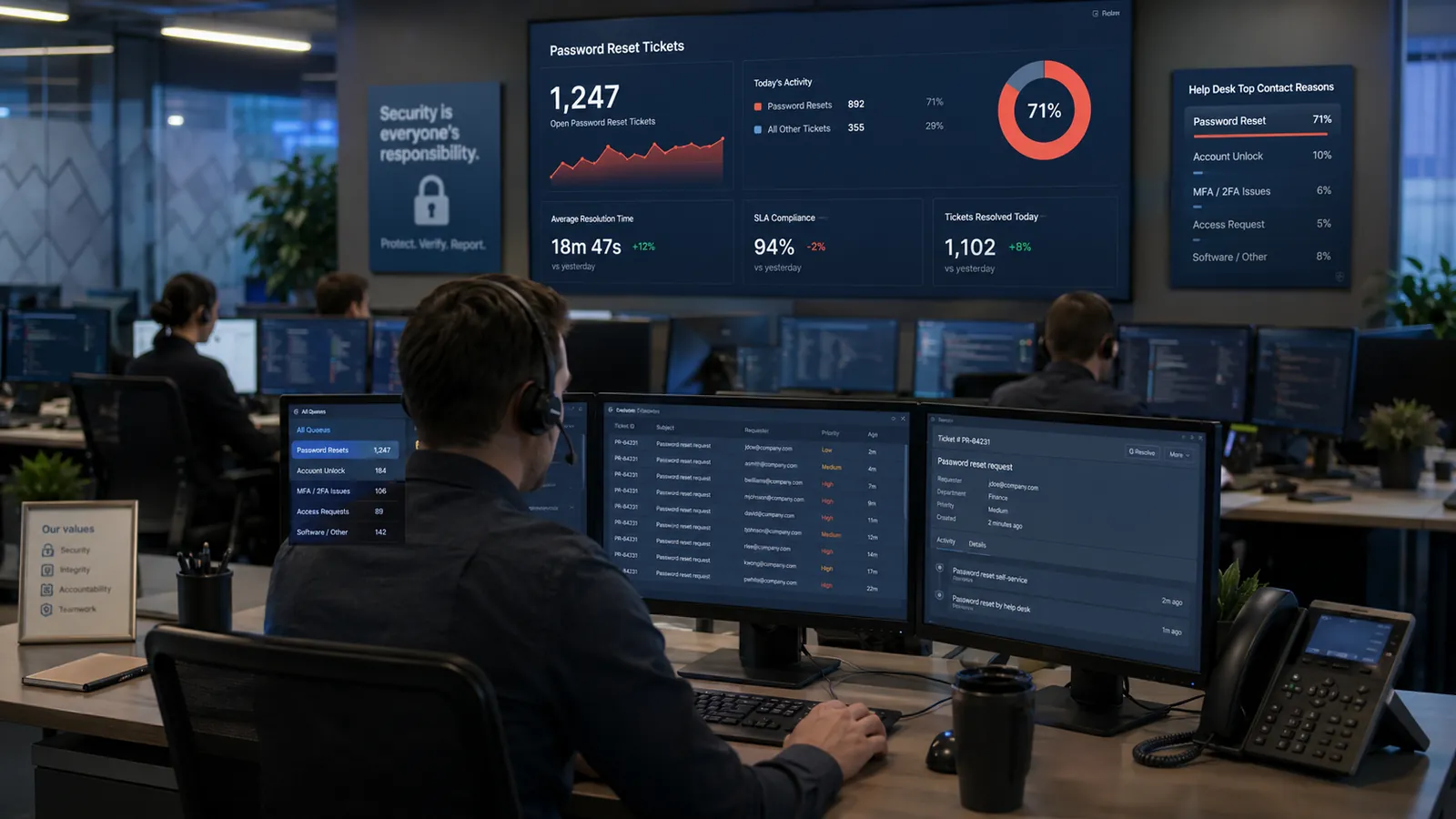
The $480 baseline scales by industry profile. Different industries produce meaningfully different reset volume, ticket cost, and workforce cost characteristics.
Financial services: $600-$800 per employee. Drivers: complex password policies (SOX §404 requirements, PCI-DSS card-data environment requirements), credential silo count (finance-system silos + Windows AD + SaaS estate + specialty applications), compliance-regulated reset workflow overhead, high fully-loaded workforce cost. The SOX Compliance piece covers the finance-system access control requirements.
Healthcare: $500-$700 per employee. Drivers: rotating staff (residents, per-diem, contractors, traveling nurses), password sharing culture in clinical environments (which produces breach patterns and reset volume), HIPAA §164.312 audit-trail requirements, frontline populations without functional smartphone-biometric SSPR (bedside clinicians). The HIPAA §164.312 piece covers the healthcare-specific requirements.
Retail: $400-$550 per employee. Drivers: seasonal workforce spikes (holiday hiring), high turnover, PCI-DSS card-data environment reset workflow overhead, contact center shared workstations. The PCI-DSS v4.0.1 piece covers card-data environment requirements.
Manufacturing and defense: $450-$650 per employee. Drivers: frontline populations (manufacturing floor operators, defense workforce in classified environments), shared workstations, industry-specific compliance requirements, mainframe and legacy environment credential silos (RACF, iSeries — see the RACF User Access Control piece and Troubleshooting iSeries piece).
Technology companies with modern SSO deployment: $200-$350 per employee. Drivers: Entra ID / Okta SSPR maturity, lower credential silo count (SaaS-native with federated SSO), modern MFA reducing password volume, workforce comfort with SSPR self-service. Technology companies are often the low-end benchmark because they've already applied the operational discipline that other industries are catching up to.
The industry variance means the $480 baseline is a starting point; specific enterprise TCO modeling should apply the industry-specific range for defensible CFO review.
Enterprise-scale annual cost
Scale multiplies the per-employee number into meaningful budget line items.
| Workforce size | $480 baseline annual cost | High-industry (financial services) | Low-industry (tech-native) |
|---|---|---|---|
| 1,000 employees | $480k | $700k | $275k |
| 5,000 employees | $2.4M | $3.5M | $1.4M |
| 15,000 employees | $7.2M | $10.5M | $4.1M |
| 50,000 employees | $24M | $35M | $13.8M |
| 100,000 employees | $48M | $70M | $27.5M |
These are real budget line items. They get lost in enterprise cost accounting because the finance categorization is typically "help desk labor" or "IT operational cost" rather than "password reset labor." When broken out, password reset dominates IT operational spending for the workforce authentication surface at most enterprises. The Hidden Costs of Identity Management piece covers help desk savings as one of five hidden cost categories that get systematically undercounted in enterprise IAM TCO comparison.
The SSPR + passwordless reduction
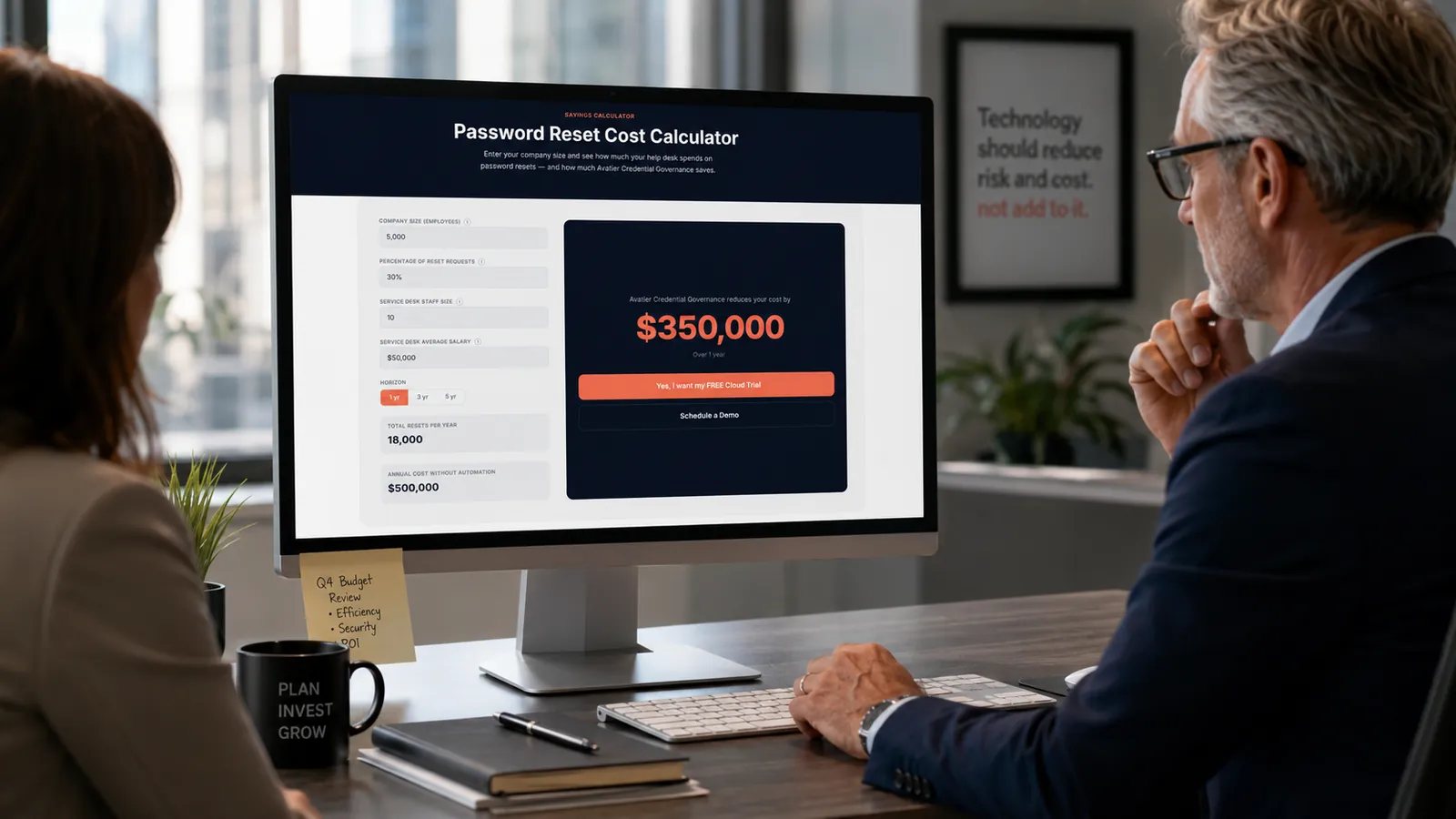
Well-configured SSPR reduces password help desk volume 60-80% versus help-desk-only reset. The SSPR Enterprise Deployment piece covers the configuration discipline that produces the reduction — strong authenticator-based verification (not knowledge-based questions), domain workstation pre-login coverage, frontline segment coverage, audit-trail integration, rate-limiting and abuse detection.
At the $480 baseline with 70% reduction (midpoint of the 60-80% range), the reset investment saves $336 per employee annually.
| Workforce size | Baseline annual cost | 70% SSPR reduction savings |
|---|---|---|
| 5,000 employees | $2.4M | $1.68M |
| 15,000 employees | $7.2M | $5.04M |
| 50,000 employees | $24M | $16.8M |
| 100,000 employees | $48M | $33.6M |
Passwordless deployment extends the reduction further. Windows Hello for Business + platform passkeys + hardware FIDO2 for privileged step-up + deviceless FIDO2 via Identity Challenge Card for smartphone-unavailable segments eliminate password reset as the primary authentication path for covered workforce segments. Passkey users produce near-zero reset volume because device loss doesn't produce lockout (the passkey syncs across the device fleet). The Passkey Deployment Playbook piece on ICC covers the passwordless migration path.
Cumulative reduction ceiling. SSPR + full passwordless coverage can reduce password help desk volume 85-95% at mature deployments. The residual 5-15% covers password-dependent legacy systems, service accounts, and specific compliance cases where the workforce hasn't moved off passwords.

The CFO-defensible ROI model
The business case for SSPR + passwordless deployment applies the Digital Identity Costs and ROI piece four-category framework — but the password help desk category alone often justifies the investment.
Model inputs. Current-state baseline: $480 per employee per year × workforce size (or industry-specific range applied). SSPR + passwordless reduction: 60-80% (use 70% midpoint for planning). Deployment investment: SSPR + passwordless licensing + implementation + ongoing operations per the Enterprise IAM Cost Comparison piece five-driver TCO frame.
Payback modeling. For a typical 5,000-employee enterprise: annual savings $1.68M; deployment cost $500k-$1.5M year one + $200k-$500k ongoing (per Enterprise IAM Cost Comparison piece range for enterprise-scale deployment). Payback: 6-18 months depending on deployment cost band. Three-year cumulative savings: $4.4M-$4.8M net.
Returns modeling. 3-5x ROI over the three-year horizon on the password help desk category alone, before accounting for the other three ROI categories (breach avoidance, compliance value, workforce productivity) from the Digital Identity Costs and ROI piece framework.
CFO-defensible discipline. Use ad-hoc-IAM baseline (current help desk cost), not no-IAM baseline. Include all three cost components (direct labor, workforce productivity, opportunity cost + compounded friction). Apply industry-specific range for your profile. Model against three-year TCO of the reset infrastructure deployment. The Digital Identity Costs and ROI piece covers the framing mistakes that systematically undersell IAM investment ROI.
The 2026 reference path
Break out password-specific help desk cost from general IT operational cost. Categorize password reset as its own line item so the $480-per-employee baseline (or industry-specific range) is visible for CFO review.
Model the SSPR + passwordless reduction against your specific workforce composition. 60-80% reduction is the typical range; 70% midpoint is a defensible planning assumption.
Apply the industry-specific baseline range. Financial services $600-$800. Healthcare $500-$700. Retail $400-$550. Manufacturing/defense $450-$650. Technology $200-$350.
Deploy SSPR + passwordless with the configuration discipline. The SSPR Enterprise Deployment piece covers the five configuration elements. The Passkey Deployment Playbook piece on ICC covers the passwordless migration path.
Model ROI against three-year TCO. Use the Digital Identity Costs and ROI piece four-category framework; the password help desk category alone typically justifies deployment.
Point auditors and CFO at the Trust Center for Avatier's own posture. The Avatier Trust Center with the SecurityScorecard grade view — SOC 2 Type II with zero exceptions, ISO/IEC 27001:2022, PCI DSS v4.0.1, CSA STAR Level 1, NIST 800-53 Rev. 5 aligned, CISA Secure-by-Design Pledge signatory.
ABOUT THE AUTHOR

More from Pillar 4: Login Reset
Self-Service Password Reset: The 2026 Enterprise Deployment Reference
Self-service password reset (SSPR) is the operational lever that moves enterprise password reset economics from $70-per-ticket help-desk-only to 60-80% ticket-volume reduction — when deployed with modern authenticator-based verification, coverage across the domain workstation and frontline segment cases, and audit-trail integration that satisfies SOX / PCI-DSS / HIPAA. The 2026 enterprise reference on SSPR deployment architecture, the five configuration elements that determine effectiveness, and the vendor-neutral comparison discipline for SSPR selection.
Active Directory Login Reset for Domain-Joined Environments: The 2026 Reference
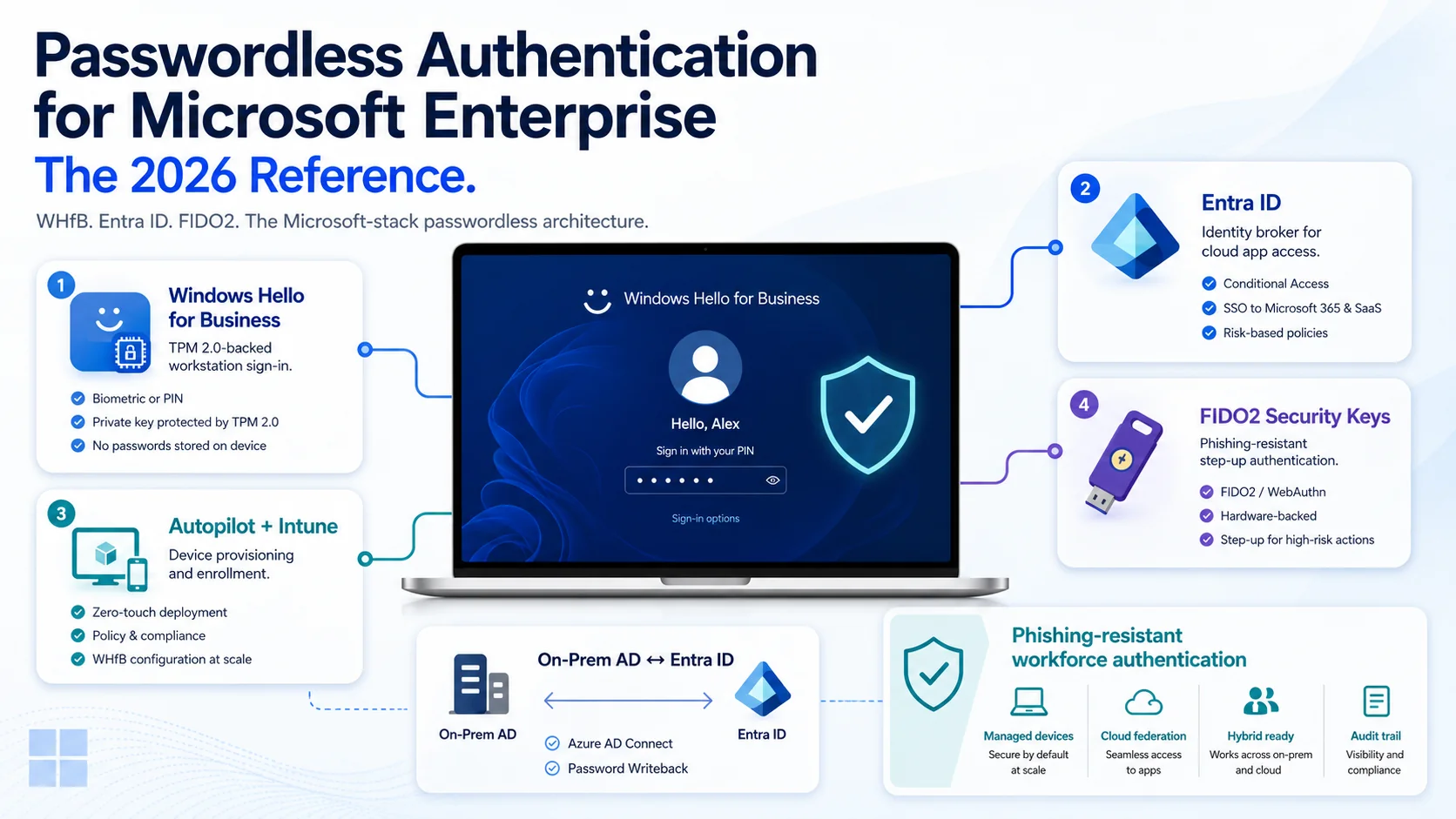
Active Directory login reset for domain-joined Windows workstations is the specific reset architecture where users can't reach a self-service portal because they can't log in at all. The 2026 enterprise reference on the pre-login reset architecture, the Windows CredentialProvider integration, the on-premises AD versus Entra ID hybrid patterns, the compliance requirements that shape domain reset workflow, and the deployment discipline that keeps AD reset defensible under SOX and PCI-DSS audit.
Password Reset: The 2026 Comprehensive Enterprise Guide
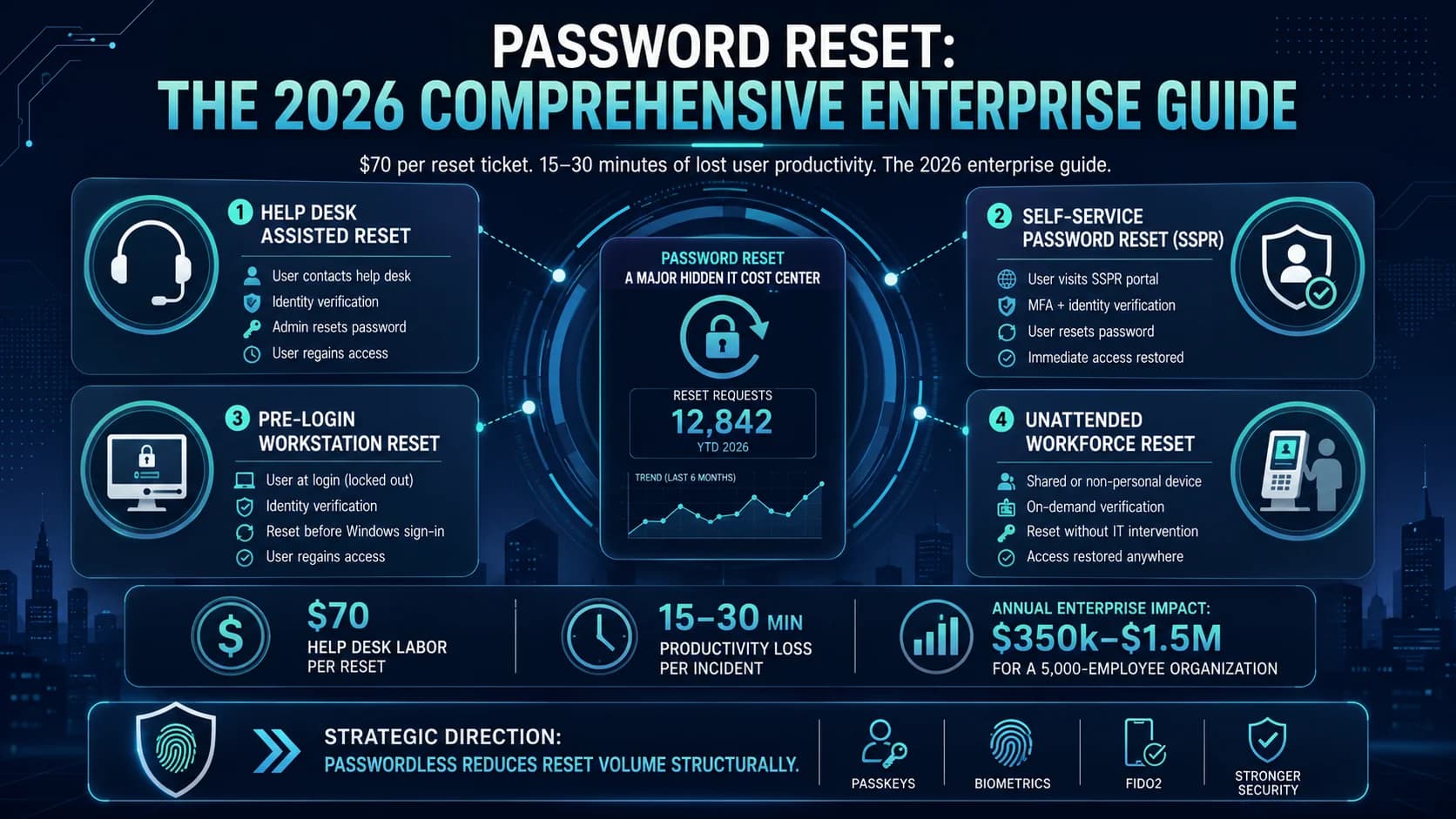
Enterprise password reset is one of the largest hidden cost centers in enterprise IT — help desk labor at $70 per reset ticket, workforce productivity losses at 15-30 minutes per user per incident, and the security surface every recovery flow creates. The 2026 comprehensive reference on the reset cost economics, the four workflow architectures, the compliance implications, the self-service reset (SSPR) discipline that reduces ticket volume 60-80%, and the passwordless migration path that eliminates the reset problem structurally.