AI Virtual Assistants for Identity Management: Conversational Access Without a New Attack Surface (2026)
A chatbot that resets passwords is trivial to build and a genuinely bad idea — because the hard part of a password reset was never the conversation, it was proving who is asking. The 2026 reference on conversational identity done properly: the four workflows worth deflecting to chat, why identity verification must live outside the language model, the prompt-injection and social-engineering surface a naive deployment opens, and the deflection math against a $480-per-employee support baseline.

A chatbot that resets passwords is trivial to build and a genuinely bad idea — because the hard part of a password reset was never the conversation, it was proving who is asking. The 2026 reference on conversational identity done properly: the four workflows worth deflecting to chat, why identity verification must live outside the language model, the prompt-injection and social-engineering surface a naive deployment opens, and the deflection math against a $480-per-employee support baseline.
- A chatbot that resets passwords is a weekend project and a bad idea. The difficulty in a password reset was never understanding the request — it was proving the requester is who they claim to be. A conversational layer that handles intent but delegates verification to the identity platform is useful; one that handles verification itself has rebuilt the help desk's weakest link in software, at scale, with no human intuition to catch the con.
- The design rule that separates safe from dangerous: the language model owns intent understanding and workflow navigation. The identity platform owns verification, authorization, and execution. The model never holds a credential, never makes an authorization decision, and never has an API path that can grant access — it hands off to workflows that would enforce the same policy if a human had clicked the button in a portal.
- Four workflows are worth deflecting to chat, in descending order of confidence: password reset (highest volume, clearest deflection math), access status inquiries (read-only, zero risk, surprisingly large ticket share — 'is my request approved yet?'), access requests (chat surfaces the right existing role instead of inviting a new one), and group membership changes for delegated owners.
- The attack surface a naive deployment opens is real and specific: prompt injection where a user talks the assistant into a workflow it shouldn't run, social engineering that exploits an assistant with no skepticism and infinite patience, and over-helpful disclosure where the model reveals org structure or entitlement details in the course of being useful. Each has a structural mitigation, and none of them is a better prompt.
- The economics: password support runs about $480 per employee per year at the enterprise average ($2.4M at 5,000 employees). Conversational deflection is measurable weekly against that baseline — which is why this is one of the few AI identity capabilities that proves itself inside a quarter ([Password Help Desk Cost Analysis piece](/en/blog/password-help-desk-cost-analysis-2026/)).
You can build a chatbot that resets passwords in a weekend. You should not deploy it.
Not because the technology doesn't work — it works fine. Because it solves the wrong half of the problem. The hard part of a password reset was never understanding the request. Users have been perfectly capable of saying "I forgot my password" for thirty years. The hard part is proving the person asking is who they claim to be — and a conversational interface that takes that job on has rebuilt the help desk's weakest link in software: the agent who can be talked into a reset, except now it runs at machine scale, never gets suspicious, and has infinite patience for the attacker's tenth attempt with a slightly different story.
Conversational identity is genuinely valuable. It just has one architectural rule, and everything below follows from it.
The rule: the model never verifies
The language model owns intent understanding and workflow navigation. The identity platform owns verification, authorization, and execution.
Concretely, that means the assistant:
- recognizes what the user wants and routes them into the right workflow,
- explains what's about to happen and what's needed,
- and then hands off to the same verification the self-service portal enforces — a phishing-resistant factor, a registered device, a deviceless FIDO2 credential.
And it never:
- holds a credential,
- makes an authorization decision,
- or has an API path capable of granting access that a human clicking the same button wouldn't have.
The test is simple: if a user could talk the assistant into an outcome they couldn't achieve by clicking through the portal themselves, the architecture is wrong. The model makes the workflow easier to reach. It must never make it easier to pass.
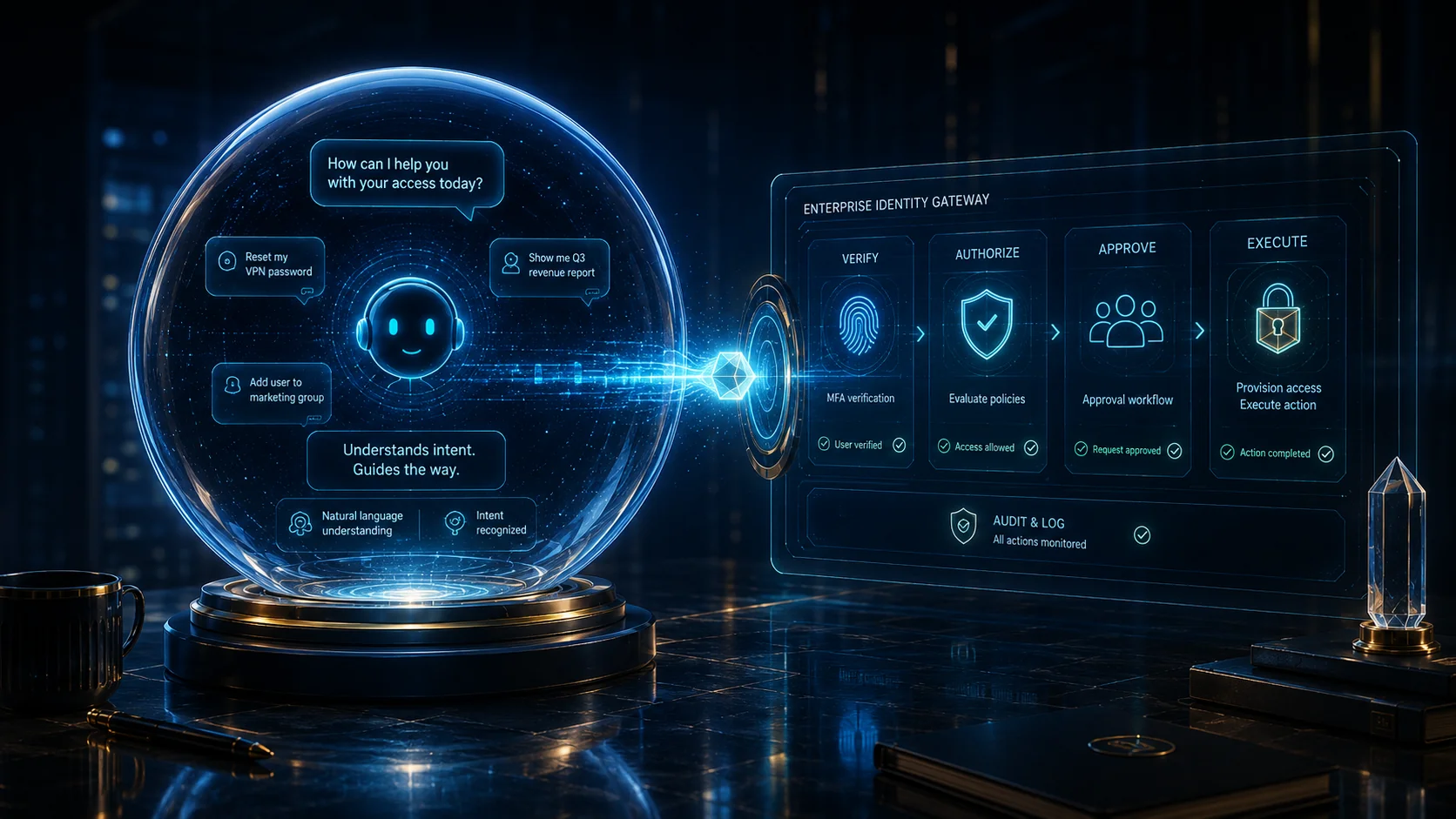 The assistant understands the request. The gateway verifies, authorizes, approves, and executes it. That boundary is the architecture.
This sounds obvious written down. It is violated constantly, because the demo where the assistant "handles the whole reset conversationally" is much more impressive than the one where it hands off to an authentication ceremony halfway through.
The four workflows worth deflecting
In descending order of confidence:
1. Password reset. Highest ticket volume, clearest math, and the workflow users most want to finish without hunting for a portal URL they've never bookmarked. The deflection is measurable against a known baseline — password support runs about $480 per employee per year at the enterprise average (Password Help Desk Cost Analysis piece).
2. Access status inquiries. Read-only, essentially zero risk, and a much bigger share of service desk volume than most teams realize — "is my request approved yet?" and "who's sitting on my approval?" are tickets nobody categorizes as identity tickets. The assistant answers from the workflow state with no ability to change it. This is the free win most deployments skip because it isn't glamorous.
3. Access requests. Valuable for a reason beyond convenience: chat can surface the existing role that fits the stated need, instead of letting the user request a bespoke entitlement bundle. That attacks role explosion at its source — the catalog grows because nobody can find the right role, so they invent one (AI and Role-Based Access Control piece). The assistant becomes a search interface over the role catalog, which is a genuinely good use of language understanding.
4. Group membership changes for delegated owners. Good fit where business owners already own their groups and just want to skip the portal round-trip.
 Four workflows, in descending order of confidence. Note what isn't here — privileged elevation and break-glass, where the friction is the point.
What doesn't belong in chat: privileged access elevation, anything that should require just-in-time approval, and break-glass workflows (Just-in-Time Access piece). Not because chat can't technically do it — because the friction in those workflows is deliberate. Convenience is the feature everywhere else and the bug here.
The attack surface, and why prompts don't fix it
Three failure modes. Each has a structural mitigation. None of them is a better system prompt — prompts are guidance, architecture is enforcement, and an attacker only has to win once.
Prompt injection. The user constructs input designed to talk the assistant into invoking a workflow it shouldn't. Structural fix: the assistant's available actions are a fixed allowlist enforced server-side. There is no sentence that unlocks an action outside the list, because the list isn't in the conversation — it's in the API gateway.
Social engineering. The attacker works the assistant the way they'd work a sympathetic help desk agent: urgency, authority, a plausible story, persistence. An assistant is a better target than a person — it doesn't get suspicious, doesn't escalate to a colleague, doesn't notice this is the fourth similar request this hour. Structural fix: the assistant has no discretion to grant. Verification lives outside it and cannot be argued with. You cannot socially engineer a component that has no authority.
Over-helpful disclosure. In the course of being useful, the model reveals who approves what, who reports to whom, which systems exist, what entitlements are available. Individually harmless; collectively an org chart and an attack map, assembled for free. Structural fix: scope the model's context to the authenticated user's own data. Don't hand it the full directory and trust it to withhold — a model that can see something will eventually say it.
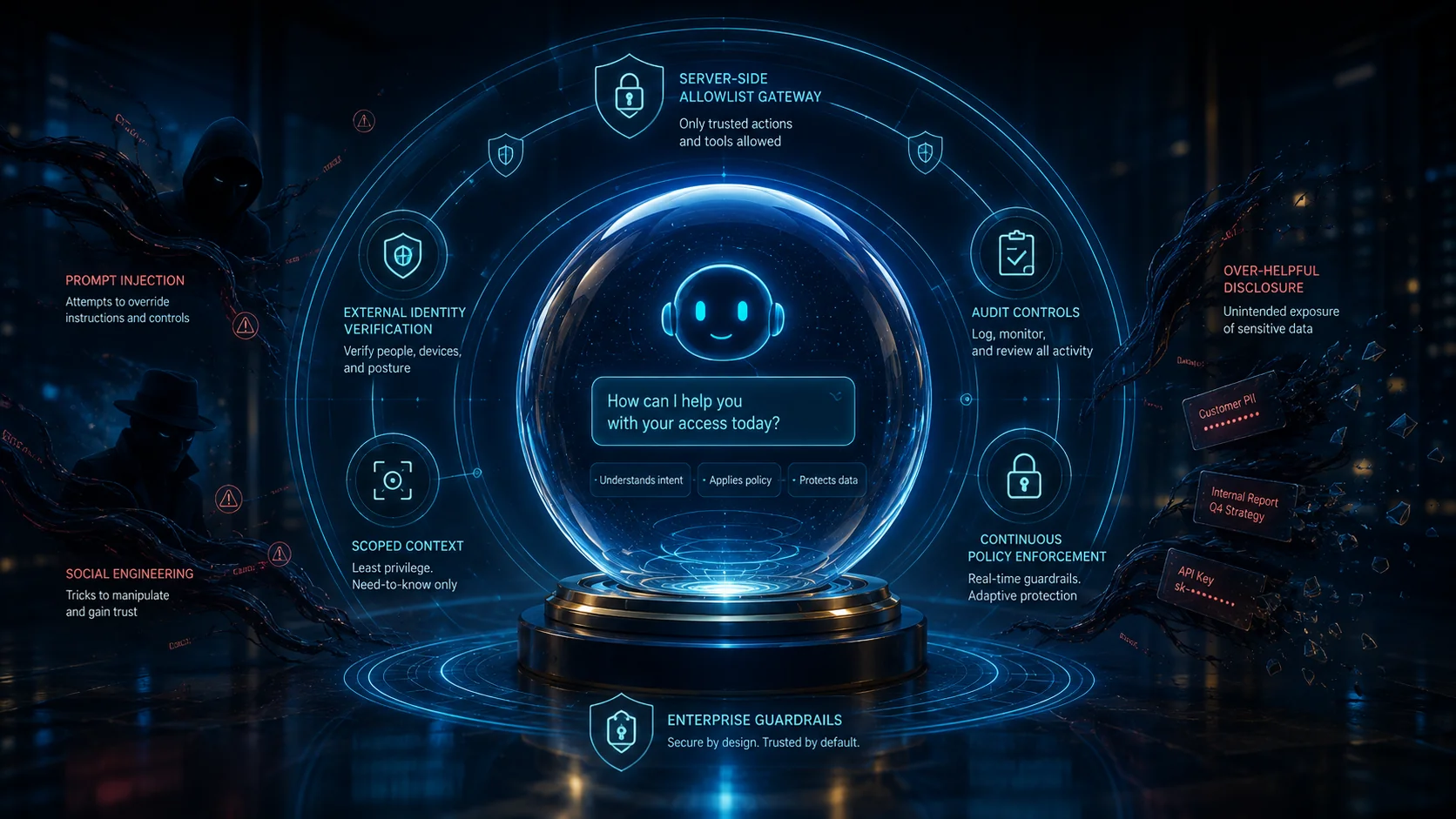 Three attacks, five structural controls — every one of them enforced outside the conversation, where an attacker's words can't reach.
The pattern across all three: never rely on the model's behavior for a security property. Rely on what it structurally cannot do.
The deflection math
This is one of the few AI identity capabilities that proves itself inside a quarter, which is why it's worth doing early (AI in IAM Strategy piece covers the broader sequencing).
The baseline: ~$480 per employee per year in password-related support at the enterprise average. At 5,000 employees, $2.4M annually.
The measurement discipline that keeps the business case honest:
- Deflection rate — tickets resolved in chat ÷ tickets that would have reached the desk. Watch for the gotcha: an assistant that's pleasant can generate new contacts that were never going to be tickets, which inflates the numerator and flatters everyone.
- Completion rate — conversations that reach a successful reset. A high deflection rate with low completion means you've built a very polite dead end.
- Escalation quality — when it hands off to a human, does the human get the context? A bad handoff makes the ticket more expensive than if the assistant hadn't been involved.
- Attempt-to-success on verification — where users fail the ceremony, and why. This is where the segment problem surfaces.
The segment problem is the one to plan for. Conversational deflection works best for people with a phone in their hand and a registered factor. It works worst for exactly the populations that generate the most password tickets: frontline workers on shared devices, contact center staff in phone-prohibited environments, seasonal workers without registered devices. Those users hit the verification wall and end up back on the phone line — so the deflection rate for your highest-volume segment is the lowest.
Which is why the chatbot isn't a strategy on its own. Those segments need a credential that works without a personal device — deviceless FIDO2 via Identity Challenge Card — and the assistant becomes a front door to that ceremony rather than a dead end in front of it (Cross-Platform Identity Management piece covers the no-platform workforce in depth).
Assistant, not agent — and the difference is commercial
Worth being precise, because 2026's marketing has blurred it.
A conversational assistant is a front door. It interprets what a person wants and routes them into workflows that already exist. A human drives every step; the identity platform enforces every decision. The governance question is just "did the workflow enforce policy?" — the same question as the portal.
An autonomous agent plans and acts on its own behalf across systems. It needs its own identity, its own scoped entitlements, its own lifecycle, its own audit trail, and a revocation path. That's a fundamentally different governance problem.
Avatier governs agent and assistant requests through Avatier Actions and Avatier Ledger, two MCP connectors launched September 24, 2026: every request must invoke an approved Avatier capability, and Ledger turns every outcome into evidence (AI agent audit trail). Our Ai4 2026 piece covers the five questions worth asking any vendor about agent governance.
The commercial note: a meaningful share of what's marketed as "agentic identity" right now is a conversational front end. That's a fine thing to be — the four workflows above are real value. It's just a different thing than the label implies, and knowing which one you're being sold is worth a question or two in the demo.
The 2026 reference path
- Architect verification outside the model first. If this isn't settled before anything gets built, nothing below matters.
- Start with status inquiries. Read-only, zero risk, real volume. It builds user trust in the assistant before it touches anything consequential.
- Add password reset with hard handoff to the same ceremony the portal enforces.
- Instrument the four metrics — deflection, completion, escalation quality, verification attempt-to-success — from day one, not after the QBR asks.
- Solve the segments the assistant can't reach with a deviceless credential, or your highest-volume population stays on the phone.
- Add access requests as role search, so chat reduces role explosion instead of feeding it.
- Keep privileged workflows out. The friction there is the point.
The through-line: conversational identity is a user experience improvement over workflows that must already be correct. It doesn't make bad workflows safe, it makes existing workflows reachable — which is worth real money when the baseline is $480 per employee, and worth real risk if you let the conversation do the verifying.
ABOUT THE AUTHOR

More from Pillar 3: Assisted Reset

The Real Cost of a Help Desk Password Reset (It's Not $15) 2026
The $15-per-password-reset figure that's been quoted for two decades undercounts the true cost meaningfully. The 2026 enterprise reference on the five cost components that make up the actual per-reset price, why each one undercounts, how to compute the number for your own organization, and the savings model when reset automation is deployed properly.

Temporary Password Best Practices 2026: NIST 800-63B Rev. 4 and Beyond
Temporary passwords are the recovery credential class that most enterprises still issue, share insecurely, and persist beyond their intended scope. NIST 800-63B Rev. 4 raised the bar in 2025, and the 2026 architectural pattern moves further — away from temporary passwords toward workflow-verified recovery. The enterprise reference on what's required, what's recommended, and where temporary passwords genuinely still belong.

AI Service Desk Automation: Resolving Identity Requests with Avatier
AI service desk automation resolves unlocks, resets, access and group changes by conversation, through governed identity actions. What to automate, what to route, and how Avatier does it.