AI Service Desk Automation: Resolving Identity Requests with Avatier
AI service desk automation resolves unlocks, resets, access and group changes by conversation, through governed identity actions. What to automate, what to route, and how Avatier does it.

AI service desk automation resolves unlocks, resets, access and group changes by conversation, through governed identity actions. What to automate, what to route, and how Avatier does it.
- AI service desk automation, for identity, means routine requests such as unlocks, password resets, access requests and group changes are resolved in a conversation, through governed identity actions, rather than waiting in a ticket queue.
- The assistant takes the request but never decides it. Identity verification, policy, and the organization's existing approvals decide whether the action runs, and every completed action leaves evidence.
- Automate the requests with a clear policy answer and a verifiable requester. Route privileged accounts, failed or unavailable verification, and anything that asks for an exception to a human agent.
- The agent path needs the same discipline: the verification challenge goes to the user's own device, the agent sees the result, and agent privilege is scoped to the users they support.
- Avatier Actions exposes Password Management and Help Desk actions, among more than 50 identity outcomes, so employees ask in Teams, Outlook, Copilot or Claude, and Assisted Reset governs the requests that still need an agent.
AI service desk automation, for identity, means routine requests such as account unlocks, password resets, access requests and group changes are resolved in a conversation, through governed identity actions, instead of waiting in a ticket queue. The assistant takes the request. Verification, policy and the organization's existing approvals decide whether it runs.
That distinction is the whole design. An assistant that can reset passwords on its own judgment is a faster ticket queue with a new attack path. An assistant that can only invoke governed actions is a way to take routine identity work out of the queue without taking it out of governance.
Why identity requests clog the ticket queue
A ticket queue is built for work that needs a person to look at it. Routine identity requests do not. A locked account needs a verified requester and an unlock. A forgotten password needs a verified requester and a new password that meets policy. A request to join a team's group needs the group owner's yes. The answer is already written down; the queue just adds waiting, triage and a hand-off to a console.
The queue also turns identity decisions into human judgment calls under pressure. CISA's advisory on Scattered Spider describes actors who "posed as employees to convince IT and/or helpdesk staff" to reset passwords and move MFA to a device they control. Every request that reaches an agent as an open-ended conversation is a chance for that play to work.
Avatier's own Identity Attack Ledger, which reads every breach notification filed with the California Attorney General from January 2023 through September 30, 2026, shows how often a person is the way in. Of the 53 incidents whose letters say how the attacker got in, 12, or 22.6%, name social engineering of a person, a category that includes vishing and help-desk pretexting.
The cost of that volume is covered in The Real Cost of a Help Desk Password Reset, and the metrics for tracking it in Help-Desk KPIs and Reducing Password-Reset Tickets. This post is about the resolution path itself: what replaces the ticket.
From ticket to governed conversation
In a governed conversational model, the request and the resolution happen in the same place, and the controls travel with the action rather than with the agent. Five steps cover it:
- Ask. The employee or manager asks where they already work, such as Microsoft Teams, Outlook, a chat assistant or Copilot: "My account is locked," or "Add Priya to the finance reporting group."
- Verify. The requester proves who they are with an MFA method they enrolled. The chat session itself is never treated as proof of identity.
- Check policy and approvals. The request is tested against policy. Anything that needs approval, such as an access or group change, goes to the approver the organization already uses.
- Run the action. The unlock, reset or membership change runs as a defined identity action, not as a script with broad privileges.
- Record the evidence. The completed action is logged with who asked, what ran, under what authority and with what result.
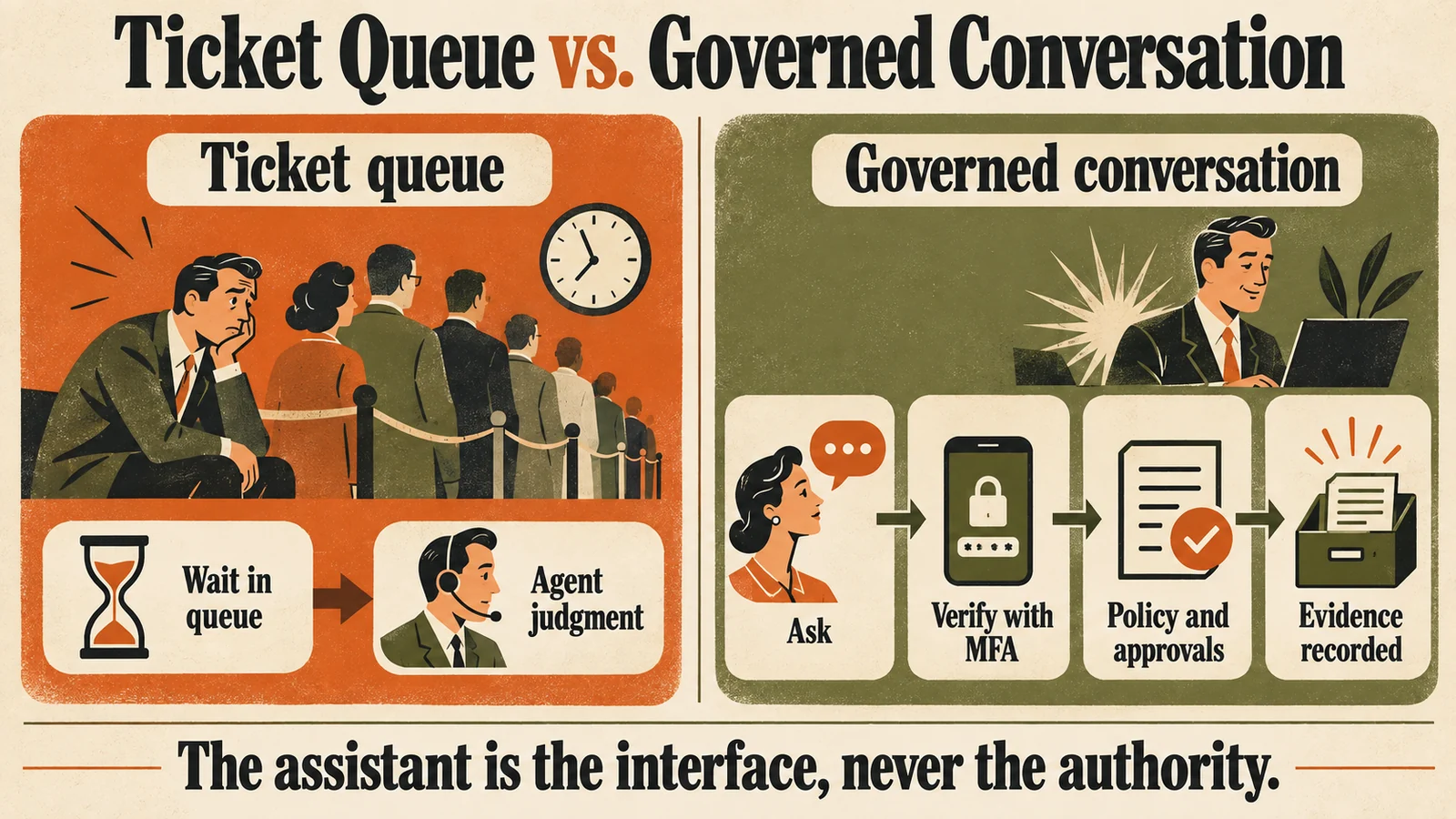 The same request, two paths: one waits for an agent's judgment, the other runs through verification, policy and approvals and leaves evidence.
The assistant's job is narrow. It understands the request, collects missing details and reports the outcome. It does not hold the authority to decide.
Which requests to automate, and which to route to an agent
Automation works best where the policy answer is clear and the requester can be verified. The table below is general guidance; your own policy sets the lines.
| Request | Default path | Why |
|---|---|---|
| Account unlock | Automate after MFA | Clear policy answer; verification is the only question |
| Forgotten password | Automate after MFA and a policy check | The new password must still meet policy |
| Password change | Automate | The user is already signed in and verified |
| Standard access request | Automate the request; keep the approval | The approver decides, not the assistant |
| Group membership change | Automate within policy; owner approves | Group owners stay accountable |
| Privileged or high-risk account reset | Route to an agent, with stricter verification | Higher impact if the reset is wrong |
| User cannot verify (lost or new phone) | Route to an agent | Verification has to be re-established |
| Any request for an exception | Route to an agent and escalate | Pressure and urgency are warning signs |
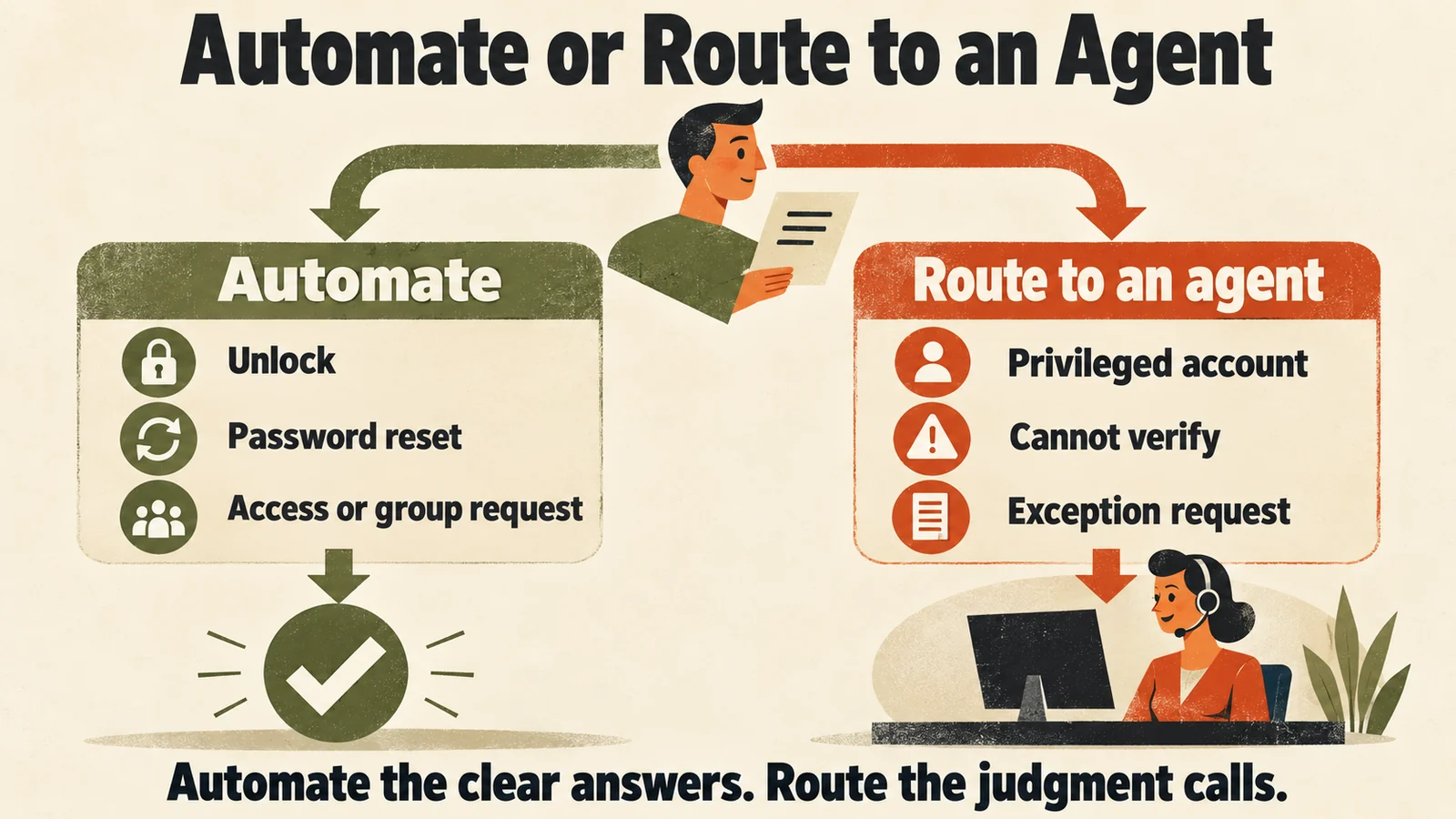 Automate the requests that already have a policy answer; route privileged, unverifiable or exceptional requests to a human agent.
Routing to an agent should not mean dropping back to the old process. The agent path needs its own controls. The verification challenge should go to the user's own enrolled device rather than depend on what the caller says. The agent's privilege should be scoped to the users they support. And the record should show how the user was verified, not just that a ticket was closed.
What Avatier ships toward this pattern
Avatier Actions, available through Avatier Identity Anywhere 2027™, is an MCP connector that exposes more than 50 identity outcomes across eight modules inside Microsoft Copilot, Claude, Avabot and any MCP-compatible assistant. Two modules map directly to service desk work:
- Password Management: unlock, forgot password, change password, enrollment, account and activity views, and account linking.
- Help Desk: assisted unlock, quick and full assisted reset, batch reset, verify user, enrollment email, activity, mapping and un-enrollment.
Access and group requests draw on Lifecycle Management, which includes requesting and removing access and roles, and Group Management, which spans twelve actions from membership and ownership to nesting and expiration. Workflow Approval covers pending requests and history. An employee or manager asks in Teams, Outlook, Copilot or Claude, and the outcome runs through the customer's existing policies, approvals and roles. Nothing bypasses governance, because the assistant is the interface, never the authority. Setup is one administrator connection, with permissions inherited from Microsoft Entra ID, Active Directory, Okta or Ping, and Avatier runs alongside those platforms rather than replacing them. Avatier supports 34 languages across every conversational channel.
For the requests that still need an agent, Assisted Reset, Pillar 3 of Avatier Credential Governance™, gives service desk agents a delegated console. Every challenge goes to the user, and the agent sees only pass or fail. Delegation can follow OUs, regions or support responsibilities, and Assisted Reset works with ServiceNow, Zendesk, Jira and Freshservice. For end-user self-service across web, mobile, Teams, Outlook and AI voice, see the Password Portal pillar page. The employee side of the conversation is covered in Conversational Password Reset in Teams, Copilot and Chat.
Each Secure Outcome records the identity involved, the initiating agent or experience, the authorization context, the policy applied, the action taken and the final result. Through Avatier Ledger's Persona Briefings, the security team's briefing is built around exposure, dormant and orphaned access, privileged activity, and the vishing surface at the help desk. Avatier's credential governance customers report help-desk password ticket reductions of up to 70 percent.
Under Pay Per Identity Action™, customers pay only for completed, verified, policy-compliant outcomes. Getting started is free, deployment services are included, and a 45-day money-back guarantee applies. Compliance details are on the Avatier Trust Center: SOC 2 Type II audited with no exceptions noted, and ISO/IEC 27001:2022 certified. For the invitation-only preview, see the Avatier Identity Anywhere 2027™ site; for the wider company, see avatier.com.
ABOUT THE AUTHOR

More from Pillar 3: Assisted Reset
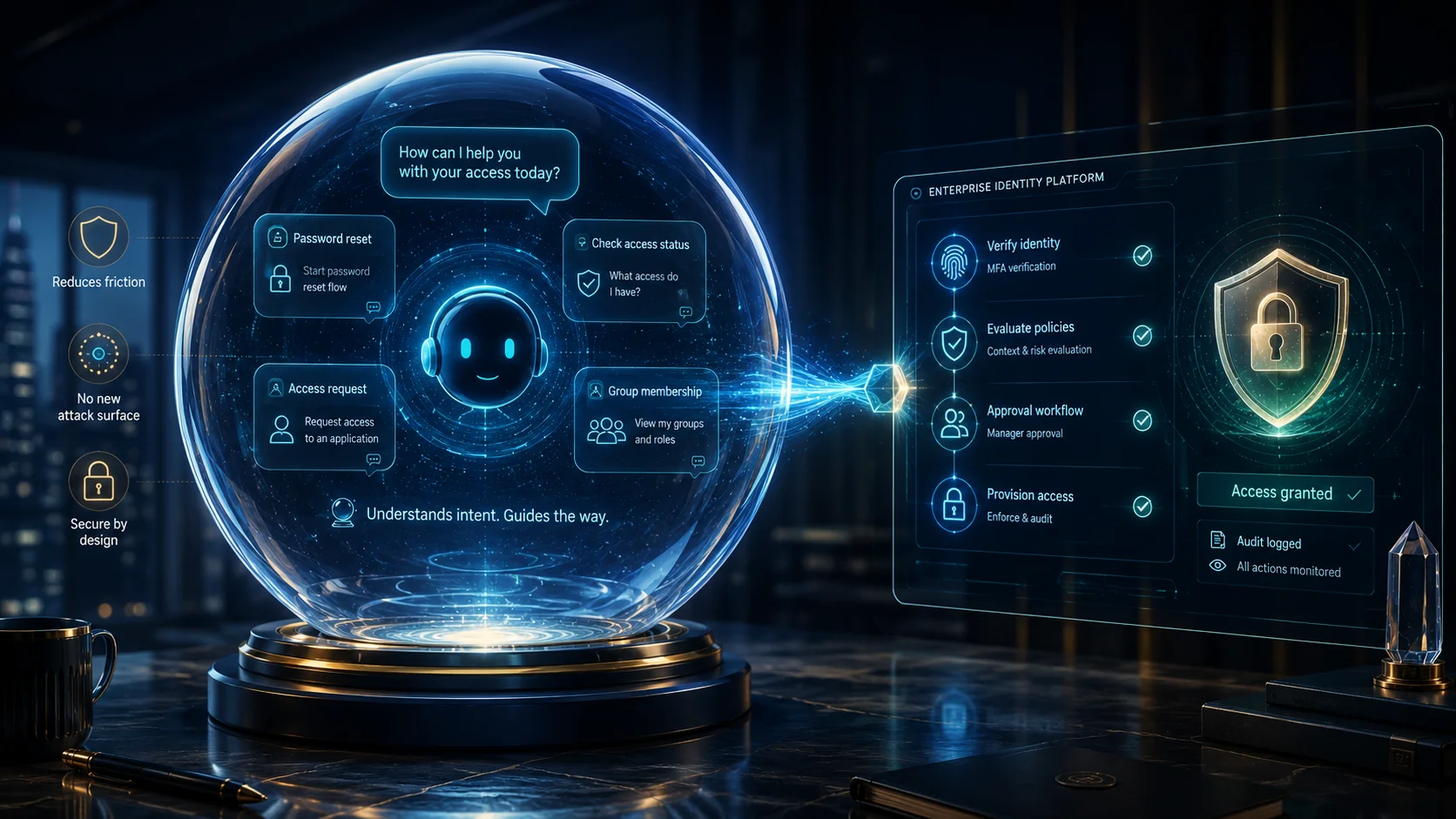
AI Virtual Assistants for Identity Management: Conversational Access Without a New Attack Surface (2026)
A chatbot that resets passwords is trivial to build and a genuinely bad idea — because the hard part of a password reset was never the conversation, it was proving who is asking. The 2026 reference on conversational identity done properly: the four workflows worth deflecting to chat, why identity verification must live outside the language model, the prompt-injection and social-engineering surface a naive deployment opens, and the deflection math against a $480-per-employee support baseline.

The Real Cost of a Help Desk Password Reset (It's Not $15) 2026
The $15-per-password-reset figure that's been quoted for two decades undercounts the true cost meaningfully. The 2026 enterprise reference on the five cost components that make up the actual per-reset price, why each one undercounts, how to compute the number for your own organization, and the savings model when reset automation is deployed properly.

Help Desk Social Engineering Defense: Avatier Assisted Reset
Help desk social engineering works because an agent has to judge whether a caller is real. The defense is to move that decision to the user's own device, so the agent sees only pass or fail.