How Avatier Automates Identity Lifecycle for SaaS and Tech Companies
Hires, team changes and exits at a software company should drive access from the HR record. How Avatier automates that lifecycle and records it for SOC 2 reviews.

Hires, team changes and exits at a software company should drive access from the HR record. How Avatier automates that lifecycle and records it for SOC 2 reviews.
- Identity lifecycle automation lets the HR record drive access: hires get day-one accounts, team changes swap old access for new, and exits disable accounts.
- Avatier HR User Provisioning connects to 70+ HR and payroll systems and turns hire, transfer, leave, rehire and termination events into automated identity workflows.
- Group Automation sets group membership from title, department, location and manager, and lets you test a rule against live data before it goes live.
- Access Governance certifies who has access to what across 90+ systems, and delta certification reviews only what changed each cycle, which helps support SOC 2 access evidence.
- Through the Avatier MCP Server, engineers can ask from Microsoft Copilot Studio, Claude Code or OpenAI Codex, and requests follow the approval workflows your tenant already has.
Identity lifecycle automation for a technology company means letting the HR record drive access: a hire gets day-one accounts and groups, a team change swaps old access for new, and an exit disables accounts, with a request or log entry left at each step. Avatier runs that pattern from HR events through its Lifecycle & Access Governance pillars, and keeps records that help support the access evidence a SOC 2 review or a customer's security questionnaire asks about.
For why technology firms need identity management at all, see the technology and gaming section of Industries That Need Identity Management Most in 2026. This post goes one level down, to the hire, team change and exit at a scaling software company and the evidence those events leave. For mover events in general, see Joiner-Mover-Leaver Automation.
Hire, team change, exit: what each event should trigger
As general guidance, a growing software company feels the lifecycle in three places. Hiring waves put many first days on the calendar at once. Reorgs move engineers between teams, and each move should add the new team's access and remove the old team's. Exits need accounts turned off on every system the person used, with a record that it happened.
Avatier HR User Provisioning connects to "70+ HR and payroll systems through a single unified integration." It turns every HR event, "including hire, transfer, promotion, leave, layoff, rename, rehire, or termination," into an automated identity workflow. Avatier describes each event this way:
| HR event | What HR User Provisioning does |
|---|---|
| Hire | Creates a "standardized username, email, and home directory," and assigns roles and Microsoft 365 licenses |
| Transfer or promotion | "applies the new role's access and removes what no longer fits" |
| Leave of absence | "Access suspended during leave," then "Restored upon return" |
| Rename or rehire | Updates usernames, email aliases and directories; "Rehires reactivated with the right role-based access" |
| Termination or layoff | Disables accounts, revokes access and starts asset recovery |
For first days, Passwordless New User Provisioning™ grants "secure first-day access without ever assigning a password." Property push sends "title, manager, department, and location" to AD, Entra ID and connected apps. On the exit side, "the moment HR marks someone terminated, Avatier disables their accounts and revokes access."
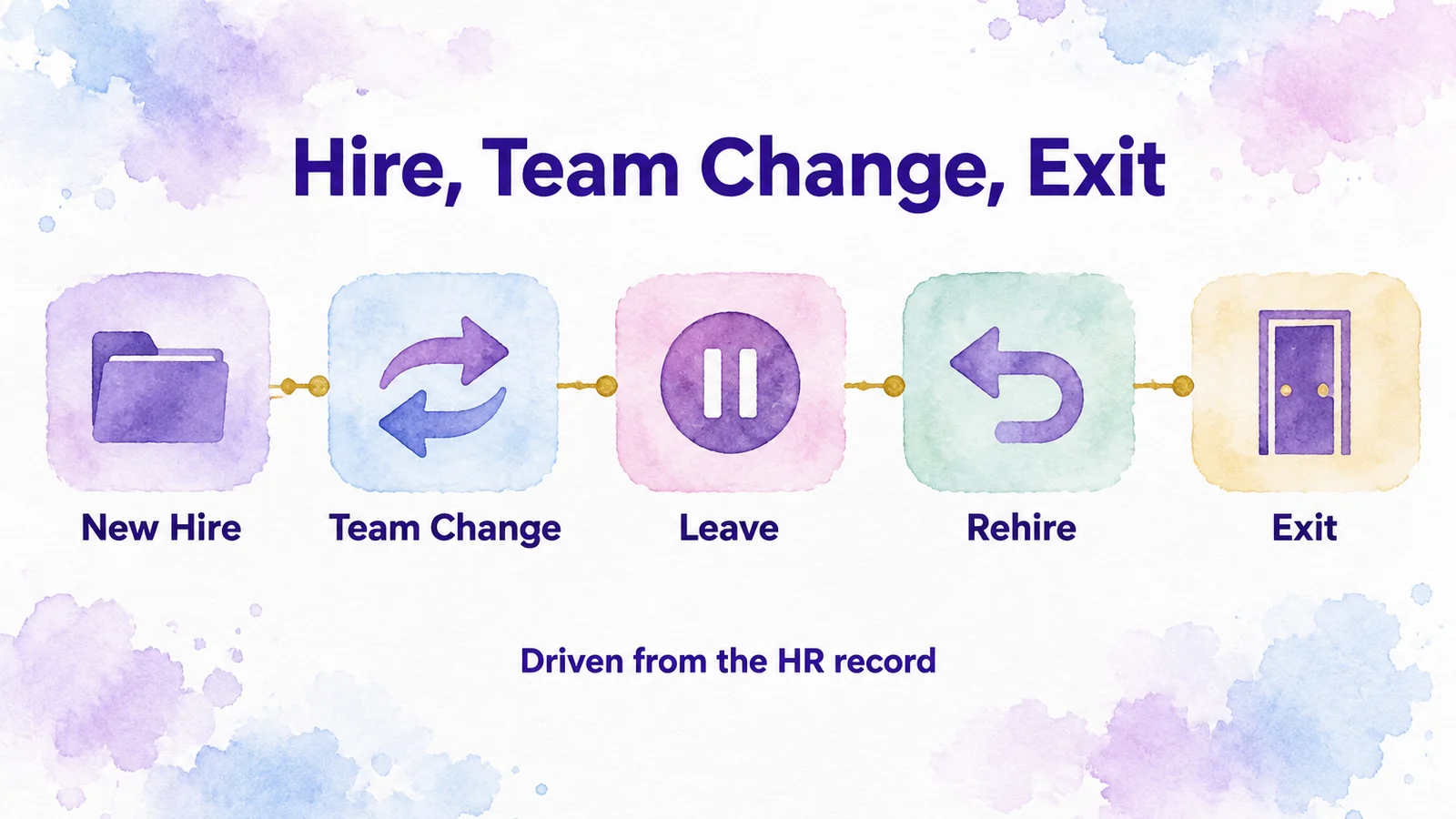 Each HR event, from a new hire through a team change to an exit, starts its own identity workflow instead of a ticket.
Reorgs land in groups. Avatier Group Automation "drives membership straight from authoritative HR attributes: title, department, location, and manager," and "When someone is hired, moved, or leaves, their groups follow." Business owners define each rule "in a guided wizard, with no scripting and no PowerShell." Before a rule goes live, "you test it against live data and see exactly who will be added or removed," which is worth doing before a reorg reshapes several teams in the same week. Rules then run "daily, weekly, or monthly," and "Controlled manual overrides cover the edge cases."
Between those events, engineers still ask for SaaS tools. For that request pattern, see Access Request Portal Adoption: The 2026 Storefront Playbook. Avatier's IT Shopping Cart is tied to HR data, so requested access is "revoked when their role changes or they leave."
SOC 2 reviews and customer security questionnaires
A scaling software company answers access questions from two directions: its own auditor, and the security questionnaires its customers send. The AICPA's Trust Services Criteria present control criteria "for use in attestation or consulting engagements to evaluate and report on controls over the security, availability, processing integrity, confidentiality, or privacy of information and systems." Whatever the framework, as general guidance the access evidence that holds up is produced by the work itself: who approved a grant, who reviewed it and when it was removed.
Avatier Access Governance captures Access Certification Snapshots, "a real-time view of who has access to what." One certification layer reaches "more than ninety enterprise systems and cloud services through a single unified integration," and reviewers "approve or revoke in a click." Reviews route to managers, and app owners "certify access to the systems they govern." With delta certification, "each cycle reviews only what changed." The Compliance Manager "flags risk, tracks status, supports multi-level approvals, and captures evidence."
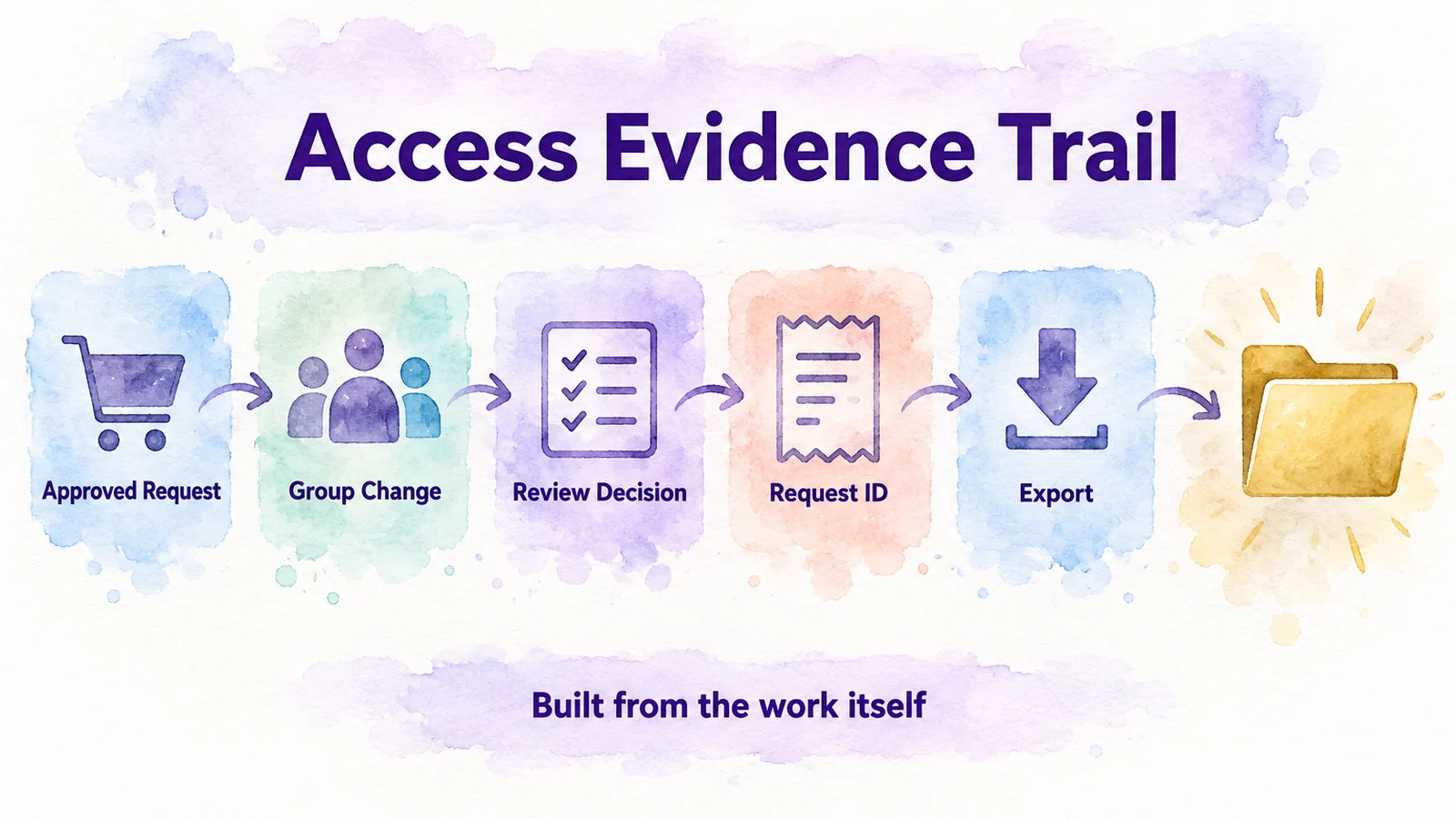 Approvals, group changes, review decisions and request records each leave a record that helps support an access review.
The lifecycle side adds its own records. In Group Automation, "Every membership change is policy-enforced and logged." In IT Shopping Cart, "Every request, approval, and fulfillment is logged for audit." Between review campaigns, patent-pending Continuous Governance™ "detects orphaned accounts and revokes access that no longer fits." Together, these records help support the access-control evidence that a SOC 2 auditor or a customer's questionnaire asks about.
Engineers who ask through AI assistants
If your engineers already work in an AI assistant, the Avatier MCP Server lets them "Connect Avatier to the AI assistant you already use." Its page gives setup steps for Microsoft Copilot Studio, Claude Code and OpenAI Codex, among others. The server URL is https://mcp.avatier.com/mcp, and it "signs you in with OAuth, so there is no API key to manage."
The guardrail heading on the page reads "Your Assistant Asks. Avatier Decides." Requests "follow the approval workflows your tenant already has," and "Requests land in Request History, ready to review and export." Lifecycle actions run here too: in Avabot chat and MCP, Transfer Account "always goes through workflow."
For the agent questions themselves, see Least-Privilege Access for AI Agents, Shadow AI Agents and AI Assistant Access Control for Copilot and Claude.
What Avatier ships toward this pattern
The five Lifecycle & Access Governance pillars run "on the Avatier Identity Anywhere platform, a private cloud instance that's isolated by design." For a technology company's workforce lifecycle, four of them map to the hire, the team change, the exit and the review, with the MCP Server as another way to ask.
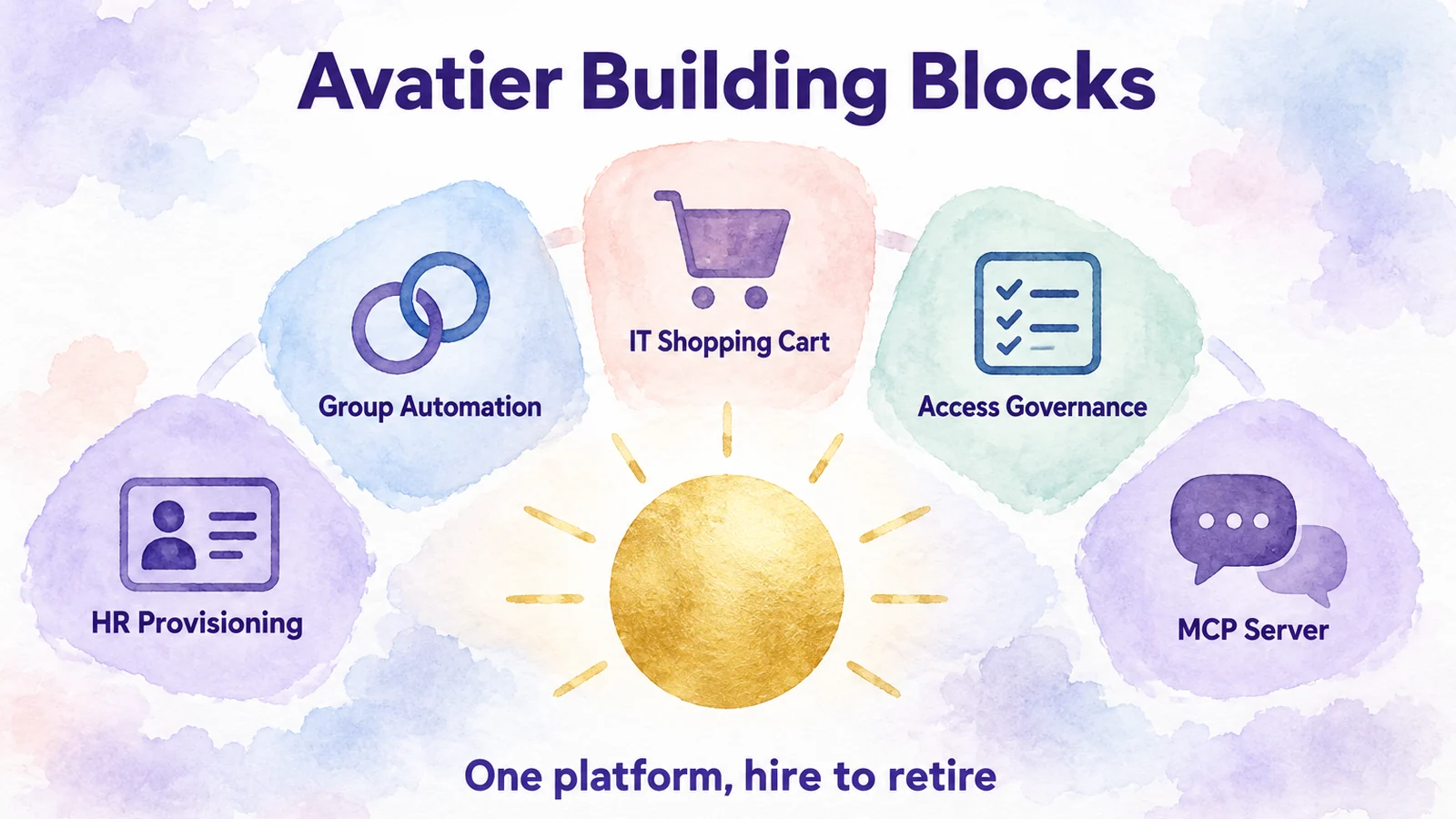 Four lifecycle pillars and the Avatier MCP Server cover the hire, the team change, the exit and the access review.
- HR User Provisioning turns hire, transfer, leave, rehire and termination events into identity workflows across "AD, Entra ID, Microsoft 365, and every connected app." For the event list, see HR User Provisioning.
- Group Automation keeps security groups and email distribution lists in step with HR attributes on the schedule you choose.
- IT Shopping Cart routes each request "for the manager and security approvals your policies require," and "Approved items are provisioned automatically, with no ticket."
- Access Governance runs certification campaigns, delta reviews and privileged-access reviews. For campaign details, see Access Governance.
- Avatier MCP Server takes requests from an AI assistant and records them in Request History.
For the credential side, Credential Governance™ covers six pillars, from Password Firewall to Hybrid Passwordless. Avatier says most customers go live in days to weeks.
Getting started
For security documentation, see the Avatier Trust Center. Avatier completed its SOC 2 Type II audit with no exceptions noted, and the report "covers the Trust Services Criteria for Security, Availability, and Confidentiality." Avatier is also ISO/IEC 27001:2022 certified.
Under Pay Per Identity Action™, each completed, verified action is one Secure Outcome, and attempts, failures and retries are never billed. Getting started is free, deployment services are included, and a 45-day money-back guarantee applies; full terms are in the invitation-only preview. For the credential pillars, see Credential Governance™. For the preview, see the Avatier Identity Anywhere 2027™ site; for the company, see avatier.com.
ABOUT THE AUTHOR

More from Identity by Industry

CMMC Access Controls: How Avatier Helps Support Level 2 Evidence
CMMC Level 2 uses the NIST SP 800-171 Rev. 2 access control and authentication requirements. What each one asks, how a C3PAO scores the evidence, and how Avatier helps support it.
NERC CIP Access Management: CIP-004 Revocation with Avatier
CIP-004-7 asks utilities to authorize access on need, verify it every quarter and remove remote access within 24 hours of a termination. How Avatier starts revocation from the HR event and records each review and request.

Bank MFA Rules and Help-Desk Resets: Identity Governance with Avatier
NYDFS requires MFA for any individual on any information system, and the FFIEC flags help-desk resets. What banks and insurers owe examiners, and the Avatier controls behind it.