Access Request Portal Adoption: The 2026 Storefront Playbook
A correctly built access request portal still goes unused when the storefront layer is missing — this is the 2026 playbook for browse, search, bundled checkout, status transparency, and re-request.

A correctly built access request portal still goes unused when the storefront layer is missing — this is the 2026 playbook for browse, search, bundled checkout, status transparency, and re-request.
- Most access request portals fail at the storefront layer, not the pipeline layer. The catalog, the approval routing, and the connectors can all be correct while adoption sits near zero, because the thing people bounce off is the surface they are asked to shop in — not the governance machinery behind it.
- Adoption is a competition against the shadow path. Users are not choosing between your portal and nothing; they are choosing between your portal and pinging a teammate, emailing an app admin, or opening a free-text ticket. The portal has to be faster than the informal route on the user's clock, not on yours.
- People cannot request what they cannot name. A storefront presents each requestable item by the capability it grants, the owner who authorises it, and what happens after submission — with technical entitlement identifiers mapped underneath, never shown as the thing to pick.
- One checkout for several systems is the difference between a request tool and an errand. Real onboarding and project needs span four or five systems at once; a portal that forces four separate submissions with four separate justifications has designed its own abandonment.
- Status transparency and re-request are what earn the second visit. A requester who can see the order moving — submitted, approving, provisioning, active, and honestly failed when a connector rejects — comes back. One who submits into silence goes back to the ticket queue and never returns.
Most access request portals go unused for reasons that have nothing to do with whether they were built correctly. The catalog is loaded, approval routing is policy-driven, the connectors provision cleanly, and the audit write-back closes the loop — and the portal still sits idle while access keeps arriving through Slack messages, direct emails to app admins, and free-text tickets. The failure is not in the pipeline. It is in the storefront: people cannot find what they need, cannot tell which cryptic entitlement is the right one, cannot get four systems in a single pass, and cannot see what happened after they hit submit. Adoption is a merchandising problem sitting on top of a governance problem you already solved.
This post assumes the machinery underneath is already built. If it is not, start with how to implement self-service access requests, which covers the resource catalog and the governed request-to-access loop that everything here sits on top of. What follows is the layer above that loop — the part that decides whether anyone ever touches it. Think of it as the difference between a warehouse and a shop. The warehouse can be immaculate, correctly indexed, and fully stocked, and still sell nothing, because a warehouse is not a place anyone browses.
The adoption gap: a correct portal that nobody opens
The uncomfortable thing about an unused access request portal is that it does not look like a failure. There is no outage, no incident, no angry escalation. The project closed on time, the integration tests passed, and the governance architecture is genuinely sound. The only symptom is an absence — a dashboard with a flat line on it, and a service desk whose access ticket volume never fell the way the business case promised.
That absence is not neutral. Every access grant that bypasses the portal is a grant that happened without a catalog entry, without a routed owner approval, without an inline segregation-of-duty evaluation, and without a write-back that certification and deprovisioning can later see. The portal did not fail to deliver an efficiency gain; it failed to deliver the governance it was bought for, because governance only applies to traffic that flows through it. A correct portal nobody opens is an ungoverned access path wearing a governance badge.
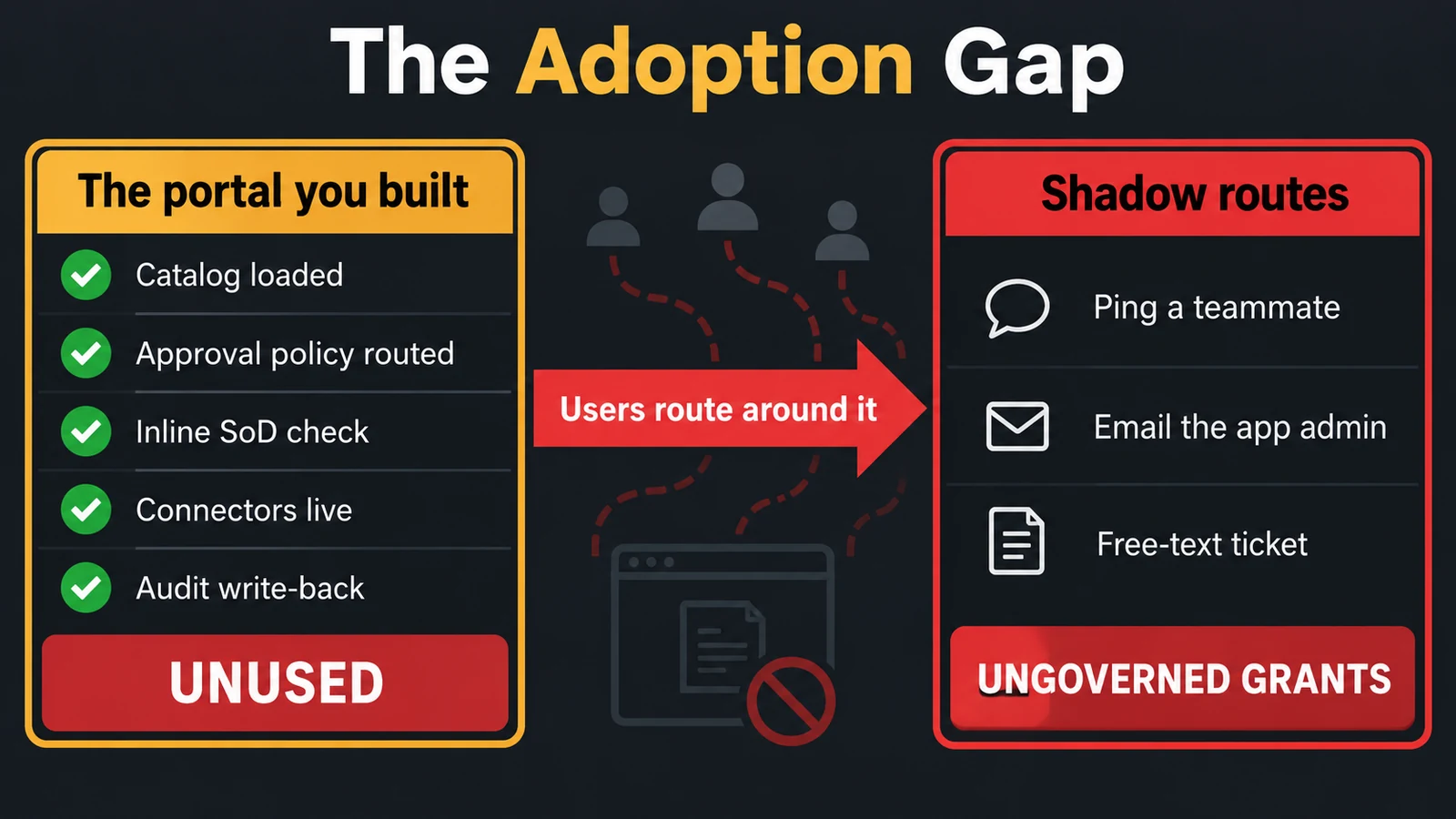 Governance only applies to the traffic that flows through it. An unused portal does not fail quietly — it fails invisibly, one off-catalog grant at a time.
The second uncomfortable thing is that your competition is not inaction. Nobody abandons a request because they decided they did not need the access after all. They abandon it because another route is cheaper in the only currency that matters to them: effort and elapsed time right now. Pinging a teammate who already has the entitlement costs one message. Emailing the application owner directly costs one message. Filing a free-text ticket costs two sentences and no decisions about which of 1,400 catalog entries is the correct one. Against that field, a portal has to win on the user's clock, not on the architecture diagram.
This is why adoption work is best framed as displacement rather than enablement. The question is never "can a user complete a request here" — of course they can, you tested it. The question is "is this the path of least resistance for a person who is mid-task, mildly annoyed, and has a colleague two desks away who already has what they need." Everything below is a way of answering yes.
The storefront surface: nobody requests what they cannot name
The first and largest adoption failure is naming. A catalog is a technical inventory, and technical inventories are organised the way the underlying systems are organised: by entitlement identifier, by security group distinguished name, by role code. Those identifiers are correct, unique, and necessary — they are the raw material of an access control entry and they are what provisioning and audit ultimately operate on. They are also completely unusable as a shopping surface. A person who needs to approve supplier invoices does not know they are looking for CN=SG-FIN-GL-APPROVE,OU=Groups, and when the search box returns six results that all look like that, they close the tab.
The storefront layer solves this by being a presentation over the catalog rather than a view into it. Every requestable item gets a display name stated as a capability — what it lets a person do — qualified by the system it belongs to. "NetSuite — Approve AP invoices" rather than the group name. Underneath that display name, the technical identifier is still attached, still provisioned, still audited; it has simply stopped being the thing a human has to recognise. Alongside the name, three pieces of context do most of the remaining work: who owns the item and will decide, what the item actually grants in one plain sentence, and what happens after submission — including whether it expires.
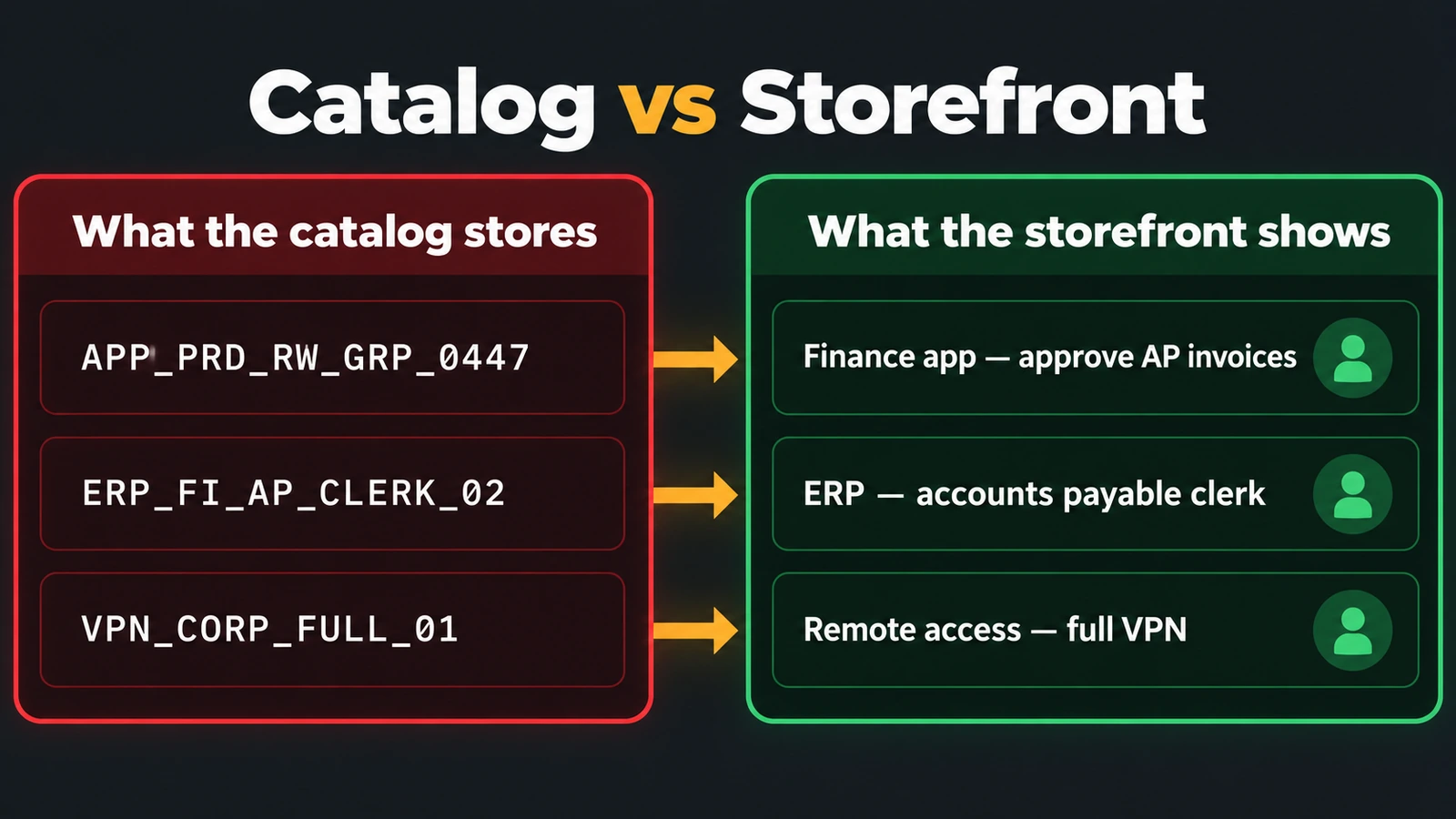 The storefront translates the catalog into the language people search in. The identifier does not disappear — it stops being the thing a human has to recognise.
Search then has to forgive the words people actually use, which are rarely the words the item is filed under. Three affordances carry most of the load. Aliases and synonyms, so that "expenses", "travel claims", and the vendor's product name all land on the same item. The application name as a first-class facet, because the single most common thing a requester knows for certain is which app they need and nothing else. And a browse path for people who do not even know that — grouped by what they are trying to do, by team, or by the systems their peers already hold.
That last pattern is worth dwelling on, because it is where the storefront earns its keep for genuinely lost users. Someone who has just joined a team does not know what to search for; they know who they sit next to. Showing a starting set derived from what comparable people hold — same department, same job family, same location — turns an impossible search into a short confirmation. This is the same attribute logic that drives attribute-based access control, used here to merchandise rather than to authorise. Nothing is granted by similarity. The attributes only decide what gets shown first, and every item still runs its own approval path.
One discipline keeps this honest: resist the urge to surface everything. A storefront that exposes every entitlement in the estate is a catalog dump with better fonts, and it reintroduces exactly the paralysis it was meant to remove. Curate what is routinely requested, make those items excellent, and leave a clearly-marked path for the long tail.
One checkout for several systems
The second adoption failure is granularity. Most portals are built around a single request as the unit of work, because that is how the pipeline thinks: one item, one policy, one approval chain, one grant. But it is almost never how a user thinks. A person joining a project needs the project tool, the shared drive, the reporting dashboard, and the VPN segment — not one of those things. A manager onboarding a new report needs a set. Someone covering a colleague on leave needs whatever that colleague touches.
When the portal forces that into four separate submissions, it has designed its own abandonment. Four forms, four justifications typed four times, four independent waits, and four separate places to go looking for an answer. The informal path handles the same need in one message to one person. The bundled checkout is how the portal competes: several items in one basket, one business justification captured once and attached to all of them, one submission, one order to follow.
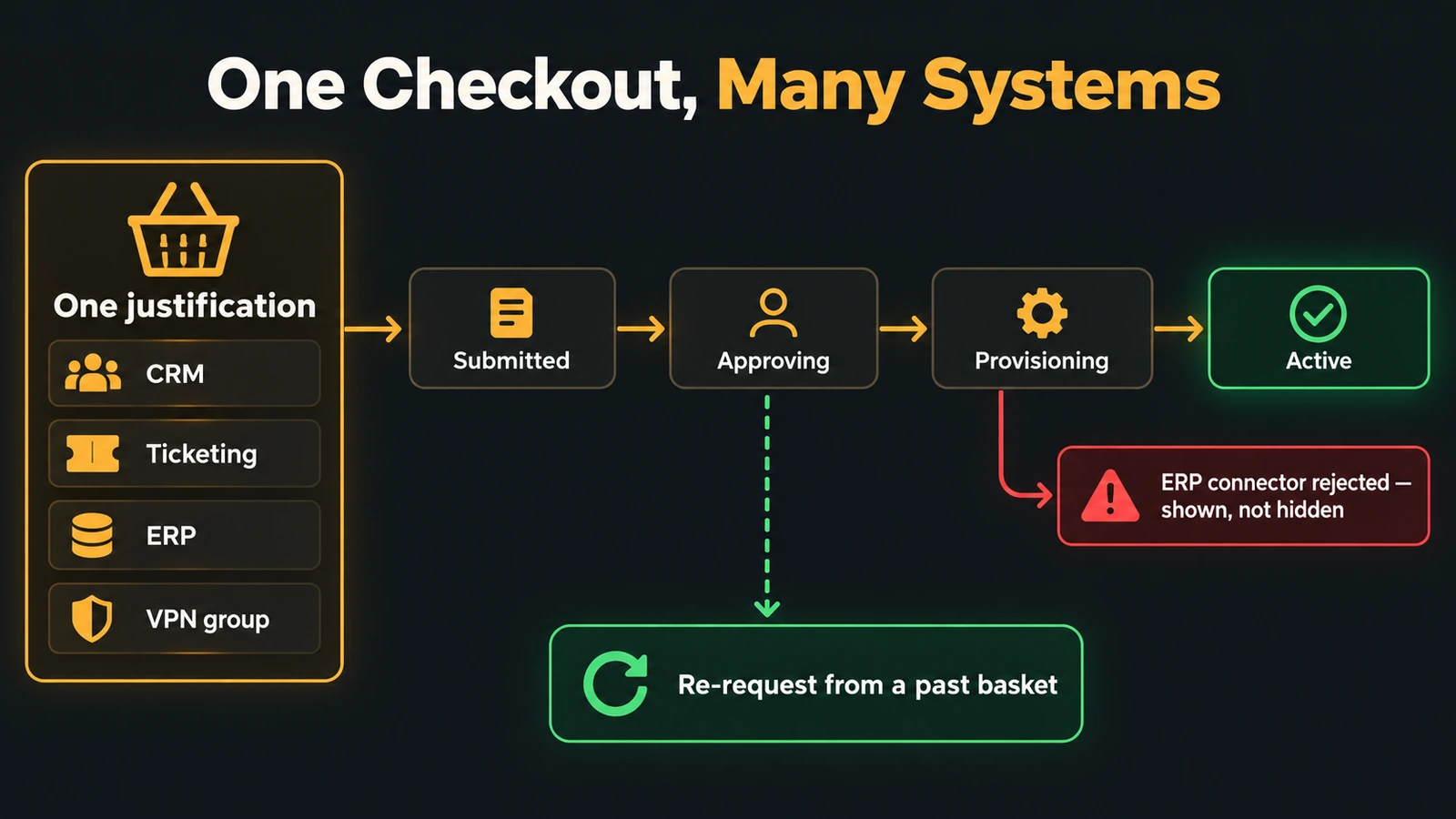 One basket, one justification, one status thread. The governance still fans out per item — the user simply stops paying the cost of that fan-out.
Crucially, bundling changes the interaction and not the governance. Behind the basket, each item still fans out to its own owner, its own approval policy, its own segregation-of-duty evaluation, and its own expiry. Two items from the same basket can take completely different paths — one auto-approved as birthright, one held for a resource owner, one blocked by a toxic-combination check and routed for documented exception. The requester does not need to understand that fan-out. They need one place that shows them the current state of each piece.
Which raises the one hard design problem bundling introduces: partial outcomes. A basket of four rarely resolves as four simultaneous yeses. The portal must be able to represent an order that is partly active, partly waiting, and partly refused, without blocking the approved items behind the contested one and without pretending the contested one went through. Make each item independently resolvable, let approved items provision immediately, and keep the unresolved ones visible as unresolved rather than collapsing the basket to a single misleading state.
Status transparency: where is my order?
The third adoption failure is silence. A requester submits, the screen says "your request has been submitted", and then nothing happens that they can see. Hours pass. They do not know whether a human has looked at it, whether it is stuck on someone who is on holiday, whether it has already provisioned and they simply have not tried logging in, or whether it quietly failed. So they do the rational thing: they go find a human. Often the same human they would have gone to in the first place — which means the portal has now cost them time rather than saved it, and they have learned not to come back.
Status transparency is the cheapest adoption fix available and the one most often deferred, because the data almost always exists already. The pipeline knows which approvals are outstanding, which connector calls have fired, and which grants landed. The gap is that this is typically visible to administrators and not to the person waiting. Exposing it is mostly a surfacing exercise: per item, show submitted and accepted, which approval is outstanding and who holds it, whether provisioning has started, and whether the item is live.
The state that matters most is the one teams are most tempted to hide. When a target system rejects a grant — a connector error, a licence ceiling, a mismatched account — the portal has to say so. Automated provisioning is reliable but it is not infallible, and a request marked complete that did not actually provision is two failures at once: the user goes looking for access that is not there, and the audit record now asserts something untrue. Surfaced honestly, a failed item with a clear next step preserves trust. Hidden, it destroys it permanently, because the user's conclusion is not "the SAP connector had a bad day" — it is "this portal lies."
Two smaller things compound the effect. Give an expectation, not just a state: naming the pending approver, or saying that items like this typically resolve within a working day, converts anxious waiting into ordinary waiting. And push the resolution rather than requiring a return visit — a notification when access goes live, including what to do first, closes the loop in the user's world rather than in yours.
Re-request: the cheapest returning-user feature you have
The fourth adoption failure is treating every request as novel. A large share of access requests are repeats in disguise: the same basket a teammate got last month, the same project set as the last rotation, the same time-boxed grant that just expired while the work carried on. Forcing each of those through a fresh search is asking the user to re-solve a problem the system already has the answer to.
Three affordances cover most of it. Reorder a previous basket, so a returning requester starts from their own history. Renew an expiring grant from the expiry notification itself, which is the single highest-intent moment a requester ever has — they are being told access is about to disappear while they still need it, and the correct response is one button, not a search. And request the same set as a named colleague, scoped to comparable people, which is how new joiners and project rotations genuinely think.
Re-request is also the point where adoption and governance stop pulling against each other. A copied basket is a basket that was already defined, already owned, and already approved once — so it is both the fastest path for the user and the cleanest one for review. Renewal in particular converts a silent risk into a decision: without it, time-boxed access either lapses and breaks someone's work, which teaches the organisation to stop time-boxing, or gets quietly extended out-of-band. With it, expiry becomes a scheduled, logged re-authorisation. That is the kind of evidence that makes a later certification campaign tractable rather than performative, which is most of what the access review an auditor actually wants comes down to.
Measuring adoption without fooling yourself
Submission count is the metric every portal reports and the weakest one available. A portal can be busy and still be losing the majority of real access events, because the denominator — all access granted in the estate, by any route — is not on the dashboard. The honest question is what share of grants originated in the portal versus arriving through tickets, email threads, or an admin acting directly in a target system. That ratio is the only number that tells you whether the storefront is displacing the shadow path or merely running alongside it.
A handful of secondary signals point at specific failures rather than general health. Searches that end without a submission locate naming and synonym gaps precisely — the exact words people typed and did not find. Baskets of size one, in an organisation whose real needs span several systems, suggest related items are not discoverable together. Time from submission to active access, measured as the requester experiences it rather than as approval SLAs report it, exposes where the wait actually sits. And return rate — the share of requesters who come back a second time — is the closest thing to a verdict on the whole experience, because nobody returns to a portal that wasted their time once.
It is worth being deliberate about what not to optimise. Approval turnaround is a real operational metric, but driving it down by making approval easier is how rubber-stamping starts. The storefront's job is to make the right request easy to find, assemble, and track. It is not to make the decision easier to say yes to.
What Avatier ships toward this pattern
Avatier approaches access requests as a storefront rather than a form, and ships it as the IT Store: every IT service, application, asset, and subscription surfaced in one catalog and requested the way people shop online. Items are presented in business language — capability, owning system, and accountable approver — with the technical entitlement mapped underneath so provisioning and audit still operate on the real identifiers. Search is built for the words requesters use rather than the names administrators file things under, with application-level browsing and attribute-derived starting points for people who do not know what to search for.
Items go into a single cross-platform access cart spanning disconnected systems, with one captured justification, and check out as one order while each item fans out behind the scenes to its own owner, policy, and segregation-of-duty evaluation. Approved items reach self-service fulfillment and are provisioned automatically, with no help-desk ticket in the path. Requesters, approvers, and the service desk see the same per-item status thread through approval, provisioning, and activation, including an explicit failed state when a target system rejects a grant. Reorder, renewal from an expiry notification, and request-the-same-as-a-colleague cover the repeat traffic. Managers and delegates can request on behalf of their people, which is how a large share of real onboarding actually happens. The platform context is on the Identity Anywhere 2027 site and the Credential Governance product home, with the wider product line at avatier.com.
The compliance posture behind the platform is published on the Avatier Trust Center: SOC 2 Type II with zero exceptions, ISO/IEC 27001:2022 certified, PCI DSS v4.0.1 compliant, CSA STAR Level 1, NIST 800-53 Rev. 5 aligned, FedRAMP-aligned controls, CISA Secure-by-Design Pledge signatory, and FIDO2-compatible authentication.
What this does not solve
The storefront layer is a conversion fix, and it is worth being precise about what it leaves untouched. It does not improve a bad catalog. If the underlying items are wrong — overly broad bundles, no accountable owner, entitlements nobody can describe — then better merchandising sells the wrong thing faster. Presentation can translate an item; it cannot fix one that should not have been offered.
It does not, on its own, fix approval. If owner review is a reflexive click, the storefront simply routes more requests to the same reflex, and a well-adopted store is an amplifier pointed straight at it. The honest reading is that adoption is a stress test: it does not create governance weaknesses, it finds the ones a low-traffic portal was concealing. What narrows the gap is giving approvers the context they have always lacked at the moment of decision — how old an entitlement is, when it was last requested, whether it is actually in use, how often it is requested, its SLA and its risk. Avatier embeds exactly that intelligence in each catalog item, which is what turns a rubber stamp into a least-privilege decision. The sequencing still matters: harden approval alongside driving traffic, not after.
It does not remove the ceiling set by connector coverage. A beautiful checkout in front of a resource that is still fulfilled by hand produces a fast request and a slow grant, and users judge the portal on the grant. Be honest in the storefront about which items are automated and which are not, rather than letting the interface imply a speed the back end cannot deliver.
And it does not reduce entitlement sprawl — in the short term it will probably increase it, because making requests easy means more requests get made. The counterweights are the ones that were always required: narrow scoping, time-boxed grants that actually expire, and certification that reviews what accumulated. The storefront makes governed access the easiest path, which is genuinely worth doing, because the alternative is not less access. It is the same access, granted off-catalog, by someone who was never asked to approve it, in a system nobody can later certify.
The pipeline is what makes access defensible. The storefront is what makes the pipeline the path people take. You need both, and the second one is the half that most programs never staffed.

More from Access Management

Access Request Fulfillment Time: How to Measure It in 2026
Fulfillment time is the elapsed interval between a user asking for access and that access actually working — and most organizations measure it wrong, because they stop the clock when the ticket closes. This is the 2026 method for defining the clock, attributing the wait, and deciding which delays are worth engineering out.

OAuth vs MCP for Enterprise Access: Where Avatier Governs the Gap
OAuth and MCP aren't rivals. MCP connects AI assistants to tools, and its authorization builds on OAuth 2.1. What each one answers, what scopes miss, and how Avatier governs each action.

Active Directory Group Cleanup: The 2026 Remediation Program
You already know the groups have sprawled. This is the remediation program that reverses it: discovery, ownership assignment, consolidation order, and deletion with a rollback window.