Dynamic Group Membership Automation: Rules That Hold in 2026
Dynamic groups replace hand-maintained membership lists with rules over identity attributes. The 2026 guide to writing those rules, choosing an evaluation cadence, handling the people the rule gets wrong, and detecting drift.

Dynamic groups replace hand-maintained membership lists with rules over identity attributes. The 2026 guide to writing those rules, choosing an evaluation cadence, handling the people the rule gets wrong, and detecting drift.
- Dynamic group membership replaces a hand-maintained roster with a rule over identity attributes, so the group's contents are computed from source-of-truth data rather than assembled from individual requests, and the rule becomes the thing you review instead of the list.
- A membership rule is a standing access decision applied to an entire population at once, which means its blast radius is the whole population — a mis-scoped predicate grants or revokes for hundreds of people simultaneously rather than one at a time.
- Evaluation cadence is not a performance setting but a correctness setting: between the moment an attribute changes and the moment the rule re-runs, membership is wrong, and the length of that lag window is the organization's real exposure.
- Every rule gets some people wrong, so exceptions need a register with a named owner, a stated reason, and an expiry date, rather than being handled as untracked manual additions that quietly contradict the rule.
- Drift is detected by recomputing the rule, reading live membership, diffing the two sets, and subtracting registered exceptions — whatever remains is divergence nobody has accounted for, and it is the most reliable health signal a dynamic group produces.
Dynamic group membership automation is the practice of defining a group's contents as a rule over identity attributes — department, job code, location, employment status — and letting a system compute who belongs, rather than having administrators add and remove people by hand. The rule is the authority. The membership list is merely its current output. That inversion is the whole idea, and it changes what governance actually reviews: instead of auditing a roster of names that nobody can explain, you audit one condition that explains every name in it.
The appeal is obvious to anyone who has maintained membership by hand. Lists assembled from individual requests only ever grow, because every addition is an event somebody wanted and every removal is an event nobody owns. A rule has the opposite property: it describes the population directly, and re-describes it every time it runs.
But the inversion also moves where the risk lives. This piece is not about how to structure a directory or how permissions resolve once a group is attached to a resource — those are separate concerns with their own mechanics. It is about the rule itself: how to write one that holds, how often it should re-evaluate and what that costs, what to do about the people it inevitably gets wrong, and how to notice when its output and reality have quietly stopped matching.
What a membership rule actually replaces
The thing a dynamic rule replaces is not really a list. It is a decision process — usually an undocumented one, distributed across whoever happened to approve each request. When membership is maintained by hand, the reason any given person is in a group lives in a ticket from two years ago, in somebody's memory, or nowhere at all. Ask why a particular person is in a particular group and the honest answer is frequently that someone asked and someone approved, and both have since moved on.
A rule makes that reasoning explicit and uniform. Everyone in the group is there for the same stated reason, because the same condition returned true for all of them. This is the quiet governance win, and it is larger than the labour saving: a reviewer evaluates one sentence instead of four hundred names, and the answer to "why does this person have this access" becomes a fact about them rather than an anecdote about a request.
It also makes non-membership meaningful. In a hand-maintained group, absence carries no information — someone might not need the access, or might simply never have asked. Under a rule, absence is an outcome the rule asserted. That turns a group from a collection of grants into a statement about a population, which is what makes it reviewable at all.
Anatomy of a rule that holds
A membership rule has three parts: the attributes it reads, the predicate it applies to them, and the group it targets. Almost everything that goes wrong in practice goes wrong in the first two, and the failures are more about data than about logic.
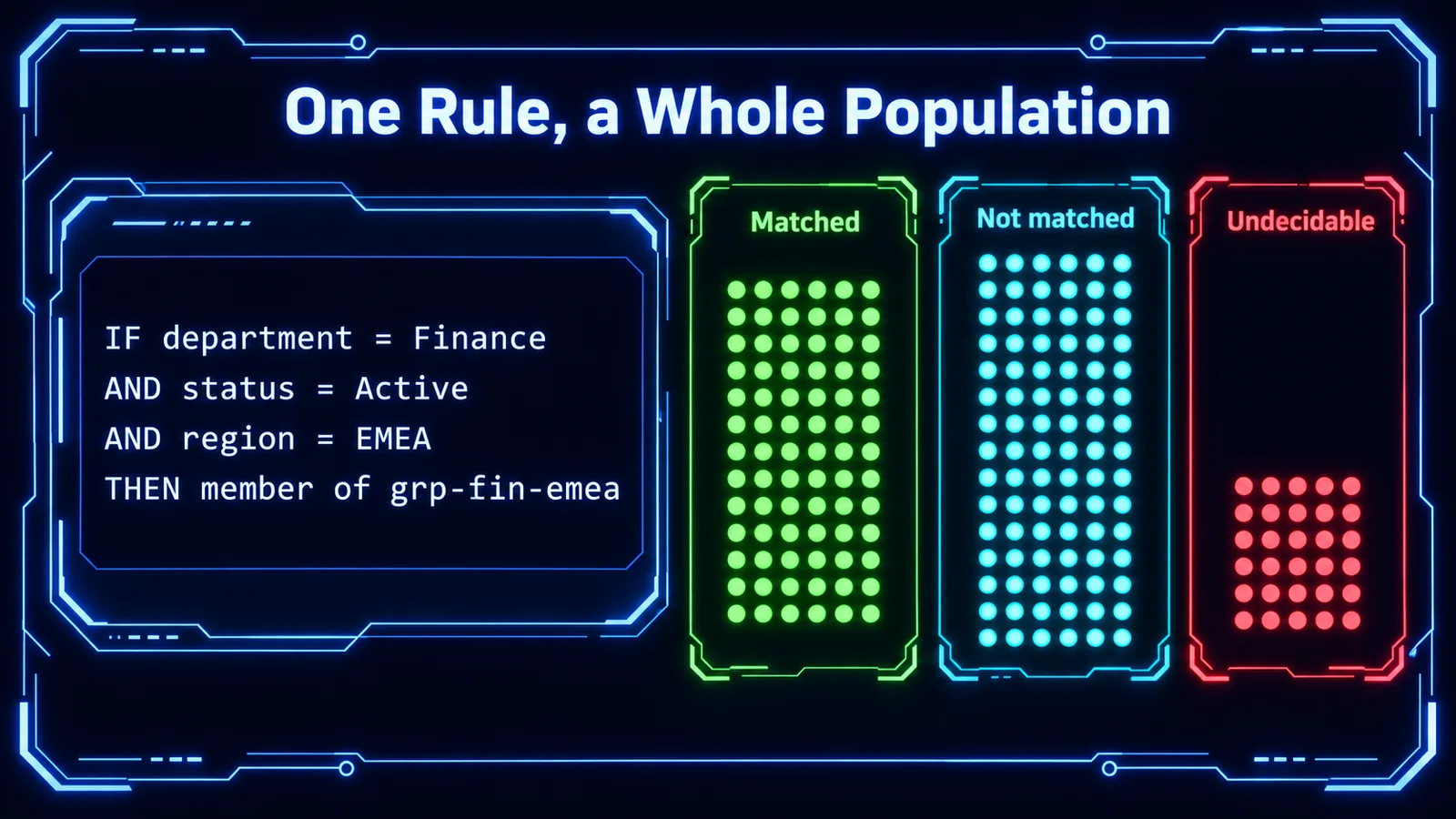 A rule turns an HR fact into a membership decision — and makes every non-member and every undecidable record an explicit, reviewable outcome too.
The attributes are the load-bearing element, and the strongest ones are those a system of record already maintains for its own purposes. Department, job code, cost centre, manager, employment type, employment status, and work location are reliable precisely because HR and payroll processes break visibly when they are wrong. Attributes invented solely to drive access rules are much weaker, because nothing notices when they rot. Before a rule depends on an attribute, three questions are worth answering: who owns it, how fast it updates after the real-world change it represents, and what share of the population has a usable value for it.
That last question is the one most often skipped, and it produces the outcome shown in the third column above. A rule evaluated against an identity with a missing or malformed attribute does not return false in any meaningful sense — it returns an answer nobody should trust. Treating those identities as non-members silently denies access to people who may well qualify; treating them as members is worse. The honest handling is to surface them as a distinct, undecidable population and fix the data, because an undecidable record is a data-quality defect that happens to be showing up in an access system. This is the same dependency that makes attribute-driven authorization powerful and fragile in equal measure, explored more fully in attribute-based access control.
The predicate deserves more suspicion than it usually gets, because a rule is a standing decision applied to an entire population at once. A hand-maintained group fails one person at a time, and someone usually notices. A mis-scoped predicate grants or revokes for hundreds of people in a single evaluation. Writing department = Finance when the source data actually stores Finance Operations and Corporate Finance as distinct values does not produce a small error; it produces an empty group or a doubled one. Running the rule in simulation — computing what it would return without acting on it, and reviewing that set before go-live — is the cheapest control available, and the one most often skipped under time pressure.
Evaluation cadence and the lag window
Once a rule exists, the next decision is how often it re-evaluates. This is routinely treated as a scheduling or performance question, and it is not. It is a correctness question, because between the moment an attribute changes and the moment the rule re-runs, the group's membership is simply wrong.
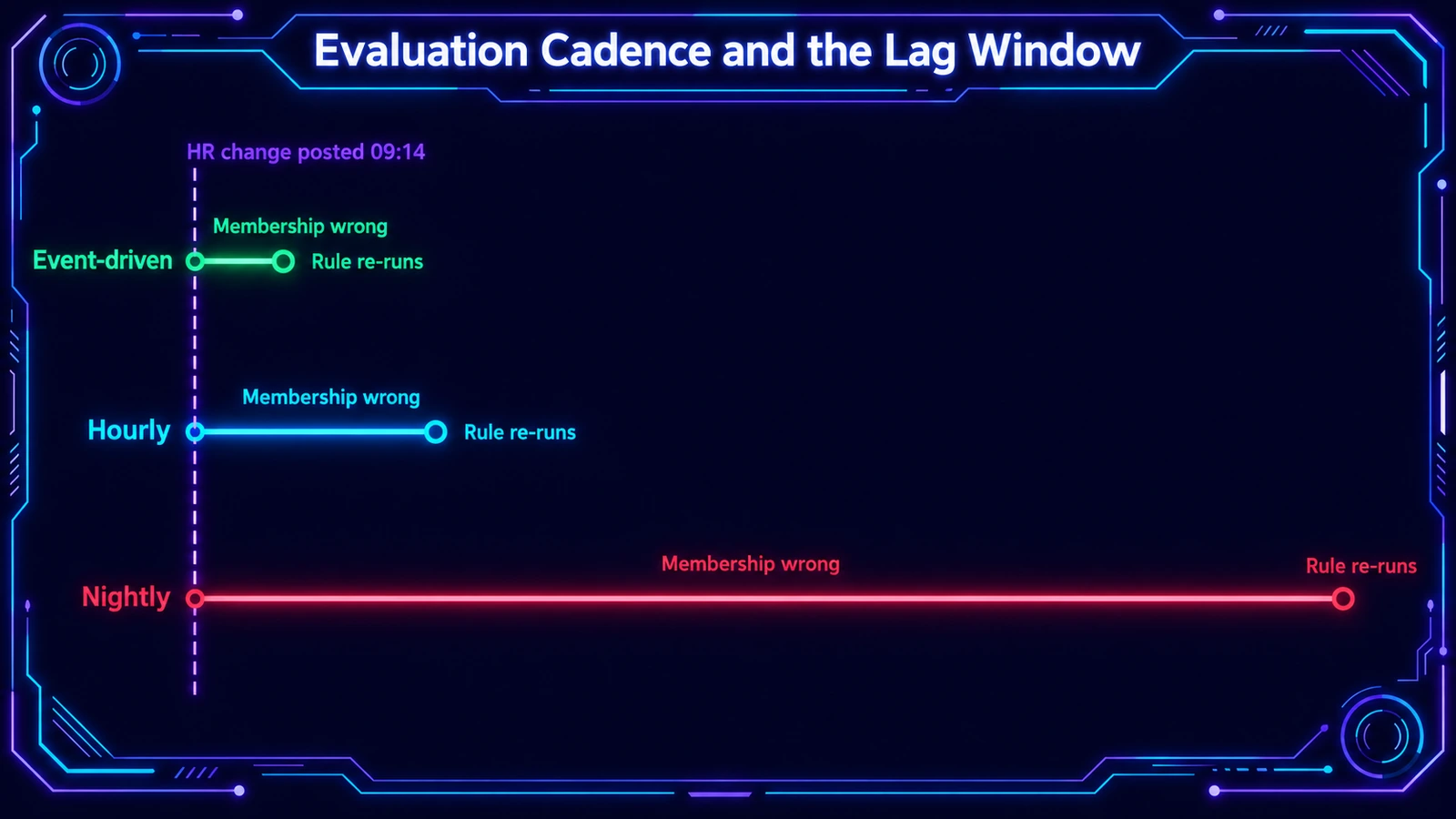 Cadence is not a tuning knob — it is an explicit decision about how long you are willing to let a membership stay wrong.
The three practical options trade the same two costs against each other. Continuous or event-driven evaluation reacts to the attribute change itself, keeping the error window to minutes, and costs the most to run because every relevant event re-evaluates every affected rule. Scheduled hourly evaluation produces a bounded error that averages half the interval, which has the underrated virtue of being easy to state precisely when someone asks how quickly access follows a transfer. Nightly evaluation is cheapest and leaves a window that can span most of a working day — which means a person who transferred out of a sensitive team at nine in the morning retains that team's access until the small hours of the next day.
Whether that matters depends entirely on what the group controls, which is why uniform cadence is almost always the wrong answer. Applying continuous evaluation everywhere overspends on groups where a day of lag is genuinely harmless. Applying nightly evaluation everywhere underprotects the handful of groups where a day of lag is the whole risk. The useful discipline is to set cadence per group against the sensitivity of what it grants, and to write the resulting window down as a stated property of that group rather than leaving it as an implicit consequence of a scheduler's configuration.
There is a second-order cost worth anticipating. Re-evaluating a rule across a large population is not free, and organizations that move everything to continuous evaluation sometimes discover they have built a steady load against an HR system never sized for it. The usual mitigation is to evaluate on change events and reconcile on a slower full sweep — the sweep catches what the event stream missed, which is also the foundation of drift detection.
The people the rule gets wrong
Every rule gets some people wrong. This is not a sign of a badly written rule; it is a property of describing a messy organization with a clean condition. The person on secondment whose HR record still says the old department. The contractor whose employment type does not match the pattern the rule expects. The new joiner whose start date has not passed but who needs access for onboarding. The employee on extended leave whose status flips to a value nobody considered when the rule was written.
What distinguishes a well-run dynamic group is not the absence of these cases but how they are recorded. The tempting response is a quiet manual addition — add the person to the group directly and move on. That resolves the immediate problem and creates a worse one, because a manual addition is indistinguishable from drift, from a provisioning failure, and from an unauthorized grant. Nobody can later tell whether that person is there deliberately, and nobody owns the decision.
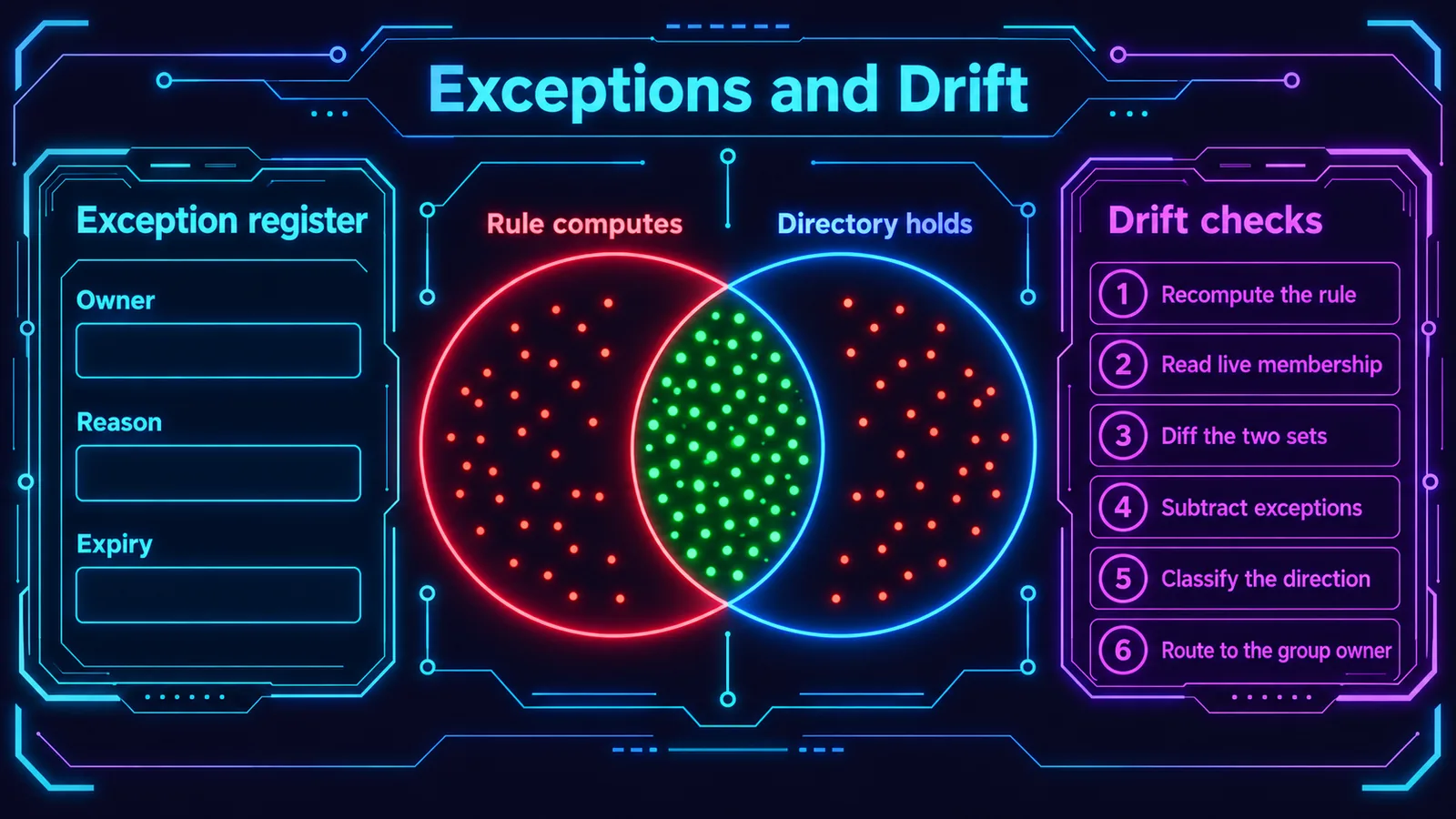 An exception is drift you decided to keep; everything else the diff returns is drift that nobody has noticed yet.
The alternative is an exception register, and the structure matters more than the tool. Each entry needs a named owner who is accountable for it, a stated business reason, and — most importantly — an expiry date. The expiry is what prevents the register from becoming its own accumulation problem, and it reflects the reality that most exceptions are temporary even when nobody says so. A secondment ends. A contract converts. A leave concludes. An exception with no expiry is a permanent silent contradiction of the rule; an exception that expires forces a decision at a defined moment.
The register also does something structurally useful: it makes exceptions subtractable. Because every intentional deviation is recorded, drift detection can remove them from its results and leave behind only divergence that nobody has accounted for. Without the register, every detection run returns the same known exceptions mixed in with genuine problems, reviewers learn to ignore the output, and the control stops working — the familiar failure mode of any alert that cries wolf.
One pattern is worth watching: the exception that should be a rule change. When the same category of person keeps needing the same exception, the rule is describing the organization incorrectly rather than those people being unusual. Three secondments handled as individual exceptions signals that the rule needs to account for secondment, not that three more register entries are required.
Detecting drift between rule and reality
Drift is the gap between what the rule computes and what the directory actually holds, and it is the most informative signal a dynamic group produces — because dynamic groups fail silently. A rule that stopped running, a connector erroring for three weeks, an attribute feed broken by a schema change: none of these announce themselves. The group simply stops changing, and a group that stops changing looks exactly like one that is correct.
Detection is mechanically simple. Recompute the rule against current attribute data. Read live membership from the directory. Diff the two sets. Subtract the registered exceptions. Whatever remains is unexplained divergence, and it falls into two directions that mean genuinely different things.
Identities the rule returns but the directory does not hold mean the grant did not happen or did not persist — a failed write, a connector error, or a manual removal. This direction is usually an operational failure, and it is under-noticed because the symptom is someone lacking access, which surfaces as a help-desk ticket rather than a security finding. Identities the directory holds but the rule does not return mean someone added access outside the rule. That direction is the security-relevant one: standing access no current rule justifies, which is precisely what access reviews exist to catch. How those entries resolve once attached to a resource is a separate topic, covered in the access control entry deep dive.
The diff should generally run at least as often as the rule evaluates, which sounds backwards until you consider what it is checking. Evaluation keeps membership current; the diff verifies that evaluation is actually working. A nightly rule checked weekly can be broken for six days before anyone knows.
Routing matters as much as detection. A drift report landing in a generic queue gets triaged by someone with no context about why the rule exists. The same report routed to that group's named owner reaches the one person who can tell at a glance whether an entry is a problem, a missing exception, or a sign the rule needs rewriting. Ownership is what converts a diff into a decision.
Operating a rule set over time
A single rule is easy. A few hundred rules written by different people across several years is an operational system, and it needs the governance that implies.
Each rule needs a named owner — a person, not a team mailbox — accountable for whether it still describes the population correctly. Rules outlive the reorganizations that motivated them, and the commonest decay is a rule perfectly scoped for a structure that no longer exists, quietly returning a population that no longer makes sense.
Rule changes need the same seriousness as code changes, because the blast radius is identical in kind and often larger. A simulation showing the before-and-after membership delta, a reviewer who is not the author, and a record of what changed and why are the minimum. The question to answer before any rule change is not whether the new condition is correct in isolation, but how many people gain or lose access the moment it ships.
Overlap is the accumulation problem specific to rule sets. As rules multiply they intersect — two rules granting overlapping access to overlapping populations, with neither author aware of the other. Nobody designed the combined outcome; it emerges from rules that are each individually defensible. Periodically computing which identities are covered by which rules is the equivalent of reviewing a role catalogue for redundancy. That relationship is explored further in AI and role-based access control, and the upstream lifecycle events feeding these attributes in the automated user provisioning guide.
Finally, rule-driven membership does not mean every platform behaves alike. Mainframe environments have their own group semantics and administrative model, and a rule that computes an intended population still has to be expressed through whatever the platform provides — a distinction that matters when rules reach into RACF user-group assignments.
What Avatier ships toward this pattern
Avatier ships this as Group Enforcer, its rule-based group management automation, which treats membership as an attribute-driven outcome of the identity lifecycle rather than a standing request queue. Business rules run against authoritative HR and directory attributes — job title, department, location, or any attribute the source carries — so a rule can express "all C-level executives" or "everyone in the Dallas office" and keep resolving correctly as people join, move, and leave.
The evaluation cadence is explicit rather than implied: a scheduler sets the frequency and time at which rules are enforced, down to a particular day of the month or the last day of each month, which makes the lag window described above a deliberate setting instead of an accident of configuration. Rules can be tested against live data before they are promoted, so the first time a rule's blast radius becomes visible is not in production.
Exceptions are first-class rather than untracked manual additions — members can be added who do not meet the rule criteria without custom coding, which is what allows reconciliation to subtract them and report only genuine divergence. Drift is handled in both directions: the engine returns users an administrator erroneously removed, and removes users who were manually added but do not match the defined rules, with alerting that continuously monitors group integrity for orphan accounts and unauthorized members. The audit trail records what the rule returned, what was provisioned, and what was deliberately excepted — the evidence an auditor asks for when they want to know how quickly access follows a transfer. The broader platform is described at Identity Anywhere and on the Credential Governance product home.
For regulated buyers, the vendor's own posture is published at the Avatier Trust Center: SOC 2 Type II audited with zero exceptions noted, ISO/IEC 27001:2022 certified, PCI DSS v4.0.1 compliant, CSA STAR Level 1 attestation, NIST 800-53 Rev. 5 aligned, FedRAMP-aligned, FIDO2-compatible, and a signatory of the CISA Secure-by-Design Pledge.
What rule-driven membership does not solve
Rule-driven membership is a genuine improvement over hand-maintained rosters, and it is worth closing on what it leaves untouched rather than overselling it.
It does not fix bad attribute data — it depends on that data more directly than manual administration ever did, and propagates errors faster. An administrator processing a request has a chance to notice that a department value looks wrong. A rule has no such instinct: it evaluates correct logic against whatever it is given and returns a confidently wrong answer at population scale. Automating membership on top of an unreliable attribute feed does not produce automated correctness; it produces automated error with better throughput.
It does not decide what access a group should carry. A rule determines who is in a group, not what being in that group permits. If a group grants more than the job requires, a perfectly accurate rule simply delivers that excess to exactly the right people, faster and more consistently than before. Membership accuracy and entitlement appropriateness are independent problems, and solving the first can disguise the second by making the arrangement look well governed.
It does not remove the need for human review. The rule set still needs owners who can judge whether a condition still describes the organization, whether a cluster of exceptions is really a rule defect, and whether two rules have combined into something nobody designed. Automation changes what reviewers look at, not whether judgment is required — and a rule set nobody reviews drifts away from the organization it was written for just as surely as a static list does.
And it does not resolve how the target system represents membership. The rule layer computes an intended population; the directory or application still applies its own semantics to it, and those semantics vary enough that the same intent produces different effective access in different places — which is why the directory layer underneath remains its own discipline, as set out in the LDAP implementation reference.
The organizations that get real value from dynamic groups are not the ones with the cleverest rules. They are the ones that treat each rule as a standing access decision with a named owner, choose a cadence deliberately against what the group controls, record every exception with an expiry instead of hiding it in the membership list, and run the diff often enough that silent failure has a bounded lifetime. The rule is the easy part. Keeping it true is the work.
ABOUT THE AUTHOR

More from IAM & Identity Governance

Deprovisioning AI Agents: Governed Offboarding with Avatier
Deprovisioning an AI agent retires its identity, credentials, and tool access when its purpose ends. The triggers, a seven-step offboarding runbook, and how Avatier supports it.

What Is Pay Per Identity Action™? Outcome-Based Identity, Explained
Pay Per Identity Action™ is Avatier's outcome-based identity pricing model: you pay only for completed, verified, policy-compliant identity outcomes, not for seats, modules, or services hours.

How to Inventory and Baseline Identity Action Volume in 2026
Before any per-action conversation makes sense, someone has to count. How to define the unit, find the counts, de-duplicate across sources, and produce a 12-month baseline you can defend.