Access Request Fulfillment Time: How to Measure It in 2026
Fulfillment time is the elapsed interval between a user asking for access and that access actually working — and most organizations measure it wrong, because they stop the clock when the ticket closes. This is the 2026 method for defining the clock, attributing the wait, and deciding which delays are worth engineering out.

Fulfillment time is the elapsed interval between a user asking for access and that access actually working — and most organizations measure it wrong, because they stop the clock when the ticket closes. This is the 2026 method for defining the clock, attributing the wait, and deciding which delays are worth engineering out.
- Fulfillment time is elapsed wall-clock time from the moment a request is submitted to the moment the requester can actually use the access. Both ends are design decisions, and getting them wrong makes every downstream number meaningless — which is why the definition deserves more scrutiny than the measurement.
- "Ticket closed" is the wrong stop event. Ticket closure is a queue-management action taken by whoever owns the queue, and it can land before the entitlement is usable or long after it was granted. Measuring to ticket closure measures how fast a team tidies its backlog, not how fast access arrives.
- Elapsed time decomposes into distinct waits — approver wait, queue wait, manual provisioning work, hand-offs between teams, and verification — and the only useful question is which segment owns the bulk of the interval in your environment. Nothing can be fixed until the time is attributed.
- Approval latency and fulfillment latency are different problems with different owners and different fixes. Approval latency is a decision problem solved by routing, delegation and notification; fulfillment latency is an execution problem solved by connectors and automation. A single blended average hides both.
- Some delay is deliberate. An approval that exists because someone must take accountability for the grant is a control, not latency, and engineering it away is a governance regression dressed up as an efficiency win. The goal is to remove the waiting around the control, not the control.
Access request fulfillment time is the elapsed interval between the moment someone asks for access and the moment that access actually works for them. Not when it was approved, not when an administrator believed they were finished, and not when the ticket was closed — the moment the requester could do the thing they asked to be able to do. Most organizations that track this metric at all measure to ticket closure, a queue-management event that can land before the entitlement is usable or long after it was granted. Fixing the definition usually changes the number more than any process improvement does.
This post is about elapsed time and nothing else. It does not cover how to design a request catalog or structure the approval pipeline — that ground belongs to implementing self-service access requests. It is about the clock: what starts it, what legitimately stops it, where the interval between those events goes, and which parts are worth engineering out. Fulfillment time is one of the few identity metrics a non-identity executive intuitively understands, which makes it unusually easy to report badly and unusually damaging when the number turns out not to mean what everyone assumed.
One commitment up front: this post will not tell you what a typical fulfillment time is. Any such figure would be invented, and an invented benchmark is worse than none, because it hands a program a target with no relationship to its own environment. The useful output here is a method — define the clock, attribute the wait, split the latencies, sort the delays — that produces your number rather than borrowing someone else's.
Defining the clock: what starts it and what stops it
Fulfillment time is a duration, and every duration is two events and a subtraction. The subtraction is trivial. The two events are where the difficulty lives, and they deserve more deliberation than most programs give them.
The start event should be the first moment the organization was told that access was needed, in whatever channel it actually offers. This sounds obvious and is routinely violated. If a user raises the need in a chat channel, or files a general service-desk form, and that request is later re-keyed into an identity governance tool by a human being, starting the clock at the re-key quietly deletes the earliest portion of the wait — frequently the longest, because intake queues are where unrouted work accumulates. The same distortion appears whenever an organization runs several intake channels and instruments only the modern one, so the channel with the worst latency becomes the one least visible in the data.
The stop event should be the moment the entitlement exists and is usable in the target system by the person who asked for it. "Usable" is doing real work in that sentence. An entitlement written into a directory that has not yet propagated to the application reading that directory is granted but not usable, and the requester experiences the propagation delay as part of their wait, because from where they sit nothing has changed. The honest stop event is confirmed by the provisioning layer — the component that knows whether the grant landed — rather than asserted by a workflow status change upstream of it.
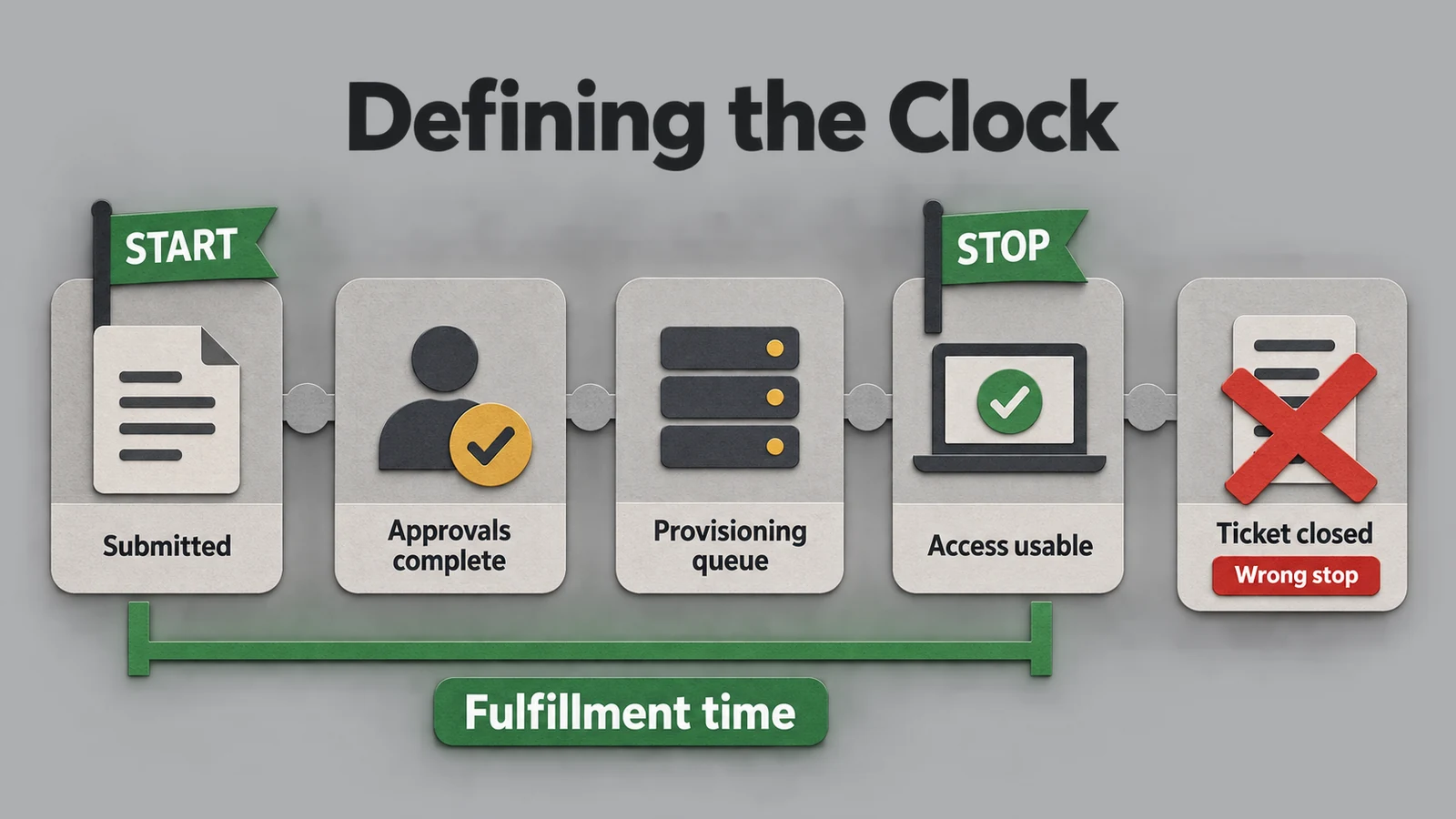 Start when the request is submitted, stop when the access is usable. Everything after that is queue hygiene, not fulfillment.
Between those two events, measure elapsed wall-clock time rather than worked effort. This is deliberate and sometimes unpopular, because elapsed time includes nights, weekends, and every hour during which nobody was touching the request. Teams argue that is unfair, and in a sense it is — but it is exactly what the requester experienced. Worked effort is useful for capacity planning; it is the wrong instrument for "how long did this take."
Why "ticket closed" is the wrong stop event
Ticket closure deserves its own treatment, because it is the single most common stop event in production and it is wrong in both directions at once.
Closure is an action taken by whoever manages the queue, governed by queue hygiene rather than by the state of the access. An administrator who has completed what they believe is the last step closes the ticket immediately — before downstream synchronization has propagated the entitlement to the application the requester uses. The measurement records a fast fulfillment while the requester is still locked out, and the error is invisible, because a closure timestamp looks as authoritative as any other in the dataset.
The opposite error is just as common and larger in magnitude. Tickets are routinely closed in bulk during backlog cleanups, long after the work was finished, because the queue is being tidied rather than worked. Every one of those requests carries administrative lag unrelated to how long access took. A team that starts enforcing closure discipline will watch its fulfillment time appear to improve sharply while nothing about delivery has changed — a reporting artifact that is hard to explain afterwards.
The deeper problem is one of category. A ticket is a record of work that a queue owns; an entitlement is a state in a target system. These are different objects with different lifecycles, and the closure of the first says almost nothing reliable about the arrival of the second. Any process in which the service desk fulfills requests by hand produces this mismatch structurally, which is one reason service-desk automation tends to improve both the delivery and its measurability at once — an automated path emits a real completion event rather than relying on a human to assert one.
If closure is the only timestamp available, say so when reporting the number. A caveated metric is usable; an uncaveated one with a known systematic error is a liability the first time someone audits the reporting.
Where the elapsed time actually goes
Once the clock is defined, the interval needs decomposing, because an undifferentiated duration supports no decision. The useful question is never "how long does fulfillment take" but "which segment owns most of it here."
Approver wait is the time a request sits in a queue before a human dispositions it. Its notable property is that it is almost entirely idle: the decision itself usually takes seconds, while the wait for someone to notice there is a decision to make can run far longer. Instrument the interval between routing and disposition, not the duration of the review.
Queue wait is the time between a request being approved and someone picking up the fulfillment work. It exists only where fulfillment is manual, and it is the segment most sensitive to staffing, shift patterns, and the fact that queues do not run overnight.
Manual provisioning is the hands-on work of creating the entitlement — logging into the target system, finding the right group, making the change. Where automated user provisioning covers a resource, this segment collapses toward the connector's execution time. Where it does not, it also carries error risk, and the resulting rework extends the interval further.
Hand-offs are the transitions between teams — service desk to identity administrator, identity administrator to application owner. Each adds a fresh queue wait on the receiving side and frequently involves re-keying the request into another system, which is both latency and a correctness risk.
Verification is the time between the grant and the confirmation that it works — often uninstrumented, and the segment most likely to be silently excluded from a measurement that stops at the grant.
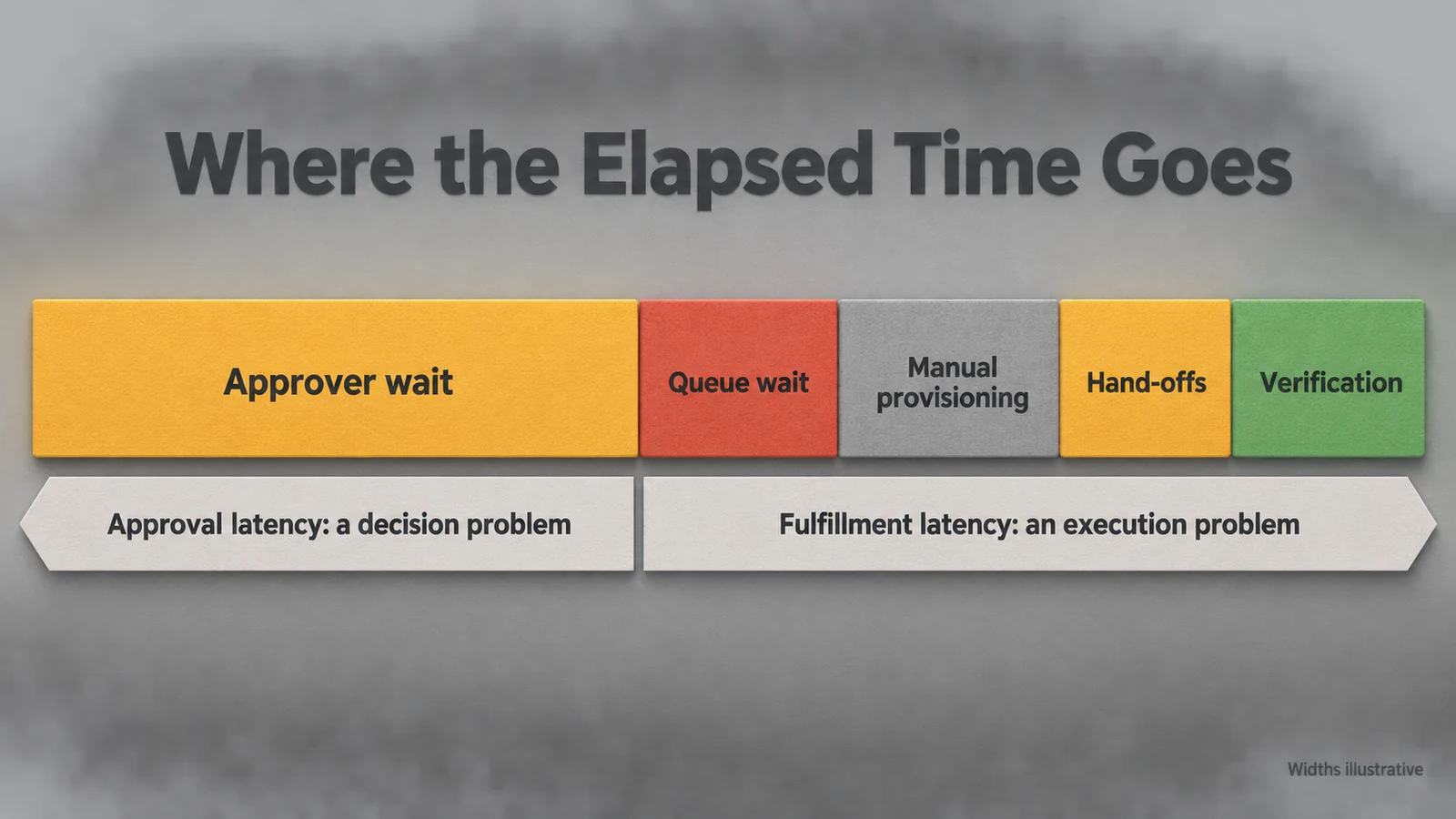 Attribute the interval before you try to shrink it. The segment that owns your elapsed time is rarely the one the team assumes.
The segment widths in that diagram are illustrative. Your distribution is an input you measure, not a shape you inherit, and it differs by resource type inside a single organization.
Approval latency and fulfillment latency are different problems
The decomposition above collapses into two groups, and keeping them separate is the highest-value move in this exercise.
Approval latency is a decision problem. The request waits on a human judgment, and the fixes are about getting the right human to decide sooner: routing to a role rather than a named individual so absence does not stall the queue, delegation that activates automatically, escalation after a defined interval, notification that reaches people where they work, and batching so an approver dispositions a reviewed set rather than context-switching repeatedly. None of these touch provisioning, and none remove the approval itself.
Fulfillment latency is an execution problem. The decision is made and the work is waiting to be done, so the fixes are about removing humans from the execution path: connectors that write the entitlement directly, eliminating the hand-off between the team that approves and the team that provisions, and closing the loop so completion is detected rather than reported. These are engineering investments with a very different cost and timeline from the approval fixes.
Blending the two into a single average hides which problem you actually have, and the practical consequence is misallocated investment. A program that reports one number and sees it is too high will usually reach for provisioning automation, because that is the visible, purchasable intervention. If the bulk of the interval was approver wait, that investment compresses a segment that was never the constraint and the headline barely moves. The reverse happens too: teams redesign approval routing when the real delay was an administrator hand-keying entitlements into six systems. Split the latency first, then decide where the money goes.
Measuring defensibly across a ticketing system and an IGA tool
In almost every real environment the start event lives in one system and the stop event in another, which makes fulfillment time a data-joining problem before it is a reporting problem. Four things make the join defensible.
Carry one correlation key. Stamp a single request identifier at intake and require it to travel into every downstream system the request touches. Without a shared key, events get joined by heuristics — requester plus resource plus an approximate time window — and heuristic joins fail precisely on the long-tail requests that matter most, because those are the ones that got re-keyed, split, merged, or reopened.
Assign authority per event. Decide explicitly which system is the source of truth for each timestamp, and do not let that drift. The intake system owns the start. The approval engine owns the decision timestamps. The provisioning layer owns completion, because it is the only component that knows whether the entitlement landed. Writing this down matters more than which choice you make, because the failure mode is two systems both claiming the same event and a report that silently prefers whichever one it queried first.
Normalize time properly. Record timezone explicitly on every event and convert to UTC before any arithmetic. Cross-system duration calculations are a known source of negative intervals and off-by-an-hour errors around daylight-saving transitions, and a metric that occasionally reports negative durations will be dismissed entirely — along with everything else on the dashboard.
Publish the unjoinable remainder. Some share of requests will not reconcile across systems at all. Report that share as a first-class figure rather than dropping those rows. It is the most honest indicator of how well the request path is wired together, and usually the finding that drives the most useful change. The same instinct underlies what an auditor actually wants from an access review: completeness of the evidence is what is under examination, not the attractiveness of the summary.
One more discipline: report distributions rather than averages. Fulfillment is long-tailed — many requests complete quickly on automated paths while a minority stall far longer — so the mean sits where very few real requests live. A median describes what a typical requester encounters; an upper percentile describes the worst-served, which is where the pressure toward ungoverned workarounds originates. Segment by resource sensitivity, intake channel, and automated versus manual path.
Which delays to engineer out, and which to leave alone
Here is where most writing on this subject goes wrong. The reflex is that all delay is waste and the goal is to drive the interval toward zero. Applied without discrimination, that reflex produces a faster pipeline and a weaker control environment — and an approval removed to improve a metric is a governance regression, whatever the dashboard says afterwards.
The sorting test: does the wait exist because a person is taking accountability for the grant, or because of how the work happens to be wired?
Waits that are controls doing their job include resource-owner authorization on sensitive data, segregation-of-duty evaluation before the grant, manager review that establishes business need, exception handling for out-of-policy requests, and in some environments a cooling period on highly privileged access. These are not latency. They are why the request system is defensible, and the time they consume buys something specific — a named person who can be asked, afterwards, why this access was granted.
Waits that produce no decision and no evidence include an approver who was never told a request was waiting, the same request re-keyed into a second system, a hand-off between the service desk and an identity administrator, an entitlement built by hand that a connector could create, and a queue that stops overnight. Removing any of these changes nothing about who authorized what. They are pure friction.
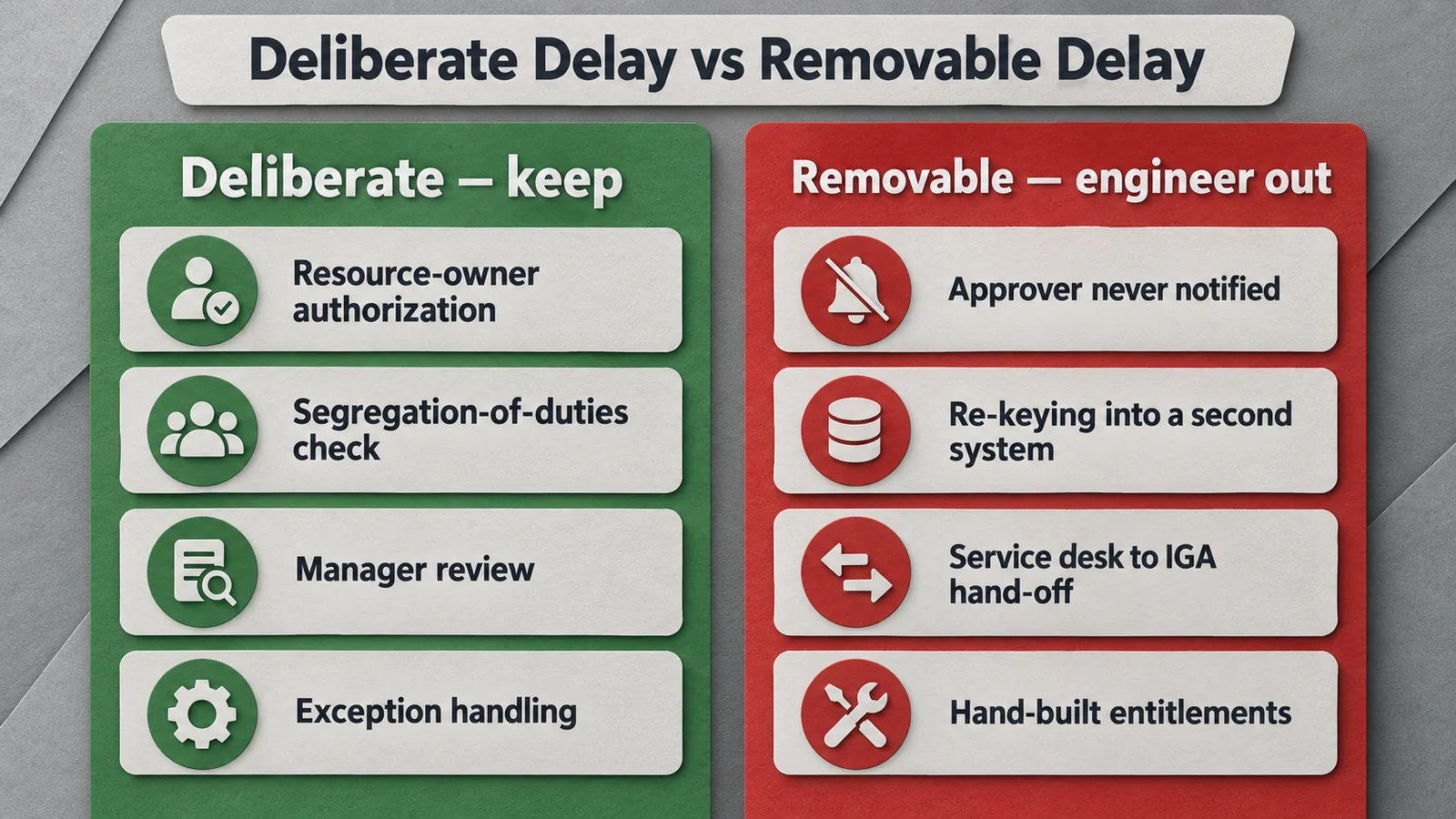 Sort every segment before automating it. The target is the waiting around the control, never the control itself.
The productive framing is that a deliberate control has an irreducible floor and a removable overhead. An approval needs the approver's attention for as long as the judgment takes — that is the floor. Everything around it, the waiting for them to notice and the re-keying afterwards, is overhead. Compress the overhead to near zero and the control costs what it should rather than what the plumbing makes it cost. That is the honest version of "faster access requests."
What Avatier ships toward this pattern
Avatier emits the events this measurement needs rather than requiring them to be reconstructed. Requests captured through the IT Store carry a single identifier from intake through approval, provisioning, and confirmation, so start and stop events join on a real key instead of a heuristic. Approval routing is policy-driven, with delegation and escalation so an absent approver does not become an open-ended wait, and self-service fulfillment executes approved grants automatically with no help-desk ticket in the path — collapsing the manual provisioning and hand-off segments rather than merely speeding them up. Because every grant is written back into the platform, the completion event reflects the entitlement actually landing rather than a queue status being changed, which is the stop event this post argues for.
Two details are worth drawing out for anyone instrumenting this. Each catalog item carries its own SLA alongside its risk, age, usage and request history, which means the expectation a measurement is judged against is attached to the item rather than held as a single organisation-wide target that fits nothing. And birthright access provisioned at the joiner and mover events keeps predictable access off the request path entirely — the one intervention that reduces elapsed time by removing requests rather than accelerating them. The platform is described at Identity Anywhere, the product home is Credential Governance, and the company site is avatier.com.
The compliance posture behind the platform is published on the Avatier Trust Center: SOC 2 Type II with zero exceptions, ISO/IEC 27001:2022 certified, PCI DSS v4.0.1 compliant, CSA STAR Level 1, NIST 800-53 Rev. 5 aligned, FedRAMP-aligned controls, CISA Secure-by-Design Pledge signatory, and FIDO2-compatible authentication.
The honest closing
Measuring fulfillment time well is worth doing, and it is worth being clear about what it does not accomplish.
It does not tell you whether the access should have been granted. A fast fulfillment and a slow one are indistinguishable on this metric if both granted access nobody should have approved. Fulfillment time measures the pipeline's responsiveness, not its judgment, and judgment is assessed through approval quality and periodic review — which is why this metric belongs alongside a broader access governance posture rather than standing in for one.
It does not make the number comparable across organizations. Fulfillment time is so sensitive to clock definition, intake-channel coverage, resource mix, and automation footprint that two organizations with identical processes can report numbers differing by an order of magnitude purely through measurement choices. Treat it as an internal trend against your own prior measurement, under a definition you wrote down and have not quietly changed.
And it does not, by itself, make anything faster. A measured interval creates the conditions for improvement — it tells you which segment to attack and whether an intervention worked — but it is diagnostic, not therapeutic. The common failure is a program that stands up a dashboard, reports the metric monthly for a year, and never acts on the attribution, because the number arrived without an owner for its segments.
What it does deliver, done honestly, is an end to the argument. Instead of a service desk insisting that access is granted promptly and a business unit insisting that it takes forever, there is an interval, a decomposition, and a specific segment that owns most of it. The conversation moves from whose impression is right to which wait to work on next — and whether that particular wait was ever the kind worth removing.
ABOUT THE AUTHOR

More from Access Management

OAuth vs MCP for Enterprise Access: Where Avatier Governs the Gap
OAuth and MCP aren't rivals. MCP connects AI assistants to tools, and its authorization builds on OAuth 2.1. What each one answers, what scopes miss, and how Avatier governs each action.

Least-Privilege Access for AI Agents: Scoping MCP Tools with Avatier
Least privilege for AI agents means task-scoped, time-bound access capped at the user's own authority. A five-step how-to for scoping MCP tools, and where the MCP spec helps.

Access Request Portal Adoption: The 2026 Storefront Playbook
A correctly built access request portal still goes unused when the storefront layer is missing — this is the 2026 playbook for browse, search, bundled checkout, status transparency, and re-request.