Active Directory Group Cleanup: The 2026 Remediation Program
You already know the groups have sprawled. This is the remediation program that reverses it: discovery, ownership assignment, consolidation order, and deletion with a rollback window.

You already know the groups have sprawled. This is the remediation program that reverses it: discovery, ownership assignment, consolidation order, and deletion with a rollback window.
- Group sprawl is already a well-diagnosed condition, and this post does not re-diagnose it; it is about the remediation program that follows the diagnosis, which is a different and considerably harder discipline than running a report.
- The discovery pass is not a directory dump. It inventories each group's membership, nesting, declared owner, last membership change, the resources it actually grants, and its last authenticated use, then classifies every group as keep, merge, or retire with no residual 'unknown' bucket.
- Ownership is assigned before anything is deleted, through an escalating sequence — declared owner, resource owner, dominant cost-centre manager, then a named human asked to accept or decline in writing — and groups nobody will claim are quarantined, not immediately removed.
- Consolidation order matters more than consolidation volume: merge duplicates of identical membership and identical grants first, then near-duplicates, and leave nested and privileged groups until last, because the merges that teach you the least are the ones that break the least.
- Deletion is a staged sequence with a rollback window — empty the group, deny-stage its grants, disable and park the object, hold it, export the state, and only then delete — because deleting the object destroys the SID and orphans every access control entry that referenced it.
An Active Directory group cleanup program is the structured remediation that follows the diagnosis of group sprawl: a discovery pass that classifies every group, an ownership assignment process that puts a named human behind each one, a consolidation sequence that merges duplicates in a deliberate order, and a staged deletion with a rollback window so that mistakes surface while they are still reversible. It is not a script, and it is not a weekend. If you are here because you already know your group estate has grown past the point of explanation, this is the part that comes next.
The diagnosis is covered elsewhere, and this post deliberately does not repeat it: the mechanics of how a group estate gets into this state are laid out in the access control entry technical deep dive. Read that first if you still need convincing the problem is real. This post assumes you are past that point and are looking at an estate you have to actually reduce, with production systems attached to it and people whose jobs depend on the access those groups carry.
That assumption changes the advice. A remediation program has to survive contact with an estate where a group named for a department that no longer exists is still the only thing granting access to the payroll share, and where the first thing that breaks will be blamed on you. Every stage below is designed so that being wrong stays cheap and recoverable for as long as possible, and so the one irreversible step happens last, on purpose, with a window in front of it.
What a remediation program has to produce
Before any of the mechanics, it is worth being precise about the deliverable, because "clean up the groups" is not a goal anybody can finish. A group cleanup program produces three things, and the program is done when all three exist and stay true.
The first is a complete classification. Every group in scope carries a decision — keep, merge, or retire — with the evidence behind it and the date it was made. Not most groups. Every group. The most common way these programs stall is an unexamined residue nobody could classify, which quietly becomes the new baseline and makes the next pass start from the same place.
The second is named accountability. Every group that survives has a human attached to it who has acknowledged, in some durable form, that they are answerable for who belongs to it. This is the deliverable that makes the next cleanup unnecessary, because an owned group gets maintained and an unowned group only accumulates.
The third is a reduced, intentional estate. Fewer groups, shallower nesting, and no group whose purpose cannot be stated in a sentence. The number matters less than the property: you should be able to pick any surviving group at random and get a straight answer about what it is for and who decides who is in it.
Note what is not on that list. The program does not promise correct access. It promises governable access — an estate small enough and attributed clearly enough that correctness becomes a question somebody can actually answer. That distinction matters later, when we get to what this program does not solve.
The discovery pass: inventory before judgement
Discovery is where most programs are won or lost, and the failure mode is subtle: teams run a query, get a list, and mistake the list for the inventory. A list of names tells you nothing about whether a group matters. The pass has to collect enough per group that a classification is defensible without returning to the directory a second time.
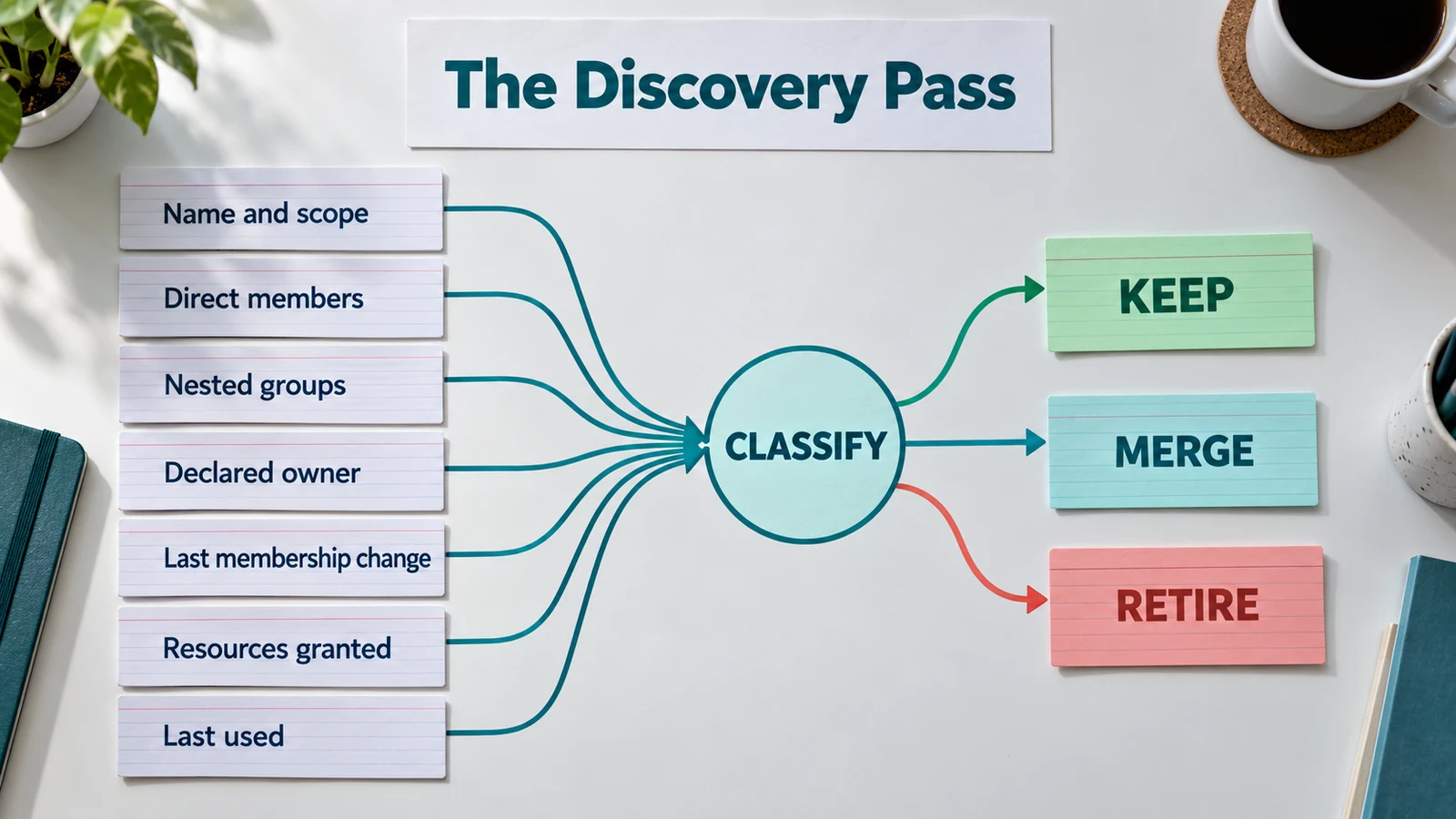 Seven facts per group, one decision per group, three possible answers — and no fourth bucket for the ones that are hard.
Seven attributes carry most of the decision weight. Name, type, and scope establish what the object even is — a security group that grants access is a different problem from a distribution list that only routes mail, though the latter is frequently nested inside the former with consequences nobody intended. The full direct member list gives you the population. Nested parents and children give you the inheritance, and this is the expensive one to collect properly, because it has to be walked transitively in both directions. The declared owner is whatever managedBy or equivalent attribute holds, which in most estates is empty for a large share of groups and populated with a departed employee for a meaningful share of the rest.
The remaining three are the ones that get skipped and shouldn't. Last membership change distinguishes a group that is actively curated from one that has been inert for years. The resources the group actually grants is the hardest attribute to assemble, because it means reading permissions from the resource side rather than the directory side, but it is the only thing that tells you what breaks if the group disappears. And last authenticated use — whether anybody has actually exercised the access this group confers within a meaningful window — is the single most useful signal for retirement, because it converts an argument about whether a group is needed into an observation about whether it is used. If your directory tooling cannot produce it directly, the underlying mechanics of querying directory state for this kind of attribute are covered in the LDAP implementation reference.
With those seven facts, every group gets exactly one of three classifications. Keep means it has a named owner, live authenticated use, and a purpose no other group serves. Merge means its membership and granted resources overlap another group so heavily that maintaining both is redundant. Retire means nobody will claim it, it has no members left, or it has gone a full business cycle with no authenticated use. A full business cycle rather than ninety days, because annual processes exist and the group that only matters at year-end close is exactly the group a ninety-day window will wrongly condemn.
Assigning ownership to ownerless groups
Ownership assignment is the stage that converts a cleanup into a program, and it has to happen before deletion rather than after. The reason is practical: an owner is the cheapest possible source of truth about whether a group matters, and asking them costs far less than discovering the answer by removing the group and waiting for the complaint.
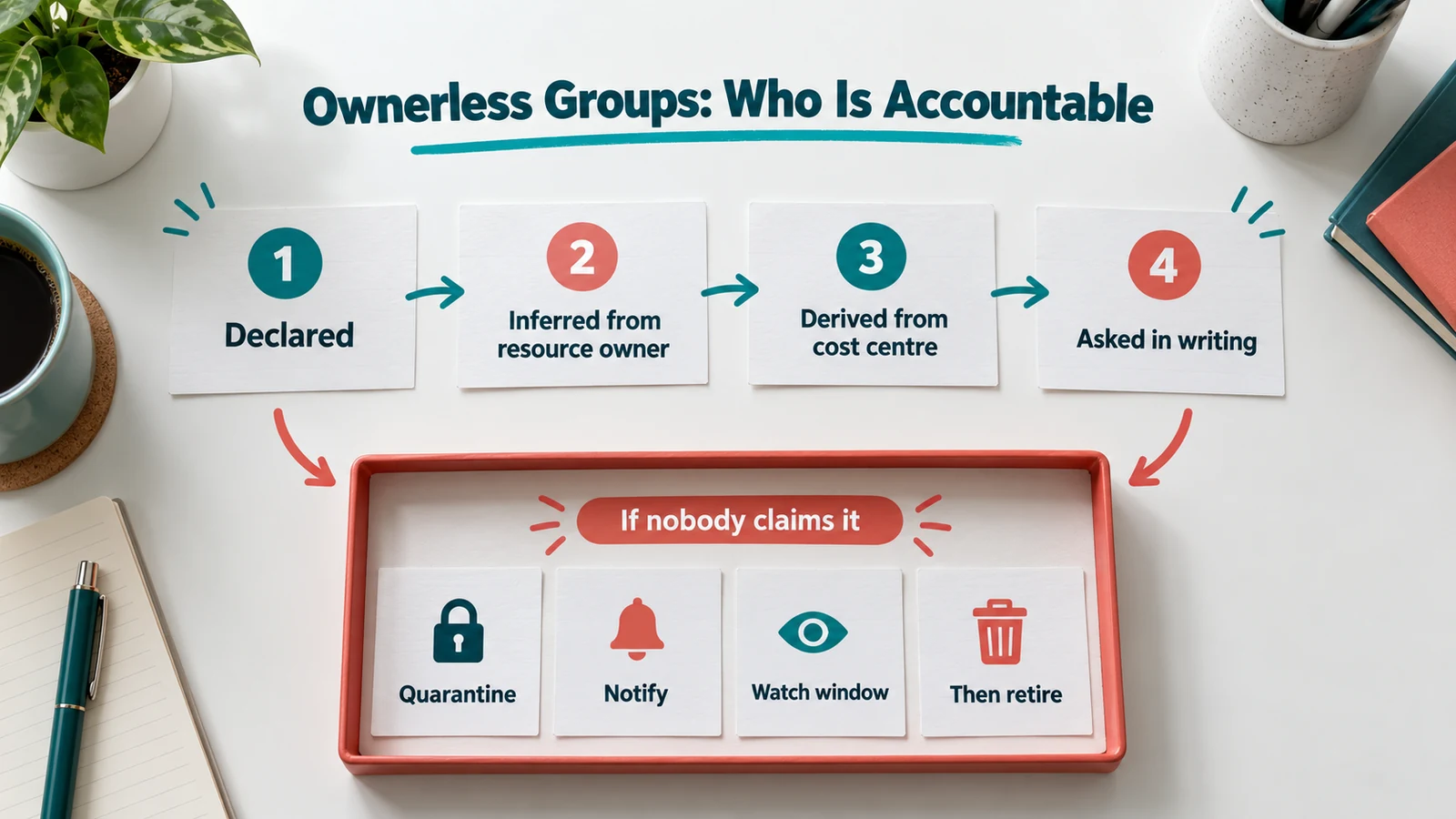 Four escalating claims, then quarantine — because an unclaimed group should be frozen and watched, never deleted on a hunch.
The four claims run in order, and you stop at the first that answers. Declared ownership is whatever is already recorded, provided it resolves to an active person; a managedBy pointing at a disabled account is not an owner. Inferred ownership comes from the resource side — whoever owns the share, application, or mailbox the group grants has a real stake in its membership, and this claim tends to resolve much of the ownerless population, because resources have clearer custodians than directory objects do. Derived ownership comes from the membership itself: where most of a group's members report into one cost centre, that manager is a defensible candidate. Asked is the fallback — put the name in front of a human and require an explicit accept or decline.
Design the asking step so that declining is easy and silence is not. A decline is a genuinely useful answer — it tells you the candidate you derived was wrong, and it moves the group along. Silence tells you nothing, which is why a process that treats non-response as acceptance produces a register full of people who do not know they own anything. The write-up on what an auditor actually wants from an access review makes the same point about certification campaigns, and the failure mode is identical: a rubber-stamped attestation is worse than no attestation, because it manufactures false assurance.
For the groups that survive all four claims unclaimed, the answer is quarantine rather than deletion. Freeze the membership — no additions, no new nesting, no new resource grants — while leaving the group functionally intact. Notify the current members and the owners of the resources it grants that the group is unclaimed and frozen. Then hold it through one full business cycle. Quarantine works because it is load-bearing without being destructive: the freeze is visible enough that genuine use surfaces an owner, and harmless enough that being wrong costs nothing. A group that passes the entire window in silence has told you what it is, and the silence becomes the recorded justification for retirement.
Consolidation order: what to merge first and why
Consolidation is where the estate actually shrinks, and the ordering principle is counterintuitive: merge the boring duplicates first, even though they teach you the least, precisely because they break the least.
The first tier is identical duplicates — two or more groups with the same membership granting the same resources. These exist in essentially every estate for the same mundane reason: somebody needed a group, searching for an existing one was harder than creating a new one, and so a second group was born. Merging these is close to a no-op in access terms, it produces immediate visible reduction, and it gives the program a track record of landing changes without incident before it touches anything that matters.
The second tier is near-duplicates, where membership and grants overlap heavily but not completely. These require real decisions, because the differences have to be reconciled: do the three people in group A but not group B genuinely need the extra resource, or are they the residue of a project? This is where consolidation starts producing access changes rather than just object-count reductions, and it is where you want the batch sizes small and the owners engaged.
The third tier is nested groups, and these come late for a structural reason. Collapsing a group that is nested inside others changes the effective access of every parent above it, which means the blast radius of a mistake is not the group you touched but everything that inherits from it. Walk the nesting before you collapse any of it, and do not treat the removal of nesting as a goal in itself — a shallow, deliberate hierarchy is a perfectly good design, and the thing worth removing is nesting nobody chose rather than nesting as a concept.
The fourth tier is privileged groups, last for the obvious reason: being wrong there is most expensive and most visible. By the time the program reaches them it should have a demonstrated restore path, a service desk that recognises the work, and criteria calibrated against hundreds of lower-stakes decisions.
One principle cuts across all four tiers: merge toward the group with the clearer owner, not toward the one with more members or the older creation date. The surviving object inherits the governance, and governance is the thing the program is actually trying to produce.
Deletion with a rollback window
Deletion is the only stage of this program with a genuinely irreversible step in it, and the whole design of the sequence exists to push that step as late as possible and put a deliberate pause in front of it.
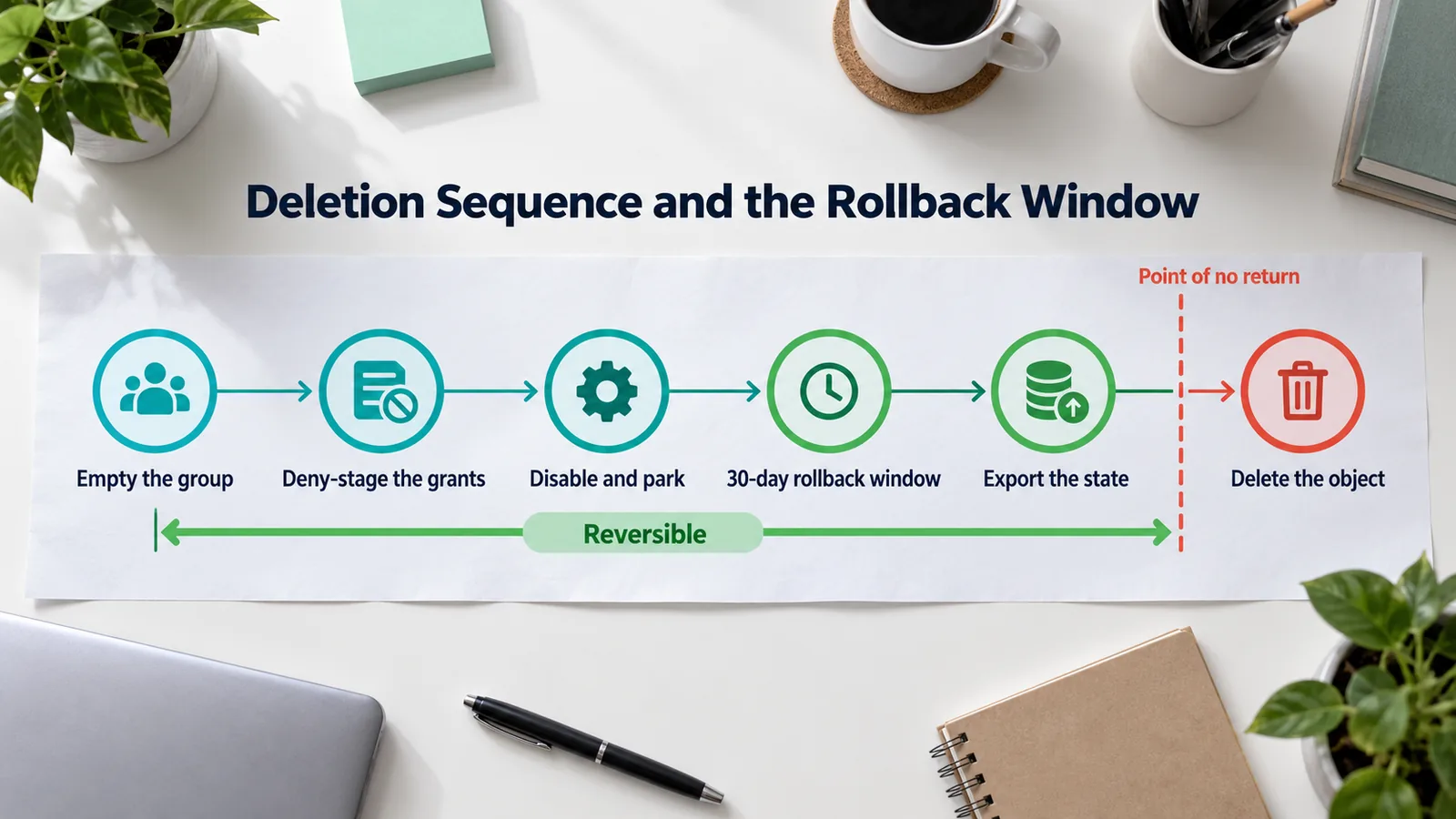 Five reversible stages, one irreversible one — and a thirty-day window that exists so breakage arrives while it is still cheap.
Empty the group first, leaving its access control entries untouched. This is the stage that does almost all the useful work, because it produces exactly the breakage signal you want: if someone needed this access, they lose it now, in a form that is restored by putting the membership back. Nothing on any resource has changed. The permission still exists, it simply has no one in it.
Deny-stage the grants next. The group is kept, but the access it confers is neutralised at the resource — either by removing the entries or by overriding them. This is the step where the resource side is tested, and keeping the group object around means you can reverse it by restoring the entries rather than by rebuilding anything.
Disable and park. Rename the group with a consistent prefix that marks it as pending deletion, and move it to a dedicated holding organisational unit. It is now visibly inert, obviously part of the program, and trivially findable by anyone investigating a problem.
Hold. The rollback window is a fixed, published duration during which nothing further happens. Thirty days is a defensible default because it spans a monthly cycle, though an estate with heavy quarterly processes has a reasonable argument for ninety. The number matters less than the fact that it is fixed in advance and the same for every batch, because a window that gets shortened under schedule pressure is not a control.
Export the state before the final step. Membership, the security identifier, and every access control entry reference that pointed at it, written somewhere durable. This is the only artefact that survives deletion, and it is what lets you answer "what was in that group?" eighteen months later when an auditor asks.
Then delete the object — and understand precisely what that destroys. The security identifier is gone. Every access control entry on every resource that referenced it now points at nothing and renders as a raw unresolved string. Those orphaned entries clutter every subsequent review and quietly degrade the legibility of the permissions they sit beside. This is why the export matters and why the step goes last.
Avoiding breakage on the way through
Three operational habits separate programs that land from programs that get suspended after an incident.
Work in small, reviewed batches with a named owner per batch. Batch size is a risk dial, and it should start small enough that a bad batch is embarrassing rather than catastrophic. Accelerating once the first few land cleanly is the most reliable way to produce the incident that stops the program.
Tell the service desk what is landing and when. This is the cheapest insurance in the entire program. A desk that knows a batch went out on Tuesday will recognise Tuesday's unusual access tickets as program signal and route them straight back; a desk that does not know will treat the same tickets as unrelated mysteries and burn days. Publishing the batch schedule and the restore path turns the desk from a casualty into an instrument.
Track restorations honestly, and treat the rate as a quality metric. A batch where several groups had to be restored does not mean the rollback window worked. It means the classification was wrong, and the right response is to recalibrate the criteria rather than to congratulate the safety net. A program with a restore rate that is not falling over time is not learning.
Finally, understand which lifecycle events will keep feeding the estate while you clean it. Group membership that is granted at joining and never removed at leaving or moving is the engine that rebuilt the sprawl in the first place, which is why wiring membership to lifecycle events — the pattern described in automated deprovisioning and offboarding — belongs in the program rather than after it. For the categories of access where membership is genuinely a proxy for an attribute somebody already maintains, an attribute-based access control model can retire the group rather than merely tidying it, which is the only form of reduction that stays reduced.
What Avatier ships toward this pattern
The honest framing first: no platform runs this program for you. The classification decisions are judgement calls about your business, and the ownership conversations are conversations. What a governance layer does is remove the parts that are purely mechanical and make the parts that are not mechanical defensible.
On the Avatier platform, group membership changes route through request and approval workflow with a full audit trail, which means the consolidation and deletion stages produce a record of who decided what and when rather than a diff nobody can explain later. Access certification puts the expanded, human-readable form of current membership in front of the owner the program assigned, on a cycle, which is what keeps the ownership register from decaying back to the state that made this program necessary. Lifecycle automation removes memberships at role change and termination, closing the input valve while the cleanup is draining the tank.
Two capabilities matter specifically for the after-state. Group Enforcer replaces the hand-maintained memberships you just consolidated with rules over HR and directory attributes, and its alerting continuously monitors group integrity for orphan accounts and unauthorized members — so the drift that refills a cleaned estate surfaces as an exception rather than as next year's discovery pass. Self-service group creation is governed by a redundancy blocker that prevents new groups with similar names and members from being created at all, alongside enforced naming conventions. That matters because a cleanup program's real failure mode is not the deletion stage; it is the business creating the same duplicates again six months later through a request path nobody constrained. The broader architecture these pieces sit inside is described across the six pillars and on the Credential Governance product home, with the platform-level view at Identity Anywhere.
The compliance posture behind the platform is published at the Avatier Trust Center: SOC 2 Type II audited with zero exceptions noted, ISO/IEC 27001:2022 certified, PCI DSS v4.0.1 compliant, CSA STAR Level 1 attestation, NIST 800-53 Rev. 5 aligned, FedRAMP-aligned, and a CISA Secure-by-Design Pledge signatory.
What a cleanup program does not solve
Close with the limits, because they are real and because overstating what this work achieves is how the next program gets defunded.
A cleanup program does not make your access correct. It makes it governable. A group with a named owner, a clear purpose, and live use can still contain exactly the wrong twelve people, and nothing in the discovery pass will tell you so — only a review by someone who understands the business will. The program shrinks the estate to a size where that review is possible; it does not perform it.
It does not stop sprawl from returning. Cleanup is subtraction, and sprawl is addition, and subtraction alone loses to a creation process that asks for nothing. If groups can still be created without a named owner, a stated purpose, and a review date, the estate will rebuild — more slowly, because the duplicates are gone and searching is easier, but it will rebuild. The controls that matter most are at creation time, and they are not part of the cleanup.
It does nothing about how the access is used once granted. A perfectly consolidated, fully owned group grants an attacker exactly what it grants the person whose credentials they took. Group hygiene is a blast-radius control, not a prevention control, and the front door remains the front door.
And it does not resolve whether a grant should exist. That judgement lives one layer up, in role design, certification, and policy. What the program delivers is an estate where those questions have a small enough surface to be asked seriously — which, after the sprawl, is further than it sounds.

More from Access Management

Access Request Portal Adoption: The 2026 Storefront Playbook
A correctly built access request portal still goes unused when the storefront layer is missing — this is the 2026 playbook for browse, search, bundled checkout, status transparency, and re-request.

Access Request Fulfillment Time: How to Measure It in 2026
Fulfillment time is the elapsed interval between a user asking for access and that access actually working — and most organizations measure it wrong, because they stop the clock when the ticket closes. This is the 2026 method for defining the clock, attributing the wait, and deciding which delays are worth engineering out.
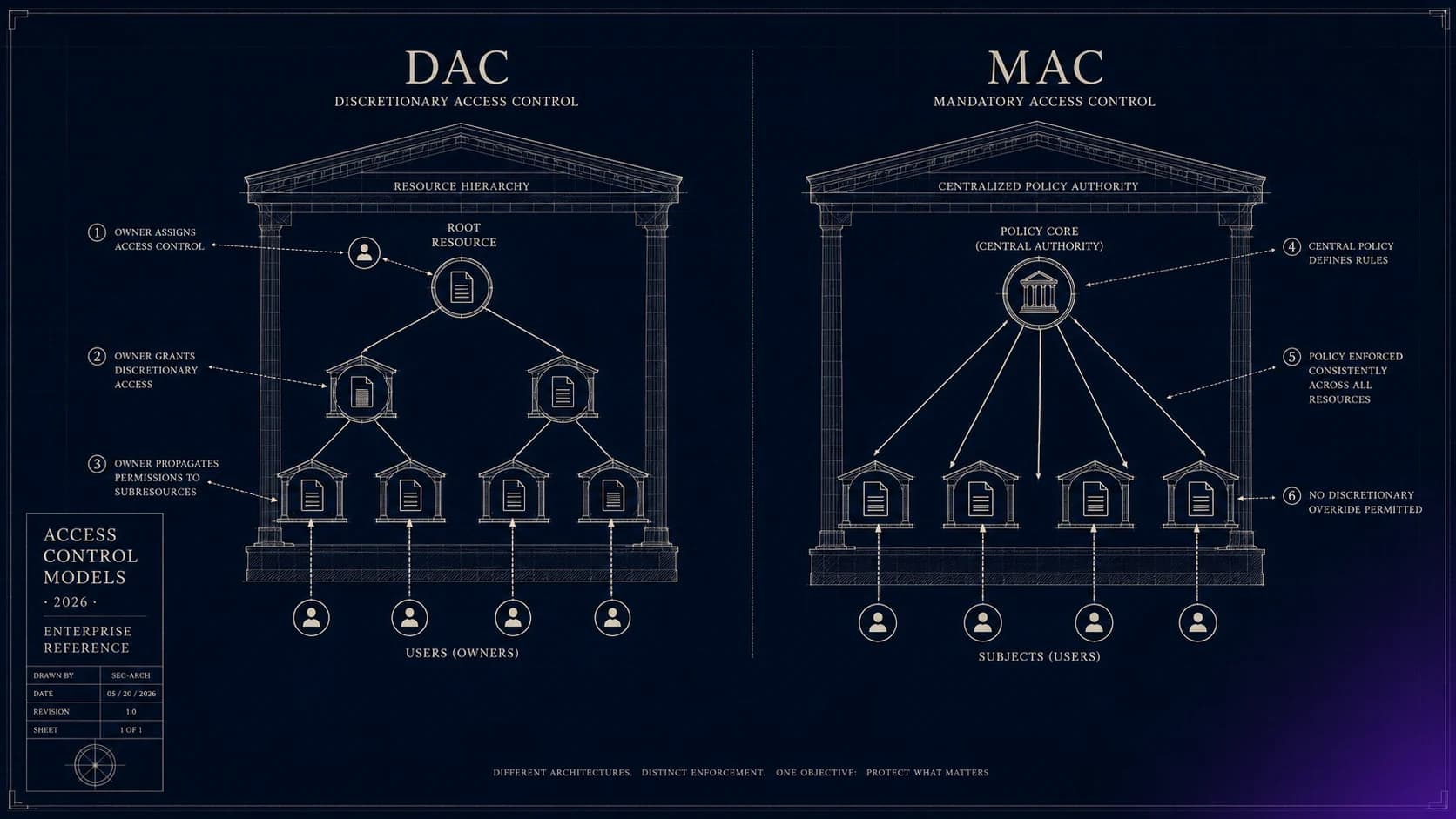
Mandatory vs Discretionary Access Control: The 2026 Enterprise Architecture Guide
Mandatory Access Control and Discretionary Access Control are the two foundational access-control models that frame every enterprise IGA decision. The 2026 reference on what each model actually enforces, where RBAC and ABAC fit, how mainframe RACF and ACF2 implement both, and the architecture that composes them cleanly.