Bank MFA Rules and Help-Desk Resets: Identity Governance with Avatier
NYDFS requires MFA for any individual on any information system, and the FFIEC flags help-desk resets. What banks and insurers owe examiners, and the Avatier controls behind it.

NYDFS requires MFA for any individual on any information system, and the FFIEC flags help-desk resets. What banks and insurers owe examiners, and the Avatier controls behind it.
- NYDFS 23 NYCRR 500.12, and the FTC Safeguards Rule for non-bank financial institutions, require MFA for any individual accessing any information system, unless equivalent controls are approved in writing.
- NYDFS's expanded MFA scope took effect on November 1, 2025, regardless of location or type of user.
- The FFIEC's 2021 authentication guidance names the call center and IT help desk as a path for social-engineered credential resets.
- Avatier Strong MFA Login binds MFA to interactive, network and service-account password events, and Assisted Reset sends every help-desk challenge to the user.
- Avatier Access Governance and IT Shopping Cart record approvals and reviews, helping support the access evidence examiners ask for.
For a bank or insurer, identity governance starts with MFA rules: New York's NYDFS Part 500 requires multi-factor authentication for any individual accessing any information system, as the FTC Safeguards Rule does for non-bank lenders, and the FFIEC's 2021 authentication guidance names the call center and IT help desk as a credential-reset risk. The work: MFA past single sign-on, verified help-desk resets, and access-review evidence an examiner can follow.
This goes one level deeper than the financial-services section of Industries That Need Identity Management Most in 2026. For SOX §404 and IT general controls, see what auditors want to see in IAM for SOX.
What NYDFS, the FTC and FFIEC ask of MFA
FTC Safeguards Rule. The rule under the Gramm-Leach-Bliley Act applies to non-bank financial institutions under FTC jurisdiction. Section 314.4(c)(5) requires them to "implement multi-factor authentication for any individual accessing any information system," unless the Qualified Individual approves in writing "reasonably equivalent or more secure access controls."
NYDFS 23 NYCRR 500.12. New York uses nearly the same words. DFS's July 2025 MFA guidance explains the phase-in: covered entities already had to use MFA for access to internal networks from an external network, and "Starting on November 1, 2025, Covered Entities will be required to use MFA for any individual accessing any of its information systems, regardless of location, type of user, and type of electronic information contained on the information system being accessed." A CISO can approve compensating controls in writing, reviewed at least annually.
The same DFS guidance grades methods. It calls SMS codes "generally considered a weaker authentication method" because of SIM-swapping and interception, and says app push without number matching is "vulnerable to push fatigue attacks."
FFIEC. Authentication and Access to Financial Institution Services and Systems (2021) replaced the FFIEC's 2005 internet-banking authentication guidance and its 2011 supplement. It covers customers, employees and third parties, and says single-factor authentication as the only control "has shown to be inadequate." Where a risk assessment finds single-factor authentication with layered security inadequate, it points to "MFA or controls of equivalent strength."
| Source | Who it reaches | What it asks of identity |
|---|---|---|
| FTC Safeguards Rule, 16 CFR 314.4(c)(5) | Non-bank financial institutions under FTC jurisdiction | MFA for any individual accessing any information system, or approved equivalent controls |
| NYDFS 23 NYCRR 500.12 | DFS-covered entities without a limited exemption | MFA for any individual accessing any information system from November 1, 2025 |
| FFIEC guidance (2021) | Financial institutions, through FFIEC members | Risk-based MFA or equivalent controls, plus enhanced authentication for credential resets |
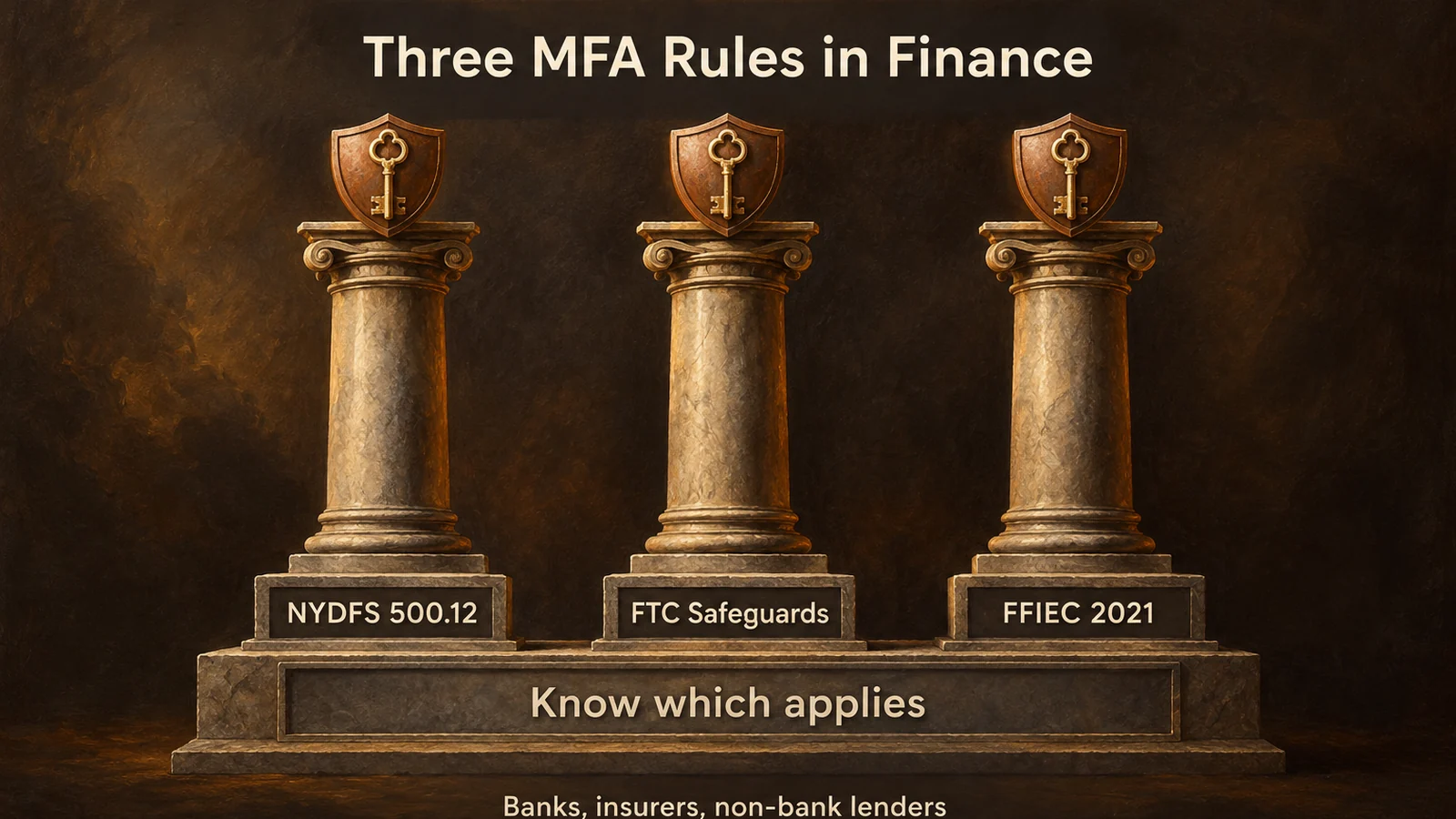 Two rules require MFA for any individual on any information system; the FFIEC adds risk-based MFA and enhanced checks on credential resets.
MFA for every login, not only the ones behind SSO
On a plain reading, "any individual accessing any information system" reaches past the apps behind an identity provider, to Windows logins, servers and older systems that check a directory password directly. The FFIEC guidance also asks institutions to identify high-risk users, weighing "privileged users," remote access to information systems and key positions such as senior management.
Avatier Strong MFA Login is built for that layer. It binds a strong second factor "to every password authentication event — interactive, network, or service-account," and the directory "issues no ticket until both the password and the second factor verify." Factors include Microsoft Authenticator, Okta Verify, Duo, RSA and the Avatier Identity Challenge Card™, and it supports RDP, Citrix, and shared workstations and servers.
Against the weaknesses DFS names, Strong MFA Login applies policy-driven method strength to "counter push-fatigue, SIM-swap, and AiTM phishing," including the Identity Challenge Card, a deviceless factor with "no push prompt for an attacker to talk a user into approving."
For desks that should stop typing passwords, Hybrid Passwordless works on shared workstations, VDI and Citrix "with no TPM or hardware lock-in," while Password Firewall keeps the directory passwords underneath governed. NYDFS 500.7(c)(2) also asks Class A companies for "an automated method of blocking commonly used passwords." For Active Directory, Password Firewall helps support this: it installs on every domain controller and checks each password change against enterprise policy, NIST Common Passwords and Have I Been Pwned before the change is accepted.
The help desk is an authentication path
Section 8 of the FFIEC guidance is about the call center and IT help desk: "Threat actors frequently have used social engineering and other techniques to deceive customer call center and IT help desk representatives into resetting passwords and other credentials." Its appendix lists enhanced authentication for credential resets, such as "sending an OTP to a pre-established communication device" or "using an authenticator application," and training staff "on verification and authentication processes for password resets."
As general guidance, what matters is where the proof goes. If the caller reads a code back to the agent, the agent is still judging a voice. If the challenge goes to the real user's enrolled device, someone impersonating a teller or a wire-room manager has nothing to approve.
Avatier Assisted Reset routes MFA to the user, not the agent: "Every challenge goes to the user — the agent only sees pass or fail." It uses existing MFA methods, such as Microsoft Authenticator, Okta Verify, Duo and Google Authenticator, before an agent completes a reset, unlock or enrollment action. It can apply stricter policies for "higher-risk users, privileged accounts, or sensitive groups," which lines up with the FFIEC's high-risk users.
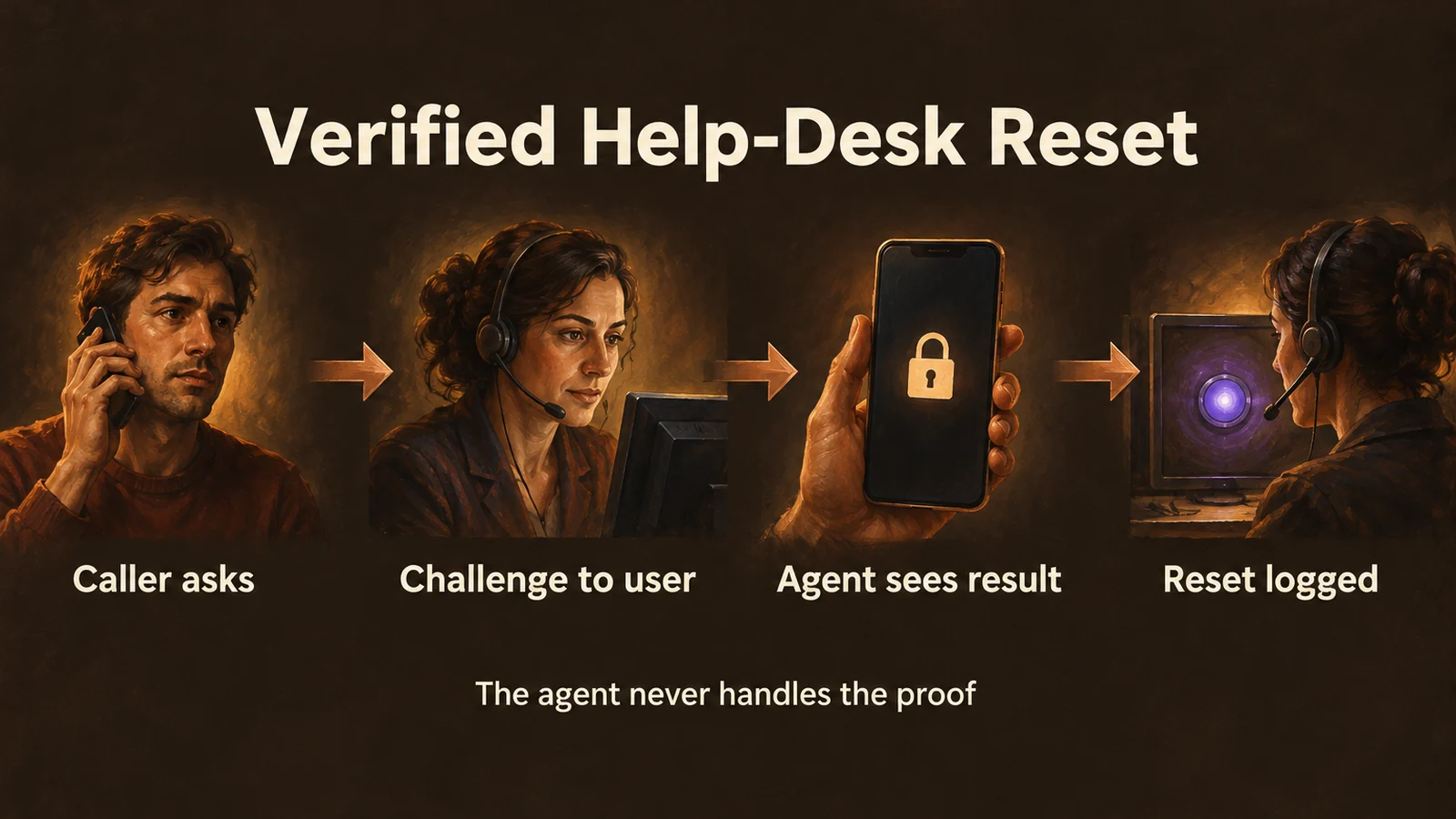 In Assisted Reset, the challenge goes to the user's own MFA method, and the agent sees only pass or fail before acting.
Help-desk access can be delegated "by group, region, OU, or support function," and security teams get a record of "who requested help, how verification was handled, what changed, and what was logged." Users who can recover on their own use Login Reset, which requires MFA before any reset at the Windows and Mac login screen and "supports all leading MFA and FIDO2." For the full playbook, see Help Desk Social Engineering Defense with Avatier Assisted Reset.
Access reviews and the evidence examiners ask for
NYDFS 500.7 asks covered entities to "periodically, but at a minimum annually, review all user access privileges and remove or disable accounts and access that are no longer necessary," and to "promptly terminate access following departures." The Safeguards Rule asks for access limited to the customer information users "need to perform their duties and functions," and for controls that "monitor and log the activity of authorized users."
As general guidance, an examiner wants each access decision with its requester, approver, date and review, not a policy document.
Avatier Access Governance captures a snapshot of "who has access to what," routes attestation to reviewers who "approve or revoke in a click," and uses delta certification, so "each cycle reviews only what changed." Reviewers certify from Teams, Slack, ServiceNow and Outlook. Its Compliance Manager "flags risk, tracks status, supports multi-level approvals, and captures evidence," and between campaigns, patent-pending Continuous Governance™ detects orphaned accounts.
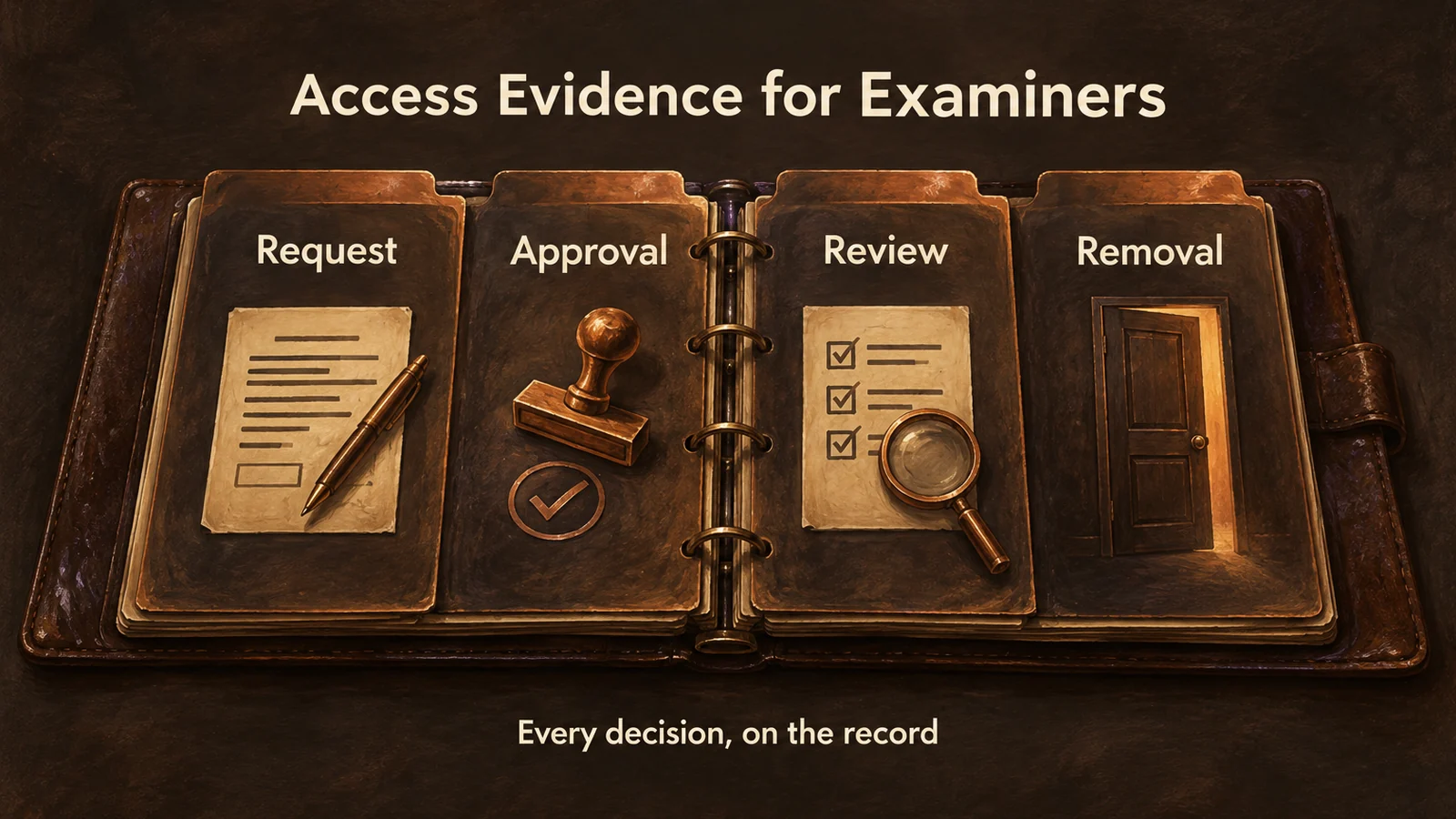 The evidence trail runs from request and approval through periodic review to removal when access is no longer needed.
Requests start in IT Shopping Cart, where "Access is granted only after approval, and every decision is logged." When HR marks someone terminated, HR User Provisioning disables their accounts and revokes access. Requests made through an AI assistant with the Avatier MCP Server follow the same verification, policy and approvals as the console, and "Requests land in Request History, ready to review and export." For role design and separation of duties, see Role-Based Access Control (RBAC): The 2026 Enterprise Guide.
What Avatier ships for bank identity teams
For the full framework, see Credential Governance™. These controls come from its six pillars, the Lifecycle & Access Governance pillars and the Avatier MCP Server:
- MFA past the IdP: Strong MFA Login on interactive, network and service-account password events.
- Password policy at the source: Password Firewall checks every password change before it is accepted.
- Verified help-desk resets: Assisted Reset sends every challenge to the user; the agent sees pass or fail.
- Recovery and passwordless: Login Reset with MFA and FIDO2, and Hybrid Passwordless on shared desktops.
- Reviewable access: Access Governance certifications and IT Shopping Cart approvals, each logged.
- Assistant requests on the record: MCP Server requests land in Request History.
For frameworks, Avatier helps support SOX and NIST evidence needs. Security documentation is on the Avatier Trust Center: SOC 2 Type II audited with no exceptions noted, ISO/IEC 27001:2022 certified, and PCI DSS v4.0.1 compliant.
Under Pay Per Identity Action™, each completed, verified action is one Secure Outcome, and attempts, failures and retries are never billed. Getting started is free, deployment services are included, and a 45-day money-back guarantee applies; full terms are in the invitation-only preview. For the preview, see the Avatier Identity Anywhere 2027™ site; for the company, see avatier.com.
ABOUT THE AUTHOR

More from Identity by Industry

Leave of Absence and Rehire: Suspend and Restore Access with Avatier
What to do with an employee's accounts during a leave of absence, and how to rehire someone without bringing back their old access. The decisions, and how Avatier runs both from HR.

Run an IAM Pilot Side by Side with Avatier Before You Switch
An IAM proof of concept should test real identity work against the tool you already run. How to scope a side-by-side pilot with Avatier, what to measure, and how to compare the results and the bill.

What Can You Ask Avatier MCP? Identity Actions by Category
Avatier MCP Server gives your AI assistant 37 of 56 Identity Actions: unlock, reset a forgotten password, request access, rehire, disable an account, add group members. Each category, with example asks.