Run an IAM Pilot Side by Side with Avatier Before You Switch
An IAM proof of concept should test real identity work against the tool you already run. How to scope a side-by-side pilot with Avatier, what to measure, and how to compare the results and the bill.

An IAM proof of concept should test real identity work against the tool you already run. How to scope a side-by-side pilot with Avatier, what to measure, and how to compare the results and the bill.
- An IAM proof of concept is a time-boxed test of a candidate identity platform on real work; a side-by-side version runs next to the tool you already have.
- Avatier invites buyers to run it next to Okta or SailPoint, compare the results and the bill, and turn off whichever loses.
- Put a defined slice of identity work in the test, such as resets, unlocks, access approvals and lifecycle changes, and write success criteria down first.
- Score both platforms on completed outcomes, policy compliance, evidence, effort, and cost per completed outcome.
- Getting started with Avatier is free, deployment services are included, and a 45-day money-back guarantee applies.
An IAM proof of concept is a time-boxed test that runs a candidate identity platform against real identity work before you commit to it. A side-by-side version runs the candidate next to the tool you already have, on the same work, under the same policies, with the results and the bill compared at the end.
Avatier puts that test on the table. The Avatier Identity Anywhere 2027™ site says it plainly: "Run Avatier next to Okta or SailPoint, compare the results and the bill, and turn off whichever loses."
Why a side-by-side pilot beats a demo
A demo shows what a product can do on the vendor's data. A standalone proof of concept shows it can work in a lab. Neither answers the question a buyer actually has: is it better than what we run today, on our work, at our cost?
A side-by-side pilot answers that question directly, and it lowers the stakes of asking it. Nothing is ripped out. The incumbent keeps doing its job while the candidate proves itself, and the decision rests on evidence from your own environment instead of a slide.
Avatier's launch announcement describes the same idea: "Enterprises can deploy Avatier alongside current systems, compare results, and let demonstrated value—not contractual lock-in—guide architecture decisions." Setup is one administrator connection. Permissions are inherited from the platforms customers already run, Microsoft Entra ID, Active Directory, Okta and Ping, and Avatier operates alongside them rather than replacing them. For existing IAM tools, the Credential Governance™ site lists "Ping, SailPoint, Saviynt — coexistence, not rip-and-replace."
What goes in the test
The Identity Anywhere 2027 site describes the 15-minute preview as a private meeting with an Avatier AI creator "to scope a free side-by-side—what goes in the test, how long it runs, and what we are both measuring." Those three questions make a good outline for any IAM pilot plan.
As general guidance, the scope works best when it is narrow, countable and written down:
- Pick a slice of everyday work. Choose workflows both platforms can run and you can count, such as password resets, account unlocks, access approvals and joiner, mover and leaver changes.
- Define a completed outcome for each one. A reset that finished, an access change executed under policy. Write it down before day one so nobody redefines success at the end.
- Hold policy constant. The same approvals, roles and rules apply on both sides, so a difference in results comes from the platform rather than a looser rule.
- Name who reads the results. For example security, IT operations and finance, each with its own question.
- Agree on the decision rule. Decide in advance what result means switch, and what means stay.
Avatier's unit of work maps cleanly onto that list. It calls these units Secure Outcomes: completed, verified, policy-compliant activities such as authentication, password resets, account unlocks, identity verification, access approvals, policy enforcement and lifecycle changes.
How long the pilot runs
There is no universal length for an IAM proof of concept. As general guidance, run it long enough to see the chosen workflows at normal volume, and fix the end date before the start.
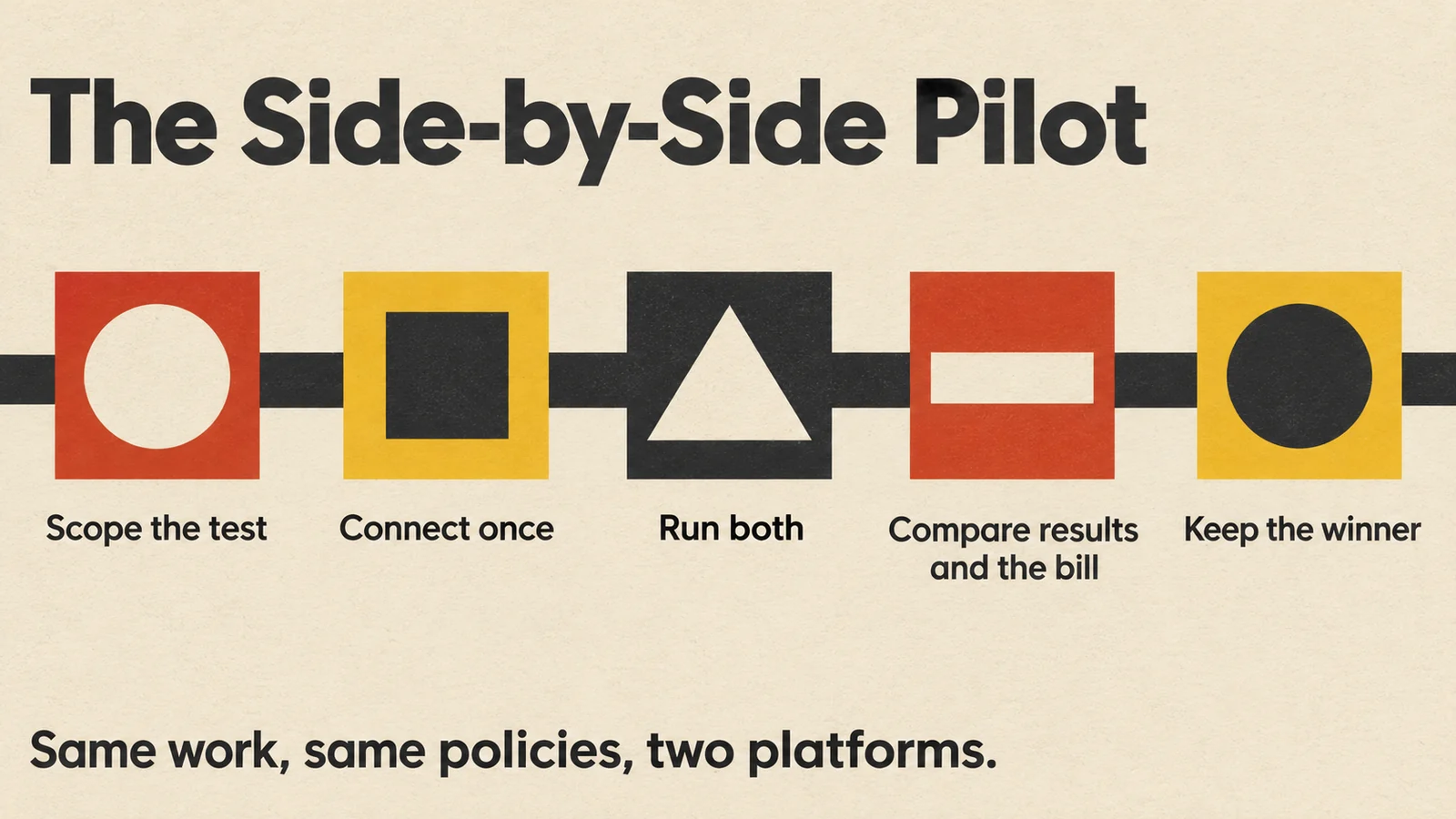 Five phases of a side-by-side pilot, from scoping the test to keeping whichever platform wins on results and cost.
Setup time matters, because a pilot that takes a quarter to stand up is a project, not a test. For the credential workloads in a pilot, Avatier's Credential Governance FAQ says "Most customers deploy Avatier Credential Governance in under a week," and that Password Portal, Assisted Reset and Login Reset "deploy via MSI, GPO, or Intune in hours." For the self-service reset workload, see the Password Portal pillar.
How to compare results
Score both platforms on the same sheet, with the same definitions. A simple scorecard has five rows.
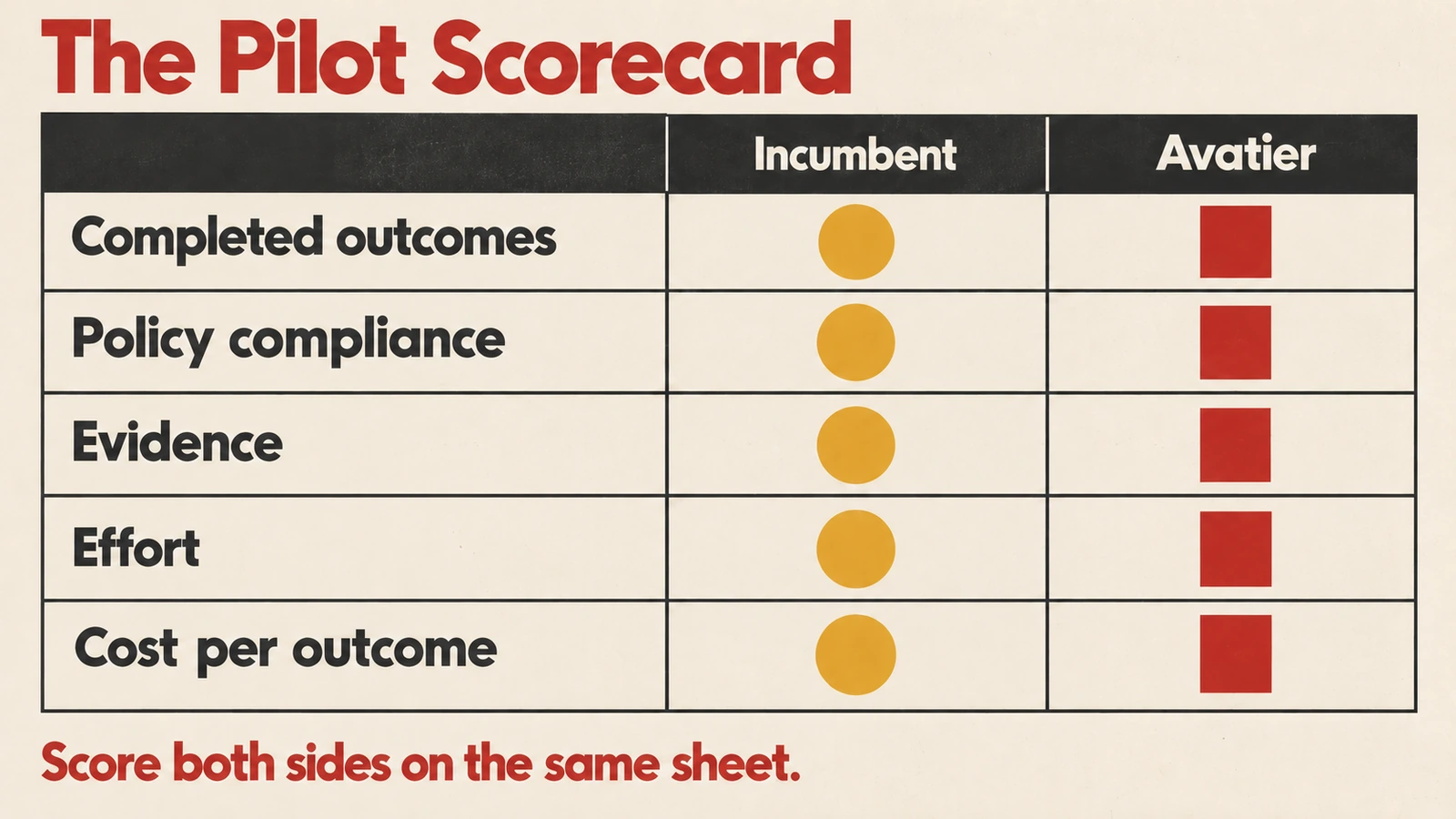 The pilot scorecard: five measures, recorded the same way for the incumbent and for Avatier, read side by side.
What each row records:
| What to measure | What to record for each platform |
|---|---|
| Completed outcomes | How many resets, unlocks, approvals and lifecycle changes finished |
| Policy compliance | Whether each outcome passed the same policies and approvals |
| Evidence | Whether you can show who, under what authority, under which policy, with what result |
| Effort | Administrator and engineer hours spent running each platform |
| Cost per outcome | The period's cost divided by completed outcomes |
Evidence deserves its own row. Each Avatier Secure Outcome records the identity involved, the initiating agent or experience, the authorization context, the policy applied, the action taken and the final result. During the pilot, ask each platform to produce that record for a sample of the same kinds of work.
Help-desk load is worth watching too. Customers of Avatier's credential governance report as much as a 70 percent drop in help-desk password tickets. A side-by-side pilot measures yours.
How to compare the bill
Seat-based licensing charges for users and modules whether or not any work completes. To compare the bill fairly, put both platforms on one unit: the cost of a completed outcome. Include people time, not only license and service fees.
Under Pay Per Identity Action™, customers pay only for completed, verified, policy-compliant outcomes. Every charge is an outcome that completed, and every completed outcome already carries its receipt. That makes the Avatier side of the bill a list of finished work. Avatier Ledger's CFO briefing focuses on cost and breach prevention, with identity spend reconciled to completed actions; Identity Reporting for CISOs and CFOs covers the briefings in detail. For the finance view of the model, see the CFO's guide to outcome-based pricing.
As general guidance, also model a heavier period, such as a hiring wave or a reorganization, to see how each bill moves with volume. A seat-based bill is set by users and modules, not by completed work. An outcome-based bill tracks the work.
When the pilot ends, read the scorecard against the decision rule you wrote down at the start. If the candidate wins on results and cost, switching is the decision you already agreed to. If it loses, turn it off. Either way, you finish knowing what your identity work actually costs per completed outcome.
What Avatier ships toward this pattern
In Avatier Identity Anywhere 2027, Avatier Actions exposes more than 50 identity outcomes as MCP tools across eight modules: Password Management, Help Desk, Lifecycle Management, User Management, Group Management, Access Governance, Workflow Approval and Reports. An employee or manager asks in Teams, Outlook, Copilot or Claude, and the outcome runs through the customer's existing policies, approvals and roles, because "the assistant is the interface, never the authority."
Avatier Ledger turns every outcome into evidence and, through Persona Briefings, tailors the answer for the CISO, the CFO and the security team. The Identity Anywhere 2027 site says Avatier "runs inside Microsoft, Okta, SailPoint, ServiceNow, Moveworks, and the platforms your people already open every day." A healthcare organization with more than 100,000 identities is running the platform today.
Compliance details are on the Avatier Trust Center: SOC 2 Type II audited with no exceptions noted, and ISO/IEC 27001:2022 certified.
Getting started
Getting started is free, deployment services are included, and a 45-day money-back guarantee applies: if a customer is not satisfied within the first 45 days of paid service, the customer may request a refund. Pricing is shared with qualified organizations during the invitation-only preview. To scope a free side-by-side, book a 15-minute preview on the Avatier Identity Anywhere 2027™ site; for the wider company, see avatier.com.
ABOUT THE AUTHOR

More from Buyer's Guides

Outcome-Based Software Pricing: A CFO's Guide to Buying Identity in the AI Era
Outcome-based software pricing charges for completed, verified, audited work instead of seats, modules, or long commitments. In an AI era where the best technology can change in a quarter, it is the pricing model that lets a CFO keep options open and make every vendor prove its value.
IAM Vendors in 2026: How the Market Breaks Down
A category-level guide to how the IAM vendor market segments into suites, point solutions, and platform plays, plus the criteria and red flags that separate real capability from marketing claims.
9 Best Identity Governance and Administration (IGA) Solutions for 2026
A 2026 buyer's guide to enterprise identity governance and administration — nine vendors compared on lifecycle automation, access certification, mainframe coverage, and the honest trade-offs that determine which deployments succeed.