Outcome-Based Software Pricing: A CFO's Guide to Buying Identity in the AI Era
Outcome-based software pricing charges for completed, verified, audited work instead of seats, modules, or long commitments. In an AI era where the best technology can change in a quarter, it is the pricing model that lets a CFO keep options open and make every vendor prove its value.

Outcome-based software pricing charges for completed, verified, audited work instead of seats, modules, or long commitments. In an AI era where the best technology can change in a quarter, it is the pricing model that lets a CFO keep options open and make every vendor prove its value.
- Outcome-based software pricing bills for finished work, such as a password reset completed or an access change executed under policy, rather than for licenses owned or capacity reserved.
- AI is changing what enterprise software can do every quarter, so any commitment that locks a buyer in for years carries more risk than it did a decade ago.
- The largest hidden identity cost is often people: skilled identity engineers spending their days configuring vendor screens and rules instead of serving the business.
- Conversational identity replaces consoles and configuration projects: people ask, and existing policies still decide what is allowed.
- A useful CFO benchmark: HR-driven lifecycle management should cost less than one identity management engineer. If yours costs more, test an alternative side by side.
Think like a CFO for a minute. Would you lock into software you can't leave, in a world where AI changes what's possible every quarter?
I wouldn't. After nearly three decades building identity software, I've watched enterprises sign long commitments for capacity they never used, modules that sat installed, and implementation projects that ran years past plan. The buyer carried all of the risk. That was tolerable when software changed slowly. It isn't tolerable now.
What is outcome-based software pricing?
Outcome-based software pricing is a commercial model in which the customer pays for completed, verified results rather than for access to software. The billable unit is a finished piece of work with evidence attached, not a seat, a module, or a consulting hour.
In identity management, an outcome is concrete: a password reset that completed, an account unlocked, a human verified, an access request approved under policy, a joiner, mover, or leaver change executed. At Avatier, we call these Secure Outcomes, and our Pay Per Identity Action™ reference defines exactly what counts.
The principle is simple. If a vendor's technology is great, it should be able to prove its value through outcomes that are measurable, valued, audited, and on time. Not features. Not seats. Not roadmaps.
Why long software commitments are riskier in the AI era
Long software commitments are riskier today because the pace of AI means a buyer cannot know what the best available technology will be three months from now. A contract that locks you in assumes the market stands still. It no longer does.
Consider what changed in 2026 alone. Enterprise software leaders publicly declared the traditional software interface optional, and AI assistants became the place where work happens. A capability that required a custom project in January can arrive as a conversation by September.
That changes the CFO's risk calculation in three ways:
- Option value matters more. The ability to switch to a better solution has real financial value when better solutions arrive quickly.
- Sunk cost grows faster. Every year of prepaid capacity is a year you cannot redeploy to something better.
- Vendor incentives drift. Once a long commitment is signed, the vendor has been paid whether or not the outcomes arrive.
The honest conclusion for any vendor, including us, is this: if someone builds better technology, customers should be free to pick the best of breed when they need it. Earning the business every month is the vendor's problem to solve, not the customer's.
The hidden identity cost CFOs miss
The identity cost most CFOs underestimate is not the license. It is the people required to operate the software. Senior identity engineers commonly earn $150,000 or more a year, and in many enterprises they spend much of that time configuring a vendor's screens, connectors, and rules.
That is brilliant talent working for the software instead of the business. Every hour spent maintaining a workflow designer or a rules engine is an hour not spent on zero trust architecture, audit readiness, or the AI initiatives the board is asking about.
The broader cost structure, from implementation services to shelfware, is covered in the hidden costs of identity management and the truth about IAM costs. The point for a CFO is narrower: the engineer's time is a real line item, and it should shrink as the software gets smarter, not grow.
From configuration to conversation
Conversational identity management replaces consoles and configuration projects with requests made in plain language, inside tools like Microsoft Teams, Outlook, Claude, and Copilot. The person asks. The identity platform checks policy, routes approvals, executes the action, and records the evidence.
The important word there is policy. There are no screens to configure, but governance does not disappear. The assistant is the interface, never the authority. Every action still runs through the organization's existing roles, approvals, and rules. This is enforced through the Model Context Protocol, where each identity action is a named, governed tool call. MCP identity governance explains the control model in depth.
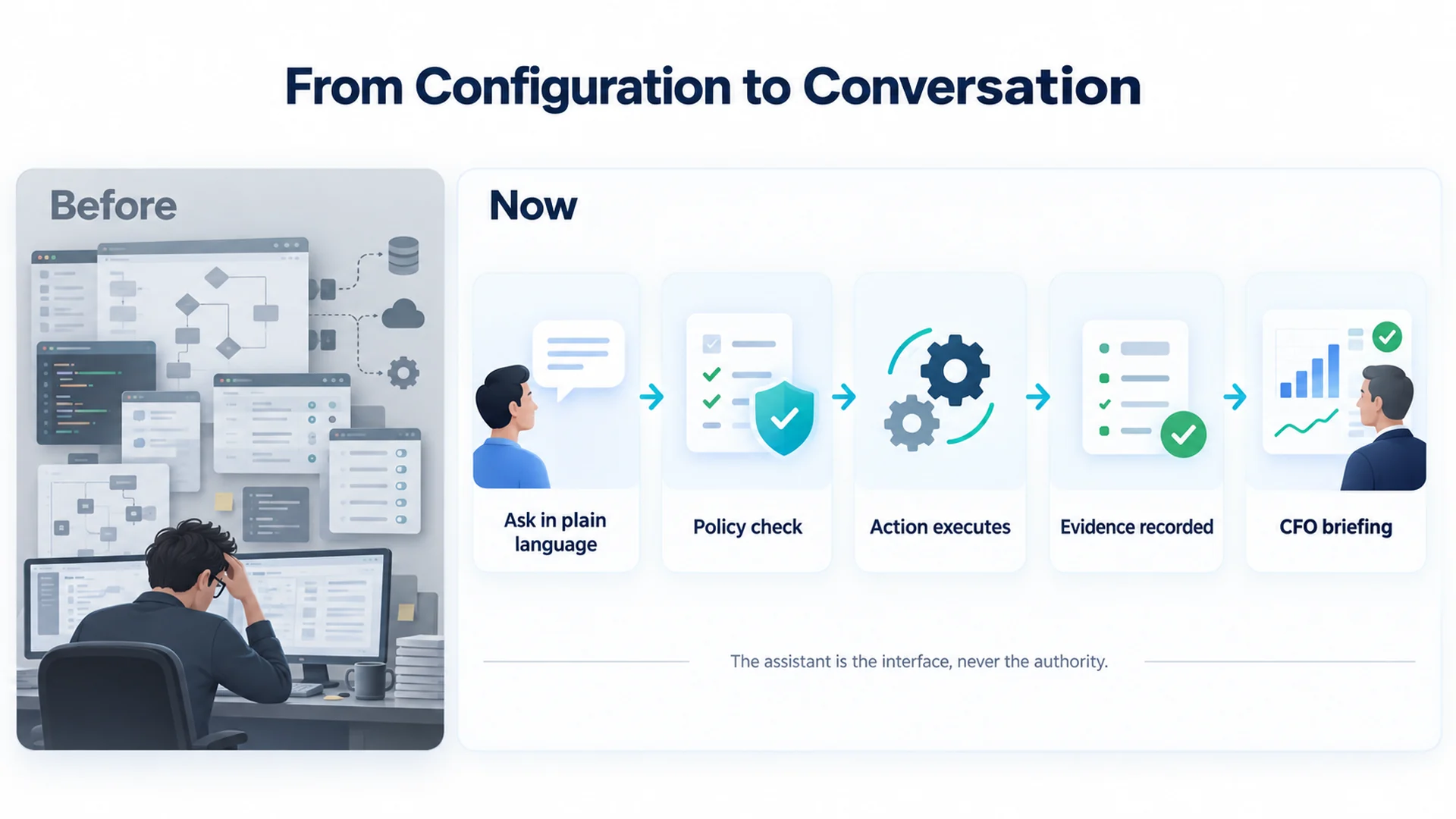
What changes is the skill that matters. In the future, how well you communicate with your identity system determines how good the output is. That future is already here.
What a CFO should get from identity: evidence
A CFO should get evidence from an identity program, not dashboards: proof of what work was completed, what it cost, and what risk it removed. Under outcome-based pricing, every charge corresponds to a finished action, and every finished action carries its own record.
At Avatier, that evidence lives in Avatier Ledger, which records who asked, what ran, under whose authority, and which policy allowed it. Through Persona Briefings, the same evidence is presented differently for each stakeholder. The CFO sees identity spend reconciled to completed actions and cost projections built from the organization's own data. The CISO sees compliance evidence and remediation windows. The security team sees exposure and dormant access. The Avatier Ledger audit trail guide covers the record in detail.
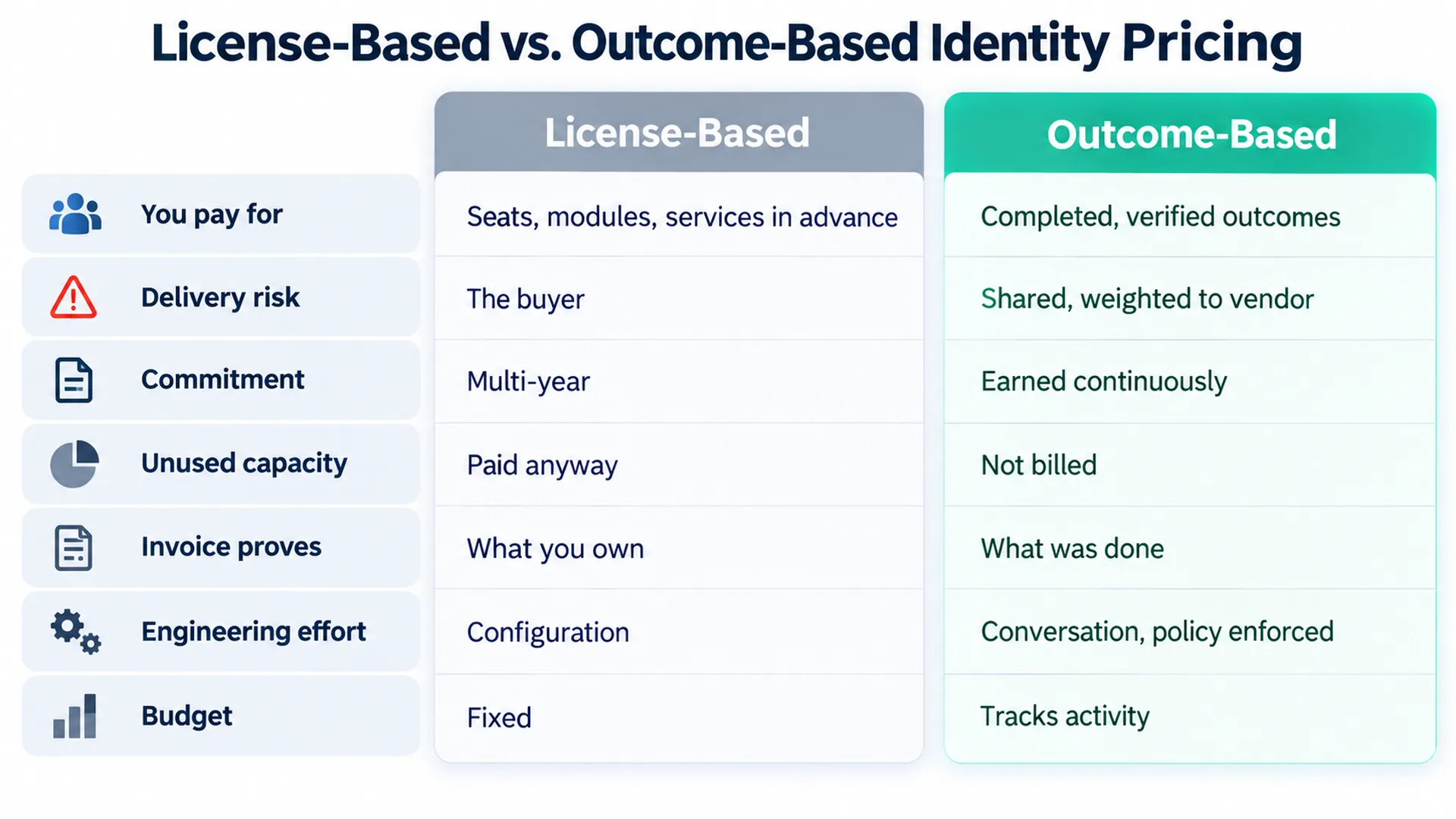
Outcome-based vs. license-based identity pricing
| Dimension | License-based pricing | Outcome-based pricing |
|---|---|---|
| What you pay for | Seats, modules, and services in advance | Completed, verified, policy-compliant outcomes |
| Who carries delivery risk | The buyer | Shared, weighted toward the vendor |
| Commitment | Typically multi-year | Built to earn the business continuously |
| Unused capacity | Paid for anyway | Not billed |
| What the invoice proves | What you own | What was done, with a record per charge |
| Engineering effort | Configuration and maintenance | Conversation, with policy enforced |
| Budget behavior | Fixed | Tracks activity |
For a vendor-specific comparison, see SailPoint vs. Avatier pricing models.
A benchmark worth testing
Here is a benchmark I'd encourage every CFO to test: HR-driven user lifecycle management should cost less than one identity management engineer. If your total cost of lifecycle automation, including licenses, services, and the people who operate it, is higher than that, it's worth running an alternative side by side.
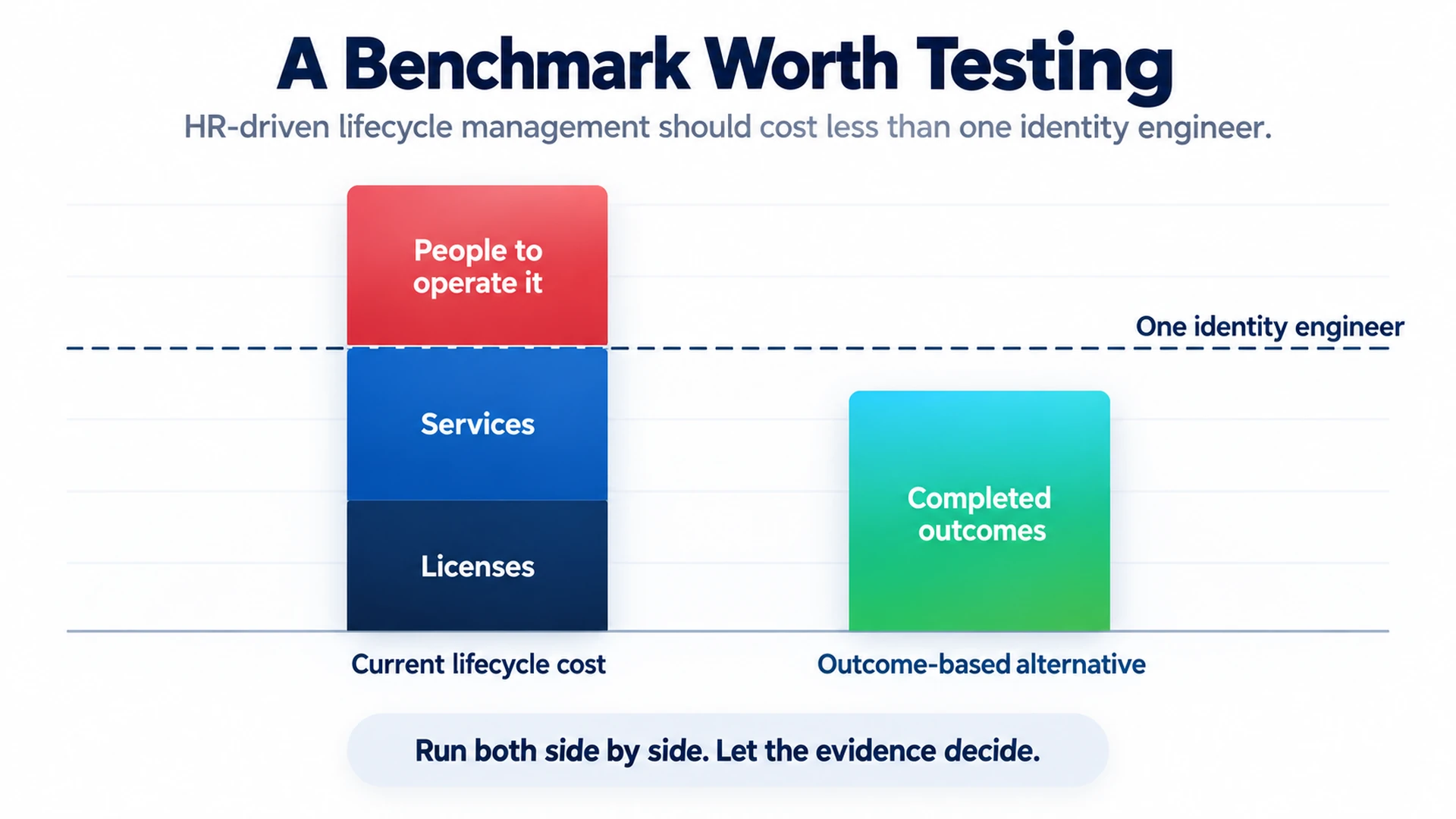
Avatier is built to beat that benchmark. More importantly, the side-by-side approach means you don't have to take anyone's word for it, including ours. Run both, measure the outcomes, and let the evidence decide. To estimate your own password support baseline, try the Avatier cost calculator.
What Avatier ships toward this model
Avatier stopped shipping code. We don't sell products or features. We sell business systems that deliver measurable cost and time savings, so our customers can focus on their core business. Here is what that means today:
- Avatier Identity Anywhere 2027™ is the platform, priced under Pay Per Identity Action™.
- Avatier Actions delivers more than 50 identity outcomes across eight modules inside Claude, Copilot, Teams, and other MCP-compatible assistants.
- Avatier Ledger records evidence for every action and produces Persona Briefings for the CFO, CISO, and security team.
- Commercial terms for new capabilities: month-to-month, free to start, deployment services included, and a 45-day money-back guarantee.
- Side-by-side operation with Entra ID, Active Directory, Okta, Ping, SailPoint, and ServiceNow, so nothing has to be replaced to start.
- Security posture: SOC 2 Type II audited with no exceptions noted and ISO/IEC 27001:2022 certified, published at the Avatier Trust Center.
And wait until you see what we're working on next.
How CFOs should evaluate an outcome-based vendor
- Ask what counts as a completed outcome, in writing, for your top five identity workflows.
- Ask how evidence is recorded and whether it maps to your auditors' templates.
- Ask what you can leave, and when. A vendor confident in its outcomes should not need to lock you in.
- Ask to run side by side with your current platform before committing.
- Model a heavy quarter, such as a hiring wave or acquisition, to see how spend moves with volume.
- Include people costs in the comparison, not just licenses.
What outcome-based pricing does not solve
It does not make spend perfectly fixed. Costs track activity, so a reorganization or mass credential reset raises the total for that period.
It requires clear definitions. If "completed" isn't defined up front, invoices become arguments.
It does not fix bad policy. An overly permissive policy will be enforced efficiently, with an excellent record.
It does not remove the need to secure the AI layer. Prompt injection, over-broad tokens, and unvetted servers still need controls. See how to secure MCP servers.
Book a 15-minute Credential Governance demo to see a termination executed by asking, with the evidence and CFO briefing that follow.
ABOUT THE AUTHOR

More from Buyer's Guides

IAM Vendors in 2026: How the Market Breaks Down
A category-level guide to how the IAM vendor market segments into suites, point solutions, and platform plays, plus the criteria and red flags that separate real capability from marketing claims.

SailPoint vs Avatier: The 2026 Enterprise Pricing Model Comparison
Enterprise IAM buyers evaluating SailPoint against Avatier are comparing two fundamentally different pricing philosophies — modular per-capability pricing with premium tiers and per-connector charges versus all-inclusive licensing that bundles the same capability set into the base license. The 2026 enterprise reference on the structural pricing differences, the modules that drive most of the SailPoint cost surprises, the Avatier all-inclusive positioning, and the buyer-side comparison discipline that produces defensible vendor selection instead of feature-checklist theater.

Login Reset Licensing Models: The 2026 Enterprise Cost Structure Reference
Enterprise password reset licensing has three fundamentally different pricing models — per-user subscription, per-reset-event consumption, and modular capability-based licensing — and the fit between model and buyer profile determines whether TCO tracks the vendor's list-price projection or surprises 18-24 months into deployment. The 2026 enterprise reference on the three licensing models, the specific line items that drive cost variance, and the buyer discipline that produces defensible reset-workflow vendor selection.