Help Desk Social Engineering Defense: Avatier Assisted Reset
Help desk social engineering works because an agent has to judge whether a caller is real. The defense is to move that decision to the user's own device, so the agent sees only pass or fail.

Help desk social engineering works because an agent has to judge whether a caller is real. The defense is to move that decision to the user's own device, so the agent sees only pass or fail.
- Help desk social engineering is a phone call in which an attacker poses as an employee and talks a service desk agent into a password reset, an unlock or a new MFA device.
- It works because the agent has to decide whether the caller is real, using facts the attacker can research in advance.
- Avatier's Identity Attack Ledger counts 12 of 53 California incidents that name a vector (22.6%, Jan 2023 to Aug 14, 2026) as social engineering of a person.
- The defense is to move the decision off the agent: the challenge goes to the user's own enrolled device and the agent sees only pass or fail.
- Avatier Assisted Reset applies that pattern in a delegated help desk console that routes MFA to the user, not the agent, and records how the user was verified.
Help desk social engineering is a phone call in which an attacker poses as an employee and talks a service desk agent into resetting a password, unlocking an account or moving multi-factor authentication to a new device. The defense that holds up is to take the verification decision away from the agent: send the challenge to the user's own enrolled device, and let the agent see only pass or fail.
That shifts the question. The agent no longer has to decide whether the caller sounds real. The system checks whether the real user, on a device they enrolled before the call, confirms the request.
How a help desk pretexting call works
The pattern is documented in detail. CISA's advisory on Scattered Spider, AA23-320A, describes actors who "posed as employees to convince IT and/or helpdesk staff to provide sensitive information, reset the employee's password, and transfer the employee's MFA to a device they control." The same advisory says these attempts use "layered social engineering techniques which frequently occur over several calls."
Read as a sequence, the advisory describes a call that is prepared, not improvised:
- Research the target. The actors search business-to-business sites to work out the target's role, then gather usernames, passwords and personal information.
- Learn the process. The first calls are "designed to first learn what steps are needed to conduct password resets from helpdesks."
- Pose as the employee. The pretext explains why the caller needs an agent rather than self-service.
- Pass the agent's questions. The researched details answer them.
- Ask for the change. A password reset, an MFA transfer to a device the attacker controls, or both.
- Take over the account. The advisory says the actors then perform account takeovers in single sign-on environments.
Steps 1 through 3 happen before the agent is involved. The attack succeeds at steps 4 and 5, where a person has to decide whether the caller is who they claim.
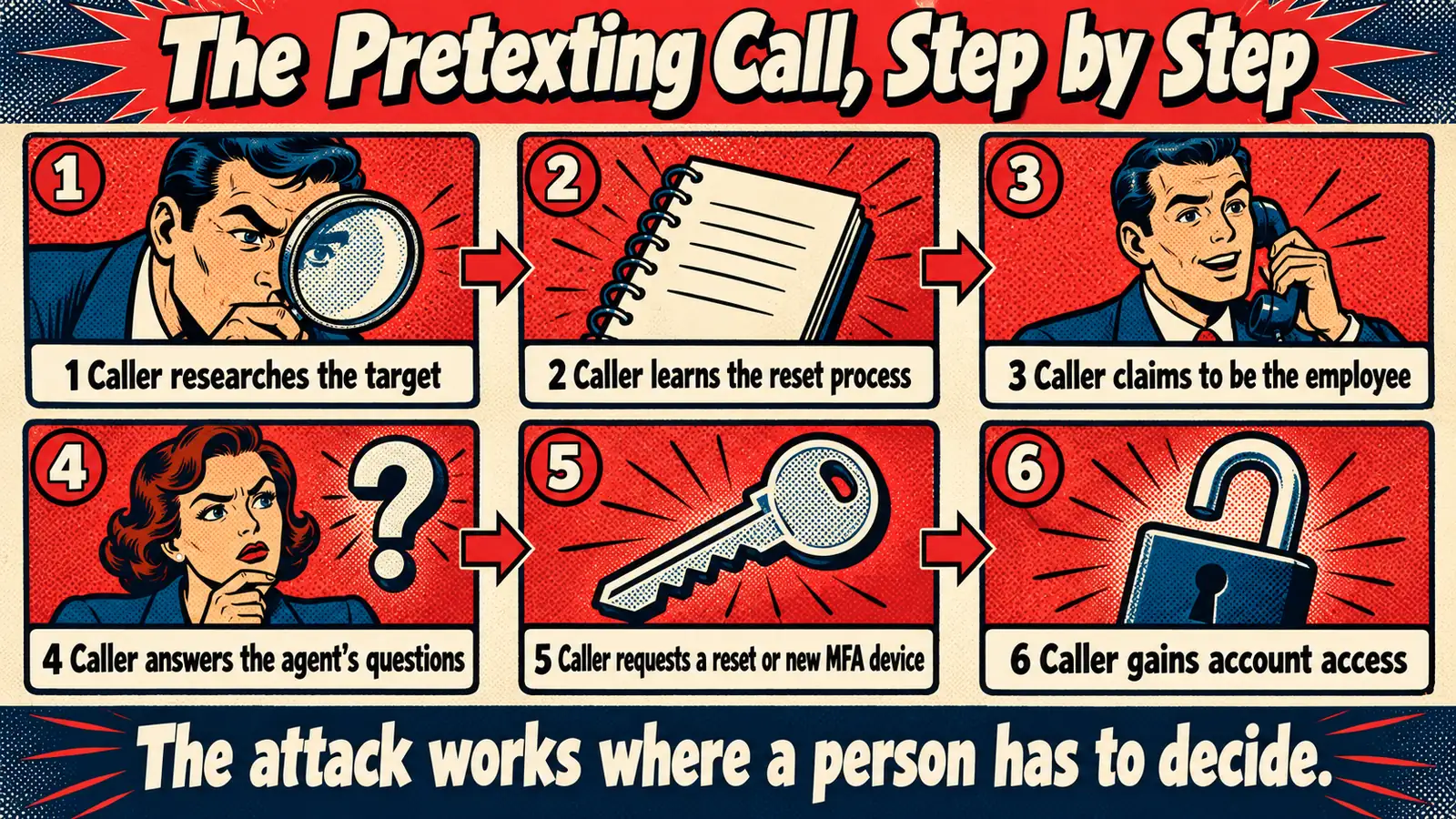 Six steps of a help desk pretexting call. The research happens out of view; the attack lands where the agent has to decide.
The wider pattern of a single impersonation call is covered in The Help-Desk Call That Cost $100M. This post is about the verification step itself.
Why agent-judged verification fails
Agent-judged verification asks the agent to judge evidence the caller supplies: an employee ID, a manager's name, a department, a callback number the caller suggests. Each answer can be researched in advance, and the advisory describes actors who gather personal information and password reset details over several calls.
Three things make the agent the weak point, and none of them is the agent's fault:
- The agent is trained to help. A locked-out employee with a deadline is the normal case, so urgency reads as normal.
- The evidence is the attacker's evidence. Everything the agent hears comes from the caller.
- Judgment varies. Different agents, regions and service desks apply different standards, and an attacker who fails with one agent can call back and reach another.
Avatier's own research counts how often breach letters name a deceived person as the way in. The Identity Attack Ledger reads every breach notification filed with the California Attorney General from January 2023 through August 14, 2026. Of the 53 incidents whose letters name how the attacker got in, 12, or 22.6%, name social engineering of a person, a category that includes vishing and help-desk pretexting. Those figures describe the letters that name a vector, not all breaches, and they are California filings, not a national rate. The page also notes that its help-desk pattern can match letters that mention a help desk without the desk being the attack path.
Take the decision away from the agent
The fix is structural. Instead of asking the agent to judge the caller, send a challenge to a device the real user enrolled before the call, and let the result decide whether the reset runs. The agent sees the outcome. The agent never sees, and never has to weigh, the evidence.
| Agent-judged verification | Device-routed verification | |
|---|---|---|
| Who decides | The agent, during the call | The user's response on their enrolled device |
| What the agent sees | Everything the caller says | Pass or fail |
| What the attacker needs | A good story and researched facts | Control of the user's enrolled device |
| What gets recorded | Ticket notes, if any | How the user was verified and what changed |
A pretext changes nothing on the right-hand side. However convincing the caller is, the real user's device is either answered or it is not.
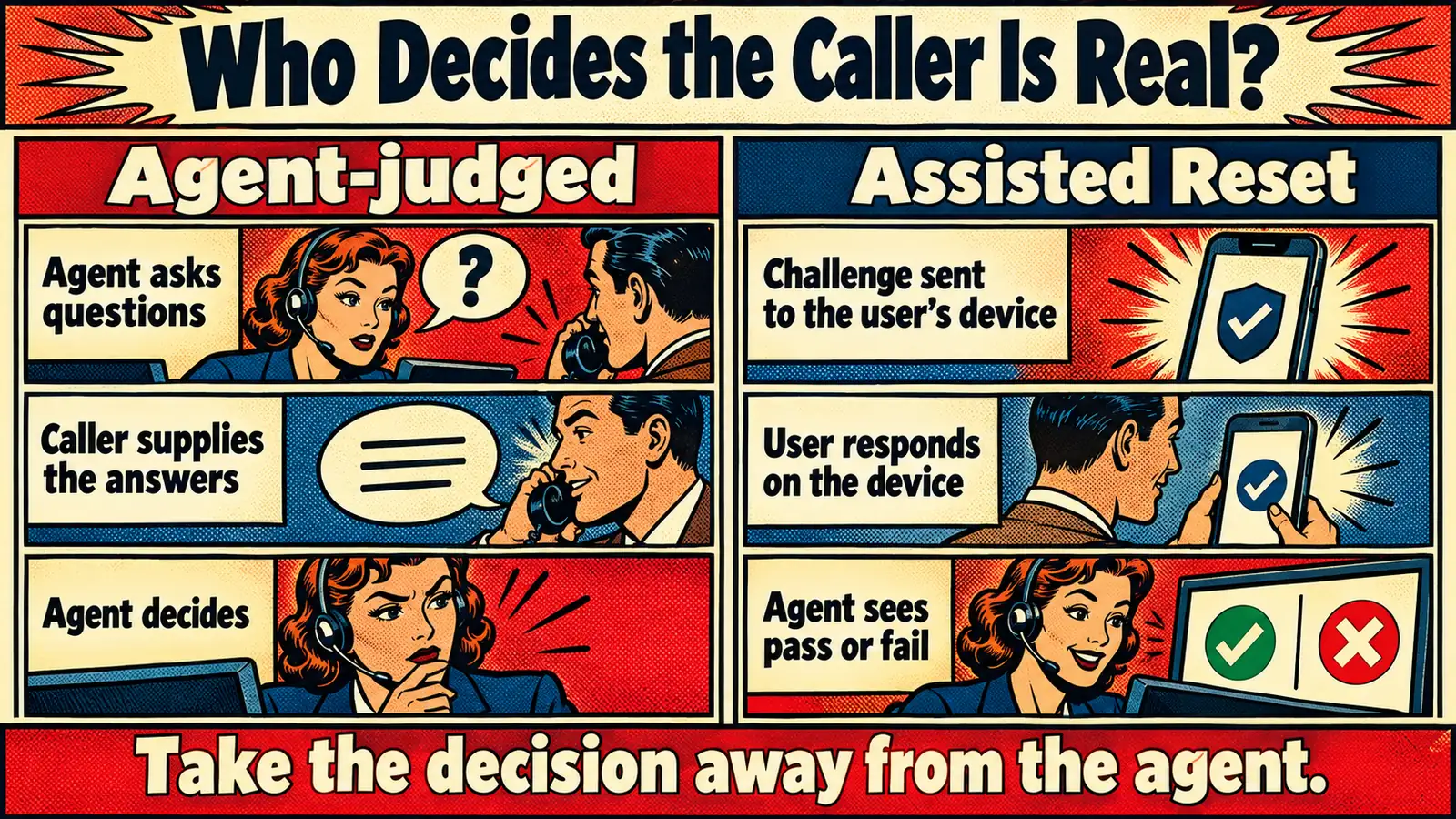 In agent-judged verification the caller supplies the evidence. With Assisted Reset the challenge goes to the user, and the agent sees only the result.
Rules for the calls that still need a person
Device-routed verification covers the routine call. The calls that fall outside it need rules, not discretion. This is general guidance:
- Treat MFA re-enrollment as high risk. "I lost my phone" is the pretext that moves a call off the strong path. Require a stricter check, such as a manager's confirmation or an in-person step, and log who approved it.
- Apply stricter policy to privileged accounts. A bad reset on an administrator costs more than one on a standard user.
- Scope what each agent can touch. An agent should be able to reset only the users they support.
- Make "no" safe. If verification fails, the agent ends the call and routes it, without an override button and without a satisfaction-score penalty.
- Record the verification, not just the ticket. A closed ticket shows that work was done; it does not show the user was verified.
The same discipline applies when an AI assistant takes the request instead of an agent. That path is covered in AI Service Desk Automation, and voice channels in AI Call Center Authentication.
What Avatier ships toward this pattern
Assisted Reset is Pillar 3 of Avatier Credential Governance™. It gives service desk agents a delegated help desk console to verify users, unlock accounts, reset passwords and send enrollment invitations. It routes MFA to the user, not the agent: every challenge goes to the user, and the agent sees only pass or fail.
- Verify User, marked patent pending, is described as guided MFA identity proofing before any account is touched.
- Existing MFA methods verify users before agents complete sensitive actions, including Microsoft Authenticator, Okta Verify, Duo and Google Authenticator.
- Scoped delegation can follow OUs, regions or support responsibilities, and the product page says Assisted Reset can support stricter policies for higher-risk users, privileged accounts or sensitive groups.
- Reviewable records cover who requested help, how verification was handled, what changed and what was logged.
- Ticketing works with ServiceNow, Zendesk, Jira Service Management and Freshservice.
The page also says Assisted Reset can "support deviceless verification for air-gapped and restricted environments," listing the Identity Challenge Card among those integrations. Enrollment templates are localized, with coverage of 34 languages.
For the full capability list, see the Assisted Reset pillar page; for all six pillars, see Credential Governance. Compliance details are on the Avatier Trust Center: SOC 2 Type II audited with no exceptions noted, and ISO/IEC 27001:2022 certified. For the invitation-only preview, see the Avatier Identity Anywhere 2027™ site; for the wider company, see avatier.com.
ABOUT THE AUTHOR

More from Pillar 3: Assisted Reset

AI Service Desk Automation: Resolving Identity Requests with Avatier
AI service desk automation resolves unlocks, resets, access and group changes by conversation, through governed identity actions. What to automate, what to route, and how Avatier does it.
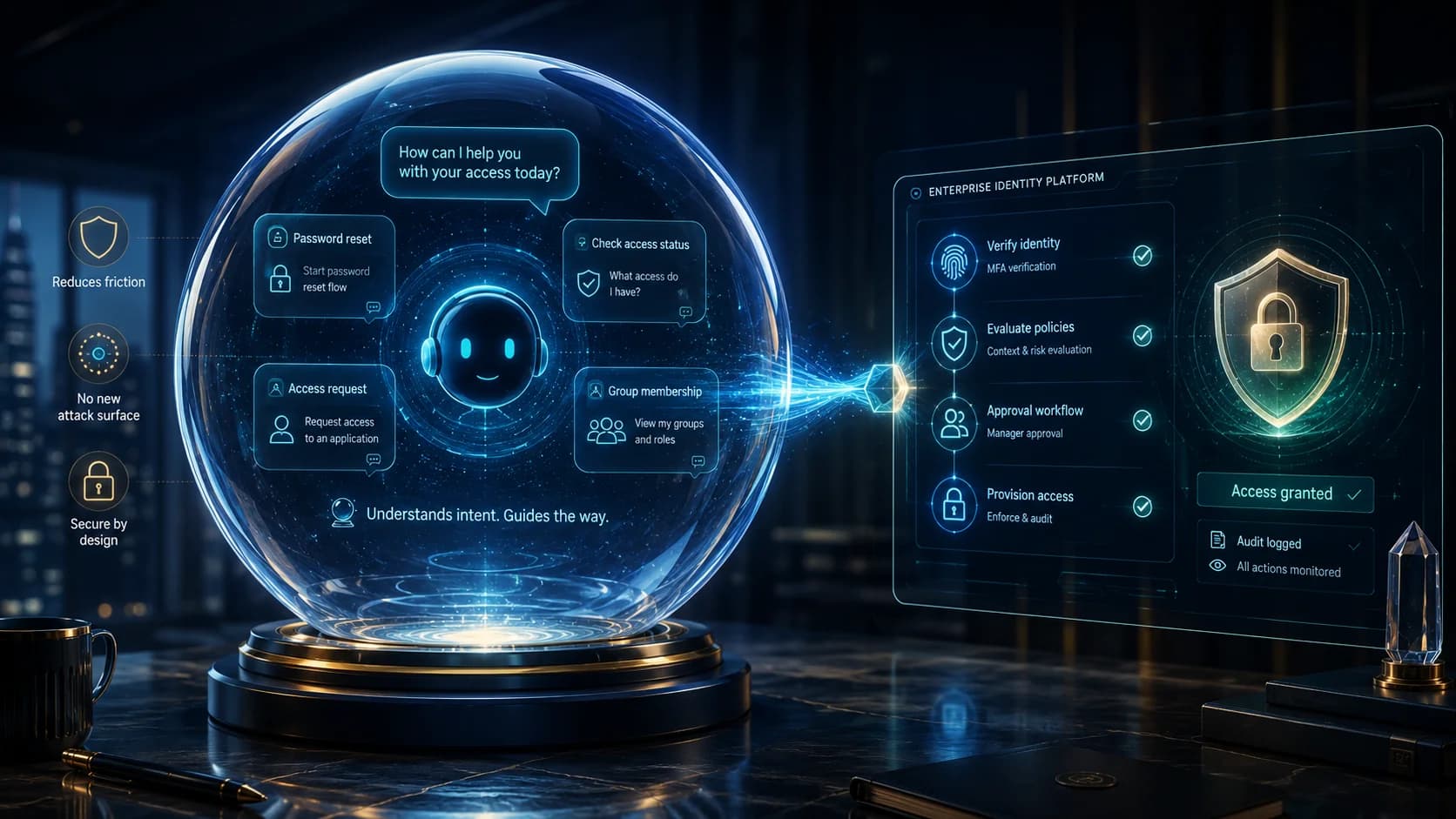
AI Virtual Assistants for Identity Management: Conversational Access Without a New Attack Surface (2026)
A chatbot that resets passwords is trivial to build and a genuinely bad idea — because the hard part of a password reset was never the conversation, it was proving who is asking. The 2026 reference on conversational identity done properly: the four workflows worth deflecting to chat, why identity verification must live outside the language model, the prompt-injection and social-engineering surface a naive deployment opens, and the deflection math against a $480-per-employee support baseline.

Temporary Password Best Practices 2026: NIST 800-63B Rev. 4 and Beyond
Temporary passwords are the recovery credential class that most enterprises still issue, share insecurely, and persist beyond their intended scope. NIST 800-63B Rev. 4 raised the bar in 2025, and the 2026 architectural pattern moves further — away from temporary passwords toward workflow-verified recovery. The enterprise reference on what's required, what's recommended, and where temporary passwords genuinely still belong.