The Playbook: Moving Legacy Systems to Modern IAM 2026
Most enterprises still run a meaningful share of business-critical workloads on identity infrastructure from a previous era — Sun Identity Manager, Oracle Identity Manager, NetIQ, on-prem AD with manual provisioning, ACF2 / RACF / Top Secret on the mainframe. The 2026 enterprise playbook for moving them to modern IAM without breaking the workloads they secure.
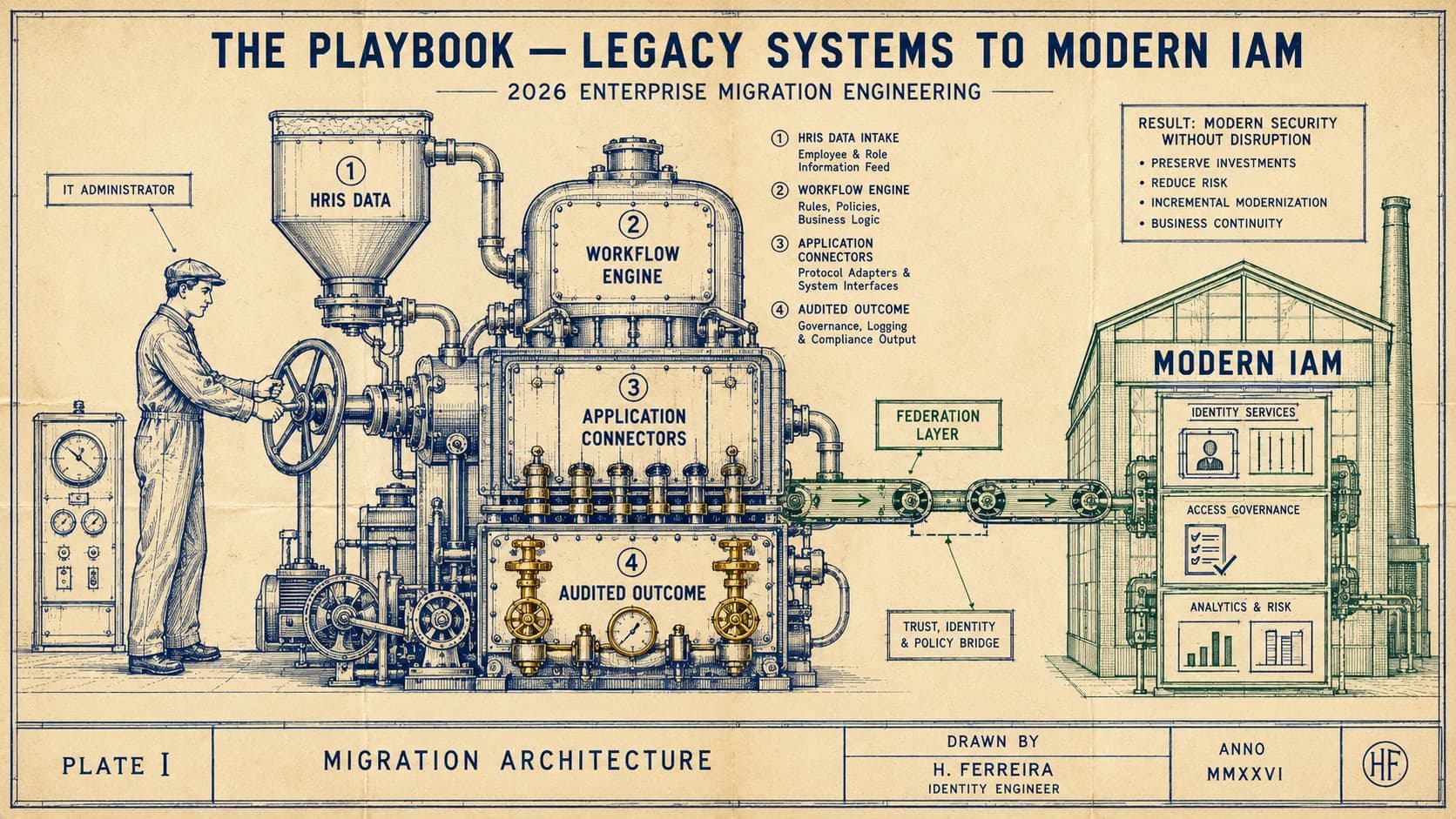
Most enterprises still run a meaningful share of business-critical workloads on identity infrastructure from a previous era — Sun Identity Manager, Oracle Identity Manager, NetIQ, on-prem AD with manual provisioning, ACF2 / RACF / Top Secret on the mainframe. The 2026 enterprise playbook for moving them to modern IAM without breaking the workloads they secure.
- Legacy IAM is still production infrastructure in most large enterprises in 2026. Sun Identity Manager (Oracle Waveset) installations dating from 2006-2010. Oracle Identity Manager 11g deployed mid-2010s. NetIQ Identity Manager. On-prem Active Directory with manual provisioning. RACF / ACF2 / Top Secret on the mainframe. The legacy landscape is broad and the workloads it secures are often the highest-value ones in the enterprise.
- The five-phase playbook for moving to modern IAM: (1) inventory + dependency mapping — what does the legacy IAM platform actually do, and what depends on it; (2) federation-based parallel running — modern IdP federates with legacy authoritative source while migration is in progress; (3) lifecycle workflow port — joiner-mover-leaver workflows move from the legacy platform to the modern IGA; (4) application connector cutover — each application integrates with the modern IAM instead of the legacy; (5) legacy decommission — only after every dependency is migrated.
- Five risk patterns derail legacy IAM migrations: (1) underestimated dependency depth (the legacy platform is doing more than the inventory captured), (2) authoritative-source disagreement (two systems both think they're the source of truth), (3) connector capability gaps (the modern platform doesn't have a connector for a niche legacy application), (4) workflow semantics drift (the new workflow doesn't behave identically to the legacy one), (5) decommission held hostage by long-tail dependencies (the last 5% of dependencies block the legacy shutdown indefinitely).
- Federation-based parallel running is the architectural pattern that lets most legacy IAM migrations succeed. The modern IdP federates with the legacy authoritative source during the transition; users authenticate through the modern IdP but the legacy directory still provides identity attributes; applications cutover one at a time without big-bang risk.
- Typical migration timeline: 12-24 months for enterprise-scale legacy IAM. The pace is constrained by application-connector cutover, not by platform deployment. The platform deployment phase is the first 3-4 months; the application cutover phase is the remaining 9-20 months and varies enormously by application portfolio depth.
The phrase "legacy IAM" carries a misleading implication. It suggests something obsolete, neglected, easily replaced. The 2026 operational reality is different — legacy IAM platforms still secure the highest-value workloads in most large enterprises. Sun Identity Manager installations from 2008 still running production provisioning workflows in banking. Oracle Identity Manager 11g still authoritative for hundreds of applications in government and telecommunications. NetIQ Identity Manager running mid-market enterprise lifecycle. On-prem Active Directory with manually-augmented provisioning still the operational reality for many enterprises that "have IGA" only because they bought a platform that's never been fully deployed against the legacy AD reality.
These platforms aren't going away because the workloads they secure aren't going away. The economics of replacing the application portfolio are usually worse than the economics of replacing the IAM layer. The question for the CIO and CISO in 2026 is rarely "should we modernize identity" — that answer is usually yes. The question is "how do we modernize identity without breaking the production workloads the legacy IAM secures."
This piece is the 2026 enterprise playbook for that question. The legacy IAM landscape still in production, the five-phase migration playbook that succeeds in practice, the five risk patterns that derail migrations, and the federation-based parallel-running architecture that lets most migrations succeed. The companion pieces handle adjacent territory: the HRIS-Driven Lifecycle piece covers the lifecycle-automation foundation that Phase 3 depends on, the IGA Project Failed piece covers the recovery path when the migration has already stalled, the Best IGA Solutions buyer guide covers the modern IGA platform layer the migration targets, the Demystifying RACF piece covers the mainframe-security integration patterns, and the Identity Maturity Model piece covers where legacy IAM modernization sits in the broader maturity ladder (Stage 2 → 3 transition territory).
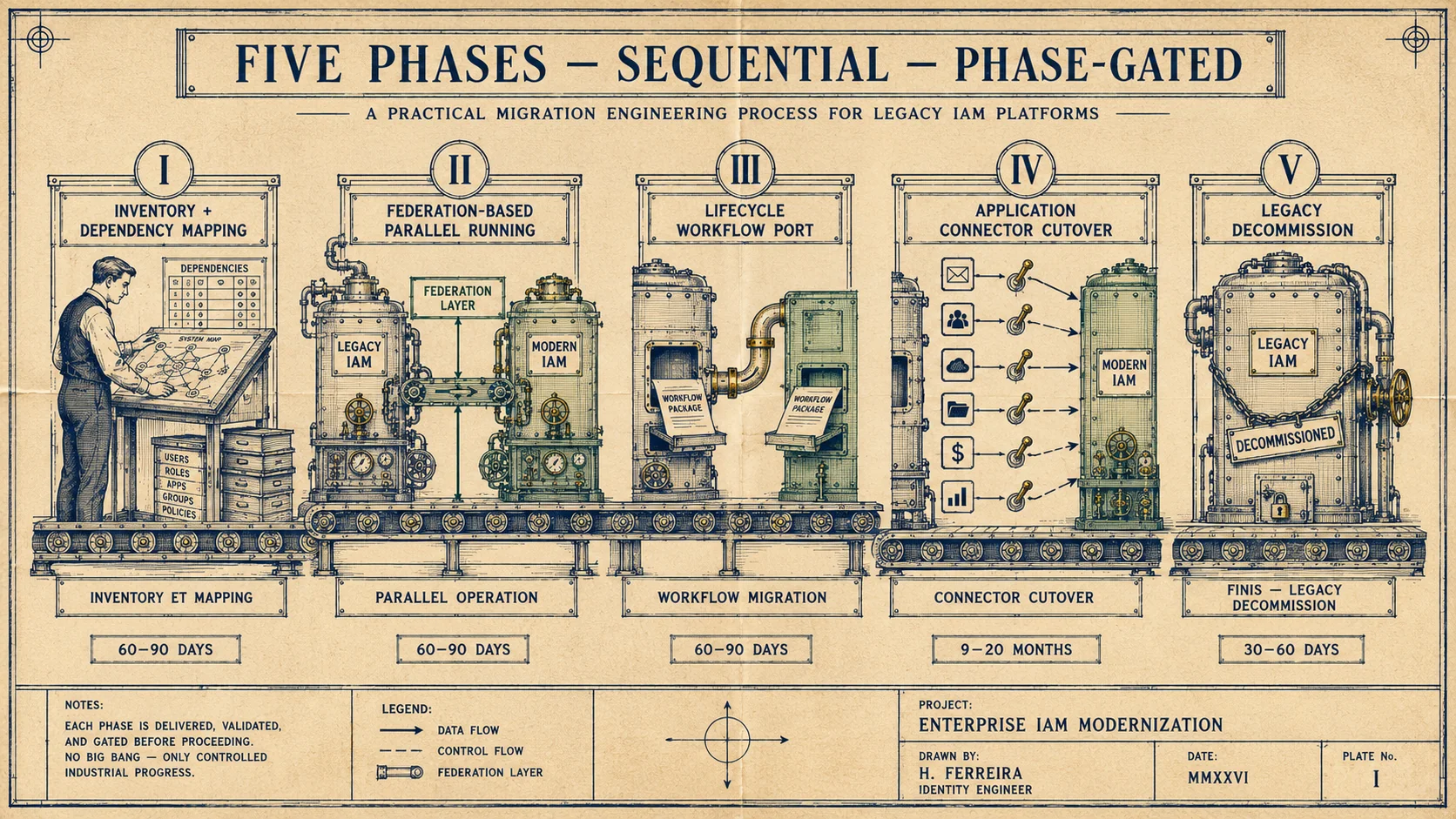 Five phases, sequential, gated by completion of the prior phase. Most migrations take 12-24 months. The pace is constrained by application cutover, not platform deployment.
The legacy IAM landscape in 2026
The major legacy platforms still in production at meaningful enterprise scale:
Sun Identity Manager / Oracle Waveset. Originally Sun Microsystems' identity product, acquired by Oracle in 2009. Many installations date from 2006-2010 and still run production provisioning workflows in financial services, government, and telecommunications. The product has been on extended support for years; Oracle's strategic direction has been to migrate customers to Oracle Identity Governance (the more modern successor), but many customers have stayed on Sun IDM because the cost and risk of migration exceeded the cost of staying on extended support.
Oracle Identity Manager 11g (and 12c). Deployed mid-2010s as the Oracle stack equivalent for organizations standardized on Oracle infrastructure. Strong provisioning capabilities, complex configuration, often used as the authoritative source for hundreds of Oracle ERP and adjacent applications. Migration is harder than for Sun IDM because the Oracle-stack integration depth is broader.
NetIQ Identity Manager. Originally Novell (later Micro Focus, now OpenText after the 2023 acquisition). Deployed in mid-market and enterprise organizations with Novell / NetIQ heritage. Strong scripting capabilities (the DirXML rule engine), often heavily customized over years of operation. Migration challenges concentrate in the custom DirXML logic that needs to be ported or rewritten.
On-prem Active Directory with manual provisioning. The most common "legacy IAM" pattern — not because AD itself is legacy (it remains the dominant enterprise directory) but because the manual provisioning workflow around it predates modern IGA. New hires get AD accounts via help desk tickets. Role changes get handled through ad-hoc requests. The lifecycle isn't broken; it just isn't automated. Modernization here is less about replacing the directory and more about putting IGA workflow on top of it.
Mainframe security managers (RACF, ACF2, Top Secret). Not being replaced — mainframes still run the workloads they secure. Modernization is about integrating mainframe security with the modern IAM platform so the joiner-mover-leaver workflow extends to RACF/ACF2 accounts alongside Active Directory and cloud accounts. Our Demystifying RACF piece covers the mainframe-integration foundations.
Other legacy platforms. CA Identity Manager (now Broadcom), IBM Tivoli Identity Manager (now IBM Security Verify Governance), Hitachi ID Manager, plus various proprietary in-house identity systems that grew over decades in specific industries. Each has its own migration profile.
The common pattern across all of them: the legacy platform is doing real work that the modern IAM has to take over, with workloads attached that can't tolerate interruption.
Phase 1: Inventory and dependency mapping
The first phase is the unglamorous foundational work that determines whether the rest of the migration succeeds. Most failed migrations had inadequate Phase 1 work — the team thought they understood the dependency landscape and discovered later that the legacy platform was doing more than the inventory captured.
What to inventory:
- Authoritative sources. Which systems does the legacy IAM consume identity data from? HRIS, organizational directories, contractor management systems, customer-relationship systems if customer identity is involved.
- Provisioning targets. Every application the legacy IAM provisions to. The list is usually larger than expected because of long-tail systems added over years of operation.
- Workflows owned by the legacy IAM. Joiner-mover-leaver, access request approval, certification campaigns, segregation-of-duty enforcement, exception handling.
- Audit reports. Compliance reports produced from the legacy IAM that downstream teams (compliance, internal audit, external audit) depend on.
- Custom integrations. Scripts, custom code, scheduled jobs that depend on legacy IAM schema or APIs. This category is where most surprises live.
- Connected applications' assumptions. Applications that consume identity from the legacy IAM and depend on specific behaviors (specific attribute names, specific provisioning timing, specific group naming conventions).
How to inventory honestly:
The inventory should be cross-checked against three sources. The legacy IAM's own configuration (what does it say it does). The application teams' understanding (what do they think the legacy IAM does for them). The actual operational data (what events does the legacy IAM produce in production traffic). Discrepancies between the three sources surface the gaps.
The IGA Project Failed piece's Phase 1 audit pattern applies here too — most stalled IGA migrations had Phase 1 work that captured what the team thought was happening but missed what was actually happening. The same discipline applies to legacy IAM migration Phase 1.
Output: a documented dependency map that names every system, workflow, report, integration, and assumption tied to the legacy IAM. The map becomes the baseline against which migration progress is measured.
Phase 2: Federation-based parallel running
The architectural pattern that makes legacy IAM migration tractable. The principle: the modern IAM and the legacy IAM coexist during the transition rather than cutting over as a big-bang event.
How it works:
The modern IdP federates with the legacy authoritative source. Users authenticate through the modern IdP (which is where they're going long-term). The legacy directory still provides identity attributes (so legacy-aware applications keep working without modification). The federation flow looks something like:
- User attempts to access an application
- Application redirects to the modern IdP for authentication
- Modern IdP authenticates the user (typically with phishing-resistant MFA per our Phishing-Resistant MFA piece on ICC)
- Modern IdP queries the legacy directory for identity attributes (manager, department, location, role)
- Modern IdP issues a SAML or OIDC token with the attributes from the legacy directory
- Application accepts the token, lets the user in
The user experience is "I authenticated through the modern system" while the application sees "I got identity data from the legacy authoritative source." Both sides of the migration are satisfied; the transition window can last months or years without forcing either side to cutover prematurely.
Why this matters:
The alternative — big-bang cutover — requires every application to migrate simultaneously, which is operationally impossible at enterprise scale. Big-bang migrations fail. Federation-based parallel running converts the migration from a single coordinated event into an incremental rollout, application by application.
The architectural test is whether the modern IdP can assert federation tokens that legacy-aware applications consume cleanly. SAML federation handles this for most modern web applications. OAuth/OIDC handles the API-integrated applications. Long-tail mainframe-resident and proprietary applications often require custom federation work but the work is bounded.
Phase 3: Lifecycle workflow port
Joiner-mover-leaver workflows move from the legacy platform to the modern IGA. This is the phase that does the bulk of the workflow modernization.
The migration pattern:
The legacy lifecycle workflow gets dissected into its component parts. The HRIS-driven trigger (when a new hire is recorded). The authorization logic (who approves what). The provisioning actions (which systems get accounts created, with what entitlements). The completion verification (how the workflow knows it succeeded).
Each component is reimplemented in the modern IGA platform. The new workflow runs in parallel with the legacy one initially, with the legacy as the production system. Once the new workflow is validated (produces the same outcomes, handles the same edge cases, doesn't break the downstream systems), the production responsibility transfers to the new workflow. The legacy workflow is left as a fallback for a defined period, then deprecated.
Why HRIS-driven matters:
The HRIS-driven lifecycle pattern documented in our HRIS-Driven Lifecycle piece is usually the right modernization target. The legacy IAM often consumes HRIS data through batch interfaces or manual reconciliation; the modern IGA consumes through SCIM push, delta synchronization, webhooks, or some combination. The integration upgrade is a meaningful improvement in lifecycle timeliness (joiner provisioned same-day vs week, leaver deprovisioned same-day vs week+).
Risk pattern: workflow semantics drift.
The new workflow's behavior should match the legacy one's in routine cases. The edge cases are where drift produces problems: leave of absence returns, contractor-to-employee conversions, internal transfers across business units, terminations followed by rehires, name changes. The legacy workflow handled these cases in specific ways (sometimes correctly, sometimes through accumulated hacks). The new workflow should make explicit choices about each edge case rather than inheriting the legacy behavior accidentally.
Phase 4: Application connector cutover
The longest phase. Each application that consumes identity from the legacy IAM is migrated to consume from the modern IAM. The application portfolio depth determines the duration; typical enterprises have 100-500 applications to cutover, taking 9-20 months depending on prioritization and parallelism.
The cutover pattern per application:
For each application:
- Identify the application's current integration with the legacy IAM (federation, directory query, batch sync, API call, etc.)
- Build the equivalent integration with the modern IAM
- Run both in parallel for a defined validation period
- Cut the application's primary integration to the modern IAM
- Decommission the legacy IAM integration
- Document completion
The pattern is repeated per application. Some applications migrate in days (a clean SAML integration that just needs the IdP endpoint pointed at the modern IdP). Some take weeks (custom integrations that depend on legacy IAM schema). Some take months (mainframe-resident applications with proprietary identity flows).
Prioritization:
The cutover order is strategic. High-value, high-traffic applications first — the user experience improves immediately when the most-used applications run on the modern stack. Mainframe and legacy-stack applications last — these are the hardest to migrate and the most likely to expose long-tail dependencies. Mid-tier in the middle.
Risk pattern: connector capability gaps.
The modern IAM platform doesn't have a connector for a niche legacy application that the legacy IAM did support. Options: build a custom connector (engineering investment), replace the application with a modern equivalent (separate program, often longer than the migration), keep the application on a legacy-only integration path indefinitely (technical debt). The right answer varies by application; surfacing the gap early in Phase 1 inventory is what prevents it from becoming a Phase 4 surprise.
Phase 5: Legacy decommission
Only after every dependency has migrated. The decommission phase is the smallest of the five but produces the migration's measurable end state.
The decommission checklist:
- All applications cutover to the modern IAM (verified per-app)
- All workflows running on the modern IGA (legacy workflows verified inactive)
- All authoritative-source consumers reading from the modern stack (verified per-source)
- All audit reports produced from the modern stack (verified equivalent to legacy reports)
- All custom integrations reimplemented (verified operational)
- Final validation period (typically 30-90 days of running with legacy "available but not used" before decommission)
Risk pattern: decommission held hostage by long-tail dependencies.
The most common Phase 5 failure mode. The last 5% of dependencies block the decommission indefinitely — typically because they're owned by teams that haven't prioritized the migration work, or because they're applications scheduled for retirement that haven't been retired yet, or because they're "we'll get to it" items that never get to.
The mitigation is executive sponsorship combined with a hard decommission deadline. The legacy IAM has a published shutdown date. Applications that haven't migrated by that date either accept their fate (the application stops working) or get an extended migration deadline with explicit executive sign-off. The forcing function produces completion; without it, the last 5% can drag on for years.
The five risk patterns to surface early
Across the five phases, five risk patterns recur in failed legacy IAM migrations. Surfacing them in Phase 1 prevents them from blocking later phases.
Underestimated dependency depth. The legacy IAM is doing more than the inventory captured. Mitigation: cross-check Phase 1 inventory against legacy IAM operational logs (what does it actually do in production) plus application-team interviews (what do they actually use it for).
Authoritative-source disagreement. Two systems both think they're the source of truth for the same attribute. Mitigation: explicit authoritative-source decisions before Phase 2 begins, captured in writing with stakeholder sign-off.
Connector capability gaps. Modern platform doesn't have a connector for a niche legacy app. Mitigation: Phase 1 inventory specifically catalogs every connector required and validates that the modern platform supports each one (or that the gap has a remediation plan).
Workflow semantics drift. New workflow behaves differently than legacy in edge cases. Mitigation: Phase 3 workflow port includes explicit edge-case documentation; the new workflow is tested against the legacy workflow's edge-case behavior before production cutover.
Decommission held hostage by long-tail dependencies. Last 5% blocks Phase 5 indefinitely. Mitigation: published shutdown date with executive sponsorship; applications that haven't migrated either accept consequences or get explicit extended-migration sign-off.
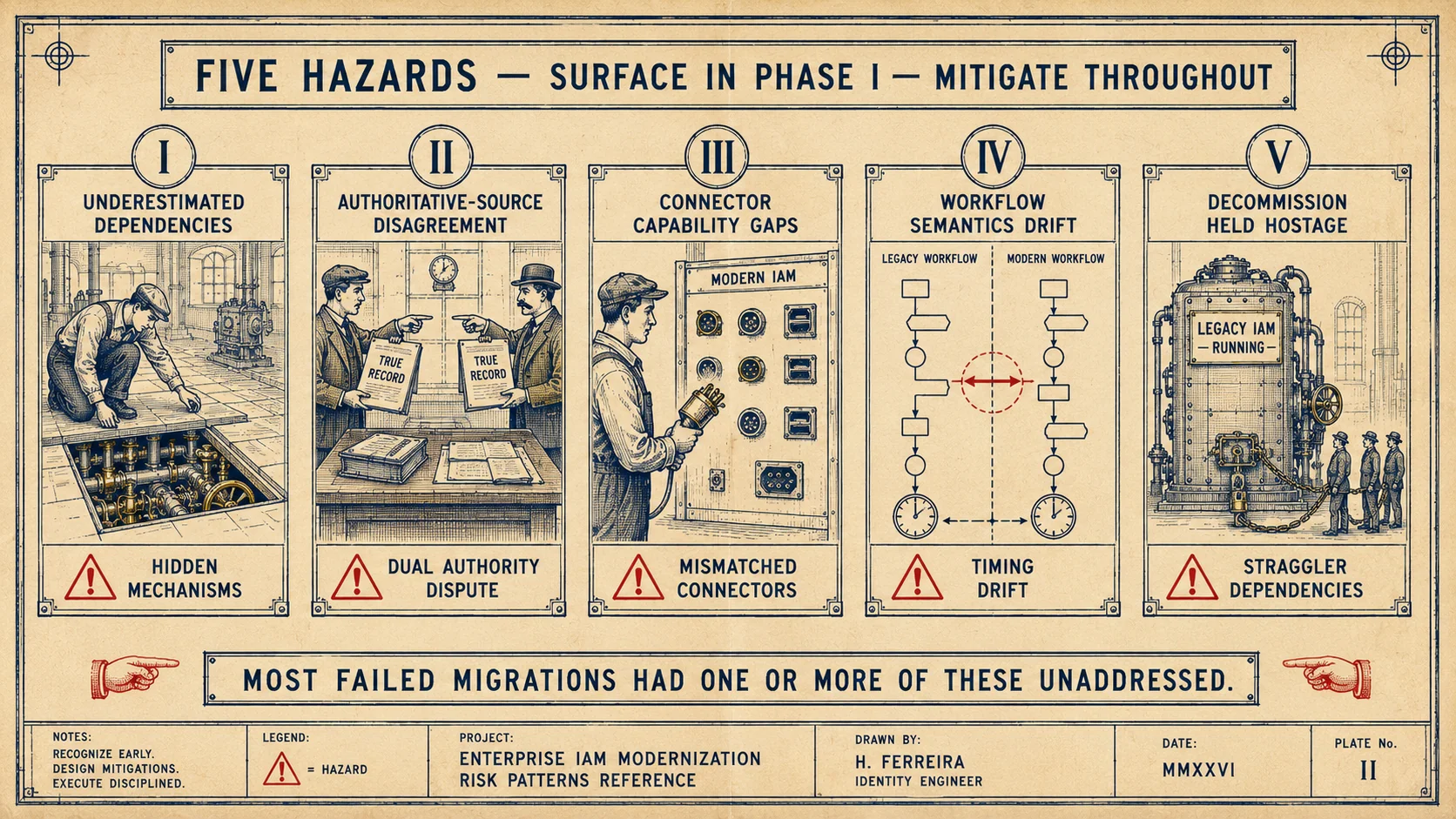 Five risks that derail legacy IAM migrations. Each is operationally addressable when surfaced early; each is a Phase 5 disaster when surfaced late.
The 2026 reference path
Run the five-phase playbook in sequence with explicit phase gating. Phase 1 inventory + dependency mapping → Phase 2 federation-based parallel running → Phase 3 lifecycle workflow port → Phase 4 application connector cutover → Phase 5 legacy decommission. Each phase produces a documented output that the next phase consumes; skipping phases produces failures.
Surface the five risk patterns in Phase 1 explicitly. Most failed migrations had one or more of these unaddressed; surfacing them early converts them from disasters into known risks with mitigation plans.
Plan for 12-24 months at enterprise scale. The pace is constrained by application-connector cutover (Phase 4), not by platform deployment (Phase 2). Set executive expectations accordingly; the platform deployment progress visible in the first 3-4 months doesn't predict the application cutover pace that dominates the remaining timeline.
Compose with the modern IAM stack. The migration targets are the platforms documented in our companion pieces: Best IGA Solutions, HRIS-Driven Lifecycle, PAM Enterprise. For mainframe integration specifically, the Demystifying RACF piece covers the foundations.
Use the IGA Project Failed piece as the recovery playbook if a previous migration attempt has stalled. The four-phase recovery (audit → narrow scope → re-baseline → restart) applies to legacy IAM migrations that derailed under prior leadership or earlier consulting engagements.
Legacy IAM modernization is one of the highest-leverage architectural improvements available to enterprise identity programs in 2026. The legacy platforms still secure mission-critical workloads; the modern platforms produce dramatically better operational outcomes (lifecycle timeliness, audit position, attack surface reduction). The migration is hard but the patterns that succeed are well-understood. Run the playbook.
ABOUT THE AUTHOR

More from IAM & Identity Governance
Identity Management and Digital Transformation in 2026
Every major transformation initiative — cloud migration, remote and hybrid work, mergers and acquisitions — eventually stalls on the same question: who gets access to what, and who decided? The 2026 strategy reference on identity management as the enabler and the bottleneck of digital transformation, the business case executives actually fund, and what modernization does not fix.

AI and Behavioral Analytics for Identity Monitoring: The 2026 Enterprise Reference
Static identity rules catch the attacks that announce themselves. They miss the ones that log in with valid credentials and behave almost normally. The 2026 reference on AI-driven identity monitoring — what behavioral analytics actually detects, the four telemetry sources that make or break the model, the false-positive economics nobody budgets for, and the honest limits of anomaly detection at enterprise scale.
Security Team Collaboration: A 2026 Framework for Identity Programs
Identity governance fails when it runs as a security-team-only initiative. The 2026 framework for cross-functional collaboration: four stakeholder groups, three coordination models, and how zero trust makes it a shared discipline.