The Truth About IAM Costs: Is Your Business Ready to Invest in 2026?
IAM investment questions rarely fail on the ROI math — the math works. They fail on readiness: enterprises buy governance platforms before the identity data, ownership model, and process discipline exist to use them. The 2026 reference on what IAM actually costs across its five cost drivers, what the investment returns and when, and the five-dimension readiness assessment that predicts whether your organization will realize the ROI or join the roughly half of IGA programs that stall.

IAM investment questions rarely fail on the ROI math — the math works. They fail on readiness: enterprises buy governance platforms before the identity data, ownership model, and process discipline exist to use them. The 2026 reference on what IAM actually costs across its five cost drivers, what the investment returns and when, and the five-dimension readiness assessment that predicts whether your organization will realize the ROI or join the roughly half of IGA programs that stall.
- IAM investment spans five cost drivers: licensing (per-user subscription, with wide variance in what the base tier includes), implementation and professional services (the driver that most often doubles budgets — traditional IGA deployments run 2-3x license cost in services), infrastructure (largely absorbed into SaaS/container deployment in 2026), ongoing operations (administration, policy upkeep, connector maintenance), and the hidden compliance surface (audit preparation, certification labor, evidence assembly) that rarely appears in vendor quotes.
- The returns concentrate in four categories: help desk reduction (password-related support runs $480 per employee per year at the enterprise average; SSPR + passwordless removes 60-80% of it), breach risk reduction (identity remains the leading attack vector; global average breach cost sits in the $4.4-4.9M range per IBM's annual study), audit and compliance efficiency (certification campaigns and evidence assembly drop from weeks to days when automated), and workforce productivity (provisioning time from days to minutes for joiners and movers).
- The ROI math works on paper for almost every enterprise above ~1,000 employees. What separates realized ROI from stalled programs is readiness — roughly half of IGA programs miss their original scope or timeline, and the failure analysis almost never blames the software. It blames identity data quality, unclear ownership, and process debt the platform was expected to fix by itself.
- The five-dimension readiness assessment: identity data quality (is there one authoritative source for who works here and in what role), ownership model (who owns IAM outcomes — not the tool, the outcomes), process maturity (do documented joiner-mover-leaver and access-request processes exist to automate), integration surface (are the target systems enumerated with connector coverage verified), and executive sponsorship (is there a business owner who will spend political capital when app owners resist onboarding). Score each 1-5; below 15 total, fix readiness before buying anything.
- Readiness gaps are not a reason to delay indefinitely — they are the first project phase. The 2026 pattern that works: fix the identity data source and ownership model first, deploy the quick-win layer (SSPR, SSO, MFA) that self-funds through help desk reduction while governance phases follow, and phase IGA scope by risk tier instead of attempting big-bang deployment.
Ask a CFO why an IAM investment got deferred and you'll rarely hear that the ROI math failed. The math almost always works: password support alone burns $480 per employee per year, identity remains the leading breach vector, and audit labor grows every cycle. Ask why an IAM investment disappointed two years after it was approved, and you'll hear a different story — one that has nothing to do with the spreadsheet and everything to do with readiness.
That's the truth about IAM costs that vendor TCO calculators skip: the investment question is really two questions. What does it cost and return? — which has well-established answers. And is this organization ready to realize the return? — which most buyers never formally ask, and which predicts program outcomes better than any feature comparison.
This piece answers both. The five cost drivers, the four return categories, and then the part that actually determines your outcome: a five-dimension readiness assessment you can score in an afternoon.
What IAM actually costs: the five drivers
Enterprise IAM cost decomposes into five drivers. Vendor quotes emphasize the first; budgets die on the second and fifth.
1. Licensing. Per-user subscription pricing dominates in 2026, with the critical variable being what the base tier includes. Modular vendors price lifecycle, governance, password management, privileged access, and connectors as separate SKUs — the quoted base price and the deployed price diverge module by module. All-inclusive vendors fold the capability set into one per-user number. The Enterprise IAM Cost Comparison piece carries the vendor-by-vendor figures; the pattern to underwrite is the capability-set price, never the base-tier price.
2. Implementation and professional services. The swing driver. Traditional IGA platforms carry services costs of 2-3x license fees — enterprise deployments where the integration bill exceeds $500K are common, and 12-18 month timelines are the traditional norm (SailPoint vs Avatier Pricing Comparison piece documents the pattern). Architecture determines this driver more than negotiation does: containerized platforms with pre-built connector libraries compress both the timeline and the services multiple dramatically.
3. Infrastructure. The driver that 2026 has mostly retired. SaaS and container-based deployment absorb the hardware, database, and scaling costs that on-premises IGA once carried. It survives as a line item mainly in regulated on-premises deployments and in hybrid architectures with data-residency requirements.
4. Ongoing operations. Administration, policy upkeep, connector maintenance, upgrade cycles. Budget real headcount fractions — and note that this driver is where platform complexity converts directly into permanent cost. A platform that needs specialist consultants for every workflow change carries a services annuity, not a services fee.
5. The hidden compliance surface. Certification campaign labor, audit evidence assembly, access-review cycles, separation-of-duties analysis. These costs exist whether or not you automate them — un-automated, they're paid in spreadsheet-weeks per audit (Access Review — What the Auditor Actually Wants piece); automated, they become the fourth return category below. Vendor quotes rarely mention this surface in either direction. The Hidden Costs of Identity Management piece covers the full undercounted-cost taxonomy.
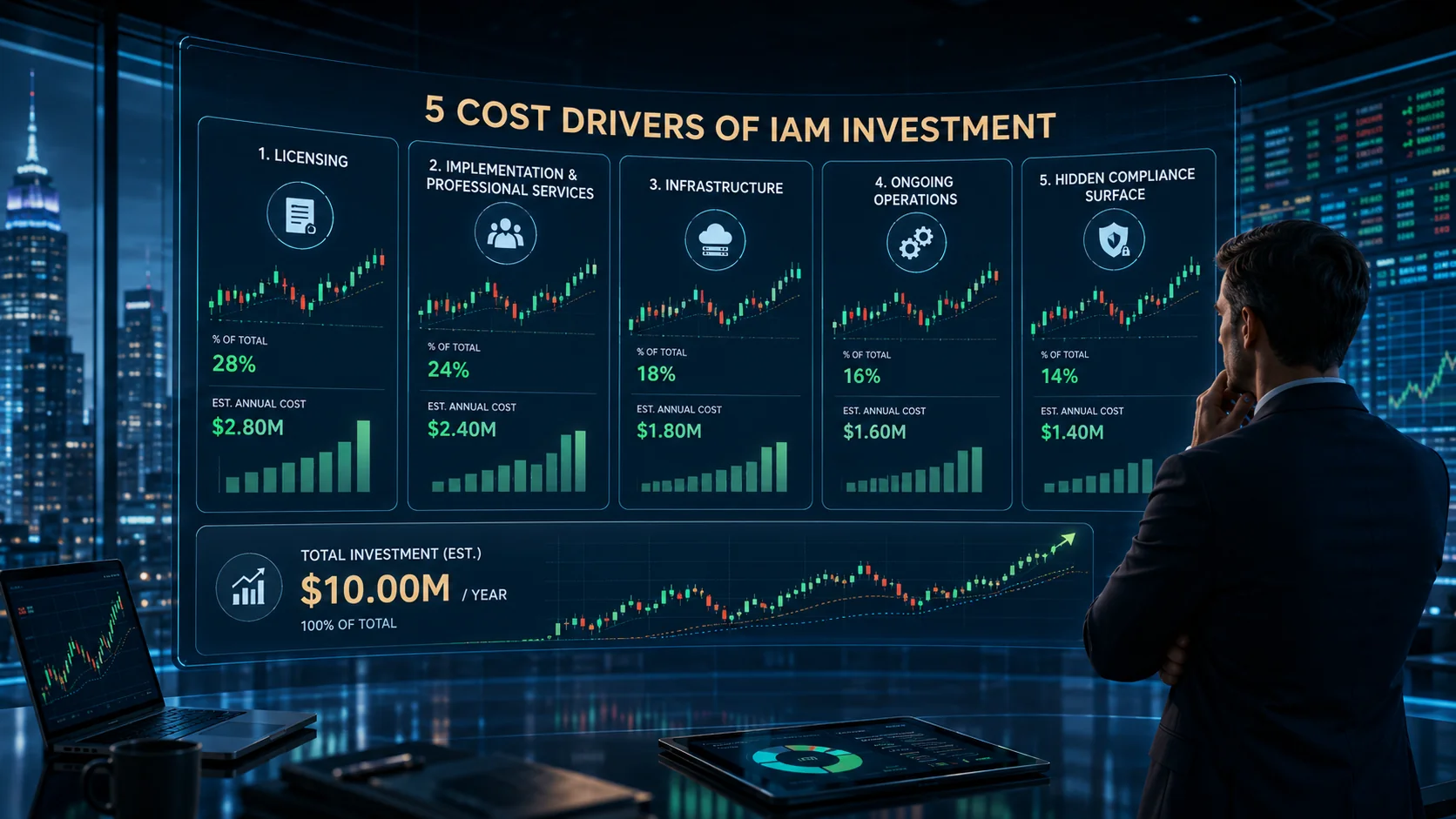 An illustrative composition of enterprise IAM spend across the five drivers — on traditional IGA deployments the professional-services share swells well past this split, which is exactly the line item to interrogate in vendor quotes.
What IAM returns: the four categories
1. Help desk reduction — the fast payback. Password-related support runs $480 per employee per year at the enterprise average, scaling to $2.4M annually at 5,000 employees (Password Help Desk Cost Analysis piece). SSPR plus passwordless deployment removes 60-80% of that volume (SSPR Enterprise Deployment piece). This category alone typically pays back the reset-layer investment in 18-36 months — which is why it's the standard self-funding first phase.
2. Breach risk reduction — the big number. Identity remains the leading attack vector, and the global average breach cost sits in the $4.4-4.9M range per IBM's annual Cost of a Data Breach study. IAM controls attack this number from multiple angles: MFA and phishing-resistant authentication cut credential compromise; lifecycle automation eliminates the orphaned accounts attackers love; least privilege caps blast radius (Principle of Least Privilege piece); ITDR shortens detection windows (ITDR piece). Priced as avoided expected loss, this is usually the largest line in the business case — and the one that requires the most disciplined modeling to survive CFO scrutiny (Digital Identity Costs and ROI piece).
3. Audit and compliance efficiency. Automated certification campaigns, continuous evidence assembly, and provable joiner-mover-leaver control convert audit preparation from weeks of spreadsheet excavation into report generation. For SOX, HIPAA, and PCI-DSS regulated enterprises, this category is frequently what gets the project approved, because audit findings have named owners and deadlines in a way that abstract risk does not.
4. Workforce productivity. Provisioning time from days to minutes for joiners and movers; self-service access requests replacing ticket queues; SSO removing login friction across the app estate. Individually small, multiplied by headcount and turnover — material.
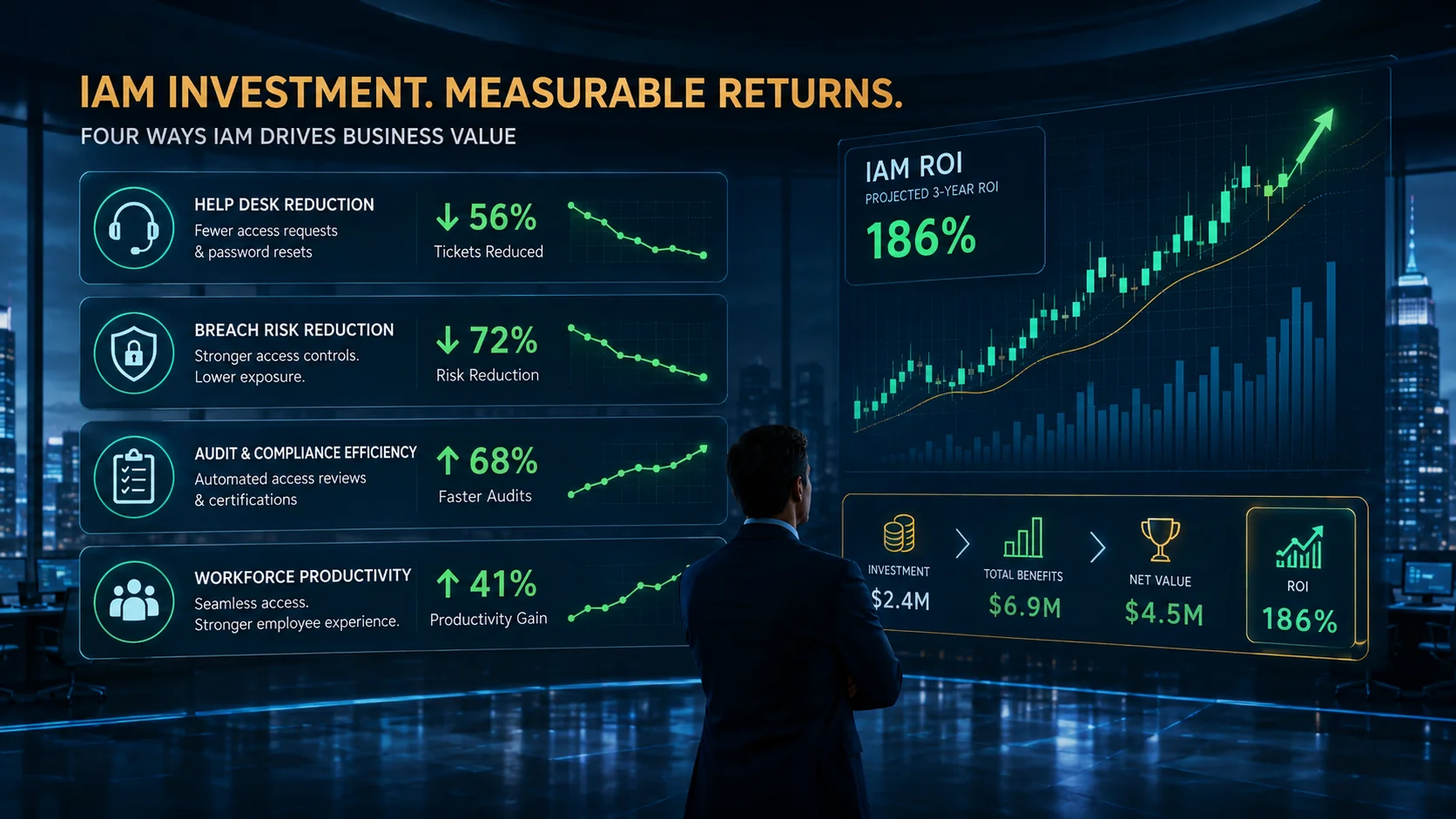 The four return categories, illustrated — help desk reduction pays fastest, breach-risk reduction is the biggest number, audit efficiency is what usually gets the project approved.
Run honestly, the four categories clear the five cost drivers for almost any organization above roughly 1,000 employees. Which raises the real question: if the math works this reliably, why do so many IAM programs disappoint?
The readiness gap: why fine ROI models produce stalled programs
Industry analysts have documented for years that roughly half of IGA programs miss their original scope or timeline. The post-mortems almost never blame the software. They blame the conditions the software landed in: identity data nobody trusted, processes nobody had written down, ownership nobody had assigned, and sponsorship that evaporated at the first integration dispute (IGA Project Recovery piece covers the recovery playbook when this has already happened).
That's the readiness gap. The platform automates what exists. If what exists is contradiction and tribal knowledge, the platform automates contradiction at scale.
The five-dimension readiness assessment
Score each dimension 1 (absent) to 5 (strong). The scoring conversation itself — done with HR, IT, security, and one business stakeholder in the room — is worth more than most vendor demos.
1. Identity data quality. Is there one authoritative source for who works here, in what role, reporting to whom, active or terminated? Does HR data match directory data? Score 5: HRIS is authoritative, synced, and trusted (HRIS-Driven Identity Lifecycle piece). Score 1: HR, IT, and payroll produce three different headcounts.
2. Ownership model. Who owns IAM outcomes — orphaned-account rates, certification completion, provisioning SLA — as opposed to who administers the tool? Score 5: a named business owner with outcomes in their goals. Score 1: IAM is a shared service nobody's performance review mentions.
3. Process maturity. Do documented joiner-mover-leaver and access-request processes exist? Automation requires a defined process to automate. Score 5: documented, followed, and periodically reviewed. Score 1: the process is whatever the last admin remembers doing.
4. Integration surface. Are target systems enumerated — with owners, protocols, and connector coverage verified against a real vendor catalog? Connector surprises are the top services-budget killer. Score 5: full inventory including the legacy and mainframe estate (RACF and iSeries systems are exactly where inventories go to be wrong). Score 1: the app list is "whatever's in SSO today."
5. Executive sponsorship. When an application owner refuses to onboard — and one will — who spends the political capital? Score 5: C-level sponsor with a mandate. Score 1: the project's authority ends at the IT org chart boundary.
Scoring: 20-25 — ready; buy against the capability-set evaluation in Selecting an Identity Vendor. 15-19 — ready with conditions; close the weakest dimension in parallel with a quick-win-first deployment. Below 15 — fix readiness before signing anything; the platform will not fix it for you.
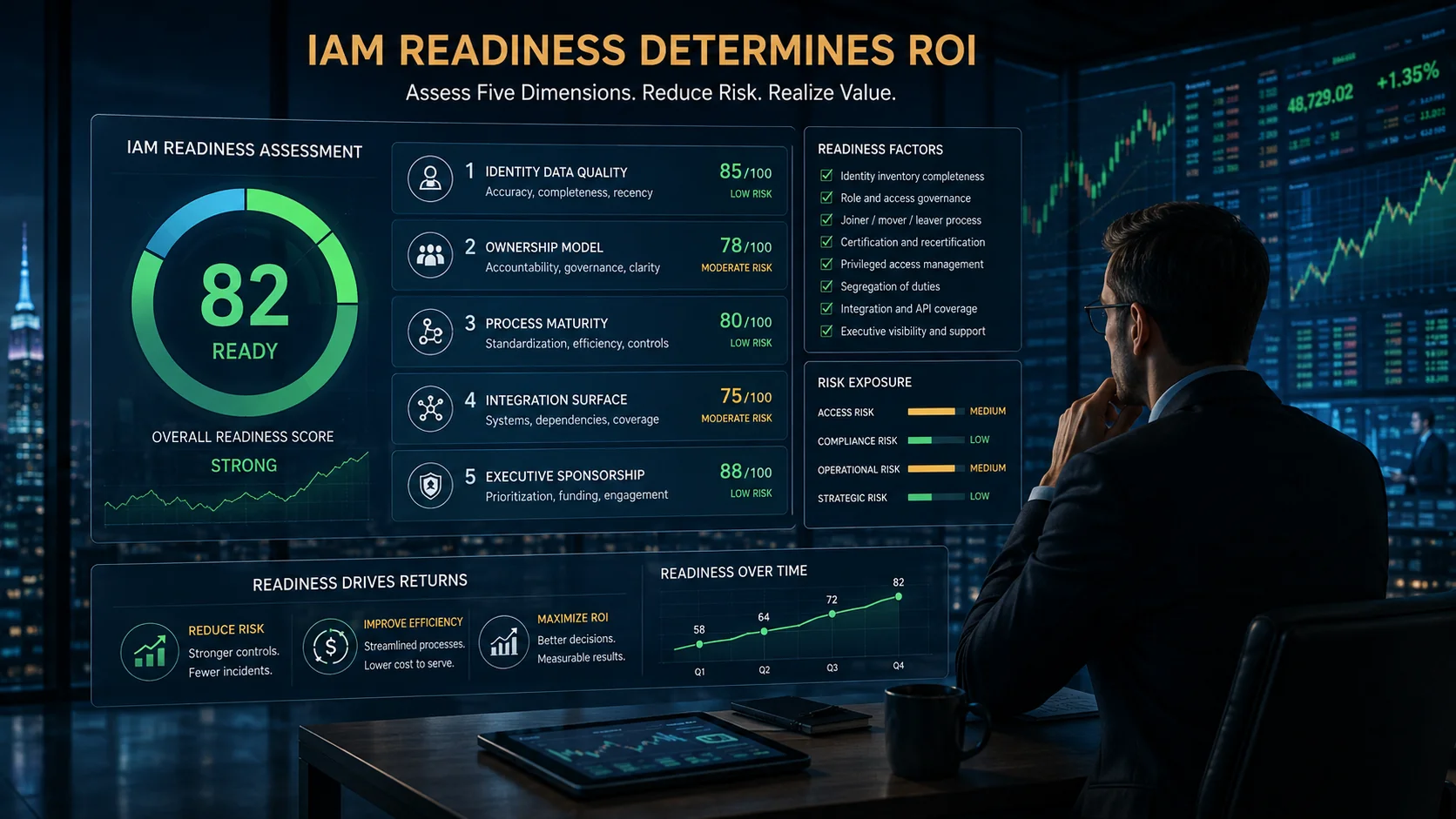 An example of the five-dimension scorecard in practice — the scoring conversation with HR, IT, security, and a business stakeholder in the room is worth more than most vendor demos.
Readiness gaps are phase one, not a reason to wait
The wrong conclusion from a low readiness score is indefinite delay — identity risk and help desk burn continue regardless. The right conclusion is sequencing:
- Fix the identity source and ownership first. HRIS-to-directory reconciliation and a named outcome owner cost little and de-risk everything downstream.
- Deploy the self-funding layer early. SSPR, SSO, and MFA don't require governance maturity, cut the $480-per-employee burn immediately, and build organizational trust in the program while the harder phases assemble.
- Phase governance by risk tier. Certify and automate the regulated and privileged scope first; expand outward. Big-bang IGA scope is the signature move of the stalled-program cohort (Identity Maturity Model piece maps the full staged progression).
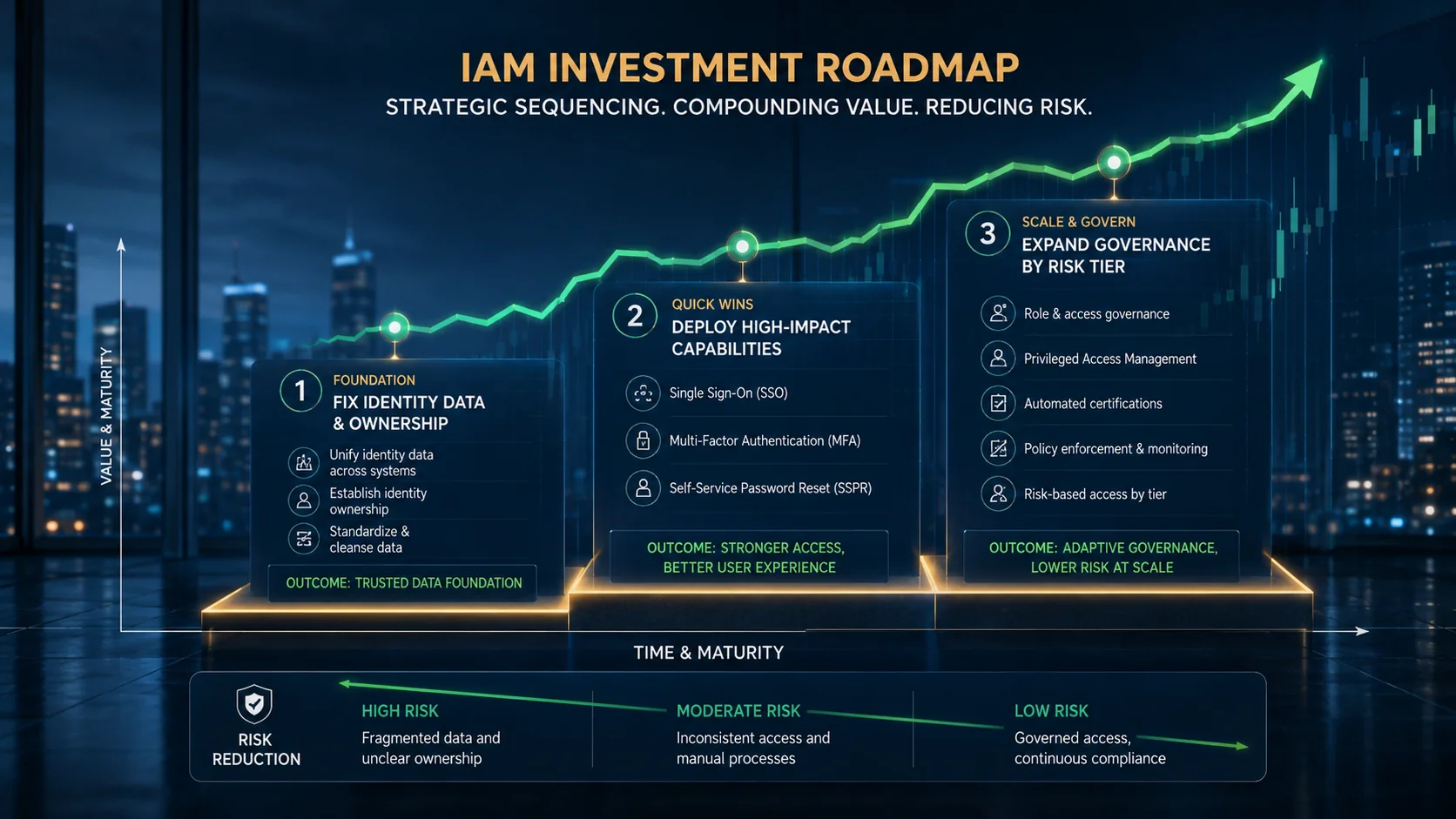 Readiness gaps as phase one — fix the data and ownership, deploy the self-funding layer, then phase governance by risk tier.
So — are you ready to invest?
The truthful 2026 answer: the cost side of IAM is more favorable than it has ever been — containerized deployment and all-inclusive licensing have collapsed the services and licensing traps that defined the last decade — and the return side is well-documented and CFO-defensible. The math is not your risk.
Your risk is readiness, and unlike breach probability, it's entirely within your control. Score the five dimensions honestly, sequence the gaps as phase one, deploy the self-funding layer while governance matures — and the IAM investment stops being a leap of faith and becomes what it should have been all along: an infrastructure decision with a payback schedule.
ABOUT THE AUTHOR

More from IAM & Identity Governance

Identity Management and Digital Transformation in 2026
Every major transformation initiative — cloud migration, remote and hybrid work, mergers and acquisitions — eventually stalls on the same question: who gets access to what, and who decided? The 2026 strategy reference on identity management as the enabler and the bottleneck of digital transformation, the business case executives actually fund, and what modernization does not fix.

AI and Behavioral Analytics for Identity Monitoring: The 2026 Enterprise Reference
Static identity rules catch the attacks that announce themselves. They miss the ones that log in with valid credentials and behave almost normally. The 2026 reference on AI-driven identity monitoring — what behavioral analytics actually detects, the four telemetry sources that make or break the model, the false-positive economics nobody budgets for, and the honest limits of anomaly detection at enterprise scale.
Security Team Collaboration: A 2026 Framework for Identity Programs
Identity governance fails when it runs as a security-team-only initiative. The 2026 framework for cross-functional collaboration: four stakeholder groups, three coordination models, and how zero trust makes it a shared discipline.