Privileged Access Management (PAM) for Enterprise in 2026
Privileged Access Management is the discipline that governs the small population of identities with disproportionately large blast radius — domain admins, mainframe operators, financial-system controllers, security tools, service accounts. The 2026 reference on what PAM actually covers, where it overlaps and diverges from IGA, and the architecture that gets both right.

Privileged Access Management is the discipline that governs the small population of identities with disproportionately large blast radius — domain admins, mainframe operators, financial-system controllers, security tools, service accounts. The 2026 reference on what PAM actually covers, where it overlaps and diverges from IGA, and the architecture that gets both right.
The privileged population is small. In most enterprises, fewer than 5% of identities have privileged access of any meaningful scope, and the population of identities with truly high-impact privilege (production database admins, domain admins, mainframe security officers, financial-system controllers) is typically under 1%. The mathematical implication is that securing the privileged surface is bounded — a small enough population to apply controls that would be operationally prohibitive at workforce scale.
The risk distribution is the opposite of the population distribution. The privileged identities account for a disproportionate share of breach impact, lateral-movement scope, and incident severity in essentially every 2026 enterprise incident report. The Mandiant M-Trends data continues to show privilege escalation and privileged-account compromise as primary attack patterns; the Microsoft Digital Defense Report identifies privileged-account abuse as one of the dominant pathways from initial access to material business impact. The asymmetric mathematics — small population, large risk — is why Privileged Access Management is a distinct discipline rather than a subset of general identity governance.
This piece is the 2026 enterprise reference on PAM. The companion pieces handle adjacent territory: Best IGA Solutions covers the broader governance layer PAM integrates with, Storm-2949 governance failure covers the recovery-channel pattern that defeats privileged accounts as well as any others, Mandatory vs Discretionary Access Control covers the policy-model foundation, and the ITDR piece covers the detection layer that watches for privileged-account abuse at runtime. This piece is the PAM-specific layer that runs across all of them.
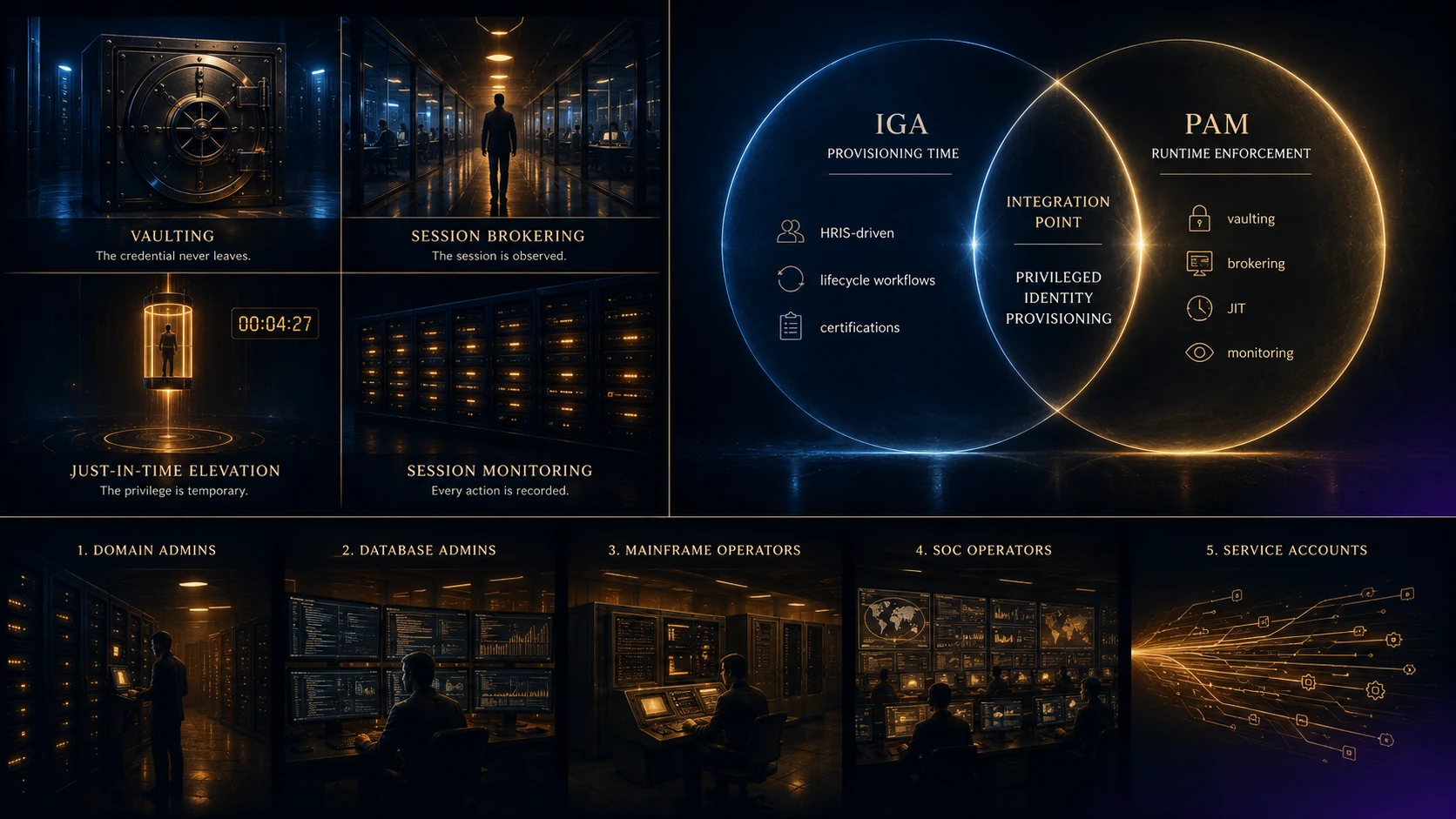 The four PAM capabilities at the top, the IGA-PAM integration relationship beside them, and the five workforce segments PAM must cover below. The discipline is defined by what it does at runtime, not by what permissions it grants at provisioning time.
What PAM actually covers, mechanically
Privileged Access Management is defined by four core capabilities that distinguish it from general identity governance. The capabilities are operationally specific and each addresses a different facet of the privileged-account risk surface.
Vaulting is the practice of storing privileged credentials in a centrally-controlled, hardware-protected vault that users do not directly access. Instead of a domain admin holding their administrator password in their head (or in a password manager), the password lives in the vault. When the admin needs to use the privileged credential, they authenticate to the vault with their personal identity (which can be phishing-resistant), the vault retrieves the credential, and either supplies it directly or initiates a session on the admin's behalf. The admin never sees the credential. The credential is rotated automatically on schedule and after every use, so even if it were captured in transit, the captured copy is invalid quickly.
Session brokering mediates privileged sessions through a controlled proxy. Instead of the admin connecting directly to a target system (SSH to a production server, RDP to a domain controller, terminal access to a mainframe), the connection routes through the PAM proxy. The proxy authenticates the admin, verifies the policy permits the requested session, performs the credential injection so the admin doesn't see the password, records the session for audit, and enforces runtime policy (block specific commands, time-box the session, require approval for high-risk operations). The brokered session is what makes privileged access observable and policy-enforceable in ways that direct credential-based access is not.
Just-in-time elevation grants privilege at the moment of use, scoped to the specific operation, with explicit time-limited duration. Instead of a user holding a standing domain-admin role permanently, the user has a regular role plus a workflow path to request domain-admin elevation when needed. The request triggers approval (which might be automatic for routine operations, or require manager sign-off for sensitive ones), grants the privilege for the requested duration, and automatically revokes when the duration expires. The standing privileged-account surface is minimized — when no one currently holds standing domain-admin privileges, the attacker has fewer targets.
Session monitoring and recording captures what privileged users actually do during their sessions. The session recording provides forensic evidence in incident response, audit evidence for compliance review, and signal for runtime anomaly detection. The pattern varies by session type — keystroke logging for terminal sessions, screen recording for GUI sessions, command logging for API-based privileged operations, mainframe SMF (System Management Facility) records for z/OS workloads. The recording itself is stored in a tamper-evident format so it can be relied on as forensic evidence.
The four capabilities compose into a PAM architecture that addresses the privileged-account risk surface across the standard dimensions: credentials are not held directly by users (vaulting), sessions are mediated and observable (brokering), standing privilege is minimized (JIT), and what privileged users do is recorded (monitoring).
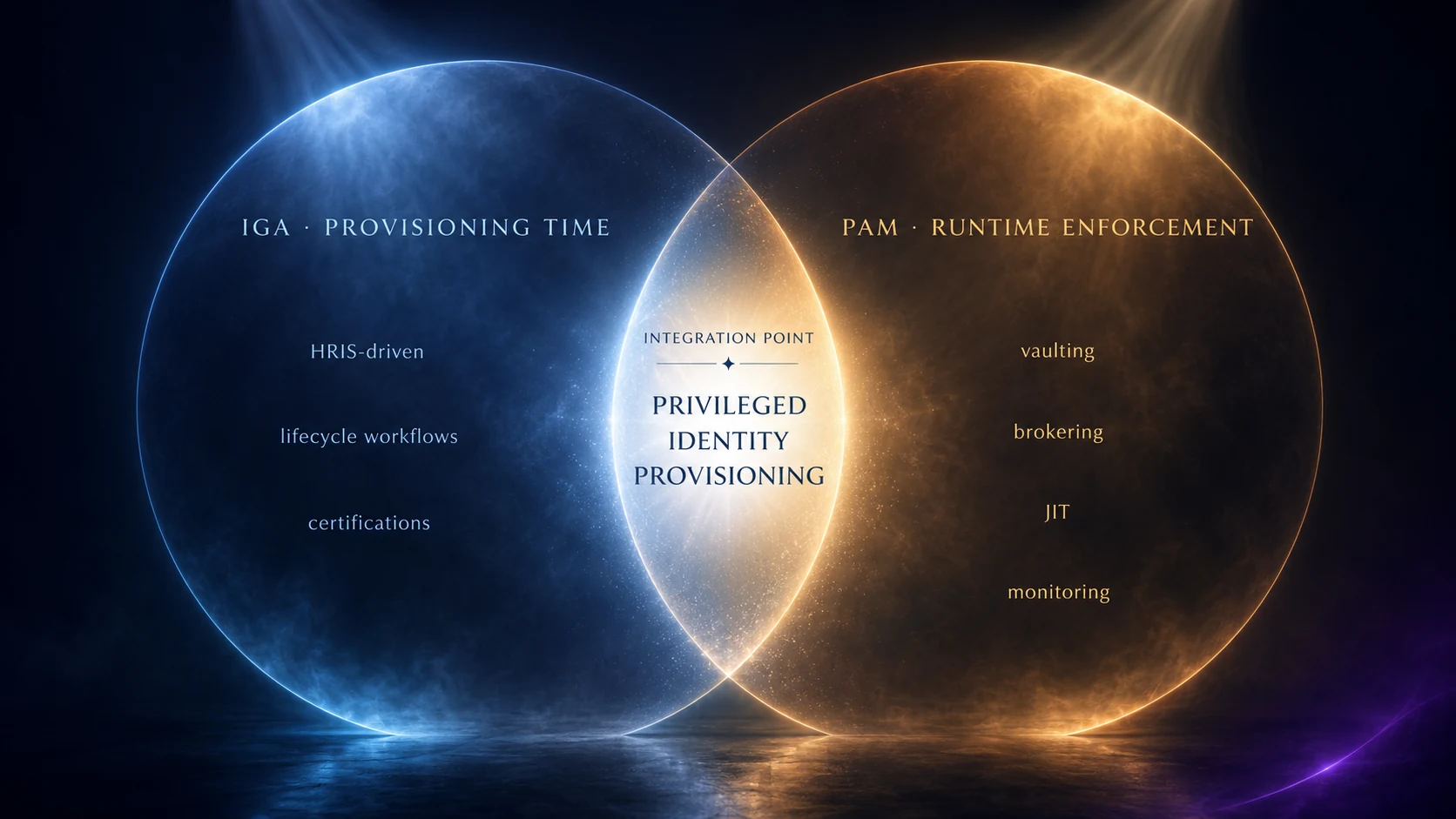 Different layers, integrated workflow. IGA owns who can have privileged access; PAM owns what happens when they exercise it. The integration runs in both directions — IGA's lifecycle workflows drive PAM provisioning, PAM's runtime signals feed back into IGA certifications.
Where PAM overlaps and diverges from IGA
PAM and Identity Governance (IGA) share enough conceptual territory that enterprises sometimes try to use one to do the other's job. The result is usually that both layers underperform. The cleaner architecture pattern recognizes the overlap and the divergence and integrates the two layers explicitly.
Where the overlap is. Both PAM and IGA govern access to enterprise resources. Both depend on HRIS source-of-truth for authoritative identity state. Both implement role-based access decisions. Both produce audit evidence for compliance. The lifecycle workflows that govern when a user gets privileged access in the first place (a new domain admin gets hired, a user changes role and needs new privileged scope, a user leaves and needs privileged access revoked) are IGA workflows. The overlap is real and the integration is necessary.
Where the divergence is. IGA operates at provisioning time — when a user is hired, when a role changes, when access certification runs. The decision is what access the user should have, expressed as a set of role assignments that propagate into the resource layer. PAM operates at runtime — when the user actually exercises privileged access, what controls apply to that exercise. The decision is what the user is allowed to do right now in this specific session, expressed as enforcement actions in the brokered session. IGA produces the standing state; PAM enforces the runtime behavior.
The IGA layer cannot meaningfully implement vaulting, session brokering, JIT elevation, or session recording. These are runtime controls that require a different architectural pattern than provisioning workflows. The PAM layer cannot meaningfully implement access certification, lifecycle-aligned deprovisioning, or organization-wide policy expression — these are provisioning concerns that require the IGA layer's pattern.
The integration pattern. IGA owns the question of who can have privileged access — derived from HRIS, evaluated through governance workflows, certified periodically. PAM owns the question of what controls apply when they exercise it — vaulting, brokering, JIT, monitoring. The integration runs in both directions: IGA's lifecycle workflows drive PAM's account provisioning (a new domain admin's account is created in the PAM platform when the IGA platform sees the role assignment from HRIS), and PAM's runtime signals feed back into IGA's certification cycles (a domain admin who hasn't used the account in 90 days gets flagged in the next access certification).
The pattern that fails is treating PAM as a feature of IGA or IGA as a feature of PAM. The pattern that works is recognizing that they are distinct disciplines with explicit integration.
The five workforce segments PAM has to cover
Enterprise PAM deployments in 2026 cover five operationally distinct populations. Each has a different deployment pattern, different policy requirements, and different operational fit considerations.
Domain administrators and platform engineers. The canonical PAM population — users with administrative authority over the Windows domain, Linux systems, cloud platforms, network infrastructure. The deployment pattern is hardware-FIDO2-key authentication to the PAM vault, brokered sessions to target systems, JIT elevation for routine work, session recording for forensic purposes. The population is small (typically dozens to hundreds in a large enterprise) and the operational fit is well-understood.
Database administrators. Privileged access to production databases is one of the highest-impact privileged surfaces because of the data sensitivity. The deployment pattern is similar to domain admins but with database-aware session brokering — the PAM platform proxies database connections, enforces query-level policy (block bulk export, require approval for schema changes), and records the actual SQL statements executed. The operational fit varies by database technology; Oracle, SQL Server, PostgreSQL, MongoDB each have their own access patterns and PAM integration depths.
Mainframe operators and security officers. The mainframe population is operationally distinct because the access patterns predate most modern PAM platform designs. RACF, ACF2, and Top Secret have their own privileged-user concepts (RACF SPECIAL, ACF2 SECURITY, Top Secret MSCA) that PAM platforms need to integrate with rather than replace. The session recording uses z/OS SMF records (Type 80 for RACF, equivalents for ACF2 and Top Secret) rather than the terminal-based recording PAM uses for Linux. Avatier's native mainframe connectors handle this integration in a way most general-purpose PAM platforms do not.
Security tools and SOC operators. The security toolchain (SIEM admin, EDR console, SOAR platform, identity-platform admin) is a privileged surface that's often under-managed because it's not on the conventional privileged-account inventory. The PAM coverage of this population is operationally challenging because the security tools themselves often have their own authentication and session models that don't integrate cleanly with general PAM platforms. The 2026 pattern is to bring SOC-tool admin under PAM coverage explicitly as a first-class population, recognizing that compromising the SOC tools is one of the highest-impact attack patterns against the defending organization.
Service accounts and non-human identities. The largest privileged population in most 2026 enterprises is service accounts — applications, scripts, automation pipelines, and integration components that hold privileged credentials to perform their function. The traditional pattern (credentials in configuration files, environment variables, or hardcoded in application code) is what PAM platforms are designed to replace. The replacement pattern is vault-retrieval at runtime, workload identity federation (Kubernetes service account tokens, AWS IAM roles, Azure managed identities), or secret-rotation-aware client libraries. The operational challenge is discovery — many enterprises have substantial populations of legacy service accounts whose existence is not centrally inventoried.
The deployment architecture decides which PAM platform fits which segment. CyberArk and BeyondTrust have broad coverage across human-privileged populations; Delinea covers the smaller-scale and mid-market deployments well; HashiCorp Vault has strong non-human-identity coverage but less native human-PAM functionality. Most large enterprises run multiple PAM platforms for different segments.
What Avatier ships toward this pattern
Avatier Identity Anywhere does not compete with dedicated PAM platforms — instead, the architecture is designed to integrate with the PAM platforms enterprises already deploy. Avatier Identity Anywhere Lifecycle Management drives the privileged-account provisioning lifecycle into the PAM platform through standard provisioning interfaces (SCIM, REST API, vendor-specific connectors). Joiner workflows from HRIS create privileged identities in the PAM vault; mover workflows update them when roles change; leaver workflows revoke them at offboarding.
For mainframe environments, Avatier's native RACF, ACF2, and Top Secret connectors handle the privileged-account provisioning that general-purpose PAM platforms have weak coverage for. The privileged populations on the mainframe (RACF SPECIAL users, ACF2 SECURITY users, Top Secret MSCA accounts) are provisioned through the same Avatier lifecycle workflows as modern-stack privileged accounts, with the same HRIS-aligned ground truth.
The access certification workflows in Avatier IGA include privileged-account certifications as a first-class category — privileged accounts get more frequent certifications than general accounts, with stricter approver requirements and explicit out-of-band verification when high-risk decisions are involved. The certification signal feeds back into the PAM platform for revocation when the certification expires without renewal.
Recovery flows tie through Password Station for workflow-verified resets — the architecture that closes the social-engineering vector covered in the Storm-2949 piece. Privileged-account recovery is especially sensitive because a compromised recovery flow on a privileged account is one of the highest-impact attack patterns; the workflow-verified pattern is what closes the recovery-channel gap that defeats privileged accounts as effectively as it does any others.
The Avatier Trust Center publishes our compliance posture (SOC 2 Type II zero exceptions, ISO/IEC 27001:2022, PCI DSS v4.0.1, CSA STAR Level 1, NIST 800-53 Rev. 5 aligned, CISA Secure-by-Design Pledge signatory). The architectural pattern is intentionally vendor-neutral on the PAM-platform side — Avatier provides the governance and lifecycle layer that integrates with whichever PAM platform the enterprise has chosen, not a competing PAM platform.
The honest closing
PAM is the runtime control discipline for the small population of identities with disproportionate blast radius. The four core capabilities — vaulting, session brokering, just-in-time elevation, session recording — are what distinguish PAM from general identity governance, and the integration with IGA is what makes both layers work. The 2026 enterprise reality is that PAM coverage extends beyond the conventional domain-admin and database-admin populations to include mainframe operators, security toolchain admins, and the rapidly-growing service-account and non-human-identity population. The deployment architecture choices — which PAM platforms cover which segments, how the integration with IGA is structured, how the mainframe estate is governed, how JIT and ZSP are deployed across the privileged surface — are what separate enterprises that have actually secured the privileged surface from those that have merely deployed a vault for the production passwords and called it done.
ABOUT THE AUTHOR

More from Access Management

PIM vs PAM vs PUM: Privileged Access Defined for 2026
PIM, PAM, and PUM get used interchangeably and mean three different things. PIM manages who holds privileged identity and which roles carry it. PAM controls how privilege is exercised through vaulting, session control, and just-in-time elevation. PUM manages the shared privileged accounts nobody personally owns. The 2026 reference on distinguishing the three terms, where they overlap, and where to start.

DNS as Identity Infrastructure: A 2026 Reference
DNS resolution, DNSSEC integrity, and DNS poisoning as a credential-harvesting vector — the 2026 reference on treating DNS as identity infrastructure, not network plumbing.

Password Hash Synchronization in 2026: Hybrid AD to Entra ID
Password hash synchronization keeps on-prem Active Directory and Microsoft Entra ID authoritative together — how the sync cycle works, its security tradeoffs, and where it fits against federation.