Identity Management and Digital Transformation in 2026
Every major transformation initiative — cloud migration, remote and hybrid work, mergers and acquisitions — eventually stalls on the same question: who gets access to what, and who decided? The 2026 strategy reference on identity management as the enabler and the bottleneck of digital transformation, the business case executives actually fund, and what modernization does not fix.

Every major transformation initiative — cloud migration, remote and hybrid work, mergers and acquisitions — eventually stalls on the same question: who gets access to what, and who decided? The 2026 strategy reference on identity management as the enabler and the bottleneck of digital transformation, the business case executives actually fund, and what modernization does not fix.
- Identity management enables digital transformation by answering one question at the speed the business now needs it answered: who gets access to what, granted and revoked automatically as people join, move, and leave. When that question is slow, every initiative built on top of it is slow too.
- The three transformation initiatives that dominate enterprise roadmaps — cloud migration, remote and hybrid work, and mergers and acquisitions — all convert directly into access problems. Each one multiplies the number of identities, systems, and entitlements a single directory was never designed to govern.
- Legacy identity slows transformation in three recurring ways: siloed directories that no single system can see across, manual provisioning that turns onboarding into a multi-week ticket queue, and the absence of a unified audit trail that makes every compliance cycle a manual reconstruction.
- The executive business case is not a security pitch. It is speed-to-value: faster time-to-productivity for new hires, faster cloud and application onboarding, faster and cleaner M&A integration, and audit evidence produced as a byproduct of operations rather than a quarterly fire drill.
- Identity modernization does not authenticate anyone on its own, does not fix bad HR data, and does not replace the executive alignment that transformation actually requires. It removes the identity bottleneck; it does not remove the need for the rest of the program.
Identity management enables digital transformation by answering one question at the speed the business now needs it answered: who gets access to what, and for how long. Every transformation initiative an enterprise runs — migrating workloads to the cloud, standing up a durable hybrid-work model, absorbing an acquired company — ultimately resolves into that access question, multiplied across more identities, more systems, and more entitlements than any legacy directory was designed to handle. When identity can grant the right access on day one and revoke it the moment it is no longer justified, transformation moves at the pace of the business. When identity is manual and fragmented, it becomes the bottleneck every other project quietly waits on. That is the whole thesis: identity is both the enabler and, when neglected, the rate limiter of digital transformation.
This is the 2026 update of Avatier's original piece on identity management and digital transformation. The original framed identity as a strategic enabler and leaned on a stack of vendor-attributed statistics to make the case. This rewrite keeps the strategic frame — identity as the layer transformation runs through — and drops the borrowed numbers in favor of the mechanics practitioners can actually verify against their own environment. The argument does not need inflated percentages; it needs to be recognizable to anyone who has watched a cloud migration or a merger slow to a crawl because nobody could answer, quickly and defensibly, who was allowed to touch what.
Why every transformation initiative eventually becomes an identity problem
Transformation initiatives get funded on outcomes — faster product cycles, lower infrastructure cost, a workforce that can work from anywhere, a bigger footprint through acquisition. None of those outcomes are described in the language of identity. And yet each one, followed to its operational floor, lands on the same substrate: people and systems that need access to resources, granted deliberately and removed reliably.
The reason is structural. Digital transformation is, in large part, the multiplication of digital resources. More applications, more infrastructure, more data stores, more integrations, more external collaborators. Every one of those resources is something that some identities should reach and most should not. The transformation adds the resources on a project timeline; the obligation to govern access to them arrives at the same moment, whether or not anyone planned for it. If the identity layer can absorb that obligation automatically, the resources come online and stay governed. If it cannot, the organization faces a choice it usually makes badly under deadline pressure: grant access broadly and manually, and defer the cleanup indefinitely.
This is why identity is the initiative that is never on the roadmap but always on the critical path. A cloud migration plan has workstreams for infrastructure, networking, data, and application refactoring. It rarely has a workstream that reads "re-answer who can access all of this, at the new scale, without adding weeks of provisioning delay." So the identity work happens anyway — as unplanned friction, discovered mid-project, absorbed as schedule slip and audit debt rather than managed as a deliverable. The organizations that treat identity as a first-class transformation workstream are not more cautious; they are just paying the bill on purpose instead of by surprise.
Identity as the enabler: cloud, hybrid work, and M&A
Three initiatives dominate enterprise transformation roadmaps, and each one is, underneath, an identity story. Seeing them that way is what turns identity from a cost center into the enabler that lets the other three succeed.
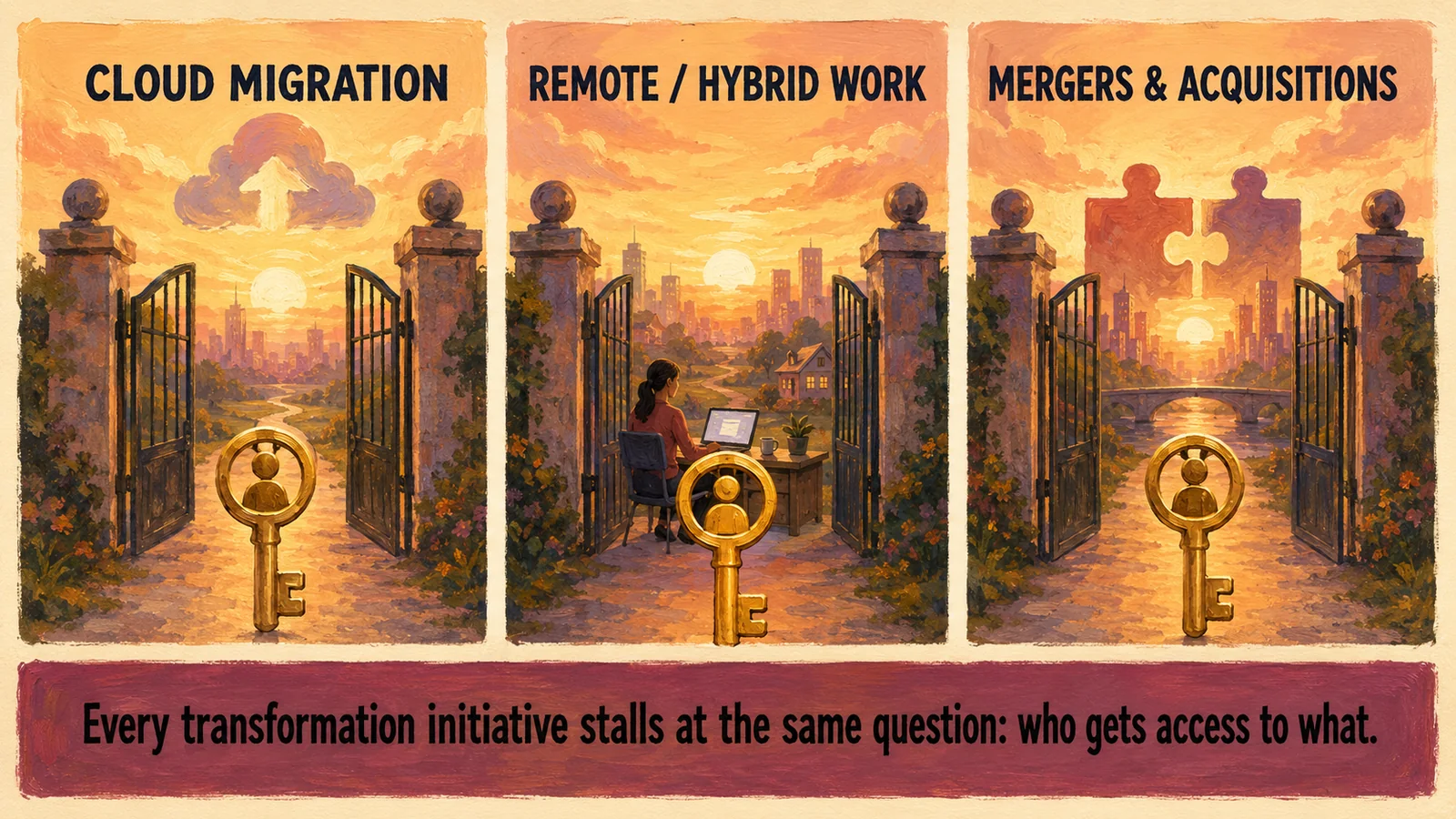 The same key opens all three gates: identity is the single credential that unlocks cloud, hybrid work, and M&A as transformation initiatives.
Cloud migration. Moving workloads off owned hardware changes where resources live without changing who is allowed to reach them — and it multiplies the surfaces where that question has to be answered. A single employee may now hold entitlements spread across legacy on-premises systems, a dozen SaaS applications, and infrastructure in more than one public cloud, each with a distinct permission model and admin console. Modern identity management is what keeps that from fragmenting into a dozen ungoverned islands: a single control plane over access regardless of where the workload runs, standards-based provisioning to cloud applications, and federated single sign-on so users authenticate once rather than accumulating a password per platform. Migrate without that layer and the cloud program silently recreates — at greater scale — the exact fragmentation it was chartered to eliminate.
Remote and hybrid work. The durable shift to distributed work removed the corporate network as a trust boundary. A device is no longer meaningfully "inside" or "outside"; location tells you almost nothing about whether an access request is legitimate. That forces access decisions onto the identity itself — strong authentication that travels with the user, single sign-on that behaves identically from a home office or an airport, self-service access requests that never depend on being in a building, and lifecycle automation that keys access to employment status rather than physical presence. Identity is what makes "work from anywhere" compatible with "governed everywhere." It is also where authentication strength stops being optional, because the identity is now the perimeter.
Mergers and acquisitions. An acquisition doubles the identity estate on the day the deal closes, and does it under the highest time pressure of any initiative on this list. The acquired organization brings its own directory, its own applications, its own entitlement conventions, and a population of people who may now exist as duplicate identities across two systems. The path of least resistance — grant broad access fast, reconcile later — is precisely how orphaned accounts and unmapped privilege become permanent fixtures. Identity management shortens the integration by giving both sides a target model to consolidate into: unified directories, lifecycle automation driven from an authoritative HR source, and governance that surfaces redundant and orphaned access before it calcifies. Done well, employees from an acquired company are absorbed into a coherent access model in weeks; done poorly, the seams are still visible years later.
Where legacy identity slows transformation down
If identity is the enabler, legacy identity is the anchor. The failure is rarely dramatic — no single outage, no headline breach. It is chronic drag, and it comes from three recurring sources.
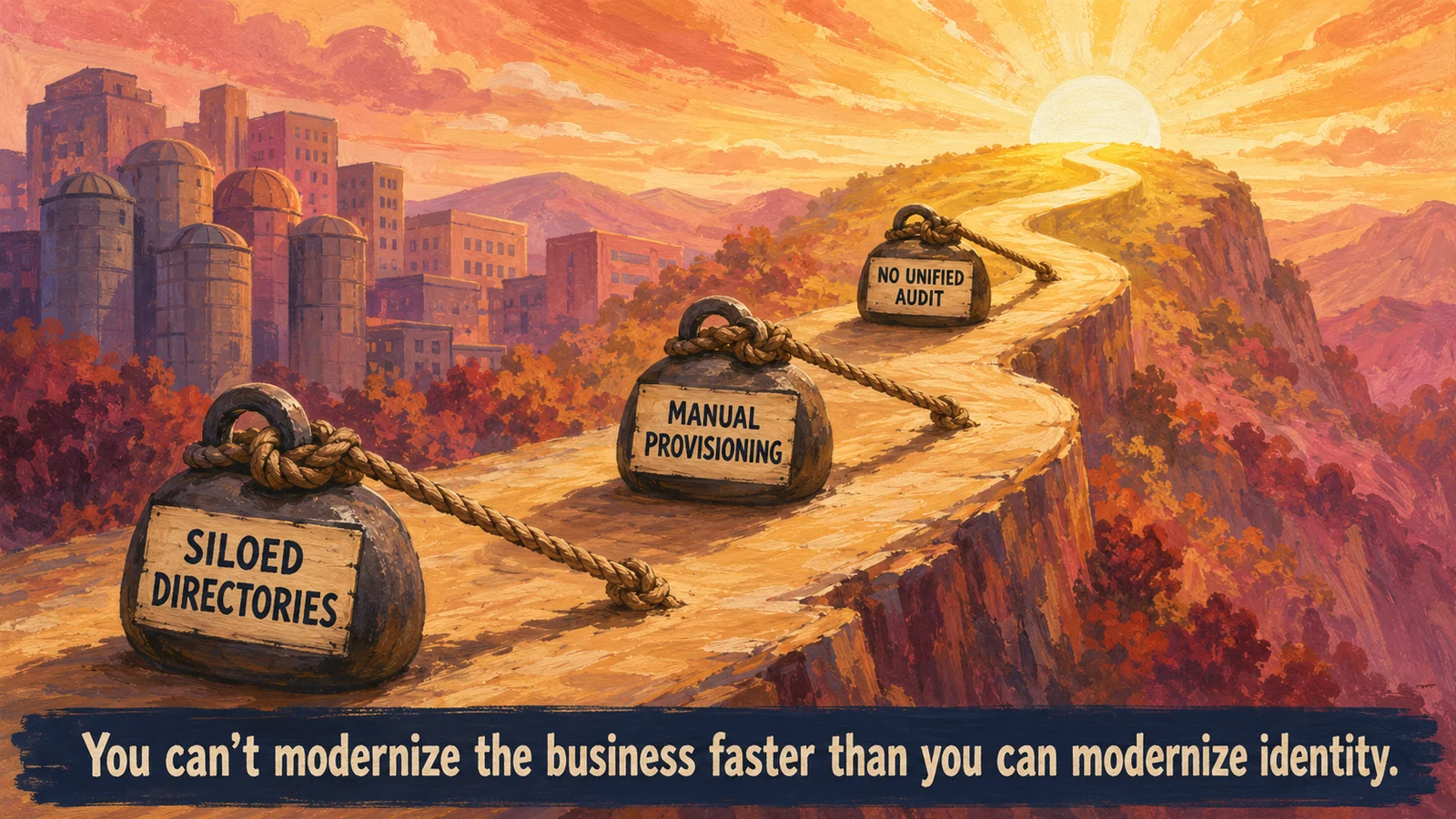 Three weights on the climb: siloed directories, manual provisioning, and the absence of a unified audit trail are what turn transformation momentum into drag.
Siloed directories no single system can see across. When identity data lives in multiple disconnected directories — a legacy on-premises directory here, a cloud directory there, standalone application user stores everywhere else — no system holds the complete picture of what any given person can access. Every transformation initiative that touches access then starts from archaeology: assembling, by hand, a view that should be a query. The silos also guarantee inconsistency, because the same person's access is maintained in several places by several processes, none of which is authoritative. Consolidation onto a coherent directory and lifecycle model is unglamorous work, but it is the precondition for every faster thing downstream.
Manual provisioning that turns onboarding into a ticket queue. When access is granted by humans filing and fulfilling tickets, the speed of the business is capped by the throughput of that queue. New hires wait days or weeks for the access they need to be productive — a direct, measurable tax on every hire during a growth phase. Transfers accumulate access from their old role on top of their new one because revocation is a separate ticket nobody files. And the whole apparatus scales linearly with headcount and system count, which is exactly the wrong scaling behavior during a transformation that is deliberately increasing both. Automating the joiner-mover-leaver lifecycle is the single highest-leverage change most enterprises can make here; our reference on identity lifecycle management solutions covers what mature automation looks like.
No unified audit trail. When access decisions are spread across siloed systems and manual processes, there is no single place that records who was granted what, by whom, and why. Every compliance cycle then becomes a manual reconstruction — screenshots, spreadsheets, and email archaeology assembled under deadline to answer questions the system should answer continuously. This is not only expensive; it is fragile, because a reconstructed audit trail is only as good as the memory and diligence of the people rebuilding it. A modern identity platform produces that evidence as a byproduct of normal operation, which is what turns audits from quarterly fire drills into routine reporting.
Each of these three is survivable in a static organization. Under transformation, they compound: the migration multiplies the silos, the distributed workforce multiplies the provisioning volume, and the acquisition multiplies both while adding a compliance deadline. Legacy identity does not break transformation so much as it makes transformation slow, expensive, and hard to defend to an auditor.
The business case executives actually fund
Identity modernization is frequently pitched as a security investment, and security is a real benefit — but it is not, on its own, the case that gets a transformation budget approved. Executives fund speed and they fund risk they can quantify. The durable business case for modernizing identity during transformation is built from four claims, none of which requires a borrowed statistic to stand up.
First, time-to-productivity. Automated provisioning means new and transferred employees hold the right access on their first day rather than their third week. Multiply the reclaimed days across every hire during a growth or integration phase and the productivity recovery is concrete and defensible from the organization's own numbers.
Second, speed of cloud and application onboarding. When a new SaaS platform or cloud environment plugs into an existing provisioning and governance model through open standards, it comes online as a governed resource in days. When it does not, it becomes another unmanaged island that someone will eventually have to remediate at far greater cost. Standards-based integration is the difference between adding capability and adding debt.
Third, M&A integration speed. Post-merger, the ability to absorb an acquired workforce into a unified, governed access model in weeks rather than quarters is a direct contributor to realizing deal value on schedule. Slow identity integration shows up as delayed synergies and prolonged exposure to duplicated, orphaned access.
Fourth, audit readiness as a byproduct. Continuous, system-generated evidence replaces the periodic manual reconstruction described above, converting a recurring cost and risk into routine reporting. The honest way to size all four of these is against the organization's own baseline rather than a vendor's aggregate; our reference on the cost and ROI of digital identity walks through that quantification without leaning on inflated figures. The pattern that persuades a CFO is not "identity is important" — it is "here is delay we are paying for today, across initiatives you have already funded, that this removes."
A staged roadmap that survives contact with reality
Identity modernization fails most often when it is attempted as a single big-bang replacement synchronized to a transformation deadline. The programs that actually land sequence the work so that each stage delivers standalone value and the risky steps come after the foundational ones. Four stages, in order.
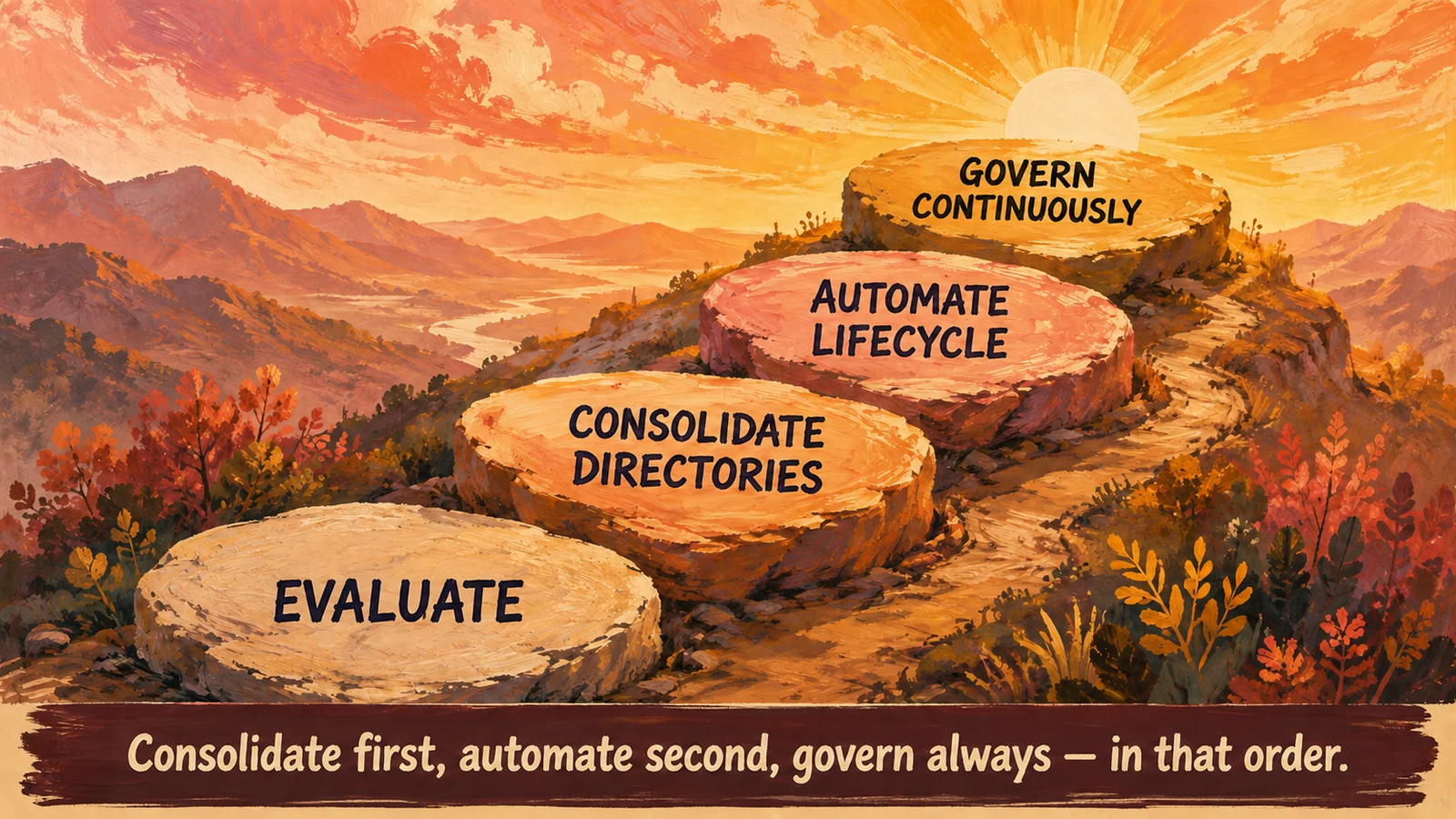 Four ascending steps toward the goal: evaluate, consolidate directories, automate lifecycle, then govern continuously — sequenced so each stage stands on the one below it.
Evaluate. Start with an honest inventory of the current state: where identity data lives, which directories exist and how they overlap, how provisioning actually happens today, and where the audit trail has gaps. This stage produces no automation, but it produces the map every later stage depends on — and it almost always surfaces immediate findings (orphaned accounts, systems no one is governing) that justify the effort on their own.
Consolidate directories. Reduce the number of authoritative identity stores and establish a coherent source of truth, ideally driven from the authoritative HR system that already knows who works here and in what role. This is the unglamorous foundation; skipping it means automating on top of fragmentation, which just moves faster in the wrong direction. The HRIS-driven lifecycle pattern is the model to consolidate toward.
Automate lifecycle. With a coherent source of truth in place, automate joiner-mover-leaver so access is granted, changed, and revoked in response to authoritative events rather than manual tickets. This is the stage that converts identity from a bottleneck into an enabler — the point at which onboarding stops being a queue and offboarding stops being a liability. Standards-based provisioning to cloud applications is what makes this reach beyond the on-premises estate.
Govern continuously. With provisioning automated, layer in the oversight discipline: risk-scored access reviews, policy and separation-of-duties enforcement, and continuous verification that access still matches need. This is where identity modernization becomes durable rather than a one-time cleanup, and it is covered in depth in our access governance reference. Attempting continuous governance before the foundational stages are done is the most common way these programs stall — you cannot govern continuously across data you have not consolidated or a lifecycle you have not automated.
The stages are cumulative and roughly sequential, but they are not a waterfall that has to complete before value appears. Each stage improves the organization's position on its own, which is what lets the program survive the budget scrutiny and priority shifts that every multi-quarter initiative eventually faces.
What Avatier ships toward this pattern
Avatier's position on all of the above is that identity should accelerate transformation, not tax it — which means the operational experience of provisioning, requesting, and governing access is treated as a first-class engineering problem rather than an afterthought. Avatier Identity Anywhere brings the pieces this piece describes into one platform: a unified control plane over access across on-premises and multi-cloud systems, standards-based provisioning to cloud applications, lifecycle automation driven from authoritative HR sources so joiner-mover-leaver events translate directly into access changes, federated single sign-on so a distributed workforce authenticates once, and self-service access requests with policy checks enforced at request time. FIDO2-compatible authentication supports the remote-and-hybrid case by binding credentials to the origins they were registered against. The design intent throughout is that a transformation initiative plugs into an existing identity model instead of spawning another ungoverned island.
The compliance posture backing the platform is published at the Avatier Trust Center: SOC 2 Type II audited with zero exceptions noted, ISO/IEC 27001:2022 certified, PCI DSS v4.0.1 compliant, CSA STAR Level 1, NIST 800-53 Rev. 5 aligned, FedRAMP-aligned, and a signatory of the CISA Secure-by-Design Pledge. That posture exists for the same reason this piece argues for a unified audit trail: during transformation, the ability to produce evidence continuously is worth more than the ability to assert control, and auditors have stopped accepting the difference.
What identity modernization does not solve
An honest strategy piece ends with its own limits, because identity sold as a transformation cure-all gets blamed for failures it was never scoped to prevent.
Identity modernization does not authenticate anyone by itself. It decides what access an identity holds; it does not, on its own, guarantee the person presenting the credential is who they claim to be. If authentication is weak or phishable, an attacker walks in as a legitimate, fully-provisioned identity and inherits exactly the access the lifecycle granted. Modernizing provisioning without strengthening authentication moves the bottleneck; it does not remove the risk.
It does not fix bad source data. Automation is a multiplier, and it multiplies whatever it is fed. If the HR system driving the lifecycle carries wrong roles, stale reporting lines, or duplicate records, automated provisioning propagates those errors faster and more consistently than a manual process ever would. Data quality upstream of identity is a precondition, not a detail.
It does not replace governance discipline. A platform can make access reviews cheap to run well, but someone still has to run them, mean them, and act on what they find. Tooling lowers the cost of doing governance honestly; it cannot supply the intent.
And it does not supply the executive alignment, change management, and cross-functional coordination that transformation actually requires. Identity is the enabling layer beneath the strategy — necessary infrastructure, not the strategy itself. The organizations that succeed treat identity modernization as the thing that removes a specific, expensive bottleneck so the rest of the transformation can move, and they keep doing the harder organizational work around it. That is the accurate promise: identity gets the access question out of the critical path. Everything the transformation was actually for still has to be built on top.
ABOUT THE AUTHOR

More from IAM & Identity Governance

AI and Behavioral Analytics for Identity Monitoring: The 2026 Enterprise Reference
Static identity rules catch the attacks that announce themselves. They miss the ones that log in with valid credentials and behave almost normally. The 2026 reference on AI-driven identity monitoring — what behavioral analytics actually detects, the four telemetry sources that make or break the model, the false-positive economics nobody budgets for, and the honest limits of anomaly detection at enterprise scale.

Security Team Collaboration: A 2026 Framework for Identity Programs
Identity governance fails when it runs as a security-team-only initiative. The 2026 framework for cross-functional collaboration: four stakeholder groups, three coordination models, and how zero trust makes it a shared discipline.

IaaS Identity Management: The 2026 Deployment Challenges Reference
Infrastructure-as-a-Service breaks identity models built for one directory. The 2026 reference on multi-cloud fragmentation, compliance auditability, and provisioning automation at IaaS scale.