








































PREVENT UNAUTHORIZED ACCESS
Credential Governance — Pillar 5

Strong MFA Login

Hardens Windows Login.

“Windows Login is weak. MFA login alone is a failed patch. Strong MFA Login makes your environment secure and stops lateral movement at the source.”

— Sam Wertheim, Avatier CISO

Most MFA programs protect the apps behind the IdP. The password underneath them is still wide open.
Supports RDP, Citrix, and shared workstations and servers.

  • 100% of password events MFA-verified
  • Every system. Every credential. Verified.
  • One audit trail for every credential event
Try ItTrust It
SOC 2 Type 2 — Avatier compliance attestation
ISO/IEC 27001 — Avatier compliance attestation
PCI DSS v4.0.1 — Avatier compliance attestation
GDPR — Avatier compliance attestation
HIPAA — Avatier compliance attestation
HITECH — Avatier compliance attestation
NIST 800 Series — Avatier compliance attestation
NIST Cybersecurity Framework — Avatier compliance attestation
CISA Secure-by-Design — Avatier compliance attestation
CSA STAR Level 1 — Avatier compliance attestation
CSA STAR Level 2 — Avatier compliance attestation
CSA STAR AI Level 1 — Avatier compliance attestation
CSA AI Trustworthy Pledge — Avatier compliance attestation
FERPA — Avatier compliance attestation
FICAM — Avatier compliance attestation
VPAT — Avatier compliance attestation
WCAG 2.2 AA — Avatier compliance attestation
U.S. Air Force relies on Avatier for credential governance
U.S. Army relies on Avatier for credential governance
Bayer relies on Avatier for credential governance
BBC relies on Avatier for credential governance
Broward County relies on Avatier for credential governance
Build-A-Bear relies on Avatier for credential governance
The Cosmopolitan relies on Avatier for credential governance
DHL relies on Avatier for credential governance
Emerson relies on Avatier for credential governance
ESPN relies on Avatier for credential governance
Fox News relies on Avatier for credential governance
GSA relies on Avatier for credential governance
Humana relies on Avatier for credential governance
ING relies on Avatier for credential governance
Lockheed Martin relies on Avatier for credential governance
Marriott relies on Avatier for credential governance
MillerCoors relies on Avatier for credential governance
NASA relies on Avatier for credential governance
Nordstrom relies on Avatier for credential governance
Oscar Mayer relies on Avatier for credential governance
Pfizer relies on Avatier for credential governance
Rockwell Collins relies on Avatier for credential governance
SC Johnson relies on Avatier for credential governance
Sprint Canada relies on Avatier for credential governance
Starbucks relies on Avatier for credential governance
Steak 'n Shake relies on Avatier for credential governance
USA Today relies on Avatier for credential governance
Welch's relies on Avatier for credential governance
Vail Resorts relies on Avatier for credential governance
Visa relies on Avatier for credential governance
Volkswagen relies on Avatier for credential governance
Zep relies on Avatier for credential governance

Protecting the world’s workforce since 1997 • Over 15 Million Licenses Sold

The Credential-Layer MFA Gap

MFA Bolted Onto Applications Is MFA With Holes

Most MFA programs protect the apps behind the IdP. The password underneath them is still wide open. Every system that authenticates directly against Active Directory, Entra ID, RACF, or LDAP accepts a stolen credential with no second factor at all. The risk is not that MFA is missing — it is that enforcement stops at the application while the credential keeps working everywhere else.

What Buyers Think Is Covered
01

Teams often assume the MFA program is complete because every app behind the IdP prompts for a second factor. The dashboard says coverage is high, the SaaS surface is protected, and conditional access policies are in place. But the IdP only sees the traffic that routes through it. Beneath the federation layer, password authentications continue directly against the directory — interactive logins, network authentications, service accounts, legacy applications, and every system that predates modern auth. Application-layer MFA does not eliminate credential-layer risk. It makes governing the credential layer more important.

What Is Not Covered
02

Underneath the IdP, the password is still validated against Active Directory, Entra ID, RACF, and legacy systems with no second factor. An attacker who steals a credential — phishing, infostealer, breach dump — logs in cleanly on any system that doesn't route through the IdP. Legacy ERPs, mainframes, custom applications, service accounts, and network authentications rarely appear in the MFA coverage report. Each one is a password event that no second factor ever touches. That is the credential-layer MFA gap: the program looks complete until an attacker finds the one authentication path the IdP never sees.

Why It Matters Now
03

Every enterprise MFA rollout has a blind spot, and attackers found it. While security teams were rolling out push notifications for SaaS apps, the password itself — validated directly against Active Directory, Entra ID, or legacy directories — kept accepting stolen credentials with no second factor at all. Two distinct attack patterns expose the same gap. MFA fatigue, also called prompt bombing, floods a user with repeated push notifications until exhaustion or confusion produces an approval. SSPR abuse — the technique Microsoft documented in its 18 May 2026 report on a threat actor it tracks as Storm-2949 — is quieter and more targeted: a single, well-timed approach from someone posing as internal IT support, asking the victim to approve one routine-looking MFA prompt during what appears to be a normal password reset. Once approved, the attacker resets the password, strips the user's existing authentication methods, and enrolls their own device as the new trusted authenticator. Both succeed for the same reason MGM Resorts and Caesars Entertainment were breached in 2023: the help desk and the password-reset flow are the soft target, because MFA bolted onto the application layer never touches the password itself. Strong MFA Login binds a strong second factor to every password authentication event — not just the ones behind your IdP — so a stolen credential alone is never enough to get in.

The Verification Layer Credential Governance Runs On
04

Strong MFA Login is Pillar 5 of Credential Governance. It binds a strong second factor to every password authentication event — interactive, network, or service-account — so enforcement happens at the credential layer, not per application. Across the six Credential Governance pillars, Avatier governs credential enforcement, user self-service, human-assisted recovery, login recovery, and passwordless access. Strong MFA Login owns the verification moment. Password Firewall keeps the credential strong; Strong MFA Login keeps every use of it verified.

What it is

Bind Strong MFA to Every Password Event

Avatier Strong MFA Login binds a strong second factor — Microsoft Authenticator, Okta Verify, Duo, RSA, or the Avatier Identity Challenge Card — to every password authentication event, regardless of where the credential lives. The MFA verification is wired into the credential lifecycle so the same enforcement policy applies whether the user is signing in to Entra ID, AD, RACF, a legacy ERP, or a custom application.

Strong MFA Login Features

Inside Avatier Strong MFA Login

Turn every server and workstation login into a layered, alarmed checkpoint — an MFA challenge first, a Password Firewall–validated password second, an optional corporate third factor, and a real-time alert the moment any gate is missed.

Credential-Event InterceptionPatent Pending

Every password authentication — interactive, network, or service-account — routes through the Strong MFA Login verifier before Active Directory, Entra ID, or RACF grants access. A stolen credential alone never produces a ticket.

Password Gate Retained

An approved push on its own gets an attacker nowhere. The directory issues no ticket until both the password and the second factor verify, so neither one alone is enough.

Corporate Third Factor

An optional company-issued attribute such as an employee ID — a gate the user doesn't control and social engineering can't harvest.
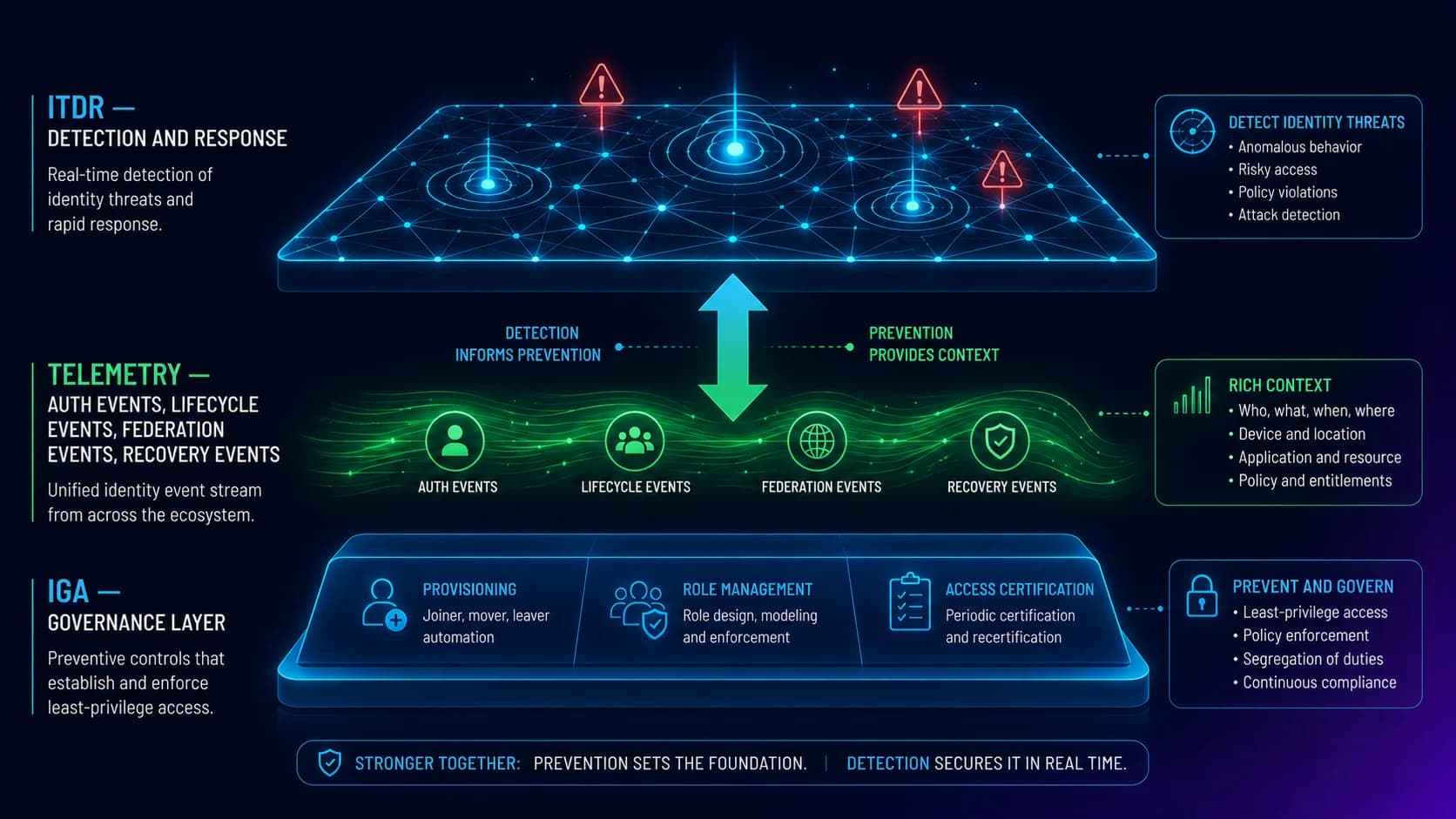
Lateral-Movement Defense

Installed on every server, each login is an independent three-gate checkpoint — containing a network breach before it becomes a data-center breach.
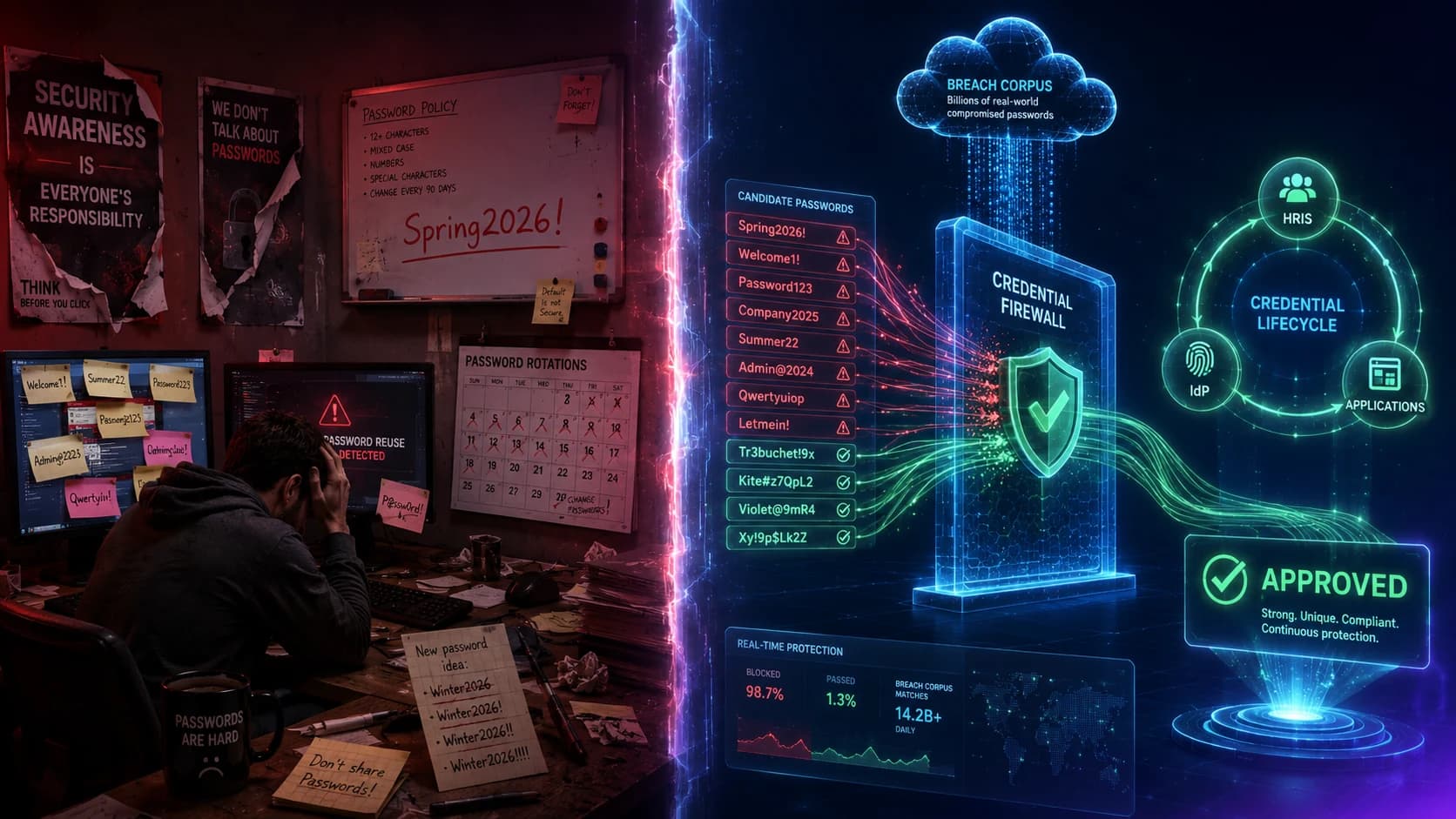
Real-Time Alarms

A failure at any gate raises a real-time alert and notifies the security team — turning failed attempts into early-warning signal, not buried log noise.

Policy Enforcement

The password gate runs through the Avatier Password Firewall™, so every credential is breach-checked and policy-compliant at the moment of login.

Deviceless MFA

The Identity Challenge Card delivers air-gapped MFA in defense, healthcare, and manufacturing sites where mobile phones are banned or impractical.

Universal Coverage

A browser-based, hardware-agnostic gateway covers physical servers, shared workstations, VDI, and Citrix — with no TPM chip or PKI lock-in.

Centralized Control

One console for MFA, policy, and audit — immutable evidence for SOC 2, ISO 27001, and CMMC from a single control plane.

Outcomes by Role

The Business Value of Strong MFA Login Mapped to Who's Buying

Strong MFA Login gives every stakeholder a different win: closed credential-layer gaps for security, one MFA policy across every system for IT leadership, lower breach exposure for finance, protected continuity for executives, practical enforcement for IAM teams, and a unified evidence story for analysts and investors.

Enterprise Trust

Credential-Event MFA Built for Security Review

Strong MFA Login gives enterprises a governed way to verify, control, and evidence every password authentication. It supports security reviews and compliance workflows by helping teams prove that interactive logins, network authentications, legacy-system access, and service-account events were MFA-verified, policy-controlled, and immutably logged.

Verified Password Events

A second factor on every credential use

  • Helps ensure every password authentication is verified before the directory grants access
  • Extends MFA enforcement to legacy systems, mainframes, and custom applications
  • Covers interactive, network, and non-interactive authentication paths
  • Reduces the exploitable window of phished and stolen credentials
  • Supports deviceless verification with the Identity Challenge Card — no push prompt to approve

Policy-Driven Method Control

More than a blanket MFA prompt

  • Method-strength policy matches factor rigor to account risk
  • Risk-based step-up applies stricter verification to privileged accounts
  • Policy precedence follows OU, group membership, or risk tier
  • Service-account gating uses method substitution without breaking automation
  • Policy updates apply in place — no downstream application changes

Audit-Ready Authentication Evidence

One evidence stream, not per-app fragments

  • Every verified event is bound to the password authentication itself
  • Immutable logs capture user, method, policy decision, and outcome
  • Supports SOC 2, ISO 27001, NIST 800-63-3, CMMC, HIPAA, GDPR audit workflows
  • Unified credential-layer trail simplifies MFA attestations
  • Reduces manual audit preparation versus per-application evidence collection

Built for the Credential Layer

Fits the Directories, MFA Providers, and Legacy Systems You Already Run

Strong MFA Login wires verification into the identity environments, MFA investments, and legacy platforms your teams already operate — the enforcement point moves to the credential layer without replacing any of them.

Active Directory logo
Identity Systems

Enforce credential-event MFA across the directories your users already authenticate against — Active Directory, Entra ID, LDAP, and Okta Universal Directory — with Conditional Access coexistence on the Microsoft stack.

MFA providers logo
MFA Providers

Use the MFA investment you already made as the factor engine — Microsoft Authenticator, Okta Verify, Duo, RSA, and Google Authenticator — wired to every password event instead of only the SAML apps.

Business systems logo
Legacy & Mainframe Systems

Extend the same MFA enforcement to RACF, ACF2, AS/400, legacy ERPs, and custom applications behind the modern auth perimeter — no per-app SDK, no IdP migration.

Identity Challenge Card logo
Verification & Password Protection

Support deviceless and air-gapped environments with the Identity Challenge Card, and keep the credential itself governed with Password Firewall so a verified login never carries a compromised password (Identity Challenge Card, Have I Been Pwned, Password Firewall).

Full Comparison

Strong MFA Login, capability by capability

CapabilityAvatierOthers / Industry-Wide
MFA challenge before the password fieldFullNot offered
Password validated after MFA (breach + policy checked)FullPartial
Corporate-supplied third factor (employee ID / badge)FullPartial
Push-bombing / MFA fatigue defeated on its ownFullPartial
Per-server three-gate checkpoint (lateral-movement containment)FullPartial
Deviceless MFA for phone-restricted areasFullNot offered

Native / full capabilityPartial or add-onNot offered

Side By Side

Bolted-On MFA Protects Applications. Strong MFA Login Protects the Credential.

Application-layer MFA depends on every system routing through the IdP — and the ones that don't stay exposed. Strong MFA Login moves enforcement to the moment the password is validated, so coverage, evidence, and policy live at the credential layer instead of fragmenting per application.

Application-Layer MFA (SAML / OIDC only)

Status quo
  • Coverage
    Apps behind the IdP only; direct-to-directory authentications stay unverified.
  • Phishing resistance
    Push-fatigue and AiTM phishing can bypass the app-layer prompt.
  • Legacy app support
    Requires IdP migration or per-app integration projects.
  • Service-account auth
    Typically unprotected and unlogged.
  • Audit evidence
    Per-app, fragmented across MFA consoles and IdP logs.
  • Time to deploy
    Months per app; every new system is a new project.

Avatier Strong MFA Login

Avatier
  • Coverage
    Every password event, including legacy systems and service accounts.
  • Phishing resistance
    Strong factor verified at the credential event — and the Identity Challenge Card has no push notification to approve, so there is nothing to socially engineer.
  • Legacy app support
    Native — enforcement runs at the directory layer, no app changes.
  • Service-account auth
    Policy-gated and logged without breaking automation.
  • Audit evidence
    Unified, immutable audit trail at the credential layer.
  • Time to deploy
    Days, framework-wide — new systems inherit the policy automatically.

Bolted-on MFA asks every application to enforce the second factor. Strong MFA Login enforces it once — at the credential — so nothing underneath is left uncovered.

Rollout

How Strong MFA Login Deploys

Strong MFA Login is designed for identity and IAM teams to deploy framework-wide without app code changes, PKI infrastructure, or per-application MFA integration projects.

  1. Phase 01

    Connect Directories and MFA Providers

    Connect Strong MFA Login to the identity environments your teams already manage — Active Directory, Entra ID, LDAP — and register your existing MFA providers as the factor engine.

  2. Phase 02

    Define Verification Policy

    Set method-strength requirements, risk-based step-up rules, and per-group policy — stricter verification for privileged accounts, streamlined flows for standard users, method substitution for non-interactive authentication.

  3. Phase 03

    Enable Credential-Event Enforcement

    Turn on enforcement at the credential layer so every password authentication — interactive, network, or service-account — is verified before the directory issues a ticket, including the legacy systems that never routed through the IdP.

  4. Phase 04

    Log and Review Authentication Activity

    Capture an immutable, unified audit trail of every verified password event — user, method, policy decision, outcome — so security, IAM, and compliance teams review one evidence stream instead of per-app fragments.

Identity and IAM teams can close the credential-layer MFA gap without rebuilding applications or asking users to learn a new prompt.

Global Workforce Coverage

Strong MFA Login Available in 34 Languages

Strong MFA Login verifies users in their native language — covering 34 languages across MFA prompts and verification workflows so global enforcement stays consistent without bolt-on translation tooling.

English flagEnglishSupported
Spanish flagSpanishSupported
French flagFrenchSupported
German flagGermanSupported
Japanese flagJapaneseSupported
Portuguese (Brazil) flagPortuguese (Brazil)Supported
Simplified Chinese flagSimplified ChineseSupported
Korean flagKoreanSupported
Italian flagItalianSupported
Dutch flagDutchSupported
Hindi flagHindiCurrent Site
Arabic flagArabicSupported
Swedish flagSwedishSupported
Spanish (Mexico) flagSpanish (Mexico)Supported
French (Canadian) flagFrench (Canadian)Supported
Portuguese (Portugal) flagPortuguese (Portugal)Supported
Traditional Chinese flagTraditional ChineseSupported
Russian flagRussianSupported
Polish flagPolishSupported
Turkish flagTurkishSupported
Indonesian flagIndonesianSupported
Thai flagThaiSupported
Danish flagDanishSupported
Norwegian flagNorwegianSupported
Finnish flagFinnishSupported
Greek flagGreekSupported
Czech flagCzechSupported
Hungarian flagHungarianSupported
Slovak flagSlovakSupported
Catalan flagCatalanSupported
Arabic (Egyptian) flagArabic (Egyptian)Supported
Bengali flagBengaliSupported
Urdu flagUrduSupported
Swahili flagSwahiliSupported
English flagEnglishSupported
Spanish flagSpanishSupported
French flagFrenchSupported
German flagGermanSupported
Japanese flagJapaneseSupported
Portuguese (Brazil) flagPortuguese (Brazil)Supported
Simplified Chinese flagSimplified ChineseSupported
Korean flagKoreanSupported
Italian flagItalianSupported
Dutch flagDutchSupported
Hindi flagHindiCurrent Site
Arabic flagArabicSupported
Swedish flagSwedishSupported
Spanish (Mexico) flagSpanish (Mexico)Supported
French (Canadian) flagFrench (Canadian)Supported
Portuguese (Portugal) flagPortuguese (Portugal)Supported
Traditional Chinese flagTraditional ChineseSupported
Russian flagRussianSupported
Polish flagPolishSupported
Turkish flagTurkishSupported
Indonesian flagIndonesianSupported
Thai flagThaiSupported
Danish flagDanishSupported
Norwegian flagNorwegianSupported
Finnish flagFinnishSupported
Greek flagGreekSupported
Czech flagCzechSupported
Hungarian flagHungarianSupported
Slovak flagSlovakSupported
Catalan flagCatalanSupported
Arabic (Egyptian) flagArabic (Egyptian)Supported
Bengali flagBengaliSupported
Urdu flagUrduSupported
Swahili flagSwahiliSupported
Strong MFA Login FAQs

Frequently Asked Questions

Strong MFA Login answers a different problem for every stakeholder. CISOs want to close the credential-layer gap application MFA can't reach. CIOs want one policy across every system. CFOs want to reduce breach exposure without new infrastructure. CEOs want continuity. IT and IAM teams want enforcement that doesn't break automation. Compliance teams want evidence. Analysts want to understand how it fits into Credential Governance.

Close the MFA Gap Attackers Actually Use

How is this different from the MFA we already have?

Most enterprises run MFA at the application layer, behind a SAML or OIDC IdP. That covers the apps that speak modern auth, but it does nothing for password authentications that happen directly against Active Directory, Entra ID, RACF, or legacy systems. Strong MFA Login moves enforcement to the credential event itself, so every password authentication is verified regardless of which application is asking.

Does credential-event MFA resist push-fatigue and AiTM phishing?

It materially reduces both. Method-strength policy can require stronger factors for higher-risk accounts, risk-based step-up limits blanket push prompts, and the Identity Challenge Card provides a deviceless factor with no push notification to approve, for environments where push or SMS is unacceptable.

What happens to systems that never route through our IdP?

They are exactly what Strong MFA Login covers. Because enforcement runs at the directory layer, any system that validates a password against AD, Entra ID, RACF, or LDAP is verified — legacy ERPs, mainframes, custom apps, and network authentications included.

Can verification be stricter for privileged accounts?

Yes. Policy precedence follows OU, group membership, or risk tier, so domain admins, executives, and privileged service accounts get stricter method requirements while standard users keep a streamlined flow.

How does Strong MFA Login fit with Password Firewall and Hybrid Passwordless?

Password Firewall keeps the credential strong at issuance. Strong MFA Login keeps every use of it verified. Hybrid Passwordless retires the password from the login experience while governance continues beneath. Together they cover the credential lifecycle end to end.

Recognized on Gartner Peer Insights

4.4

Based on 14 verified customer reviewsIdentity Governance and Administration

Read the reviews on Gartner Peer Insights
Resource Library

Explore the Credential Governance Pillars

Strong MFA Login is Pillar 5 — the credential-event verification layer of Credential Governance inside Avatier Identity Anywhere. Explore the supporting pillar briefs to see how Avatier extends Credential Governance across password enforcement, self-service recovery, help-desk-assisted resets, login-screen recovery, and hybrid passwordless access.

See It In Your Environment

See Strong MFA Login in Your Environment

Put strong MFA on every password event — including the legacy systems and service accounts your current MFA program can't reach.

No commitment. 30-minute walkthrough. Same-day response.

Savings Calculator

Password Reset Cost Calculator

Enter your company size and see how much your help desk spends on password resets — and how much Avatier Credential Governance saves.

Horizon
Total Resets per Year
18,000
Annual Cost Without Automation
$500,000

Avatier Credential Governance reduces your cost by

$350,000

Over 1 year

See the full methodology and sources →

4733 Chabot Drive, Suite 201
Pleasanton, CA 94588
(800) 609-8610

Credential Governance — a unified framework for password and passwordless identity from Avatier.

© 2026 Avatier Corporation. All rights reserved.

Last updated:

Ready to see it?

Book a Credential Governance Demo

See how Avatier governs every credential — passwords, keys, tokens, service accounts — across Active Directory, Entra ID, and legacy systems in a 20-minute walkthrough.

Book Meeting