Credential Governance
The 6-Pillar Framework for Password and Passwordless Identity
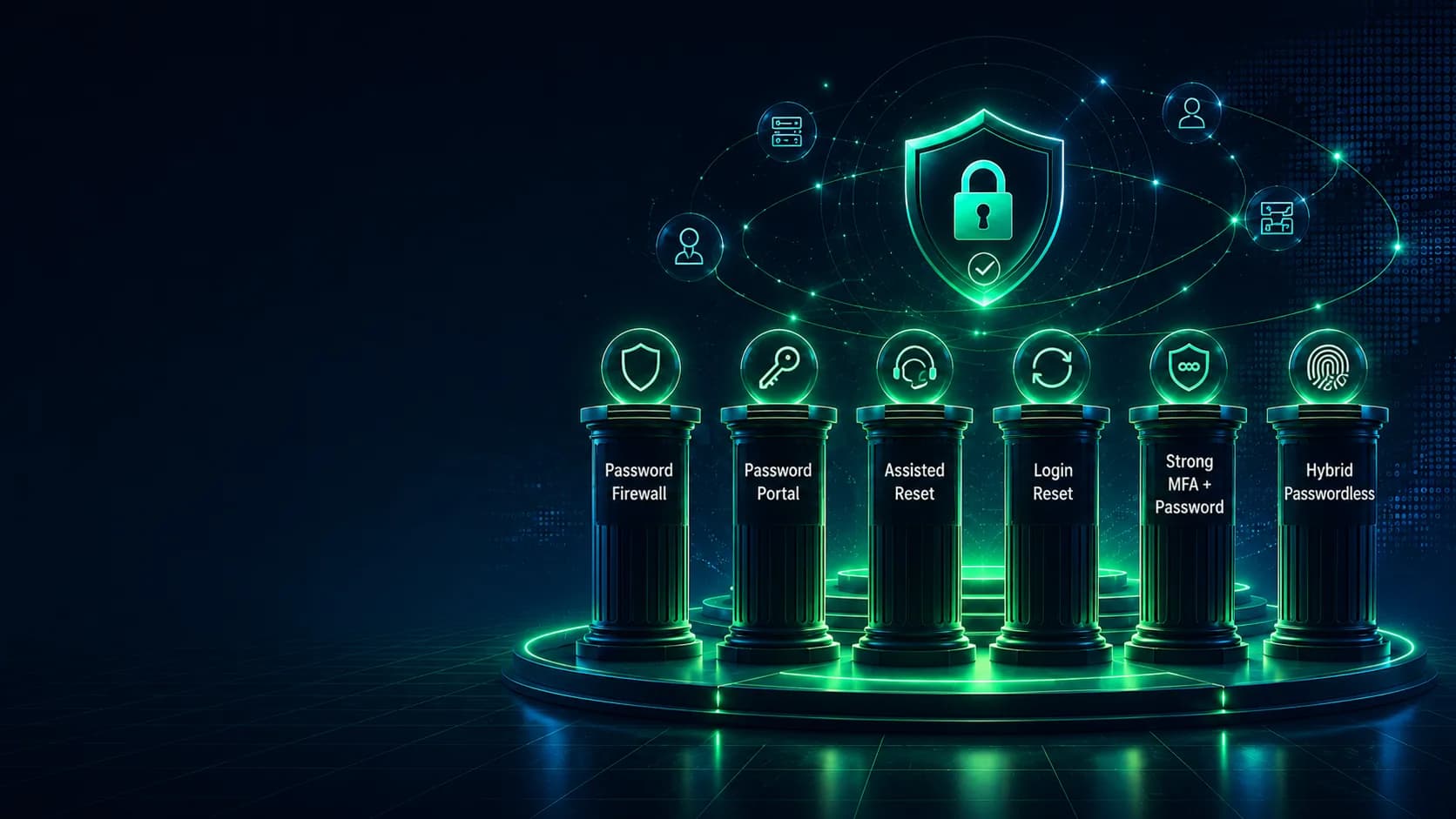
Password management is a point solution. Credential Governance manages every credential — passwords, keys, tokens, service accounts — from birth to retirement, across Active Directory, Entra ID, and legacy systems.






































Protecting the world’s workforce since 1997 • Over 15 Million Licenses Sold
How It Works
How Credential Governance Works
Six pillars, one credential lifecycle — each governs a different moment where a password is set, recovered, or proven. Play any pillar's 60-second explainer and follow the transcript as it speaks.
- Pillar 01TranscriptTap a word to play from there
Most password rules only check format.
That gap, inconsistent format-only enforcement, is the first thing attackers exploit.
Meet Password Firewall, a lightweight agent on every Active Directory domain controller.
It intercepts every password change and validates it in real time, before it reaches the directory.
Each new password is checked against enterprise policy, NIST common passwords,
and have I been Pwned. Weak, breached, reused, or predictable passwords are blocked
on the spot. It centralizes enforcement across Active Directory, Entra ID, and legacy systems,
can apply stricter rules for admins, and creates exportable evidence for audit.
Who's it for? Large enterprises, and the IT, IAM, and Active Directory teams running
Microsoft identity under real compliance obligations.
Password Firewall is Pillar 1 of Credential Governance.
It complements MFA, it doesn't replace it.
See it at credentialgovernance.com.
Password Firewall
Every password change is intercepted and checked against breach data and policy in real time — weak or exposed credentials are blocked before they ever reach Active Directory or Entra ID.
Explore Password Firewall - Pillar 02TranscriptTap a word to play from there
Passwords didn't disappear. They went deeper into the stack.
Every lockout, forgotten password, and failed sync still lands on your help desk.
Password Portal from Avatier is one secured place for your workforce.
Unlock accounts, recover and change passwords, enroll recovery methods,
check account status, and get back to work.
This isn't just a reset button. Every action is verified with multi-factor authentication.
enforced by policy, synchronized across your systems, and logged for compliance.
Is this for you? If you lead security, IT, or the budget behind them, yes. It serves
employees, contractors, frontline, and remote teams in 34 languages. It deploys
in a day, no rip and replace. Avatier has protected the world's workforce
since 1997. Over 15 million licenses sold. Up to 70 % of password tickets? Gone. See it.
Try it. Trust it. Password Portal at credentialgovernance.com.
Password Portal
Users reset, unlock, and enroll themselves across web, mobile, Teams, Outlook, and AI voice — every request MFA-verified and breach-checked, with no help-desk ticket.
Explore Password Portal - Pillar 03TranscriptTap a word to play from there
Attackers don't hack in anymore, they call the helpdesk with urgency, impersonation, and pressure, and ask for a reset.
Agents get talked into resets, the system can't be.
This is Assisted Reset, a delegated helpdesk console, Pillar 3 of credential governance, that verifies users before sensitive credential actions.
Here's the mechanic, the verification challenge goes straight to the end user.
the agent only sees pass or fail no judgment calls just guided policy
scoped delegated workflows and every assisted action leaves reviewable
evidence who asked for help how they were verified and what changed not just
a ticket note if you lead security IT finance or the whole business or you
run the service desk itself this is for you your agents keep helping without
becoming the exception path. Protecting the world's workforce since 1997, over
15 million licenses sold. See it. Try it. Trust it at credentialgovernance.com.
Assisted Reset
When a user calls the help desk, the identity challenge routes to the user's own device — the agent only ever sees pass or fail, so a reset can't be social-engineered.
Explore Assisted Reset - Pillar 04TranscriptTap a word to play from there
You're locked out at the Windows or Mac login screen.
Before the network, VPN or Helpdesk can reach you, the pre-login recovery gap.
Avatier login reset embeds recovery right into that screen.
Self-service unlock and reset, MFA verified before you sign in.
Choose unlock and reset, and a secure, locked-down browser opens.
Verify with MFA, set a new password checked against policy,
network, and cached credentials update together, no IT call.
It runs on Windows, Mac, Entra ID, Hybrid, and Citrix VDI with adaptive MFA.
It can even set a new hire's first password from HR data, patent pending.
Who's it for?
Enterprises with remote, hybrid, and off-VPN workers, new hires, and VDI users, plus IT
teams running Active Directory and Entra ID. Log in reset. Pillar 4 of
Credential Governance. It resets before you log in. See it at credential
governance.com
Login Reset
Unlock and reset right at the Windows and Mac login screen, MFA-verified before the network — and cached credentials update automatically, so there's no second lockout.
Explore Login Reset - Pillar 05TranscriptTap a word to play from there
One factor is one breach away.
A stolen password logs an attacker straight into your servers.
A push-bombed MFA prompt does the same.
Avatier Strong MFA Login is a browser-based Windows credential provider.
MFA First. Password Second. Corporate Factor Third.
To reach a server, an attacker has to beat every gate.
An MFA challenge before the password.
password, the password itself, breach checked by the password firewall, and a corporate
factor like an employee ID they can't harvest.
Installed on every server, each login is its own checkpoint.
One stolen credential unlocks nothing, and a miss at any gate alerts your security team.
It's built for servers and shared workstations, privileged systems, and high-security sites
where phones are banned.
And for the teams containing a breach before it spreads.
Strong MFA Login. Pillar 5 of Credential Governance.
One factor is an invitation. Three is a wall.
See it at credentialgovernance.com.
Strong MFA Login
Three gates on every server and workstation login: an MFA challenge first, a Firewall-checked password second, a corporate factor third — and a miss at any gate alarms security.
Explore Strong MFA Login - Pillar 06TranscriptTap a word to play from there
A passwordless login looks finished. No password field, just a prompt.
But underneath, the directory password is still there,
in Active Directory, Entra ID, and Legacy Systems.
Avatier Hybrid Passwordless Login is a browser-based Windows credential provider.
It skips phones, badges, and hardware.
It isn't tied to any device. The credential moves with the user.
Shared workstations, Citrix, virtual desktops.
your existing MFA becomes the passwordless factor.
No TPM, no PKI, no tokens.
And it doesn't pretend the password is gone.
It governs the password while retiring it,
synchronized, validated, and breach checked underneath.
Who's it for?
Shared workstations, Citrix, and virtual desktops,
and sites where phones are banned.
Plus the IT and identity teams
running Active Directory and Entra ID.
Hybrid passwordless login. Pillar 6 of Credential Governance. See it at credentialgovernance.com.
Hybrid Passwordless Login
The credential travels with the user across shared workstations, Citrix, and VDI; your existing MFA becomes the passwordless factor — no TPM, PKI, tokens, or app.
Explore Hybrid Passwordless Login
Outcomes
What Credential Governance Delivers
- Up to 70% reduction in help desk password tickets
- 100% MFA enforcement on every credential event
- Zero successful social-engineering resets
- Audit-ready evidence for SOC 2, ISO 27001, NIS2, DORA, and CMMC
- Rollout in days, not months — no TPM, no PKI
Password Management vs Credential Governance
| Password Management | Credential Governance | |
|---|---|---|
| Scope | Password storage only | Full credential lifecycle |
| Policy enforcement | At the vault, after the fact | At the source, in real time |
| Help desk security | Manual verification, easy to social-engineer | MFA-verified workflow, zero exceptions |
| Login recovery | Requires IT ticket | Embedded in Windows & Mac login screen |
| Passwordless coverage | Surface only — passwords buried beneath | Hybrid — passwordless with governance |
| Audit evidence | On request, manual export | Immutable, real-time |
| Rollout | Weeks to months, TPM/PKI required | Days, hardware-agnostic |
Fits Your Stack

Microsoft
Entra ID, Active Directory, Intune, Teams, Outlook, Copilot.

Okta
Okta Verify and Workforce Identity integration.

CyberArk
PAM integration for privileged credential governance.

ServiceNow
Native connector for ticketing and CMDB updates.

HR systems
Workday, BambooHR, SuccessFactors for lifecycle triggers.

Existing IAM
Ping, SailPoint, Saviynt — coexistence, not rip-and-replace.
The picture at a glance
Avatier is the only vendor that covers every category
NP Accel mapped 25+ identity vendors against 11 product categories. Avatier markets all 11. Microsoft markets 7. Okta 6. CyberArk 3. Every other competing vendor leaves visible gaps the buyer has to fill by stitching three to six products together from three to six vendors.
Frequently Asked Questions
Common questions about Avatier Credential Governance, answered.
What is Credential Governance?
Credential Governance is a unified framework from Avatier that manages every enterprise credential — passwords, keys, tokens, and service accounts — across its full lifecycle, with continuous policy, MFA-verified workflows, and audit-ready evidence. It unites six pillars: Password Firewall, Password Portal, Assisted Reset, Login Reset, Strong MFA Login, and Hybrid Passwordless Login. Available in 34 languages and certified to SOC 2 and ISO 27001.
How is credential governance different from IGA?
Identity Governance and Administration (IGA) governs who has access to what — provisioning, role mining, recertification. Credential Governance governs the credential itself — issuance, rotation, attestation, recovery, and revocation across Active Directory, Entra ID, and legacy systems. The two complement each other. IGA platforms like SailPoint and Saviynt handle access entitlements; Credential Governance handles the lifecycle of the secret used to assert that access.
How is it different from a password manager?
A password manager (LastPass, 1Password, Bitwarden) stores and auto-fills user-chosen passwords on a device. Credential Governance enforces password policy at the source — every change is validated against NIST, Have I Been Pwned, and custom dictionaries before it reaches Active Directory or Entra ID. It also handles MFA-verified resets across web, mobile, Teams, Outlook, and AI voice; help desk workflows; and Windows login-screen recovery. A password manager is a tool; Credential Governance is the framework.
Do I need to replace Okta, Entra, or CyberArk?
No. Avatier Credential Governance fits alongside existing IAM and PAM investments, closing gaps those platforms don't cover. Okta and Microsoft Entra ID govern access; CyberArk governs privileged accounts. Credential Governance governs the credential itself — every issuance, rotation, attestation, and revocation across Active Directory, Entra ID, and legacy systems — with MFA-verified workflows, breach-database checks, and audit evidence for SOC 2, ISO 27001, NIS2, DORA, and CMMC.
How do I block breached passwords in Active Directory?
Install the Avatier Password Firewall agent on each Active Directory domain controller. The agent intercepts every password-change request and validates it against the Have I Been Pwned breach database, NIST Common Passwords, and your enterprise's policy in under a second. If the password is compromised, the change is rejected with real-time feedback. See the Password Firewall pillar for how the agent deploys, governs new domain controllers automatically, and extends to Entra ID.
How do I prevent a Scattered Spider attack on my help desk?
Scattered Spider, Octo Tempest, and copycat groups target help-desk agents, social-engineering them into resetting passwords or MFA without proof of identity. MGM ($100M), Caesars ($15M), Clorox ($380M), and Change Healthcare ($22M) breaches all started this way. Avatier Assisted Reset routes every agent-initiated reset through an MFA challenge sent to the user — bound to your existing identity provider. The agent never sees the factor and cannot bypass.
How long does deployment take?
Most customers deploy Avatier Credential Governance in under a week. The Password Firewall agent installs on domain controllers in minutes per DC, with auto-detection and auto-deployment to new controllers. Password Portal, Assisted Reset, and Login Reset deploy via MSI, GPO, or Intune in hours. No TPM, no PKI, no hardware refresh — Avatier is hardware-agnostic and runs on any Windows device, Mac, Citrix, or Azure Virtual Desktop.
What compliance frameworks does Credential Governance support?
Credential Governance generates immutable, audit-ready evidence for SOC 2 Type II, ISO 27001, NIST 800-63-3, CMMC, GDPR, HIPAA, NIS2, and DORA. Every credential event — change, reset, rotation, attestation, revocation — is logged with tamper-evident timestamps and exportable to SIEM platforms (Splunk, Microsoft Sentinel, Chronicle). Live certification artifacts are available at trust.avatier.com, Avatier's SafeBase trust center.
How does Avatier handle 34-language support?
Avatier Credential Governance ships with native support for 34 languages — including English, Spanish, French, German, Japanese, Portuguese, Chinese, Korean, Italian, Dutch, Hindi, Arabic, Swedish, and Hebrew — across web, mobile, Microsoft Teams, Outlook, and AI voice, including the call-center workflow. Right-to-left layouts (Arabic, Hebrew) and CJK fonts (Chinese, Japanese, Korean) are fully supported, with brand and product names preserved in their English form.
Why "Credential Governance" instead of "password management"?
Password management is a point solution — it stores passwords, sometimes rotates them, and stops there. Credential Governance is a category. It manages every enterprise credential — passwords, API keys, certificates, service accounts, tokens — across its full lifecycle: issuance, attestation, rotation, recovery, revocation, and audit. Regulators (NIS2, DORA, NYDFS 500.17, SEC disclosure rules) increasingly require demonstrable lifecycle control, not just hygiene. Password management was sufficient in 2015. It isn't in 2026.
Further reading
Related from the Credential Governance library

Outcome-Based Software Pricing: A CFO's Guide to Buying Identity in the AI Era
Outcome-based software pricing charges for completed, verified, audited work instead of seats, modules, or long commitments. In an AI era where the best technology can change in a quarter, it is the pricing model that lets a CFO keep options open and make every vendor prove its value.
Read more
OAuth vs MCP for Enterprise Access: Where Avatier Governs the Gap
OAuth and MCP aren't rivals. MCP connects AI assistants to tools, and its authorization builds on OAuth 2.1. What each one answers, what scopes miss, and how Avatier governs each action.
Read more
Least-Privilege Access for AI Agents: Scoping MCP Tools with Avatier
Least privilege for AI agents means task-scoped, time-bound access capped at the user's own authority. A five-step how-to for scoping MCP tools, and where the MCP spec helps.
Read moreSee Credential Governance in Action
Book a 30-minute demo with an Avatier solutions architect.