







































Most MFA programs cover the modern SaaS surface — the apps behind your IdP.
Strong MFA Login
Windows Login is weak. MFA login is a failed patch.
Combining something you have (MFA) with something you know (Password) is the fastest way to leverage your MFA investment — making your environment secure and preventing lateral movement.
Supports RDP, Citrix, and shared workstations and servers.
- 100% of password events MFA-verified
- Every system. Every credential. Verified.
- One audit trail for every credential event
Protecting the world's workforce since 1997 • Over 15 Million Licenses Sold


The gap
MFA Bolted On Is MFA With Holes
Underneath, the password itself is still validated against Active Directory, Entra ID, RACF, and legacy systems with no second factor. Attackers who steal a credential — phishing, infostealer, breach dump — log in cleanly.
Push-fatigue attacks, SIM-swap, and AiTM phishing have all defeated bolted-on MFA at scale. The only credential-event MFA that holds is the one verified at the moment the password is presented, before the directory grants the ticket.
An MFA program with gaps at the password layer creates a false sense of coverage and a directly exploitable attack surface.
What it is
What Strong MFA + Password Is
Avatier Strong MFA + Password binds a strong second factor — Microsoft Authenticator, Okta Verify, Duo, RSA, or the Avatier Identity Challenge Card — to every password authentication event, regardless of where the credential lives. The MFA verification is wired into the credential lifecycle so the same enforcement policy applies whether the user is signing in to Entra ID, AD, RACF, a legacy ERP, or a custom application.
The flow
How Strong MFA + Password Works
Password event intercepted
Every password authentication — interactive, network, or service-account — is routed through the Strong MFA + Password verifier before the directory issues a ticket.
User verifies via any MFA method
Microsoft Authenticator, Okta Verify, Duo, RSA, or Identity Challenge Card for deviceless environments. Method selection follows policy + risk signal.
Result logged in the credential lifecycle
MFA outcome is bound to the password event itself in immutable audit logs — same evidence stream auditors use for SOC 2, ISO 27001, and CMMC.
Policy adapts automatically
Risk-based step-up, deny lists, and method-strength policy update in place without changing any downstream application.
What changes
Strong MFA + Password Outcomes
Strong MFA on every password event — not just SAML apps
Coverage for legacy systems that can't speak modern auth
Audit-ready evidence at the credential layer
Phishing-resistant when paired with Identity Challenge Card
Foundation that makes the eventual passwordless rollout safe
The wedge
Why Credential-Event MFA Matters
Bolted-on MFA at the application layer leaves a directly exploitable gap: every system that doesn't yet route through your IdP — and there are always more than you think — accepts a stolen password with no second factor at all. Push-fatigue and AiTM phishing attacks have shown that even SAML-protected MFA is bypassable when the user is the weak link. Strong MFA + Password collapses that gap by moving the enforcement to the moment the password is validated, so the directory itself never issues a ticket without a second factor. This is the layer that makes the rest of the framework defensible — Password Firewall keeps the credential strong, Strong MFA + Password keeps every use of it verified.
Legacy + mainframe
RACF, ACF2, and other systems that predate SAML or OIDC get the same MFA enforcement as your modern SaaS — the verification runs at the credential layer, not the application.
Service accounts + automation
Even non-interactive password authentications can be policy-gated and logged. Reduces the blast radius of a leaked service-account credential to near zero.
Deviceless + air-gapped
When personal phones are banned (defense, healthcare clean rooms, manufacturing floors), the Identity Challenge Card supplies the deviceless MFA factor. Same enforcement, no mobile device.
Who it's for
Who It's For
Close the credential-layer MFA gap that bolted-on MFA can't reach.
One MFA policy, every system — including the legacy ones you can't replace.
Standards-based, vendor-agnostic on the second factor side.
Side by side
Bolted-On MFA vs Strong MFA + Password
Application-Layer MFA (SAML / OIDC only)
Status quo- CoverageApps behind the IdP only
- Phishing resistancePush-fatigue / AiTM bypassable
- Legacy app supportRequires IdP migration
- Service-account authTypically unprotected
- Audit evidencePer-app, fragmented
- Time to deployMonths per app
Strong MFA + Password
Avatier- CoverageEvery password event, including legacy + service accounts
- Phishing resistanceCryptographic factor at the credential event
- Legacy app supportNative — runs at the directory layer
- Service-account authPolicy-gated and logged
- Audit evidenceUnified at the credential layer
- Time to deployDays, framework-wide
The receipts
Proof
Plays well with
Fits Your Stack
Entra ID, Active Directory, Authenticator, Conditional Access.
Microsoft Authenticator, Okta Verify, Duo, RSA, Identity Challenge Card.
AD, Entra ID, LDAP, Okta Universal Directory.
RACF, ACF2, AS/400, and other systems behind the modern auth perimeter.
Rollout
Deployment
Frequently Asked Questions
Common questions about Avatier Credential Governance, answered.
How is this different from the MFA we already have?
Most enterprises run MFA at the application layer — usually behind a SAML / OIDC IdP. That covers the apps that speak modern auth, but it does nothing for the password authentications that still happen directly against Active Directory, Entra ID, RACF, or legacy systems. Strong MFA + Password moves the enforcement to the credential event itself, so every password authentication is MFA-verified, regardless of which application is asking.
Does this replace Microsoft MFA or Okta Verify?
No — it uses them. Strong MFA + Password is the verification layer; the factor itself can be Microsoft Authenticator, Okta Verify, Duo, RSA, or the Avatier Identity Challenge Card. Your existing MFA investment is the engine; Avatier wires it to every password event, not just the SAML apps.
What about service-account and non-interactive authentications?
Policy-gated and logged. Strong MFA + Password supports method-substitution for non-interactive flows (certificate-based, signed-assertion, or vaulted-credential patterns) so service accounts get coverage without breaking automation, and every authentication leaves an audit trail at the credential layer.
Does it work for legacy systems that don't support SAML or OIDC?
Yes — that's the point. Because the enforcement runs at the credential layer (the directory) rather than the application, any system that authenticates against AD, Entra ID, RACF, or LDAP is covered without app changes. This is the primary reason most enterprises adopt it.
How does it work with the eventual passwordless rollout?
It's the bridge. Strong MFA + Password keeps the credential strong and every event verified while you build out the Hybrid Passwordless layer in parallel. Once a workforce segment is fully passwordless, the same MFA factor continues to enforce; the password layer simply retires beneath.
What compliance frameworks does this support?
All authentication events are immutably logged for SOC 2 Type II, ISO 27001, NIST 800-63-3, CMMC, GDPR, and HIPAA. The single credential-layer audit trail materially simplifies attestations compared to per-application MFA evidence collection.
Explore the framework
Related Credential Governance pages
Strong MFA on Every System
See Strong MFA + Password against your stack in a 30-minute demo.
Further reading
Related from the Credential Governance library

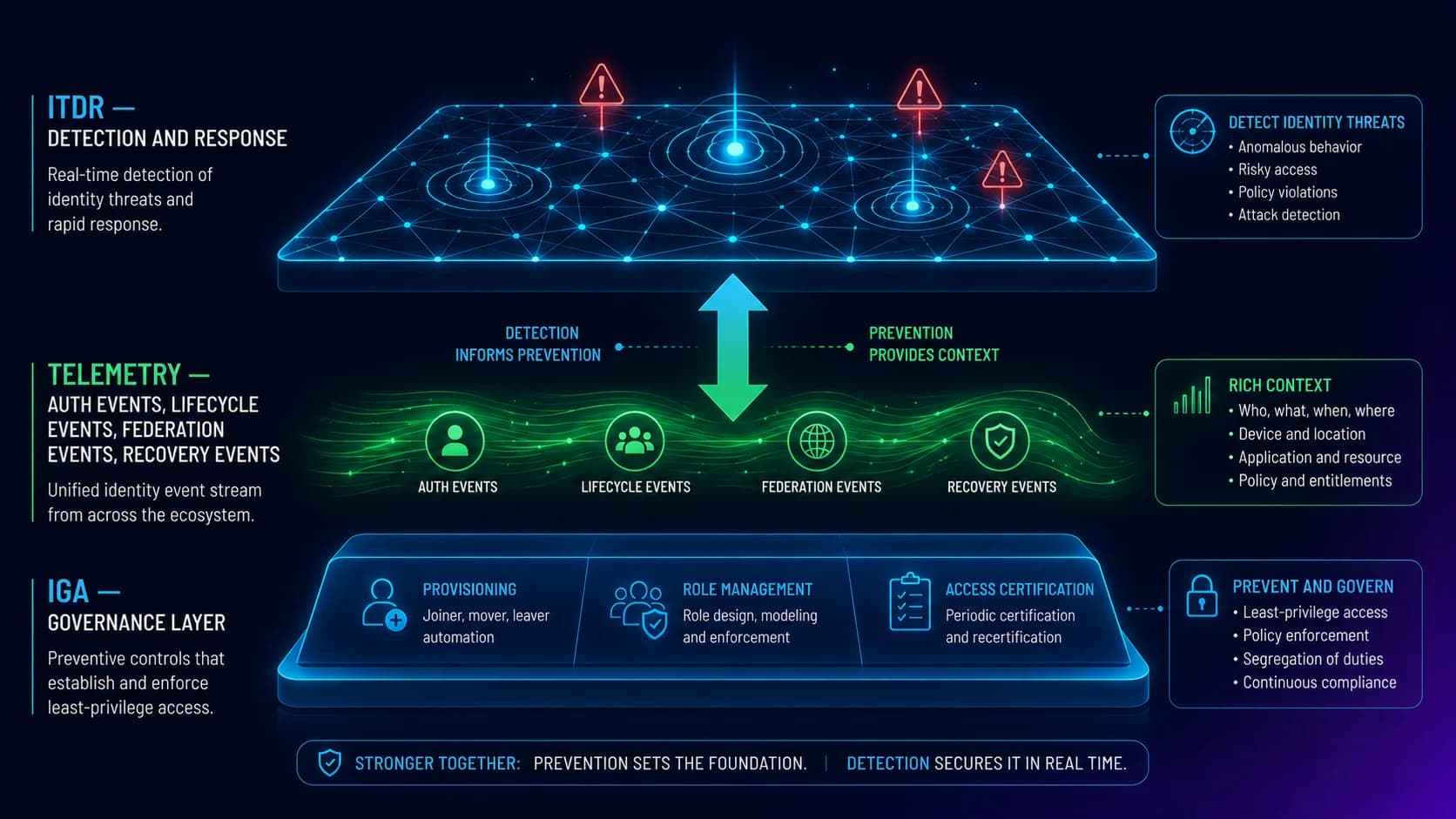
Identity Threat Detection and Response (ITDR) for Enterprise 2026
ITDR is the buzzy adjacent category to IGA — and in 2026 it has become a load-bearing layer for any enterprise that wants to detect identity-based attacks instead of just preventing them. The honest guide to what ITDR is, where it fits relative to IGA, and the architecture that ties identity governance to identity detection.
Read more
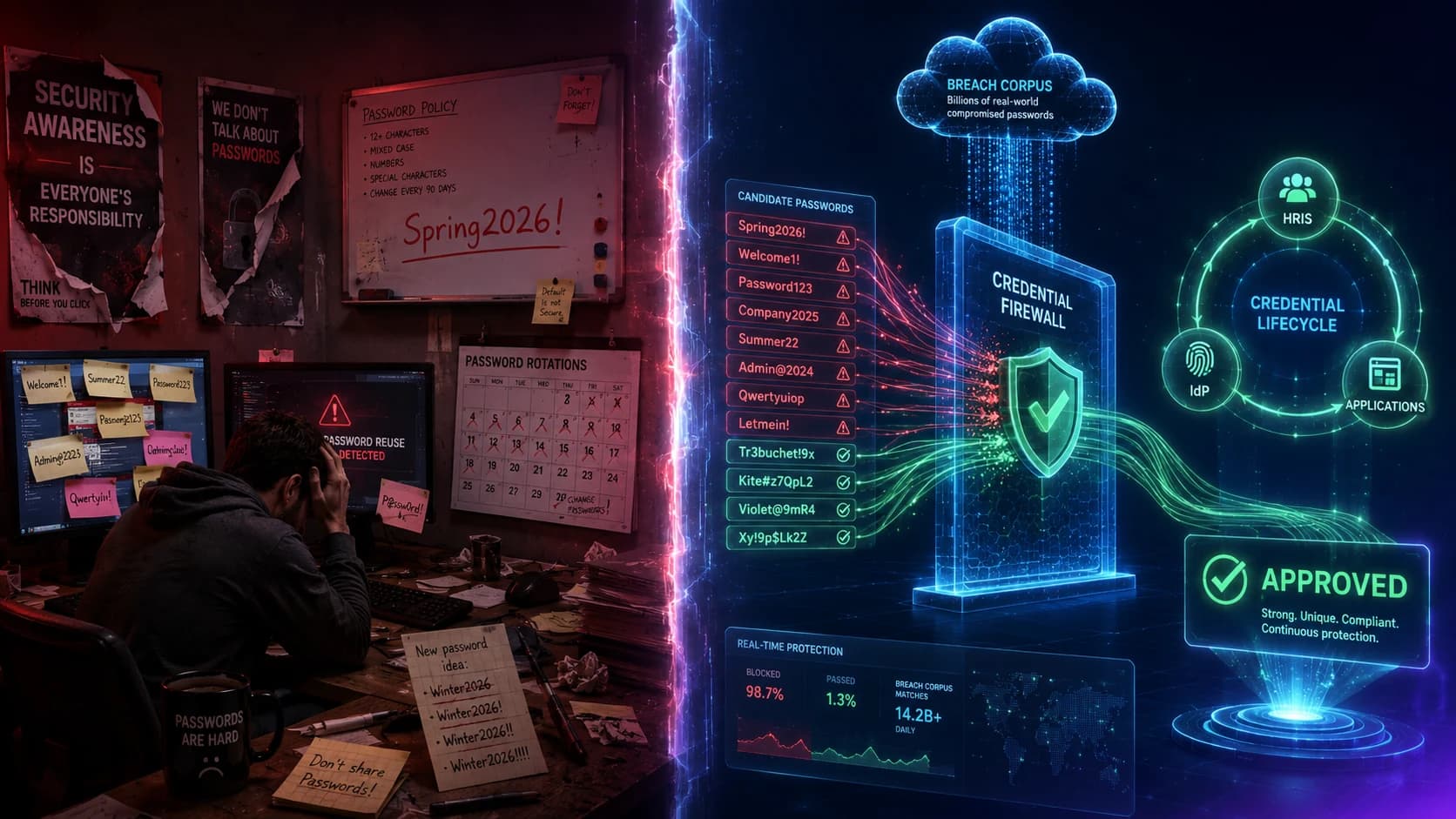
Weak Passwords in 2026: Architecture, Not Awareness
Why weak passwords persist in 2026 despite decades of training — and the policy-enforcement, credential-firewall, and lifecycle controls that eliminate them at scale.
Read more
Password Complexity vs Password Strength: What 2026 Got Right
Complexity rules don't measure what attackers actually exploit. Strength does. The architecture that produces strong workforce passwords without the 'Spring2026!' rotation theater that wastes everyone's time.
Read more