Weak Passwords in 2026: Architecture, Not Awareness
Why weak passwords persist in 2026 despite decades of training — and the policy-enforcement, credential-firewall, and lifecycle controls that eliminate them at scale.
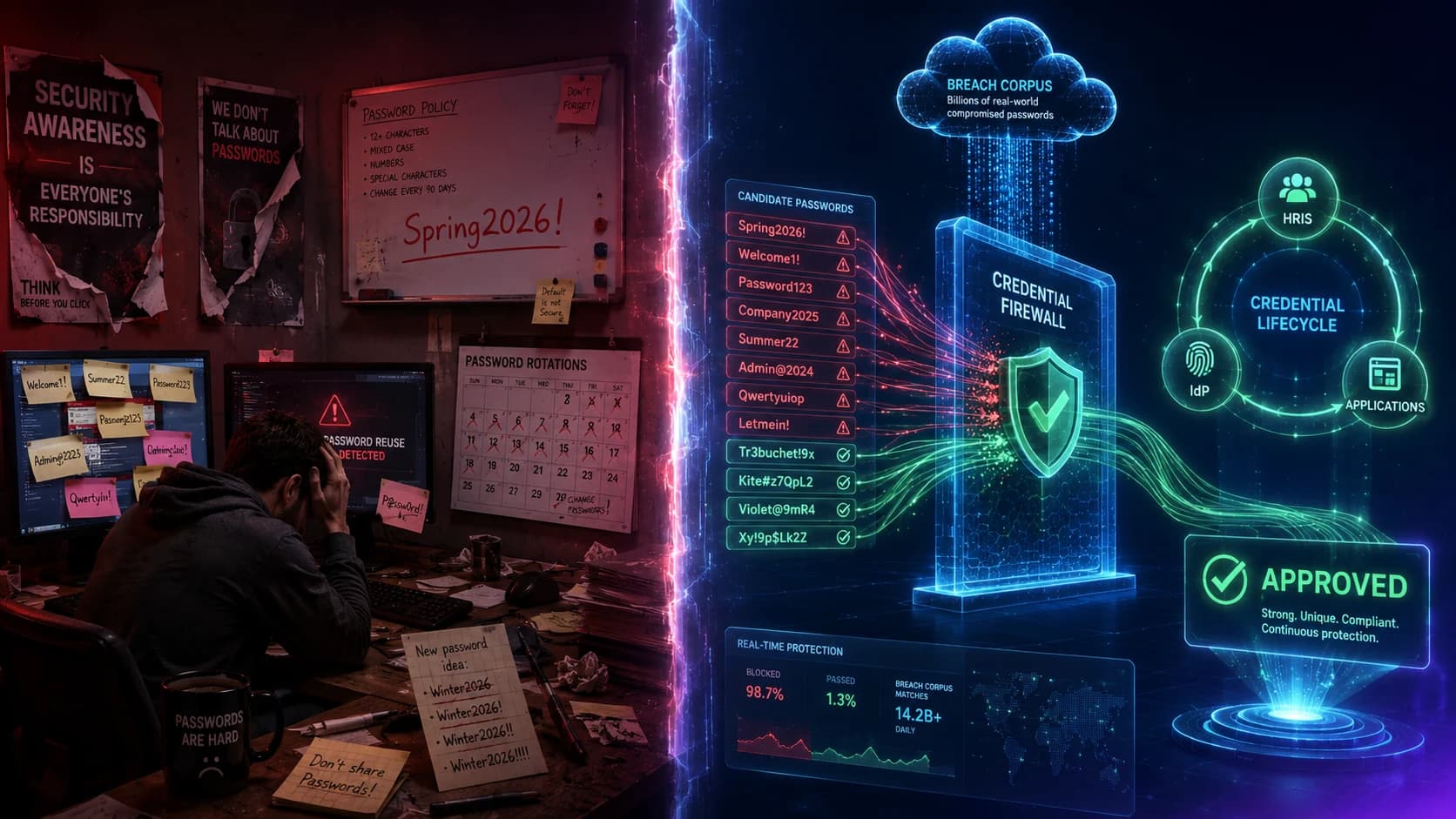
Why weak passwords persist in 2026 despite decades of training — and the policy-enforcement, credential-firewall, and lifecycle controls that eliminate them at scale.
Weak passwords persist in 2026 not because users have not been told about them. They persist because the architecture around credentials has not caught up with the architecture around the rest of enterprise security. We patch operating systems automatically, scan code for vulnerabilities continuously, and rotate cloud credentials on a schedule — and then we ask humans to invent unique, complex strings from memory every ninety days and trust them to get it right. The result is predictable. Roughly half of breaches still involve compromised credentials. The number has been stable since 2018.
This is a 2026 refresh of an earlier piece on the same topic. The structural problems are unchanged; what has changed is the operational toolkit. NIST SP 800-63B no longer requires forced periodic rotation, the breach corpus has grown to billions of credentials that can be checked against every candidate password, credential firewalls have matured into runtime controls, and credential governance has converged with the broader identity lifecycle. The architectural fix for weak passwords is now feasible at workforce scale. Most enterprises have not deployed it.
This piece is about that fix — what the production-grade controls look like, why they work where awareness training does not, and how to deploy them in an enterprise where passwords still exist in significant portions of the estate.
Why awareness training doesn't move the number
The data on weak-password persistence is uncomfortably consistent. Every breach report since 2018 attributes roughly half of breaches to compromised credentials. Every annual training cycle reaches roughly the same percentage of employees. The intersection of those two facts means awareness training is not moving the breach number, regardless of how well it is delivered.
There are structural reasons. Humans optimize for memorability under cognitive load. A user being asked to invent a unique twelve-character password while also remembering ten other passwords, while also doing their actual job, will produce a credential that satisfies the rule set as cheaply as possible. The result is predictable — Company2026! becomes Company2027! at rotation, Welcome123 gets recycled across services, and the breach corpus inherits the same patterns year after year.
The fix is not better training. It is moving the control out of the user's memory and into the system. The user picks a password; the system enforces that the password is strong; the system enforces that the password is not in the public breach corpus; the system enforces that the credential rotates on evidence of compromise rather than on a calendar. The user's job becomes "pick something" rather than "invent and remember the strongest credential possible." The architecture takes responsibility for the policy compliance.
That shift — from awareness to architecture — is what the 2026 toolkit makes possible. The pieces are not new individually; the integration into a coherent control system is what changed.
What "weak" actually means in 2026 numbers
The abstract argument for architecture-over-awareness gets more concrete when the numbers are on the table. Weak passwords in 2026 aren't weak against 1990s attackers; they're weak against 2026 attackers with 16 × RTX 5090 GPU rigs running against bcrypt-hashed credential stores. Here's what "weak" looks like in that model:
| Length | Numbers only | Lowercase letters | Numbers + upper + lower + symbols |
|---|---|---|---|
| 6 | Instantly | 37 mins | 1 week |
| 7 | Instantly | 16 hours | 2 years |
| 8 | Instantly | 2 weeks | 132 years |
| 10 | 20 hours | 32 years | 645k years |
| 12 | 3 months | 21k years | 3bn years |
| 14 | 23 years | 14m years | 15tn years |
Two numbers to sit with. First, the classic 8-character password with the full complexity rule — the credential most enterprise policies still require — takes 132 years to brute force. That sounds strong until you notice that 12 characters of lowercase-only beats it by orders of magnitude (21,000 years vs 132 years). The composition rule adds character-set entropy; length adds exponent. Length wins.
Second, and more damning: a 7-character password that satisfies the full complexity rule falls in 2 years. The 8-character composition-rule requirement is a cliff — one character under it is a real vulnerability against a well-resourced offline attacker. And that's assuming the attacker is doing pure brute force. Attackers who start with the breach corpus, dictionary variants, and structural-transform mutations reach common passwords in seconds regardless of length or composition. That's the practical vulnerability weak-password architecture creates.
Full time-to-crack model — 15 rows × 5 character-set columns — is in the Password Complexity vs Password Strength piece, which shares the same reference hardware and hash assumptions.
This is what architecture-over-awareness is arguing against. The user who satisfies the composition rule at 8 characters is not weak because they lack awareness — they're weak because the system asked them to satisfy the wrong requirement. The four controls below fix the requirement.
The four controls that actually eliminate weak passwords
Four controls, deployed together, eliminate weak passwords as a meaningful attack surface. None of them is novel. All of them are operationally deployable in 2026.
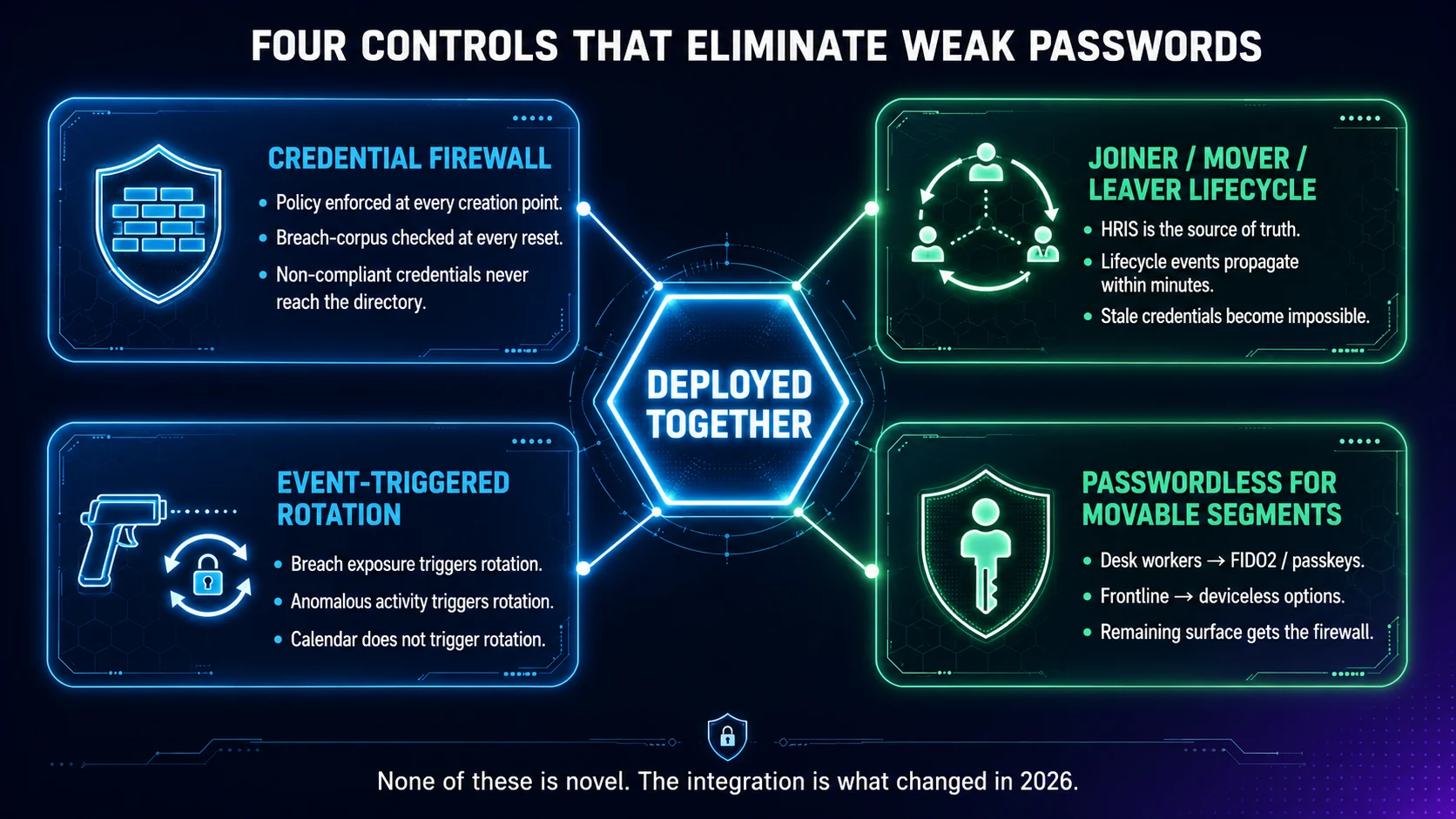 Four controls. None of them novel individually. The 2026 difference is that they can be deployed as a single integrated control system rather than as four separate projects.
The credential firewall
A credential firewall checks every candidate password against policy at every creation point — user self-service, administrative reset, API-driven provisioning, password import, programmatic rotation. The policy is enforced at runtime. Non-compliant credentials never reach the directory.
The policy itself is the result of two decades of empirical security research, codified in NIST SP 800-63B and adjacent standards. Minimum length (12-14 characters in 2026 enterprise practice), no maximum length below 64, no required composition rules (uppercase plus lowercase plus number plus symbol is no longer recommended because it produces predictable patterns), no forced periodic rotation, mandatory check against the breach corpus, mandatory check against the user's own previous credentials, and mandatory check against simple structural transforms (Company2026 → Company2027 fails).
The breach-corpus check is the single highest-impact addition since the 2010s. The ALIEN TXTBASE collection that fed Storm-2949 — covered in our governance failure analysis — contains billions of leaked credentials. Checking each candidate password against that corpus at creation time prevents the user from picking a password an attacker already has. Avatier ships this check as Password Bouncer; Specops Password Policy, HaveIBeenPwned's Pwned Passwords API, and several other vendors implement the same control surface.
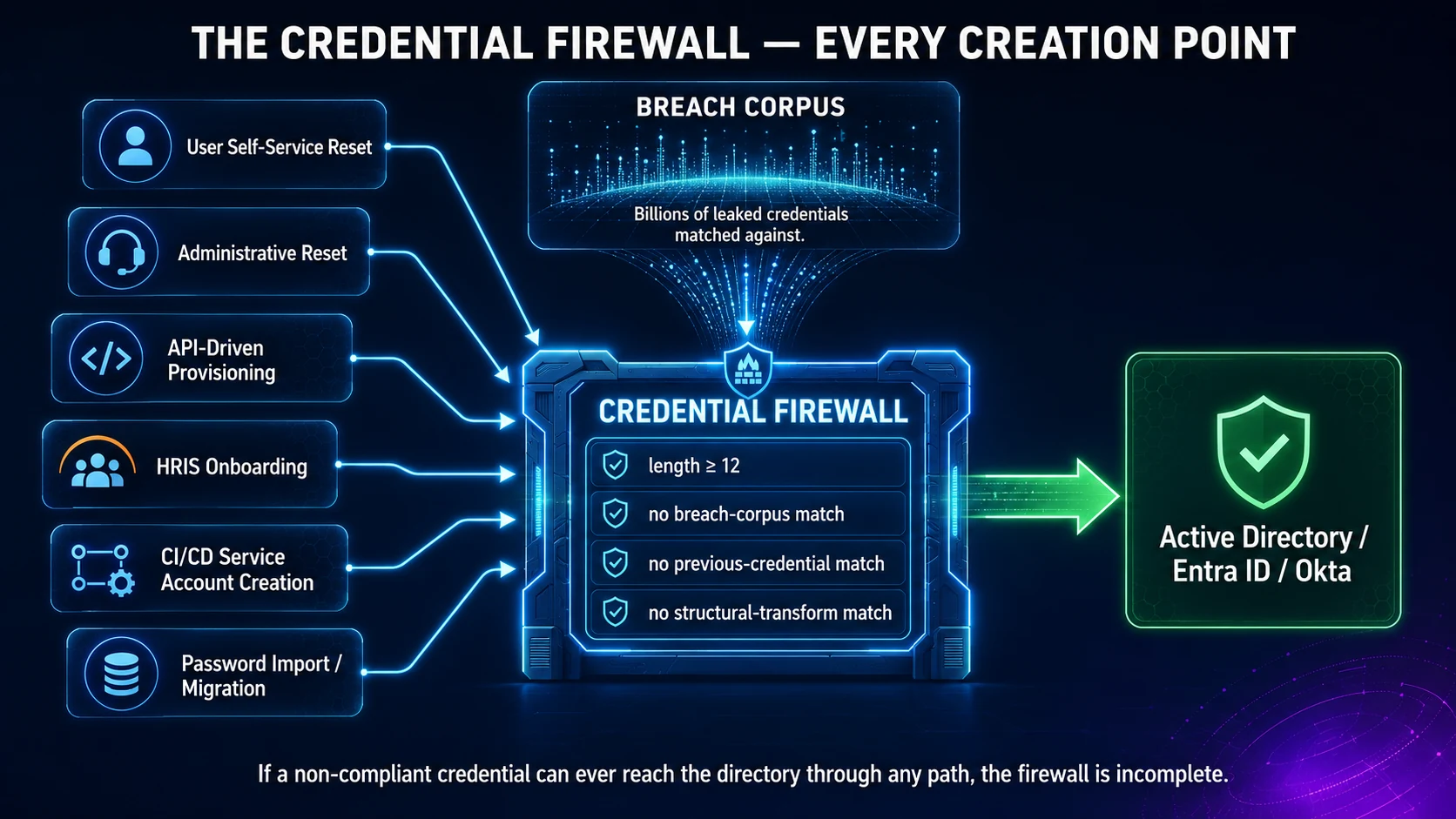 Every creation point — or none of them. The credential firewall is a runtime control, not a documentation control. The architectural test is whether a non-compliant credential can ever reach the directory through any path.
The firewall has to be at every creation point or it does not work. A policy that fires at the user-facing reset page but not at the helpdesk-driven admin reset, or that fires at the IdP but not at the legacy application's local credential store, or that fires at human-driven changes but not at automation-driven provisioning, has gaps that attackers (and well-meaning administrators) exploit. The architectural test is whether a non-compliant credential can ever reach the directory through any path; if yes, the firewall is incomplete.
Joiner/mover/leaver lifecycle
The lifecycle is where weak passwords accumulate fastest in practice. Onboarding produces temporary credentials that often never rotate. Role changes inherit credentials from previous responsibilities. Departures leave credentials in shared accounts that the offboarding workflow does not capture. Service accounts created for one application sit forgotten for years, with the original temporary password still active.
The mature lifecycle pattern integrates the credential firewall with the HRIS as the source of truth. New hire fires in Workday or SuccessFactors → IdP creates account → user receives enrollment link → user picks a credential, which passes through the firewall before being stored. Role change → if the role transition crosses a privilege boundary, force credential rotation through the firewall. Termination → revoke all credentials, including service-account credentials the departing employee created, within minutes.
The operational discipline that makes this work is that the lifecycle platform and the credential firewall integrate bidirectionally. The HRIS event triggers the credential action; the credential action reports back to the lifecycle platform when it completes. Stale credentials become impossible because the lifecycle platform knows about them and the firewall enforces rotation.
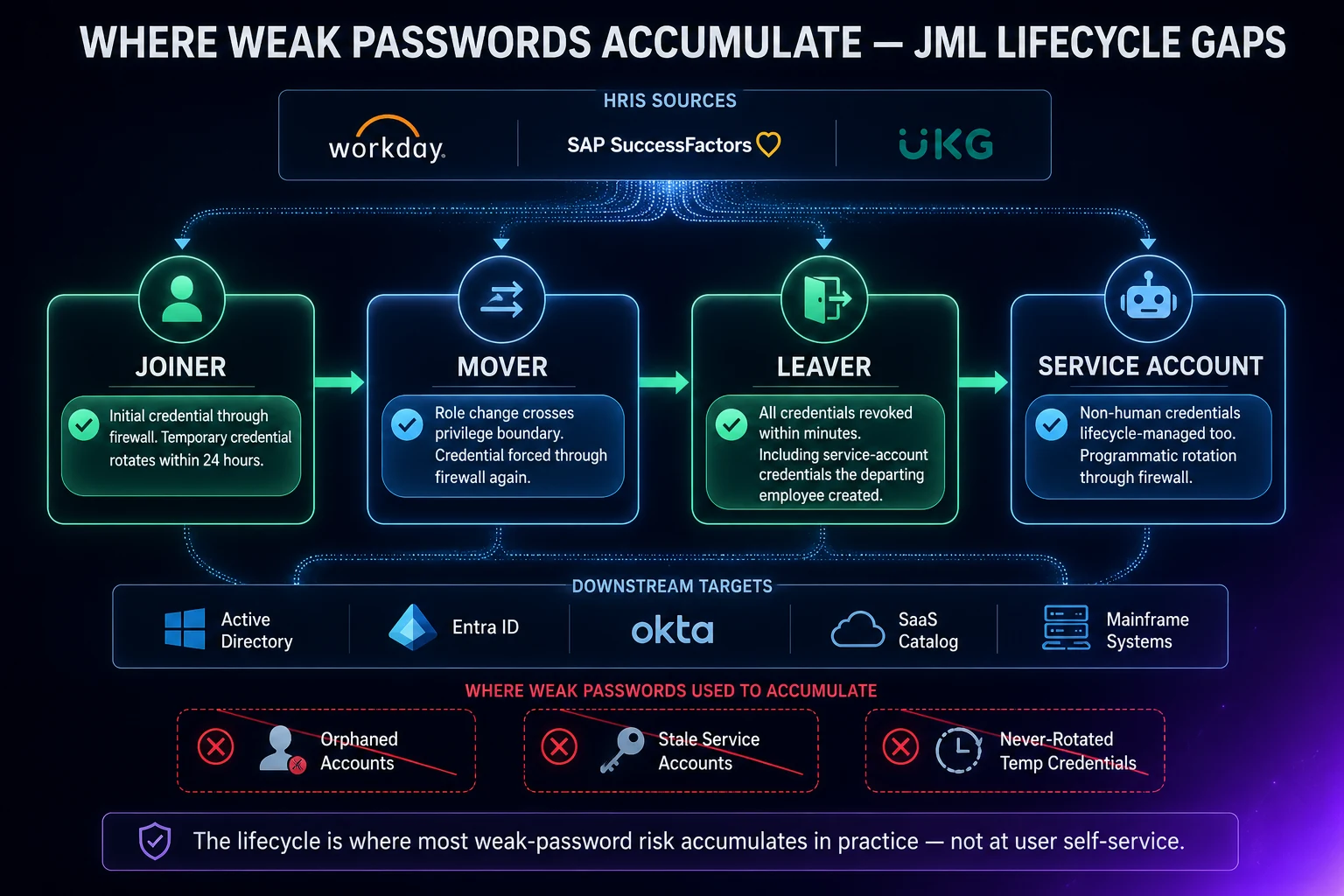 The lifecycle is where most weak-password risk accumulates in practice. Joiner, mover, leaver, and service-account events are where the failure modes live — not at the user-facing reset page where awareness training operates.
Our Best IGA Solutions guide covers the buyer-guide framing for the lifecycle platform layer. The relevant point for the weak-password problem is that the lifecycle is where the problem actually lives in production — not at user self-service, where awareness training operates, but at the dozens of provisioning and re-provisioning events that happen across every employee's tenure.
Event-triggered rotation
The 2026 rotation pattern is event-triggered, not calendar-triggered. The events that trigger rotation include credential appearance in a new breach corpus, anomalous account activity (impossible-travel sign-ins, unusual application access, high-volume failed-auth attempts), explicit security incidents on related accounts, role changes that cross privilege boundaries, and offboarding for any shared credentials the departing user had access to.
The shift away from forced 90-day rotation is one of NIST 800-63B's most consequential recommendations. The operational evidence over a decade was that forced rotation produces incremental changes that are weaker than the original credential, increases helpdesk volume, and does not measurably reduce breach incidence. Event-triggered rotation captures the actual risk events (compromise indicators, role changes) without the human-overhead cost.
The implementation requires continuous monitoring of the credential surface for the trigger events — breach corpus subscriptions for the leaked-credential trigger, anomaly detection on the identity-event stream for the suspicious-activity trigger, integration with the lifecycle platform for the role-change and offboarding triggers. Avatier ships the integration in Identity Anywhere; the architectural pattern works regardless of vendor.
Passwordless for the segments that can move
The fourth control is the recognition that some workforce segments should not have passwords at all. Desk workers on managed laptops can move to FIDO2 passkeys or platform passwordless. Frontline workers on shared workstations can move to deviceless options like Avatier's Identity Challenge Card. Privileged accounts can move to hardware security keys with no password fallback.
Passwordless is not a complete replacement for the credential firewall — most enterprises will have some portion of the estate (legacy applications, mainframe, service accounts, shared frontline workstations) running on passwords for years. Passwordless is a substantial reduction of the password surface for the segments that can move. The remaining surface needs the firewall, the lifecycle integration, and event-triggered rotation.
Our Best Passwordless Solutions guide covers the workforce-segmented framing for the passwordless layer. The relevant point for the weak-password problem is that passwordless and credential firewall are complements, not alternatives — the segments that move to passwordless reduce the password surface; the remaining surface gets the architectural controls.
What this looks like for an enterprise architect
The deployment sequence that works for an enterprise architect closing the weak-password gap is concrete.
First, deploy the credential firewall at every creation point. Audit the paths a credential can enter the directory; close the ones that bypass the firewall. The audit alone usually surfaces three or four gaps an enterprise did not know it had — usually a legacy application with its own credential store, a CI/CD pipeline that provisions service accounts directly, or an HR import workflow that sets initial passwords without firewall enforcement.
Second, subscribe to the breach corpus and enable the leaked-credential check. The major sources — HaveIBeenPwned's Pwned Passwords, ALIEN TXTBASE, and several vendor-curated commercial feeds — are operationally affordable and update frequently. The check is computationally cheap (hash comparison against a corpus, with no need to share credentials with the corpus provider in the strong implementations).
Third, integrate the firewall with the joiner/mover/leaver lifecycle. The HRIS source-of-truth integration is the operational core; without it the lifecycle events do not propagate to the credential infrastructure and stale credentials accumulate. Most modern identity governance platforms — covered in our IGA Buyer's Guide — ship the integration as a first-class capability.
Fourth, switch from calendar rotation to event-triggered rotation. The communication change matters as much as the technical change — employees who have been told for a decade that they need to rotate every 90 days will not believe overnight that the rule has changed. Pair the policy update with clear communication about what does trigger rotation (breach exposure, anomalous activity, role change, offboarding) and what does not (the calendar).
Fifth, identify the workforce segments that can move to passwordless and move them. The reduction in password surface compounds the impact of the credential firewall on the remaining surface. Most enterprises start with desk workers on managed laptops and privileged accounts; frontline staff and contractors follow once the deployment pattern is stable.
What the architecture does NOT eliminate
Two failure modes the credential-firewall architecture does not address by itself.
The first is the recovery channel. A user who forgets their password and calls the service desk for a reset enters a different control surface — service-desk identity verification — that has its own attack patterns. Our Beyond Foundational MFA analysis on the ICC blog covers this gap and the workflow-tied verification pattern that closes it.
The second is the service-account surface. Non-human credentials — application credentials, machine identities, OAuth client secrets — have the same weak-credential risks as human credentials, but they sit outside the joiner/mover/leaver workflow. Service-principal hygiene as a governance discipline is what closes that gap; we covered the pattern in our Storm-2949 governance failure analysis.
The complete architecture is credential firewall plus event-triggered rotation plus passwordless for movable segments plus workflow-tied recovery verification plus service-principal lifecycle governance. Each control is necessary; together they take weak passwords from "the leading cause of breaches" to "an artifact of legacy systems that the architecture contains and monitors."
What Avatier ships
Avatier Identity Anywhere ships the four controls integrated as a single platform — Password Bouncer for the credential firewall, the breach-corpus check at every creation point, joiner/mover/leaver lifecycle integration through Identity Anywhere Lifecycle Management, event-triggered rotation through Identity Anywhere Compliance Auditor, and the Identity Challenge Card for the deviceless passwordless layer. Avatier is a CISA Secure-by-Design Pledge signatory, and our Trust Center publishes the SOC 2 Type II (zero exceptions), ISO/IEC 27001:2022, PCI DSS v4.0.1, CSA STAR Level 1, and NIST 800-53 Rev. 5 alignment that the platform meets.
The architectural pattern works regardless of vendor. The point of this piece is not that you have to buy Avatier — it is that the weak-password problem is solvable in 2026 with controls that exist, work at workforce scale, and produce measurable reductions in credential-related breach risk. The enterprises that deploy them will not be the ones whose 2027 breach reports cite "compromised credentials" as the initial access vector. The enterprises that continue to rely on awareness training will be.
The architecture is the fix. The training was never going to work.
ABOUT THE AUTHOR

More from Pillar 1: Password Firewall
Password Policy for Enterprise Authentication 2026: The NIST 800-63B Rev. 4 Reference
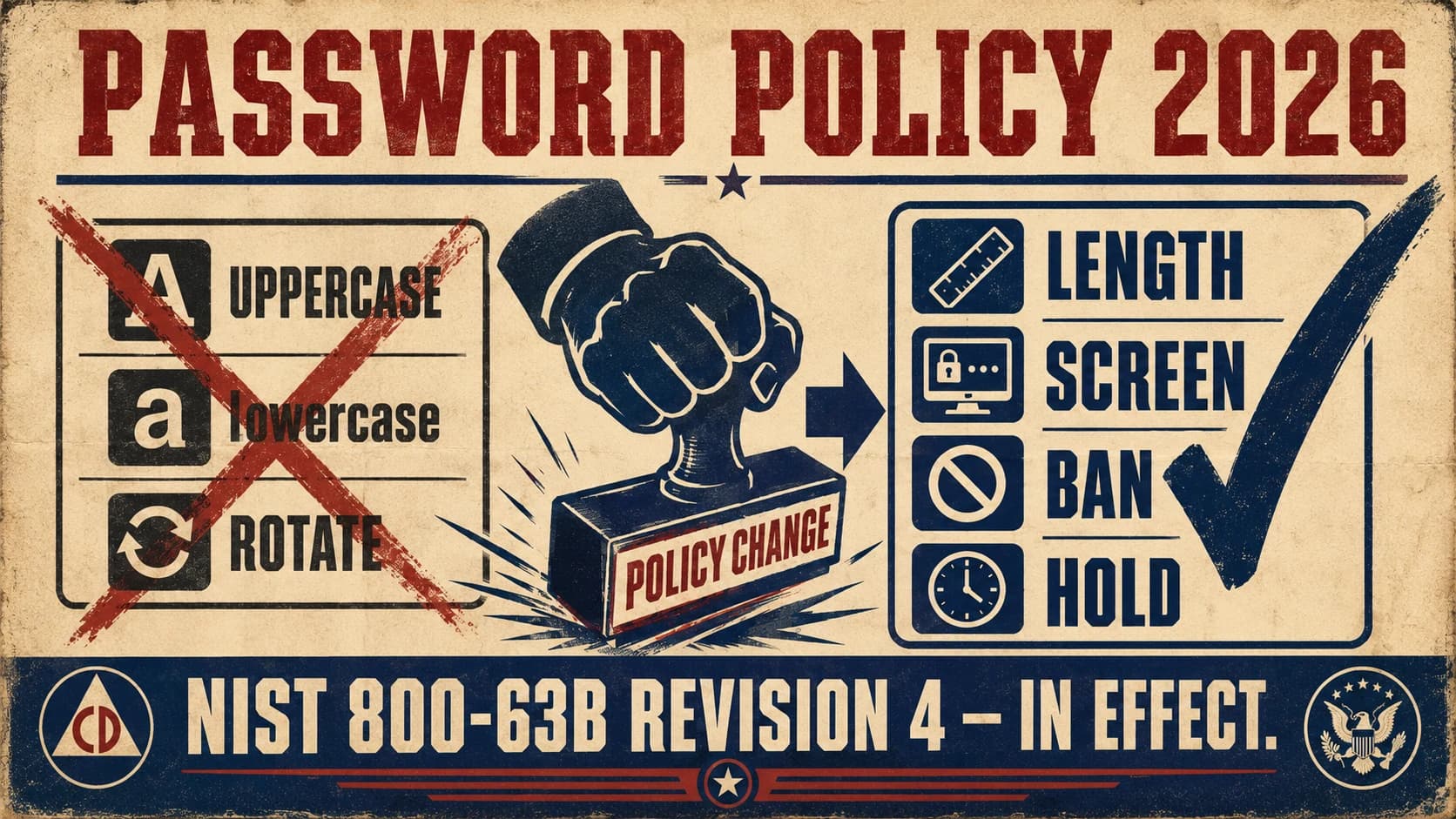
The password policy that actually reduces risk is not the password policy most enterprises still enforce. NIST 800-63B Rev. 4 (finalized 2025) dismantles the composition rules and periodic-reset mandates that defined the 2000s and codifies a fundamentally different discipline — length over complexity, breach-corpus screening, banned-list enforcement, no forced periodic rotation. The 2026 enterprise reference on the modern password policy, the AAL1/2/3 assurance-level mapping, the enforcement architecture that operationalizes it, and the migration path from the legacy policy every enterprise still carries.

Password Spraying Defense: Blocking Guessable Passwords with Avatier
Password spraying tries a few common or breached passwords across many accounts, spread thinly enough to dodge lockout. The defense is to screen every new password before it can be set.

Password Aging Policies in 2026: What NIST Actually Says
Mandatory password rotation on a fixed calendar is no longer best practice — NIST SP 800-63B favors length and breach screening over forced expiration, and here's what to do instead.