False-Positive Reduction in Identity Security: A 2026 Reference
Identity systems generate a lot of suspicious-looking events that aren't actually attacks. The 2026 architecture for separating real signal from noise — without losing the signal.

Identity systems generate a lot of suspicious-looking events that aren't actually attacks. The 2026 architecture for separating real signal from noise — without losing the signal.
Identity systems generate a lot of suspicious-looking events that aren't actually attacks. A user signing in from a new country during a documented business trip. A help-desk-processed password reset that's tied to a ticket. A scheduled provisioning run that touches hundreds of accounts simultaneously. A privileged-account elevation that follows the change-management calendar. All of these look like attack patterns when viewed in isolation, and all of them are normal when viewed with context.
The discipline that separates real signal from operational noise is called false-positive reduction, and the 2026 architecture for it is substantially different from the 2024 version. The shift is driven by two adjacent realities: detection AI has matured to the point where it can integrate richer context, and the Storm-2949 attack pattern documented in mid-2025 raised the cost of treating "help-desk-driven identity events" as automatic-noise. The combination means detection systems now need to do more work to classify an event as legitimate — and that work, done well, is the false-positive reduction story for 2026.
This piece walks through where the noise actually comes from, what the 2026 controls look like, where AI helps and where it doesn't, and how the architecture ties together. It's the operational complement to our Storm-2949 governance failure analysis, which covers the attack chain that reshaped the threat model. False-positive reduction is what makes that threat model actionable without burning out the analysts who have to respond to it.
Where identity false positives actually come from
The first cut at the problem is that "identity false positives" is several different problems sharing one label. The high-volume categories in production are predictable.
Sign-in-anomaly false positives dominate by raw volume. A user travels and signs in from an unfamiliar country. A user gets a new laptop and the device fingerprint changes. A user starts using a VPN and the source IP no longer matches their pattern. Detection systems that score on sign-in heuristics alone treat these as suspicious; reality is that they're routine. The mitigation is integrating the sign-in event with the user's calendar, the device-management system's enrollment state, and the network team's VPN allocation log.
Lifecycle-event false positives show up at moments of organizational change. A new hire's first week shows access to dozens of applications they've never touched before — which looks like account-takeover behavior except that the user joined the company yesterday and is going through normal onboarding. A role transition triggers a flurry of access modifications that look like privilege escalation but are actually a documented mover event. A bulk offboarding during a layoff triggers deprovisioning across hundreds of accounts simultaneously, which looks like account-deletion attack except that HR scheduled it. The mitigation is integrating the lifecycle platform (HRIS-driven joiner/mover/leaver) with the detection feed.
Workflow-driven false positives are the Storm-2949 category. A help-desk-driven password reset on a privileged account looks like the Storm-2949 attack chain (attacker initiates reset, social-engineers the user into approving the MFA prompt for the reset, takes over the account). It also looks identical to a legitimate help-desk reset where the user genuinely forgot their password. The distinguishing context is whether the reset is tied to a workflow ticket with verification — and detection systems that don't integrate the ticket system can't tell the difference. The mitigation is workflow-tied verification, which we covered in the Storm-2949 analysis and the Beyond Foundational MFA companion piece.
Scheduled-change false positives come from documented operational activity. The DevOps team runs a scheduled credential rotation across service accounts. The IT team pushes a configuration change that briefly looks like privilege elevation. The compliance team runs a quarterly access certification campaign that triggers a wave of access revocations. The mitigation is integrating the change-management calendar with the detection feed so that scheduled events are pre-classified.
The shared pattern across all four categories is that the noise isn't random — it's structurally tied to other systems that the detection layer typically doesn't see. False-positive reduction is mostly about making those systems visible to detection.
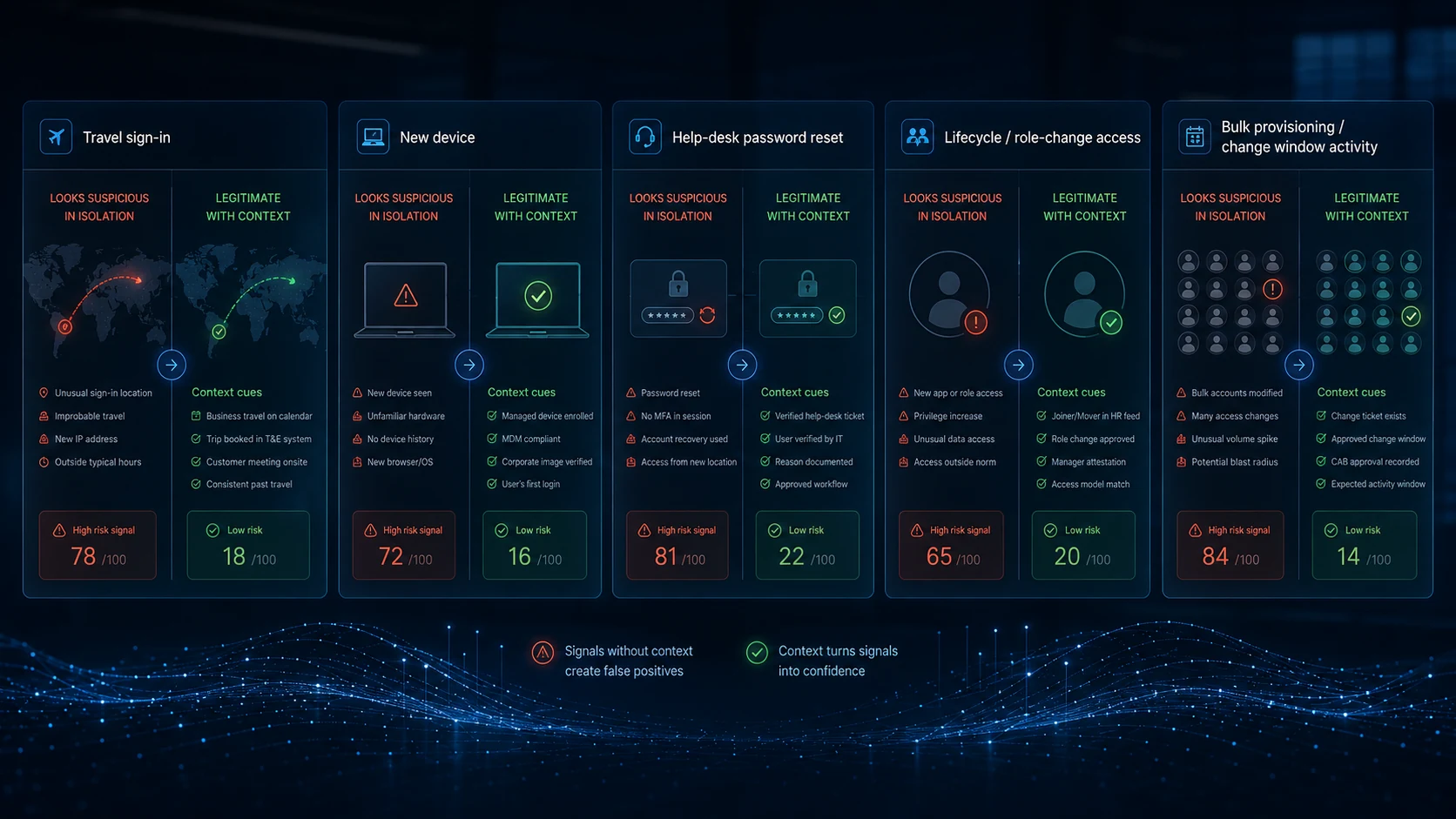 The same identity event can be high-risk or low-risk depending on what context the detection layer has access to. False-positive reduction is making the context visible.
Where AI actually helps
The honest framing is that AI in identity detection is a multiplier on whatever signal is already in the data. When the underlying telemetry is rich, AI scoring produces useful results. When the underlying telemetry is sparse, AI scoring produces noise dressed up as confidence. The 2026 deployments that work are the ones that pair AI with the underlying integration work.
Behavioral baselines work well when there is enough event history per user to distinguish normal patterns from anomalies. A baseline that knows a particular user's sign-in pattern across a six-month window can distinguish a routine travel sign-in from a credential-theft sign-in with reasonable accuracy. A baseline trained on a workforce-level average can't, because the workforce average doesn't capture individual variation. The implementation question is whether your identity provider supports per-user baselines and whether your event history is long enough to be useful.
Risk scoring works well when the scoring inputs include lifecycle state, workflow context, and authenticator strength alongside the sign-in heuristics. A score that integrates "user is on a documented mover event" with "sign-in came from a registered device with phishing-resistant MFA" produces a different — and more useful — score than one that only sees the sign-in itself. The integration is what makes the score actionable; in isolation, the score is the same kind of noise as the rule-based alert it was supposed to replace.
Anomaly detection on lifecycle events works well when the detection system has access to the HRIS-driven joiner/mover/leaver feed. A sudden access pattern that maps to a documented joiner event isn't an anomaly; a sudden access pattern that doesn't map to any documented event is. The differentiator is integration with the lifecycle platform — covered in detail in our Best ILM Solutions guide.
Adaptive thresholds work well when the system has feedback loops from analyst dispositions. A scoring model that learns from "analyst marked this alert as false positive" over time gets better; one that doesn't have a feedback loop just runs the same scoring forever. The implementation question is whether your SIEM or SOAR captures analyst disposition and routes it back to the identity scoring engine.
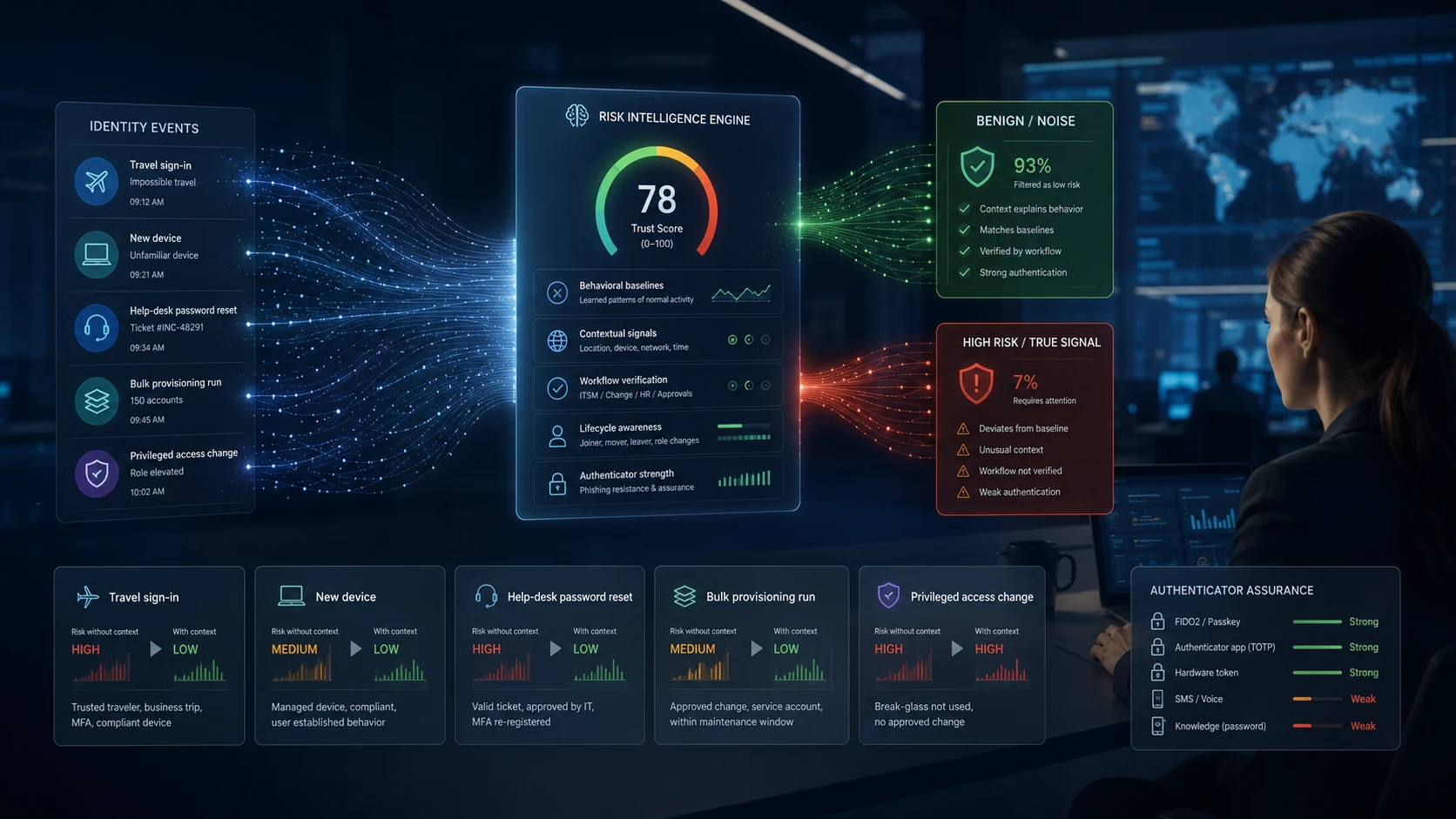 The composite score is what an integrated risk engine produces when it can see all four lower layers simultaneously. Routing is automatic at the high-confidence boundaries; only the ambiguous middle requires analyst time.
Where AI is counterproductive
The flip side is real. AI scoring on top of weak telemetry doesn't fix the underlying problem — it adds a confidence label to it. Three failure modes recur in production.
First, AI scoring without lifecycle integration. A scoring model that doesn't know the user joined yesterday flags every new-application access as anomalous. The model isn't wrong about the events being unusual; it just doesn't have the context to know they're expected. Without lifecycle integration, the false-positive rate from this failure mode dominates the rest.
Second, AI scoring without workflow context. A scoring model that doesn't know whether a help-desk-processed reset is tied to a verified ticket can't distinguish a Storm-2949 attack chain from a routine forgot-password call. Post-Storm-2949, both look the same on the wire; only the workflow context distinguishes them.
Third, AI scoring without authenticator-factor differentiation. A scoring model that treats "the user authenticated" as a single signal misses the distinction between phishing-resistant MFA and SMS OTP. Two sign-ins from the same user at the same time with the same device fingerprint can have very different risk levels depending on factor strength — and a model that doesn't see factor strength can't represent that difference.
The synthesis is that the underlying integration work is the hard part. Once the integration is in place, AI scoring becomes a useful layer on top. Without the integration, AI scoring is the same problem as rule-based alerting, just with more authoritative-sounding confidence scores.
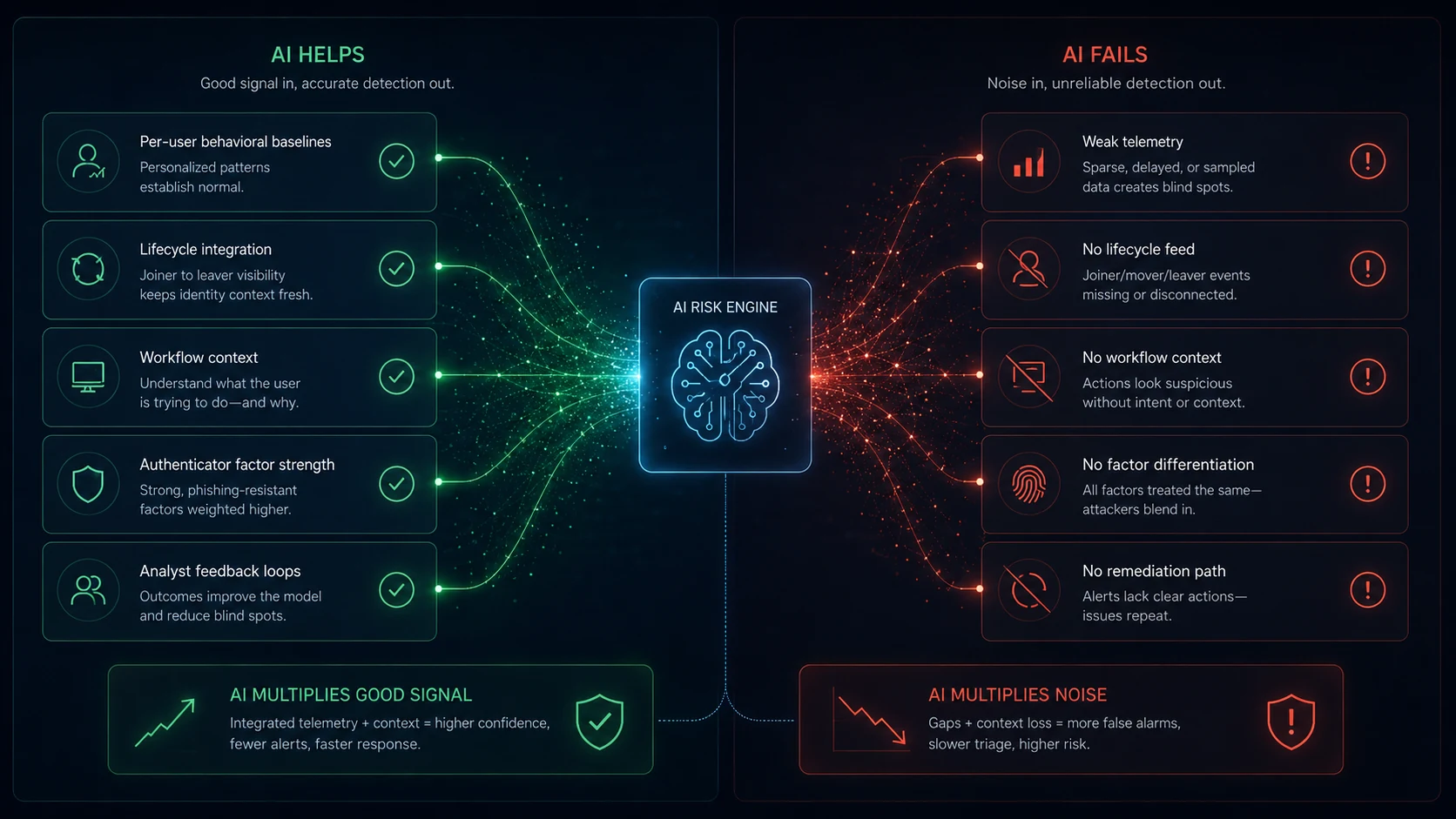 AI is a multiplier on whatever signal is already in the underlying integrations. With good integration it produces faster, higher-confidence response. Without it, it produces noise dressed up as confidence scores.
What the integrated architecture looks like
The architectural pattern that produces low false-positive rates in 2026 has five components. None of them is novel individually; the integration is the work.
The lifecycle layer publishes joiner/mover/leaver events with enough metadata for downstream systems to consume them. New hire from HR system → identity-event stream sees the joiner record. Role change → mover event published with the old/new role attributes. Termination → leaver event published with the deprovisioning trigger. Detection systems subscribed to this feed pre-classify activity that aligns with documented lifecycle events.
The workflow layer ties help-desk-processed identity events to ticket records with verification metadata. A password reset processed by an agent is tagged with the ticket number, the verification method used (workflow-tied code, knowledge-based question, in-person), and the verification outcome. Detection systems subscribed to this feed can distinguish verified-legitimate identity events from unverified ones. Our Storm-2949 analysis covers why this integration matters.
The authentication layer publishes factor-strength metadata with each sign-in event. The detection layer sees that a user signed in with FIDO2 versus SMS OTP versus password-only. Scoring models that integrate factor strength produce different scores for the same sign-in event depending on what was used. The Best MFA and Best Passwordless guides on the ICC blog cover the authentication-layer architecture this depends on.
The change-management calendar publishes scheduled operational events: DevOps credential rotations, IT configuration pushes, compliance certification campaigns, planned maintenance windows. Detection systems subscribed to this feed pre-classify activity that aligns with scheduled changes.
The risk-scoring layer sits on top of the other four and produces composite scores that integrate all the signal sources simultaneously. The scoring model can be ML-driven or rule-based; what matters more is the integration with the underlying feeds. A simple rule-based model with rich integration produces lower false positives than a sophisticated ML model with poor integration.
When the five components are integrated, the false-positive rate becomes a function of how well the integration is maintained over time — and the analyst work shifts from "investigating noise" to "validating the integrations." That shift is the operational improvement.
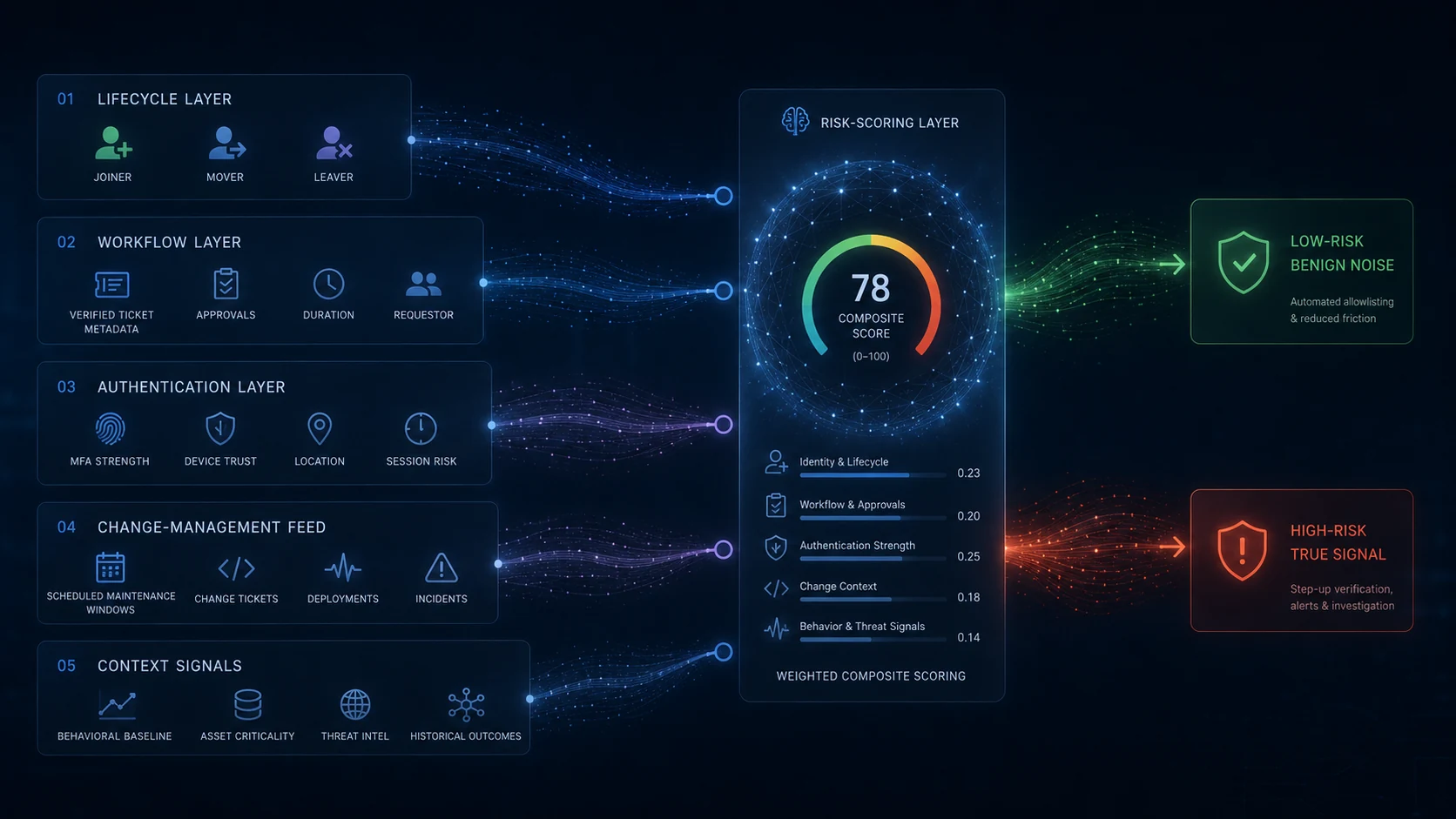 Five integrated source layers feeding one composite scoring layer. The five layers individually aren't novel; the integration between them is what produces the operational improvement.
What Avatier ships toward this pattern
Avatier Identity Anywhere integrates four of these five layers natively. Identity Anywhere Lifecycle Management publishes the joiner/mover/leaver event stream; Password Station ties help-desk-processed identity events to workflow-verified ticket records; Identity Anywhere Authentication produces factor-strength metadata in the event log; and Identity Anywhere Compliance Auditor captures the scheduled-change feed from the change-management integration. The risk-scoring layer is typically the customer's SIEM (Splunk, Sentinel, Chronicle) or a dedicated identity-threat-detection platform — Avatier publishes the event feeds those platforms consume.
The architectural point is not that Avatier is the only path to this pattern; the point is that the pattern requires the integration to exist, and the integration is what reduces false positives. Whatever path you choose, the question to ask is whether the layers expose their state to detection or whether detection is left to infer it from incomplete telemetry.
Avatier is a CISA Secure-by-Design Pledge signatory; our Trust Center publishes the SOC 2 Type II, ISO/IEC 27001:2022, PCI DSS v4.0.1, CSA STAR Level 1, and NIST 800-53 Rev. 5 alignment posture the platform meets.
What this looks like operationally
The analyst-team workflow that emerges from the integrated architecture is different from the rule-based-alert workflow most teams are running now. Three shifts matter.
The first is that high-confidence alerts become genuinely actionable. When a score integrates lifecycle, workflow, factor, and change-management context, a high score is much more likely to be a real attack than a misclassification. The investigation that follows can start from "this needs response" rather than "this needs verification."
The second is that low-confidence events get classified rather than ignored. The scoring layer can route low-confidence anomalies to lightweight verification (auto-prompt the user via the workflow channel: "did you just sign in from Lisbon?") rather than queuing them for analyst review. Most of these clear in seconds without analyst time.
The third is that the integrations themselves become the operational target. When the system is producing low false positives, the analyst-team focus shifts to maintaining the integrations: the HRIS feed is current, the ticket-system integration captures verification context, the authentication-factor metadata is complete, the change-management calendar is up to date. The work becomes preventing the false-positive rate from creeping back up rather than triaging individual events.
That operational shift is the point of the 2026 architecture. The technology has moved past "AI will fix it" into the more useful framing of "integration produces signal; AI scores it; analysts maintain the integration." It's less exciting as a vendor pitch and more useful as an operational pattern.
The honest closing
False-positive reduction in identity systems is a long arc, not a single project. The teams that do well treat it as continuous integration maintenance, not a one-time deployment. The detection AI is a useful multiplier on whatever signal the underlying layers produce; it does not, by itself, solve the problem.
The architecture that works in 2026 is the lifecycle layer, the workflow layer, the authentication layer, the change-management feed, and the risk-scoring layer — integrated. Avatier ships four of those five and integrates with the fifth via the standard SIEM feeds. The pattern works regardless of vendor; the question is whether the integration exists.
Get the integration right, and the analyst team stops investigating noise and starts maintaining signal. That's the operational improvement worth chasing.
ABOUT THE AUTHOR

More from IAM & Identity Governance

Identity Management and Digital Transformation in 2026
Every major transformation initiative — cloud migration, remote and hybrid work, mergers and acquisitions — eventually stalls on the same question: who gets access to what, and who decided? The 2026 strategy reference on identity management as the enabler and the bottleneck of digital transformation, the business case executives actually fund, and what modernization does not fix.

AI and Behavioral Analytics for Identity Monitoring: The 2026 Enterprise Reference
Static identity rules catch the attacks that announce themselves. They miss the ones that log in with valid credentials and behave almost normally. The 2026 reference on AI-driven identity monitoring — what behavioral analytics actually detects, the four telemetry sources that make or break the model, the false-positive economics nobody budgets for, and the honest limits of anomaly detection at enterprise scale.

Security Team Collaboration: A 2026 Framework for Identity Programs
Identity governance fails when it runs as a security-team-only initiative. The 2026 framework for cross-functional collaboration: four stakeholder groups, three coordination models, and how zero trust makes it a shared discipline.