IAM Vendors in 2026: How the Market Breaks Down
A category-level guide to how the IAM vendor market segments into suites, point solutions, and platform plays, plus the criteria and red flags that separate real capability from marketing claims.

A category-level guide to how the IAM vendor market segments into suites, point solutions, and platform plays, plus the criteria and red flags that separate real capability from marketing claims.
- The IAM vendor market segments into four problem domains — workforce IAM, customer IAM (CIAM), identity governance (IGA), and privileged access (PAM) — and most vendors are strong in one, not all four.
- The suite-vs-point-solution choice is a real tradeoff, not a marketing question: point solutions add integration work, suites add a single point of failure.
- Evaluate vendors on four axes together — integration breadth, deployment model, total cost, and governance depth — not one at a time.
- Buy-vs-build only favors building in-house when the identity problem is narrow, static, and small; every other case erodes into a maintenance burden a vendor already solved.
- The biggest vendor-claim red flags are unqualified analyst-quadrant citations, deployment-time estimates with no stated scope, and compliance language that blurs 'aligned' with 'authorized' or 'certified.'
Enterprises evaluating identity and access management vendors run into the same problem almost immediately: every vendor's website describes itself as "the complete IAM platform," and no two vendors mean the same thing by that phrase. The honest answer is that IAM vendors differ along four structural axes — the problem domain they were built to solve (workforce access, customer access, governance, or privileged access), whether they ship as a suite or a point solution, how they deploy across your actual estate, and what a defensible total cost of ownership looks like once implementation and operational headcount are counted. Evaluating vendors well means scoring candidates against those axes deliberately, rather than against a feature checklist assembled from marketing pages.
This is the 2026 update of our original IAM vendor overview, rebuilt with a narrower, more useful scope. The original piece ran through a short list of well-known names and a paragraph each. This version steps back to the category level: how the market actually segments, what separates a suite from a point solution, the criteria that predict operational fit, and the claims worth treating skeptically. If you're comparing specific IGA platforms vendor-by-vendor, our IGA buyer's guide picks up where this leaves off; if you're specifically weighing Avatier against Okta on price, our head-to-head pricing comparison covers that narrower question directly.
How the IAM vendor market actually segments
The first mistake most buyers make is treating "IAM vendor" as one category. It isn't. The market splits into four distinct problem domains, and a vendor's depth in one rarely transfers cleanly to the others.
Workforce IAM covers employees, contractors, and service accounts — provisioning, single sign-on, and lifecycle automation tied to the HR system of record. Customer IAM (CIAM) covers the identities of the people who use what your organization sells — registration, consumer-grade authentication, consent management, and scale requirements that look nothing like workforce IAM's. Identity governance and administration (IGA) layers certifications, segregation-of-duties policy, role engineering, and audit evidence on top of either workforce or customer identity data. Privileged access management (PAM) is its own discipline again, focused specifically on elevated and administrative accounts — credential vaulting, session recording, and just-in-time elevation for the accounts that can do the most damage if compromised.
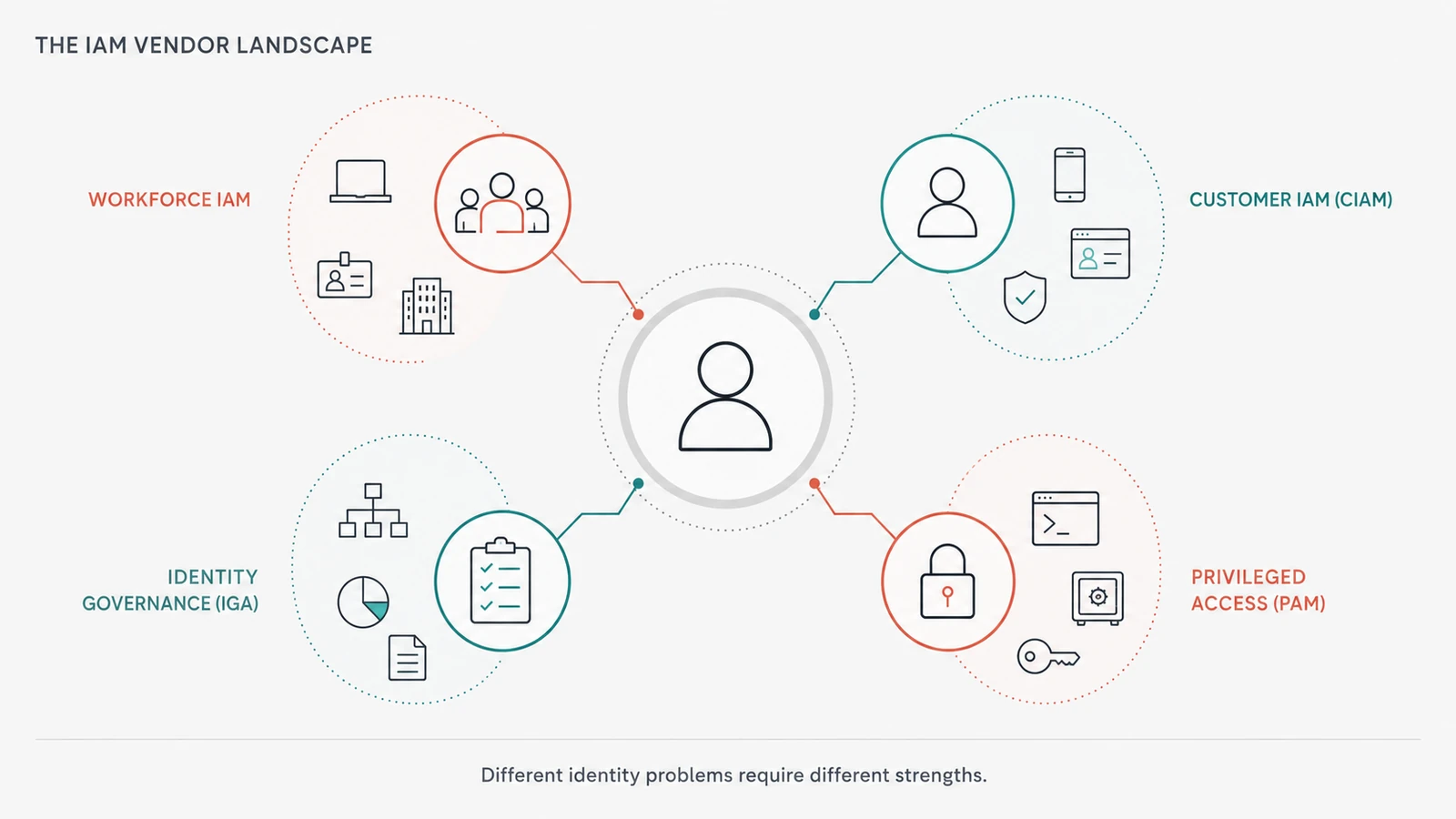 Workforce IAM, CIAM, IGA, and PAM solve different problems — a vendor's strength in one rarely transfers to the others.
Most vendors have a home domain where their engineering investment is deepest, and everything else is either a bolt-on acquisition, a partner integration, or a genuinely newer module still maturing. When a vendor markets itself as covering all four domains equally well, that's worth probing specifically — ask which domain the company was originally built to solve, and how long the other three have been part of the platform.
A related axis, orthogonal to problem domain, is how the vendor packages its capability: as a suite, as a point solution, or as a platform play that others build on top of.
Suites, point solutions, and platform plays
A suite vendor ships multiple identity capabilities — lifecycle, governance, authentication, sometimes PAM — as one integrated platform with a shared data model and policy engine. A point solution vendor does one thing (multi-factor authentication, say, or access reviews) and does it deeply, expecting to sit alongside other vendors' tools rather than replace them. A platform play sits underneath both — an identity fabric or orchestration layer that other tools plug into, rather than a destination application itself.
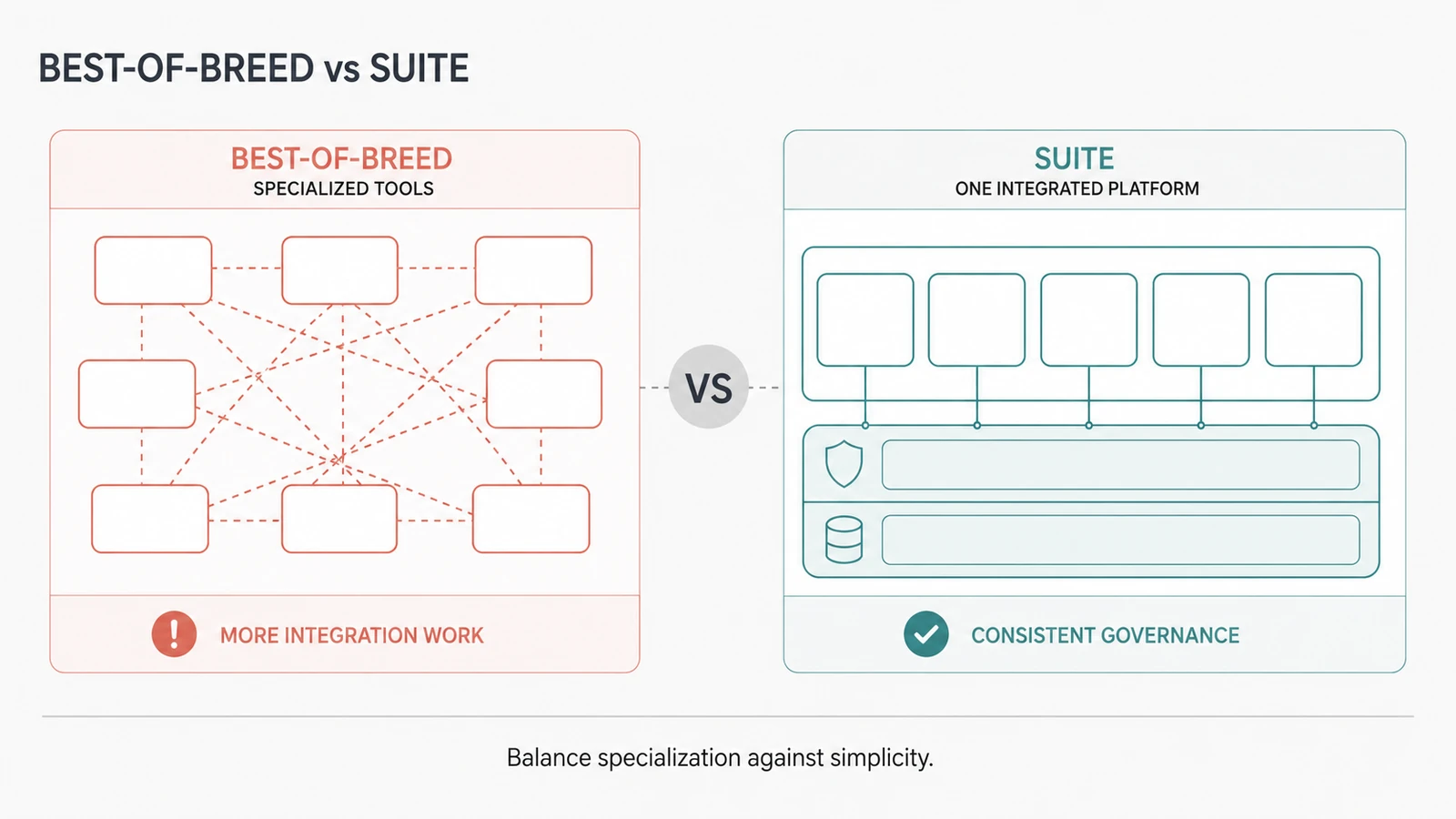 More specialized tools mean more integration work; one platform means simpler operations but a single point of failure.
The tradeoff in that image is the real one, not a marketing simplification. Best-of-breed point solutions let you pick the strongest tool for each specific problem — the best MFA vendor, the best access-review vendor, the best PAM vendor — but every one of those choices is another integration your team owns: another API to monitor, another set of credentials to rotate, another vendor relationship to manage when something breaks at 2 a.m. A suite collapses that integration surface into one data model and one policy engine, at the cost of being only as strong as the suite vendor's weakest module, and tied more tightly to that vendor's roadmap. Neither option is categorically better. An organization with a well-staffed identity engineering function and a strong opinion about the best tool in each category tends to do well with best-of-breed; an organization without that capacity gets more predictable outcomes from a suite, even when no individual module in the suite is the market leader. Point solutions in the authentication category specifically — MFA, passwordless, recovery-channel tooling — are covered from the buyer's-guide side in our best MFA solutions comparison.
Core evaluation criteria that actually predict fit
Feature checklists are the wrong evaluation instrument for IAM vendors, because every serious vendor can check most of the boxes on a generic feature list. The criteria that actually predict whether a vendor will work well in your environment are structural, not feature-level.
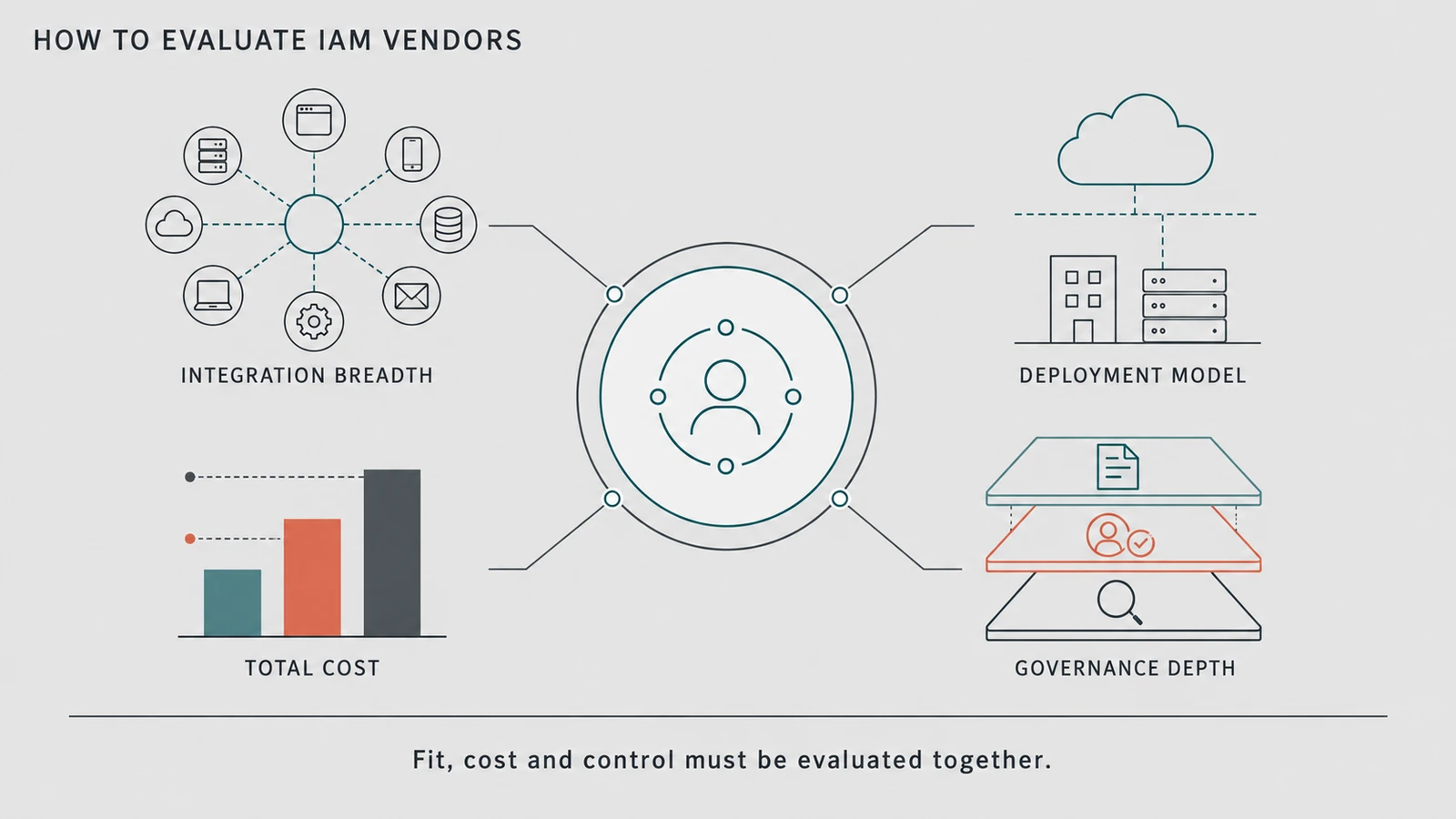 Integration breadth, deployment model, total cost, and governance depth — evaluate all four together, not one at a time.
Integration breadth is whether the vendor's connector library actually reaches the systems you run — including anything legacy, on-premise, or mainframe — not just the modern SaaS estate every vendor's demo environment is built around. Deployment model is whether the platform runs cloud-only, hybrid, or can operate against on-premise directories and legacy authentication protocols where those still hold primary records. Total cost is the fully loaded number: license, implementation, and the ongoing engineering and operational headcount the platform requires to run, not the number on the pricing page. Governance depth is whether certifications, segregation-of-duties policy, and audit evidence are native platform capabilities or a separately licensed module bolted on afterward.
Score every serious candidate against those four axes on the same scale, and the comparison becomes usefully concrete instead of a subjective read of which sales team presented better. For the governance axis specifically, cross-referencing a vendor's position in the Gartner IGA Magic Quadrant is a reasonable input — with the caveat, covered below, that quadrant position measures a specific and narrow set of criteria, not fit for your environment.
Deployment and integration considerations
Two deployment questions matter more than the rest combined: what does the vendor's connector actually do versus what does it claim to do, and what happens to identities the platform doesn't natively reach.
A "native connector" and a generic SCIM or REST API adapter are not the same engineering investment, even though both appear as a checkmark on a connector-count slide. A native connector typically means the vendor has built and tested specific logic for that target system's provisioning model, attribute mapping, and edge cases. A generic adapter means the vendor's platform can talk SCIM or REST, and your team is responsible for building and maintaining the target-specific mapping logic on top of that generic capability. The difference shows up during implementation, not during the sales cycle — ask specifically which of the vendor's "500+ integrations" are native versus generic before you count on any specific one being turnkey.
The second question — what happens to identities the platform doesn't reach — matters most for organizations with mainframe, AS/400, or other legacy systems still holding primary records. Most workforce IAM and IGA platforms were built connector-first for modern SaaS and Active Directory/Entra ID; mainframe support, where it exists at all, is frequently a third-party connector or a partner integration rather than a native capability. If your estate includes mainframe-resident identity data, confirm the vendor's mainframe story before the rest of the evaluation, because it's the detail public buyer's-guide content most often glosses over. Lifecycle-specific deployment patterns — how long a realistic rollout takes given your HR source count, identity provider count, and application catalog size — are covered in more depth in our identity lifecycle management buyer's guide.
Buy vs. build: when building in-house is the right call
Every identity team eventually asks whether a specific capability is worth buying versus scripting internally. The honest answer scales with problem size, not with engineering pride.
Building in-house is defensible when the problem is genuinely narrow and stable: a single script that provisions one SaaS application from one HR event, running against one identity provider, with no compliance evidence requirement attached. That's a reasonable weekend project, and licensing a full platform to solve it would be over-engineering.
The case for building erodes fast as scope grows. Add a second identity provider, and the script needs to reconcile state across two systems. Add a compliance framework, and the script needs to produce audit evidence, not just move access around. Add a legacy or mainframe target, and the script needs protocol-level knowledge that took vendors years to build and battle-test across many customers' environments. Add non-human identity governance — service accounts, API keys, workload identities — and the problem multiplies again. At each step, the in-house build is re-implementing functionality a mature vendor already shipped, maintained by a smaller team, with less operational hardening, and with the maintenance burden landing permanently on your identity engineering headcount rather than on a vendor's.
The realistic dividing line: build for genuinely single-purpose, low-change-frequency problems where the maintenance cost stays flat over time. Buy once the problem touches multiple systems, needs audit evidence, or is likely to grow in scope over the next two to three years — which describes most enterprise identity programs within a year of starting.
Total cost of ownership, beyond the license line
The number on a vendor's pricing page is reliably the smallest piece of what an IAM platform actually costs to run. A defensible TCO comparison includes at least five categories: license cost, implementation services (internal or vendor-delivered), the ongoing engineering time to build and maintain any custom connectors, the operational headcount required to run day-to-day workflows and respond to access requests, and the cost of whatever gap the platform leaves that gets patched with a separate tool or manual process.
That last category is the one buyers most reliably underestimate. If a platform doesn't natively cover mainframe provisioning, or doesn't bind service-desk identity verification to lifecycle state, that gap doesn't disappear — it gets covered by a manual process, a separate point solution, or accepted as residual risk, and all three have a real cost that belongs in the comparison even though no vendor's pricing page itemizes it. A detailed vendor-by-vendor breakdown of these categories, sized against actual enterprise deployments, is in our enterprise IAM cost comparison.
Red flags in vendor claims
A handful of patterns in vendor marketing are worth specific skepticism, not because they're always dishonest, but because they're frequently presented without the context needed to evaluate them.
Unqualified analyst-quadrant citations. "Leader in the [analyst firm] Magic Quadrant" is a real signal, but quadrant methodology measures a specific, narrow set of criteria — usually execution and completeness of vision as the analyst firm defines them — not fit for your specific environment. Our Gartner IGA Magic Quadrant buyer's guide covers how to read quadrant position without over-indexing on it.
Deployment-time claims with no stated scope. "12-week deployment" is meaningless without knowing how many HR sources, identity providers, and applications that estimate assumes. Vendors that quote a fast timeline without qualifying the scope are setting expectations that a complex environment won't meet, and the gap surfaces as a difficult conversation months into the project rather than during the sales cycle.
Integration-count inflation. "500+ connectors" sounds like breadth until you ask how many are native versus generic API/SCIM adapters your team has to configure and maintain yourself. The count is real; the implication that it means turnkey coverage of your specific stack usually isn't.
Compliance language that blurs distinct postures. "FedRAMP" without specifying aligned versus authorized, or "compliant" used where the honest word is "aligned," conflates materially different levels of assurance. A vendor's own published trust-center page listing specific certification status — not marketing-page adjectives — is the source to check before taking a compliance claim at face value.
What Avatier ships toward this pattern
Avatier positions as a suite play in workforce IAM: Identity Anywhere ships lifecycle management, access governance, and self-service password and account management as one platform with a shared data model, rather than as separately licensed modules bolted together after acquisitions. The integration breadth extends to native RACF, ACF2, and Top Secret mainframe connectors — a deployment-model gap most workforce IAM and IGA vendors leave to third-party connectors or partner integrations — and service-desk identity verification bound to lifecycle state through Password Station, closing the specific gap that service-desk impersonation attacks exploit.
On the trust and compliance axis, Avatier is a CISA Secure-by-Design Pledge signatory, and the Avatier Trust Center publishes current status for SOC 2 Type II (audited with zero exceptions noted), ISO/IEC 27001:2022, PCI DSS v4.0.1, CSA STAR Level 1, and NIST 800-53 Rev. 5 alignment — aligned, not authorized, which matters for federal and federal-adjacent buyers weighing that distinction directly against the red flags above.
None of that makes Avatier the right fit for every organization in the taxonomy above. It's a suite-model answer to the workforce IAM and IGA domains specifically, with a deliberate mainframe and legacy-integration emphasis; a cloud-only, modern-SaaS organization with a strong internal integration team may reasonably prefer a lighter best-of-breed stack, or a vendor whose engineering investment is concentrated in CIAM or PAM instead. That's the point of evaluating on structural fit rather than on which vendor's homepage makes the biggest claim.
What choosing a vendor does not solve
Picking the right IAM vendor is necessary and, for most enterprises, insufficient on its own. A platform with strong governance capability doesn't write your segregation-of-duties policy for you — someone still has to decide which role combinations are actually toxic for your organization. A platform with a deep connector library doesn't discover your undocumented shadow-IT applications — that's an ongoing discovery process, not a one-time integration project. A platform with mature service-desk verification tooling doesn't train your service-desk staff to actually use it under social-engineering pressure — that's a process and culture investment layered on top of the technology. And no vendor, suite or point solution, eliminates the ongoing work of keeping access current as people join, change roles, and leave; the platform automates the mechanics, but the organizational discipline to act on what it surfaces is still the buyer's responsibility.
The vendor decision sets the ceiling on what's achievable. The governance program, the operational discipline, and the people running both determine how close to that ceiling the organization actually gets.
ABOUT THE AUTHOR

More from Buyer's Guides
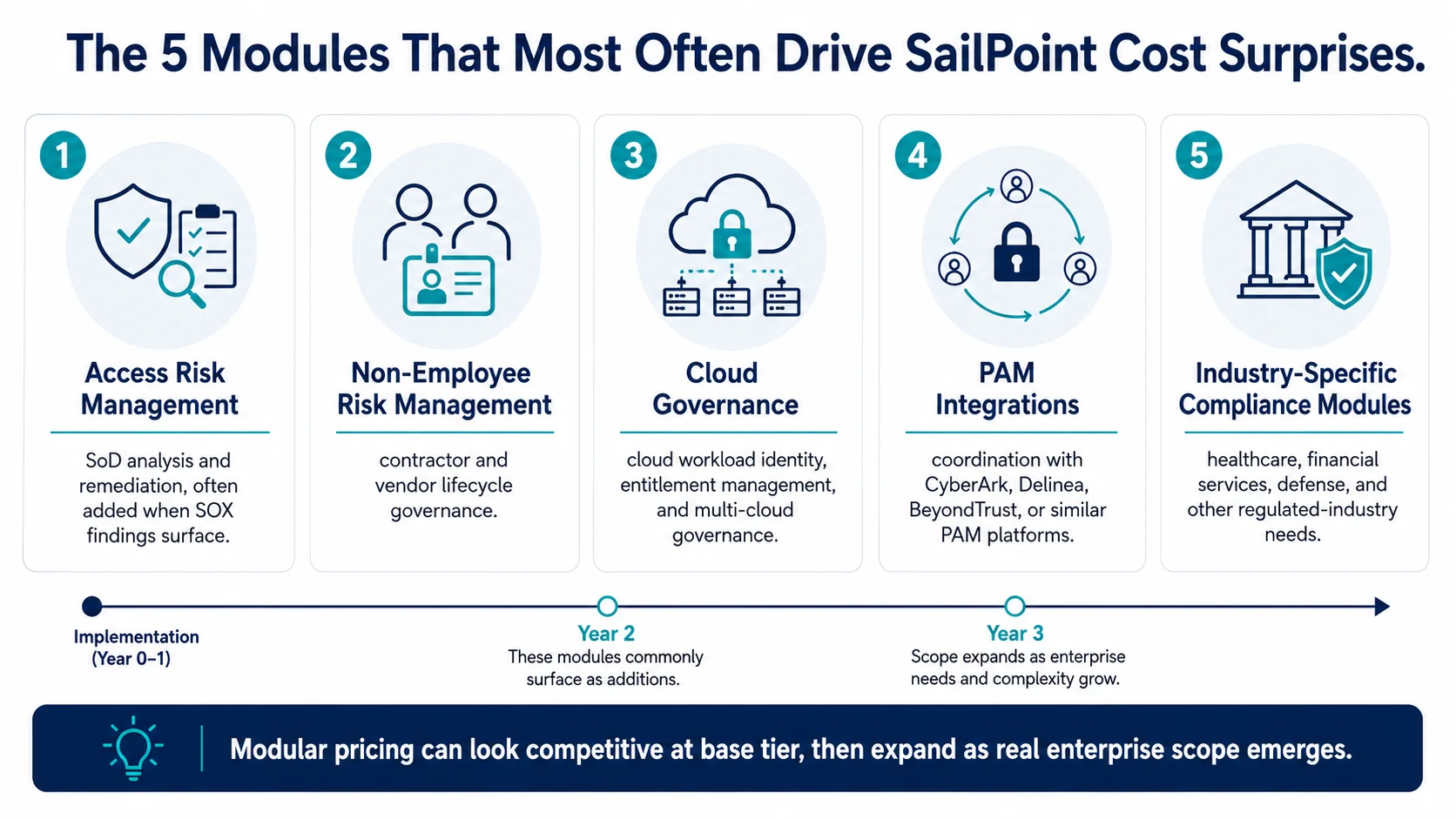
SailPoint vs Avatier: The 2026 Enterprise Pricing Model Comparison
Enterprise IAM buyers evaluating SailPoint against Avatier are comparing two fundamentally different pricing philosophies — modular per-capability pricing with premium tiers and per-connector charges versus all-inclusive licensing that bundles the same capability set into the base license. The 2026 enterprise reference on the structural pricing differences, the modules that drive most of the SailPoint cost surprises, the Avatier all-inclusive positioning, and the buyer-side comparison discipline that produces defensible vendor selection instead of feature-checklist theater.

Login Reset Licensing Models: The 2026 Enterprise Cost Structure Reference
Enterprise password reset licensing has three fundamentally different pricing models — per-user subscription, per-reset-event consumption, and modular capability-based licensing — and the fit between model and buyer profile determines whether TCO tracks the vendor's list-price projection or surprises 18-24 months into deployment. The 2026 enterprise reference on the three licensing models, the specific line items that drive cost variance, and the buyer discipline that produces defensible reset-workflow vendor selection.
Avatier vs Okta: The 2026 Enterprise Pricing Model Comparison
Enterprise IAM buyers evaluating Avatier against Okta are comparing two fundamentally different pricing philosophies — all-inclusive licensing that bundles IGA workforce lifecycle and identity governance into base pricing versus a workforce IdP with tiered pricing where governance capability is priced as premium modules above the federation baseline. The 2026 enterprise reference on the structural pricing differences, the specific modules that produce Okta cost variance at scale, and the buyer discipline for defensible vendor selection.