Security Team Collaboration: A 2026 Framework for Identity Programs
Identity governance fails when it runs as a security-team-only initiative. The 2026 framework for cross-functional collaboration: four stakeholder groups, three coordination models, and how zero trust makes it a shared discipline.
Identity governance fails when it runs as a security-team-only initiative. The 2026 framework for cross-functional collaboration: four stakeholder groups, three coordination models, and how zero trust makes it a shared discipline.
- Identity governance programs that stay inside the security team plateau. The programs that scale route decisions through four stakeholder groups — IT/security, executive leadership, DevSecOps, and business units — each of which holds context none of the others has.
- Three collaboration models do the actual coordination work: cross-functional security councils (org-wide priorities and incident review), embedded security champions (department-level translation), and shared identity platforms (one source of access truth every team reads from).
- Zero trust is the clearest evidence that security has become a collaborative discipline rather than a security-team mandate — it only works when IT, security, executives, and business units treat continuous verification as a shared operating rule, not a control bolted on by one team.
- The most common failure mode is not hostility between teams, it's translation loss: security frames risk in terms business leaders can't act on, and business units frame velocity in terms security can't evaluate. Shared metrics and embedded champions exist specifically to close that gap.
- AI is starting to function as a collaboration layer — translating security posture into business-relevant terms, automating the routine coordination overhead — but it doesn't replace the underlying structures (councils, champions, shared platforms). It makes them cheaper to run, not optional.
Security collaboration is the practice of routing identity and access decisions through the people who hold context the security team doesn't have on its own — IT, executive leadership, DevSecOps, and the business units who actually use the access being governed. Programs that skip this and run identity governance as a security-team-only initiative don't fail because the policy is technically wrong; they fail because nobody outside security bought into it, and an unbought-into policy gets routed around.
This is the 2026 update of Avatier's original piece on security team collaboration (legacy version), rebuilt around a specific identity-governance lens: which four stakeholder groups a program needs, which three coordination models actually get used in practice, and why zero trust is the clearest evidence that security has become a cross-functional discipline rather than a department.
Why identity governance can't stay inside the security team
An identity governance policy is a set of claims about who should have access to what, under which conditions, reviewed on what cadence. Security can write the technical rules — least privilege, time-bound access, certification cycles — but security doesn't independently know whether a given access grant reflects real operational need or historical accumulation nobody's cleaned up. That knowledge sits with the business unit that requested the access in the first place, often years earlier, under a manager who's since moved on.
A policy built without that context tends to be either too permissive (approving access nobody questions because nobody has the standing to question it) or too restrictive (blocking access a team genuinely needs, which produces workaround behavior — shared credentials, shadow tools, informal data exports — that's worse for security than the access request would have been). Neither failure mode is a security-competence problem. Both are collaboration failures dressed up as policy failures.
The four stakeholder groups
IT and security teams. This is the technical core — sharing threat intelligence, developing joint architecture for how identity infrastructure and network infrastructure interoperate, coordinating vulnerability management, and aligning on identity strategy. IT and security are usually already collaborating by necessity; the gap in most programs is what happens past this pair.
Executive leadership. Executives align security investment with business objectives, allocate the budget and headcount collaboration actually requires, and set the cultural tone that determines whether cross-functional work gets treated as core or as overhead. A CISO with technically sound priorities and no executive sponsorship gets deprioritized the first time a competing initiative needs the same budget line.
DevSecOps teams. Where identity governance touches application development — provisioning service accounts, managing API credentials, embedding access checks into CI/CD — DevSecOps is the group that makes remediation a shared responsibility instead of a security-team backlog item nobody in engineering prioritizes. Automated testing that catches an over-permissioned service account before it merges is collaboration expressed as tooling.
Business units and end users. The group with the most context and the least formal voice in most governance programs. Business units understand which access requests are genuine operational need, which are convenience, and which are stale grants from a role someone left two reorgs ago. End users are also, in practice, the primary defense against social engineering — a well-run collaboration program treats them as a stakeholder group with information to contribute, not just a population to train.
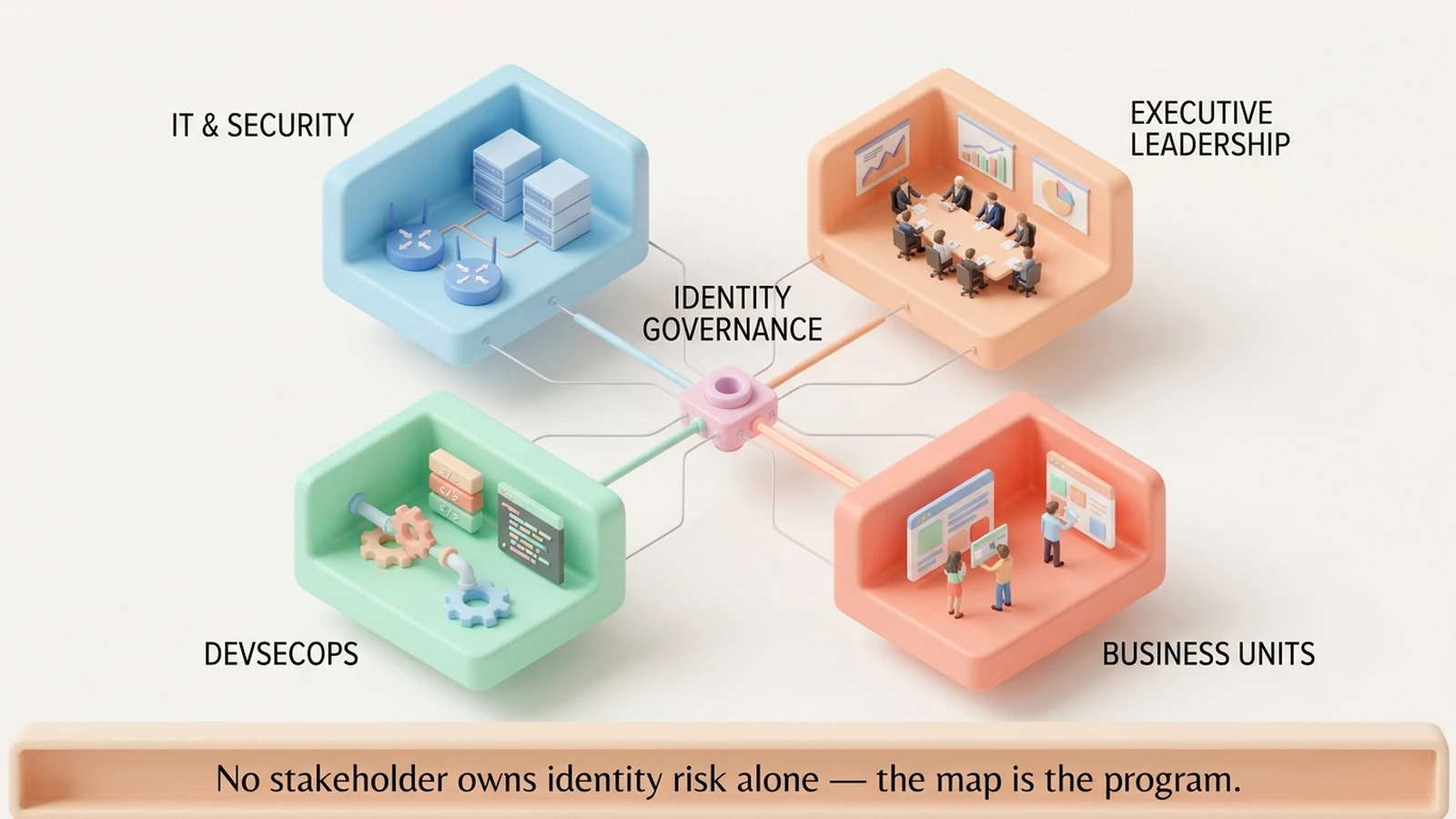 Each stakeholder holds context none of the others can see alone — the coordination mechanism, not any single team, closes the gap.
Practical model one: cross-functional security councils
A security council is a standing group, usually meeting monthly or quarterly, that sets org-wide security priorities, reviews incident response outcomes, and approves policy changes with explicit business-impact review. The council's job is governance — the decisions that need buy-in from multiple functions to stick, not the day-to-day operational work.
What makes a council functional rather than ceremonial is a real charter: defined membership across the four stakeholder groups, a fixed cadence, and actual decision authority rather than an advisory role that gets overridden downstream. A council that only reviews decisions already made elsewhere isn't a collaboration structure, it's a status meeting.
Practical model two: embedded security champions
No security team scales headcount to match every department, which is the practical argument for embedded champions — individuals inside a business unit, DevSecOps team, or regional office who act as the standing security liaison for that group. A champion translates security requirements into that department's operational language, provides first-line guidance so not every question routes to the core security team, and feeds real operational constraints back upstream.
The champion model works because it solves the translation-loss problem at the source. A security requirement stated in security's native vocabulary ("enforce time-bound elevated access with quarterly recertification") often needs restating in the receiving department's vocabulary ("your team leads approve extended project access for 90 days, then it auto-expires unless renewed") before it actually changes behavior.
Practical model three: shared technology platforms
A common identity platform is the collaboration model that scales without adding headcount. When IT, security, and business units are all reading and writing against the same access data — instead of security holding its own spreadsheet, IT its own ticketing system, and business units their own informal approval chains — the coordination overhead of "who has access to what" drops structurally, because there's one source of truth instead of three that periodically disagree.
The division of labor on a shared platform is itself a collaboration pattern: IT manages implementation, security defines the governance rules (approval workflows, certification cadence, risk scoring), and business units establish the access needs the platform then enforces and audits. Our access governance piece covers how that governance layer is typically structured.
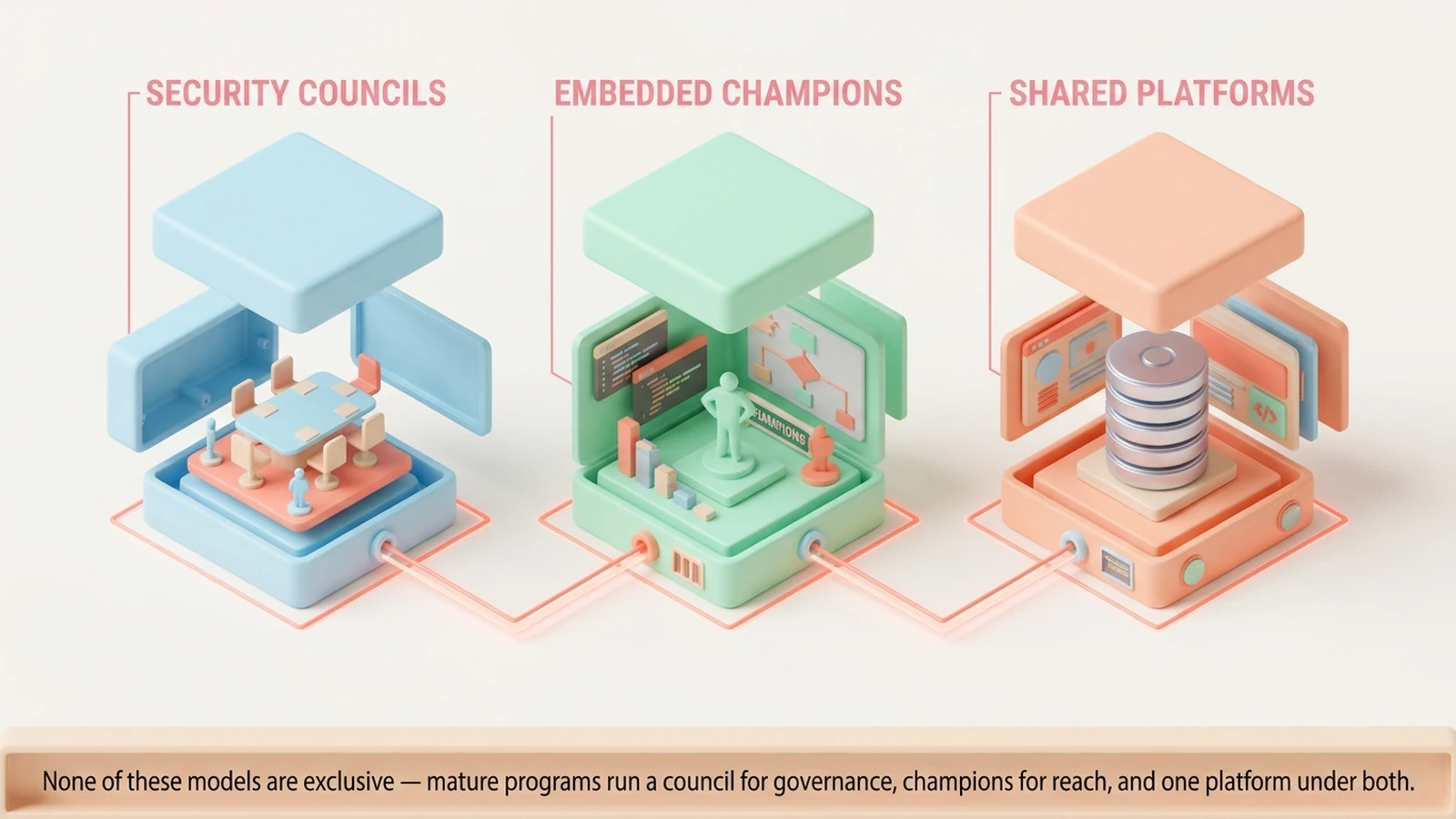 None of these models are exclusive — mature programs run a council for governance, champions for reach, and one platform under both.
Zero trust as the clearest collaborative framework
Zero trust gets described most often as a technical architecture — continuous verification replacing perimeter-based trust — but its actual dependency is organizational. IT teams implement the technical controls and monitoring that continuous verification requires. Security teams define the verification protocols and least-privilege rules those controls enforce. Business units accept that access requirements now get stated explicitly instead of inherited by default, which is a workflow change, not just a technical one. Executives champion the cultural shift, because continuous verification introduces friction a security team can't force through an organization that hasn't bought in.
A zero trust rollout run as a security-team-only initiative tends to stall at the first friction point business units push back on, because there's no executive cover and no business-unit buy-in to absorb it. A rollout run as a cross-functional initiative — with the same four stakeholder groups from earlier in this piece involved from the start — treats that friction as an expected cost to manage, not a surprise to litigate after the fact. Our zero trust metrics piece covers the specific measures that show whether adoption is holding across all four groups.
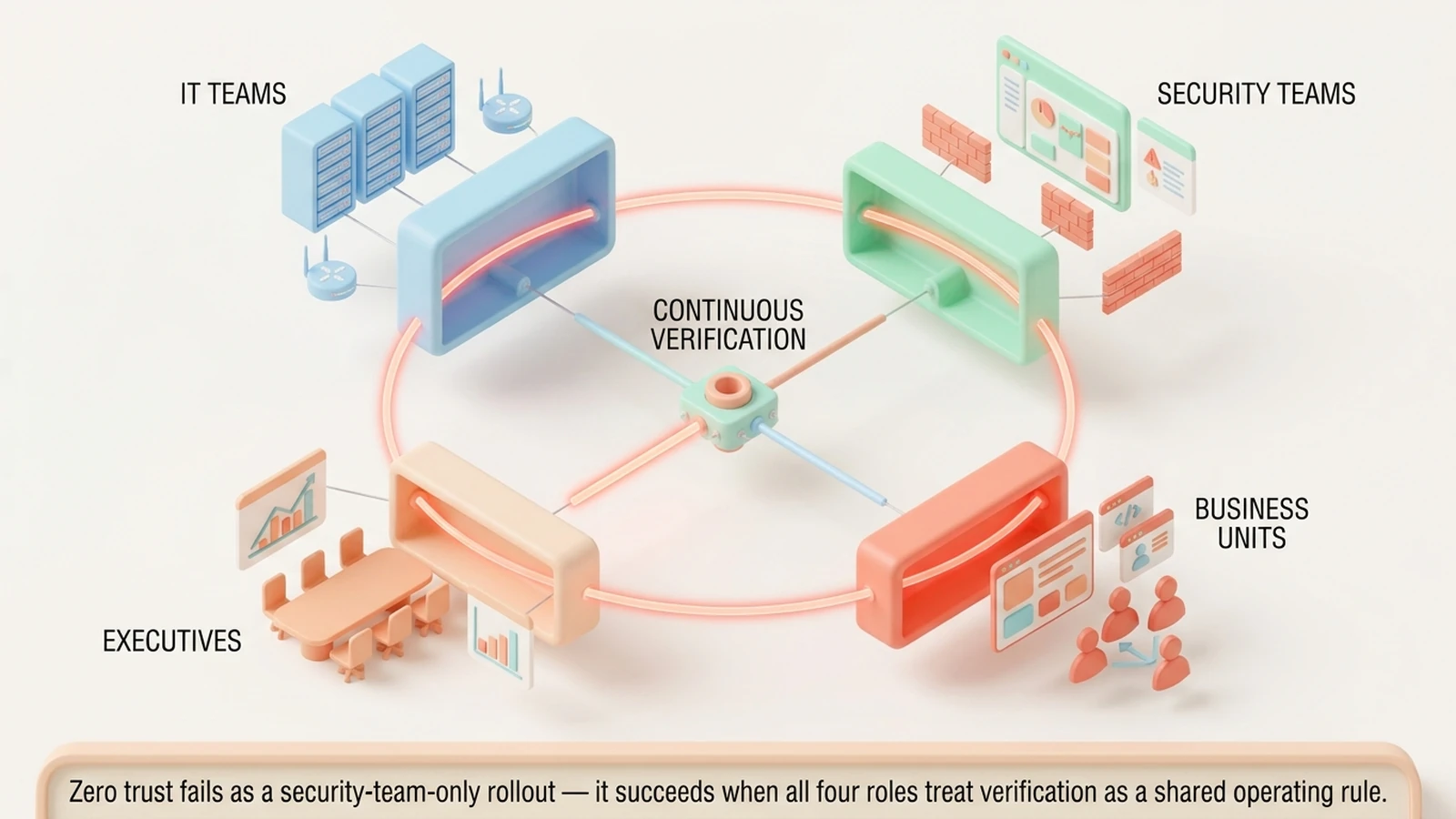 Zero trust fails as a security-team-only rollout — it succeeds when the four roles above treat verification as a shared operating rule.
Overcoming the common barriers
Three barriers show up across most organizations attempting cross-functional security work. Communication gaps are the most persistent: security and business professionals describe the same tradeoff in genuinely different vocabularies, and without active translation — the job embedded champions exist to do — each side hears the other as speaking past the actual issue. Competing priorities get framed internally as security-versus-velocity, even when the real tradeoff, once made explicit through a shared metric, is much smaller than the framing suggests. Technology integration challenges compound both of the above: disconnected security tooling means each team has partial visibility, so disagreements about what's actually happening are common even when everyone is negotiating in good faith.
None of these three is solved by asking teams to communicate better as a general instruction. They're solved by the specific structures this piece covers — a council that forces the conversation on a fixed cadence, champions who do the translation as their actual job, and a shared platform that removes the "whose data is right" argument by making there be only one dataset.
There's a fourth barrier worth naming separately because it's more structural than the first three: accountability ambiguity. When an access review finds a stale entitlement — someone still has admin rights to a system they left two projects ago — whose job was it to catch that? Without an explicit answer, the honest one is usually "nobody's," which is a governance gap dressed up as an oversight. Councils and champions fix the communication and translation problems; only an explicit ownership model, typically written into the same charter that establishes the council, fixes the accountability gap. A council with decision authority but no named owner for follow-through tends to generate excellent meeting minutes and no actual remediation.
Measuring whether collaboration is actually happening
Structures are easy to stand up and easy to let go hollow — a council can meet quarterly and rubber-stamp decisions made elsewhere, a champion program can exist on an org chart with no protected time behind it. The way to tell the difference is to measure participation and outcomes, not just attendance.
For councils, the useful signal isn't meeting cadence, it's decision reversal rate: how often does a council-approved policy get quietly overridden downstream because a business unit routed around it anyway? A high reversal rate means the council has authority on paper and not in practice. For embedded champions, the signal is ticket deflection — how much first-line security guidance gets resolved by the champion inside the department versus escalated to the core security team? A champion program that escalates everything is a title without a function. For the shared platform, the signal is data agreement — when security, IT, and a business unit each pull a report on who has access to a given system, do the three reports match? Persistent disagreement means the "shared" platform still has shadow spreadsheets competing with it.
These are structurally the same category of signal as the identity-telemetry approach in our security culture KPIs piece: voluntary, hard-to-game behavior tells you more than a self-reported survey about whether collaboration is real or ceremonial. A department that voluntarily loops its champion in before a policy exception request, rather than after being caught without one, is telling you collaboration is functioning — no survey question captures that as reliably as the pattern itself does. Programs that build this measurement layer in from the start catch the drift from real collaboration to org-chart collaboration long before it shows up as an incident; our security awareness training KPIs piece covers the adjacent discipline of separating genuine behavior change from completion-rate theater, which is the same trap collaboration metrics fall into if left unchecked.
What Avatier ships toward this pattern
Avatier Identity Anywhere is built as the shared-platform layer underneath the council-and-champion structures rather than a security-team-only tool bolted alongside them. Access requests, approvals, and certifications run through workflows that security defines, IT implements, and business-unit managers actually execute themselves — a manager approving direct-report access from a mobile device is business-unit participation in governance, not governance happening to the business unit. Self-service password reset and access request tooling exist specifically so the sanctioned path is the easy path, which is what makes voluntary adoption (and the collaboration it signals) measurable rather than assumed; our security culture KPIs piece covers how that measurement works in practice. For workforces where a personal smartphone can't be assumed — manufacturing floors, clinical environments, shared workstations — deviceless FIDO2-compatible authentication via Identity Challenge Card keeps those segments inside the same governance model instead of becoming the permanent exception every collaboration framework quietly excludes.
What this framework does not solve
A council, a set of embedded champions, and a shared platform address the structural half of the collaboration problem — they create the venues and the shared data where cross-functional decisions can actually get made. They don't fix an organization's underlying incentive conflicts on their own: if a business unit is measured purely on velocity with no security-adjacent metric in its scorecard, a council seat doesn't change what that unit optimizes for day to day. They also don't substitute for genuine executive sponsorship — a council without resourcing or a champion program without protected time from the champion's home department both degrade into ceremony within a few quarters. And none of these structures resolve incidents that trace back to an individual's judgment call under pressure, the scenario our help desk breach lessons piece walks through in detail — collaboration reduces how often that scenario reaches a help desk analyst with insufficient verification authority, but it doesn't eliminate the scenario. Programs that treat collaboration structures as sufficient on their own, rather than as the necessary venue for harder incentive and accountability work, tend to look collaborative in the org chart and stay siloed in practice.
Avatier's own posture on this reflects the same split: as CEO Nelson Cicchitto has put it, cybersecurity is everyone's responsibility, but it doesn't have to be everyone's burden — the structural work in this piece is what keeps the responsibility distributed without dumping the operational weight of it onto any single team, including the security team itself. Full technical security posture and compliance detail is available at trust.avatier.com.
For a program building this out for the first time, the sequencing matters more than trying to stand up all three models simultaneously. Start with the shared platform, because a council or a champion program without common data underneath it spends its first several sessions arguing about whose numbers are correct instead of making decisions. Once the platform gives every stakeholder group the same starting point, the council can form around real decisions that need cross-functional sign-off, and champions can be recruited from departments that have already seen value from the shared data rather than being asked to advocate for a program that hasn't proven itself yet. Programs that try to launch a council first, on the theory that governance should come before tooling, tend to spend a year in meetings and produce a policy document nobody's systems can actually enforce.
ABOUT THE AUTHOR

More from IAM & Identity Governance

Identity Management and Digital Transformation in 2026
Every major transformation initiative — cloud migration, remote and hybrid work, mergers and acquisitions — eventually stalls on the same question: who gets access to what, and who decided? The 2026 strategy reference on identity management as the enabler and the bottleneck of digital transformation, the business case executives actually fund, and what modernization does not fix.

AI and Behavioral Analytics for Identity Monitoring: The 2026 Enterprise Reference
Static identity rules catch the attacks that announce themselves. They miss the ones that log in with valid credentials and behave almost normally. The 2026 reference on AI-driven identity monitoring — what behavioral analytics actually detects, the four telemetry sources that make or break the model, the false-positive economics nobody budgets for, and the honest limits of anomaly detection at enterprise scale.

IaaS Identity Management: The 2026 Deployment Challenges Reference
Infrastructure-as-a-Service breaks identity models built for one directory. The 2026 reference on multi-cloud fragmentation, compliance auditability, and provisioning automation at IaaS scale.