AI and Role-Based Access Control: What Machine Learning Actually Fixes in RBAC (2026)
RBAC's problems are well documented and thirty years old: role explosion, role drift, rubber-stamped certifications, and privilege that only ever accumulates. AI is the first tool that attacks them at the scale they occur — but only three of the four are genuinely solvable by a model. The 2026 reference on AI-assisted role mining, entitlement clustering, certification triage, and predictive provisioning: what each one actually does, where the human stays in the loop, and why role mining on bad data just industrializes the mess.
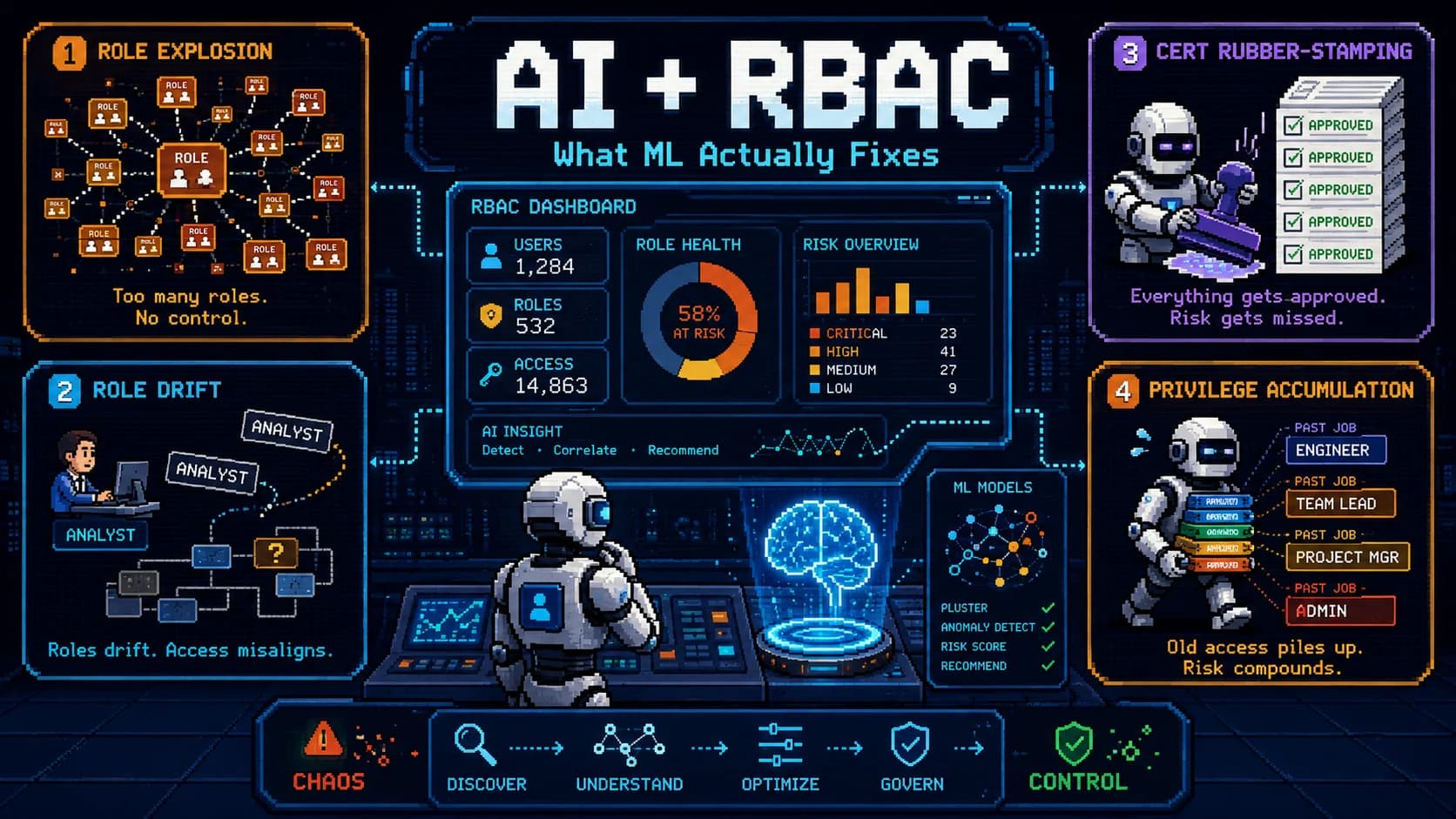
RBAC's problems are well documented and thirty years old: role explosion, role drift, rubber-stamped certifications, and privilege that only ever accumulates. AI is the first tool that attacks them at the scale they occur — but only three of the four are genuinely solvable by a model. The 2026 reference on AI-assisted role mining, entitlement clustering, certification triage, and predictive provisioning: what each one actually does, where the human stays in the loop, and why role mining on bad data just industrializes the mess.
- RBAC has four chronic failure modes: role explosion (the role count grows until it exceeds the workforce it describes), role drift (definitions diverge from what people actually do), certification rubber-stamping (reviewers approve everything because nothing stands out), and privilege accumulation (movers keep prior-role access forever). AI attacks all four, but only three are genuinely model-solvable — accumulation is a lifecycle problem wearing an analytics costume.
- AI-assisted role mining clusters users by observed entitlement usage and proposes candidate roles from what people actually do, rather than from what an interview said they do. The output is a hypothesis, not a role: it needs a business owner to name it, validate that the cluster is a real job function rather than a coincidence, and accept accountability for it.
- Certification triage is the highest-confidence AI win in governance. Instead of presenting a reviewer with 400 identical-looking entitlements, the model ranks by anomaly — this person has access nobody with their job title has — so reviewer attention goes to the 20 decisions that carry the risk. It doesn't decide; it orders the queue. That distinction is what keeps the audit trail defensible.
- Predictive provisioning suggests likely entitlements at joiner and mover time from peer patterns, cutting first-week access tickets. It is also the easiest place to automate a bad habit: if the peer group is over-entitled, the model recommends over-entitlement, confidently, to every new hire. Birthright policy must gate the recommendation, never the reverse.
- The precondition nobody sells: role mining on unclean entitlement data produces clean-looking roles that encode existing over-provisioning. The clusters are real; they're just clusters of a mess. Fix lifecycle and revocation first, then mine — otherwise AI industrializes the problem it was bought to fix ([Identity Maturity Model piece](/en/blog/identity-maturity-model-enterprise-2026/)).
Role-based access control is thirty years old and its problems are as old as it is. Anyone who has run an RBAC program can list them from memory: too many roles, roles that no longer describe the job, certifications where every reviewer clicks approve, and privilege that only ever goes up.
None of these are mysteries. They persist because they occur at a scale human attention cannot cover — thousands of users, tens of thousands of entitlements, and a review cycle that arrives before the last one finished. That scale mismatch is exactly the kind of problem machine learning is genuinely good at.
But not all four are model-solvable, and the distinction matters when you're deciding what to buy. This is the 2026 reference on what AI actually fixes in RBAC — and what it just makes faster.
The four failure modes
Role explosion. Creating a new role is always easier than finding the existing one that fits. The catalog accretes near-duplicates until the role count exceeds the headcount, at which point RBAC has become per-user access management wearing a costume.
Role drift. A role is defined once, accurately, and then the job changes. Departments reorganize, tools get replaced, responsibilities move. The definition stays. Six quarters later the role describes a job nobody holds.
Certification rubber-stamping. A reviewer gets 400 entitlements to approve. They are presented as a flat list with no risk signal and no context. Every row looks like every other row. The reviewer approves all 400 in eight minutes, because that is the only rational response to a task designed this way (Access Review — What the Auditor Actually Wants piece).
Privilege accumulation. A user moves from finance to marketing and keeps their finance access, because the mover event granted the new role and never revoked the old one. Repeat for six years and you have a user with the union of every job they've ever held.
Three of these are pattern-recognition problems at scale. One of them — accumulation — is not. Hold that thought.
What AI-assisted role mining actually produces
Role mining inverts the traditional approach. Instead of asking managers what their people need, it clusters users by their observed entitlement assignments and usage, and proposes candidate roles from the natural groupings.
The advantage is real: it describes what people do rather than what an interview said they do, and it scales past what an analyst can hold in their head. Where a human analyst can meaningfully reason about a few dozen entitlements, clustering handles tens of thousands without fatigue.
The critical framing — and where deployments go wrong — is what the output is. A cluster is a hypothesis, not a role. The model can tell you that eighty people share an access pattern. It cannot tell you whether that pattern is:
- a legitimate job function that deserves a role,
- an artifact of eighty people being onboarded from the same over-privileged template,
- or a separation-of-duties violation that eighty people share.
Those three look identical to a clustering algorithm and completely different to an auditor. Turning a cluster into a role requires a named business owner who validates it, names it, and accepts accountability for it. The model does the search; the human does the deciding.
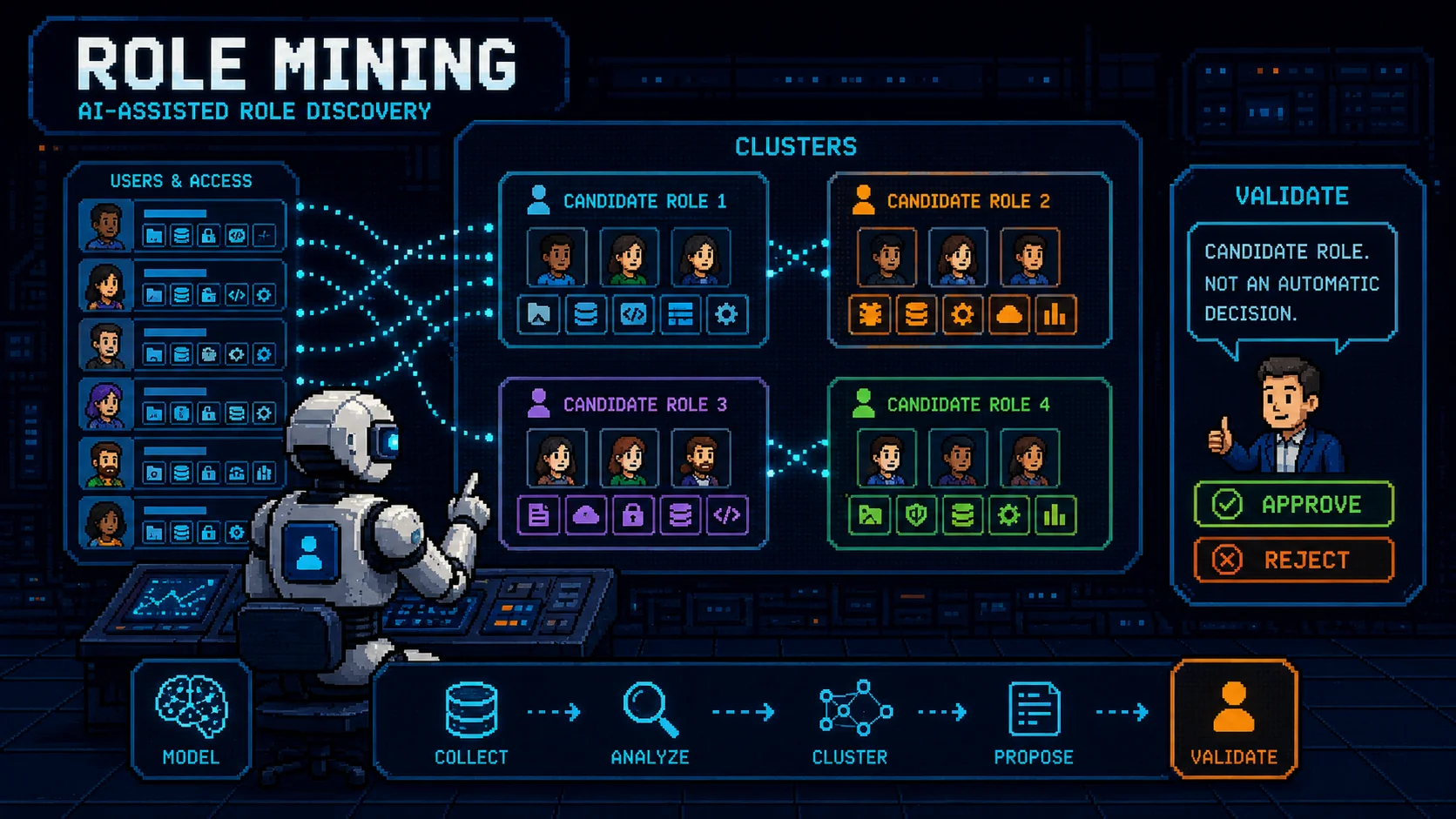 The model searches the space no analyst can hold in their head. A named human still decides whether a cluster is a role.
The precondition nobody puts on the slide: role mining on unclean entitlement data produces clean-looking roles that encode existing over-provisioning. The clusters are real — they're just clusters of a mess. If your environment has six years of accumulated privilege and broken revocation, mining it will faithfully discover "the role of person who has too much access," name it something respectable, and industrialize it. Fix lifecycle first (Identity Maturity Model piece).
Certification triage: the highest-confidence win
If you only get budget for one AI capability in governance, this is the one with the clearest mechanism.
The rubber-stamping problem isn't reviewer laziness. It's an information design failure: 400 rows, no risk signal, no context, no way to tell the dangerous one from the routine one. A reviewer facing that has no rational option except bulk approval.
Anomaly ranking fixes the design. Instead of a flat list, the reviewer gets an ordered queue: this person has an entitlement nobody else with their job title holds; this one hasn't used this access in eleven months; this combination crosses a separation-of-duties boundary. The 380 birthright entitlements that match their peer group exactly get presented as what they are — routine — and reviewer attention goes to the 20 decisions that carry the actual risk.
The model orders the queue. It doesn't decide. That distinction is the whole ballgame for audit defensibility — "the model approved it" is not a sentence you want in an incident report or a SOX finding (AI Access Certification piece covers the campaign mechanics).
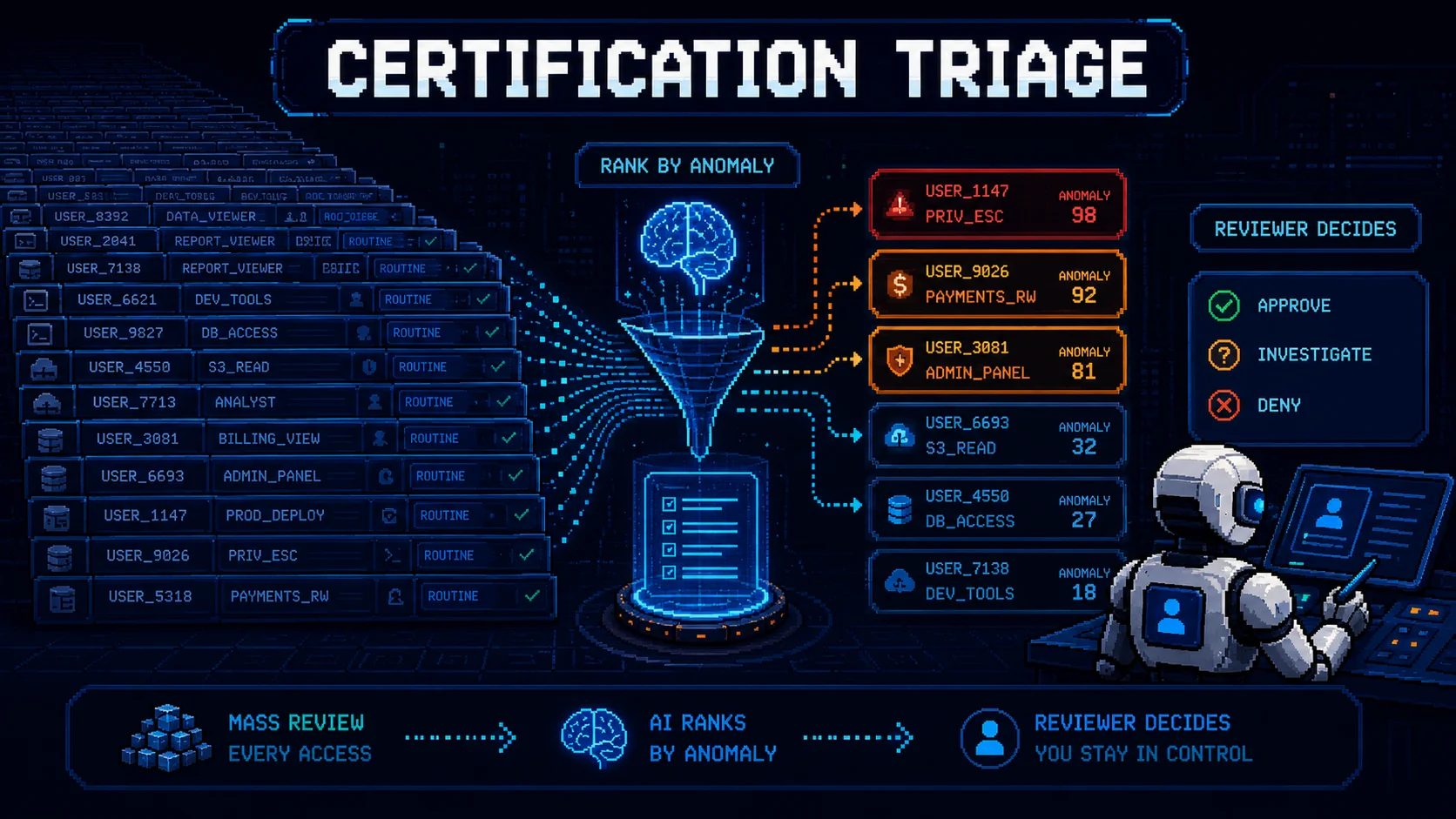 Same 400 entitlements, different task. The model ranks; the reviewer decides — and the audit trail still has a human name on it.
The same anomaly logic works from the detection side rather than the review side — the individual whose access has drifted away from their peers is a governance finding and a behavioral signal simultaneously (AI Analytics for Identity Monitoring piece).
Predictive provisioning: useful, and the easiest way to automate a bad habit
At joiner and mover time, the model can suggest likely entitlements from peer patterns: people with this title, in this department, reporting to this manager, typically hold these fourteen things. Done well, this cuts the first-week access ticket storm and the associated productivity drag.
Done carelessly, it is the fastest way to scale over-provisioning ever invented. If the peer group is over-entitled — and in most environments it is — the model will recommend over-entitlement, confidently, to every new hire, forever. The bad habit gets a machine to enforce it.
The guardrail is ordering: birthright policy gates the recommendation, never the reverse. Policy defines what the role legitimately requires; the model suggests within that boundary and flags the rest as an access request that needs approval. A recommendation engine allowed to exceed policy isn't provisioning automation — it's privilege creep with a UI.
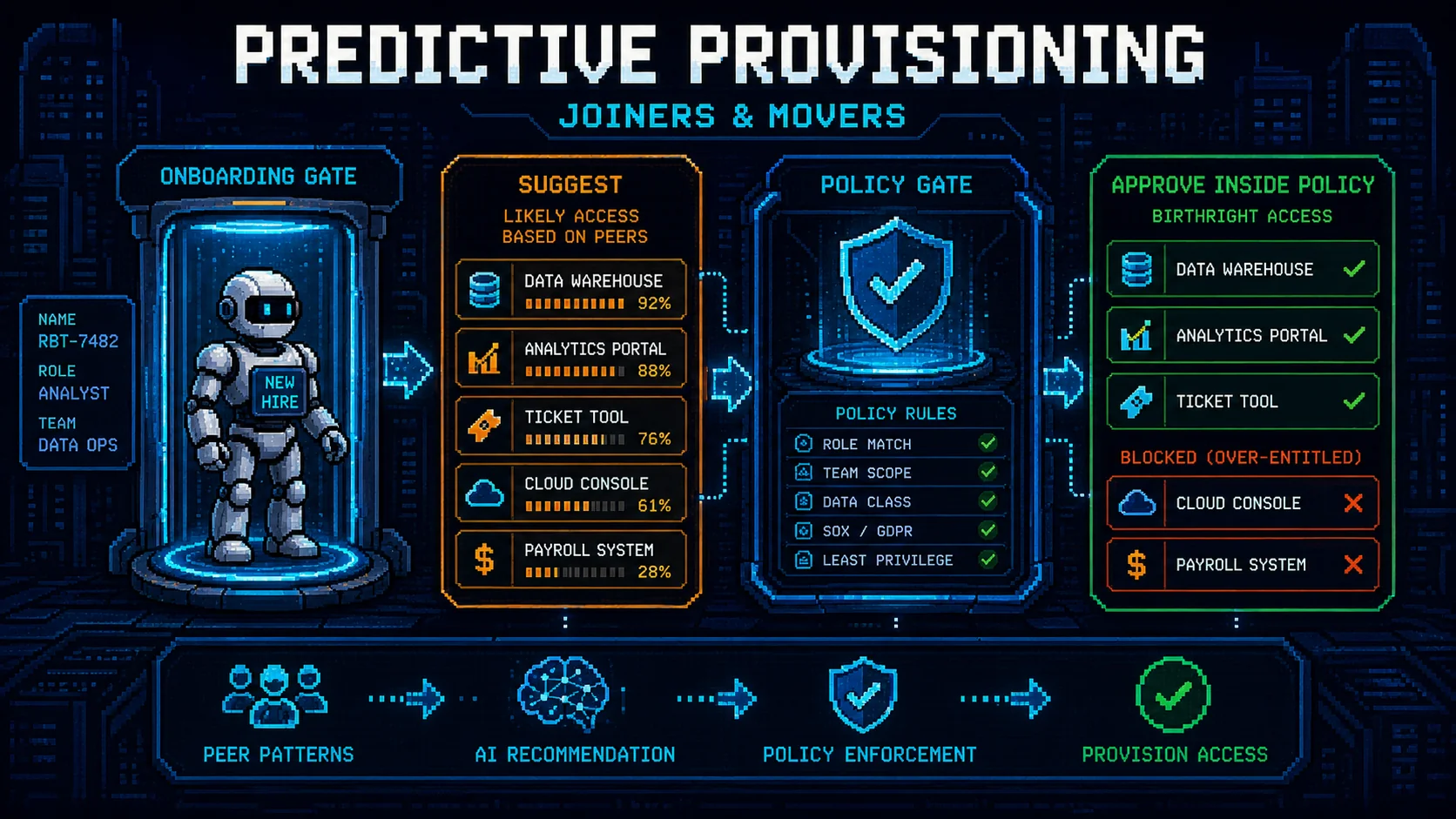 The model suggests inside the boundary. Policy sets the boundary. Reverse that order and you've automated your over-provisioning.
The one AI doesn't fix
Privilege accumulation looks like an analytics problem and isn't.
A model can absolutely find your accumulated privilege. It can rank it, visualize it, and produce an excellent report on exactly how much of it you have. What it cannot do is remove it, because accumulation is not a detection failure. It's a lifecycle failure: the mover event granted the new role and never revoked the old one.
You can point the best model in the industry at that environment and it will produce a beautiful, accurate description of the problem every quarter, forever, while the problem gets worse. The fix is a mover workflow that re-resolves entitlements — grants the new, revokes the prior — automatically, on an HRIS event, without waiting for anyone to remember (Access Governance and Lifecycle Integration piece).
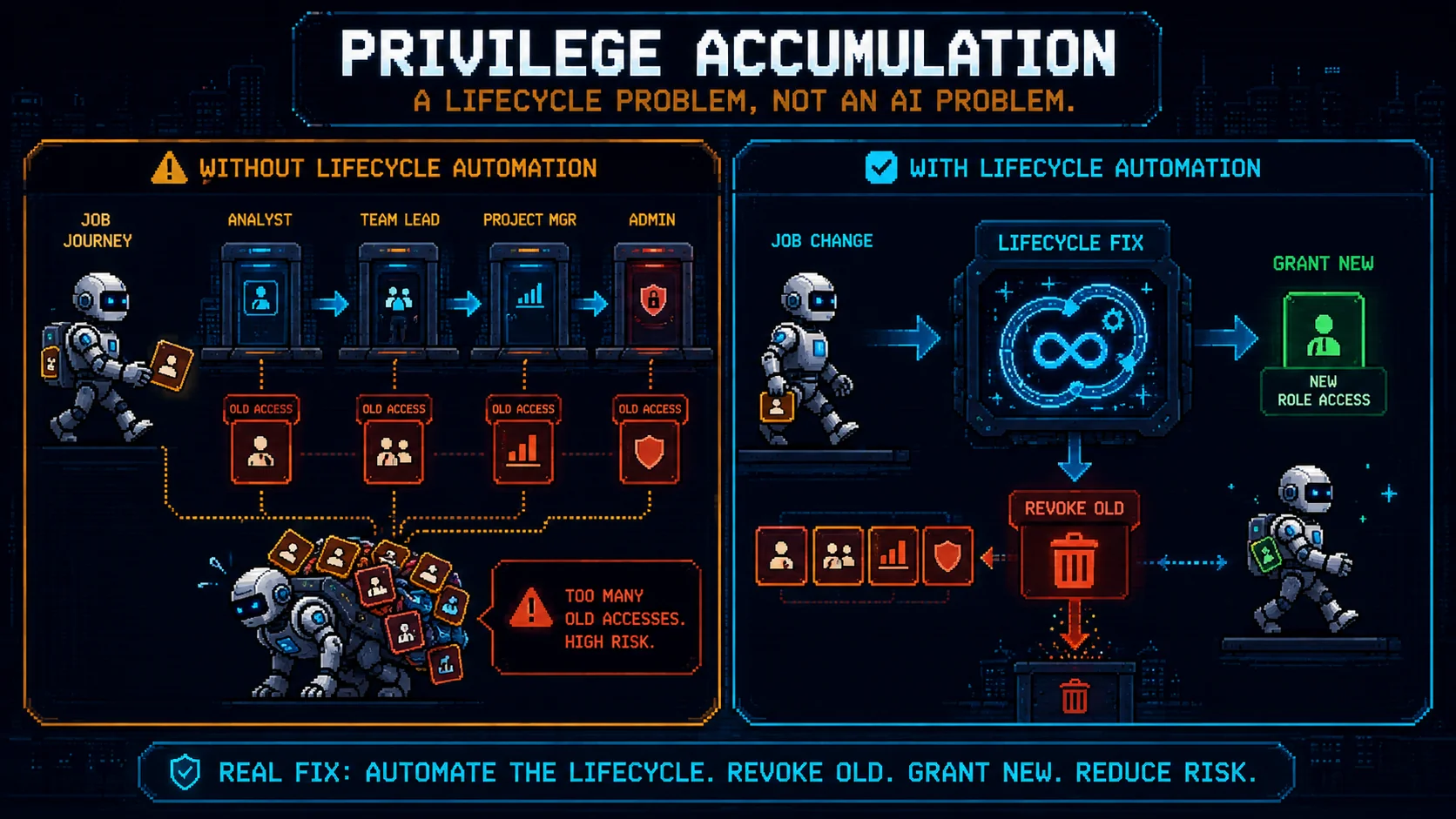 The one a model can describe beautifully and never fix. Accumulation is a mover-workflow failure, and the remedy is plumbing.
That's not AI. That's plumbing. And it's the higher-value purchase for most organizations that think they need AI.
Where this goes: agents will need roles too
The 2026 conversation is about software that acts — agents that plan, call tools, and touch systems of record. They will need scoped entitlements the same way people do, with the same least-privilege discipline and the same review cadence.
They also break the RBAC model in a specific way worth naming: a human's access needs change on an HR event you can hook. An agent's access needs change when someone edits a prompt or registers a new tool — no event, no ticket, no mover workflow, just a different agent behind the same identity. Role-based thinking assumes the role is stable enough to define. That assumption is doing a lot of work, and for agents it may not hold.
That's an open industry problem, not a solved one — and to be direct about scope, Avatier's platform does not govern AI agents today. Our Ai4 2026 piece maps the gap and the five questions worth asking any vendor claiming to have closed it. What exists now is the entitlement foundation any agent governance would have to be built on, which is the discipline this piece is about.
The 2026 reference path
- Fix revocation before mining. Mover and leaver events must re-resolve entitlements automatically. Everything below is worth less until this is true.
- Mine for hypotheses, not roles. Every candidate cluster gets a named business owner who validates and accepts it, or it doesn't become a role.
- Deploy certification triage early. Highest-confidence win, clearest mechanism, immediate reviewer relief — and it makes the next audit materially better.
- Gate predictive provisioning with birthright policy. The model suggests inside the boundary; it never sets the boundary.
- Measure recommendation acceptance. If reviewers routinely override the model, that's a data quality signal, not a training problem.
- Keep the human accountable. Every consequential access decision needs a person's name on it. The model orders the work; it never owns the outcome.
The pattern across all six: AI in RBAC is an attention allocator, not a decision maker. It finds the twenty things worth a human's judgment inside the four hundred that aren't. That is genuinely valuable — and it's worth nothing if the underlying entitlement state is wrong. The AI in IAM Strategy piece covers where this sits in the broader program sequence.
ABOUT THE AUTHOR

More from Access Management

PIM vs PAM vs PUM: Privileged Access Defined for 2026
PIM, PAM, and PUM get used interchangeably and mean three different things. PIM manages who holds privileged identity and which roles carry it. PAM controls how privilege is exercised through vaulting, session control, and just-in-time elevation. PUM manages the shared privileged accounts nobody personally owns. The 2026 reference on distinguishing the three terms, where they overlap, and where to start.

DNS as Identity Infrastructure: A 2026 Reference
DNS resolution, DNSSEC integrity, and DNS poisoning as a credential-harvesting vector — the 2026 reference on treating DNS as identity infrastructure, not network plumbing.

Password Hash Synchronization in 2026: Hybrid AD to Entra ID
Password hash synchronization keeps on-prem Active Directory and Microsoft Entra ID authoritative together — how the sync cycle works, its security tradeoffs, and where it fits against federation.