The Principle of Least Privilege: Why It Matters for Access Control 2026
Least privilege is the oldest and most durably-relevant access-control principle in enterprise identity. The 2026 enterprise reference on what 'minimum necessary access' actually means operationally, the four surfaces where it applies (human, privileged, service, agentic), and the architecture that produces defensible least-privilege posture across all four.
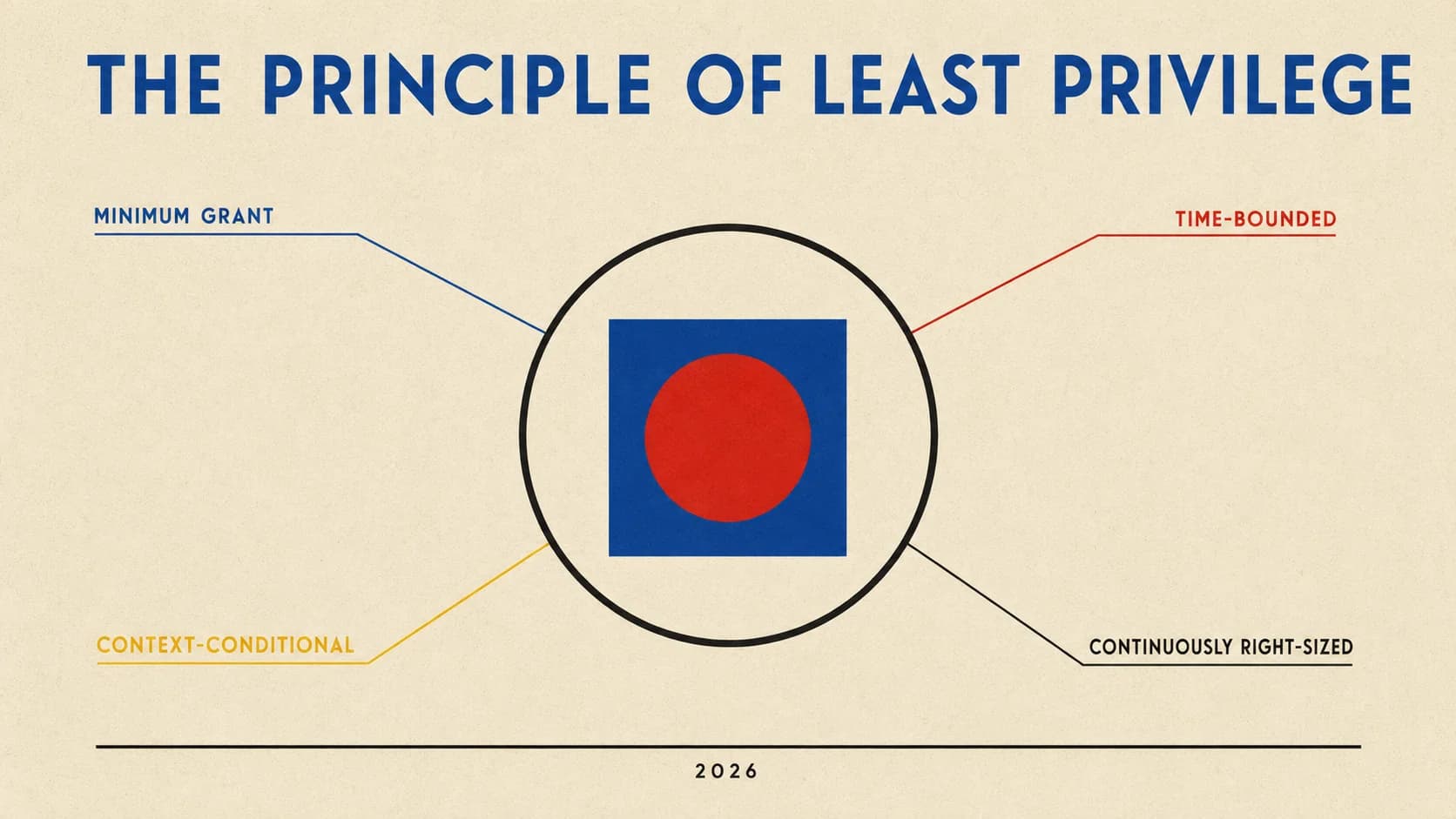
Least privilege is the oldest and most durably-relevant access-control principle in enterprise identity. The 2026 enterprise reference on what 'minimum necessary access' actually means operationally, the four surfaces where it applies (human, privileged, service, agentic), and the architecture that produces defensible least-privilege posture across all four.
- Least privilege is the access-control principle that every user (human or non-human) should have exactly the access needed to perform their current role — no more, no less. The principle is 50+ years old and has never gotten less relevant; the 2026 architecture applies it to four surfaces simultaneously.
- The four surfaces where least privilege applies in modern IAM: human standing entitlements (what a user has by default), privileged elevation (what a user can request just-in-time), service account permissions (what workloads have), and AI agent per-invocation scope (what agents get for a specific task).
- The dominant failure mode isn't policy — most organizations have least-privilege policy. The failure is operational drift: entitlements accumulate through role changes, temporary grants become permanent, service accounts grow scope over time, and AI agents get over-broad tokens because narrow ones are hard to specify at deployment time.
- The 2026 architecture composes IGA workflow discipline (grant only what's justified), lifecycle automation (remove entitlements when role changes), certification with engagement enforcement (catch accumulated over-privilege at review), JIT elevation (privileged access is temporary and audited), and agent-side scope discipline (per-invocation tokens with narrow scope).
- Least privilege is a compliance requirement across every major regime — SOX §404, PCI-DSS v4.0.1 Requirement 7, HIPAA §164.312(a), SOC 2 CC6.1, ISO 27001 Annex A.5.15, NIST 800-53 AC-6. Failure produces findings in every audit cycle. Success is a defensible posture, not a static state — least privilege is maintained by architecture, not by one-time policy declaration.
The principle of least privilege is the oldest access-control principle in enterprise identity, and it has never gotten less relevant. Every major compliance regime references it, every zero-trust framework depends on it, every breach report about access-abuse retrospectively identifies over-privilege as a contributing factor. The principle itself — every user gets exactly the access needed to perform their current role, no more and no less — is simple enough that anyone can state it. The operational discipline required to actually produce that state is what generates the difference between organizations with defensible least-privilege posture and organizations with least-privilege policy statements but chronic over-privilege in practice.
This piece is the 2026 enterprise reference on least privilege — what the principle means operationally, the four surfaces where modern IAM applies it, and the architectural mechanisms that produce defensible posture across all four. The companion pieces cover the specific surfaces and the compliance regimes that require least-privilege posture. The SOX Compliance piece, PCI-DSS v4.0.1 piece, HIPAA §164.312 piece, and Access Review Auditor Wants piece cover the compliance-audit angle. The PAM piece covers privileged elevation. The Service Account Governance / NHI piece covers service accounts and non-human identities. The Agentic Authentication piece on ICC covers AI agent per-invocation scope. This piece is the horizontal that ties them together.
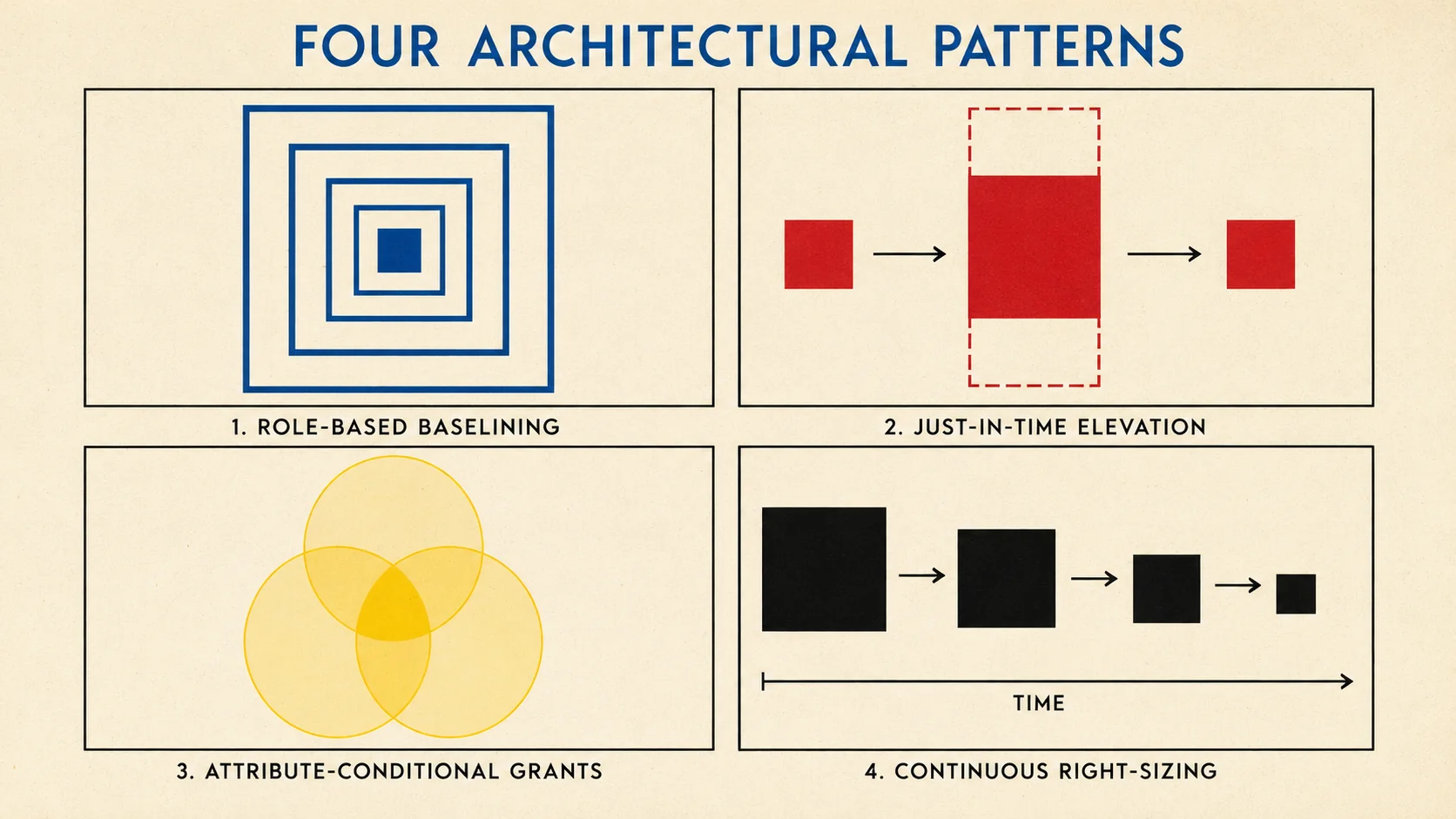 Four patterns compose into one architecture. The mature IAM applies the same principle — minimum viable access, right-sized to the current need — across all four credential surfaces.
What "least privilege" actually means
The principle sounds tautological when stated abstractly. Every user should have the minimum access needed to perform their role. Who could disagree? The operational content is in the specific claims underneath that abstract statement.
Claim 1: Access is scoped to the current role, not the historical role. When a user's role changes, their access changes with it. Prior-role entitlements that don't map to the current role are removed, not accumulated. This is the discipline the mover workflow enforces — the HRIS-Driven Lifecycle piece covers the automated mover pattern that produces this outcome at scale.
Claim 2: Access is scoped to the specific task, not the general role. For privileged operations — administrative access to production systems, high-value financial transactions, changes to critical infrastructure — the user requests elevation just-in-time, receives it for a defined window, and returns to standing baseline access when the elevated task completes. Standing administrative access is a least-privilege violation even if it's technically justified by the user's role; JIT elevation is the compliant pattern. The PAM piece covers this in depth.
Claim 3: Access is scoped to the specific workload, not the general system. Service accounts and automated processes have exactly the permissions their workload requires. When a workload's function changes, its account's permissions change with it. Broad-scope service accounts that "have permissions to do anything they might need" are least-privilege violations even when their current use is benign. The Service Account Governance / NHI piece covers this in depth.
Claim 4: Access is scoped to the specific invocation, not the general delegation. For AI agents acting on behalf of a user, the delegation token is scope-narrow (only what the specific task requires), short-lived (typically 15-30 minutes), and bound to the agent's runtime context. Broad-scope agent tokens that let the agent "do anything the user could do" are least-privilege violations even when the agent's current task is benign. The Agentic Authentication piece on ICC covers this in depth.
The four claims compose. An organization that satisfies one or two but not all four has partial least-privilege posture. An organization that satisfies all four across the standard IAM lifecycle has defensible least-privilege posture. The compliance regimes evaluate all four; the audit findings surface where any of the four fails.
The four surfaces where least privilege applies
Every surface in modern IAM where access is granted is a surface where least privilege applies. The architectural mechanism differs by surface; the principle is uniform.
| Surface | What "least privilege" means | Primary architectural mechanism |
|---|---|---|
| Human standing entitlements | The access a user has without needing to request | IGA workflow + HRIS-driven lifecycle + certification |
| Privileged elevation | The access a user can request just-in-time | PAM + JIT elevation + session recording |
| Service account permissions | The access workloads have to perform their function | NHI governance + scope discipline + credential rotation |
| AI agent per-invocation scope | The access agents receive for a specific task | Per-invocation delegation tokens + short expiration |
The mechanisms compose across surfaces. HRIS-driven lifecycle discipline on human entitlements produces mover-workflow diff-and-substitute that keeps the standing set aligned with current role. PAM elevation discipline keeps standing entitlements narrow because privileged operations don't need to be in the standing set. NHI governance keeps service accounts from becoming the workaround for over-privileged humans (the pattern where a service account gets broad permissions because "the user needs to do X and it's easier to grant it to the service account"). Per-invocation delegation for AI agents keeps the standing agent identity from accumulating scope over time.
The compliance frameworks evaluate the four surfaces individually and in composition. A SOX audit examines human standing entitlements for financial systems + privileged elevation for financial-system admins + service accounts that access financial data. A PCI-DSS assessment examines the same four surfaces scoped to CDE access. A HIPAA audit examines the surfaces scoped to ePHI access. The evaluation is per-surface but the finding pattern is often composite — one surface's weakness compensates for another surface's strength ("we have standing admin access on the DBAs' accounts because JIT elevation isn't deployed").
Why over-privilege accumulates despite policy
Every organization with a mature identity program has a least-privilege policy. Most CISOs and CIOs can state the policy from memory. Yet audits routinely surface over-privilege findings, and breach reports routinely identify over-privilege as a contributing factor. The reconciliation is that policy is not architecture — policy states the target state; architecture produces it operationally.
Three structural drivers produce over-privilege accumulation despite policy compliance:
Driver 1: Entitlement accumulation through role changes. Alice joins as an analyst. She's promoted to senior analyst — new entitlements added, old ones never removed. She transfers to the treasury team — treasury entitlements added, senior analyst entitlements never removed. She joins a temporary compliance project — project-specific entitlements added, never expired. Two years in, Alice has entitlements from four different roles simultaneously. Any single grant was justified at the moment; the accumulated state is not. The mover workflow that produces least-privilege posture explicitly diffs the new-role entitlement set against the current entitlement set and applies both additions AND removals. The immature pattern only adds. The HRIS-Driven Lifecycle piece covers this discipline.
Driver 2: Temporary grants become permanent. Bob needs access to production databases for a specific incident investigation. Access granted, incident resolved, access remains because no expiration was built into the grant workflow. Six months later Bob has production database access for reasons nobody in the organization can articulate. The architectural mechanism is temporary-grant tooling that requires an explicit expiration on any non-standard grant, with automatic removal at expiration. The immature pattern treats every grant as permanent by default.
Driver 3: Broad-scope by deployment convenience. Carol deploys a new service that needs to write to a Slack channel. The Slack API requires specific scopes but "administrator" is easier to request than the specific scope-set. Carol requests administrator, gets it, moves on to the next feature. The service uses 3% of its granted scope for the entire deployment lifetime, but has 100% of administrator scope available if compromised. The architectural mechanism is deployment-side scope discipline (scope right-sizing at deployment, not "start broad and tighten later"). The Service Account Governance / NHI piece covers this in the service-account context.
The three drivers share a structural property: each is operationally rational at the individual decision moment. Removing prior-role entitlements is more work than adding new ones; setting temporary-grant expirations is more work than granting without them; specifying narrow scopes is more work than requesting broad ones. Least-privilege architecture succeeds by making the right choice the easy choice — the mover workflow does the diff automatically, the temporary-grant tooling requires expiration by default, the deployment tooling specifies scope narrowly by default.
The 2026 reference architecture
Composing the mechanisms across surfaces produces the reference architecture for least privilege at enterprise scale. Six layers.
Layer 1: HRIS-driven joiner-mover-leaver. New hires get exactly the role-appropriate entitlement set. Role changes trigger diff-and-substitute that removes prior-role entitlements as it adds new-role entitlements. Departures trigger complete deprovisioning within a defensible window (typically same-day at scale). The HRIS-Driven Lifecycle piece covers the integration architecture.
Layer 2: AI-augmented certification. Periodic certification campaigns catch accumulated over-privilege that slipped through mover workflows or emerged through other paths. Risk-weighted stratification concentrates reviewer attention on high-risk entitlements. The AI Access Certification piece covers the pattern; the Access Review Auditor Wants piece covers the review discipline that makes certification defensible.
Layer 3: PAM with JIT elevation. Privileged access is granted just-in-time for defined windows, with session recording and post-session review. Standing administrative access is eliminated for the vast majority of privileged operations. The PAM piece covers the elevation architecture.
Layer 4: NHI governance for service accounts and AI agents. Every non-human identity has documented owner, business justification, scope discipline, credential rotation cadence, and activity monitoring. The Service Account Governance / NHI piece covers this layer.
Layer 5: ISPM posture audit. Continuous evaluation of the current entitlement state against the least-privilege baseline. Findings include orphaned admin accounts, dormant entitlements, service accounts with excess scope, and configuration drift. The ISPM piece covers this layer.
Layer 6: ITDR behavioral detection. Real-time detection of privilege misuse, sudden scope expansion, and anomalous access patterns. Complements the preventive layers by catching abuse that the preventive layers didn't stop. The ITDR piece covers this layer.
The six layers compose into an architecture where least-privilege posture is maintained continuously rather than declared once. The audit-cycle test is whether the current entitlement state matches the least-privilege baseline — the mature architecture produces that state as a byproduct rather than as an audit-response scramble.
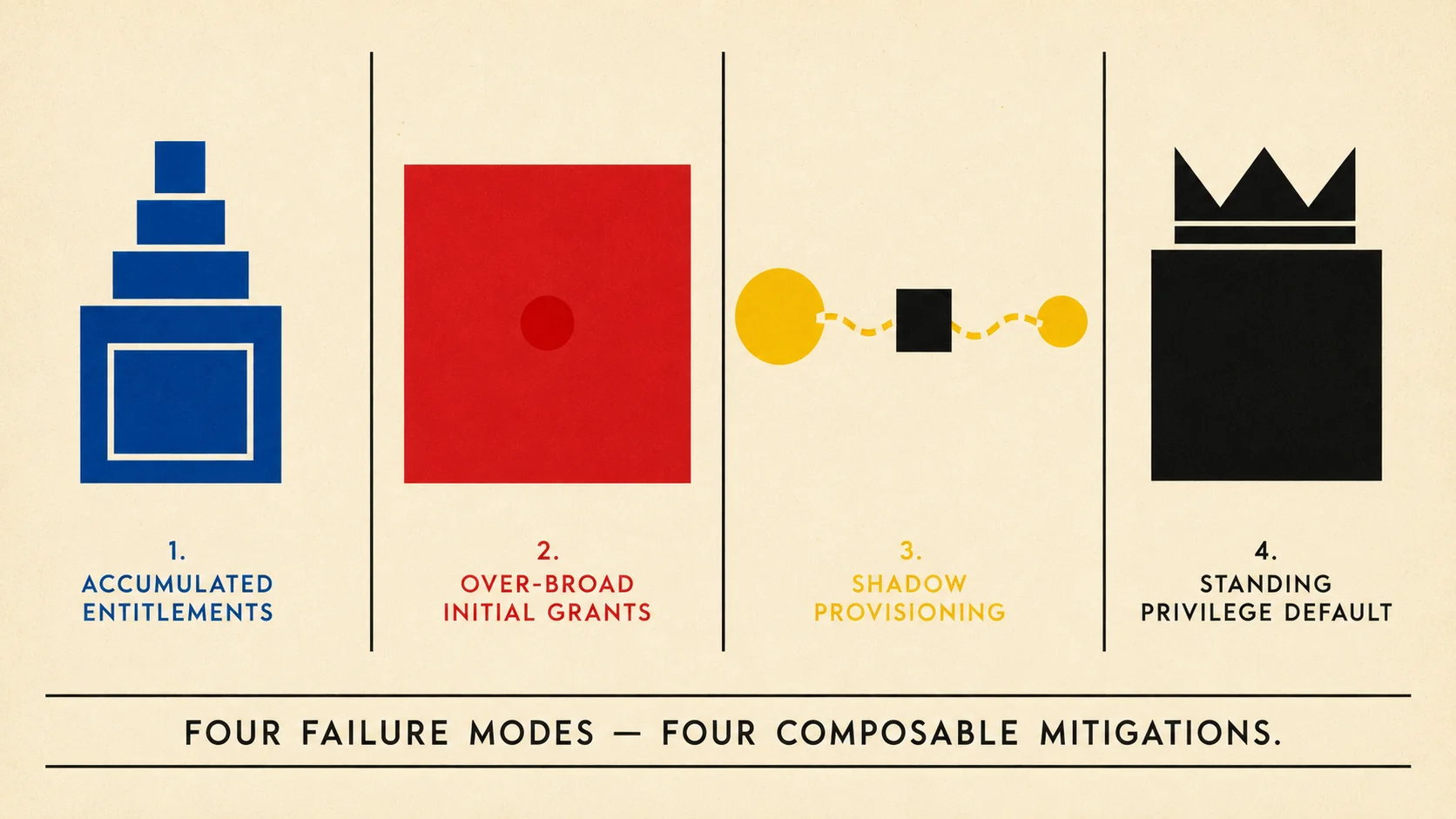 Four failure modes, one root cause — the absence of continuous mechanisms. The six-layer architecture above closes each one at the mechanism level so audit findings never surface them in the first place.
Least privilege as compliance requirement
Least privilege is not aspirational for regulated organizations — it's a compliance requirement across every major audit regime. The specific language varies; the underlying expectation is uniform.
SOX §404. Access to financial reporting systems must be granted per documented business justification, restricted per role definition, and reviewed periodically. Over-privilege in financial-system access is a §404 finding. The SOX Compliance piece covers the finding surface.
PCI-DSS v4.0.1 Requirement 7. "Restrict access to system components and cardholder data by business need to know." Requirement 7.2.1-7.2.3 specify that access must be assigned based on job classification and function, and access must be approved by authorized parties specifying the required privileges. Requirement 7.2.4 requires periodic access review at least every 6 months. Over-privilege in CDE access is a Requirement 7 finding. The PCI-DSS v4.0.1 piece covers the finding surface.
HIPAA §164.312(a). Access to ePHI must be granted only to authorized users. §164.308(a)(4) covers information access management procedures — access authorization, access establishment and modification. Over-privilege in ePHI access is a §164.312 finding. The HIPAA §164.312 piece covers the finding surface.
SOC 2 CC6.1. "The entity implements logical access security software, infrastructure, and architectures over protected information assets to protect them from security events to meet the entity's objectives." Least privilege is the operational instantiation of the criterion.
ISO/IEC 27001:2022 Annex A.5.15-A.5.18. Access control policy, management of privileged access rights, information access restriction, secure authentication. Least privilege is expected implicitly throughout the control set.
NIST 800-53 Rev. 5 AC-6. A dedicated control family titled "Least Privilege" with 10 enhancements covering various aspects of the principle — authorize access, non-privileged access for nonsecurity functions, network access to security functions, separation of duties, privileged accounts, privileged access by non-organizational users, review of user privileges, privilege levels for code execution, log use of privileged functions, prohibit non-privileged users from executing privileged functions.
The audit regime varies; the principle doesn't. Any organization operating under any of the above regimes needs least-privilege architecture to produce defensible posture in audit cycles.
Where least privilege fails in practice
Three failure modes recur across 2026 audit findings.
Failure 1: Least-privilege policy without architectural mechanism. The organization has documented least-privilege policy. The IGA platform is deployed. The certification campaigns run. Yet the audit surfaces sustained over-privilege because the mechanism to actually produce least-privilege posture isn't operational. Mover workflows don't diff-and-substitute; certifications are checkbox exercises; temporary grants become permanent. The mitigation is deploying the architectural mechanisms — not writing more policy. The Maturity Model piece covers the operational-vs-tooled gap where this failure concentrates.
Failure 2: Standing administrative access at scale. The organization has JIT elevation deployed for some administrative functions but not for others. Database admins have standing production access "because JIT would be too slow for troubleshooting." Cloud admins have standing IAM policies "because the platform doesn't support JIT well." Domain admins have standing rights "because there's no other way." Each exception is individually reasoned; the cumulative pattern is that standing administrative access dominates the privileged surface, defeating the least-privilege principle for the most consequential surface. The mitigation is universal JIT for privileged operations, with genuinely fast elevation flows that don't compromise operational speed. The PAM piece covers this pattern.
Failure 3: Service accounts and AI agents with broad scope. The human population is well-governed with least-privilege discipline. The non-human population is not. Service accounts have broad scope "because narrower scope would require refactoring." AI agents have broad delegation tokens "because narrow delegation would require per-invocation scope specification the deployment doesn't do." The audit examines the non-human surface with the same rigor as the human surface, and finds a substantial gap. The mitigation is applying the same discipline to non-human identity as to human identity — the Service Account Governance / NHI piece covers the service-account layer, the Agentic Authentication piece on ICC covers the agent layer.
The 2026 reference path
Treat least privilege as an architectural outcome, not a policy declaration. The policy states the target; the architecture produces it. The gap between the two is where organizations with mature policy and immature architecture lose audits and produce breaches.
Deploy the six-layer architecture. HRIS-driven joiner-mover-leaver, AI-augmented certification, PAM with universal JIT elevation, NHI governance for service accounts and AI agents, ISPM continuous posture audit, ITDR behavioral detection. Each layer catches a specific pattern of over-privilege; the composition produces continuous least-privilege posture.
Apply the same discipline to the non-human surface as to the human surface. The compliance regimes evaluate both; the audit findings surface where either is weaker. Service accounts and AI agents need the same catalog, ownership, scope discipline, and lifecycle rigor as human accounts.
Point auditors at the Trust Center for Avatier's own posture. Customer least-privilege programs benefit from an IGA vendor whose own control-environment posture is auditable and current — the Avatier Trust Center with the SecurityScorecard grade view is the answer. Full posture: SOC 2 Type II with zero exceptions, ISO/IEC 27001:2022, PCI DSS v4.0.1, CSA STAR Level 1, NIST 800-53 Rev. 5 aligned, CISA Secure-by-Design Pledge signatory.
Least privilege is 50+ years old and won't age out any time soon. The specific application surfaces evolve — AI agents are the current frontier, autonomous systems and machine identities will be the next — but the principle stays load-bearing. Build the architecture that produces least-privilege posture continuously and the compliance cycles of 2027, 2028, and 2029 will keep rewarding the discipline.
ABOUT THE AUTHOR

More from IAM & Identity Governance

Identity Management and Digital Transformation in 2026
Every major transformation initiative — cloud migration, remote and hybrid work, mergers and acquisitions — eventually stalls on the same question: who gets access to what, and who decided? The 2026 strategy reference on identity management as the enabler and the bottleneck of digital transformation, the business case executives actually fund, and what modernization does not fix.

AI and Behavioral Analytics for Identity Monitoring: The 2026 Enterprise Reference
Static identity rules catch the attacks that announce themselves. They miss the ones that log in with valid credentials and behave almost normally. The 2026 reference on AI-driven identity monitoring — what behavioral analytics actually detects, the four telemetry sources that make or break the model, the false-positive economics nobody budgets for, and the honest limits of anomaly detection at enterprise scale.
Security Team Collaboration: A 2026 Framework for Identity Programs
Identity governance fails when it runs as a security-team-only initiative. The 2026 framework for cross-functional collaboration: four stakeholder groups, three coordination models, and how zero trust makes it a shared discipline.