Securing Microservices: Identity as the New Perimeter (2026)
How service-to-service authentication, mTLS, and workload identity replace the network perimeter microservices architectures outgrew — the 2026 reference for CISOs and platform teams.

How service-to-service authentication, mTLS, and workload identity replace the network perimeter microservices architectures outgrew — the 2026 reference for CISOs and platform teams.
- Perimeter-based security fails for microservices because there's no single boundary to defend — services talk to each other constantly, across zones, clouds, and clusters, and a compromised pod inside the network is treated as trusted by default.
- Service-to-service authentication has converged on two mechanisms that compose: mutual TLS (mTLS) for transport-layer identity and encryption, and signed tokens (JWTs, OAuth 2.0 client-credentials) for request-level authorization context.
- Workload identity — a short-lived, cryptographically verifiable identity issued per service instance (the SPIFFE/SPIRE pattern is the emerging open standard) — replaces shared static API keys, which fail as a security control the moment more than one service holds the same secret.
- A service mesh (Istio, Linkerd, Consul) and an API gateway solve different layers of the same problem: the mesh secures east-west (service-to-service) traffic, the gateway secures north-south (external-to-service) traffic, and both need identity-aware policy, not just network segmentation.
- Zero trust inside the mesh means every hop re-authenticates and re-authorizes independently — this closes the lateral-movement gap that perimeter security leaves wide open once an attacker is inside, but it does not replace human-identity governance or eliminate the need to lifecycle-manage the service accounts and credentials the mesh still depends on.
How do you secure a microservices architecture? Not by hardening a network boundary around it — that boundary doesn't map to how microservices actually talk to each other. You secure it by giving every service its own verifiable identity, requiring every call to authenticate against that identity through mTLS or signed tokens, enforcing policy at every hop inside the service mesh rather than once at the edge, and issuing identity dynamically so no service ever runs on a long-lived, hand-rotated static credential. The unit of trust moves from "inside the network" to "this specific workload, right now, presenting this credential." Everything below is the architecture that makes that shift operational.
This piece is the 2026 update to Avatier's original microservices security post, published October 2025 (https://www.avatier.com/blog/microservices-security-modern-application/). The core argument hasn't changed — perimeter security was never built for how microservices communicate — but the deployment patterns for service-to-service authentication and workload identity have matured substantially since then, and this reference reflects that maturity rather than the earlier draft.
Why perimeter security fails for microservices
Perimeter security assumes a defensible boundary — a firewall or network edge separating "trusted inside" from "untrusted outside," with enforcement concentrated at that single line. It's a model built for monolithic and client-server architectures, where traffic crossed the boundary once, in a predictable direction, and internal traffic was comparatively rare.
Microservices invert that pattern. A typical enterprise deployment runs dozens to hundreds of independently deployed services across multiple clusters, cloud accounts, and often multiple providers, calling each other continuously. East-west traffic — service to service, inside whatever boundary exists — routinely dwarfs north-south traffic, the requests that cross in from outside. There's no single wire where one control sees everything that matters.
The failure mode that follows is structural, not incidental. Once an attacker compromises any single service — a vulnerable dependency, a misconfigured container image, a leaked deployment credential — perimeter security has nothing left to say. Every other service inside the boundary trusts the compromised one by default, because the model was built on "already inside" being sufficient proof of trustworthiness. Lateral movement isn't a sophisticated technique here; it's the default behavior of a system with no internal controls.
Cloud-native deployment amplifies the problem: services scale, get rescheduled, and get replaced constantly as part of normal CI/CD operation. A network-location-based model — "this IP range is trusted" — breaks down when the IP behind a given service changes every few minutes. The boundary has to travel with the workload, not a subnet.
None of this makes network segmentation worthless — it's a legitimate defense-in-depth layer, covered later. It means segmentation alone, as the primary control, was never designed for an architecture where trust boundaries roughly equal the number of services running.
Service-to-service authentication: mTLS and signed tokens
If the network boundary can't be the control, the control has to be identity presented on every call. Two mechanisms have converged as the practical answer, and mature 2026 deployments use both.
Mutual TLS (mTLS) authenticates at the transport layer. In standard TLS, only the server presents a certificate; mutual TLS flips that so both sides do — the calling service proves its identity to the receiving service, and vice versa, before any application data moves. The channel is also encrypted end-to-end as a byproduct, closing off passive network sniffing inside the mesh. mTLS answers one question well: is this actually the service it claims to be, on a private channel. It says nothing about what that service is authorized to do once it's proven who it is.
Signed tokens — JSON Web Tokens issued through an OAuth 2.0 client-credentials grant, or an equivalent internal scheme — answer the authorization question mTLS leaves open. A calling service presents a token a trusted issuer has cryptographically signed; the receiving service verifies the signature and checks the claims (issuer, audience, expiration, scope) before honoring the request. Tokens carry context certificates don't: what this specific call is authorized to do, on whose behalf, until when.
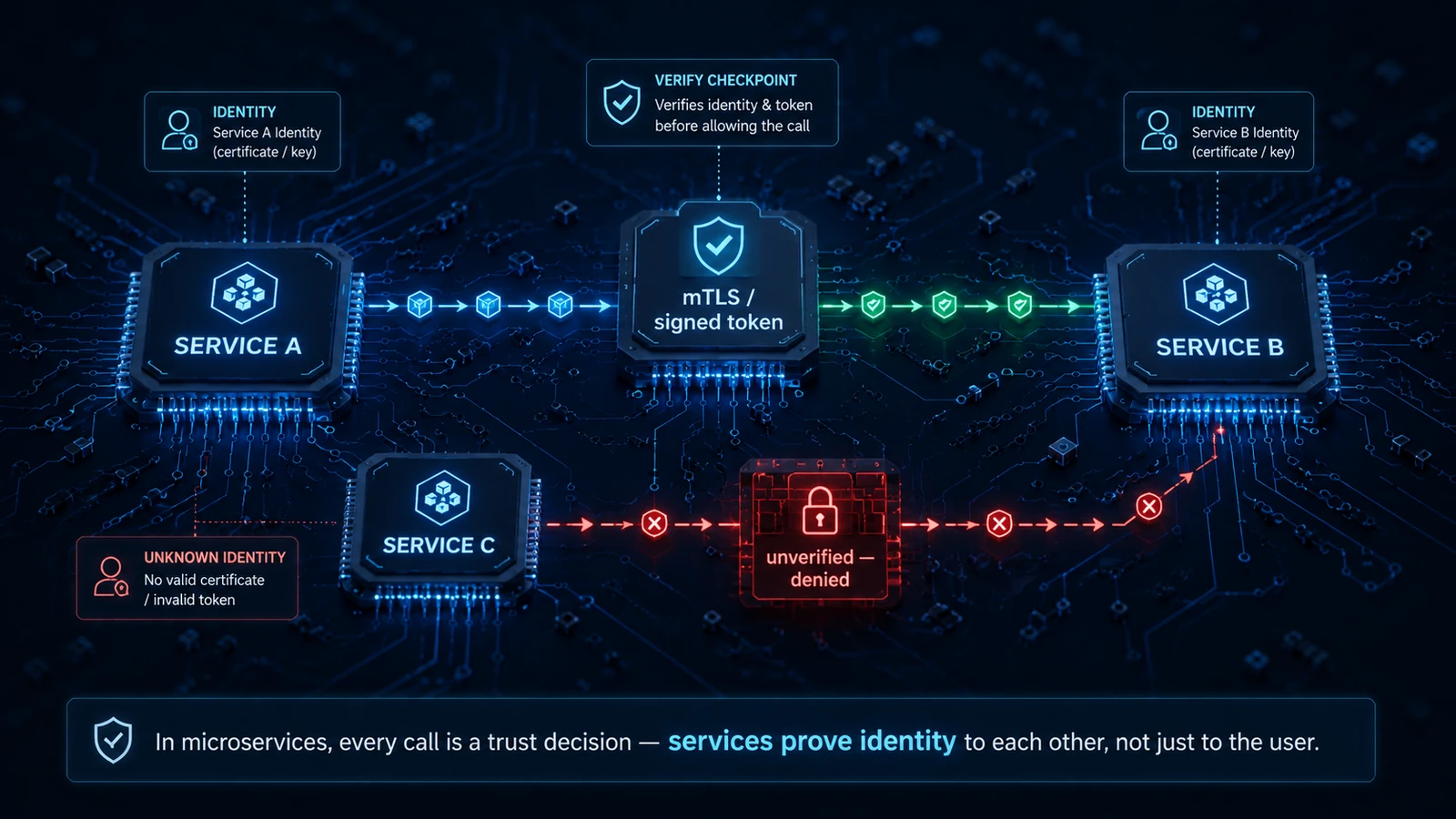 Every service-to-service call passes through an identity checkpoint — mTLS and signed tokens replace network trust as the actual gate.
The two compose cleanly: mTLS secures the channel and proves identity at the transport layer; the token travels inside that channel and carries finer-grained authorization context. A mesh sidecar typically handles mTLS transparently, issuing and rotating certificates without code changes, while the application layer or edge gateway handles token issuance. The failure mode to avoid is skipping one and assuming the other covers it — mTLS without tokens tells you who's calling but not what they're allowed to do; tokens without mTLS leave the channel itself unauthenticated.
Workload identity: per-service identity vs. shared static keys
Authentication mechanisms only matter if the credential behind them is trustworthy, and this is where legacy microservices deployments still fail. The common anti-pattern is a shared static API key: one secret string, baked into configuration, that every instance of a service — and often every different service calling a downstream API — presents as proof of identity.
Shared static keys fail for reasons that compound. There's no per-instance accountability — if ten pods present the same key, an audit log showing "key X made this call" tells you nothing about which pod made it. There's no meaningful rotation cadence — rotating a key a dozen services depend on requires a coordinated deployment, so it rarely happens. And the blast radius of a single leak is total — a key leaked from a config file or public repository compromises every holder until someone notices and manually rotates it, often months later.
Workload identity inverts every one of those failure properties. Instead of a long-lived shared secret, each running instance of a service — a pod, container, or serverless invocation — is issued its own short-lived, cryptographically verifiable identity, typically valid for minutes to an hour, automatically rotated, and scoped to exactly what that instance needs. The SPIFFE specification, implemented through SPIRE, is the closest thing to an open standard for this: every workload gets an SVID — a short-lived certificate bound to its attested identity — issued at startup and revoked at shutdown, with no human or pipeline ever handling a long-lived secret directly.
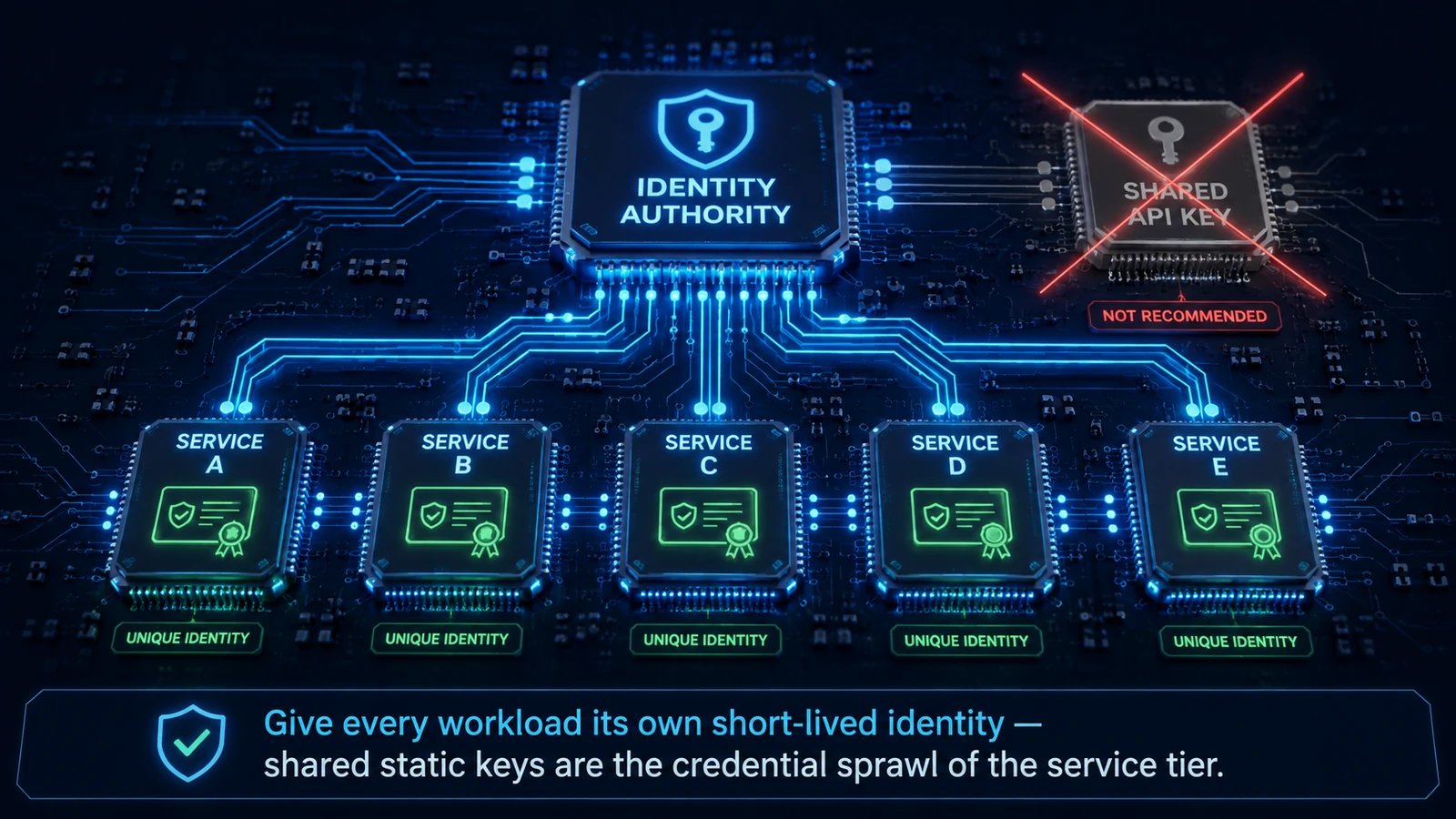 A shared key protects nothing once it leaks. Per-service short-lived identity limits blast radius to minutes, not months.
A stolen credential is close to worthless by the time anyone finds it — it expires within minutes regardless of whether the theft is noticed, and it authorizes far less than a static key would have even during its validity window. Cloud-native platforms have converged on native equivalents even where they don't implement SPIFFE directly — Kubernetes service account tokens, AWS IAM roles assumed via the metadata service, Azure managed identities, GCP workload identity federation — all following the same principle: identity issued to the running workload, not baked into a config file. The governance discipline around those non-human identities — ownership, scope certification, lifecycle tied to the workload's own — is a distinct topic our Service Account Governance piece covers directly.
Service mesh and API gateway security
Two infrastructure layers do the enforcement work here, frequently confused because both involve routing and TLS. They solve different problems.
A service mesh (Istio, Linkerd, Consul Connect are the common 2026 options) manages east-west traffic — the calls services make to each other. Most implementations use a sidecar-proxy pattern: a lightweight proxy runs alongside every service instance, intercepting its traffic. The control plane pushes configuration to every sidecar — which services can call which, the mTLS policy, retry behavior — and the sidecars enforce it transparently, without application code implementing any of it. This is what makes mesh-level mTLS practical at scale: a platform team can mandate it without asking every application team to implement certificate handling themselves.
An API gateway sits at the edge of the deployment, or a specific trust domain within it, and manages north-south traffic — requests from external clients or a different internal trust domain. The gateway is where edge concerns concentrate: authenticating external callers, rate limiting, validating inbound requests, routing to the correct backend, and addressing API-specific attack surface (schema validation, payload limits, injection protection).
The two are complementary, not redundant. A gateway with no mesh behind it authenticates external traffic well but leaves the internal network essentially flat — once a request clears it, it can typically reach any internal service unchecked. A mesh with no gateway in front has no consistent edge policy. The gateway is the front door; the mesh is the hallway system inside. Mature architectures deploy both, with the gateway also acting as an identity-issuing boundary — external callers get exchanged for internal service credentials there, so the mesh never trusts an externally-supplied credential directly.
Zero trust within the mesh
A service mesh that only encrypts traffic without enforcing per-hop authorization is halfway to the architecture that closes the lateral-movement gap. The other half is zero trust applied inside the mesh, not just at its edge: every hop independently re-authenticates the caller and re-evaluates policy, rather than inheriting trust because a request already cleared an earlier checkpoint.
This matters because of how lateral movement works. If Service A calls B, and B calls C, a perimeter-style model treats "the request came from inside the mesh" as sufficient for C to trust it. Zero trust inside the mesh instead requires C to independently verify B's identity and authorization on that specific call, regardless of whether B was legitimately authenticated a moment earlier. If an attacker takes control of B's running workload directly, a perimeter model hands over everything B could reach. A zero-trust mesh limits the attacker to exactly what B's identity is authorized to call — C's check doesn't care that the request technically originated "inside."
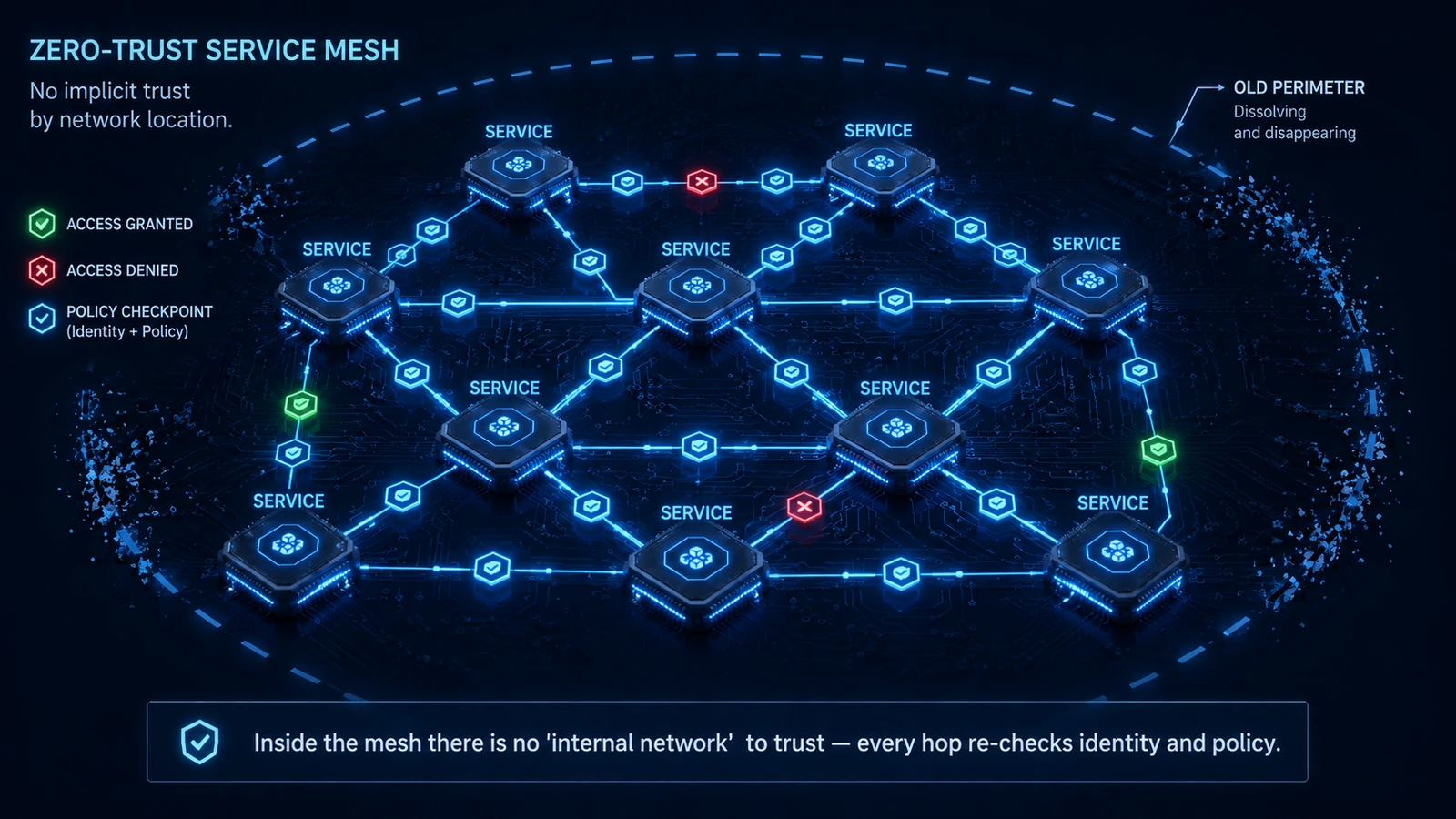 Inside the mesh, trust is never inherited from the network — every hop re-authenticates and re-authorizes independently.
The practical implementation is fine-grained authorization policy defined per service pair, not per network segment: B is permitted to call C's /read-balance endpoint but not /write-transaction, enforced at C's sidecar on every call, not cached as a standing grant. Mesh platforms scope this to service identity (a SPIFFE ID, not an IP address), which is what makes policy travel correctly when workloads get rescheduled or scaled. The old perimeter doesn't get removed so much as become irrelevant — the mesh doesn't ask "did this originate inside the trusted network," it asks "does this identity have a grant for this call," every time.
Automating dynamic provisioning of service identity
None of the mechanisms above scale to microservices' actual deployment velocity if identity provisioning stays a manual step. A platform team deploying dozens of services multiple times a day cannot have a human manually issue, distribute, and rotate credentials for every new instance — the operational tempo makes that approach fail by design, not by neglect.
The 2026 pattern treats identity issuance as an automated part of the deployment pipeline, not a separate process layered on top of it. When a workload is scheduled — a pod starts on Kubernetes, a function is invoked on a serverless platform — the identity platform automatically issues a short-lived credential scoped to that workload's declared permissions, after verifying an attestation that proves the workload is what it claims to be (a Kubernetes service account binding, an AWS instance profile, a signed deployment manifest). The identity is revoked automatically when the workload terminates, closing the gap where a credential outlives the workload it was issued to.
Automation closes two failure modes manual processes reliably miss. The first is orphaned credentials — a service is decommissioned, but its API key stays valid because deprovisioning wasn't wired into the teardown process, sitting as unmonitored attack surface indefinitely. The second is credential reuse across environments — an engineer under deadline pressure copies a production credential into staging because generating a new one properly is more friction than the deadline allows. Automated, workload-scoped issuance removes the friction that makes both shortcuts tempting. This is also where GitOps and infrastructure-as-code intersect with identity: declaring a service's required permissions in the same manifest as its deployment configuration, rather than a separately maintained access request, means the scope is versioned and reviewed in the same pull request as the code change.
Defense in depth for microservices
Identity-centric controls are the load-bearing layer of 2026 microservices security, but treating them as the only layer is its own failure mode. Defense-in-depth still matters and composes with identity rather than competing with it.
Network segmentation remains a legitimate secondary control, even though it's no longer primary. Kubernetes network policies and namespace isolation reduce the blast radius available to an attacker who evades the identity layer — a backstop, not the front line, but worth having.
Runtime protection — image scanning, admission control blocking unsigned images, anomaly detection flagging a container outside its expected baseline — catches what identity controls don't address directly: a vulnerable dependency or misconfigured base image giving code execution inside an otherwise correctly-authenticated workload.
Edge protection at the gateway — WAF rules, rate limiting, schema validation — reduces the volume and sophistication of attacks that ever reach the mesh at all.
Secrets management — vaulting the smaller set of long-lived credentials legacy systems still require, with strict access controls on the vault itself — covers the transitional reality that most 2026 enterprises run a mix of cloud-native and legacy services, not a pure workload-identity environment.
Behavioral monitoring closes the loop — telemetry flagging a service that authenticates correctly but then behaves anomalously catches the scenario where the credential was never stolen, but the workload behind it was. None of these substitute for the identity architecture above; they catch what it doesn't reach alone.
What Avatier ships toward this pattern
Avatier's platform doesn't replace mesh-level mTLS, SPIFFE/SPIRE workload identity, or the mesh and gateway infrastructure covered above — those are platform-engineering decisions, usually Kubernetes-native tooling chosen by the team running the cluster. What Avatier Identity Anywhere contributes is the governance layer sitting above that infrastructure: a non-human identity inventory tracking every service account, deployment credential, and workload identity binding across the estate; certification workflows routing scope reviews to the owning engineering team on a cadence shorter than annual human-identity reviews, because service permissions drift faster; and lifecycle automation tying credential provisioning and revocation to deployment events rather than a manual step someone has to remember when a service is decommissioned.
For the OAuth 2.0 client-credentials flows and signed-token issuance inside the authentication layer, Avatier's OAuth and OIDC integration federates with the identity providers that issue and validate those tokens, so token issuance composes with existing infrastructure rather than requiring a separate trust anchor. For legacy service accounts that haven't yet migrated to short-lived workload identity, Avatier's PAM integrations (CyberArk, BeyondTrust, Delinea, HashiCorp Vault) handle vaulting and rotation of the credentials that remain, while the governance layer tracks ownership and lifecycle across the mixed environment.
The Avatier Trust Center publishes our compliance posture — SOC 2 Type II with zero exceptions, ISO/IEC 27001:2022 certified, PCI DSS v4.0.1 compliant, CSA STAR Level 1, NIST 800-53 Rev. 5 aligned, and CISA Secure-by-Design Pledge signatory. The pattern in this piece works regardless of vendor; the point isn't that securing microservices requires buying anything from Avatier. It's that identity-centric architecture needs a governance layer wrapped around it, or the credentials underneath the mesh drift into the same ungoverned state non-human identity risk keeps surfacing in breach post-mortems.
What this doesn't solve
Securing service-to-service communication and issuing per-workload identity is necessary, and most enterprises in 2026 still have real gaps here — but it's worth being specific about what it doesn't cover.
It doesn't solve human-identity governance. Employees, contractors, and third-party users still need joiner/mover/leaver lifecycle management, access certifications, and role-based access control — none of which this architecture touches. A perfectly implemented service mesh has nothing to say about whether a departed employee's account was deprovisioned on schedule.
It doesn't eliminate account lifecycle management — it relocates part of it. Workload identity removes the long-lived-credential problem for cloud-native services, but every binding still has an owner and a scope that needs periodic review. Our Service Account Governance and Non-Human Identity piece covers that discipline directly — the layer that keeps the identities this piece describes from drifting into the same ungoverned state the shared-API-key pattern was in before.
It doesn't solve cloud entitlement sprawl on its own. A service can have textbook-correct workload identity and still be dangerously over-permissioned across the cloud estate if nobody tracks effective entitlements and scope drift — that's the discipline our CIEM piece covers.
And it doesn't replace the broader OAuth 2.0 and OpenID Connect federation architecture most enterprises already run for human and API authentication — service-to-service identity composes with that layer rather than substituting for it, as covered in our OAuth 2.0 vs. OpenID Connect piece. Enterprises that treat microservices identity as a complete program — rather than one layer inside a broader architecture that also includes human governance, just-in-time privileged access (JIT/ZSP piece), and detection at the ITDR piece — end up with a well-secured mesh inside a poorly governed enterprise: better than the perimeter-only model this piece opened with, but still not the whole job.
ABOUT THE AUTHOR

More from Access Management
Attribute-Based Access Control: When RBAC Isn't Enough (2026)
ABAC evaluates subject, resource, and environment attributes against policy at request time, not a fixed role. The 2026 reference on what ABAC does differently, and where it earns its complexity.

How to Implement Self-Service Access Requests: The 2026 Guide
Self-service access requests only work when the full workflow is designed as one governed loop — request capture, policy-driven approval routing, automated provisioning, and closed-loop access confirmation. This is the 2026 practitioner guide to implementing an access request system that is fast for users and defensible under audit: the request-to-access pipeline, the design decisions that keep self-service from becoming rubber-stamp risk, and the operational discipline that makes it hold up.

Enterprise RBAC Implementation: Best Practices for 2026
The operational companion to the RBAC fundamentals reference — how to actually implement enterprise role-based access control well. Rollout sequencing, role design that avoids explosion, least-privilege enforcement in practice, entitlement modeling, provisioning integration, access reviews, and the pitfalls that sink real programs.