Access Governance in 2026: The Definitive Enterprise Reference
Access governance is the discipline that answers one question continuously: does every identity in the enterprise hold exactly the access it should, right now? The 2026 reference on the five control surfaces, the access governance vs. IGA distinction, where reviews collapse into rubber-stamping, and what the discipline cannot solve.
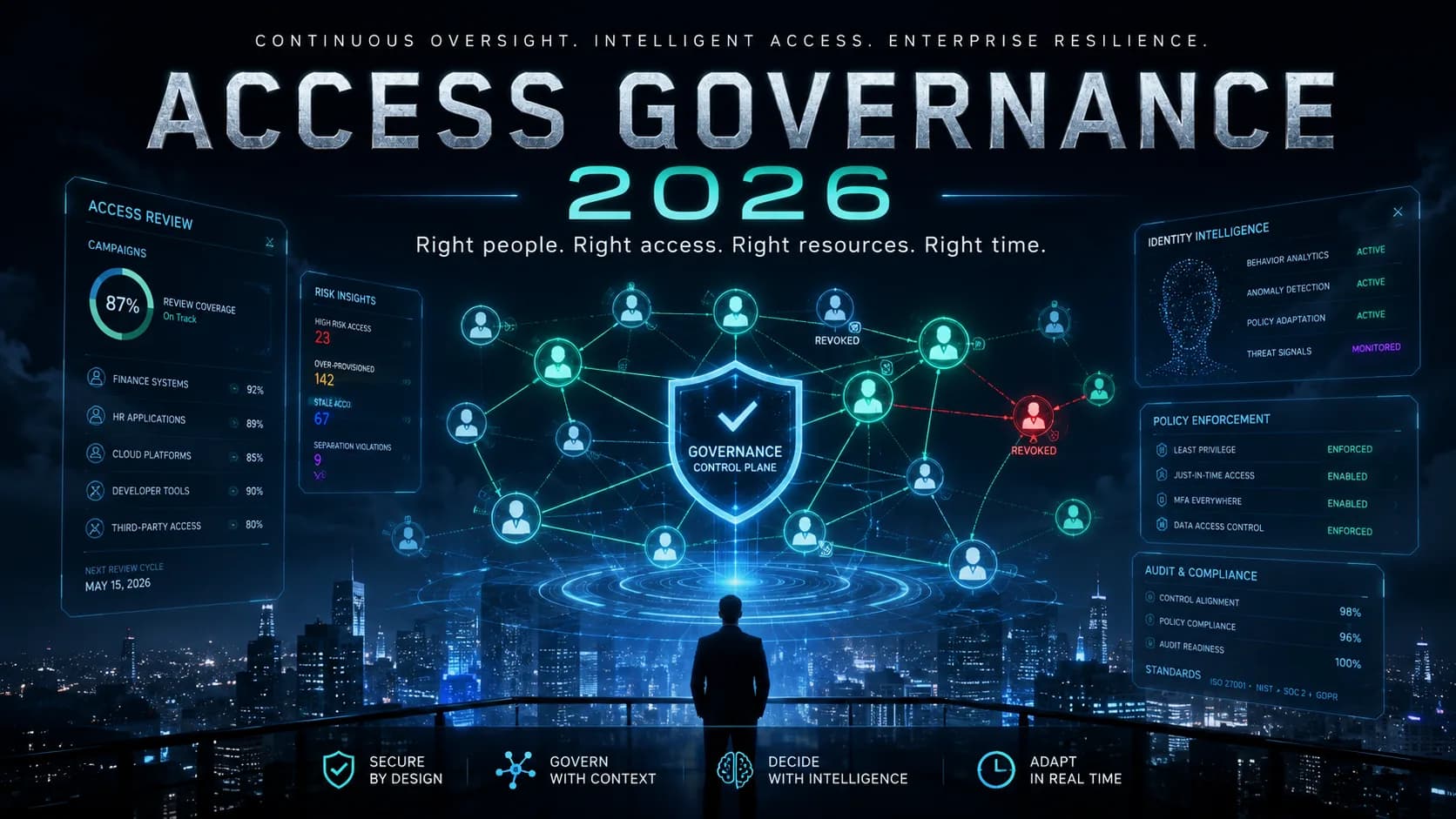
Access governance is the discipline that answers one question continuously: does every identity in the enterprise hold exactly the access it should, right now? The 2026 reference on the five control surfaces, the access governance vs. IGA distinction, where reviews collapse into rubber-stamping, and what the discipline cannot solve.
- Access governance is the oversight discipline that continuously verifies every identity holds exactly the access it should — right people, right access, right resources, right time. In 2026 it is the control layer auditors ask about first and the layer attackers exploit when it is missing, because credential misuse features in a majority of breach reports per current industry consensus.
- Five control surfaces make up the discipline: user access reviews and certification, role-based access control, policy enforcement with separation-of-duties, provisioning and deprovisioning integration, and access risk management. A program missing any one of the five leaves a gap the other four cannot cover.
- Access governance is not the same thing as identity governance and administration (IGA). Governance is the oversight layer — reviews, certification, policy, SoD. IGA is the superset that adds the operational machinery: lifecycle automation, provisioning connectors, password management, entitlement catalogs. You can buy IGA and still fail at governance.
- The dominant failure mode is rubber-stamping: certification campaigns that dump hundreds of undifferentiated line items on managers until approve-all becomes the rational response. The fix is architectural, not motivational — risk-scored review queues that make each decision small, contextual, and prioritized.
- Access governance does not solve authentication strength, endpoint compromise, or data-layer controls, and it cannot fix a broken identity data foundation. Treat it as one load-bearing layer in an identity security program, not the program itself.
Every enterprise already has an access governance program. The only question is whether anyone designed it. In the undesigned version, access accumulates: people join, move teams, take on projects, and every grant along the way persists indefinitely because revocation has no owner. The environment's effective access model becomes the sum of every decision nobody ever revisited. Auditors call this a finding. Attackers call it a lateral-movement map.
Access governance is the discipline that replaces that accumulation with deliberate, continuously verified decisions. The working definition has four parts: right people (the identity is real and current), right access (entitlements match the job), right resources (access maps to what the role actually requires), and right time (access exists while the need exists, and not after). Every framework, vendor deck, and audit workpaper in this space is an elaboration of those four clauses. The hard part is not the definition. The hard part is that verifying those four clauses continuously, across thousands of identities and hundreds of systems, is an engineering and process problem most enterprises have only partially solved — and the unsolved parts are exactly where credential-driven attacks live. Credential misuse features in a majority of breach reports per current industry consensus, and the post-incident review almost always finds the same thing: the credential that got abused held access nobody had looked at in years.
This is the 2026 update of our original reference on access governance in modern identity security, rewritten for the current landscape: non-human identities that outnumber people, AI entering the certification loop, and audit expectations that have moved from "show me a policy" to "show me the evidence."
What access governance actually is — and the five control surfaces
Strip away the vendor vocabulary and access governance is a continuous loop with three verbs: see (inventory every identity and every entitlement it holds), decide (verify each identity-to-entitlement pair against policy and business need), and act (revoke what fails verification, and record the evidence). Everything else in the discipline is machinery for running that loop at enterprise scale without drowning the humans in it.
The machinery organizes into five control surfaces. They are not a menu — a program missing any one of them leaves a gap the other four cannot cover.
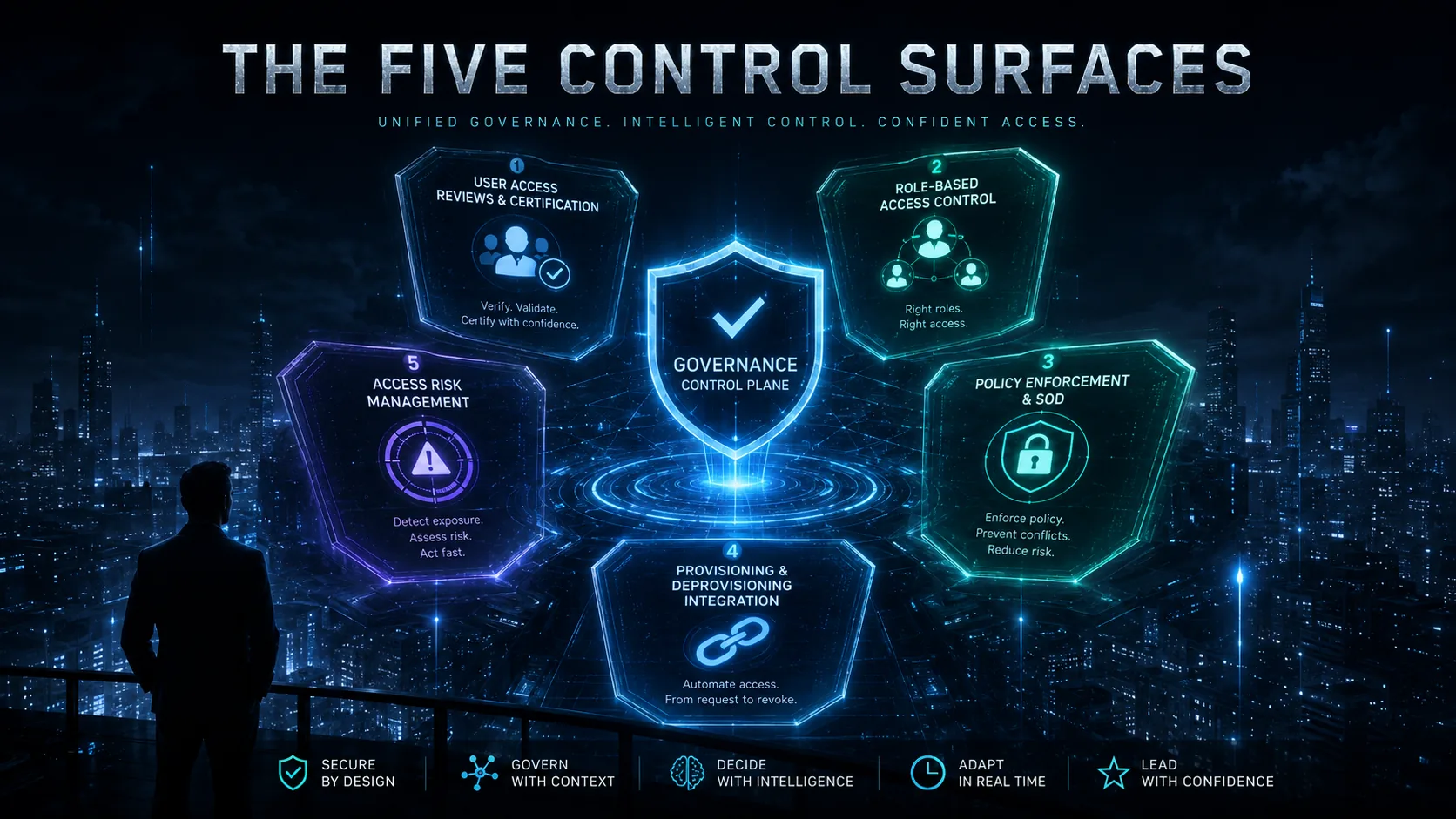 Five control surfaces, one discipline. Reviews, roles, policy, lifecycle, and risk — remove any one and the loop stops closing.
User access reviews and certification. The periodic (and increasingly event-driven) verification that each identity's entitlements are still justified, with a named reviewer accountable for each decision and evidence captured for audit. This is the surface auditors examine first, and the one that fails most visibly — more on that failure below. What a well-run review actually produces is covered in our piece on the access review your auditor actually wants.
Role-based access control. Bundling entitlements into roles mapped to job functions, so access decisions happen at the level of "what does a payroll analyst need" rather than one entitlement at a time. RBAC is what makes review queues tractable and provisioning consistent. It is also perpetually incomplete — role models drift as the organization changes, and a program that treats the role catalog as finished is a program with a stale role catalog.
Policy enforcement. The rules that constrain what access is allowed to exist regardless of who approves it: separation-of-duties pairs (the person who creates vendors cannot also approve payments), toxic combinations, and the access-control expectations embedded in SOX, HIPAA, GDPR, PCI DSS, and NIST SP 800-53. Policy enforced at request time prevents violations; policy checked only at review time discovers them a quarter late.
Provisioning and deprovisioning. Governance and lifecycle are usually bought as separate line items and then discovered to be the same problem. Every joiner, mover, and leaver event is an access decision, and a governance program disconnected from lifecycle spends its review cycles cleaning up what lifecycle automation should have prevented — the mover who kept their old team's access, the contractor whose account outlived the contract. The integration pattern is the subject of our piece on access governance and user lifecycle management.
Access risk management. The scoring layer that answers "where should oversight effort concentrate?" Privileged entitlements, sensitive-data access, dormant accounts with live permissions, outlier grants no peer holds — these deserve scrutiny that a read-only grant to the cafeteria menu does not. Risk management is what turns governance from a flat compliance exercise into a security control.
Access governance vs. IGA: the distinction that changes what you buy
The terms get used interchangeably, and the interchange causes real procurement mistakes. They are not the same thing.
Access governance is the oversight layer: reviews and certification, policy and separation-of-duties enforcement, and the risk analytics that prioritize both. Identity governance and administration — IGA — is the superset: everything in the governance layer, plus the operational machinery of identity. Lifecycle automation. Provisioning connectors. Password management. The entitlement catalog itself. Governance is a strict subset of IGA; IGA is governance plus operations.
Why the distinction matters: enterprises buy IGA platforms, but auditors and attackers evaluate governance outcomes. The failure pattern is common enough to be a cliché — a fully deployed IGA suite, connectors humming, catalog populated, and certifications still rubber-stamped because nobody engineered the review experience. The platform ran; the discipline never happened. If you are evaluating the platform side of this, our buyer's guide to identity governance and administration solutions covers the market; just go in knowing that the purchase is the beginning of the governance problem, not the end of it.
The distinction also clarifies scope conversations. "Do we have IGA?" is a deployment question with a yes/no answer. "Do we have access governance?" is an outcomes question: could you show an auditor, today, evidence that access in your top ten systems reflects reviewed, current decisions? Plenty of organizations answer yes to the first and no to the second.
Why the discipline moved to the center of identity security
Four forces, each compounding the others, explain why access governance went from back-office compliance chore to board-level control between the original version of this piece and now.
Cloud sprawl dissolved the perimeter model of access. The average enterprise runs hundreds of SaaS applications plus multi-cloud infrastructure, each with its own permission model, admin plane, and entitlement vocabulary. Access decisions that once lived in one directory now live in hundreds of consoles. Without a governance layer aggregating them, no human in the organization can answer "what can this person touch?" — which means nobody is actually managing access; the consoles are.
Credential-driven attacks made unreviewed access an exploit surface. The modern intrusion rarely opens with an exploit; it opens with a credential — phished, stuffed, bought, or socially engineered through a help desk. Once inside, the attacker's ceiling is the access the compromised identity holds. Over-provisioned accounts, dormant-but-live entitlements, and orphaned admin grants convert a single compromised credential into enterprise-wide reach. The Storm-2949 incident analysis is a case study in exactly this arithmetic: governance gaps, not malware sophistication, determined the blast radius.
Regulators stopped accepting policies as evidence. SOX, HIPAA, GDPR, and PCI DSS all require — in substance if not in the exact phrase — demonstrable control over who can access regulated systems and data. The 2026 audit posture has shifted from reviewing your access policy to sampling your access evidence: show me this quarter's certifications for these systems, show me the revocations that followed, show me the SoD exceptions and who accepted them. A governance program is the machine that produces those answers routinely instead of heroically.
Non-human identities became the majority population. Service accounts, API keys, workload identities, and now AI agents outnumber human identities in most enterprises — and they hold standing privileged access, never change jobs, never leave through HR, and have no manager to certify them. A governance model built exclusively around human reviewers reviewing human access is auditing the minority of the identity population. Extending the discipline to service accounts and non-human identities is the defining scope expansion of this era of the discipline.
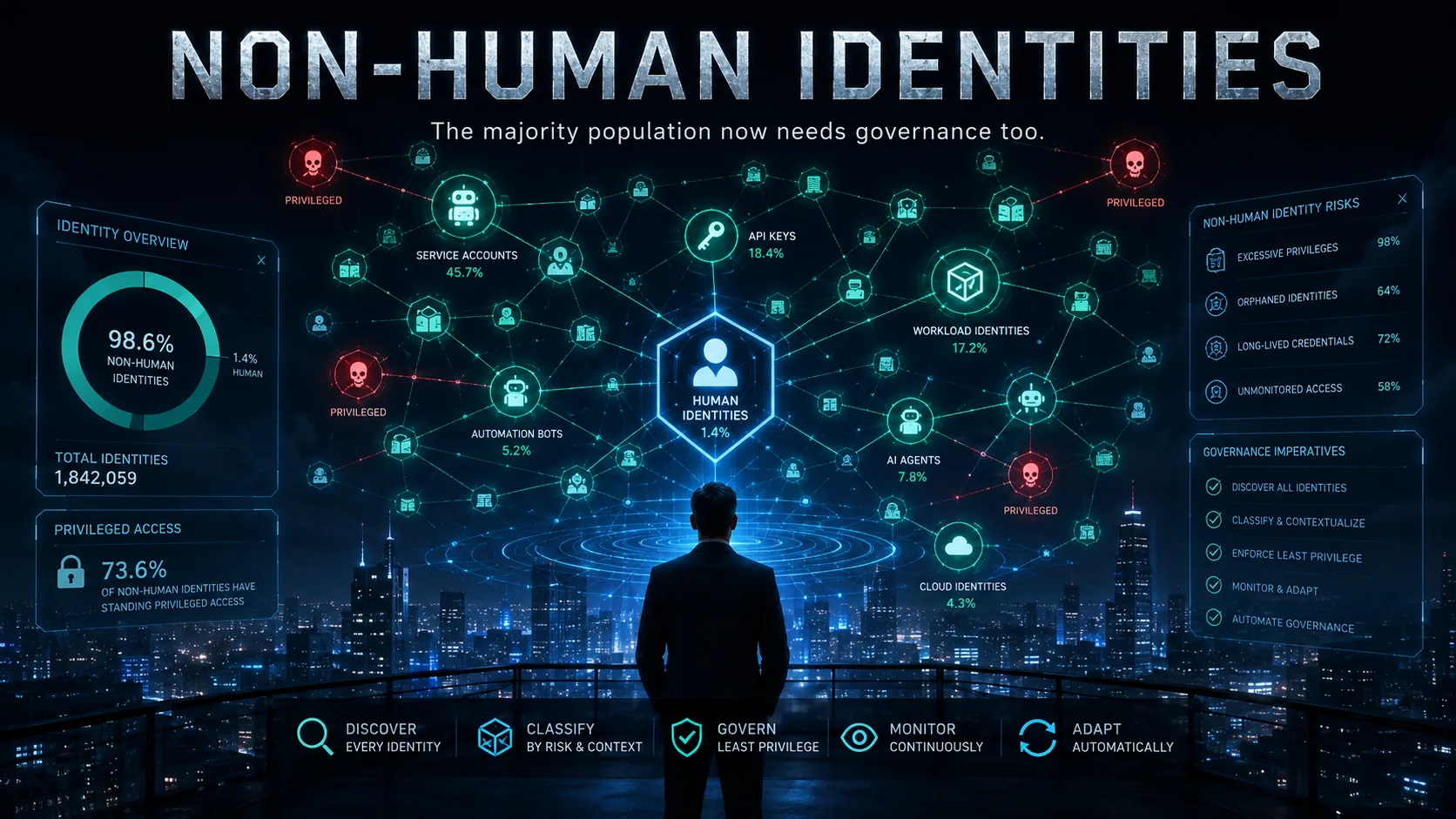 Service accounts, keys, workloads, and AI agents now outnumber people — and none of them has a manager to certify them.
Where access governance programs actually fail
The failure modes are well documented at this point, and almost none of them are platform failures. They are design failures.
Rubber-stamping is the big one, and it is architectural. Here is the mechanism. A quarterly certification launches. Each manager receives hundreds of line items — raw entitlement strings like SAP_FI_AP_CLERK_03, no description, no usage data, no risk indication. Investigating one line properly takes minutes the manager does not have; the campaign deadline is enforced; approve-all is one click away. By week two, attestation fatigue has set in and the approvals are flowing without cognition. The campaign completes at 98%, the compliance dashboard turns green, and precisely nothing about the organization's risk posture has changed. The certification exists; the verification never happened.
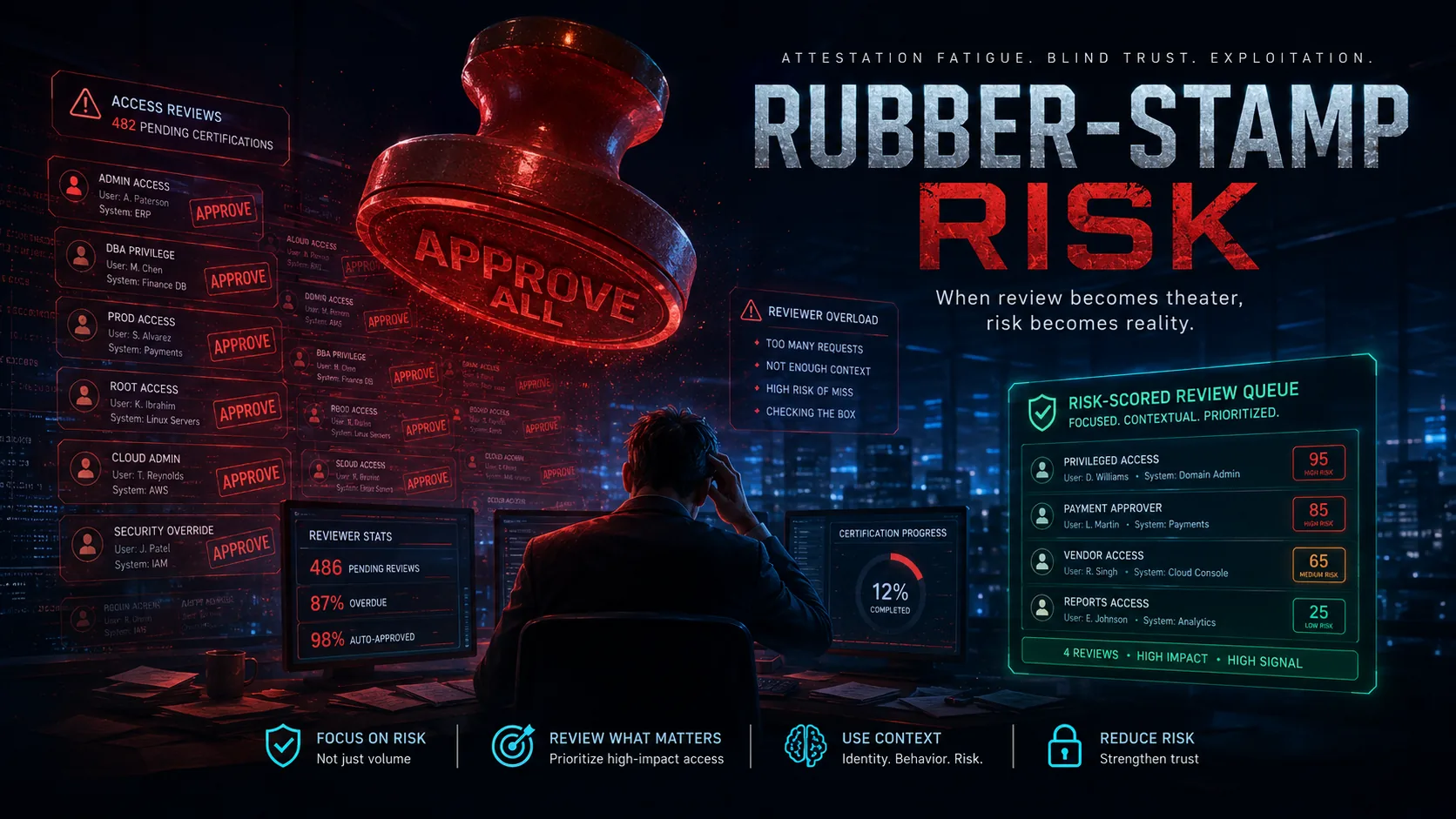 The rubber stamp is not a manager problem — it is a queue-design problem. Shrink the queue, add context, score the risk, and decisions come back.
The fix is not exhorting managers to try harder. It is redesigning the queue: risk-score every line item, auto-certify the low-risk repeat approvals with evidence of the automation logic, surface usage data ("last exercised 11 months ago") next to each remaining line, and hand the reviewer a short prioritized queue that fits inside ten minutes. Reviewers make real decisions when the architecture makes real decisions possible. This is also where AI has earned a legitimate place in the loop — pattern-baselining, outlier detection, and auto-certification of the routine tail — covered in depth in our piece on AI access certification campaigns.
Visibility gaps quietly exempt the riskiest systems. Governance coverage follows connector coverage, and connector coverage follows convenience. The directory-integrated apps get governed; the legacy finance platform with no API abides in a spreadsheet; the acquired subsidiary's stack stays dark for two years. The systems hardest to connect are frequently the ones holding the most sensitive data, which means effort and risk are inversely allocated by default. An honest program tracks its own coverage as a first-class metric and treats "ungoverned system" as a finding, not a footnote.
Standing access accumulates faster than reviews can retire it. Quarterly certification is a garbage-collection pass over a heap that grows daily. Mover events are the worst offender — access from the old role persists alongside the new role's grants, and each move ratchets effective privilege upward. Two structural mitigations outperform any review-frequency increase: wiring governance to lifecycle events so a role change triggers a targeted review of the delta immediately, and shrinking the standing-access pool itself through just-in-time access and zero standing privilege patterns, so there is simply less durable access to certify.
UX friction breeds shadow paths. When the governed route to access takes two weeks of ticket ping-pong, users route around it — a Slack DM to an admin, a shared credential, a personal-tier SaaS subscription. Every workaround is access that exists outside the governance perimeter. The uncomfortable implication for security teams: the self-service request experience is a security control. If the governed path is not the easiest path, the governance perimeter is a suggestion.
A four-phase roadmap that survives contact with reality
The programs that stick sequence the work in roughly this order. The programs that stall usually inverted it.
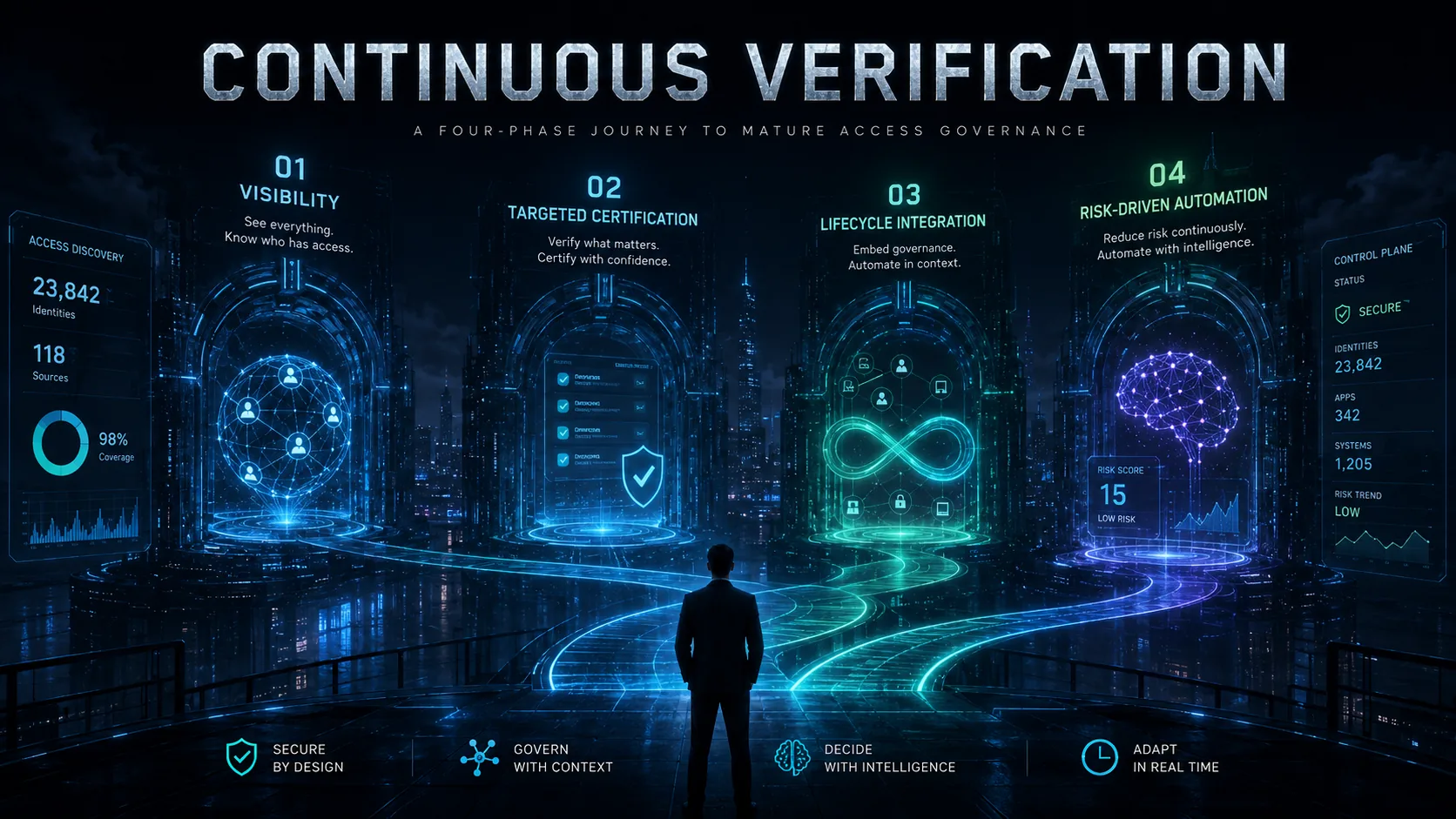 Visibility first, certification second, lifecycle third, automation last. The phases that stall are the ones run in reverse.
Phase 1 — Visibility (first quarter). Build the identity-and-entitlement inventory across the systems that matter most: identify every account, map it to an owner or flag it orphaned, catalog entitlements in human-readable terms. Expect immediate findings — orphaned accounts and forgotten admin grants surface in essentially every first inventory — and harvest them as early wins. Do not launch certifications yet; certifying an inventory you do not trust produces attestations you cannot defend.
Phase 2 — Targeted certification (second quarter). Pick one or two high-stakes scopes — SOX-relevant financial systems, production infrastructure — and run a narrow, well-engineered review: risk-scored queues, usage context, named reviewers, tracked revocations. A small certification that produces real revocations teaches the organization what governance is for. A broad shallow one teaches everyone it is theater.
Phase 3 — Lifecycle integration (second and third quarters). Wire governance to joiner-mover-leaver events so the mover's access delta gets reviewed at move time and the leaver's access dies at termination, not at the next quarterly pass. This is the phase where governance stops being purely detective and starts being preventive.
Phase 4 — Risk-driven automation (ongoing). Layer in risk scoring across the whole estate, auto-certification for the low-risk tail, anomaly detection for outlier grants, and event-triggered micro-reviews. Mature state: continuous, mostly automated verification with human judgment concentrated on the ambiguous and the dangerous — and audit evidence generated as a byproduct of operations instead of a quarterly scramble.
What Avatier ships toward this pattern
Avatier's position on all of the above is opinionated in one specific direction: governance programs fail on friction, so the reviewer and requester experience is an engineering problem, not an afterthought. Avatier Identity Anywhere ships the governance and operational layers together — unified visibility across cloud and on-premises systems, certification campaigns built around short risk-scored contextual queues rather than line-item dumps, self-service access requests with policy and SoD checks enforced at request time, and lifecycle automation that turns mover and leaver events into immediate governance actions. AI-assisted access intelligence handles peer-group baselining and the auto-certification tail, with the decision logic evidenced for audit rather than hidden behind a score.
The compliance posture backing the platform is public at the Avatier Trust Center: SOC 2 Type II audited with zero exceptions noted, ISO/IEC 27001:2022 certified, PCI DSS v4.0.1 compliant, CSA STAR Level 1 attestation, NIST 800-53 Rev. 5 aligned, and a CISA Secure-by-Design Pledge signatory. That posture exists for the same reason this piece recommends evidence-first governance to you: claims are cheap, and audit artifacts are not.
What access governance does not solve
An honest reference ends with the limits, because a governance program sold as a cure-all gets blamed for failures it was never scoped to prevent.
Access governance does not authenticate anyone. If credentials are phishable and MFA is weak or absent, an attacker walks in as a legitimate, fully-certified identity and inherits exactly the access your reviews approved. Governance bounds the blast radius; it does not stop the entry.
It does not protect against endpoint compromise or session hijacking — malware operating inside an authenticated session holds whatever the session holds, however recently certified.
It does not replace data-layer controls. Governance decides who may open the door; encryption, DLP, and monitoring govern what happens to the data after the door opens.
It cannot fix a broken identity data foundation. If HR data is wrong, ownership mappings are stale, and the entitlement catalog is gibberish, governance automates the auditing of fiction. Data quality is upstream of every control surface in this piece.
And it does not run itself. Every certification is a claim by a named human or an evidenced automation that specific access was verified. Tooling can make those claims cheap to produce honestly — it cannot make them true.
That is the discipline: see everything, decide deliberately, act on the decisions, keep the evidence. Enterprises that run that loop continuously make credential misuse expensive and audits boring. Those are the two best outcomes access governance has to offer, and in 2026 they are worth more than ever.
ABOUT THE AUTHOR

More from IAM & Identity Governance

Identity Management and Digital Transformation in 2026
Every major transformation initiative — cloud migration, remote and hybrid work, mergers and acquisitions — eventually stalls on the same question: who gets access to what, and who decided? The 2026 strategy reference on identity management as the enabler and the bottleneck of digital transformation, the business case executives actually fund, and what modernization does not fix.

AI and Behavioral Analytics for Identity Monitoring: The 2026 Enterprise Reference
Static identity rules catch the attacks that announce themselves. They miss the ones that log in with valid credentials and behave almost normally. The 2026 reference on AI-driven identity monitoring — what behavioral analytics actually detects, the four telemetry sources that make or break the model, the false-positive economics nobody budgets for, and the honest limits of anomaly detection at enterprise scale.

Security Team Collaboration: A 2026 Framework for Identity Programs
Identity governance fails when it runs as a security-team-only initiative. The 2026 framework for cross-functional collaboration: four stakeholder groups, three coordination models, and how zero trust makes it a shared discipline.