PIM vs PAM vs PUM: Privileged Access Defined for 2026
PIM, PAM, and PUM get used interchangeably and mean three different things. PIM manages who holds privileged identity and which roles carry it. PAM controls how privilege is exercised through vaulting, session control, and just-in-time elevation. PUM manages the shared privileged accounts nobody personally owns. The 2026 reference on distinguishing the three terms, where they overlap, and where to start.
PIM, PAM, and PUM get used interchangeably and mean three different things. PIM manages who holds privileged identity and which roles carry it. PAM controls how privilege is exercised through vaulting, session control, and just-in-time elevation. PUM manages the shared privileged accounts nobody personally owns. The 2026 reference on distinguishing the three terms, where they overlap, and where to start.
- PIM (Privileged Identity Management) governs who holds privileged identity and which roles carry elevated entitlement — it is identity-centric and lives at the governance and lifecycle layer, deciding who should be able to elevate at all.
- PAM (Privileged Access Management) controls how privilege is actually exercised — vaulting credentials so users never hold them, brokering and recording sessions, and granting just-in-time elevation at the moment of use rather than as standing entitlement.
- PUM (Privileged User Management) is the narrower discipline of managing shared privileged accounts — root, Administrator, service and break-glass logins that no single person owns — so that use of a shared credential still maps back to a named human.
- The three overlap in the middle on least privilege, audit evidence, and access certification, but they apply different controls at different depths; using one to do another's job is why privileged programs underperform.
- Where to start depends on the failing symptom: too many standing admin roles points at PIM, exposed secrets and unrecorded root sessions point at PAM, and an audit that cannot attribute shared-account actions points at PUM — most mature programs end up running all three with explicit integration.
PIM and PAM sound interchangeable and are not. Privileged Identity Management (PIM) governs who holds privileged identity and which roles carry elevated entitlement — it is the identity-centric, governance-layer discipline that decides who should be able to elevate at all. Privileged Access Management (PAM) governs how that privilege is exercised once someone is entitled to it — vaulting credentials so users never hold them, brokering and recording sessions, and granting elevation just-in-time. A third term, Privileged User Management (PUM), names the narrower problem of managing shared privileged accounts — root, Administrator, service and break-glass logins that no one personally owns — so their use still maps back to a named human. Three acronyms, three disciplines, one privileged surface viewed from three angles.
This piece is the 2026 update of Avatier's original comparison, Privileged Identity Management Differences, published August 2025. That piece framed the question as a two-way PIM-versus-PAM choice and leaned on a handful of vendor-attributed incident numbers to make the case. This update drops the borrowed statistics, adds the third term that the original left out, and reframes the whole thing away from "pick one" toward the disambiguation that actually matters — knowing which discipline you are talking about, where they overlap, and which one your specific failure mode points at. For the runtime mechanics of PAM in depth, the companion reference is Privileged Access Management for Enterprise; this piece stays on the definitions and the boundaries between the three terms.
Why the terms blur in the first place
The confusion is not accidental. All three acronyms describe controls over the same small population of high-impact identities, they all produce overlapping audit evidence, and vendors market across the boundaries because most platforms genuinely span more than one discipline. A PAM vendor will describe shared-account check-out (PUM territory) and role-based entitlement review (PIM territory) as features of its PAM product, because they are. A governance vendor will describe privileged certification as PIM even though the accounts being certified are governed at runtime by PAM. The result is that a practitioner can read three vendor data sheets and come away with three incompatible definitions of the same three-letter word.
The way out is to stop defining the terms by which vendor sells them and start defining them by the question each one answers. PIM answers who should hold privilege — an identity and governance question resolved at provisioning time. PAM answers what controls apply when privilege is exercised — an access and enforcement question resolved at runtime. PUM answers how does a shared account stay accountable — an attribution question that shows up wherever a credential is used by more than one person. Those three questions do not collapse into each other. A program can answer the first perfectly and still fail the second, or answer both for individually-owned accounts and still fail the third for the shared root password.
That framing also explains why "just deploy PAM" is not a complete answer even though PAM is the most heavily marketed of the three. A vault that rotates the production root password does nothing about the fifty standing domain-admin roles that were provisioned years ago and never certified — that is a PIM gap the vault cannot see. Conversely, a pristine certification program that re-attests every privileged role quarterly does nothing to record what a database administrator actually types during a production session — that is a PAM gap certification cannot close. The three disciplines are complementary layers, not competing products, and the first step in any privileged program is knowing which layer a given problem lives in.
PIM, PAM, and PUM defined side by side
The cleanest way to hold the three terms apart is to fix each one to its governing question and its layer, then never let the vendor marketing move them.
PIM — who holds privilege. Privileged Identity Management is identity-centric and lives at the governance and lifecycle layer. Its unit of work is the privileged role and the identity that holds it. PIM decides which roles carry elevated entitlement, assigns those roles from an authoritative HR source through joiner-mover-leaver workflows, re-attests them through periodic access certification, and revokes them at role change or offboarding. PIM's central artifact is the standing state of privilege — the map of who can elevate and what roles grant it. When that map is wrong (too many permanent admin roles, orphaned accounts, entitlements that outlived the job that needed them), PIM is the discipline that is failing.
PAM — how privilege is controlled. Privileged Access Management is access-centric and lives at the runtime enforcement layer. Its unit of work is the privileged session and the credential used in it. PAM vaults privileged credentials so users never hold them directly, brokers sessions through a proxy that injects credentials and enforces policy, records what happens for forensics and audit, and grants just-in-time elevation scoped to a single operation instead of a standing role. PAM assumes the who has been answered upstream and concentrates entirely on containing the blast radius while privilege is actually in use.
PUM — shared privileged accounts. Privileged User Management is the narrower discipline of managing accounts that grant elevated authority but that no single person owns — root, local Administrator, database sysadmin, service accounts, break-glass logins. Its central problem is attribution: when several people know the same shared password, the audit log cannot say which human acted. PUM addresses that with check-out workflows, per-use credential rotation, and session mediation so every use of a shared account resolves to a named individual. In practice most PAM platforms include PUM capabilities, which is why the terms are often merged — but PUM names a specific accountability problem that is worth keeping distinct.
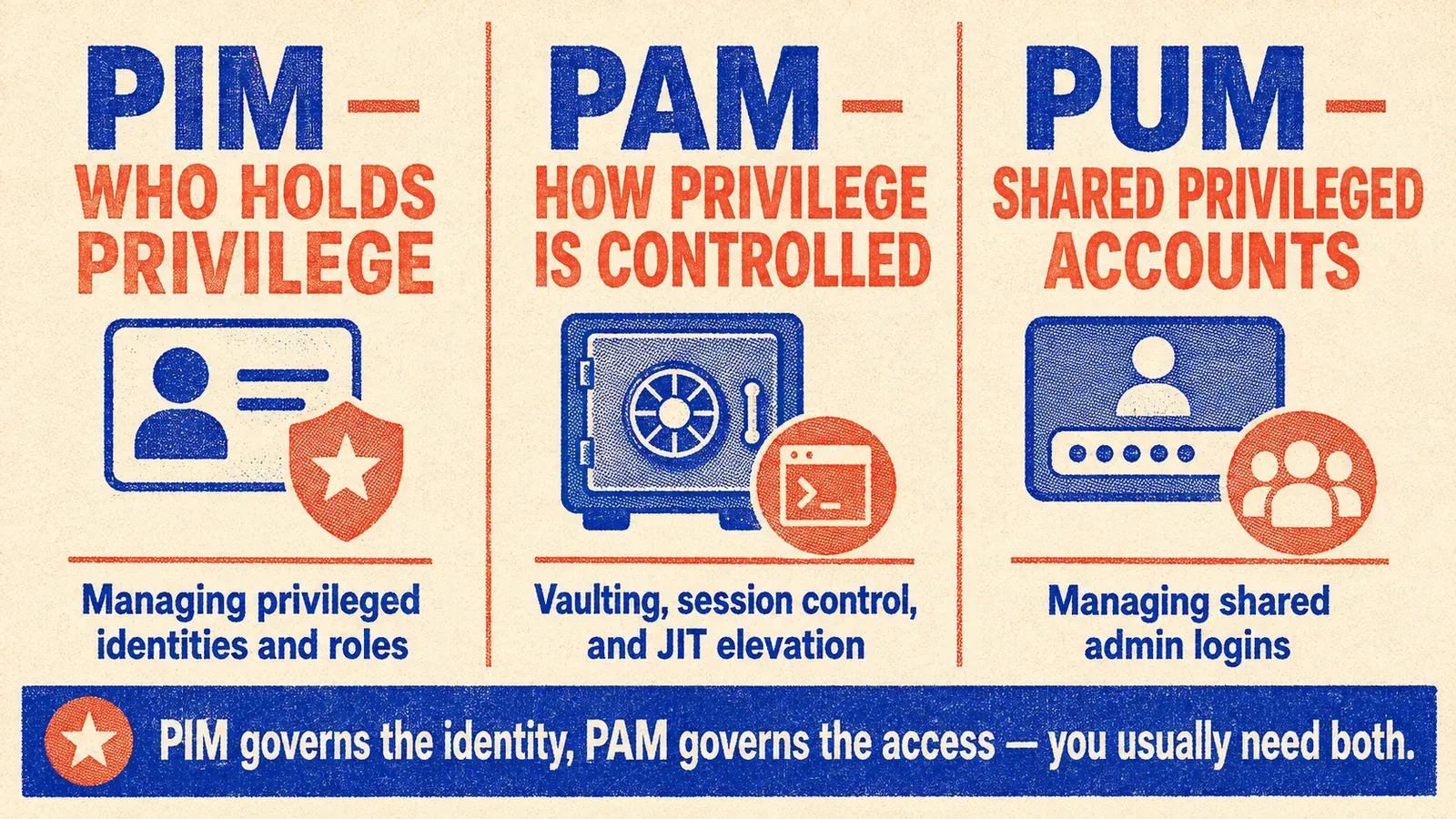 Three disciplines, three questions: PIM governs who holds privilege, PAM governs how it is exercised, PUM governs the shared accounts nobody personally owns.
Held to those definitions, the terms stop competing. PIM is a governance discipline expressed in roles and certifications. PAM is an enforcement discipline expressed in vaults and sessions. PUM is an accountability discipline expressed in check-out and rotation of shared credentials. A given product may implement one, two, or all three, but the disciplines themselves are distinct and a mature program can name which one it is investing in at any moment.
Where PIM and PAM overlap
The three disciplines are distinct but not disjoint. They share a common core, and the overlap is exactly where the terms feel most interchangeable — which is also where using one to do another's job does the least visible damage until an audit exposes the gap.
The shared middle is built from three things both PIM and PAM depend on. Least privilege is a goal both disciplines pursue from opposite directions: PIM minimizes standing entitlement by pruning roles nobody uses, PAM minimizes it by granting privilege just-in-time so there is nothing standing to prune. Audit evidence is produced by both: PIM contributes the record of who was entitled to what and who attested it, PAM contributes the record of what was actually done in each session, and a compliance reviewer needs both halves to reconstruct a privileged action end to end. Access certification sits across the boundary too: the certification re-attests privileged roles (a PIM artifact) but increasingly incorporates runtime usage signals from PAM — a privileged role that has not been exercised in ninety days is a certification finding that only exists because the PAM layer reported the non-use.
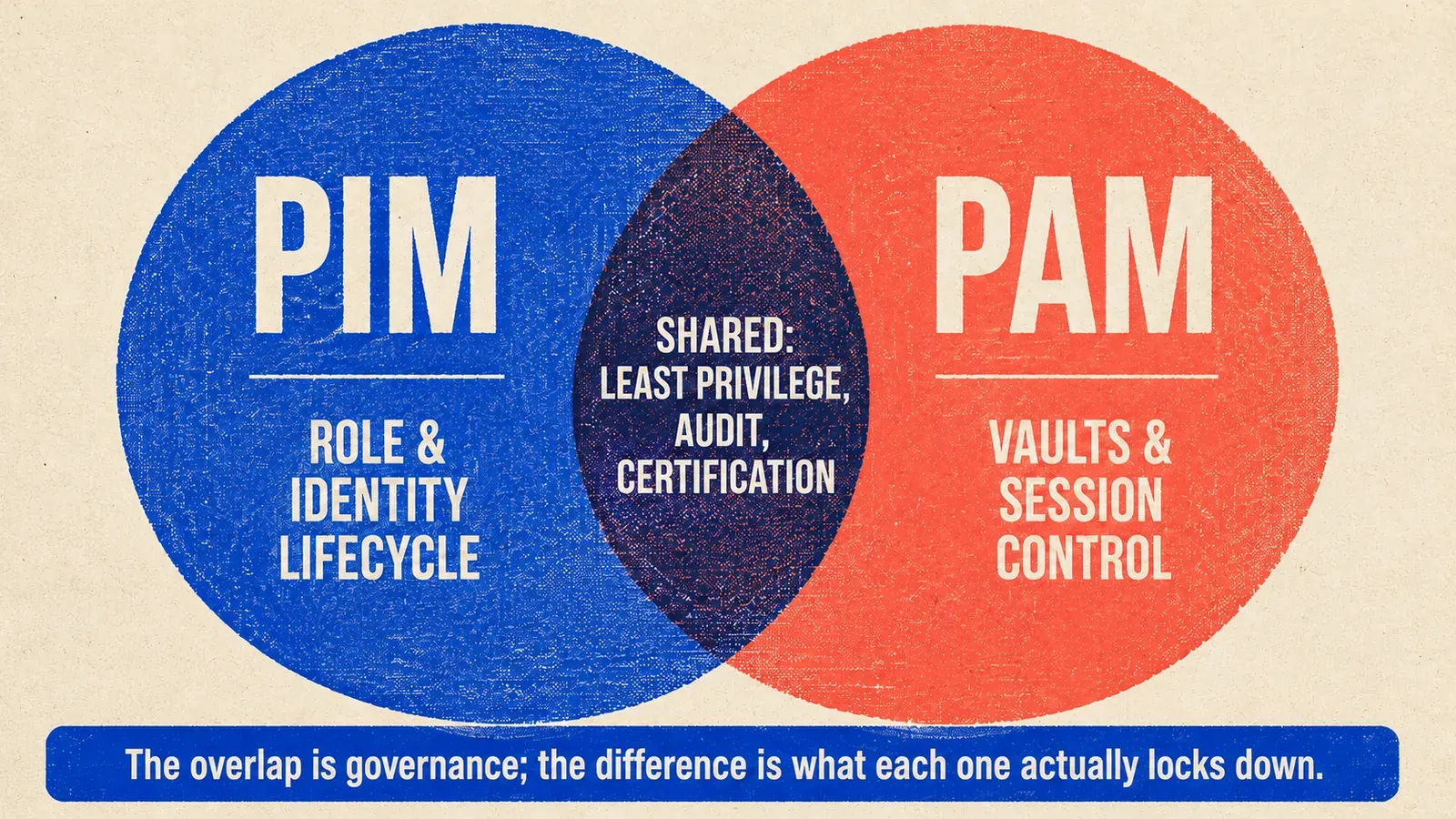 PIM owns role and identity lifecycle, PAM owns vaults and session control, and they meet in the middle on least privilege, audit, and certification — the shared controls that make each layer's work provable.
Outside that shared core, the exclusive territories are what keep the disciplines from collapsing into one. PIM's exclusive side is role and identity lifecycle — defining privileged roles, assigning them from an authoritative source, and revoking them cleanly when someone moves or leaves. That is provisioning-time governance work the PAM layer is not built to do; a vault has no concept of an HR-driven leaver event pruning a role. PAM's exclusive side is vaulting and session control — the runtime machinery that holds credentials away from users and mediates live sessions. That is enforcement work the PIM layer is not built to do; a certification workflow has no way to inject a credential into an SSH session or record the commands typed in it.
The failure pattern is trying to stretch one discipline across the whole surface. Organizations that treat PIM as sufficient end up with beautifully certified roles whose credentials are still sitting in plaintext config files, because the governance layer never touched runtime. Organizations that treat PAM as sufficient end up with well-vaulted credentials attached to a sprawl of standing roles nobody ever reviews, because the vault never touched governance. The overlap is genuine, but it is a reason to integrate the layers deliberately — not a license to skip one.
Which do you start with
Because the three disciplines are complementary rather than sequential, there is no universally correct order to adopt them. The productive question is not "PIM or PAM first" in the abstract but "which discipline does our current failing symptom point at." Start there, get value, and extend into the others.
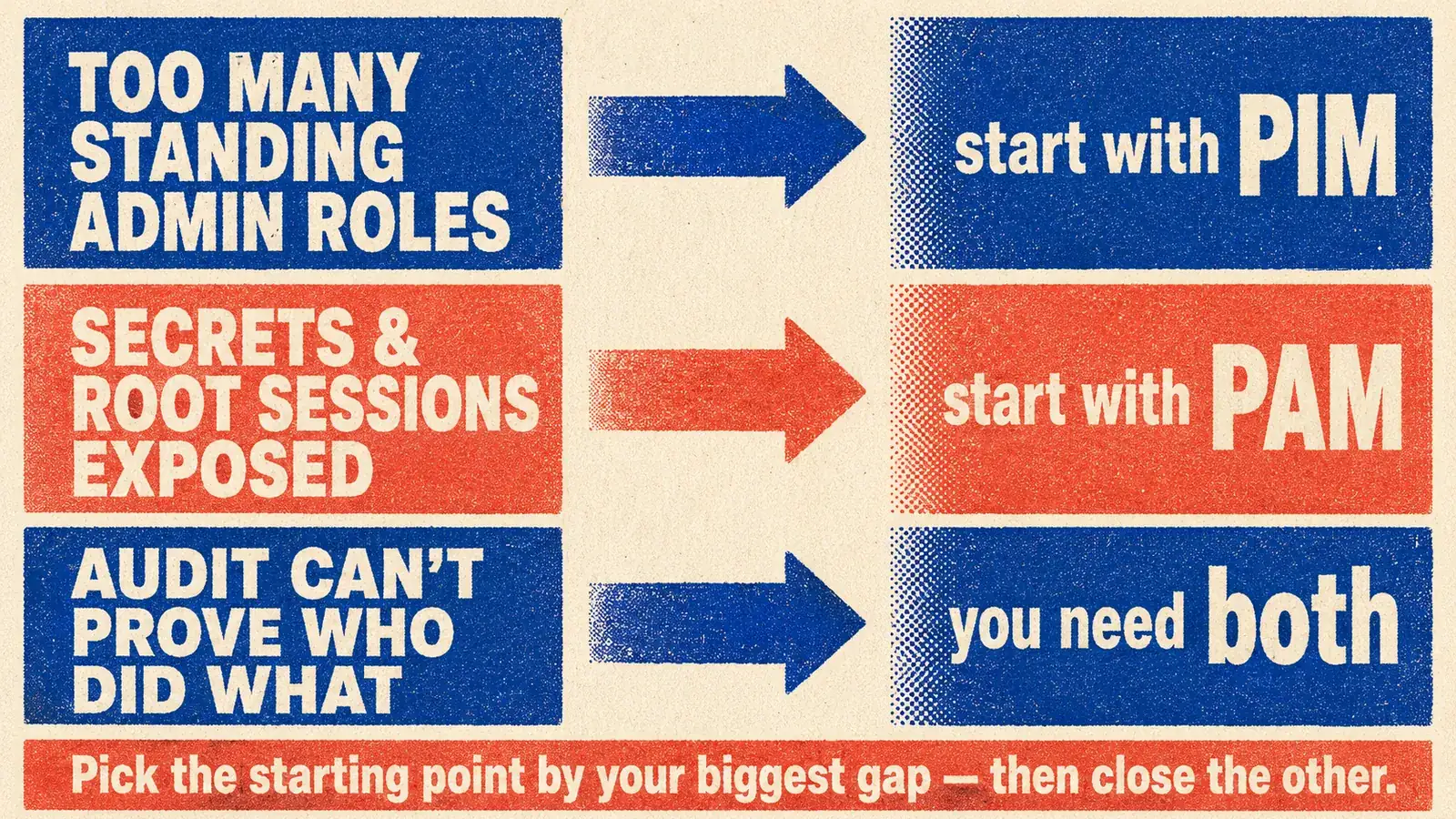 Let the failing symptom choose the entry point: standing-role sprawl points at PIM, exposed secrets and unrecorded sessions point at PAM, and unattributable audit trails mean you need both layers working together.
Too many standing admin roles → start with PIM. If the recurring problem is that permanent admin entitlements have accumulated, that certifications cannot keep up with role changes, or that offboarded people still hold privileged roles weeks later, the governance layer is what is failing. Starting with PIM means getting privileged role assignment onto an authoritative HR-driven lifecycle, standing up privileged certification with real approvers, and pruning the standing entitlement surface. This is the common entry point for governance-led and audit-driven organizations, and it is covered in depth in the principle of least privilege reference and the role-based access control reference.
Secrets and root sessions exposed → start with PAM. If the recurring problem is privileged credentials sitting in configuration files or scripts, root and database sessions that nobody records, or shared admin passwords that never rotate, the runtime enforcement layer is what is failing. Starting with PAM means vaulting the credentials, brokering and recording the sessions, and moving the highest-impact operations onto just-in-time elevation. This is the common entry point for breach-driven organizations and for cloud-heavy estates where secrets sprawl is the dominant risk — the cloud infrastructure PAM reference covers that surface specifically.
Audit cannot prove who did what → you need both. If the specific failure is that an auditor asks who performed a privileged action and the honest answer is "we cannot tell," the gap usually spans both layers. The governance layer has to establish who was entitled to the role, and the access layer has to record which human, through which session, actually used it — and when the account in question is shared, the PUM slice of the problem is what closes attribution. Break-glass and emergency accounts are the sharpest version of this, where a rarely-used shared credential has to stay both available and fully accountable; the break-glass emergency access reference covers that pattern in detail.
The honest planning answer is that most mature programs run all three, integrated. The symptom-driven entry point is about sequencing the investment, not about picking a permanent home. An organization that starts with PIM will hit a wall the first time an auditor asks what a privileged user actually did in a session; an organization that starts with PAM will hit a wall the first time it tries to reason about who should hold the roles the vault protects. Each discipline exposes the need for the next.
How the three integrate
The disciplines are worth keeping distinct in definition precisely so they can be integrated cleanly in practice. Integration runs in both directions across the PIM-PAM boundary, and PUM sits inside that flow wherever shared accounts appear.
Downstream, the governance layer drives the access layer. A joiner event from the authoritative HR source creates a privileged identity and, through PIM lifecycle workflows, provisions the corresponding privileged account into the PAM vault; a mover event updates it; a leaver event revokes it. The role assignment PIM governs is what tells PAM which accounts should exist in the first place. Without that link, the vault becomes its own island of privileged accounts that drift out of sync with the workforce — vaulted, rotated, and completely disconnected from whether the person behind the account still works there.
Upstream, the access layer feeds the governance layer. PAM's runtime signal — which privileged accounts were actually used, how often, and for what — flows back into PIM's certification cycle so that re-attestation is grounded in real usage rather than guesswork. A privileged role that has sat unused for a quarter is a certification finding that only exists because the runtime layer reported the silence. That feedback loop is what turns certification from a rubber-stamp into a genuine control.
PUM lives inside this integration wherever accounts are shared. A break-glass account is provisioned and governed as a PIM artifact (who is entitled to invoke it), controlled as a PAM artifact (check-out, session recording, rotation after use), and made accountable as a PUM concern (the shared credential's use resolving to a named human). The three disciplines are not three products stapled together; they are three views of one governed privileged surface, and the integration between them is what makes the surface both usable and provable.
What Avatier ships toward this pattern
Avatier Identity Anywhere occupies the governance and lifecycle layer — the PIM side of this picture — and integrates with the dedicated PAM platforms enterprises already run rather than competing with them. The design assumption is that vaulting, session brokering, and session recording are best handled by purpose-built PAM platforms, and that the highest-leverage thing a governance platform can add is a clean, HR-driven lifecycle and certification layer wrapped around them.
Lifecycle Management drives privileged role assignment from an authoritative HR source through joiner-mover-leaver workflows, so the standing state of privilege stays aligned with the actual workforce. Those same workflows provision and deprovision privileged accounts into the PAM vault through standard interfaces, keeping the vault's account population in sync with who is entitled to it. Access certification treats privileged accounts as a first-class category — more frequent review, stricter approvers, and explicit out-of-band verification on the highest-risk decisions — and consumes runtime usage signal so certification reflects what privileged accounts are actually doing.
For shared and mainframe privileged accounts, where general-purpose platforms tend to have weak coverage, native connectors bring those accounts under the same lifecycle as modern-stack privileged identities — the PUM slice governed with the same ground truth as everything else. Recovery flows run through workflow-verified resets so the recovery channel itself cannot be socially engineered, which matters more for privileged accounts than for any others because a compromised privileged recovery flow is among the highest-impact attacks there is. Authentication into the platform is FIDO2-compatible, and the full compliance posture — SOC 2 Type II with zero exceptions, ISO/IEC 27001:2022 certification, PCI DSS v4.0.1 compliance, CSA STAR Level 1, NIST 800-53 Rev. 5 alignment, FedRAMP-aligned controls, and the CISA Secure-by-Design Pledge — is published at the Avatier Trust Center.
What the PIM/PAM/PUM distinction does not solve
Naming the three disciplines correctly is a prerequisite for a coherent privileged program, but it is not the program itself, and it is worth being honest about what the distinction leaves untouched. Knowing that a vault is PAM and a certification is PIM tells you nothing about whether either is configured well, staffed adequately, or actually used by the people it governs.
The distinction does not solve discovery. All three disciplines assume you know what privileged accounts and roles exist, and in most enterprises the hardest part is finding them — the service accounts scattered across config files, the local admin accounts on forgotten servers, the standing roles granted for a project that ended two years ago. A perfectly clear mental model of PIM versus PAM does not inventory a single one of them; discovery is its own sustained effort that precedes governance.
The distinction does not solve operational discipline. A just-in-time elevation workflow that everyone routes around because the approval takes too long provides no protection, no matter how correctly it is categorized as PAM. A certification that approvers click through without reading re-attests nothing, no matter how properly it belongs to PIM. The disciplines describe controls; whether those controls are honored is a matter of operational culture the acronyms cannot enforce.
And the distinction does not solve the human recovery and social-engineering vector that defeats privileged accounts as readily as ordinary ones. A privileged identity governed by flawless PIM, exercised through flawless PAM, tied to a fully accountable shared account under flawless PUM, still falls if an attacker can talk a help desk into resetting its recovery channel. The workflow-verified recovery pattern addresses that, but it is a separate control that none of the three P-words implies on its own. The value of getting PIM, PAM, and PUM straight is that it lets you reason clearly about where each of these remaining problems lives — not that it makes any of them go away.
ABOUT THE AUTHOR

More from Access Management

DNS as Identity Infrastructure: A 2026 Reference
DNS resolution, DNSSEC integrity, and DNS poisoning as a credential-harvesting vector — the 2026 reference on treating DNS as identity infrastructure, not network plumbing.

Password Hash Synchronization in 2026: Hybrid AD to Entra ID
Password hash synchronization keeps on-prem Active Directory and Microsoft Entra ID authoritative together — how the sync cycle works, its security tradeoffs, and where it fits against federation.

Cloud Infrastructure PAM: Vaulting and Sessions in 2026
Cloud infrastructure PAM controls privileged sessions into AWS, Azure, and GCP — vaulting root credentials and enforcing just-in-time elevation instead of standing admin roles.