CIA Triad Security Costs: A 2026 Risk Framework
The CIA triad — confidentiality, integrity, availability — is a practical cost framework for identity programs, not just theory. Here's what neglecting each pillar actually costs.

The CIA triad — confidentiality, integrity, availability — is a practical cost framework for identity programs, not just theory. Here's what neglecting each pillar actually costs.
- The CIA triad — confidentiality, integrity, availability — works best as a cost-allocation framework for identity programs, not a security-101 slide. Each pillar has a distinct failure mode, a distinct cost profile, and a distinct set of identity controls that address it, and conflating them produces gaps that look covered but aren't.
- Confidentiality failures are access-control failures at their root — over-broad entitlements, stale accounts, and unencrypted data at rest — and the cost lands in three places at once: regulatory exposure, trust erosion, and the forensic cost of scoping what was actually exposed.
- Integrity failures are disproportionately expensive relative to the size of the change, because a single unverified or corrupted record forces a re-audit of everything downstream of it; the fix is change control and immutable, tamper-evident logging, not detection alone.
- Availability failures in an identity program are structurally different from an application outage — when the identity provider or directory goes down, it takes every dependent system down with it simultaneously, and the cost accrues per minute across all of them at once rather than sequentially.
- The three pillars compound rather than stay isolated: a confidentiality gap that goes undetected becomes an integrity problem once the exposed access is used to alter data, and an integrity incident under investigation often forces an availability trade-off (systems taken offline to preserve evidence) — which is why identity governance has to address all three together, not one at a time.
The CIA triad — confidentiality, integrity, availability — costs an identity program real money when it's neglected, and the cost profile is different for each pillar. Confidentiality failures cost through regulatory exposure and forensic scoping. Integrity failures cost through re-audit burden disproportionate to the size of the change. Availability failures cost through concurrent, per-minute disruption across every system that depends on the identity layer. Treating the triad as a security-fundamentals slide rather than a working risk framework is exactly how identity programs end up with a gap that looks covered on paper — an entitlement review that never checks write-access controls, a disaster-recovery plan that never accounts for the identity provider itself going down — but isn't actually closed.
This is the 2026 update of our original piece on the costs of ignoring the CIA triad. The original leaned on a widely-cited industry breach-cost figure and a widely-cited downtime-cost-per-minute figure to make its case, alongside a specific incident-response improvement statistic attributed to an unnamed customer deployment. This version drops those borrowed and unverifiable numbers and stays with what's actually defensible: the mechanics of how each pillar fails in an identity program, what those failures cost directionally, and which controls address each one.
What the CIA triad actually governs in an identity program
The triad is old enough — it predates modern IAM by decades — that it's easy to treat as background theory rather than a live design constraint. That's a mistake for identity programs specifically, because identity is the control plane that implements all three properties simultaneously. Every access decision an identity platform makes is, at bottom, a confidentiality decision (should this identity see this resource), an integrity decision (is the record of that decision trustworthy and unalterable after the fact), or an availability decision (can the authorized identity actually reach the resource when they need to).
The reason this framing matters operationally is that identity programs frequently over-invest in one pillar while leaving the other two exposed. A program with a mature least-privilege model (confidentiality) can still have no immutable logging of entitlement changes (integrity gap) and no failover identity provider (availability gap). Auditors and incident post-mortems consistently find that the pillar nobody was actively managing is the one that produced the finding — not the pillar the security team spent the most budget on. Using the triad as an explicit checklist, rather than an implicit assumption that "security" covers all three, is what closes that gap.
The cost of confidentiality failures: data exposure
Confidentiality is the property most people mean when they say "security" — restricting access to sensitive data and systems to those who are actually authorized to have it. In an identity program, confidentiality failures trace back to access-control design almost every time: entitlements granted more broadly than the job function requires, accounts that retained access after a role change or departure, and data left unencrypted at rest where an over-provisioned account could reach it directly.
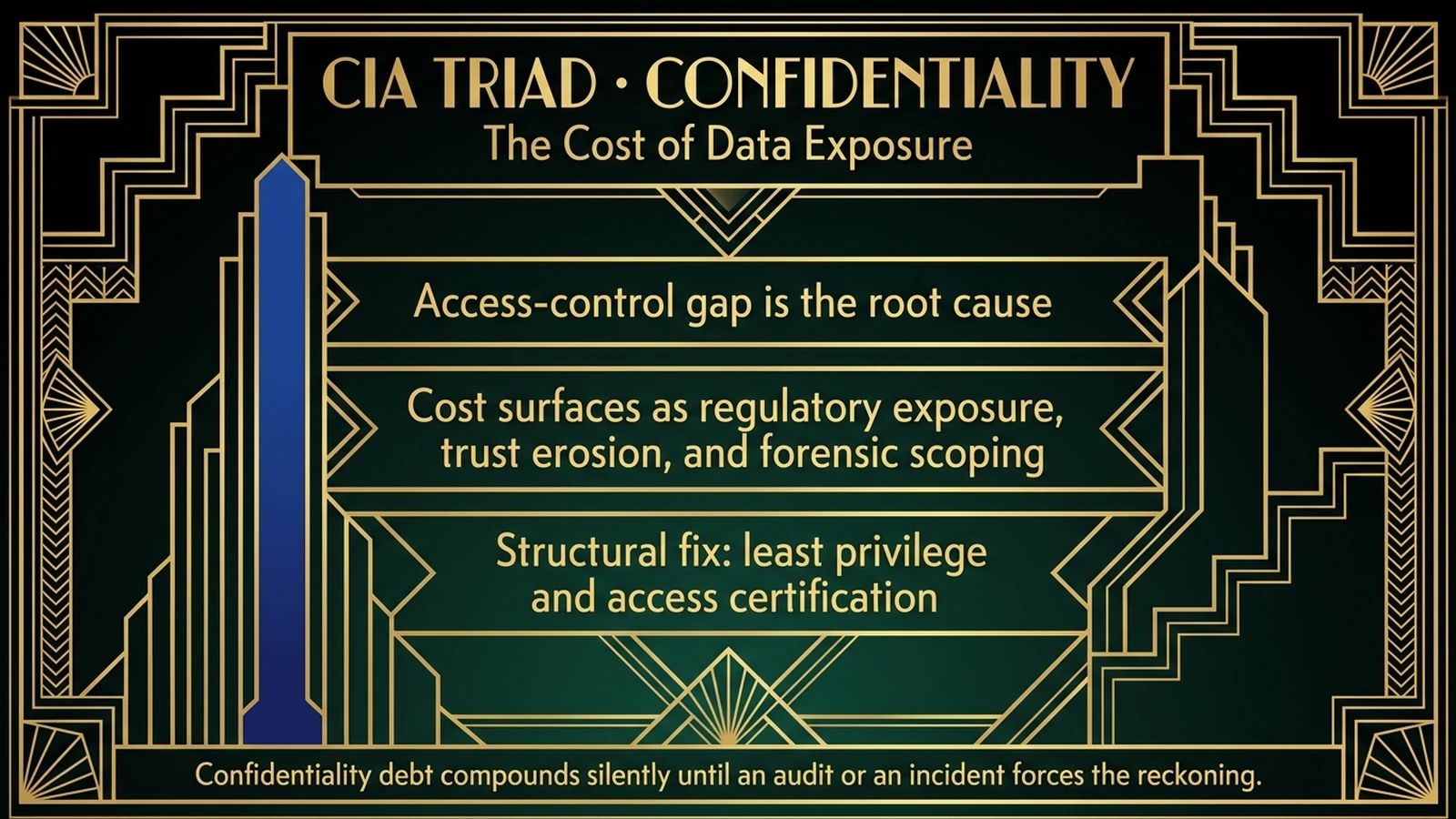 Confidentiality failures are access-control failures first — the cost shows up in regulatory exposure, trust erosion, and the forensic cost of scoping exactly what was exposed.
The cost doesn't show up in one place. It shows up in three simultaneously. Regulatory exposure is the most direct: HIPAA, GDPR-adjacent frameworks, PCI DSS, and sector-specific regulators all treat unauthorized access to protected data categories as a reportable event with its own penalty structure, independent of whether the data was actually misused. Trust erosion is the least quantifiable and the longest-lasting — a confidentiality incident that becomes public changes how customers, partners, and auditors treat every subsequent security claim the organization makes, for years. And the forensic scoping cost is the one identity programs underestimate most: proving what an over-privileged or compromised account actually accessed, as opposed to what it merely could have accessed, is expensive precisely because weak entitlement hygiene makes the boundary of "actually accessed" hard to establish. A program with clean, current entitlement records can scope an incident in days; a program with entitlement sprawl can take months, and the incident stays open — and costly — the entire time.
The structural fix is not a monitoring tool layered on top of a loose entitlement model. It's the entitlement model itself: least-privilege provisioning as the default, periodic access certification that catches drift before an incident forces the review, and deprovisioning tied to HR events rather than a manual ticket someone might forget to file. Our Hidden Costs of Identity Management piece covers entitlement sprawl and its downstream cost in more depth than fits here.
The cost of integrity failures: data corruption and tampering
Integrity is the property that gets the least explicit attention in most identity programs, largely because it's harder to observe directly than confidentiality. A confidentiality failure produces a clear signal — someone accessed something they shouldn't have. An integrity failure can sit silently for a long time: a record altered by an account with legitimate write access but no legitimate reason to make that specific change, a batch process that silently corrupts a field on every run, or an audit log with a gap in it that nobody notices until they specifically need that window of history.
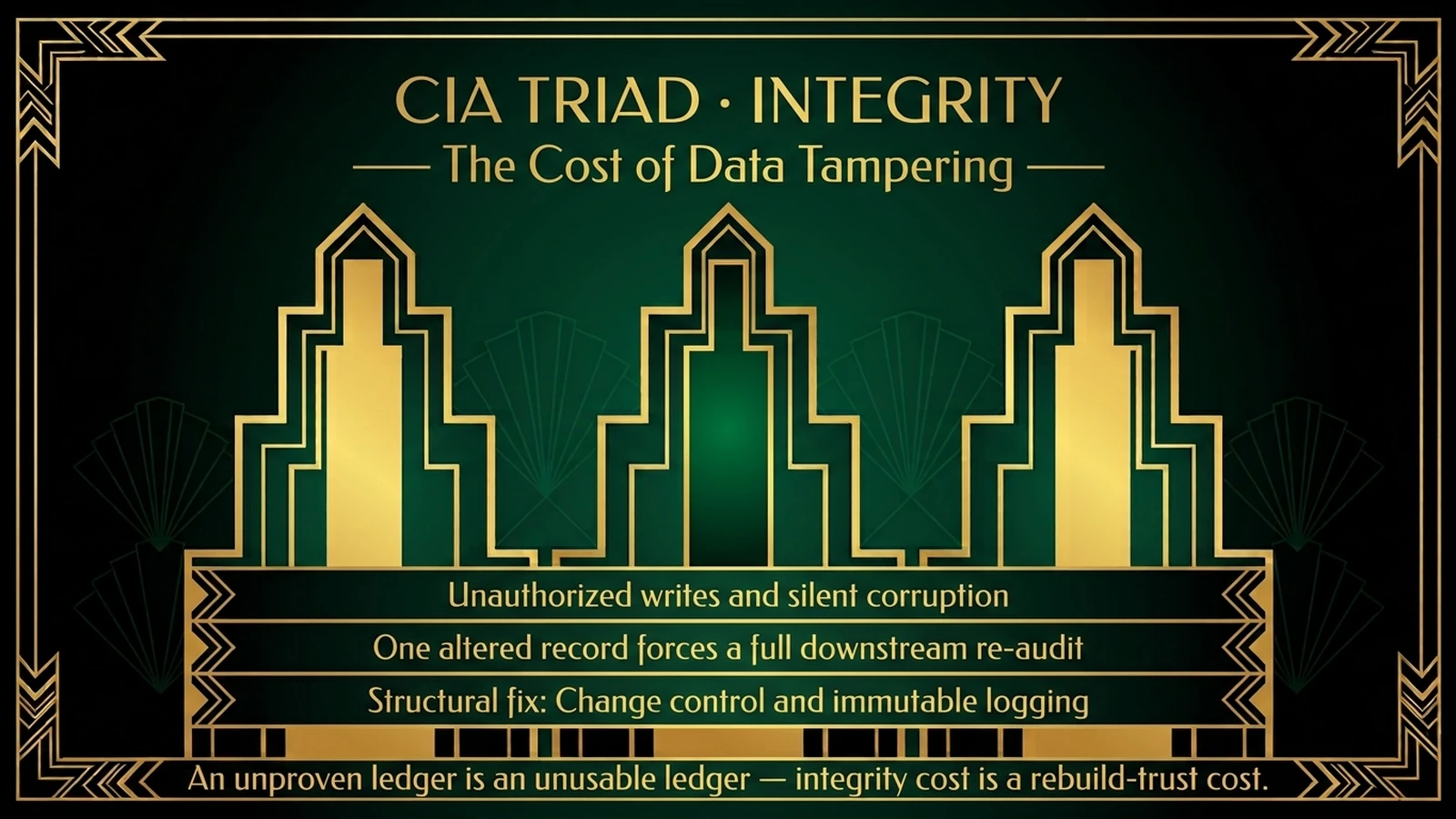 Integrity failures cost disproportionately to their size — a single unverified change can force a re-audit of everything downstream of it, which is what makes the pillar expensive to neglect.
What makes integrity failures expensive is the disproportion between the size of the underlying problem and the size of the cleanup. A single unauthorized or unverifiable change to an access-control record doesn't just require fixing that one record — it requires re-auditing every decision made using that record as input, because once one entry in a chain of trust is unverifiable, every downstream entry inherits that uncertainty. An entitlement database with one tampered row can force a full re-certification cycle across an entire application, because nobody can say with confidence which other rows are also affected. That re-audit burden, not the original change itself, is where the real cost sits.
The structural fix is change control and immutable, tamper-evident logging — not detection layered after the fact, but a design where every entitlement change is recorded in a way that can't be silently altered and where write access to sensitive records is itself restricted and monitored as tightly as read access. This is also where the integrity pillar intersects directly with audit readiness: an auditor who can't independently verify that an access log wasn't altered has to treat every claim in that log as unproven, which turns a routine audit into an adversarial one. Our Access Governance in Modern Identity Security piece covers the governance workflow discipline — approval chains, segregation of duties, certification cycles — that keeps entitlement changes verifiable in the first place.
The cost of availability failures: downtime and access loss
Availability is the pillar that most clearly separates identity-specific risk from generic application risk. When a single business application goes down, the blast radius is that application and whoever depends on it directly. When the identity provider, directory service, or authentication layer goes down, the blast radius is every application and every workflow that authenticates through it — which, in most modern enterprises, is functionally everything. That's a structural difference, not a matter of degree.
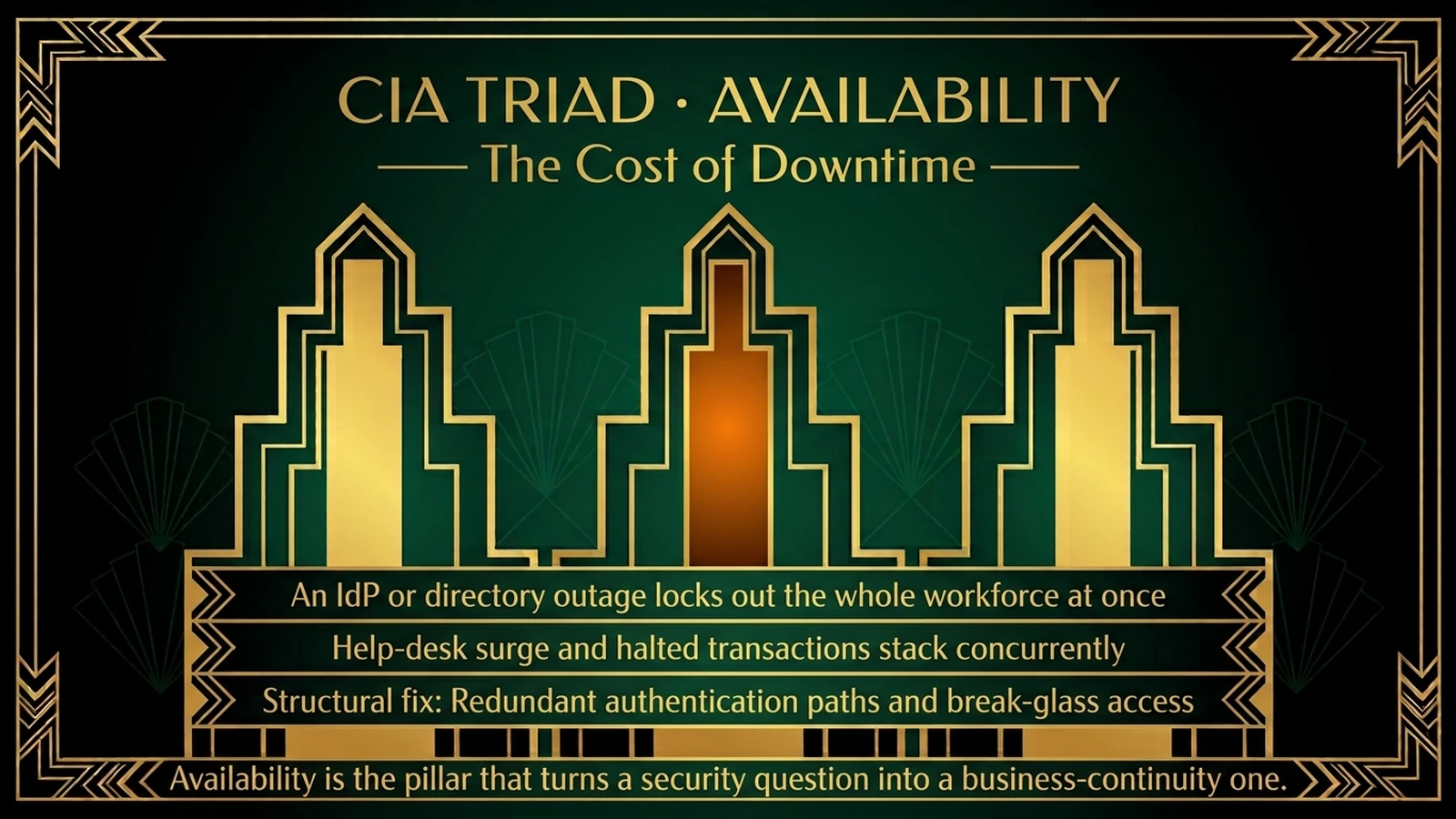 Availability failures in the identity layer are structurally different from an application outage — the cost accrues concurrently across every dependent system, not one at a time.
The cost profile reflects that structural difference. Rather than accruing sequentially the way a compliance finding or a slow-burning trust problem does, availability cost accrues concurrently: help desk ticket volume spikes the moment the outage starts, revenue-dependent transactions that require authentication halt in parallel across every affected system, SLA penalties trigger across every customer-facing service that depends on the identity layer, and workforce productivity loss compounds for every employee locked out at the same time. Outage costs for revenue-dependent systems can run into meaningful figures per minute industry-wide — the specific number varies enormously by sector and system criticality, which is exactly why a single borrowed statistic doesn't hold up as a planning input, but the pattern of concurrent, compounding cost is consistent enough to plan around.
The structural fix is redundancy at the identity layer itself, not just at the application layer behind it: a failover identity provider or secondary authentication path that keeps the workforce authenticating even if the primary directory is unreachable, and documented break-glass access procedures for the specific accounts that need guaranteed access during an identity-layer outage — with those break-glass credentials themselves subject to strict, logged, and time-boxed use so they don't become a standing confidentiality risk in the name of solving an availability one.
Where the three pillars compound
Treating confidentiality, integrity, and availability as three independent line items understates the real risk, because in practice they compound. A confidentiality failure that goes undetected for long enough becomes an integrity problem the moment the exposed access is used to alter a record, not just read it. An integrity incident under active investigation frequently forces an availability trade-off — systems get taken offline specifically to preserve forensic evidence, which means the incident-response process itself produces a planned outage on top of the original problem. And an availability failure, particularly one severe enough to require emergency access procedures, is exactly the scenario where confidentiality controls are most likely to get bypassed under pressure — break-glass access granted broadly and quickly because there's no time to scope it narrowly.
This compounding is why identity governance has to address all three pillars as one coherent design rather than three separate initiatives run by three different teams on three different timelines. Our Costs of Identity Management Failure piece covers the broader cost taxonomy that the triad's three pillars sit inside — confidentiality, integrity, and availability failures are specific, named instances of the more general pattern that piece walks through.
Compliance exposure mapped to the triad
Every major compliance framework relevant to identity programs maps onto the triad, even when the framework's own language doesn't use those three words. HIPAA §164.312 requires access controls (confidentiality), integrity controls specifically for electronic protected health information, and contingency planning for the availability of health information systems during an emergency — our HIPAA §164.312 piece covers the access-control requirements for healthcare identity programs in depth. FISMA and the NIST 800-53 control catalog it's built on organize entire control families around these same three properties for federal and federal-adjacent systems, which our FISMA compliance piece covers for enterprise environments with federal exposure. PCI DSS v4.0.1 requires strong access restriction for cardholder data (confidentiality), audit-trail integrity, and system resilience requirements that map to availability. SOC 2's trust services criteria name confidentiality and availability explicitly as their own evaluation categories, separate from the general security criteria.
The practical implication for a CISO or compliance lead is that a gap in any one pillar isn't just a security exposure — it's a specific, citable audit finding under whichever framework applies. Mapping an identity program's controls against all three pillars explicitly, rather than assuming "we passed our last SOC 2" covers the ground, is what catches the gap before an auditor does. Our Digital Identity Costs and ROI piece covers how compliance-readiness cost factors into the broader identity-program business case, alongside the confidentiality, integrity, and availability cost categories this piece walks through individually.
What Avatier ships toward this pattern
Avatier Identity Anywhere is built around a single governed identity layer that produces confidentiality, integrity, and availability outcomes as a byproduct of how it's designed, rather than as three bolted-together modules. On confidentiality: least-privilege access request workflows, periodic access certification that surfaces entitlement drift before it becomes an incident, and FIDO2-compatible passwordless authentication that closes the weak-credential exposure at the login step — deviceless authentication for smartphone-unavailable workforce segments is covered in more depth on Identity Challenge Card, Avatier's sister platform for authentication-specific topics. On integrity: workflow-based change control for every entitlement grant and revocation, with audit-trail logging designed to make every access decision reconstructable rather than merely recorded. On availability: an architecture that avoids concentrating authentication in a single choke point, paired with documented, time-boxed break-glass procedures for the specific failure scenarios where normal authentication paths aren't reachable.
Avatier doesn't position the platform as a replacement for dedicated backup, disaster-recovery, or SIEM tooling — those disciplines solve problems the identity layer alone can't. Its contribution is the governed identity foundation those disciplines depend on to know what "authorized" looks like in the first place, and to keep that definition provable under audit. The Avatier Trust Center publishes the compliance posture behind the platform directly: SOC 2 Type II audited with zero exceptions noted, ISO/IEC 27001:2022 certified, PCI DSS v4.0.1 compliant, CSA STAR Level 1 attestation, NIST 800-53 Rev. 5 aligned, FedRAMP-aligned controls, and a CISA Secure-by-Design Pledge signatory.
What this framework does not solve
The CIA triad is a useful cost and risk framework for an identity program, but it isn't a complete security model, and treating it as one is its own failure mode. It says nothing directly about non-repudiation — proving an action can't be denied after the fact — which matters for high-assurance transaction environments and sits closer to integrity in practice than as its own named pillar here. It doesn't address insider risk from an authorized identity acting maliciously within their legitimate access, which is a governance and monitoring problem layered on top of triad-clean controls, not solved by them. It doesn't cover the physical-security and personnel-vetting layers that a fully mature security program still needs. And it doesn't make the hard organizational trade-offs go away — a break-glass procedure that solves an availability emergency will always create some confidentiality risk in the moment, and no framework eliminates that tension, it only makes it visible enough to manage deliberately.
Used honestly, the triad's value is that it forces an identity program to name which pillar a given control actually protects, and to notice when one pillar has been quietly under-resourced relative to the other two. That's a narrower claim than "the CIA triad is a complete security strategy" — and it's the claim this piece is actually making.
ABOUT THE AUTHOR

More from Compliance & Audit

Why FISMA Compliance Programs Still Fail in 2026
Federal agencies pass FISMA audits every year and still get breached — the identity governance gaps assessors keep missing are the same ones attackers exploit.

Real-Time Regulatory Monitoring: How It Actually Works in 2026
Real-time regulatory monitoring replaces the quarterly compliance scramble with a continuous detect-assess-remediate loop, but only if the identity data underneath it is accurate to begin with.

AI-Driven Regulatory Reporting: The 2026 Automation Playbook
AI now assembles, drafts, and maintains the compliance evidence auditors ask for across SOX, HIPAA, PCI, and FISMA — but it still needs a human to attest before anything gets filed.