Security Awareness Training KPIs for Identity Programs 2026
Most security awareness training dashboards measure participation and quiz scores. Identity programs need to measure something different — whether the training actually changed the credential-handling, MFA-adoption, and access-request behaviors that determine the identity-attack surface. The 2026 enterprise reference on the five identity-specific KPI categories, the telemetry integration that makes them measurable, and where most training measurement programs break.
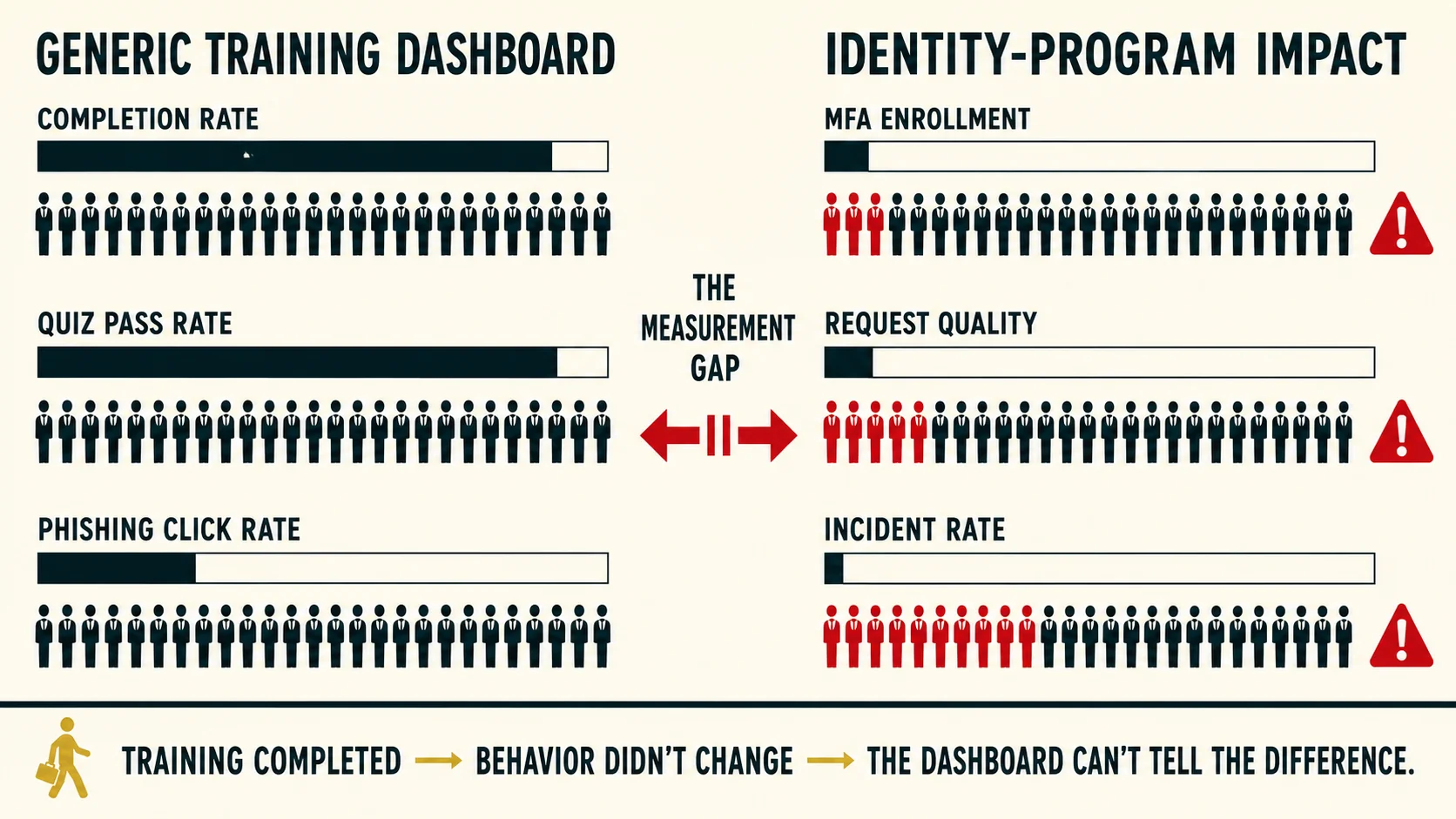
Most security awareness training dashboards measure participation and quiz scores. Identity programs need to measure something different — whether the training actually changed the credential-handling, MFA-adoption, and access-request behaviors that determine the identity-attack surface. The 2026 enterprise reference on the five identity-specific KPI categories, the telemetry integration that makes them measurable, and where most training measurement programs break.
- Generic security awareness training KPIs (completion rates, quiz scores, phishing click rates) measure participation and information transfer. Identity-program training KPIs need to measure something different — whether the training changed the credential-handling, MFA-adoption, and access-request behaviors that determine the identity-attack surface.
- Five identity-specific KPI categories matter in 2026: phishing simulation performance with identity-system context (did the user fall for credential-stealing phishing specifically?), MFA adoption and friction metrics (are users completing strong-factor enrollment and not bypassing it?), credential hygiene behaviors (password reset patterns, recovery flow usage, temporary-password behavior), access request patterns (request quality, request rate, scope-appropriate vs over-broad requests), and identity-incident impact (downstream change in identity-related incidents).
- The architectural precondition is telemetry integration between the training platform and the IAM platform — without that integration, training data and identity behavior data live in separate dashboards and the correlation question can't be answered.
- Three failure modes dominate 2026 training measurement programs: vanity metrics that look good on dashboards but don't correlate with identity outcomes (perfect completion rates with unchanged behavior), attestation fatigue where users click through training without engagement (a problem identical to the certification-fatigue pattern documented in our [AI Access Certification piece](/en/blog/ai-access-certification-campaigns-enterprise-2026/)), and training-without-identity-context that addresses general security topics but doesn't move identity-specific behaviors.
- The 2026 reference architecture composes phishing simulation tools with identity-system telemetry, runs training measurement on a 90-day correlation window (training event → behavior change → incident-rate impact), and treats identity-program outcomes as the primary measurement endpoint — completion rates and quiz scores are leading indicators, not the answer.
Most security awareness training dashboards in 2026 enterprise environments look healthy. Completion rates approach 100%. Quiz scores trend upward over time. Phishing simulation click rates drop quarter over quarter. The training program reports on these metrics with confidence. The identity team, looking at the same dashboard, has a different question: did any of this actually change the identity-system behaviors that determine our attack surface?
The honest answer in most deployments is that nobody knows — because the training-platform metrics and the identity-system telemetry live in separate dashboards, with no correlation analysis connecting them. Training completed; behavior may or may not have changed; incidents may or may not have moved. The dashboard reports the completed-training number with confidence because that's the number it has access to. The number it doesn't have access to — whether the trained users actually behave differently in the IAM platform after the training — is the one that matters.
This piece is the 2026 enterprise reference on identity-program-specific training KPIs. What to measure (five specific KPI categories that connect training to identity-system behavior), how to wire the telemetry integration that makes those KPIs measurable, where most training measurement programs break, and the architectural pattern that produces dashboards full of green numbers correlated with measurable identity-program outcomes rather than dashboards full of green numbers that don't predict incident risk.
This piece extends the foundation laid by the Avatier post on measuring training effectiveness — the original framed the five major KPI categories at a security-awareness level (phishing simulation, knowledge assessment, security incidents, completion rates, user behavior analytics). The 2026 update narrows the framing to identity-program specifics, where the connection between training and incident risk runs through credential behaviors, MFA adoption, and access-request patterns rather than through general security awareness. The companion pieces cover adjacent territory: the AI Access Certification piece covers attestation-fatigue patterns that affect training engagement too, the ITDR piece covers the behavioral-detection layer that catches training-correlation patterns, and the Best IGA Solutions buyer guide covers the IGA platforms that produce the identity telemetry these KPIs depend on.
 Two dashboards, same time period, two different stories. The training dashboard reports a healthy program. The identity dashboard reports no change. Without correlation, both can be technically true and the program can still be failing.
Why generic training KPIs miss what identity programs actually need to measure
The legacy security awareness training measurement playbook came from a different operational era. The threats it was designed to address were general-purpose — phishing emails with malicious attachments, social engineering at the help desk, password reuse across personal and work accounts. The metrics that measured success were correspondingly general — did the user click on the simulated phishing email, did they pass the quiz on the policy module, did they complete the annual training.
The 2026 threat landscape has narrowed the relevant questions substantially. The attacks that succeed in mature 2026 environments are increasingly identity-specific: credential phishing targeted at MFA-fatigue exploitation, OAuth consent-grant abuse, federation broker manipulation, privileged session capture. These attacks succeed or fail based on identity-system behavior — does the user approve the suspicious push, do they enter credentials on a lookalike portal, do they share temporary passwords through insecure channels, do they request access scopes they don't need. Generic training metrics don't measure these behaviors. Identity-specific training metrics do.
The shift in framing is from "did the user learn the material" to "did the user's identity-system behavior change in measurable ways." The two questions sound similar but produce dramatically different measurement architectures. The first is satisfied by the training platform's internal data — what got completed, what got passed. The second requires correlation between training data and identity telemetry — what behaviors changed in the IAM platform after training events, and how do those changes correlate with downstream incident risk.
Most 2026 enterprise training programs are still operating on the first question. The dashboards report well. The metrics trend favorably. The identity-program-relevant impact is unknown.
The five identity-specific KPI categories
Five KPI categories define the 2026 baseline for identity-program training measurement. Each connects training events to identity-system behaviors in a measurable way, with the underlying telemetry available from a mature IAM platform.
1. Phishing simulation performance with identity-system context. Click rates remain a useful surface indicator, but the identity-program-relevant metric goes deeper. Did the user submit credentials on the simulated phishing page (not just click the link)? Did the user approve a suspicious MFA push during the simulation (the MFA-fatigue exploitation pattern)? Did the user complete the OAuth consent flow on a lookalike app registration? The credential-submission and MFA-approval behaviors are what determine whether real phishing succeeds; the click rate is a leading indicator. The ICC MFA Fatigue piece covers the specific attack pattern this category measures defense against.
2. MFA adoption and friction metrics. Strong-factor enrollment rate (what percentage of trained users have enrolled phishing-resistant MFA — passkeys, hardware FIDO2 keys, the Identity Challenge Card?), bypass-attempt rate (how often do trained users try to fall back to weaker authentication factors?), fallback-factor usage rate (when bypass is permitted, how often is it actually used?), MFA-fatigue pattern indicators (sustained patterns of MFA prompts being approved without engagement). These metrics directly measure whether training moved the user toward stronger authentication behavior. The ICC Phishing-Resistant MFA piece covers the credential class these metrics measure adoption of.
3. Credential hygiene behaviors. Password-reset frequency (high frequency may indicate compromise, low frequency may indicate stale credentials), recovery-flow usage patterns (which recovery channels users prefer, whether they fall for social-engineering recovery attempts), temporary-password handling (do users share temporary passwords through insecure channels even after training?), time-to-rotation after credential exposure events (when a breach-corpus update flags the user's credential, how quickly does the user rotate?). These metrics measure the operational behaviors covered in our Temporary Password Best Practices piece at the user-behavior level.
4. Access request patterns. Request quality (are users requesting appropriately scoped access, or asking for over-broad permissions?), request rate (does the user submit access requests at a rate consistent with their role's needs, or are they over-requesting?), shadow-provisioning behavior (do trained users bypass the IGA workflow through Slack DMs or direct admin requests?), request-approval rate (how often are the user's requests approved at the manager and security review stages?). These metrics tie training to the shadow-IT provisioning pattern documented in our Shadow IT Provisioning piece — training that doesn't reduce shadow-provisioning behavior didn't move the operational reality.
5. Identity-incident impact. For the cohort of trained users, did the rate of identity-related incidents (account compromise events, MFA fatigue exploitation, OAuth consent grant abuse, lateral movement events involving the user's credentials) measurably decrease in the 90-day post-training window vs the 90-day pre-training baseline? This is the lagging indicator that connects training to actual security outcomes. It requires substantial telemetry depth and a willingness to wait 90+ days for results, but it's the metric that ultimately matters.
The five categories compose into a measurement architecture where the connection between training and identity-program outcomes becomes visible. None of the five is sufficient alone; the composition is what produces the answerable question.
The architectural precondition: training-to-IAM telemetry integration
The KPIs described above only work when the training platform's user-completion data and the IAM platform's identity-event data can be correlated. The integration is the precondition; without it, the KPIs remain theoretical.
The integration architecture. The training platform records who completed what training and when, typically through an LMS (Learning Management System) — Workday Learning, Cornerstone, SAP SuccessFactors Learning, Litmos, or a security-specific platform like KnowBe4. The IAM platform records identity events — authentications, MFA prompts and responses, credential resets and rotations, access requests, incidents. The integration brings the two together: for users who completed training X on date Y, what was their identity behavior in the 90 days before vs the 90 days after?
Where the integration lives. Three options. First, in the IAM platform — most modern IAM platforms can ingest training-completion events from upstream LMS systems as user attributes and use them for downstream correlation analysis. This is the cleanest architecture and produces the lowest operational overhead. Second, in a SIEM or behavioral analytics layer — the SIEM ingests both identity events and training events as data streams and the correlation analysis happens there. This is more flexible but produces more operational complexity. Third, in a purpose-built measurement infrastructure — a data warehouse plus correlation queries plus dashboard layer, built specifically for the training measurement program. This is what mature programs often build when the IAM platform integration is partial and the SIEM doesn't have the right schema.
Where the integration breaks. Schema mapping. The training platform's user identifier and the IAM platform's user identifier rarely match cleanly — one uses email, one uses sAMAccountName, one uses an HRIS-driven Universal Identifier. The mapping is often inconsistent (some users have multiple email addresses, name changes, role changes that the systems handle differently). Most 2026 deployments that have closed the integration gap report that the schema mapping was harder than expected. The CGov HRIS-Driven Lifecycle piece covers the broader schema-mapping discipline that this integration depends on.
The 90-day correlation window. Most 2026 training measurement programs use a 90-day pre-training vs 90-day post-training window for behavior comparison. The window is long enough to capture meaningful behavior change (immediately post-training, behavior changes are sometimes transient; sustained 90-day behavior is what matters), short enough to attribute observed change to the specific training event rather than to broader environmental changes. Programs that run shorter windows often catch transient changes that don't persist; programs that run longer windows often lose attribution.
Where training KPI dashboards fail in 2026
Three failure modes recur in 2026 training measurement programs. Each produces dashboards that look healthy while the program fails to deliver identity-program-relevant impact.
Vanity metrics. The dashboard reports 100% completion, 95% pass rate, 3% phishing click rate, all trending favorably quarter over quarter. The identity-related incident rate hasn't moved. The MFA enrollment rate is flat. The access request quality is unchanged. The metrics look good; the program isn't working. The failure mode is that the metrics measure the wrong thing — training-platform inputs rather than identity-system outcomes. The mitigation is to anchor measurement to outcome metrics (incident rates, behavior change, telemetry correlations) and treat input metrics as leading indicators only. The dashboard should report both, with the outcome metrics in the primary position.
Attestation fatigue. Users click through training without engagement, completing the modules quickly without learning. The completion rate is high. The pass rate is high. The behavior change is minimal because the user didn't actually engage with the material. This pattern is identical to the attestation-fatigue pattern documented in our AI Access Certification piece — when the easy path through an attestation-style workflow is to click through without engagement, that's the path users take. The mitigation is engagement enforcement: interactive elements that require active reasoning, varied content that prevents pattern-recognition completion, periodic "why did you answer this way" challenges that surface superficial completion, time-on-content metrics that flag pattern-clickers. Most 2026 LMS platforms support some version of these capabilities; the operational gap is configuration and discipline, not platform capability.
Training without identity context. Generic security awareness training that covers physical security, general social engineering, and high-level phishing concepts but doesn't address the specific identity-system behaviors the user engages with. The user learns "don't click suspicious links" but doesn't learn what makes a phishing site look legitimate enough to enter credentials, what an MFA-fatigue attack pattern actually looks like in the user's specific authenticator app, what makes a temporary password recovery legitimate vs suspicious, how the IGA self-service portal differs from a shadow-provisioning Slack DM. The mitigation is identity-specific training content tied to the IAM platform's actual user-facing behaviors — training that uses the same UI screens, the same notification formats, the same vocabulary the user encounters in production. Custom content is more expensive than off-the-shelf training but produces measurably better behavior change.
The three failure modes compound. Vanity metrics let attestation-fatigue persist undetected because the surface metrics look healthy. Attestation-fatigue prevents training-without-identity-context from being noticed because users complete it without engaging. The result is programs that report well, fail quietly, and surprise leadership when the next identity-related incident lands.
 Three failure modes that produce healthy-looking dashboards while the program fails to deliver. Each is operationally addressable when the measurement architecture is anchored to identity outcomes rather than training inputs.
The 2026 reference architecture
Build the telemetry integration first. The training-platform and IAM-platform integration is the precondition for everything else. Schema mapping discipline (per the HRIS-Driven Lifecycle piece) applies here too. Without the integration, the KPIs remain theoretical.
Anchor measurement to identity-system outcomes. Incident rates, MFA enrollment status, access request quality, credential hygiene behaviors. The training-platform inputs (completion rates, quiz scores, phishing click rates) are leading indicators that belong on the dashboard but in a secondary position. The primary metrics are the ones that tell you whether the program is moving the identity-attack surface.
Run the 90-day correlation window. Pre-training behavior baseline, training event, post-training behavior measurement, correlation analysis. Programs that try to measure impact immediately catch transient changes that don't persist. Programs that try to measure impact over the long term lose attribution to broader environmental changes. 90 days is the operational sweet spot.
Enforce engagement to prevent attestation fatigue. Interactive elements, varied content, periodic challenge questions, time-on-content metrics, audit of pattern-clickers. The same disciplines that catch certification-fatigue in AI-augmented certification apply to training engagement too.
Build identity-specific training content. Generic content has its place but doesn't move identity-program behaviors. Content that uses the same UI, vocabulary, and notification formats the user encounters in production produces measurably better behavior change. Most LMS platforms support custom content modules; the investment pays back in measurable outcome improvement.
Compose with the broader IAM stack. The Best IGA Solutions buyer guide covers the IGA platforms that produce the identity telemetry. The ITDR piece covers the behavioral detection layer that catches anomalies the rule-based metrics miss. The Identity Maturity Model piece covers where training measurement maturity sits in the broader program maturity ladder — most organizations at Stage 2 (Tooled but Inconsistent) are running training programs without identity-context measurement, and the upgrade is part of the Stage 2 → 3 transition.
Security awareness training matters more in 2026 than it did a decade ago because the threat landscape has shifted toward identity-specific attacks that depend on user behavior. The measurement architecture has to keep up. Generic training KPIs don't anymore — and the dashboards that report on them in 2026 are increasingly missing the part of the story that determines whether the program is actually working. Build the integration. Measure the right things. Treat the connection between training and identity outcomes as the question worth answering.
ABOUT THE AUTHOR

More from IAM & Identity Governance

Identity Management and Digital Transformation in 2026
Every major transformation initiative — cloud migration, remote and hybrid work, mergers and acquisitions — eventually stalls on the same question: who gets access to what, and who decided? The 2026 strategy reference on identity management as the enabler and the bottleneck of digital transformation, the business case executives actually fund, and what modernization does not fix.

AI and Behavioral Analytics for Identity Monitoring: The 2026 Enterprise Reference
Static identity rules catch the attacks that announce themselves. They miss the ones that log in with valid credentials and behave almost normally. The 2026 reference on AI-driven identity monitoring — what behavioral analytics actually detects, the four telemetry sources that make or break the model, the false-positive economics nobody budgets for, and the honest limits of anomaly detection at enterprise scale.
Security Team Collaboration: A 2026 Framework for Identity Programs
Identity governance fails when it runs as a security-team-only initiative. The 2026 framework for cross-functional collaboration: four stakeholder groups, three coordination models, and how zero trust makes it a shared discipline.